
Picture this: you're sinking into unbelievably clear, turquoise water. Sunlight streams down from the Hawaiian sky, lighting up ancient volcanic lava tubes and colorful coral gardens that are just buzzing with life. This isn't a dream—it's just another day of scuba diving on the Big Island of Hawaii, a place that consistently tops "best of" lists for divers around the globe. Thanks to the sheltered Kona coast, the conditions are calm and clear almost all year long, making it an incredible destination for divers of every skill level.
Why Choose The Big Island For Your Next Dive
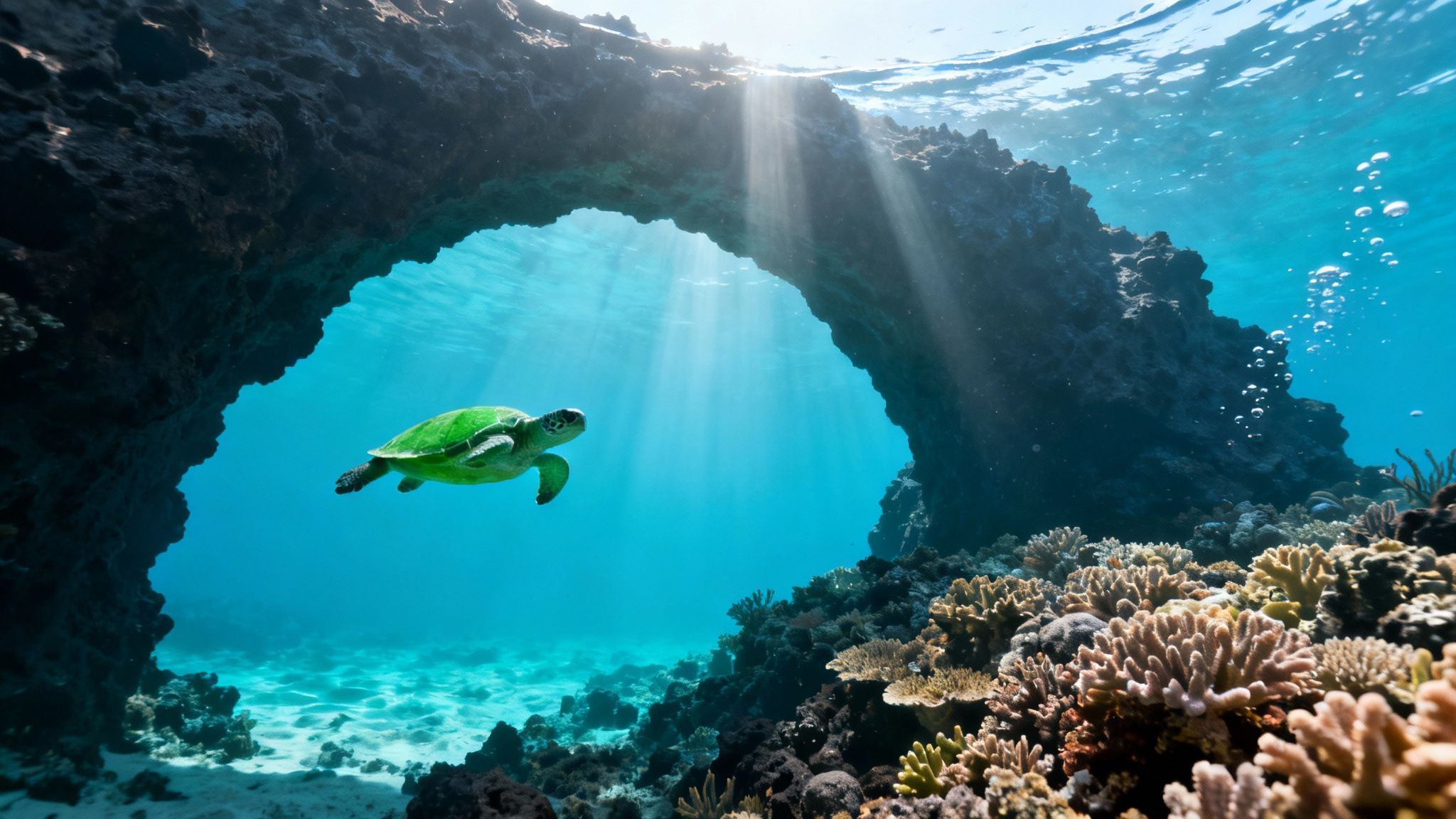
The Big Island is more than just another pretty place to go diving; it’s a true geological and biological wonder. The entire underwater landscape was shaped by volcanic activity, creating a dramatic world of lava formations. These structures aren't just cool to look at—they form a complex habitat that supports an insane amount of marine life.
What really makes the difference here is that the island's massive volcanoes shield the western coast from the usual trade winds. The result? Exceptionally calm and predictable seas that are an absolute joy to dive in. You’re not just swimming over another reef; you're exploring a world forged by primal forces. To dig a little deeper, check out our guide on the unique aspects of Kona diving.
An Unmatched Level of Biodiversity
What really sets the Big Island apart is its incredible biodiversity and the sheer number of endemic species—creatures you literally can't find anywhere else on the planet. Being so isolated out here in the middle of the Pacific has allowed evolution to do its own thing.
The Big Island is known for having some of the most biodiverse diving in the entire Hawaiian archipelago. Scientists figure there are around 1,100 fish species in these waters, and an amazing 29% of them are endemic. This is all thanks to the island's volcanic past, which created a huge variety of underwater habitats like lava tubes, pinnacles, and sprawling coral gardens.
More Than Just a Dive, It's an Experience
When you go scuba diving on the Big Island, you’re signing up for some truly unforgettable encounters. Sure, there are the vibrant reef fish, but you’ll also be swimming alongside graceful Hawaiian green sea turtles (honu), watching majestic manta rays perform their famous nightly ballet, and maybe even spotting a pod of playful spinner dolphins from the boat.
Here at Kona Honu Divers, we're all about sharing this incredible world with you. Our expert team puts safety first, keeps our groups small, and focuses on creating a personal connection to the ocean. We're firm believers that a dive trip should be more than just getting wet—it should be a genuine adventure you'll remember for years.
But don't just take our word for it. See what fellow divers have to say about their experiences with us.
Ready to see it for yourself? Our award-winning diving tours are designed to show you the absolute best of Kona's underwater realm.
Exploring Kona’s Top Underwater Landscapes
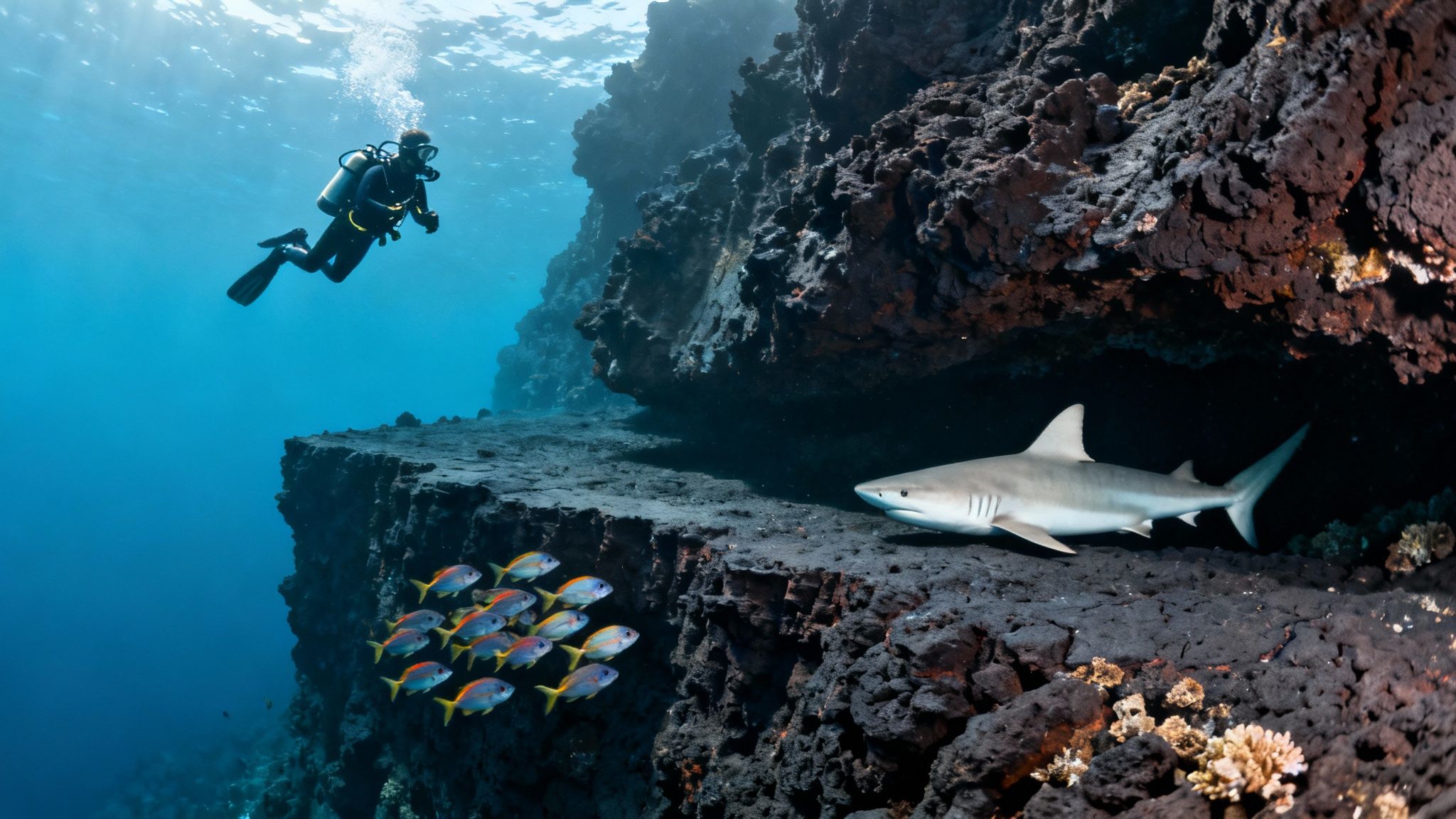
Think of the Kona coast as an underwater national park. Every single dive site tells a different story, one written by volcanic fire and then sculpted over millennia by the Pacific. The dramatic underwater topography—a direct result of ancient lava flows—has created an incredible playground of arches, caverns, and pinnacles. These formations are now home to a mind-boggling amount of marine life.
This unique geology means that no two dives are ever really the same. One moment you might be gliding over a sprawling coral garden bathed in sunlight, and the next you're peering into a dark lava tube where nocturnal critters are just starting to wake up. This sheer variety is what makes scuba diving Big Island Hawaii an experience divers from around the world keep coming back for.
Kealakekua Bay: A Protected Paradise
Kealakekua Bay isn't just another dive site; it's a living, breathing sanctuary. As a designated Marine Life Conservation District, it's a perfect example of what happens when we let an ecosystem flourish on its own terms. With fishing strictly off-limits, the bay is home to some of the healthiest and most vibrant coral reefs in all of Hawaii.
The visibility here is often legendary, frequently surpassing 100 feet and giving you a crystal-clear window into a bustling underwater city. The bay itself is massive and sheltered, making for a calm, relaxing, and totally immersive dive. From the shore, the reef slopes gently, covered in intricate coral heads that provide food and shelter for countless creatures that make up the intricate coral reef food web.
You can expect to see huge schools of yellow tang moving like a golden river, graceful spinner dolphins playing in the distance, and green sea turtles lazily munching on algae. It’s a photographer’s dream and a perfect showcase of a balanced marine environment.
Puuhonua O Honaunau (Two Step)
Affectionately known as "Two Step" for its incredibly easy shore entry—you literally take two steps down natural lava rock and you're in—Puʻuhonua O Hōnaunau offers one of the most rewarding dives on the Kona coast. This spot is a favorite for both snorkelers and divers because the conditions are typically calm and the marine life is prolific just a few kicks from the entry point.
The underwater landscape here is a fascinating mix of beautiful coral gardens and long "finger" reefs separated by channels of white sand. This structure creates natural pathways to explore, and you can often find:
- White-tip reef sharks: Usually found resting peacefully under ledges during the day.
- Octopus (Heʻe): True masters of camouflage, often spotted hiding among the rocks if you have a keen eye.
- Eels: A variety of moray eels peeking out from their lairs in the reef.
- Colorful reef fish: Including parrotfish, butterflyfish, and the endemic Potter's angelfish.
The easy access and sheer density of life make Two Step an absolute must-do for anyone looking to experience classic Kona diving without needing a long boat ride.
Other Must-See Dive Sites
While Kealakekua and Two Step get a lot of the fame, the Kona coast is dotted with dozens of other world-class sites, each with its own unique personality. Figuring out the right one often comes down to what you're hoping to see. To dive deeper, check out our guide on what is the best dive in Kona.
A local favorite is Golden Arches, named for the iconic lava-formed archways you can actually swim through. These stunning structures are often draped in vibrant yellow and orange sponges, making for an unforgettable visual. The site is a hotspot for macro life and a fantastic place to hunt for unique critters like frogfish and nudibranchs.
Quick Guide to Popular Kona Dive Sites
To help you get a feel for what each location offers, here’s a quick rundown of some of the top spots along the Kona coast.
| Dive Site | Experience Level | Key Features | Common Marine Life |
|---|---|---|---|
| Kealakekua Bay | All Levels | Protected bay, pristine hard corals, exceptional visibility | Spinner dolphins, turtles, vast schools of reef fish |
| Pu'uhonua O Honaunau | All Levels | Easy shore entry, clear waters, coral finger reefs | Turtles, octopus, white-tip reef sharks, eels |
| Golden Arches | Intermediate | Iconic lava arches, swim-throughs, vibrant sponges | Frogfish, nudibranchs, butterflyfish, moray eels |
| Crescent Beach | Beginner | Sandy bottom with coral heads, shallow and calm | Green sea turtles, eagle rays, garden eels |
This is, of course, just a small sample. Every site has its own magic, and part of the fun is discovering which one becomes your personal favorite.
Experiencing The World-Famous Manta Ray Night Dive
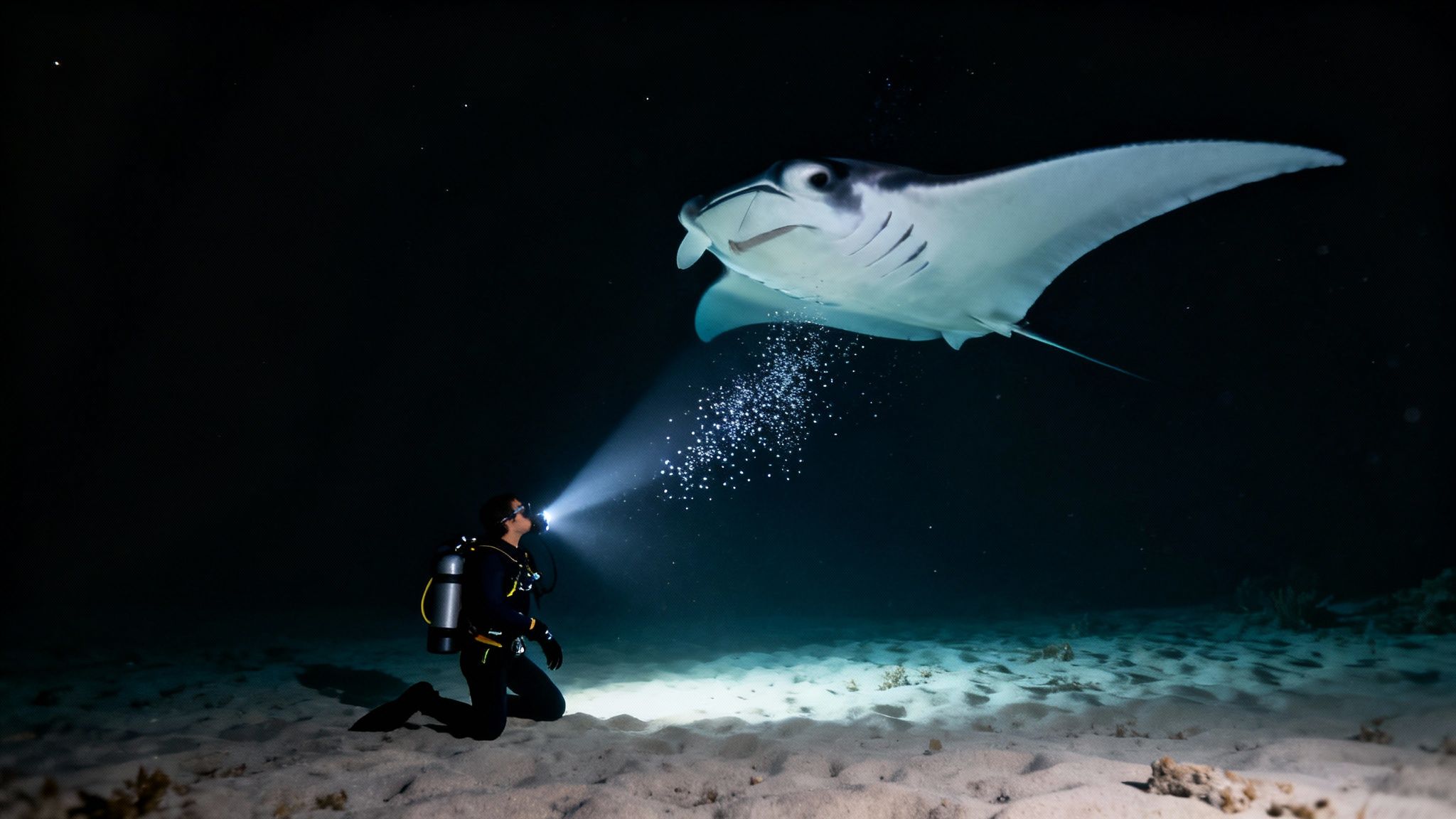
Picture this: you're kneeling on the sandy ocean floor, long after the sun has set. Your whole world is a circle of light in the dark water. Then, out of the black, a shadow takes shape. It's a giant, gentle manta ray, its wingspan stretching up to an incredible 16 feet, gliding right over your head like a starship making a silent pass. This isn't science fiction; it’s the world-famous Manta Ray Night Dive, the absolute pinnacle of scuba diving Big Island Hawaii.
This whole spectacle, which is consistently voted one of the best night dives on the planet, is built on a simple, brilliant idea. We're essentially throwing a dinner party, and the mantas are our guests of honor. We set up powerful underwater lights on the seafloor, which act like a bug zapper in reverse, attracting huge clouds of plankton—the mantas' favorite meal.
As the plankton swarm the lights, the mantas show up for the buffet. We, the divers, get a front-row seat. We stay in one spot, looking up as these magnificent creatures perform a silent ballet, swooping and somersaulting through the light beams to feast. It's an intimate, awe-inspiring, and totally passive experience, giving you an unobstructed view of nature at its most majestic.
What To Expect On Your Manta Dive Adventure
Your adventure kicks off with a detailed pre-dive briefing from our guides. We'll cover manta behavior, the dive plan, and critical safety rules to protect both you and the mantas. The most important rule? Never touch the manta rays. Touching them can remove their protective mucus coating, leaving them vulnerable to infection.
Once we hit the water, we'll descend to a designated viewing area, usually in a shallow spot about 30-40 feet deep. You'll get settled on the sand and aim your dive light up, adding to the "campfire" of light that draws in the plankton. And then, the show begins.
It’s a truly surreal feeling. One second you're watching tiny plankton dance in your light, and the next, a colossal manta ray emerges from the darkness, gliding inches above you. As they barrel roll through the water, you can see the unique spot patterns on their bellies—each one is like a fingerprint. It’s a peaceful, profound, and utterly unforgettable encounter. To really dive deep into the science behind it all, check out our guide that answers what is a manta ray night dive.
Why This is a Bucket-List Dive
The Kona coast is special. We have established feeding sites where a local, non-migratory population of reef mantas gathers reliably, all year round. That consistency is what makes the Big Island the world's capital for this dive. In other places, a manta encounter is a lucky break; here, it's practically a nightly event.
This isn't just another dive; it's a genuine connection with one of the ocean's most intelligent and graceful animals. The feeling of a massive manta choosing to glide right over you is something that will stick with you long after you've dried off.
Here at Kona Honu Divers, creating a safe, respectful, and magical manta experience is our specialty. Our expert crew makes sure every diver is comfortable and has the best seat in the house. We provide all the gear and guidance you need to make your manta ray dive the absolute highlight of your Hawaiian adventure.
Discovering Advanced Diving Adventures
So, you've mastered the reefs and are starting to feel that itch for something more. Something that gets the adrenaline pumping. For divers ready to take the next step, the Big Island is a gateway to some of the most unique and thrilling underwater experiences you can find anywhere on the planet.
Sure, the sunlit coral gardens are stunning, but the real edge of adventure lies in the deeper, darker, and more complex environments just offshore. These advanced dives aren't just about adding depth to your logbook; they’re about exploring truly otherworldly landscapes and meeting creatures few people will ever see. This is where your skills get put to the test, and the rewards are absolutely unforgettable. It’s a side of scuba diving Big Island Hawaii that pushes the boundaries of what you thought was possible.
Journey into Inner Space: The Kona Blackwater Dive
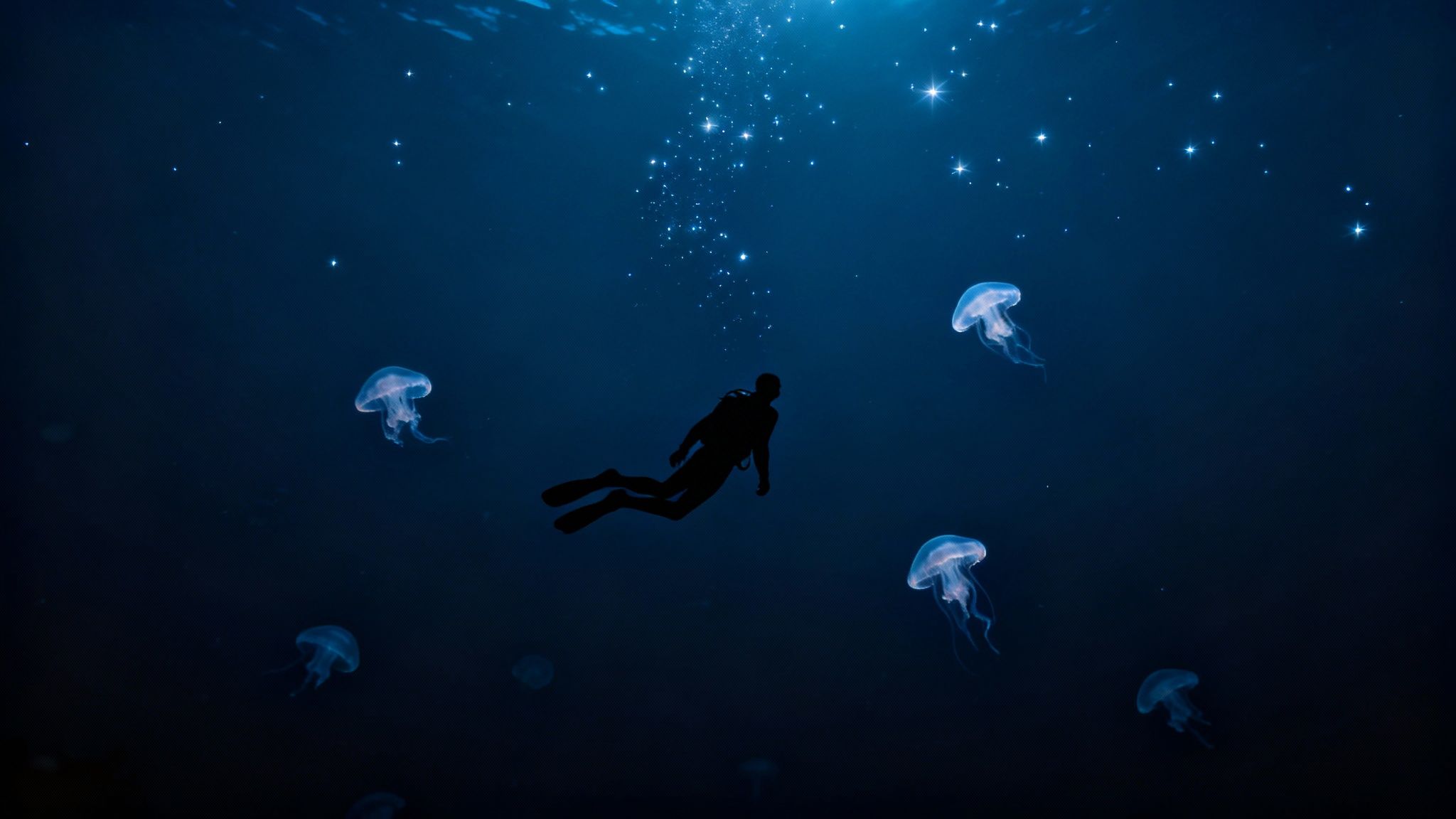
Picture this: you're suspended in the inky blackness of the open ocean, miles from shore, with thousands of feet of water right below your fins. You’re tethered to the boat, floating in a small, self-contained circle of light. This is the Kona Blackwater Dive, a surreal and captivating adventure that many divers call a trip to "inner space."
This dive lets you witness one of the largest migrations on Earth. Every single night, countless bizarre and beautiful deep-water creatures—many of them bioluminescent—journey from the crushing pressure of the abyss toward the surface to feed. What you see is a living kaleidoscope of translucent, alien-like organisms you will never find on a reef dive.
You might come face-to-face with strange larval fish, iridescent comb jellies pulsating with rainbow light, or cephalopods that look like they came straight out of a sci-fi movie. It’s a humbling, mesmerizing experience that feels more like floating through the cosmos than diving in the ocean.
This is a highly specialized dive. It demands excellent buoyancy control and a genuine comfort with being in the dark, open ocean. For those who are ready, it’s a mind-bending journey into a hidden world. Kona Honu Divers offers this unique opportunity for divers to witness this incredible deep-sea migration firsthand on their Kona Blackwater Dive tour.
Navigating Ancient Lava Tubes and Deeper Reefs
Beyond the blackwater, the Big Island's volcanic heart offers another incredible playground for advanced divers: intricate lava tubes and caverns. Formed by ancient lava flows, these underwater cave systems create a labyrinth of swim-throughs, arches, and tunnels. Getting through them requires skill, precision, and a calm mind, but the payoff is immense.
Inside, you'll discover a completely different marine ecosystem. Sunlight barely pierces these formations, creating a haven for nocturnal species and unique invertebrates that cling to the walls. It’s a quiet, mysterious world that feels like you’re exploring the very arteries of the island itself.
And for those certified for deeper dives, the outer reefs drop off dramatically into the abyss. These deep walls are where you might get lucky and spot pelagic species cruising by, like eagle rays or even the occasional shark. Exploring these depths opens up a whole new set of possibilities and challenges. For divers looking to explore these remarkable environments, Kona Honu Divers runs a premium advanced 2-tank trip designed specifically for experienced divers who want to safely push their limits.
How To Plan Your Big Island Dive Trip
Getting ready for a dive trip to Hawaii is almost as much fun as the trip itself. A bit of planning upfront can make all the difference, ensuring your time in and out of the water is smooth, safe, and absolutely unforgettable. From figuring out the best time to come to picking the right crew to show you the ropes, these tips will help you pull together the ultimate Kona diving adventure.
One of the great things about planning for scuba diving Big Island Hawaii is that there’s really no "off-season." The Kona coast is tucked behind massive volcanoes that act as a natural shield from the prevailing trade winds. The result? The ocean here stays incredibly calm and clear pretty much all year, making it a fantastic bet whenever you can get away.
When To Visit and What To Expect
While you can count on great diving 365 days a year, different seasons bring their own unique flavor. The winter months, from December through March, are particularly special. This is the height of humpback whale season, and hearing their beautiful, otherworldly songs underwater while you dive is an experience that will stick with you forever.
Summer brings the warmest water, often climbing to a comfortable 80°F (27°C). It's perfect if you're the kind of diver who prefers less neoprene. In the winter, the temperature dips just a bit to around 75°F (24°C). No matter the season, the visibility is usually phenomenal, often ranging from 50 to well over 100 feet, giving you a front-row seat to the vibrant reef life.
Here's a quick look at what you can generally expect throughout the year.
Big Island Diving Conditions At-a-Glance
| Season | Avg. Water Temp | Avg. Visibility | Marine Life Highlights |
|---|---|---|---|
| Winter (Dec-Mar) | 75-77°F (24-25°C) | 80-100+ ft | Humpback whale songs, Manta Rays, occasional Tiger Sharks |
| Spring (Apr-Jun) | 76-78°F (24-26°C) | 70-100 ft | Manta Rays, Turtles, colorful Reef Fish, Octopus |
| Summer (Jul-Sep) | 78-80°F (26-27°C) | 60-100 ft | Warmest water, Eagle Rays, Manta Rays, Dolphins |
| Fall (Oct-Nov) | 77-79°F (25-26°C) | 70-100+ ft | Manta ray mating season, calmest surface conditions |
As you can see, the conditions are consistently amazing. The protected nature of the Kona coast means you can almost always count on a comfortable and safe dive, letting you focus on the incredible marine life all around you.
Choosing The Right Dive Operator
Picking the right dive operator is easily the most important decision you'll make for your trip. A great shop doesn't just ferry you to a dive site; they elevate the whole experience with deep local knowledge, ironclad safety standards, and a true love for the ocean. As you look around, keep these things in mind:
- Safety Record: This is non-negotiable. Look for an operator with a long-standing, perfect safety record.
- Small Groups: Diving with fewer people means more personal attention from your guide and a much more relaxed, intimate time underwater.
- Experienced Guides: A good guide can spot a frogfish you'd swim right past. Their knowledge of the local ecosystem makes every dive more interesting.
- Good Boats and Gear: A comfortable, well-maintained boat and reliable rental gear just make the day so much more enjoyable and stress-free.
Here at Kona Honu Divers, we work hard to check all those boxes and then some. Our goal is to provide a safe, exceptional adventure that truly connects you with Kona's underwater world. We run a variety of daily diving tours built to show off the very best of the Big Island.
Protecting Hawaii's Fragile Paradise
As guests in this amazing ecosystem, we all share the responsibility of protecting it. Hawaii’s coral reefs are stunning, but they’re also incredibly delicate. One of the simplest and most effective things you can do is switch to reef-safe sunscreen.
Chemicals found in many common sunscreens, like oxybenzone and octinoxate, are known to be extremely harmful to coral. Before you pack, check the label and make sure your sunscreen is mineral-based, using active ingredients like zinc oxide or titanium dioxide.
It also goes a long way to practice good buoyancy control to avoid accidentally bumping or kicking the reef. Just remember the old diver's motto: take only pictures, leave only bubbles. By being a mindful visitor, you're helping to keep this underwater paradise healthy for generations of divers to come.
Your Big Island Scuba Diving Questions Answered
As you get closer to your trip, you probably have a few final questions floating around. To make sure you feel totally prepared for your adventure, we've put together answers to some of the most common things people ask us about scuba diving Big Island Hawaii.
This is the last piece of the planning puzzle. We want to clear up any lingering questions—from what kind of certification you need to what you'll see besides those famous manta rays. Getting these details sorted now means you can land in Kona ready for a fun, stress-free dive vacation.
Do I Need to Be Certified to Scuba Dive?
Great question! While having a certification opens up pretty much every dive site in Kona, you don't actually need one to experience the underwater world here. Most dive shops, including ours, offer a program called "Discover Scuba Diving."
Think of it as a one-day scuba test drive. A certified instructor will walk you through the basics in a super calm, controlled spot, like a pool or shallow ocean bay. Once you're comfortable, they'll guide you on a real, shallow dive on a beautiful reef. It’s the perfect way to see if scuba is for you without committing to a full course.
That said, for the truly iconic dives like the Manta Ray Night Dive or exploring Kona’s famous lava tubes, you will need at least an Open Water Diver certification.
What Marine Life Can I See Besides Manta Rays?
The Big Island is absolutely teeming with life. The mantas are a showstopper, for sure, but the sheer variety of other creatures you’ll see is just as amazing.
- Hawaiian Green Sea Turtles (Honu): You'll see these guys everywhere. They're often just chilling on the reef, getting a quick clean from reef fish, or gliding gracefully past you.
- Spinner Dolphins: We almost always see huge pods of these acrobatic dolphins from the boat. If you’re really lucky, you might even spot them underwater.
- Colorful Reef Fish: Get ready to be surrounded by clouds of fish. We're talking schools of bright yellow tang, intricate butterflyfish, and the endemic Potter's angelfish.
- Eels and Octopus: Keep an eye on the reef's little hideouts. Moray eels are often peeking out from their homes, and if you have a sharp eye, you might spot a master-of-disguise octopus (he'e).
- Whales (in season): This is just magical. During the winter months (December to March), you can often hear the haunting songs of humpback whales echoing through the water during your dive.
Is the Manta Ray Night Dive Safe?
Absolutely. When you go with a professional, reputable operator, the Manta Ray Night Dive is incredibly safe. Dive companies like Kona Honu Divers have been running this dive for years and have perfected the process to keep both divers and mantas safe.
You'll get a detailed briefing before you even touch the water, covering the whole plan, safety checks, and how to interact with the mantas. Once in the water, divers are positioned in a stationary spot on the sandy bottom, usually around 30-40 feet deep. You just hold onto a light and let the show come to you.
Remember, manta rays are gentle giants. They're filter feeders, so they don’t have teeth or stingers, and they pose zero threat to humans. They’re simply drawn to the plankton that your light attracts, creating one of the safest and most mind-blowing night dives you’ll ever do.
What Is the Best Way to Get to the Dive Sites?
By boat, without a doubt. Nearly all of the top-tier dive sites along the Kona coast are reached by boat. This is actually a huge plus because it protects the delicate coral reefs from things like shoreline runoff and too much foot traffic, keeping them healthy and vibrant.
Booking a trip with a professional dive charter is the standard way to go and really the only way to experience the best of what the Big Island has to offer. A good operator handles everything—the boat, the gear, a knowledgeable guide who knows where the cool stuff is, and most importantly, your safety.
Making sure the whole experience is top-notch is key to a great dive trip. For some broader ideas on what makes a great visitor experience, these tips for improving guest satisfaction offer some interesting insights. While there are a few places you can dive from shore, the boat dives are where you'll find the most spectacular reefs Hawaii is known for.
Your unforgettable underwater journey awaits. At Kona Honu Divers, we are dedicated to providing the safest and most memorable scuba diving experiences on the Big Island. From our world-famous manta ray dives to our advanced blackwater adventures, our expert team is ready to show you the best of Kona's marine paradise. Explore our full range of Hawaii diving tours and book your adventure today.