
Table of Contents
- Kona night manta ray dive at a glance
- Choose your position before choosing your date
- Their feeding world extends beyond the circle
- Keep the food patch stable
- Compare the viewing setup, not just the animals
- Why the sand circle matters
- Who can join and what skill matters
- Choose the adjustment that solves the problem
- Advanced diving is a separate choice
- Prepare before you board
- Keep the feeding lane open
- Judge the operation beyond its sighting claims
- What changes a manta night and what to do
- Separate a quiet camp from an unsafe camp
- Get a backup plan, not a promise
- Set exposure before the animal arrives
- Build a sequence without pursuing anything
- Edit for steadiness, not proximity
- How long is the dive and when does it start?
- Do snorkelers need a certification?
- How often are mantas seen?
- What happens on a quiet night?
- Is there a best season?
- Can I bring a camera?
- Reserve the right outing for your group
You're comparing Kona manta trips, looking at photographs of rays passing overhead, and trying to decide whether you'll feel comfortable getting into the ocean after dark. The part that's harder to judge from a booking page is how the crew organizes the water: where you'll wait, how the lights are placed, and what happens if the plankton is thin.
A good night manta ray dive isn't a chase through black water. It's a stationary wildlife encounter built around a carefully managed viewing circle. Garden Eel Cove is the superior choice for that setup because of its protected location, concentrated viewing area, and better surrounding reefs, but even there, plankton decides the show.
The Night Manta Ray Dive at a Glance
The evening begins with a dusk departure along the Kona coast. Once the crew establishes the underwater lights, a white circle appears on the sand, with dark water beyond its edges. Reef manta rays, Mobula alfredi, may turn through the illuminated plankton above it while divers watch from below and snorkelers look down from the surface.
The Love Big Island manta encounter guide describes dives generally beginning immediately after sunset, around 6:00 p.m., lasting about one hour, with illumination from the surface and approximately 10 meters underwater; it places Garden Eel Cove about eight miles north of Kona, near the airport. Treat those as planning expectations rather than your boat's check-in instructions. Sunset, departure logistics, sea conditions, and your own gas supply govern the actual evening.
Kona night manta ray dive at a glance
| Element | What to expect |
|---|---|
| Start | Immediately after sunset, about 6:00 p.m. |
| Time in the water | About one hour |
| Light depth | Surface lights plus a seafloor circle at about 10 meters |
| Scuba role | Kneel or stay still on sand inside the light circle |
| Snorkel role | Float together above the same lights |
| Certification | Open Water or equivalent to dive; none to snorkel |
| Site | Garden Eel Cove, about eight miles north of Kona near the airport |
| Sightings | Recur on most nights; numbers change with plankton, not with darkness alone |
The important distinction is watching versus swimming after wildlife. Divers descend to an assigned place and remain there. Snorkelers stay together overhead rather than spreading across the bay looking for their own encounter.
You don't need to make something happen when a ray approaches. Keep your breathing settled, hold your position, and leave the animal an unobstructed route through the water. The manta is feeding, not asking for an interaction.
Choose your position before choosing your date
Scuba gives you an upward view of the feeding column, but it adds equipment management, equalization, and a controlled ascent. The surface option removes those underwater tasks, although you still need genuine comfort floating in dark ocean water.
- Choose scuba if you're certified and can manage your buoyancy without holding another person.
- Choose the surface if you're comfortable with a mask and snorkel but don't have a scuba certification.
- Choose a separate reef outing if your main goal is swimming through habitat rather than remaining in a viewing area. Compare the available Kona diving tours before committing your whole group to the same activity.
Make that choice. The best position is the one where you can stay relaxed enough to watch rather than spend the evening managing anxiety or unfamiliar equipment.
Why Mantas Come to the Lights
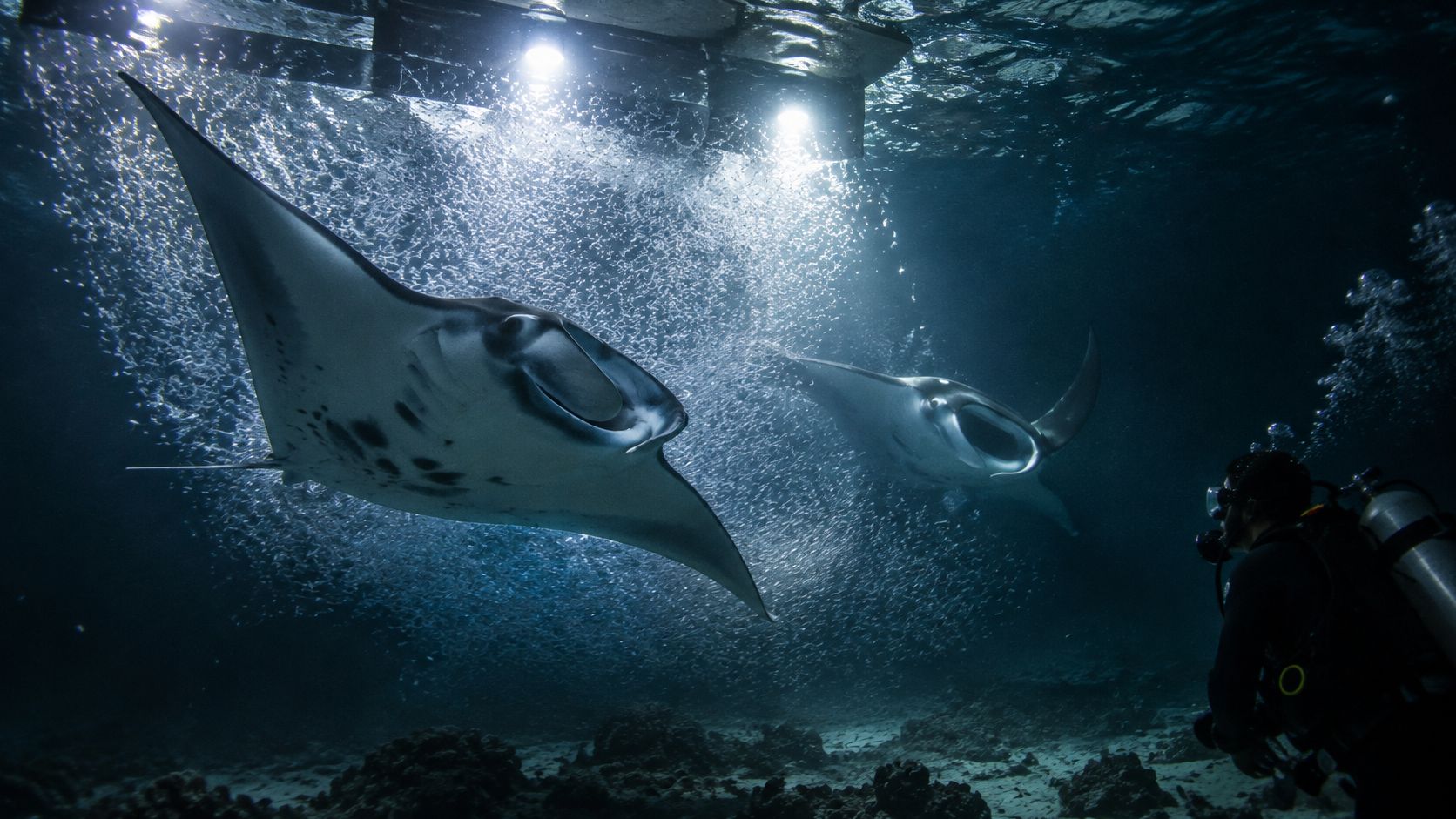
The lights concentrate food, not tame animals. They gather zooplankton into an illuminated patch, and reef mantas visit that patch to feed. Think of a porch light gathering insects and a bird taking advantage of the concentration, rather than a dinner bell summoning a pet.
That distinction changes what you should expect. A bright lamp can be working perfectly while the surrounding water contains too little suitable prey to hold a manta's attention. More lighting, more splashing, or a diver swimming toward a distant shadow won't fix a weak feeding patch.
Their feeding world extends beyond the circle
A reef manta satellite-tagging study found that dives exceeding 300 meters occurred significantly more often at night, with the deepest recorded dive reaching 672 ± 4 meters. The authors discuss access to deeper nighttime prey and dietary evidence indicating that demersal zooplankton can be an important component of reef manta diets.
Demersal zooplankton live near the seafloor and emerge into the water column after dark. Mesopelagic prey occupy deeper water, so the shallow viewing circle represents only a small part of a manta's feeding opportunities.
A ray may enter the light, turn through a dense patch, descend out of sight, and return from another direction. Don't interpret every departure as a failure of the attraction lights. The animal can leave because the next useful patch of food is elsewhere.
Practical rule: Let the manta choose the approach. Your job is to remain predictable.
Keep the food patch stable
A guide's useful contribution is a broad, steady illuminated area, not a rapidly moving beam aimed at every passing animal. Divers help by minimizing finning and avoiding the route between a ray and the plankton.
Understanding manta rays in Hawaii makes the encounter more interesting than counting close passes. Watch the direction of travel, the open feeding mouth, and how a ray turns back toward a productive patch.
Local plankton concentration, currents, moonlight, and recent weather can all change how worthwhile that patch is. Darkness alone doesn't promise a busy night.
Why Garden Eel Cove Is the Better Site
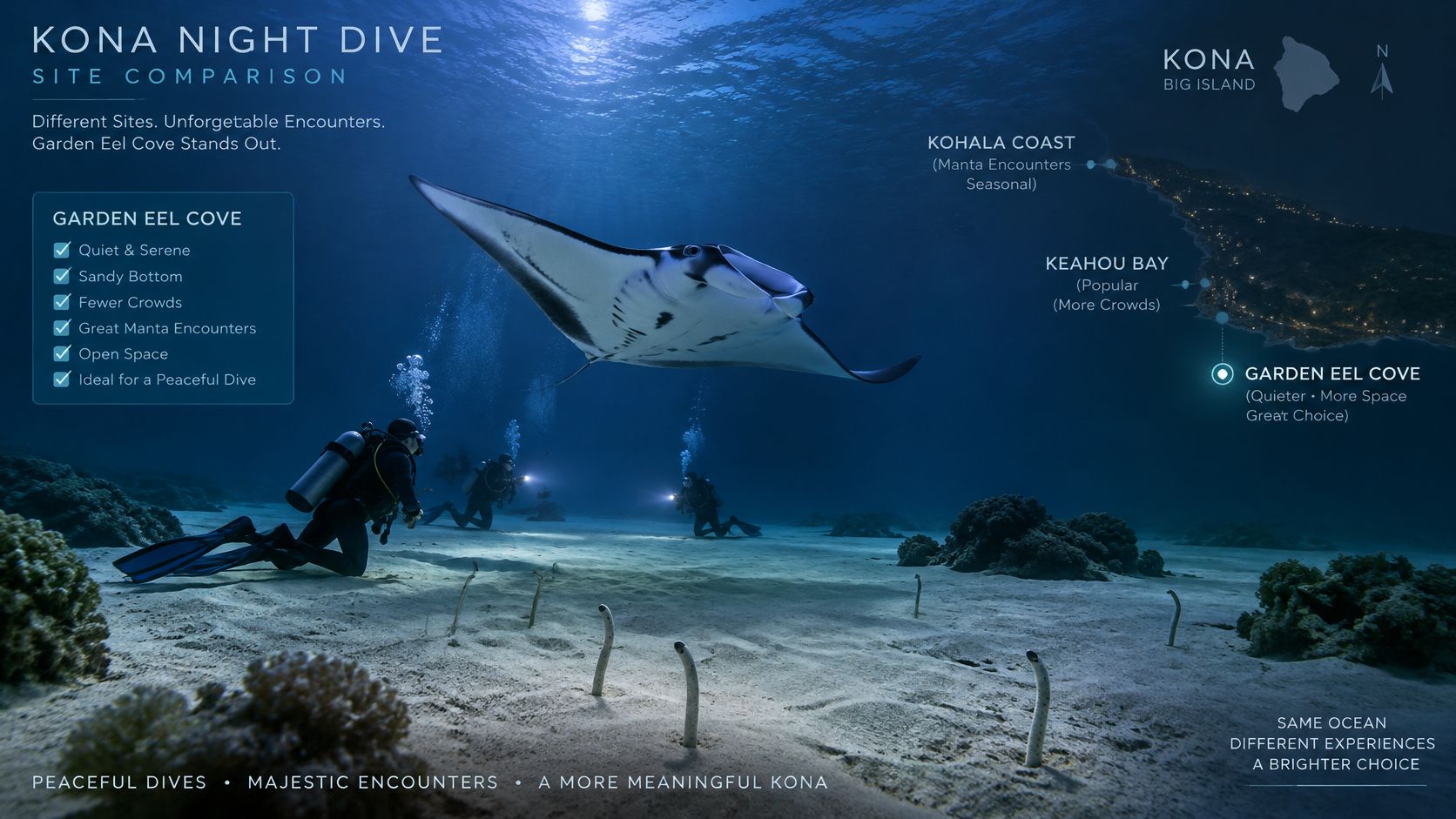
Garden Eel Cove is the stronger choice for this dive because the viewing setup works better there. Its protected northern location near the airport offers a more controlled setting than an exposed open-water encounter. The concentrated viewing area and healthier surrounding reef also make it easier to separate the wildlife-viewing space from habitat that divers shouldn't touch.
Kona's established manta areas include the southern Manta Village area and the northern airport-area site. For booking purposes, get the actual destination rather than accepting a vague promise of a manta location. A site name matters less than whether the crew can establish a stable camp under that evening's conditions.
Compare the viewing setup, not just the animals
A University of Hawaii community-sighting analysis covering 2010 through 2022 analyzed more than 23,000 sightings of 167 individually identified reef mantas, finding consistently larger aggregations at Garden Eel Cove than at Keauhou and linking aggregation size to zooplankton density. That supports choosing the northern site, but it doesn't promise a large group on your particular evening.
The practical comparison looks like this:
- Protection: A sheltered location makes it easier to organize entry, descent, and the return to the boat. It doesn't make unsafe swell acceptable.
- Viewing area: A concentrated camp gives guides a defined place to position guests and maintain clear feeding routes.
- Reef quality: Better surrounding reef adds value to the setting, provided everyone keeps fins and knees off living coral.
Our divers are positioned in a specific viewing area. They aren't released to roam beneath feeding rays.
Why the sand circle matters
The NOAA voluntary manta-viewing standard recommends placing lights over sand or rubble, leaving room so divers don't sit on live coral, and keeping snorkel groups of four or more together with a snorkel ring or similar flotation device. Those mechanics explain why a suitable viewing area matters as much as animal availability.
The reef isn't an overflow seating section. If a diver can't fit without putting a fin on coral, the formation needs adjusting rather than squeezing.
From the boat, the useful signs are straightforward: a protected cove, a defined illuminated patch over appropriate bottom, and room to keep people out of the animals' route. That's the setup worth choosing, even before a manta arrives.
Certifications and In-Water Skills Required
Who can join and what skill matters
| Role | Minimum credential | Skill that matters | Skip or adjust if |
|---|---|---|---|
| Scuba diver | Open Water or equivalent | Neutral buoyancy and staying still on sand | You cannot hover without grabbing coral or the guide |
| Recently certified diver | Same Open Water card plus a recent checkout | Comfort kneeling in a group at night | It has been many months since your last dive |
| Snorkeler | None | Floating comfortably with a mask throughout the session | You aren't comfortable in dark water with a light |
| Experienced diver wanting more reef time | Not an extra manta requirement | Optional separate advanced day trip | You treat a long-range day as part of this night |
A stationary dive can suit a newer certified diver, but stationary doesn't mean skill-free. You still need to descend under control, equalize without rushing, monitor your gas, and respond to a guide's signal when something interesting is overhead.
The revealing test is what happens when you look up. If looking at a manta makes you rise, tip backward, or kick to recover your balance, practice that movement in daylight first. Your buoyancy should remain controlled when your attention shifts away from the bottom.
Choose the adjustment that solves the problem
If you haven't dived for a long interval, arrange a refresher or calm checkout before the night outing. A recent certification card doesn't compensate for a long gap, and a thick logbook doesn't prove current comfort.
Darkness is a separate consideration. Review the practical demands of scuba diving at night, including light signals, buddy awareness, and orientation, rather than assuming daytime confidence will transfer automatically.
- Uncertain buoyancy: Practice hovering and looking upward without changing depth.
- Anxiety underwater: Choose the surface option only if floating in dark water feels comfortable. It isn't a cure for fear of the ocean.
- Difficulty with boat exits: Discuss the ladder and assistance needs before reserving. Strong swimming doesn't automatically make a moving ladder easy.
At the surface, a mask that leaks continuously can turn waiting into work. Sort out fit, breathing, and your ability to remain relaxed with your face in the water before the boat leaves.
Advanced diving is a separate choice
An optional advanced long-range reef trip serves a different purpose from the manta camp. It isn't a prerequisite, upgrade requirement, or proof that you're ready to watch mantas.
A useful self-test is simple: can you kneel on appropriate sand or hover while looking upward, without grabbing anything or following what you're watching? If you can remain settled when you're excited, you have the central skill this encounter requires.
Pre-Dive Checklist and Passive Watching Rules
Prepare before you board
Arrive rested and hydrated. Don't enter the water with congestion that prevents comfortable equalization. A stationary viewing dive is still a scuba dive, and the descent isn't the place to discover your ears won't clear.
Plan for seasickness carefully. Products you may encounter include the Ship-EEZ Seasickness Patch, Dramamine pills, Bonine pills, Sea Band wristbands, and ginger chews. These aren't interchangeable treatments or guaranteed preventatives. Follow the relevant product directions, and ask a pharmacist or clinician about suitability, drowsiness, and scuba diving before using medication.
Wear a fitted exposure suit. Remaining still after sunset feels different from swimming actively on a daytime reef. Choose a suit that seals comfortably without restricting your breathing or movement.
Secure your equipment. Clip your alternate air source where you can reach it, shorten dangling camera tethers, and check that lights and hoses can't swing into a passing animal.
Check weighting rather than adding ballast for a kneel. You need controlled buoyancy, not enough lead to pin yourself down. Don't compensate for poor trim by loading extra weight.
Listen before entering. Our detailed briefing covers the feeding science and the golden rules of passive observation. Ask about signals, the route back to the boat, and what to do if you lose the group before anyone splashes.
Keep the feeding lane open
Divers hold lights upward above their heads; snorkelers direct lights downward. Both groups remain outside the feeding lane, and nobody touches a manta, even when a pass is close enough to make contact seem easy.
Our experienced divemasters and instructors are in the water to manage the group. Follow their positioning instructions rather than moving toward whichever guest appears to have the closest pass.
A successful encounter leaves the manta's route open and every guest accounted for.
Apply responsible diver etiquette to the whole camp. Avoid stirring sand, crowding another diver, or turning around with an uncontrolled fin sweep.
Judge the operation beyond its sighting claims
A high encounter rate describes animal availability. It doesn't tell you whether the boat manages propellers carefully or whether guides can respond effectively to a separated guest.
Before booking, get clear answers about:
- Mooring practices: Does the vessel use a fixed mooring rather than dropping an anchor onto reef habitat?
- Propeller management: What happens around engines while guests enter, wait near, or return to the boat?
- Separation and emergencies: What should you do, and who manages the response?
- Group control: How are guests assigned to guides and kept together?
- Unsafe conditions: What triggers relocation, cancellation, or an early exit?
Hawaii Ocean Watch's manta management overview describes proposed rules that would cap permits at 24 commercial operations per location and limit each operator to 60 passengers per 24-hour period. These are proposed controls, not a statement of current enforceable limits, but they show why crowding deserves serious attention.
The standard is more demanding than seeing a ray: no contact, controlled movement, and no one left behind.
What Changes a Thin Night and What to Do
What changes a manta night and what to do
| Condition | What changes | Sensible response |
|---|---|---|
| Thin zooplankton | Fewer passes or smaller groups | Stay still; don't chase; crew may shorten the dive |
| Current sliding the camp | Hard to remain on the sand circle | Relocate or end the dive if guests can't hold position |
| Bright moonlight | Plankton may be more spread out and the column can look sparse | Expect less concentrated feeding; keep lights steady |
| Open-ocean swell | Unsafe or uncomfortable entry at exposed points | Use protected Garden Eel Cove only if suitable, or reschedule |
| Poor visibility | Rays may be present but hard to see | Don't treat haze as a failed attraction light |
| No reliable feeding zone | Little or no activity after a fair wait | Delay, move, limit water time, or use an available rebooking option |
Repeated use of Kona's feeding sites supports a sensible expectation of an encounter, not a guaranteed crowd. The Kona Honu Divers guide to Big Island scuba conditions summarizes a six-year study recording 25,444 observations of 118 identified mantas at Manta Heaven and Manta Village, alongside newer University of Hawaii findings connecting aggregation size with zooplankton density.
Those are repeated observations of identifiable animals, not a count of different mantas waiting beneath every departing boat. A resident animal can be elsewhere, and a familiar feeding site can be unproductive for an evening.
Separate a quiet camp from an unsafe camp
Thin plankton calls for patience. Current that prevents guests from staying in position calls for a change of plan. Don't confuse those situations or accept unnecessary exertion because everyone hopes another ray will appear.
Poor visibility creates another distinction. A hazy water column can hide an animal that's nearby, while an apparently clear column can contain little food. Swimming outward to investigate either situation breaks the organized camp and makes the guide's job harder.
Garden Eel Cove's protection is an advantage, not permission to ignore swell. If the entry, exit, or station-keeping is unsuitable, the right answer may be to stay out.
Booking question: What happens if the viewing zone never becomes productive, and what does your rebooking policy actually cover?
Get a backup plan, not a promise
A responsible crew may delay entry, relocate when safe and permitted, shorten the session, or offer rebooking under its stated terms. Don't assume any particular remedy is included unless it's confirmed before purchase.
Ask whether a quiet encounter qualifies for a return trip, whether space is subject to availability, and what happens if your travel schedule doesn't allow another attempt. Those are practical reservation details, not evidence that an operator lacks confidence.
Judge the crew by how clearly it explains the alternatives. A poster promising mantas every evening can't change what's in the water.
Photograph the Passes Without Leaving the Circle
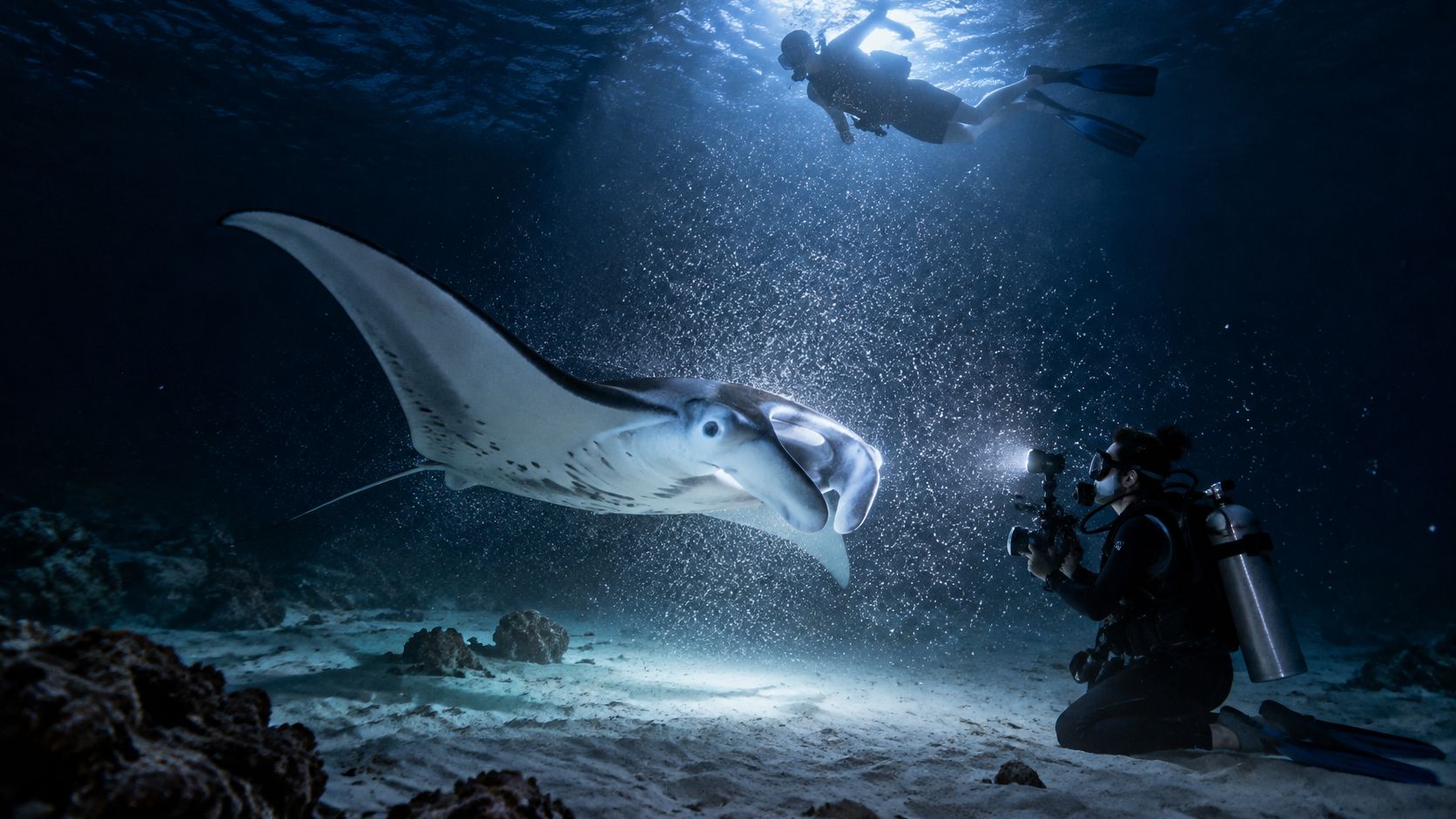
The camera has to obey the same boundaries as its owner. Your strongest realistic frame is often a wide view of the illuminated camp, black water beyond it, and a pale manta underside turning through the beam. You don't need to intercept the animal to make that photograph work.
Start with the composition available from your assigned position. Let the ray enter it, and accept that some passes will happen behind another diver or outside your lens's useful angle.
Set exposure before the animal arrives
Test your camera on the light glow and illuminated sand while the camp is settling. Check whether the brightest areas lose detail, then make an adjustment before a white belly fills the frame.
For video, a steady continuous light is easier to evaluate than repeatedly firing a close-range strobe toward an approaching face. Coordinate any additional lighting with the guide so you don't disrupt the established arrangement or shine into other guests' eyes.
- Keep the camera low: A diver can angle a permitted video light slightly upward while remaining settled.
- Stay at the surface: A snorkeler should photograph downward from the assigned float position, not duck beneath the feeding animals.
- Control the housing: Keep trays and handles close enough that you can stop their movement without extending into the lane.
Suspended particles become more obvious when you illuminate water directly in front of the lens. Resist the urge to solve every cloudy frame with more light; change the angle within the space available instead.
Build a sequence without pursuing anything
Ask the guide to demonstrate a simple sequence on deck: a wide establishing view of the camp, a feeding pass with the cephalic fins unfurled, and a composition including another diver for scale. These give you a useful story without requiring you to leave your place.
If a manta fills the dome, hold position and let it pass. Don't lift the housing into its underside or swing the camera across its exit route.
A manta night dive photo package is worth considering if operating a camera would distract you from buoyancy or the encounter itself. Confirm the current package details before choosing it rather than assuming every trip includes photography.
Edit for steadiness, not proximity
Keep the clips where the viewer can follow the animal's movement through the light. A stable pass with room around the ray usually communicates the encounter better than a frame full of motion blur.
Your closest image isn't automatically your best one. A short, steady clip from the circle beats a shaky pursuit, and no photograph is worth a touch.
Frequently Asked Questions About the Night Manta Dive
How long is the dive and when does it start?
Plan for a post-sunset session, with the precise departure and check-in schedule confirmed in your reservation. The in-water portion is generally about an hour, but your gas supply, comfort, and the crew's assessment can require an earlier exit.
Do snorkelers need a certification?
No scuba card is needed for the surface option. You do need to be comfortable floating with your face in the water, breathing through a snorkel, and following instructions in darkness.
If your group is split between certified divers and nondivers, compare snorkeling versus diving with manta rays by comfort and viewing position, not by which sounds more impressive.
How often are mantas seen?
Sightings recur on most nights in the long-running Kona observations, but published records don't all measure the same thing. A Makako Bay night-dive report analysis covering 2019 through 2023 found reported manta sightings on approximately 43% to 67% of nights, depending on the month.
That report-based measure isn't a universal success rate for every operator or departure. Plan for a possible encounter, never a guaranteed one.
What happens on a quiet night?
The crew may wait, adjust the camp, change location when suitable, or end the session. Rebooking is a booking-policy question, so confirm the actual terms rather than assuming a free return is included.
Is there a best season?
The available evidence doesn't establish a dependable best season for Garden Eel Cove. Ask about recent site conditions when reserving, and leave flexibility in your travel schedule rather than choosing a date from an unsupported seasonal promise.
Can I bring a camera?
Yes, provided you can manage it without compromising your position or equipment awareness. Keep the housing close, use lighting consistent with the briefing, and accept missed frames rather than leaving the viewing area.
- If you're task-loaded: Leave the camera aboard.
- If you're comfortable: Set it before the action and let the animal enter your frame.
Book the Kona Night Manta Ray Dive
Choose your role before reserving: certified diver below, or comfortable snorkeler at the surface. Our stationary camp accommodates beginner through advanced experience levels, but the relevant water skills still matter. The reservation should match what you can comfortably do now, not what you hope you'll manage once the boat arrives.
Kona Honu Divers uses Garden Eel Cove as its go-to manta site because it's protected, generally calmer, and offers a good viewing area with healthier surrounding reef. Powerful lights on the seafloor establish a bright camp where divers watch from the sandy bottom and snorkelers watch from above. Divers aren't left sitting in complete darkness.
Reserve the right outing for your group
The manta ray dive and snorkel tour page is the place to review the charter and choose your reservation. The underwater lights attract plankton, allowing close feeding passes, sometimes just inches away, without guests swimming after the animals.
Popular trips, including the manta night dive, often sell out weeks in advance. If this is a priority for your visit, check availability while you still have a choice of dates rather than leaving it until the end of your stay.
Before completing the booking, have your certification information ready if you're diving. Make sure everyone in the party understands whether they're joining below or at the surface, and raise any equipment-fit or mobility concerns while there's time to discuss them.
- For certified divers: Reserve the scuba role only if your buoyancy and recent water comfort suit a supervised night camp.
- For surface guests: Choose snorkeling because you're comfortable floating in dark water, not just because it requires no card.
- For mixed groups: Confirm each person's activity rather than assuming everyone must choose the same viewpoint.
For a dedicated surface outing, you can also check the manta snorkeling calendar below. Review the listing's current meeting instructions and participation requirements before purchasing.
Kona Honu Divers offers a guided night manta ray encounter at Garden Eel Cove, with certified divers watching from the sandy viewing area and snorkelers observing from the surface. If your water skills and the passive-watching rules fit, visit Kona Honu Divers to check your date now.