
The Kona coast is one of the world's most reliable places to snorkel with manta rays because it has three established feeding stations, and Manta Village has historically reported sightings on over 90% of nights, with an average of 4 or more rays per outing. The experience usually happens in shallow viewing conditions around 10 meters, or about 35 feet, deep, so snorkelers can enjoy it without scuba certification.
You're probably looking at tour pages, comparing departure harbors, and wondering whether the famous manta ray snorkeling Big Island experience really lives up to the advertising. It does, but not because a wild animal can be guaranteed on command. It works because Kona's resident reef mantas repeatedly feed at established sites, and because operators know how to create the conditions that bring plankton and rays together.
A first-time snorkeler may spend the evening lying flat on a flotation board, face in the water, while bright lights shine below. A manta with a wingspan of about 12 feet can then glide beneath the board, turn into a slow barrel roll, and pass through the light field again. That's an extraordinary encounter, but it's still an open-ocean night trip. Site choice, ocean conditions, operator setup, and your own comfort in deep water all matter.
This guide gives you the practical answer, not the sales version. You'll learn which site I'd choose, how the feeding system works, who should skip the trip, what to bring, and how to book a setup that makes sense for your group. For broader context on what makes Kona's underwater experiences different, see this guide to what's unique about diving in Kona.
Why the Big Island Is the World’s Best Place to Snorkel With Manta Rays
The first few minutes can feel strange. You're not swimming toward a reef in daylight. You're holding a flotation board in dark water, listening to the boat and the instructions from the crew, while beams of light cut down through the surface. Then a pale shape rises from below, turns on its side, and rolls beneath you.
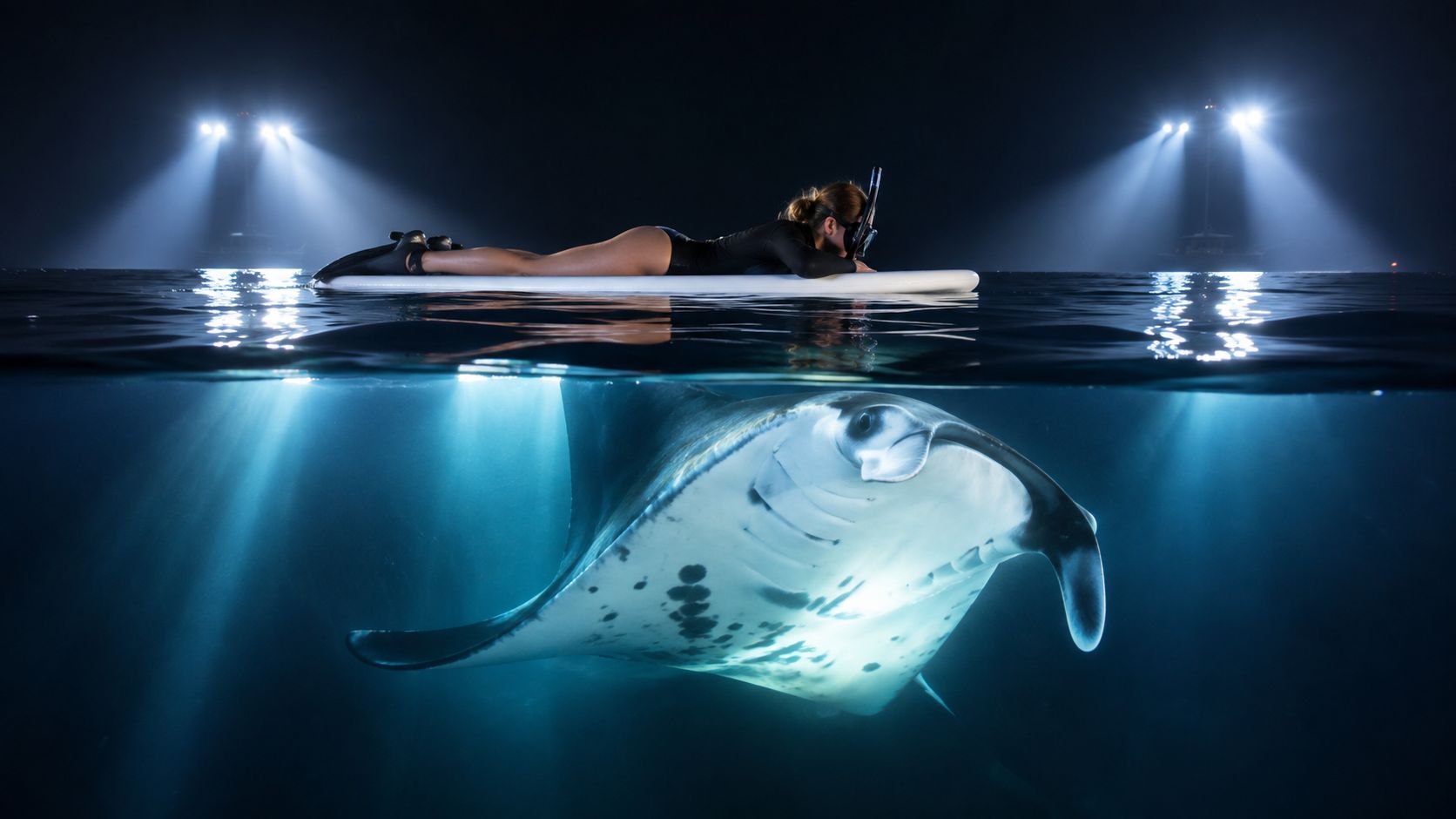
That reliability comes from geography and animal behavior working together. The Kona coast has three established feeding stations, Manta Village, Manta Heaven, and an unnamed site along the Kohala coast. Manta Village, the most visited location, has historically reported sightings on over 90% of nights, with an average of 4 or more rays per outing according to this Kona manta ray overview.
The viewing conditions also make Kona unusually accessible. Mantas commonly feed around 10 meters, or about 35 feet, deep, which allows snorkelers to watch from the surface while certified divers observe from below. You're not required to descend, hold your breath, or chase the animals. The best position is usually the simplest one, flat on the board and still.
A resident population creates repeatable encounters
Kona's mantas aren't occasional visitors passing through on a lucky migration. Long-term photo-identification has documented a resident population, with one Kona-focused source reporting more than 200 cataloged reef manta rays and another reporting over 300 individually identified mantas in Kona since 1991 as summarized by Girls that Scuba.
That history matters. It explains why the same feeding areas remain useful across seasons and why guides can recognize individual animals from the markings on their undersides. A wild encounter is never guaranteed, but Kona gives you a much stronger foundation than a destination where sightings depend entirely on passing animals.
The rest of your decision comes down to four practical questions:
- Where should you go? Site layout and protection from swell change the experience.
- When should you go? Calm ocean conditions make entry, surface positioning, and visibility easier.
- Who should run the trip? Light placement, group management, and safety briefings matter.
- Should everyone in your group participate? Night snorkeling in deep water isn't equivalent to a shallow beach excursion.
That's why I don't treat every Kona manta tour as interchangeable. The animal may be the headline, but the boat, site, conditions, and crew determine how comfortable and focused you'll be when the lights go on.
How the Manta Ray Night Snorkel Actually Works
The spectacle starts with plankton, not with the mantas. Reef mantas, Mobula alfredi, filter-feed on tiny organisms in the water. Tour operators place bright lights in the water, and plankton gather around that illuminated area. Mantas then rise from below to feed where the food has concentrated.
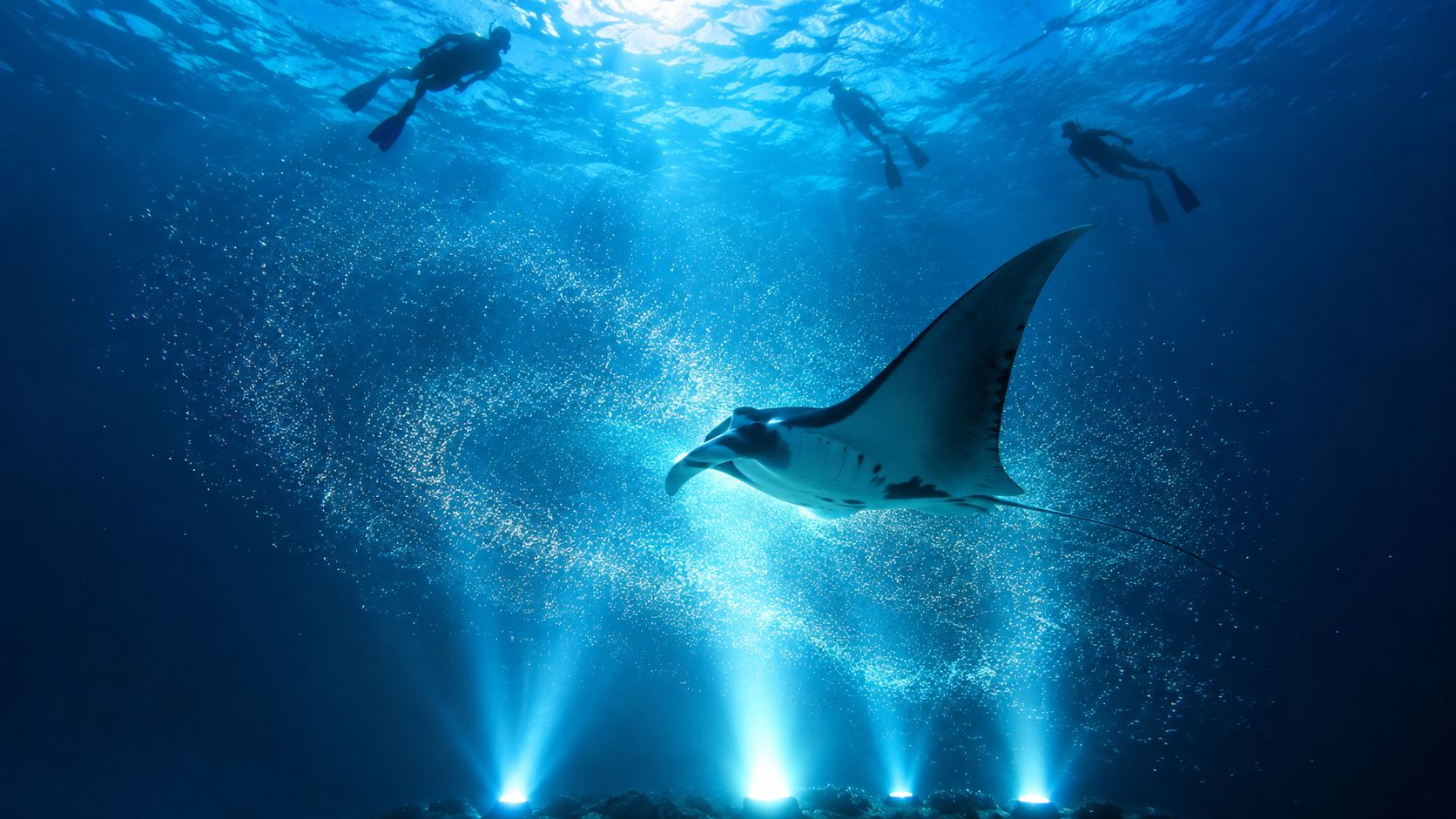
Think of the lights as a dinner bell that rings at the same place each night. The light doesn't tame the animals or make them perform. It creates a temporary food-rich area, and the mantas decide whether the conditions are worth visiting.
The feeding system in simple steps
- The crew positions the boat or flotation board. The group settles into a designated viewing area rather than spreading across the ocean.
- Bright lights shine into the water. Those lights attract and concentrate plankton near the surface.
- Mantas move through the light field. They open their mouths and make slow passes, sometimes rolling through the densest plankton.
- Snorkelers watch from above. You hold onto a flotation board and keep your body at the surface.
- Divers observe from below. Certified divers sit or kneel on the sandy bottom, creating a viewing corridor between the lights and the surface.
The positions aren't arbitrary. Snorkelers who dive down can enter the mantas' feeding space, block their path, and make the animals change direction. Remaining flat gives the mantas a clear route and keeps you stable when the water moves.
Practical rule: The less you chase the encounter, the better the encounter usually works. Stay in position and let the manta return to the light.
Kona's west coast adds another advantage. The island's landmass, including Maunaloa, shelters the coast from prevailing trade winds. Calmer conditions can reduce surge, improve visibility, and make it easier for snorkelers to hold a stable surface position. That doesn't make every night calm, but it helps explain why the activity has such a strong history of consistent encounters.
This also explains why the trip isn't free swimming. You aren't expected to explore independently in the dark. You're part of a carefully managed viewing setup, with the flotation board, lights, crew positioning, and group behavior all supporting the same goal. Once you understand the plankton mechanism, the rules feel practical rather than restrictive.
Choosing Your Manta Snorkel Site on the Kona Coast
The three established sites don't offer identical experiences. Manta Village is the traditional choice and has the strongest historical reputation for regular sightings. Manta Heaven, also known as Garden Eel Cove, can offer an excellent viewing layout and often appeals to groups that want a more structured arrangement between surface snorkelers and bottom-positioned divers. The Kohala-coast site can feel less concentrated, with conditions and animal activity playing a larger role.
Here's the useful comparison:
| Site | Protection From Swell | Viewing Setup | Reef Quality | Best For |
|---|---|---|---|---|
| Manta Village | Strong on suitable nights, but conditions still vary | Established surface viewing with light boards | Primarily a manta viewing site | First-time visitors prioritizing historical consistency |
| Manta Heaven | Often favorable, especially at Garden Eel Cove | Snorkelers remain at the surface while divers use the sandy bottom | Better surrounding reef character | Guests who want a protected setting and organized viewing area |
| Kohala-coast site | More dependent on local conditions | Smaller-scale setup when operating | Less central to the manta spectacle | Travelers who value a quieter possibility over the strongest repeatability |
My pick is Garden Eel Cove
If you're asking me where I'd send a mixed group of snorkelers and divers, I'd choose Garden Eel Cove. Its protected location, better viewing area, and better reefs give it an edge over a purely commoditized manta platform. Snorkelers remain at the surface, while certified divers position themselves on the sandy bottom at roughly 35 feet, creating a staged viewing setup around the illuminated water as described in this Garden Eel Cove site guide.
That arrangement works particularly well for families or friend groups where some people dive and others don't. Everyone watches the same feeding activity from a different level, and the divers don't need to compete with surface swimmers for the animals' attention.
Manta Village remains a sensible choice if your priority is the site with the strongest historical reporting and the most established tour activity. It can also be convenient depending on your departure harbor. But convenience and popularity can bring more activity on the water, so I wouldn't automatically call the busiest site the best site.
The Kohala location is worth considering only when the operator has a strong reason to use it and can explain the conditions clearly. A less crowded site sounds appealing, but fewer boats don't automatically mean more mantas or a better view. Ask where the trip is scheduled to go, what happens if ocean conditions prevent entry, and whether the operator's flotation and lighting setup is designed for snorkelers rather than adapted from a dive operation.
For boat logistics and departure planning, review the available Kona boat tours before choosing solely by advertised sighting language.
Safety, Etiquette, and Who Should Actually Book This Trip
Mantas aren't the main safety concern. They're filter feeders without teeth, stingers, or a barb that threatens swimmers. The key question is whether you can stay calm and control your body on the surface in deep, dark open water.
That distinction gets lost on booking pages. A neutral Kona activity listing states that swimming and snorkeling experience is required, and participants should be comfortable in deep, dark water as outlined in this activity description. That's the honest standard I'd use, even if the marketing copy sounds more relaxed.
Who usually enjoys the trip
Confident swimmers, comfortable snorkelers, and travelers who can calmly hold onto a flotation board tend to settle in quickly. You don't need to be a diver, but you do need to accept that the bottom may be out of sight and that the activity happens at night.
Think twice before booking for someone who panics when they can't see land, struggles to breathe through a mask, or expects to swim freely wherever they want. Very young children, non-swimmers, and nervous first-time snorkelers may be happier with a daytime, shallow-water excursion. Some operators may accommodate individual needs, but you should discuss those needs before arriving at the harbor, not after the boat leaves.
A flotation board helps, but it doesn't turn the trip into a pool activity. Guests still need to follow instructions, keep their faces clear of the water when necessary, and climb in and out of the boat with crew assistance.
The rules protect the encounter
Stay flat at the surface, hold the board as instructed, and keep your arms and legs from reaching into the feeding path. Don't touch, chase, grab, or try to ride a manta. Even a gentle contact can disturb the animal and interfere with its protective surface coating.
Keep lights pointed in the direction the crew specifies. Don't swim underneath the board or separate from the group to get a closer camera angle. The best footage comes from allowing the mantas to approach on their own.
Leave the manta enough room to choose its own path. That's the difference between watching wildlife and directing it.
Read the operator's guidance on responsible and considerate diver etiquette before the trip. The same principle applies to snorkelers: your job is to observe, not to manufacture contact.
What to Bring and How to Prepare for a Night Snorkel
The boat ride home catches many off guard. You may feel warm and focused while you're in the water, then notice the wind as soon as you climb back aboard. Bring a dry layer for the return trip, even if the evening felt comfortable at the dock.
A typical boat-based excursion lasts about 1.5 to 2.5 hours, with roughly 30 to 45 minutes in the water as outlined in this Big Island snorkeling guide. The rest of the time covers check-in, the ride, the safety briefing, gear preparation, entry, and the return to harbor.
Gear the operator generally handles
Operators typically provide the core equipment needed for the water portion of the trip:
- Mask and fins: Use the fitting period to report leaks or discomfort.
- Wetsuit or wetsuit top: Ask what's included before departure, especially if you get cold easily.
- Flotation board: This supports the surface viewing position and keeps the group near the lights.
- Underwater lights: These help create the plankton concentration that attracts mantas.
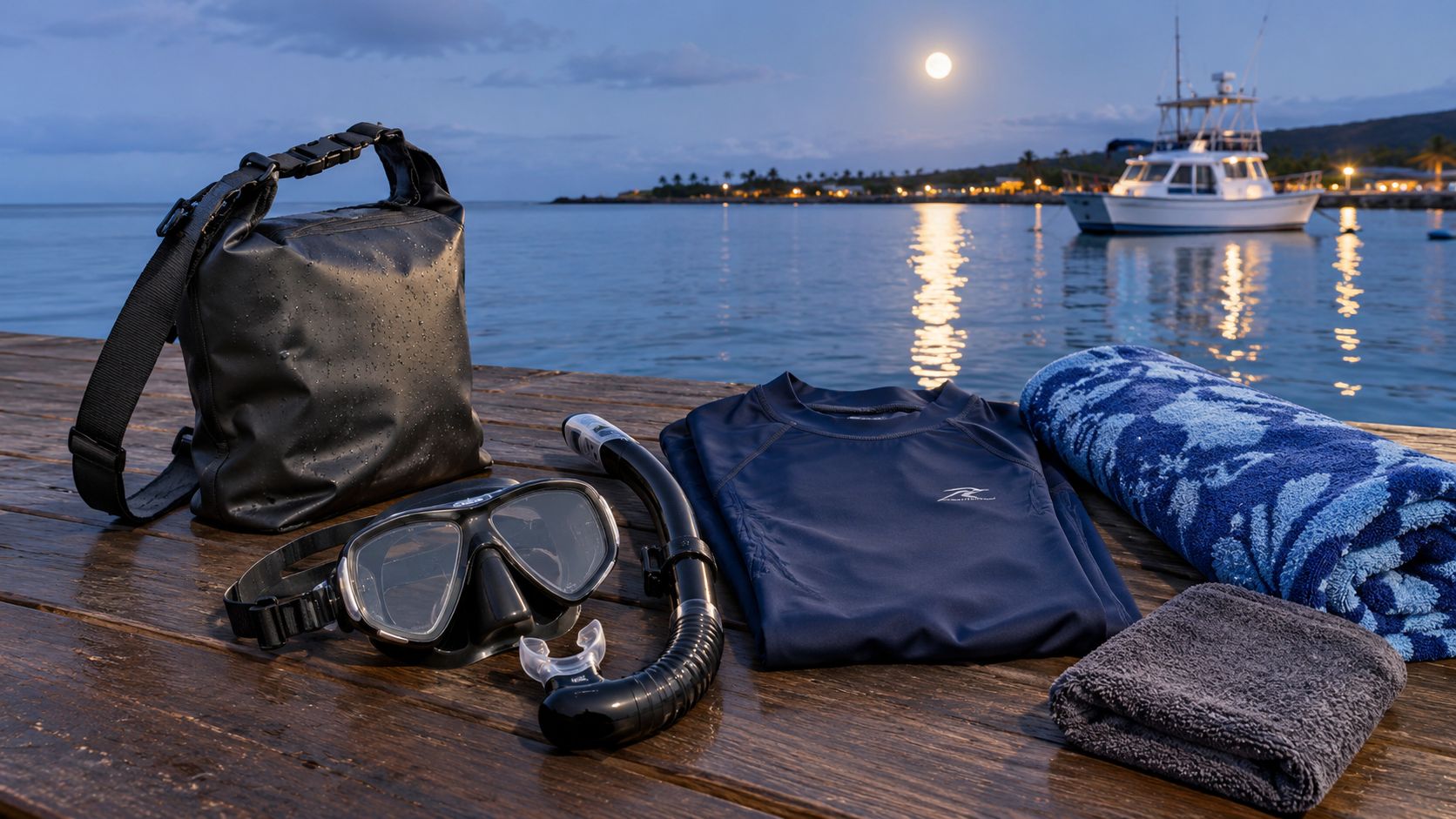
Bring your swimsuit under your clothes, a towel, a warm sweatshirt or jacket, and a way to secure long hair. Keep personal gear compact. A large dry bag can become awkward on a crowded boat, while a small waterproof pouch is easier to manage.
Prevent seasickness before the boat moves
Night boats over open water can churn your stomach. Don't wait until you feel sick to act. Follow product directions carefully, check for medication interactions, and ask a pharmacist or clinician if you have a medical condition or take other medicines.
Options you can purchase ahead of time include Ship-EEZ Seasickness Patch, Dramamine pills, Bonine pills, Sea Band wristbands, a cheaper generic option described as having better ratings, and ginger chews. If you prefer a non-drug approach, eat lightly, stay where the crew recommends, and keep your eyes on the horizon during the ride.
Apply reef-safe sunscreen well before boarding so it has time to absorb. Once you're in the water, avoid touching the mantas and keep loose accessories to a minimum. For additional preparation advice, use this guide on how to avoid seasickness.
Booking With Kona Honu Divers and Getting the Best Value
I'd look for an operator that treats the manta trip as a carefully managed wildlife encounter rather than a quick swim stop. Kona Honu Divers offers manta night dive and snorkel trips, custom boats, maintained equipment, and crew support for groups that include both certified divers and surface snorkelers. The company also offers other Kona diving tours, including options for travelers building more than one ocean activity into their itinerary.
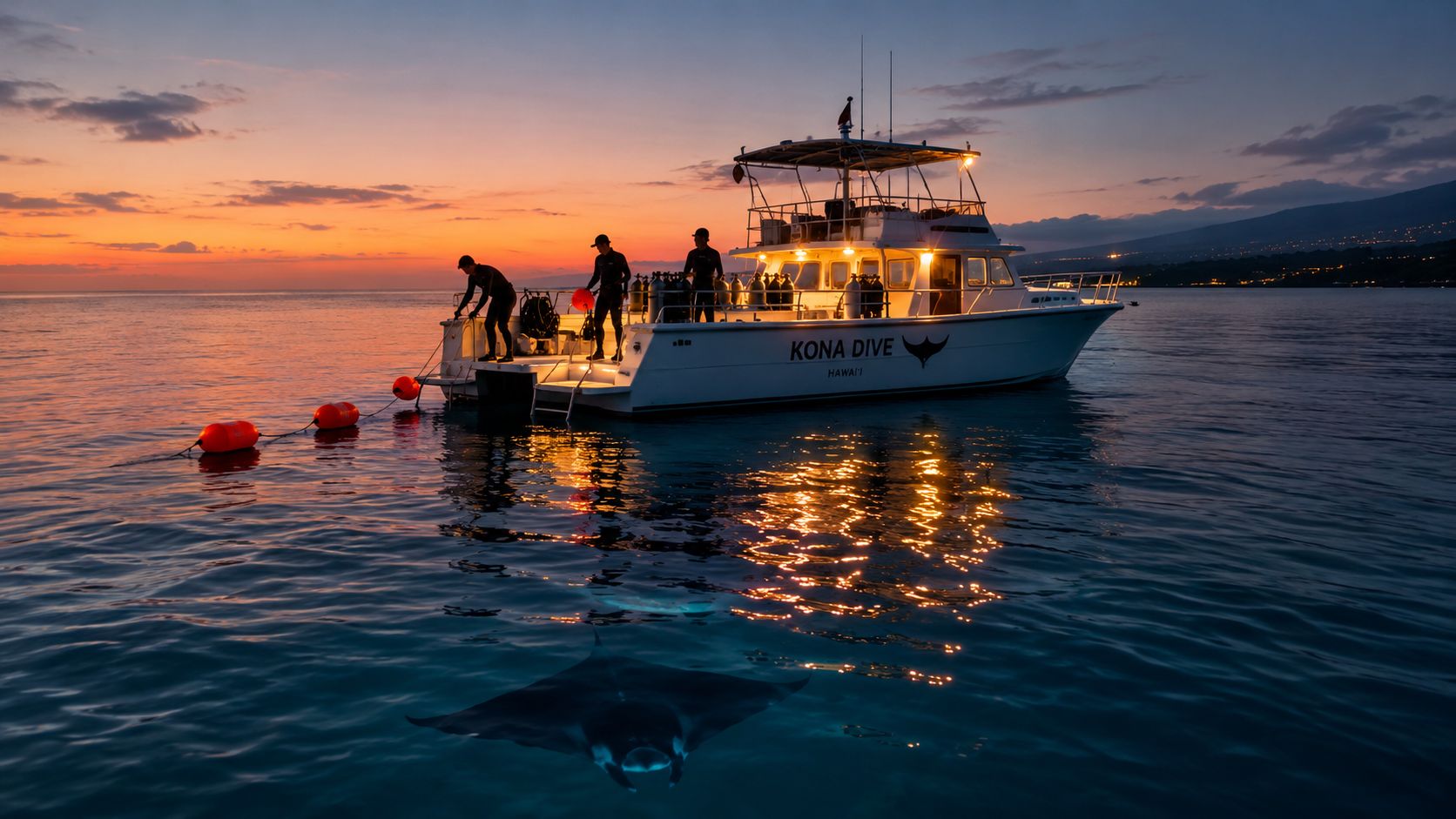
The useful part for mixed groups is the shared viewing model. Divers descend to the sandy bottom, while snorkelers remain on the surface above the same light field. Nobody has to split from the group because one traveler is certified and another prefers to snorkel.
You can review the manta ray dive and snorkel tour for the combined format, then compare it with the broader Kona diving tours if you're considering daytime or additional night trips.
Book early in your stay, not on the final night. If conditions block entry or the encounter doesn't develop, an earlier booking gives you room to adjust the itinerary. Ask about the exact departure harbor, the planned site, what the trip includes, and the operator's policy when weather or sea conditions prevent the boat from reaching the viewing area.
Value also comes from matching the trip to your group. A custom boat and experienced crew can matter more than a low headline price if one guest needs extra help with gear, another gets seasick, and a diver and snorkeler want to stay together. Choose the setup that reduces friction before you choose the cheapest listing.
Manta Ray Snorkeling FAQs and Realistic Expectations
What are the real sighting odds in 2026
No responsible operator can promise a wild animal will appear. Independent and marketplace-style pages have reported rates ranging from 85% to 95% on some nights, with some pages claiming 96% success, while also acknowledging that ocean conditions can prevent entry or reduce sightings as discussed in this current manta guide.
Treat those figures as reported historical or marketing rates, not a guarantee for your specific departure. The stronger way to improve your chances is to choose an established feeding site, book with enough flexibility to handle a weather change, and avoid making the final night of your trip your only opportunity.
Is it safe for kids and non-swimmers
Mantas themselves aren't the issue. The trip takes place at night in deep water, and participants need enough swimming and snorkeling comfort to remain calm on a flotation board and follow crew instructions.
A child who is comfortable in open water may manage well, while an older child who panics in a mask may not. Non-swimmers should choose a different activity unless an operator specifically confirms that the available format can support them safely. Don't assume a board removes every requirement.
What happens if no mantas show up
Policies vary, so ask before booking. Some operators may offer a rebooking option or another remedy, but you need to confirm the terms directly rather than relying on a general industry assumption.
Conditions can also change before the boat reaches the site. If the crew cancels or cannot enter safely, the operator should explain the available alternatives. Keep your schedule flexible enough to accept a different departure night.
Do I need to be a diver
No. Snorkelers stay at the surface and watch the mantas from above the lighted viewing area. Divers sit on the bottom and look upward, so certification changes your position in the water, not your access to the wildlife encounter.
The surface format is often the right choice for travelers who want to see the mantas without scuba training. It's still a real open-water activity, though, and confident snorkeling matters more than the absence of a certification requirement.
Kona's manta experience is special because predictable feeding behavior, established sites, resident animals, and accessible surface viewing come together in one place. Pick the site carefully, choose an operator with a clear setup, and be honest about your group's comfort in dark water. On a calm night, the Big Island can deliver one of the most memorable wildlife encounters in the ocean.
Kona Honu Divers offers a dedicated manta ray night dive and snorkel experience where certified divers can watch from the bottom while snorkelers remain at the surface. Visit Kona Honu Divers to review the trip details, compare other Kona outings, and choose a date that gives your group enough flexibility.