
Picture this: a giant, graceful manta ray with a wingspan wider than your car, soaring silently through the dark ocean, just inches from your face. This isn't a scene from a nature documentary; it's the real, heart-pounding experience of the manta ray night dive in Kona, Hawaii. It's consistently ranked as one of the planet's most breathtaking wildlife encounters and an absolute must-do for anyone visiting the Big Island.
Welcome to the World-Famous Kona Manta Ray Dive
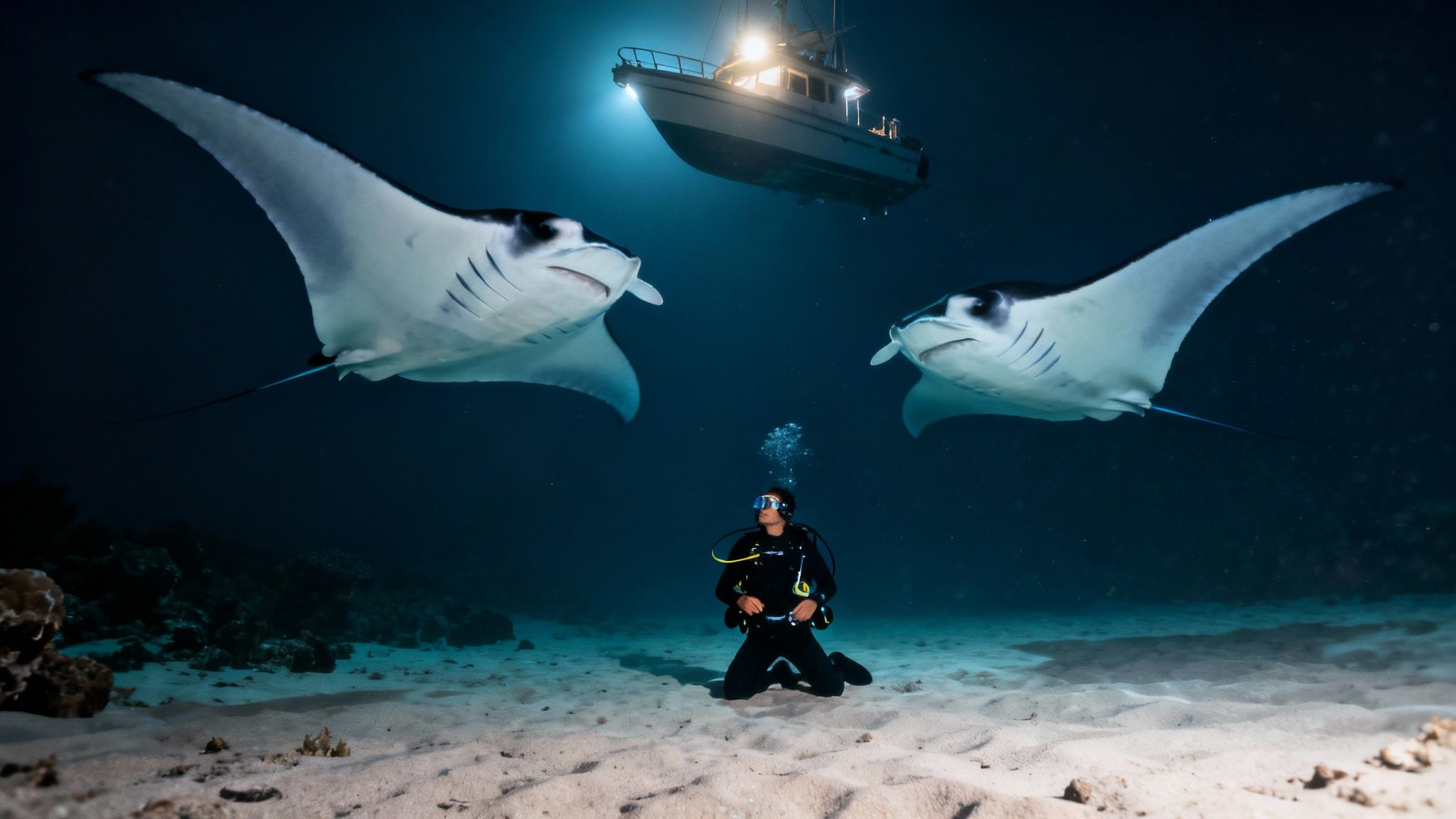
The Kona coast has rightfully earned its reputation as the global hotspot for manta ray tourism. It’s a special place where calm waters, a resident manta population, and well-established, responsible tour operators come together to create something truly magical.
This guide will walk you through everything you need to know to witness this incredible underwater ballet for yourself. We'll explore what makes this experience so profoundly unique and why it's more than just another dive—it's a genuine connection with one of the ocean's most intelligent and majestic creatures.
Why Is Kona the Premier Manta Destination?
So, what makes Kona so special? Consistency. Unlike many other places where manta sightings are a roll of the dice, Kona’s encounters are incredibly reliable. The local manta ray population doesn't migrate, which means they’re here year-round, making Kona the definitive answer for anyone wondering where is the best place to dive with manta rays.
The secret to this nightly spectacle is a fascinating, almost accidental, discovery. It all comes down to a simple formula: lights attract plankton, and plankton attracts hungry mantas.
The experience is often described as a graceful, silent ballet. The manta rays perform acrobatic loops and barrel rolls as they filter plankton from the water, often coming within inches of observers without ever touching them.
What to Expect at a Glance
To give you a clearer picture, here’s a quick overview of what makes the Kona Manta Ray Night Dive a must-do experience.
| Aspect | What to Expect |
|---|---|
| The Stars of the Show | Giant Pacific Manta Rays, with wingspans up to 16 feet. |
| The Setting | A designated viewing area on the ocean floor, illuminated by powerful lights. |
| Your Role | You’ll be positioned on the sandy bottom, shining your light up to attract plankton. |
| The Action | Mantas gracefully swoop and barrel-roll above you to feed on the concentrated plankton. |
| Interaction | Close, non-contact encounters. You'll be amazed how they navigate around you. |
| Duration | The in-water portion typically lasts around 45 minutes. |
| Who Can Go? | Both certified divers and snorkelers can participate on separate, dedicated tours. |
This is truly an experience that stays with you long after you've dried off.
Choosing the Right Operator
To make it happen, you'll need a great guide. Premier local operators like Kona Honu Divers are renowned for their deep commitment to marine conservation, safety, and education. Choosing a responsible company ensures your adventure is both thrilling and respectful of these magnificent animals and their home.
Their expert guides do more than just point out the mantas; they transform a spectacular viewing into an educational experience, helping you understand the biology and behavior of the creatures you're seeing. When you book with a top-tier operator, you’re not just signing up for a dive—you’re preparing for an unforgettable encounter with nature.
What Makes Kona’s Manta Dive So Special?
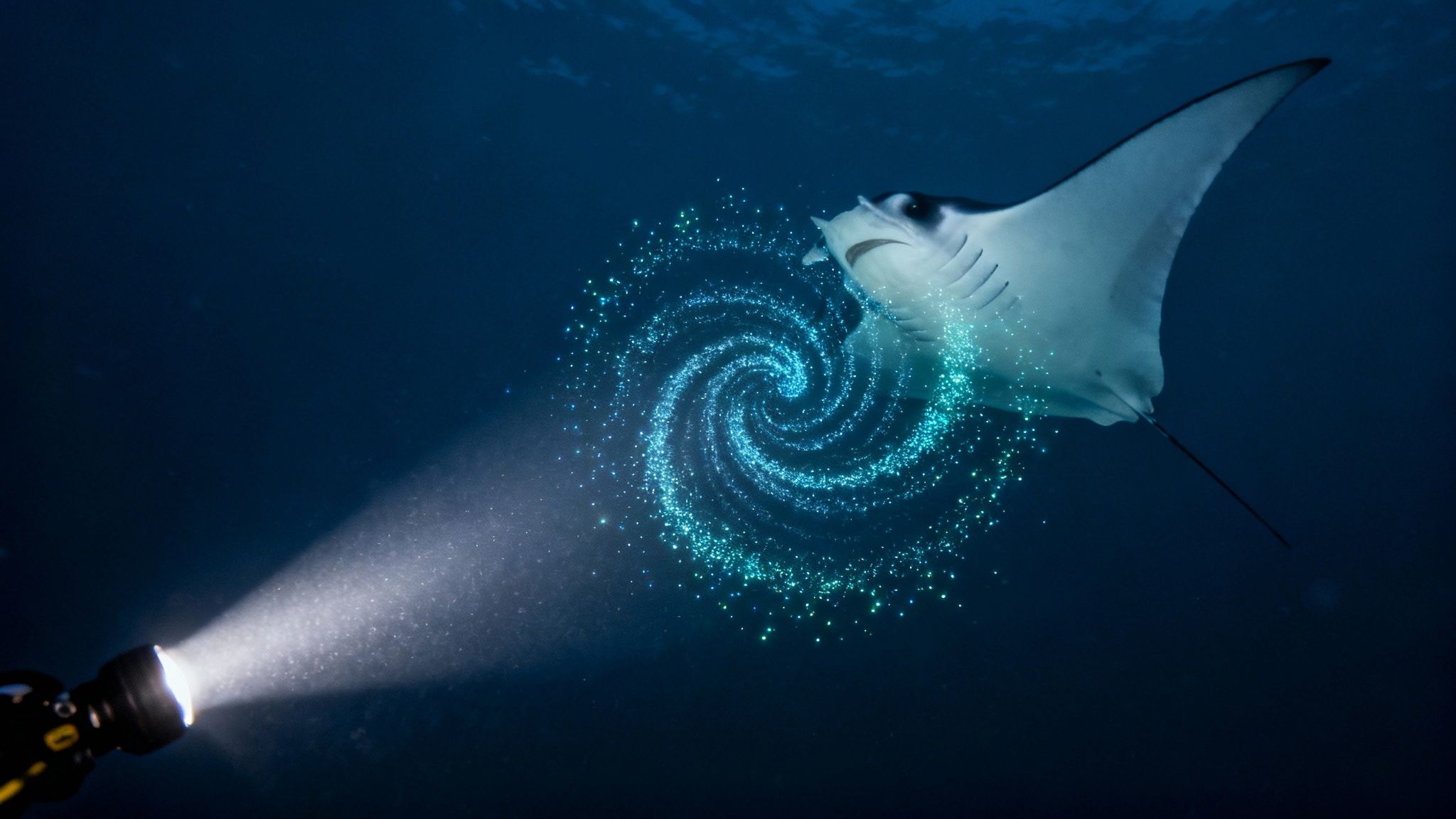
So, how did the Kona coast become the world's most reliable spot to witness this nightly manta ray ballet? It’s not just random chance. It's a brilliant, if accidental, combination of biology and human ingenuity that has been carefully managed for decades.
The whole thing is basically a cleverly set dinner table. Dive operators place powerful lights on the seafloor, and just like moths to a flame, microscopic plankton swarm to the brightness. The mantas, who are filter feeders, simply follow the food. They glide in, mouths wide open, performing these incredible, acrobatic barrel rolls to gulp down the concentrated columns of plankton.
This amazing interaction wasn't planned; it was discovered. It all started years ago when a hotel on the coast switched on its floodlights. Divers in the area started noticing that mantas were showing up to feed in the glow. From that happy accident, a world-class and sustainable wildlife encounter was born.
The Two Main Stages for the Show
In Kona, the manta action happens at two legendary locations. While you'll get an amazing experience at either, they each have their own vibe and history.
- Manta Village (Keauhou Bay): This is the O.G. manta dive site, right offshore from the Sheraton Kona Resort. It's famous for its consistency and often has calmer water, which makes it great for both divers and snorkelers. The history here runs deep.
- Manta Heaven (Garden Eel Cove): A bit further north, closer to the Kona airport, this site often draws a larger crowd of mantas. The underwater landscape is a little different, but the magic trick is the same: lights attract plankton, and plankton attract mantas.
Deciding between them usually comes down to what your dive shop recommends on a given night. They're always clued in on where the best action has been. No matter which you visit, you’re getting a front-row seat to one of the most incredible shows on Earth.
Getting to Know the Locals: An Introduction to Manta ID
Here’s what really elevates the Kona manta dive from just a cool sighting to a truly personal experience: you're not just watching anonymous animals. The local dive community knows these mantas on a first-name basis, and you can, too.
Think of it like a human fingerprint. The unique pattern of black spots on a manta ray’s white belly is one-of-a-kind. No two are the same. This allows researchers and dive guides to identify and name each individual.
This simple fact changes everything. Suddenly, you're not just watching "a manta ray"; you might be watching "Big Bertha," "Lefty," or "Koie"—all local celebrities. The Kona manta population is incredibly well-documented, with almost 200 identified individuals who call these waters home. On a good night, it’s not unusual to see over 20 different mantas!
This ongoing research gives us incredible insight into their lives and behaviors. To learn more about this amazing work, you can explore these amazing facts about Kona's manta population.
Choosing Your Adventure: Scuba Diving vs. Snorkeling
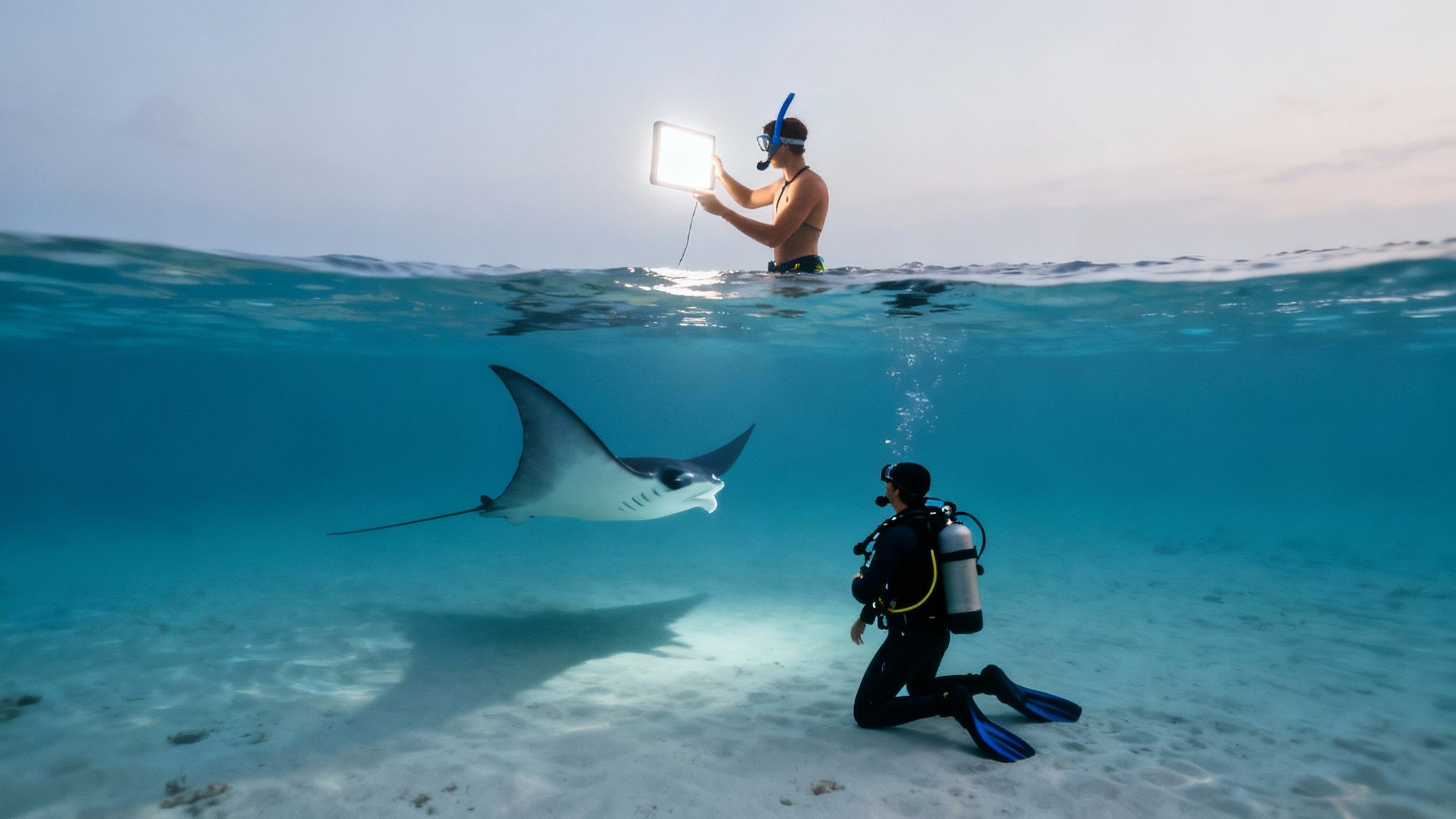
One of the incredible things about the manta ray night dive in Kona is that you don’t have to be a certified diver to see the magic unfold. Both divers and snorkelers get a front-row seat to the underwater ballet, but each offers a totally different point of view.
Figuring out which adventure is right for your comfort level is the first step to an unforgettable night. Let's break down whether you'd rather be looking up from the seafloor or down from the ocean's surface.
The Scuba Diver's Perspective
If you’re a certified diver, this is your chance for total immersion. We'll head out on a short boat ride before you descend into the calm, shallow water—typically just 30-40 feet deep. Once on the sandy bottom, the group arranges itself in a semi-circle and points their dive lights straight up. These beams of light act like magnets, attracting clouds of plankton.
And then the show begins. From your spot on the ocean floor, you’ll be looking up as manta rays perform their mesmerizing acrobatics just feet over your head. It’s a humbling, almost surreal feeling to watch these massive animals, with wingspans reaching up to 16 feet, glide, swoop, and barrel-roll through the light. You aren’t just watching the show; you're part of the set.
The Snorkeler's View from Above
Snorkeling offers an equally amazing, yet distinctly different, experience. As a snorkeler, you'll float comfortably on the surface, holding onto a custom-built light board. This isn't just any floatie; it's a powerful tool with bright lights that shine down into the water, creating a concentrated plankton buffet right at the surface.
This setup brings the mantas incredibly close. You get a bird's-eye view as they swim just inches beneath you, giant mouths open to filter feed. It's like having a private screening of one of nature's greatest spectacles. You're right where the action is, feeling the energy as these gentle giants move effortlessly below.
Making the Right Choice for You
So, which is better? Honestly, there’s no wrong answer. It all comes down to what kind of experience you're looking for. To dig even deeper, check out our guide on whether it's better to snorkel or dive with manta rays.
Here's a quick comparison to help you decide:
| Aspect | Scuba Diving | Snorkeling |
|---|---|---|
| Perspective | A bottom-up view, watching the mantas' iconic bellies glide overhead. | A top-down view, watching the mantas feed right below the surface. |
| Requirements | You must be a certified scuba diver (Open Water or equivalent). | No certification needed! Perfect for almost all swimming abilities. |
| Immersion | You're fully submerged and part of the underwater world. | You're floating on the surface, observing the action from above. |
| Proximity | Incredibly close. The mantas often pass just inches above your head. | Also incredibly close. The mantas come right up to the light board to feed. |
Ultimately, both experiences are phenomenal. Whether you choose to kneel on the ocean floor or float on the surface, you’re guaranteed an encounter you’ll be talking about for years to come.
Ready to book your spot? You can secure your manta ray tour with Kona Honu Divers today.
How to Prepare for Your Manta Ray Encounter
A little bit of prep work can be the difference between a good dive and an absolutely unforgettable one. When you step onto our boat feeling ready and relaxed, you can soak in every magical moment of the manta ray night dive in Kona. This is your go-to guide for a smooth, safe, and truly incredible adventure.
We'll walk through everything from what to pack to, most importantly, how to be a respectful guest in the mantas' world. Our goal is to have you completely prepared for the encounter of a lifetime.
What to Wear and What to Bring
Dressing for a night on the ocean is all about smart, simple layers. The water here is lovely and warm, but the air can get surprisingly cool after sunset, especially when the boat is moving.
Here’s a quick checklist to make sure you’ve got the essentials covered:
- Swimsuit: The easiest thing to do is wear it under your clothes when you arrive. You’ll be ready to go in no time.
- Warm Jacket or Sweatshirt: This is a must-have. That boat ride back to the harbor after your dive can feel brisk, and you'll be so glad you have a dry, warm layer to throw on.
- Towel: A no-brainer for drying off after you get out of the water.
- Reusable Water Bottle: It's easy to get dehydrated after spending time in saltwater, so keep some fresh water handy.
- Leave Valuables Behind: It’s always best to leave things like expensive jewelry, passports, or large wads of cash back at your hotel.
Our professional crew at Kona Honu Divers handles all the dive and snorkel gear for you, including thick, comfortable wetsuits to keep you toasty in the water. If you want a deeper dive into the equipment we provide, you can explore our guide on the gear you will need for your Kona diving adventure.
The Golden Rule of Manta Interaction
If you remember only one thing, make it this: passive observation. This is the single most important rule of engaging with the manta rays. We are visitors in their home, and our number one job is to make sure they feel safe and undisturbed.
This means you should never, ever touch, chase, ride, or block a manta ray's path. Their skin is covered in a delicate mucus layer that protects them from infection. Touching them can strip this away, leaving them vulnerable. When you remain calm and still, you’ll find the mantas often feel comfortable enough to glide right up to you as they feed.
"Observe only, never touch. Your respectful presence is what allows this incredible natural spectacle to continue. By following the guidelines, you become a guardian of the experience for both the mantas and future visitors."
Managing Expectations and Seasickness
It's important to remember that these are wild animals, but one of the most amazing things about this particular dive is its remarkable consistency. The success rate for seeing mantas in Kona hovers between an incredible 80-90%. This is thanks to a resident population and very predictable feeding patterns at sites like Manta Village. It’s no wonder around 80,000 people come to Kona every year just for this experience!
If you know you’re prone to seasickness, it’s a good idea to take medication about an hour before we head out. Little things like staying hydrated, avoiding greasy or acidic foods beforehand, and keeping your eyes fixed on the horizon can also make a huge difference.
Your Pre-Dive Briefing
Before anyone gets in the water, the Kona Honu Divers crew will give a complete pre-dive safety briefing. We'll run through the dive plan, cover all the safety procedures, and review the rules for responsible manta interaction one more time.
This is the perfect moment to ask any last-minute questions you might have. Our expert guides are there to make sure you feel 100% safe, informed, and ready for the main event.
With these simple preparations, you're all set for an evening of pure underwater wonder.
Capturing Unforgettable Manta Ray Photos
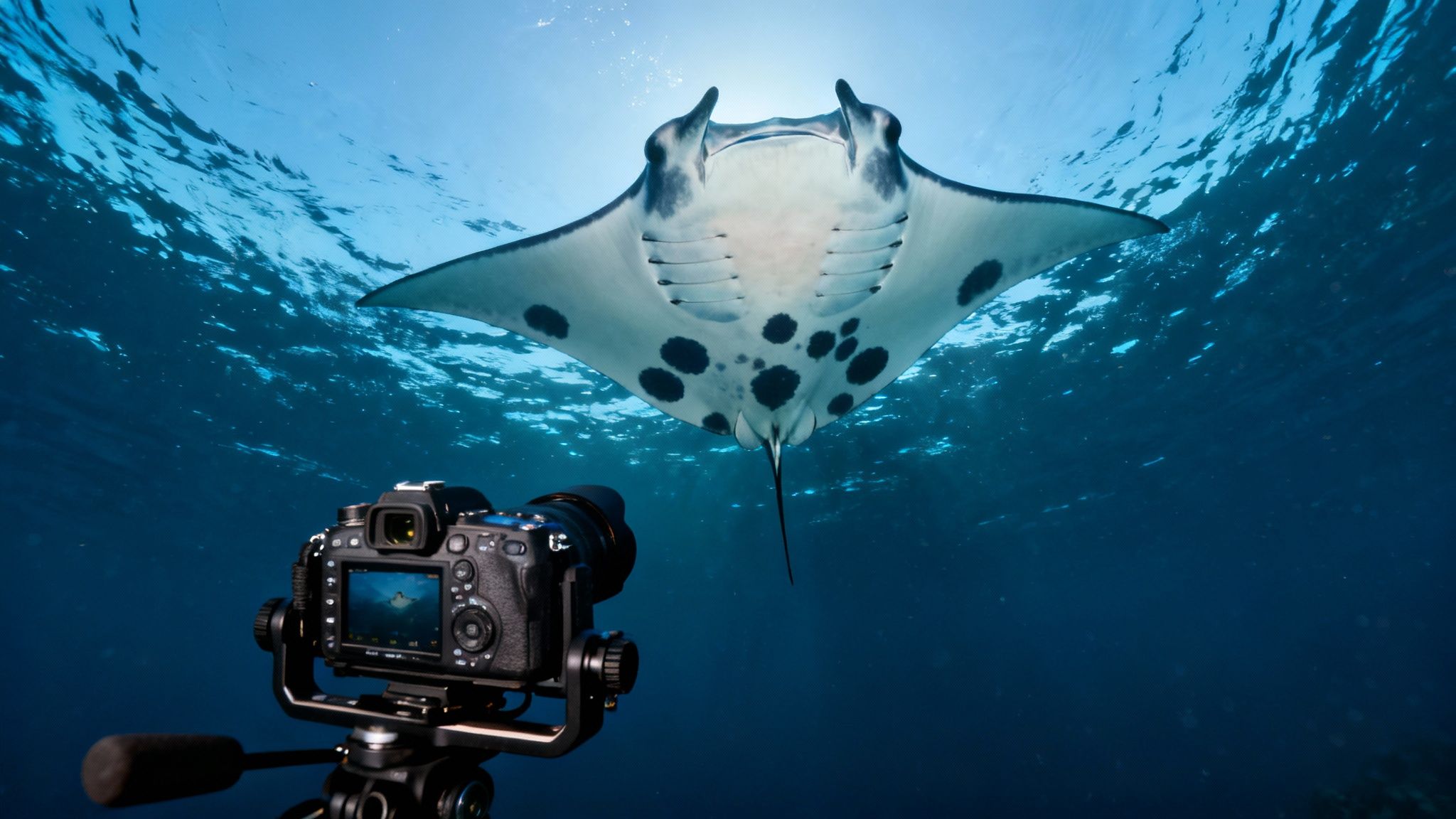
Trying to photograph the manta ray night dive in Kona is an experience in itself. You're dealing with dark water, graceful giants swooping by, and a flurry of activity all around you. It's a fantastic challenge, but bringing home images that truly capture the magic is completely doable with a little know-how.
Whether you're packing a simple GoPro or a full-blown professional rig, the goal is the same: to freeze a perfect moment of this underwater ballet. With the right approach, your photos will do justice to one of the most breathtaking encounters you can have in the ocean.
Tips for Action Cameras Like GoPro
If you’re bringing an action camera, think simple and effective. These little cameras are brilliant for capturing the sheer scale and dynamic movement of the dive.
- Use a Red Filter: The water absorbs red light first, which is why underwater shots often look overly blue or green. A simple red filter clips onto your housing and helps bring back those natural, vibrant colors.
- Keep it Steady: A camera tray with handles is your best friend here. It gives you a stable, two-handed grip that smooths out the jitters and makes your footage look far more professional.
- Get Close (Respectfully): Action cameras have a super wide lens. To make a manta look as huge and impressive as it is in real life, you need to be fairly close—while always giving the animals their space, of course.
Advanced Photography with DSLR and Mirrorless Rigs
For the serious photographer, the manta dive is a dream playground. A DSLR or mirrorless camera inside a proper housing, paired with external strobes, gives you total creative freedom.
Your biggest hurdle will be lighting. You need to light up the manta's white belly and iconic spot patterns without completely blowing out the highlights. The trick is to use two strobes, positioned out and away from your camera lens. This technique dramatically reduces backscatter—those annoying white specks you get when your flash illuminates particles floating in the water.
Think of it as a balancing act. You'll need to juggle your ISO, aperture, and shutter speed to get that deep, dark ocean background while your strobes perfectly freeze and illuminate the manta. A wide-angle lens, like a fisheye or a 16-35mm, is a must-have for fitting these enormous creatures into the frame.
Photo Etiquette and Respecting the Animals
Remember, no photograph is worth stressing out the wildlife. Great photo etiquette is what keeps this dive sustainable and amazing for everyone. Always stick to your designated spot, whether you're a diver on the sandy bottom or a snorkeler on the surface. Never, ever chase a manta for a better angle or get in the way of other people's views.
The mantas show up so consistently because we've created a safe, reliable environment for them. Just look at the historical data from 2009 to 2014—the sightings are incredibly reliable. Back in 2013, the Manta Heaven site averaged 11 manta rays per night! This consistency has been a win-win for both tourism and scientific research.
Night photography underwater is tough, and it's easy to come back with dark images. Don't worry—learning the basics of editing underexposed shots can rescue many of your favorite moments. With a little patience and a lot of respect for the animals, you’ll be ready to capture stunning images of this once-in-a-lifetime adventure.
There’s More to Kona Than Just Mantas
Let's be honest, the manta ray night dive in Kona is what brings most divers here. And it should be! It's an unforgettable, world-renowned experience. But you shouldn't let it be the only thing you do. Think of the manta dive as the incredible opening act for a full-blown Kona diving adventure.
Once you've seen the graceful dance of the mantas, it's time to explore what else lurks in the deep, dark waters off the Big Island. Kona is one of the very few places in the world where you can do a true blackwater dive, and it's a journey into another dimension of scuba.
The Famous Kona Blackwater Dive
Picture this: you’re floating in the middle of the ocean at night, with thousands of feet of inky black water beneath you. The Kona Blackwater Dive is where you get to witness the largest migration on Earth.
Every single night, an untold number of strange, beautiful, and often bioluminescent creatures rise from the depths to feed near the surface. You'll see things that look like they're straight out of a sci-fi movie—larval fish that look nothing like their adult forms, shimmering squid, and alien-like jellies. It completely changes your idea of what a night dive can be.
Lava Tubes and Colorful Reefs by Day
Beyond the night dives, Kona’s daytime diving is spectacular. The volcanic history of the Big Island has sculpted an underwater landscape you just won't find anywhere else. Our scuba diving tours take you through a world of healthy coral reefs, massive underwater archways, and incredible lava tubes you can actually swim through.
The marine life is just as impressive. On any given dive, you're likely to see:
- Honu (Green Sea Turtles): They are everywhere and always a welcome sight.
- Huge Schools of Fish: From colorful butterflyfish to the famous humuhumunukunukuāpuaʻa (Hawaii's state fish).
- Eels and Octopus: Masters of camouflage, often tucked away in the lava rock.
- Spinner Dolphins: We see them from the boat all the time, and sometimes they'll even buzz us underwater.
Ready for a Challenge?
If you're a seasoned diver looking for something more, Kona has you covered. The unique topography here creates some truly challenging and rewarding dives. For our advanced divers, we head to deeper sites, navigate through more complex underwater structures, and visit spots that most people never get to see.
These advanced diving opportunities are perfect for pushing your skills and seeing the wild, untouched side of the Big Island. It’s the next logical step after the manta dive and the perfect way to round out an epic Kona dive trip.
Your Top Questions About the Manta Dive Answered
Planning a trip to see Kona's famous manta rays at night? It's natural to have questions. We’ve pulled together answers to the most common ones we hear, so you can feel completely prepared for this incredible adventure.
Is the Kona Manta Ray Night Dive Safe?
Yes, it’s incredibly safe. We get this question all the time, and the answer is a resounding yes when you go with a top-tier operator like Kona Honu Divers. Your safety is their number one priority. Every trip starts with a thorough safety briefing, and you'll have experienced, professional guides with you in the water at all times.
The dive site itself is a controlled and relatively shallow area. Plus, it helps to remember that manta rays are true gentle giants. They're filter feeders, which means they have no teeth, stingers, or barbs, and they pose absolutely no danger to people.
Do I Need to Be Scuba Certified?
Nope! And that's what makes this experience so accessible. You don't need any scuba certifications to have a front-row seat to the show.
Snorkelers get an amazing view from the surface, holding onto a specially designed light board that floats. This board not only gives you something stable to hold onto but also shines light down into the water, attracting the plankton and, in turn, the mantas right up to you.
If you are certified (Open Water Diver or higher), you have the option to scuba dive. This lets you kneel on the sandy bottom and watch the mantas glide and swoop right over your head. Both snorkeling and diving offer a mind-blowing perspective.
What’s the Best Time of Year for the Manta Dive?
Honestly, any time is a good time. Kona is home to a resident population of manta rays, meaning they live here all year long and don't migrate away.
This is fantastic news for visitors because it makes the encounter incredibly reliable. The chances of seeing mantas are exceptionally high no matter which month you decide to visit, so you can plan your trip without worrying about an "off-season."
Will I Get Cold During the Night Dive?
The water here in Kona stays pretty warm, but we still make sure you're comfortable. You'll be provided with a thick wetsuit, usually 5mm or 7mm, which does a fantastic job keeping the chill away while you're in the ocean.
Here's a pro tip: The boat ride back to the harbor can feel surprisingly cool once the sun is down and the wind picks up. We always tell people to bring a warm jacket, a hoodie, or at least a dry towel to wrap up in as soon as you get out of the water.
What Happens If I Touch a Manta Ray?
This is a big one: please, never touch a manta ray. The golden rule for any wildlife encounter is to look, not touch, and it's especially important here.
Manta rays have a delicate, slimy coating on their skin. This mucus layer is their first line of defense, protecting them from harmful bacteria and infections in the ocean. If you touch them, you can rub off this protective slime, leaving them vulnerable to disease. The best thing we can do for these amazing animals is to be passive observers, ensuring they stay healthy and that this incredible interaction can continue for years to come.
Ready for an experience you'll be talking about for the rest of your life? Kona Honu Divers runs a world-class manta ray dive tour that consistently blows people away. Book your spot and get ready to be amazed.