
Picture this: you're floating weightlessly in the dark, warm waters of the Pacific. Suddenly, a colossal, gentle giant glides into view, barrel-rolling just inches above you. This isn't a scene from a nature documentary—it's the world-famous manta ray night dive in Kona, and it’s a truly unforgettable underwater ballet. It’s hands-down one of the most reliable and awe-inspiring marine encounters on the planet.
What Makes the Kona Manta Ray Dive a Must-Do
The manta ray night dive in Kona, Hawaii, isn't just another scuba trip; it's a globally recognized phenomenon. It’s an ethereal spectacle where the ocean’s gentle giants perform an aquatic dance, drawn to the lights that divers and snorkelers bring into the water. The experience is both thrilling and profoundly serene, leaving you with a deep connection to the marine world.
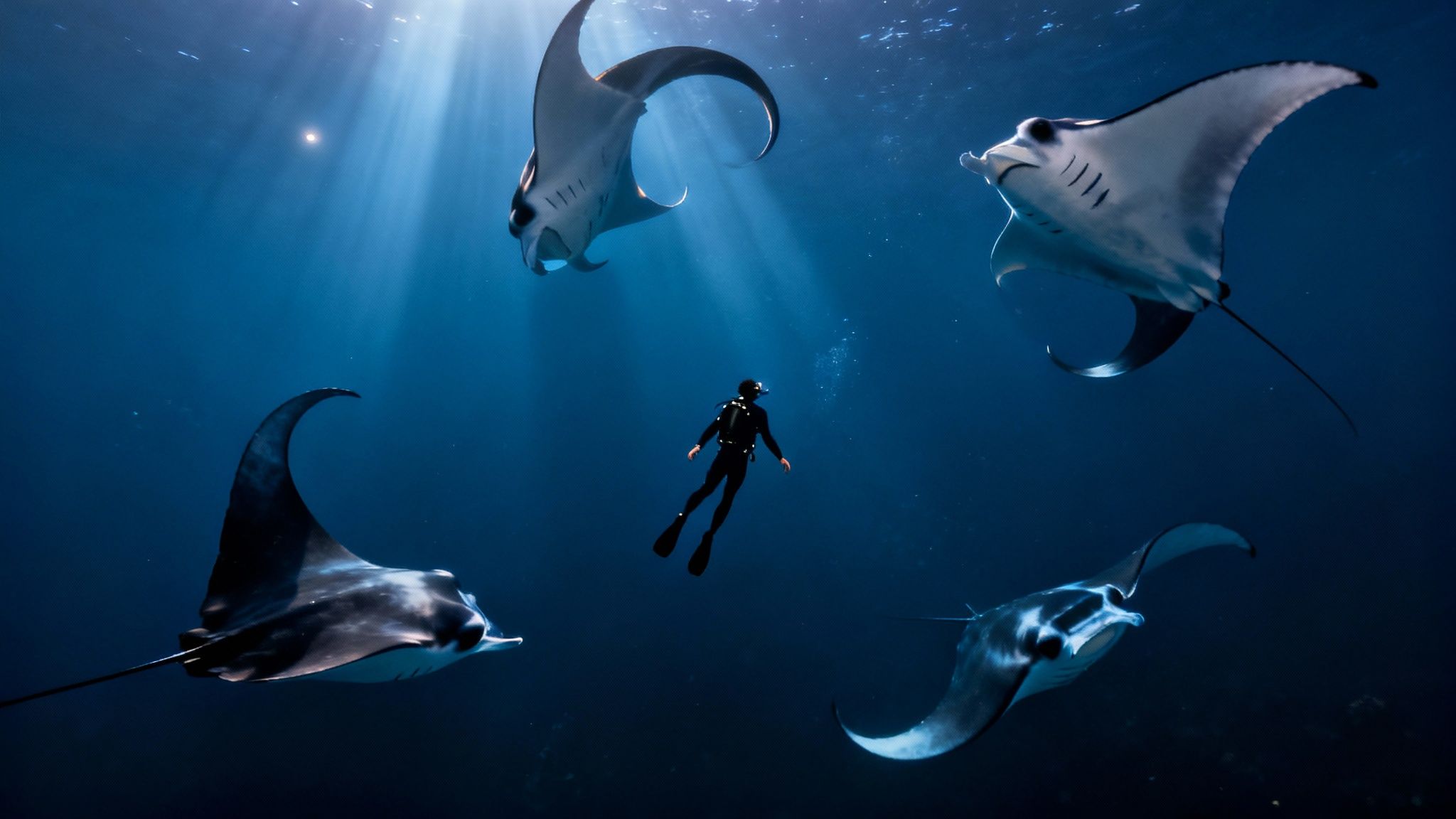
What really puts this encounter on the map is its incredible consistency. The unique topography and currents along the Kona coast create the perfect conditions for plankton—the mantas' favorite meal—to gather in sheltered bays. This natural buffet has led to a remarkably high sighting success rate, with operators reporting long-term averages between 85–90%. That kind of reliability makes it one of the most dependable wildlife encounters in the entire world.
Of course, choosing the right operator is key to a safe and memorable adventure. Companies like Kona Honu Divers have earned their reputation for excellence by combining a deep respect for the marine environment with a serious commitment to guest safety and comfort. Their experienced guides make sure everyone, whether you're diving or snorkeling, gets a front-row seat to the show.
An Unforgettable Underwater Spectacle
What truly sets this dive apart is just how close you get to these graceful giants. With wingspans that can stretch over 12 feet, these majestic creatures swoop and somersault through the illuminated water, feeding on the plankton drawn to the underwater lights. It’s often described as surreal, almost like watching a beautifully choreographed performance.
Here’s what makes it so special:
- A Unique Feeding Behavior: You get to witness the mantas' natural feeding behavior up close as they filter plankton from the water column.
- Gentle Giants: Despite their massive size, manta rays are completely harmless. They have no teeth, stingers, or barbs.
- Passive Interaction: The entire experience is built around passive observation, letting you witness these incredible animals without disturbing their natural behavior.
This magical encounter is more than just a dive; it’s a chance to connect with one of the ocean's most magnificent creatures in their own home. If you're ready for this unforgettable adventure, you can book a specialized manta ray dive tour and prepare for the experience of a lifetime. You might also want to check out our guide on where to find the best place to dive with manta rays.
How an Underwater Campfire Creates a Manta Buffet
The magic of the manta ray night dive in Kona isn't some happy accident; it's a brilliant collaboration between humans and nature. The whole spectacle hinges on a simple but ingenious concept that dive operators have perfected over the years: the "underwater campfire."
Dive masters strategically place powerful, stationary lights on the ocean floor, beaming them straight up toward the dark surface.
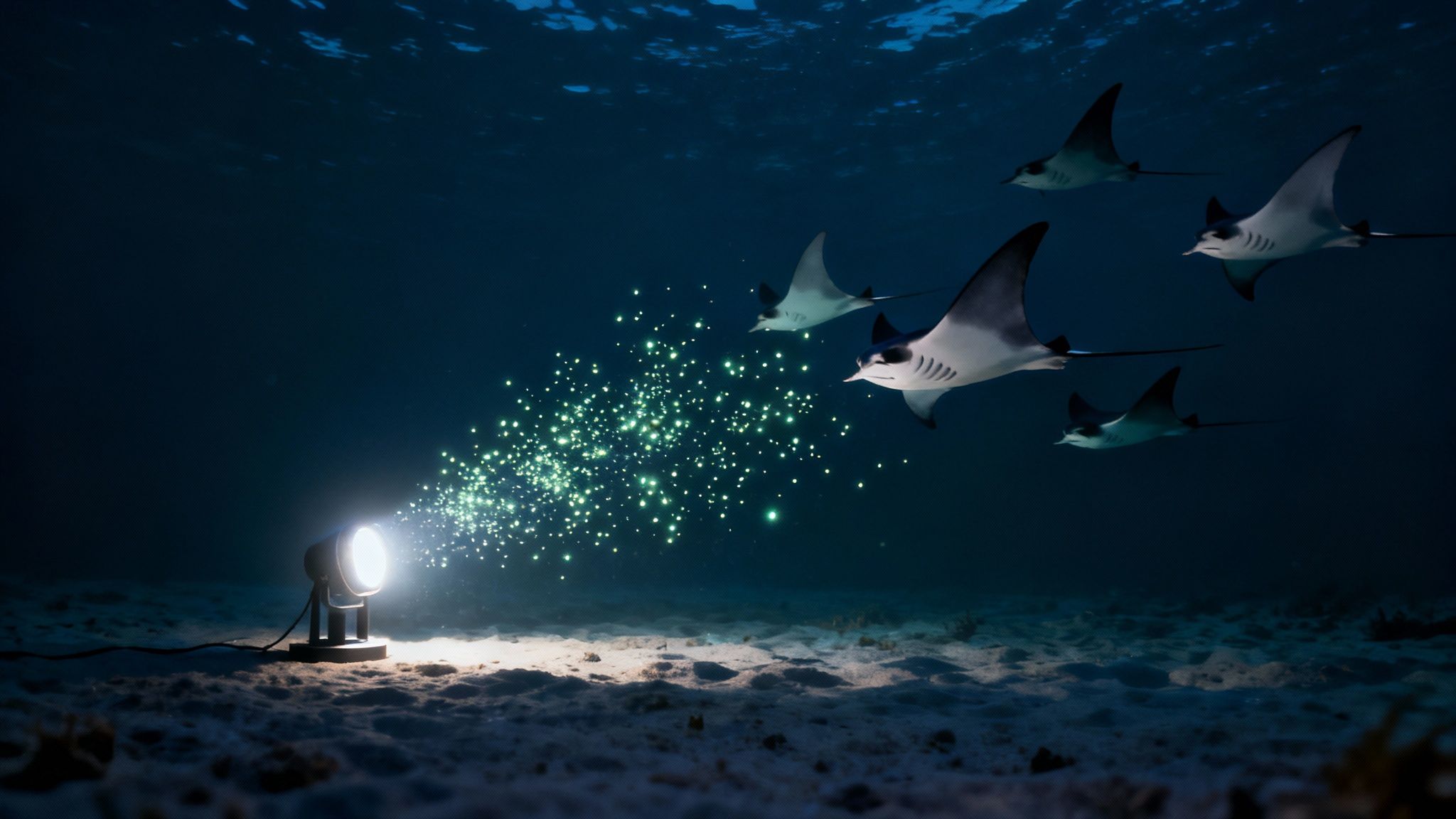
These intense beams of light act like magnets for plankton, the tiny organisms that form the very foundation of the ocean's food web. In the pitch-black water, this illuminated column becomes an all-you-can-eat buffet for Kona’s resident manta rays. Over time, these incredibly smart creatures have learned to associate the bright lights with a guaranteed meal, and they show up almost every single night for the feast.
It’s the ultimate win-win. We get a front-row seat to one of the most mesmerizing ballets in the natural world, and the mantas get an easy, energy-rich dinner.
Kona’s Premier Manta Dining Spots
In Kona, the mantas have a couple of favorite "restaurants" where the underwater campfire is always lit. While both spots are world-class, they each offer a slightly different vibe.
-
Manta Village (Keauhou Bay): Just south of Kailua-Kona, this site is a bit shallower, with a sandy bottom around 25-40 feet deep. Its calm, protected nature makes it a fantastic spot for both divers and snorkelers. The easy access and intimate feel are big draws, though conditions can sometimes be more variable.
-
Manta Heaven (Garden Eel Cove): You'll find this spot further north, near the airport. It's a bit deeper and can have more current, but that current is exactly what makes it a "heaven" for mantas—it acts like a conveyor belt, delivering a thick, steady stream of plankton. This boat-only site is often where operators head when they want to see the highest number of rays.
Ultimately, the dive operators make the call each night based on tides, plankton density, and swell to give you the best possible show.
Just how consistent are these encounters? Local researchers keep detailed records, and the numbers are impressive. For instance, in 2013, the average number of mantas seen per night at Manta Heaven was 11, compared to 4 at Manta Village—though the Village had a slightly higher overall sighting success rate. You can dive into the full manta ray sighting statistics here.
Getting to Know the Locals
What really makes the manta ray night dive in Kona so special is that you're not just seeing random animals passing through. You're meeting a resident community.
Many of these mantas live right here along the Kona coast year-round. Dedicated local guides and researchers have been studying this population for decades, and they can identify hundreds of individuals by name.
So, how can they possibly tell them apart? Every manta has a unique pattern of black spots on its white belly, which is as distinct as a human fingerprint. This allows scientists to track their health, movements, and life cycles. On your dive, your guide might point out famous locals like "Big Bertha" or "Lefty," which makes the experience feel incredibly personal.
Your trip is more than just an unforgettable memory—it's also a contribution to conservation. The data collected during these dives helps shape local protection efforts and ensures this incredible population of manta rays will be around for generations to come. Your adventure becomes a small but meaningful act of citizen science.
Choosing Your View: Scuba Diving vs. Snorkeling
You don't need a scuba certification to witness Kona's legendary manta ray night dive. This world-famous underwater ballet is open to almost everyone, and you have two incredible ways to watch the show. The real question is, which adventure is the right fit for you?
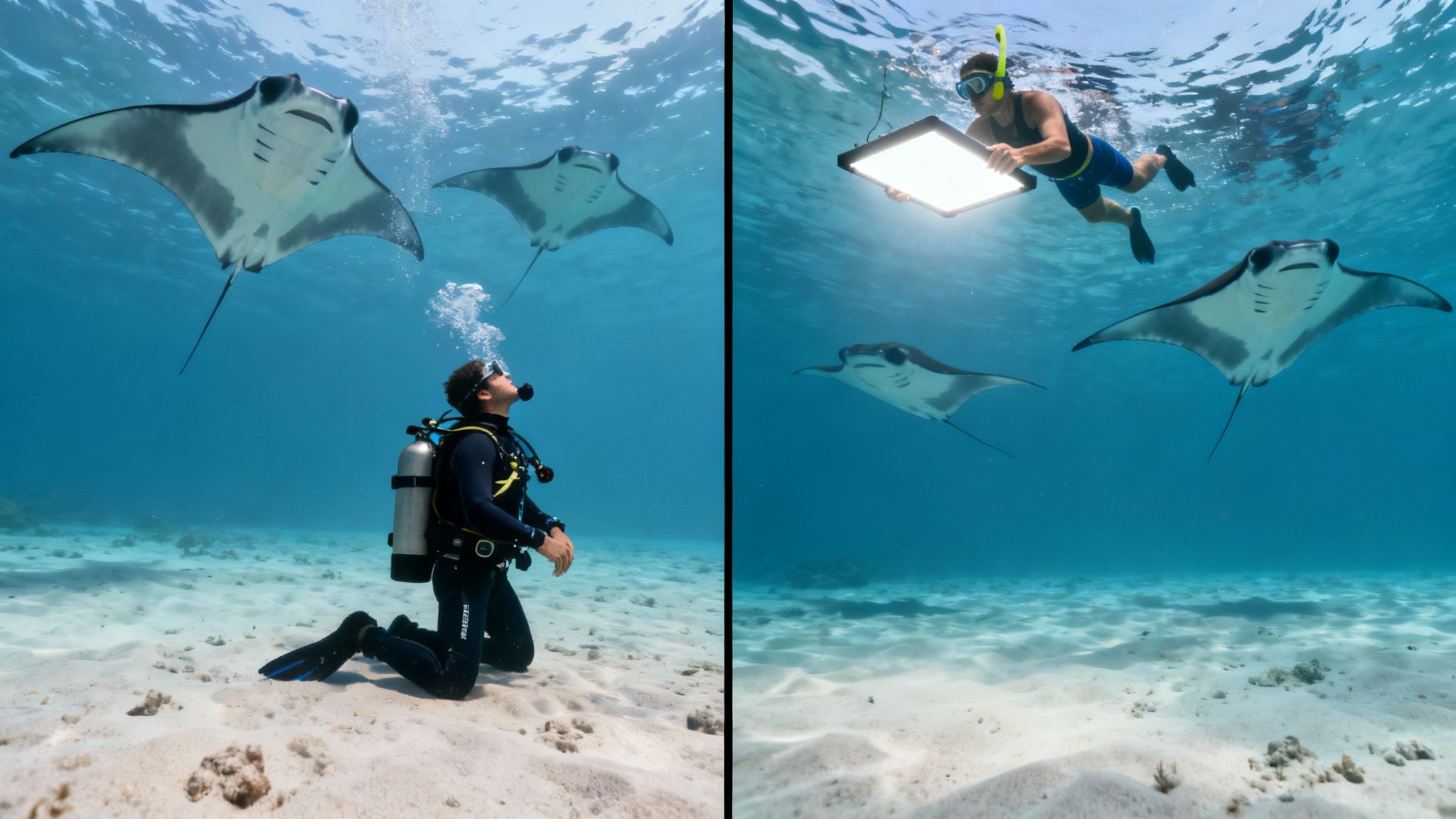
Whether you’re submerged on the ocean floor or floating on the surface, the sight is absolutely breathtaking. Think of it as choosing between a front-row seat on the sand or an aerial skybox view. Both are amazing, and a great tour operator will make sure you have a safe and unforgettable night either way.
The Scuba Diver’s Front-Row Seat
If you’re a certified diver, this is your chance for a truly immersive experience. After descending to a sandy bottom, usually somewhere between 25 and 40 feet, you’ll find your spot and settle in. Kneeling on the seafloor feels like you’ve just taken your seat in an underwater amphitheater, looking up at the "stage" above.
The magic starts when the mantas arrive. They glide, swoop, and perform barrel rolls right over your head—sometimes just inches away. You get an intimate, eye-level view that lets you appreciate their incredible size and effortless grace. It’s a surreal feeling, being a silent guest in their world, watching the performance from the best seat in the house.
The Snorkeler’s Bird’s-Eye View
Snorkeling offers an equally spectacular, but completely different, perspective. No gear, no certifications, no problem. You'll simply hold onto a custom-built, high-powered light board that floats on the surface. This board does double duty: it illuminates the water to attract the plankton and gives you a stable, comfortable platform to hold onto.
From this bird's-eye view, you see the whole scene unfold. You can watch the divers below, see their lights creating a glowing stage on the ocean floor, and witness the mantas soaring up from the darkness to feed. This top-down vantage point helps you appreciate the full scale of the event and the beautiful patterns of their underwater dance. It’s a fantastic option for families, non-divers, or anyone looking for a more relaxed way to see the show.
If you're still on the fence, we've got a whole guide on whether it is better to snorkel or dive with manta rays that breaks it down even further.
Manta Ray Night Dive vs Snorkel Experience
Deciding between diving and snorkeling really comes down to personal preference. To make it easier, here's a side-by-side comparison of what to expect from each experience.
| Feature | Scuba Diving | Snorkeling |
|---|---|---|
| Perspective | Bottom-up view; mantas glide directly overhead. | Top-down view; watch the entire scene from the surface. |
| Requirements | Scuba certification required (e.g., Open Water). | No certification needed; suitable for all swim levels. |
| Proximity | Potentially closer, eye-level encounters. | Excellent views as mantas swoop up to the surface lights. |
| Physical Effort | Minimal; stationary on the seafloor. | Minimal; holding onto a floating light board. |
| Equipment | Full scuba gear (tanks, BCD, regulators). | Mask, snorkel, and fins. |
Ultimately, both options place you in the middle of the same incredible natural spectacle. The key is to pick the one that feels right for you and your group.
No matter which you choose, the goal is the same: to witness one of nature’s most incredible displays in a way that is safe for both you and the manta rays. A professional operator will ensure your experience is both thrilling and respectful of the marine environment.
Both scuba divers and snorkelers get to be part of the same magical event. Find the right Manta Ray Dive & Snorkel tour for your preference and prepare for an evening you will never forget.
What to Expect: Your Manta Ray Adventure, Step-by-Step
It’s totally normal to feel a flutter of nerves and excitement before your first manta ray night dive in Kona. To help you know exactly what’s coming, let's walk through the whole experience from the dock to the dive and back again. When you know what to expect, you can just relax and soak it all in.
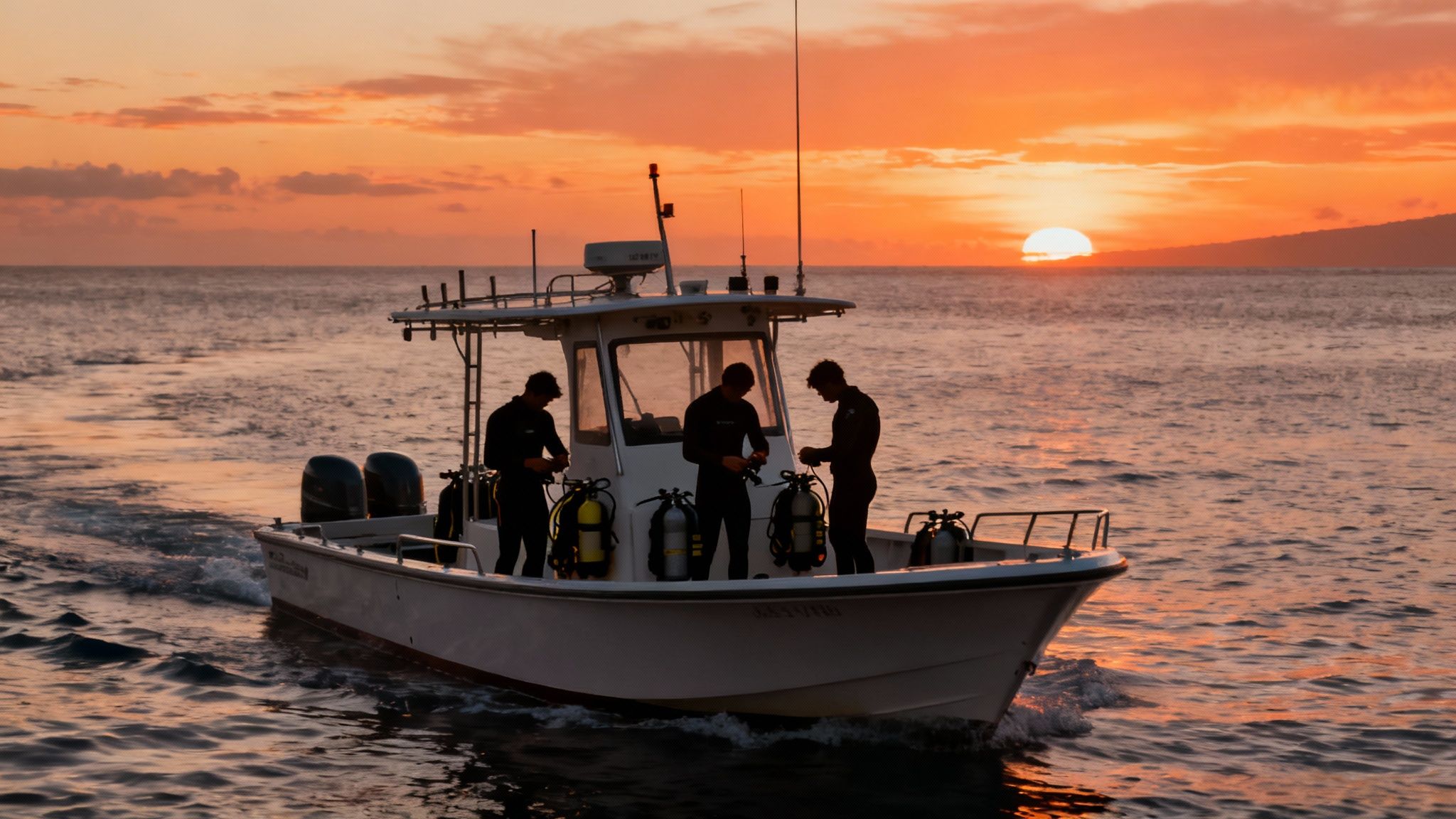
Your evening starts late in the afternoon at the harbor. You'll check in with your chosen tour operator, meet the captain and crew, and get settled on the boat that will be your home for the next few hours.
The boat ride out is an experience in itself. As you head towards the dive site, you're treated to incredible views of the Kona coastline, all lit up by the setting sun. It's the perfect, calming start before the main event.
Gearing Up for the Show
Once the boat is anchored over the manta site, the crew will gather everyone for a comprehensive briefing. Pay close attention here—this is where they cover everything you need to know for a safe and respectful encounter with the rays.
You can expect the briefing to cover:
- Safety Procedures: The crew will explain how to get in and out of the water in the dark and what to do if you need help.
- Environmental Rules: This is where you'll hear the most important rule: look, don't touch. Touching a manta ray can damage the protective mucous layer on its skin, leaving it vulnerable to infection.
- Your Job in the Water: They’ll give clear instructions on where you need to be—whether that’s holding onto the light board as a snorkeler or finding a spot on the sandy bottom as a diver.
This briefing makes sure everyone, from brand-new snorkelers to experienced divers, is on the same page. After that, it’s time to suit up! The crew will help you get into your wetsuit and make sure your mask, fins, and other gear are good to go.
The entire experience is built around passive observation. By staying still and calm, you simply become part of the scenery. This allows the mantas to go about their natural feeding behavior completely undisturbed by your presence.
The Underwater Ballet Begins
With your gear on and your heart racing, you'll slip into the surprisingly warm, dark water. The world above goes quiet, replaced by the peaceful, muffled sounds of the ocean at night. Your dive light will cut through the blackness, illuminating the sandy bottom below.
Once you’re settled in your spot, the magic starts. The powerful lights create a glowing beacon in the water, attracting a swirling cloud of plankton. Then, from the darkness, the first shadow emerges. A giant manta ray glides effortlessly into the light, its massive wings propelling it in a graceful arc.
Soon, another one joins, and then another. They perform an incredible underwater dance, swooping and barrel-rolling through the plankton feast, sometimes just inches above your head. It’s a full-sensory experience—the deep hum of the ocean, the focused beam of light, and the breathtaking sight of these gentle giants.
Your guide will be right there with you the whole time, keeping an eye on everyone and pointing out individual mantas they recognize by name. Following their lead is the key to an unforgettable and responsible manta ray night dive in Kona. When it’s over, you'll head back to the boat with memories of an otherworldly encounter that will stick with you for a lifetime.
Capturing the Moment and Protecting the Magic
Taking photos and videos of your Kona manta ray dive is a huge part of the experience. Who wouldn’t want to relive that magic? But getting great shots in the dark, underwater, while being a good guest to the mantas takes a little know-how.
The absolute golden rule of photography here is simple: don’t startle the stars of the show. This is why steady video lights are always the way to go over powerful, flashing strobes. A sudden burst of light can easily disorient a manta, interrupting their feeding and ruining the moment for everyone. A constant beam is far less invasive and keeps the whole vibe calm and natural.
Tips for Nailing Your Underwater Shots in the Dark
Getting crisp, beautiful images when it’s pitch black and you’re underwater is no small feat. But whether you’ve got a high-end camera rig or a trusty GoPro, a few adjustments can make all the difference.
- Open Up Your Lens: Set your aperture to the lowest f-stop number possible. This opens the lens wide, letting in every bit of available light from the "campfire."
- Bump Up the ISO: Carefully increase your camera’s ISO to make it more sensitive to light. Don’t go crazy here—pushing it too high will give you grainy, noisy photos. It’s all about finding that sweet spot between brightness and clarity.
- Be a Statue: The secret to sharp photos in low light is stability. If you're diving, plant yourself firmly on the sandy bottom and hold your camera rock-steady. A camera tray with handles is a game-changer for keeping things smooth.
If you’re shooting with a GoPro, make sure to switch it to "night mode" or a similar low-light setting. These presets are designed to get the best possible footage out of the camera when you're in the dark.
Becoming a Guardian of the Manta Experience
Beyond your camera settings, your actions in the water are what really count. Everyone who participates in the **manta ray night dive in Kona** shares the responsibility of protecting these gentle giants and their home. The entire encounter is built on the idea of passive observation.
When you follow the rules, you’re no longer just a spectator. You become a temporary guardian of this incredible marine spectacle, ensuring it remains just as magical for the next group, and for generations to come.
The principles are straightforward but crucial:
- Look, Don't Touch: This is the big one. Never, under any circumstances, touch a manta ray. Their skin is covered in a protective mucous coating, and our touch can strip it away, leaving them vulnerable to infection.
- Don't Chase or Block: Let the mantas dictate the encounter. Chasing after them only scares them off. Find your spot, stay put, and let their curiosity bring them to you.
- Hold Your Position: Your guide will tell you exactly where to be, whether that’s sitting on the sand or holding onto the snorkel float. Staying in your designated spot keeps the water clear and ensures everyone gets an amazing view.
Following these guidelines is about more than just protecting the mantas; it makes the experience better for you and everyone else in the water. For a deeper dive into underwater manners, check out our guide on responsible and considerate diver etiquette. Being a mindful guest is the best way to help preserve this unforgettable night.
Planning and Booking Your Manta Ray Tour
Alright, you're hooked on the idea of this underwater ballet. Now for the fun part: making it happen. A little bit of planning is all it takes to turn a good trip into a truly unforgettable manta ray night dive in Kona. Booking the tour is where the excitement really starts to build, and knowing what to look for will set you up for success.
The best news? This incredible encounter is available all year long. But if you want to give yourself the absolute best shot at calm, glassy seas, aim for the months between April and October. The Pacific tends to be much smoother along the Kona coast then, which makes for a more pleasant boat ride and an even more comfortable time in the water.
Choosing a Top-Tier Tour Operator
I can't stress this enough: who you go with is the single most important decision you'll make. A great operator doesn't just ferry you out to the dive site; they are custodians of the experience, prioritizing safety, education, and a genuine respect for the mantas.
When you're comparing companies, here's what really matters:
- An Impeccable Safety Record: You want guides who are seasoned pros, with certifications to back them up. A crew that’s on top of its safety game makes you feel secure from the moment you step on the boat.
- Eco-Conscious Practices: The best outfits are deeply committed to conservation. Look for operators who are Manta Ray Green List certified. This means they follow strict guidelines for passive, respectful interaction that keeps the animals safe.
- Smaller Group Sizes: This one's a game-changer. Smaller groups mean more personal attention from the crew and way less jostling for a good view in the water. It’s the difference between a crowded event and a private showing.
Many divers point to Kona Honu Divers as an operator that nails all these points, consistently delivering tours that are safe, memorable, and environmentally sound.
Your Simple Pre-Dive Checklist
Once you’re booked, getting ready is a breeze. The tour company handles all the heavy gear, so you just need to bring a few personal items to make the evening more comfortable.
The consistency of the manta ray night dive in Kona has made it a significant economic and cultural asset for Hawaii. Drawing roughly 80,000 visitors each year, this activity is a cornerstone of the Big Island's nature-based tourism and a global case study in balancing tourism with wildlife conservation. Learn more about the best times to visit and the dive's impact.
What You Should Bring:
- A towel
- A set of dry clothes for the ride back
- Reef-safe sunscreen (the sun is still strong on the boat ride out)
- A reusable water bottle
- Any personal meds you might need (like for seasickness)
What Your Tour Typically Provides:
- All scuba or snorkel gear (mask, fins, snorkel)
- Wetsuits (the water gets cool after sunset)
- The all-important underwater lights
- Snacks and drinks on the boat
With your spot saved and a small bag packed, you're officially set for one of the most magical wildlife encounters on the planet. All that's left to do is show up, take a deep breath, and watch the show begin.
Your Manta Dive Questions, Answered
It’s completely normal to have a few questions as you get ready for your big manta ray night dive in Kona. I hear these all the time, so let's clear up some of the most common ones. My goal is to make sure you show up to the boat feeling excited and totally prepared for the adventure ahead.
Is This Manta Ray Dive Actually Safe?
I get this one a lot. The short answer is yes, it's incredibly safe, provided you go with a professional and reputable operator. They stick to strict safety standards and use guides who know these waters like the back of their hand. The dive sites themselves are fairly shallow and tucked away from the big ocean swells.
The real stars of the show, the manta rays, are nothing to worry about. Think of them as gentle giants. They're filter feeders, which means they don't have teeth, stingers, or barbs of any kind. They are completely harmless to people. Your only job is to relax and follow your guide's lead.
What if I’m Not a Great Swimmer?
No problem at all. If you're snorkeling, the setup is designed for every skill level. You'll hold onto a big, custom-built float that has powerful lights shining down into the water. This lets you just hang out at the surface comfortably, so there’s no need to kick or tread water.
For scuba divers, this is probably one of the least strenuous dives you’ll ever do. You'll descend to a specific spot on the sandy bottom, usually somewhere between 25-40 feet, and simply settle in for the show. There’s almost no swimming involved. Just be honest about your comfort level with the crew when you book—they’re there to help.
What if the Mantas Don't Show Up?
It's a valid concern! While the chances of seeing mantas on a Kona night dive are unbelievably high—we're talking over a 90% success rate—these are still wild animals on their own schedule. A 100% guarantee is just not possible.
That’s why most top-tier operators, like Kona Honu Divers, have what they call a "manta guarantee." If you're on a rare trip where no mantas appear, they’ll typically let you go out again on another night for free, based on availability. It's always a good idea to double-check the company's specific policy before you book.
Are There Other Cool Dives in Kona?
Oh, absolutely! The manta dive is the headliner, but Kona is a world-class diving destination with so much more to see. The daytime Kona diving tours are incredible, taking you through vibrant coral reefs and incredible underwater lava tube formations.
If you're certified and looking for something truly different, the Big Island delivers. You could join an advanced dive trip to check out some deeper sites. Or, for a really unique thrill, try the Kona black water night dive. You drift in the open ocean at night and watch all sorts of strange and glowing creatures rise up from the abyss. It’s mind-blowing.
Ready to see the underwater ballet for yourself? Kona Honu Divers runs a world-class, safe, and truly unforgettable manta ray night dive. Their expert crew and focus on conservation make them a fantastic choice for this adventure. Go ahead and book your tour—you're in for the dive of a lifetime!