
Picture this: you’re floating in the warm, dark Pacific Ocean. Suddenly, a shadow emerges from the deep. A giant, graceful manta ray, with a wingspan wider than you are tall, swoops and glides just inches above your head, its massive form silhouetted by the beam of a dive light.
This is the manta ray night dive in Kona, and it's an experience that’s hard to put into words. It’s an otherworldly underwater ballet, rightfully known as one of the most reliable and awe-inspiring wildlife encounters you can find anywhere on the planet. This isn't just another dive on the logbook; it's a front-row seat to a natural spectacle that has made the Big Island a global hotspot for marine adventure.
What Makes the Kona Manta Ray Dive a Must-Do
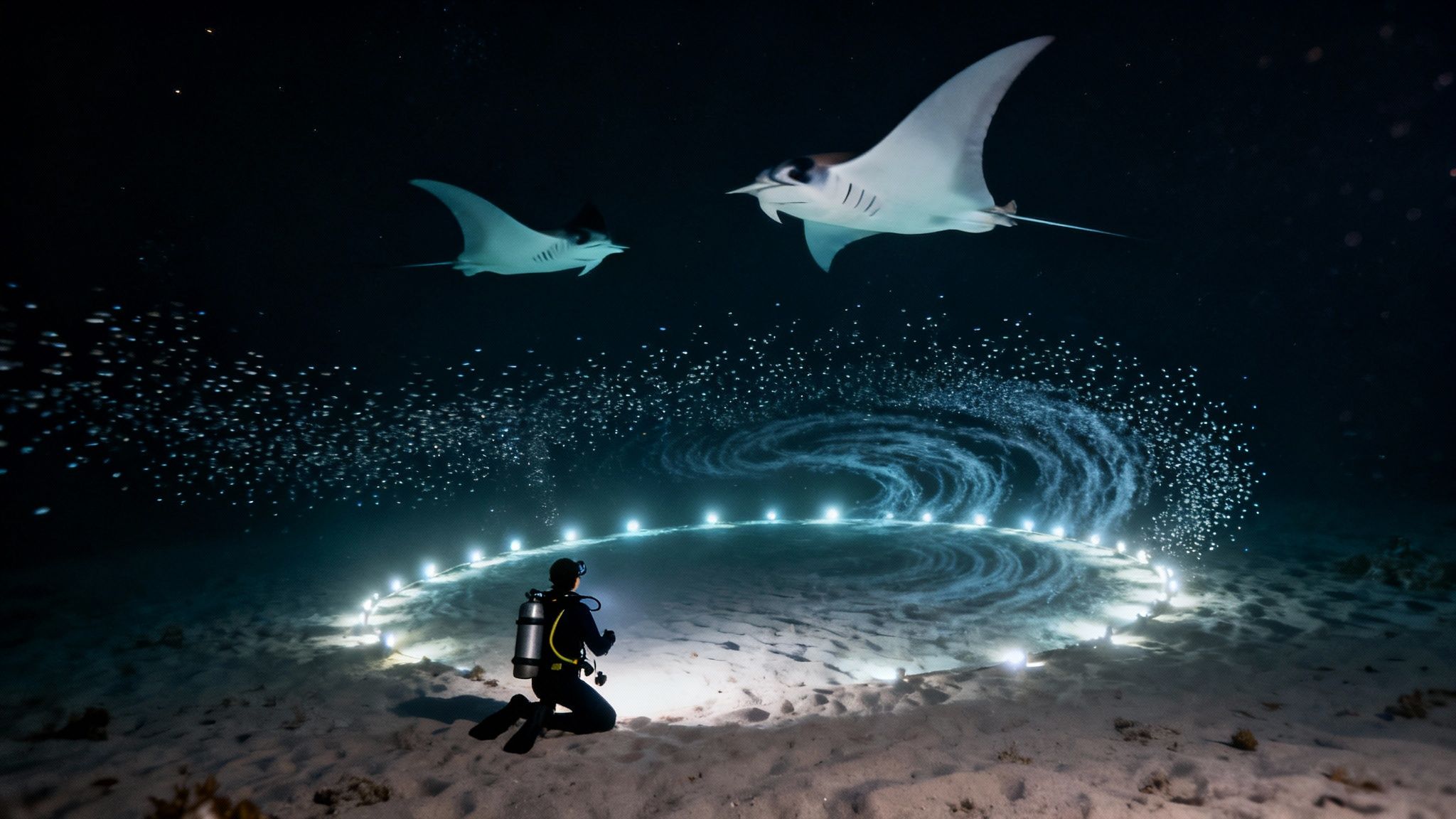
The Kona coast is a special place, and it’s uniquely suited for this incredible experience. Unlike manta encounters in other parts of the world, which often happen at "cleaning stations" during the day, the Kona event is a massive nighttime feeding frenzy. It all started with a simple, almost accidental discovery: dive lights attract plankton, and plankton is a manta ray’s favorite meal.
By creating an irresistible underwater buffet, local operators learned they could draw these gentle giants to specific, safe locations with astonishing consistency.
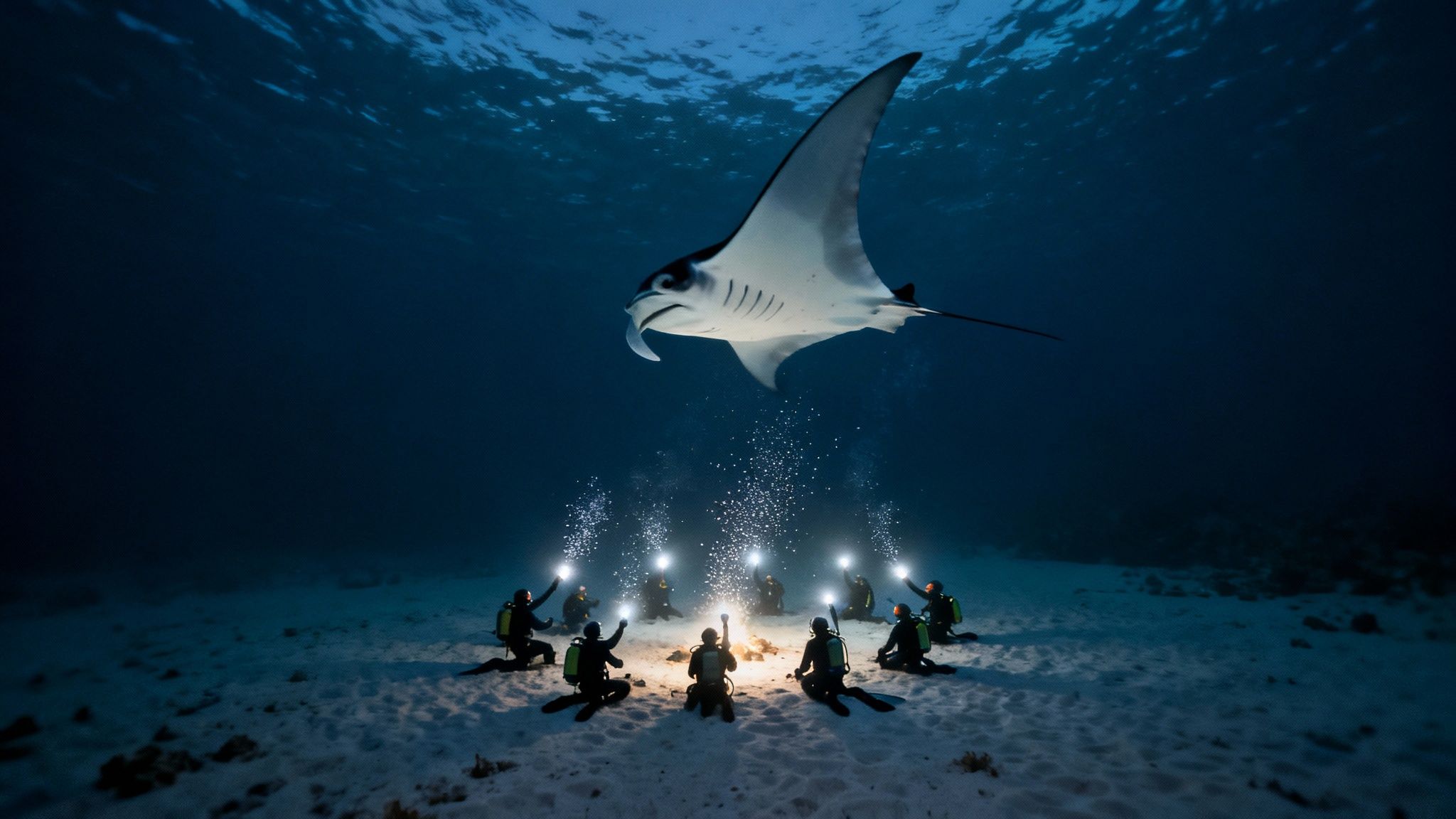
This nightly ritual has transformed what was a chance observation in the 1990s into one of Hawaii's most iconic and sustainable ecotourism activities. Dive operators like Kona Honu Divers have spent years perfecting a system that's both breathtaking for guests and completely respectful of the animals. They create what we call the "campfire," where divers settle on the sandy bottom and point their lights upward. This creates a column of illuminated plankton, and the mantas gracefully swoop in for dinner.
The Magic of a Reliable Encounter
One of the best things about the Kona manta ray night dive is its remarkably high success rate. Operators here see mantas on over 95% of their trips, all year long. This isn't a seasonal thing you have to time perfectly; the local manta population, with more than 450 identified individuals, lives and feeds in these waters year-round.
That reliability takes a lot of the guesswork out of wildlife tourism. You can book your trip with a huge amount of confidence that you're going to witness this amazing spectacle.
The feeling of a 12-foot manta ray gliding silently over your head is indescribable. It’s a mix of awe, wonder, and a profound connection to the ocean. This isn't just watching nature—it's being immersed in it.
This guide is here to walk you through everything you need to know to experience this adventure for yourself. We'll cover:
- How to Choose Your Adventure: Deciding between the scuba and snorkel experience.
- Practical Preparation: What to bring and what to expect before you get in the water.
- The Dive Itself: A moment-by-moment look at this underwater ballet.
- Beyond the Mantas: Other incredible diving opportunities around Kona.
A Commitment to Conservation
The long-term success of the manta ray night dive is built on a foundation of respect and conservation. The best operators, including Kona Honu Divers, are deeply committed to protecting these magnificent creatures. They follow strict guidelines that put the well-being of the mantas first, making sure the interaction is passive and non-invasive.
The most important rule is simple: look, but don't touch. Touching a manta ray can remove its protective mucous coating, leaving it vulnerable to infection and disease.
When you choose a reputable operator, you're doing more than just booking a tour. You're supporting a sustainable practice that directly contributes to the research and protection of Kona's fragile marine ecosystem. If you want to dive deeper into what makes this so special, you might be interested in our article exploring why you should go on a manta ray dive in Kona.
A Kona Honu Divers Manta Ray Night Dive is consistently rated as a top global dive experience because of their commitment to safety, education, and creating a respectful encounter. Here’s what divers have to say:
Ready to see it for yourself? You can book your spot on their world-famous manta ray dive tour and join the adventure.
Choosing Your Manta Ray Adventure
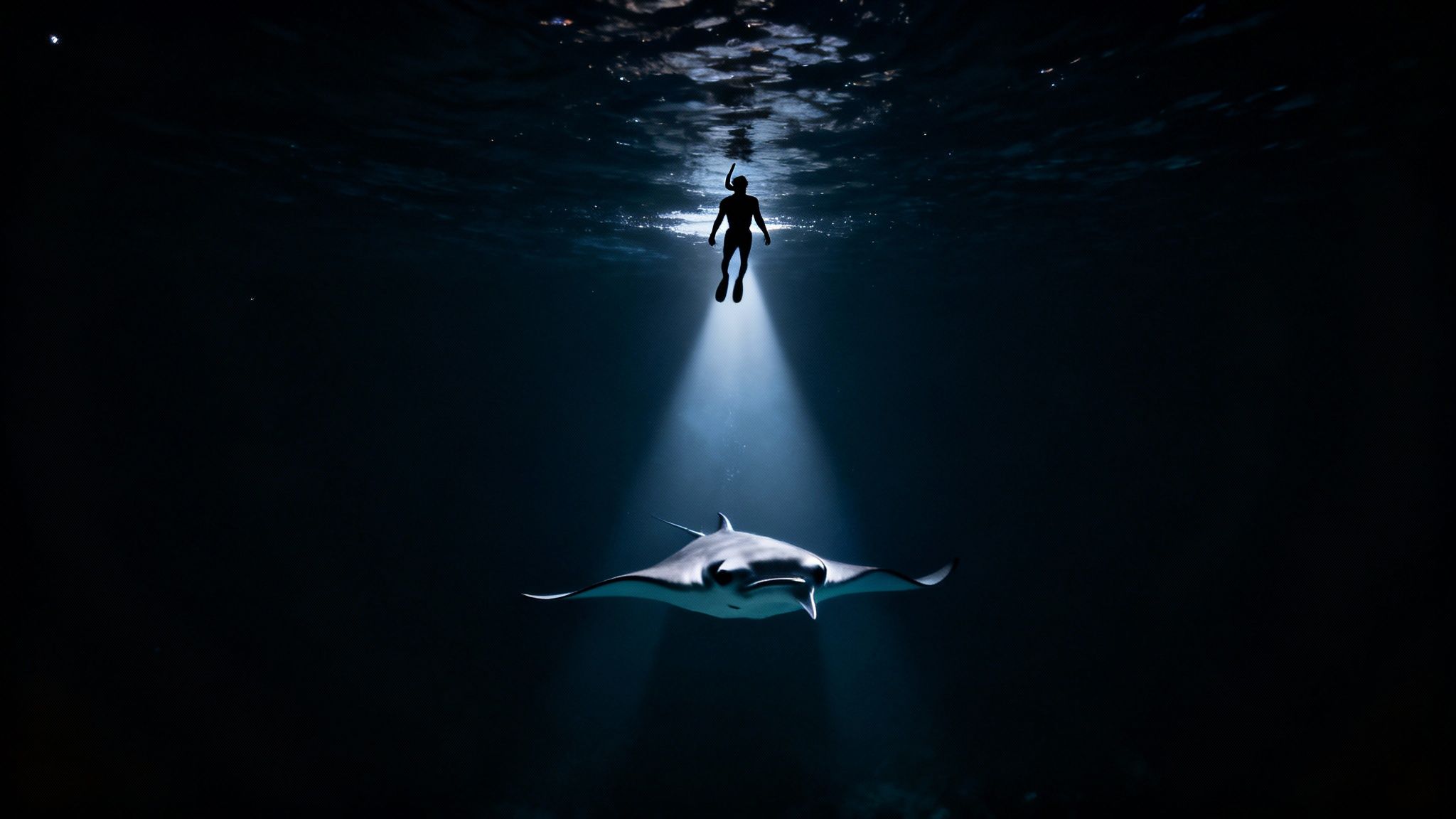
When you're gearing up for a manta ray night dive in Kona, your first big decision is about perspective. Do you want to watch the show from the front row on the ocean floor, or from a bird's-eye view at the surface? Both scuba diving and snorkeling offer completely unique, and equally incredible, ways to see the magic unfold.
If you’re a certified diver, the experience is all about total immersion. You’ll descend to a sandy patch, usually about 30 to 40 feet deep, and find your spot for the show. From down there, you get to see these gentle giants glide and barrel roll just inches above your head. It's a truly humbling viewpoint that makes you feel like you're a part of their world.
For snorkelers, the view is just as spectacular. You'll float comfortably on the surface, holding onto a custom-built light board. These powerful lights are like a dinner bell, attracting the plankton that the mantas feed on. Watching them swoop up from the depths to feed directly below you is an absolute thrill—and it's perfect for families or anyone who isn't a certified diver.
Scuba vs. Snorkeling: What's Right for You?
So, how do you choose? It really boils down to your comfort level in the water, whether you're certified, and the kind of encounter you're dreaming of. There’s no "better" option; they're just two different ways to witness the same incredible natural wonder.
To help you figure out what's best for your group, here’s a quick comparison of the two experiences.
Manta Experience Comparison Scuba Diving vs Snorkeling
| Feature | Scuba Diving | Snorkeling |
|---|---|---|
| Perspective | Bottom-up view; mantas glide right overhead. | Top-down view; watch the action from above. |
| Requirements | Open Water Diver certification is a must. | No certification needed; great for all ages. |
| Immersion | Fully submerged, kneeling on the ocean floor. | Floating at the surface, holding a light board. |
| Group Suitability | Best for certified divers seeking an immersive dive. | Perfect for mixed groups, families, and non-swimmers. |
No matter which you pick, you're in for an unforgettable night with one of the ocean's most graceful animals.
Selecting a Top-Tier Tour Operator
Once you know how you want to see the mantas, the next step is choosing who will take you. A great tour operator does more than just drive a boat; they create a safe, educational, and respectful experience from start to finish. With so many choices in Kona, it pays to know what to look for.
A company's safety record should be your absolute first priority. This means experienced, certified guides, well-maintained boats, and all the proper safety gear. A knowledgeable crew doesn't just keep you safe—they also make the trip more interesting by sharing insights about the mantas and their ecosystem.
The best tour operators are deeply committed to conservation. They follow strict guidelines to ensure every encounter is passive and doesn't disrupt the mantas' natural feeding. This protects these amazing animals and keeps this experience available for years to come.
Look for operators who are recognized for their sustainable practices. One of the clearest signs of a responsible company is the Manta Ray Green Listed Operator designation. This shows a real dedication to eco-tourism and ethical wildlife encounters. You can learn more about the importance of the manta ray dive in Kona and how choosing the right operator makes a difference.
Questions to Ask Before You Book
To make sure you're booking a tour that's safe, ethical, and fun, it's a good idea to ask a few questions upfront.
Here’s a practical checklist to run through with any potential operator:
- What is your guide-to-guest ratio? A smaller group per guide usually means more personal attention and a safer trip.
- Are you a Manta Ray Green Listed Operator? This is a key indicator of their commitment to conservation.
- What’s included in the price? Ask about wetsuits, gear, lights, snacks, and drinks so there are no surprises.
- What happens if no mantas show up? Reputable companies often have a "manta guarantee" and will let you come back another night for free.
- How long is the boat ride and what’s the boat like? A comfortable ride, especially on the way back, makes the whole experience better.
The Kona Coast has an incredible track record for manta sightings, boasting a remarkable 95% success rate on night tours. Dives typically last between 45 to 60 minutes, giving you plenty of time with the estimated 450+ manta rays that call this area home.
Doing a little homework beforehand ensures you book a trip that matches your expectations and sets you up for an adventure you'll never forget.
How to Prepare for Your Dive
Booking your manta ray night dive in Kona is just the beginning. A little bit of smart prep work is what takes a great trip and makes it truly unforgettable. Knowing what to pack and what to expect when you get to the harbor goes a long way in calming those pre-dive jitters so you can just soak it all in.
Rest assured, a top-notch outfitter like Kona Honu Divers provides all the big-ticket items. Your wetsuit, mask, fins, regulator, and BCD are all part of the package. They also supply the seriously powerful lights needed to attract the plankton that manta rays feast on. For a full rundown, check out our guide on the gear you will need for your Kona diving adventure.
Your Personal Packing List
While we’ve got the essential dive gear covered, there are a few personal items you’ll be glad you brought. Think of this as your small "go-bag" for an evening on the water.
Here’s a simple checklist of things I always recommend packing:
- A Towel: Sounds obvious, but you’d be surprised how often it’s forgotten. You'll want it the second you’re back on the boat.
- Something Warm: Even in paradise, that boat ride back to shore at night can get chilly once you’re out of the water. A hoodie or a windbreaker is a must.
- Reef-Safe Sunscreen: If your charter starts in the afternoon, slather this on beforehand. It protects you and our delicate coral ecosystems.
- Reusable Water Bottle: Staying hydrated is crucial. Most boats have a water cooler, so you can easily refill.
- Dry Clothes: Trust me on this one. Changing into something dry makes the ride back to your hotel infinitely more comfortable.
What to Expect from the Pre-Dive Briefing
Before you even get your feet wet, you’ll participate in one of the most critical parts of the entire experience: the pre-dive briefing. This isn't just a formality; it's the key to making sure the dive is safe, successful, and respectful to the wildlife.
Your guide will walk you through all the important safety procedures, the rules of the boat, and what to do in the unlikely event of an emergency. This is your chance to ask anything—no question is too small.
A huge part of the briefing is dedicated to proper night diving etiquette. You'll learn the specific hand signals we use after dark, which are different from the ones you use during the day. Your guide will also show you how to handle your powerful dive light without blinding your buddies.
The golden rule of the manta ray night dive is passive interaction. Your guide will say this more than once, and for good reason. It means we look, but we absolutely never touch. Touching a manta ray can strip off its protective slime coat, which is like its immune system, leaving it vulnerable to dangerous infections.
The briefing also sets the stage for the main event. You’ll learn how the "campfire" works—this is where all the divers settle on the sandy bottom in a circle, pointing their lights up to create a massive column of light. This light attracts the plankton, and the plankton brings in the mantas. It’s this patient, well-orchestrated method that makes the Kona experience so reliable and magical.
By the time the briefing wraps up, you'll feel completely prepared and ready to take that giant stride into the dark. You'll know exactly where to go, how to position yourself, and how to act to ensure a breathtaking encounter for everyone—including the mantas.
What the Manta Dive is Actually Like
The boat ride out is half the magic. There’s a buzz of excitement in the air, but also a sense of calm as you watch the Kona sunset paint the sky. Once that last sliver of sun disappears, the real show is about to begin. Taking that giant stride off the boat into the dark Pacific is a thrill. The world goes silent, and all you can hear is the steady rhythm of your own breathing.
You follow your guide's light down into the darkness. As you descend, a soft glow starts to appear below, getting brighter and brighter. This is what we call the 'campfire'—a circle of divers already settled on the sand, their powerful lights all pointing up. It's a beacon in the dark, and more importantly, it's a dinner bell. The combined beams attract a massive column of microscopic plankton, the mantas' favorite meal. You’ll find your spot, get comfortable, and add your light to the glow, building the anticipation.
The Underwater Ballet Begins
At first, you just watch the plankton swirling in the light beams. It’s peaceful. Then, you catch a flicker of movement out of the corner of your eye. A massive, dark shape emerges from the blackness, becoming clearer as it glides toward the light. The first manta has arrived.
Seeing one up close for the first time will take your breath away. These are huge animals, with wingspans often reaching 10-12 feet, yet they move with impossible grace. It will swoop right into the column of light, mouth wide open, and perform a slow-motion barrel roll to filter the plankton from the water. Before you know it, another one joins, and then another, until you’re surrounded by a silent, mesmerizing underwater ballet.
They soar just inches over your head, close enough to see the intricate patterns of their gills and the unique spots on their bellies. This is the moment you came for. This is the heart of the manta ray night dive in Kona—a raw, awe-inspiring connection with some of the ocean's most majestic creatures.
The sheer grace of these animals is what stays with you. They move with an elegance that defies their immense size, turning and looping in a silent, hypnotic dance. It's an encounter that feels both grand and deeply personal.
In-Water Etiquette and Respectful Viewing
To keep this experience incredible for everyone (mantas included!), there are a few simple rules to follow. Good buoyancy is everything. You'll be sitting or kneeling on the sand, so the goal is to get settled without stirring up the bottom. Your guide will show you the best place to set up.
The most important rule? Be a passive observer. Think of yourself as a rock. Stay with the group, keep your hands to yourself, and resist the urge to reach out and touch a manta, no matter how close it gets. When you remain still, you become part of the environment, allowing the mantas to carry on with their natural feeding, which results in those unbelievably close passes.
Getting to Know the Locals
Here’s something really cool: the mantas you're seeing aren't just random visitors. They’re locals. Our guides at Kona Honu Divers know many of them by name, identifying them by the unique spot patterns on their undersides, which are like fingerprints. We might point out regulars like "Big Bertha" or "Lefty" and share a bit about their history.
This turns the dive into something more personal. You're not just observing a species; you're meeting individuals from the Kona manta community. Researchers use these same spot patterns to track the population, and their work is crucial for conservation. The local population is healthy, with nearly 200 identified manta rays. On a good night, we might see as many as 20 different individuals at one site! You can learn more about the research at uwphotographyguide.com.
And if you get hooked on night diving, Kona has another otherworldly adventure waiting for you. Our Blackwater Dive takes you miles offshore to float in the deep, dark ocean and witness the strange and tiny creatures that migrate up from the abyss after sunset. It’s a completely different kind of thrill.
Exploring More Kona Diving Adventures
After the pure magic of the manta ray night dive in Kona, you might think you've already seen the best the Big Island has to offer. But trust us, that incredible show is just the beginning. The Kona coast is a world-class diving destination, and what you see at night is only half the story.
While the mantas absolutely own the night, the daylight reveals a completely different world. The island’s volcanic origins have sculpted a dramatic underwater landscape you won’t find anywhere else, full of ancient lava tubes, massive archways, and vibrant coral reefs buzzing with life.
Discovering Kona's Daytime Wonders
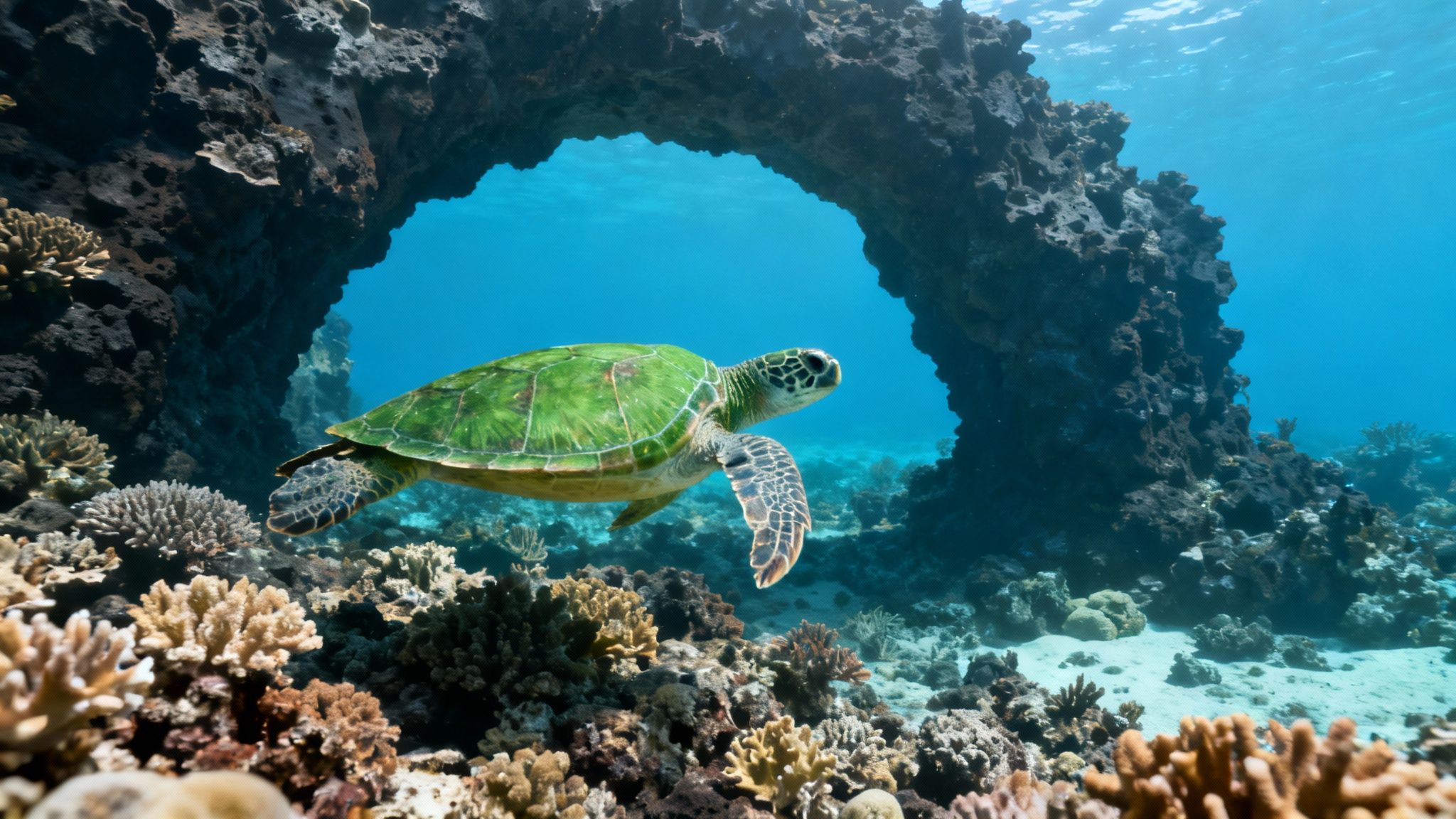
Jumping on a morning dive charter is like opening a whole new chapter of your Hawaiian adventure. The water here is famously clear and calm, and it's your best chance to swim alongside the beloved Hawaiian green sea turtle, or honu, as they cruise gracefully over the reef.
Playful spinner dolphins often pop in to say hello, and the reefs themselves are a treasure hunt for critters you just won't see on the night dive. You’ll want to keep a sharp eye out for perfectly camouflaged frogfish, shy octopuses hiding in plain sight, and countless species of colorful reef fish. These unforgettable daytime Kona diving tours really showcase the incredible biodiversity of Hawaii's marine ecosystem.
Kona's underwater topography is a diver's dream. One dive might take you through a massive lava archway, while the next could have you exploring a complex network of ancient lava tubes. It's this variety that keeps divers coming back year after year.
Here at Kona Honu Divers, we get a kick out of showing you the full spectrum of what makes diving in Hawaii so special. Our guides know these sites like the back of their hand and are experts at pointing out all the hidden gems of the reef.
Pushing Your Skills with Advanced Dives
For certified divers with a few more dives under their weight belt, Kona offers some seriously thrilling opportunities to explore deeper, more challenging environments. If you’re looking to push your skills and see a wilder side of the Big Island, an advanced dive charter is the perfect next step.
These trips head to more remote sites that are off-limits to larger groups, giving you a real sense of exploration. You might find yourself exploring dramatic underwater pinnacles, navigating intricate lava formations, or dropping in on known shark hangouts. These dives often mean deeper profiles and potential currents, but the payoff is a truly rewarding challenge for those ready for it.
On these advanced trips, some of the incredible encounters we see include:
- Schools of Scalloped Hammerhead Sharks: Seeing these powerful predators in their element is a genuinely humbling experience.
- Galapagos Sharks and Whitetip Reef Sharks: Exploring deeper sites often increases the chances of running into larger shark species.
- Dramatic Underwater Structures: Dive sites like "Au Au Crater" offer one-of-a-kind geological formations and pristine, untouched coral gardens.
We keep these charters small to ensure a more personal and focused experience. If you’re ready for the next level of adventure, have a look at our premium advanced dive charters.
Kona Honu Divers is more than just your ticket to the world-famous manta ray night dive; we're a full-service dive center dedicated to creating amazing experiences for divers of all levels. From your very first open water dive to advanced technical explorations, we're here to help you discover all the underwater wonders of the Big Island.
Your Manta Ray Night Dive Questions, Answered
It's totally normal to have a few questions swirling in your head, even after getting all the details. The manta ray night dive in Kona is unlike anything else on the planet, so we want you to feel completely at ease and fired up before you even step on the boat.
Let’s tackle some of the most common things we hear from both first-time divers and seasoned snorkelers.
Do I Have to Be Scuba Certified to See the Mantas?
Nope, not at all! While getting to the ocean floor gives divers an incredible "from below" perspective, the snorkeling experience is just as magical. Snorkelers get a front-row seat from the surface, holding onto a custom-built light board.
This board acts like a giant bug zapper for plankton, drawing them in and attracting the mantas right up to the surface. You get an unbelievable top-down view of these gentle giants as they barrel roll and feed just inches away. It’s perfect for families or groups with mixed experience, as companies like Kona Honu Divers host divers and snorkelers on the same boat, so everyone can be part of the same incredible memory.
The snorkel experience isn’t a watered-down version of the dive; it’s just a different angle on the same amazing show. Many people actually prefer the surface view, looking down directly into the action.
Is It Safe to Be in the Water with Manta Rays at Night?
When you go with a professional, reputable operator, it's exceptionally safe. The dive sites themselves are relatively shallow, usually around 30-40 feet, and the entire experience is managed in a very controlled environment.
You’ll get a thorough safety briefing from your guides before you even think about touching the water, and they’re with you every step of the way. More importantly, manta rays are the definition of gentle giants. They have zero teeth, stingers, or barbs, making them completely harmless to people. Your safety is always the number one priority.
When Is the Best Time of Year to Go?
This is one of the best parts about this adventure: it's fantastic all year long! Kona has a huge, resident population of manta rays that don’t migrate, so the underwater ballet happens every single night.
There's no such thing as a "manta season," which means you can book your trip for January or July with an extremely high probability of a great encounter. The sighting success rate hovers above 95% year-round, so your chances are always excellent. Operators are constantly watching the ocean conditions and will only go out when it's safe.
Will I Get Cold on a Night Dive?
Even in beautiful Hawaii, the ocean can get a bit chilly after an hour in the water at night. Kona's water temperature is usually a pleasant 75-80°F (24-27°C), but your body loses heat over time.
Don't worry, though. The pros have you covered. They provide high-quality, thick wetsuits—typically 5mm or even 7mm—that do a fantastic job of keeping you warm and comfortable for the entire dive. That said, it's always a good call to bring a dry towel and a warm jacket or hoodie to throw on for the boat ride back to the harbor.
Ready to see the magic for yourself? Kona Honu Divers runs a world-class manta ray dive and snorkel tour that you'll be talking about for years to come.