
The manta ray night dive in Kona is legendary for a reason. It's consistently voted one of the best night dives on the planet, and honestly, it's more like an underwater ballet than a typical dive. Picture this: you're weightless in the warm Pacific as massive, gentle creatures with wingspans over 12 feet glide inches from your face, their bodies illuminated in the dark water. It’s a surreal, almost spiritual encounter that you just can't find anywhere else.
What Makes the Kona Manta Ray Night Dive Unforgettable
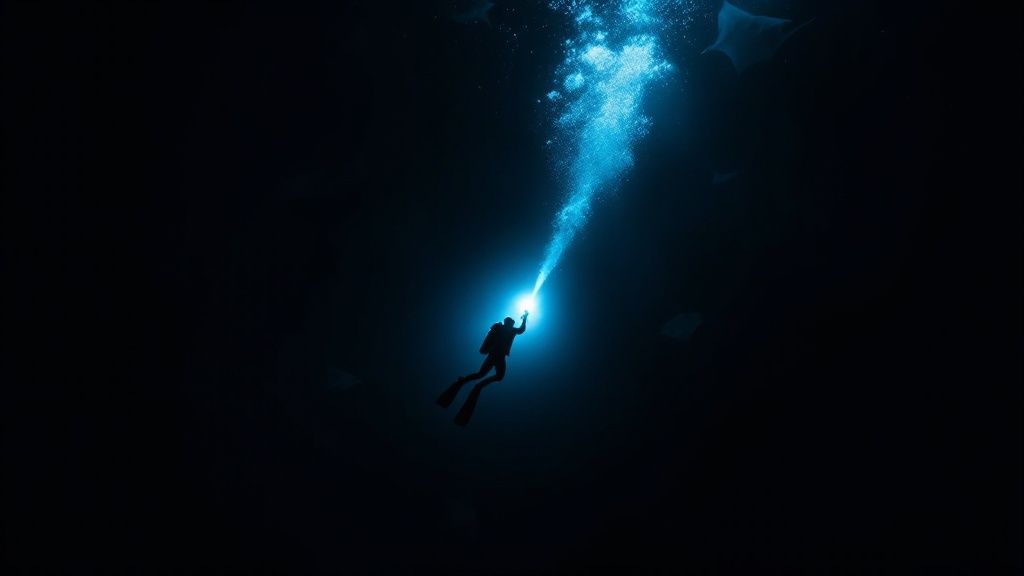
So, how does it all work? It’s a brilliantly simple setup. After descending into the dark ocean under a starry Hawaiian sky, you and your group settle on the sandy bottom. Everyone gathers around powerful underwater lights, all pointing upward. We call this the "campfire."
This column of light acts like a giant magnet for plankton, drawing in clouds of these microscopic organisms. And for Kona's resident manta rays, that's the dinner bell. They emerge from the darkness like silent ghosts, swooping and barrel-rolling through the light beams to feast on the plankton buffet. It's an absolutely mesmerizing show.
An Experience Built on Reliability
The magic of this dive is just how reliable it is. The Kona coast is world-famous for this spectacle because the manta rays show up almost every single night. We're talking about an incredible 85-90% success rate for sightings, and some of the top operators like Kona Honu Divers hit closer to 95%.
Because most of the action happens in shallow water, usually between 30 and 40 feet, you get plenty of bottom time to just relax and watch the performance. You can find more details on the high Kona manta ray night dive success rates here.
This isn't just another dive on your logbook; it's a front-row seat to one of nature's greatest performances. Companies like Kona Honu Divers have been running these trips for years, and they have it down to a science—keeping both divers and the mantas safe.
A great guide makes all the difference, turning an amazing dive into a truly educational and awe-inspiring event. When you book with a trusted operator, you're not just getting a tour; you're signing up for one of the most memorable wildlife encounters of your life. For any ocean lover visiting the Big Island, this signature Kona manta ray dive tour is an absolute must-do.
Where Should You Go? A Guide to Kona’s Two Premier Manta Dive Sites
When you're planning a manta ray night dive in Kona, one of the first questions you’ll ask is where to go. The Big Island is incredibly fortunate to have two world-class spots for this dive, but each has its own distinct personality. Your choice really sets the tone for the entire experience, so knowing the difference is key.
The two main sites are fondly called Manta Heaven and Manta Village. Both are absolutely incredible, but they're not carbon copies. Think of it as choosing between a high-energy music festival and an intimate acoustic concert—both are amazing, but they deliver a totally different vibe.
Manta Heaven: The Big Show
Manta Heaven, also known as Garden Eel Cove, sits just north of the Kona airport. As the name suggests, it often feels like a bustling metropolis for mantas. The unique underwater landscape here acts like a natural funnel for plankton, drawing in large numbers of rays for a reliable, action-packed feeding frenzy.
If your top priority is seeing the maximum number of mantas possible on a single dive, Manta Heaven is usually your best bet. It’s a spectacular, high-energy show with multiple mantas swooping and barrel-rolling all at once. The trade-off can sometimes be a few more boats in the area, but the sheer number of graceful giants often makes it more than worth it.
One 2013 study really put this into perspective. Divers at Manta Heaven saw an average of 11 manta rays per night. For comparison, Manta Village averaged about 4 during that same period.
Manta Village: The Intimate Encounter
Just south of Kona, near Keauhou Bay, you'll find Manta Village. This is the original, classic manta dive site, and it tends to offer a more personal, intimate experience. While you might see fewer mantas here on average, the encounters are every bit as magical.
Tucked into a protected bay, the conditions at Manta Village are often calm and ideal for divers of all skill levels. It first became famous thanks to its proximity to the Sheraton hotel on the shore. The whole experience can feel more up-close and personal, giving you the space to appreciate the fluid, graceful movements of a few individuals without the high-octane energy of its northern counterpart. Of course, every underwater spot in Kona is unique, and you can get a feel for other Big Island dive sites Kona Honu Divers visits.
So, what’s the right call for your manta ray night dive in Kona? It really boils down to what you’re hoping for. Do you want the lively spectacle with the best odds of seeing a massive group, or would you prefer a calmer, more personal encounter?
Either way, you’re in for a night you’ll never forget.
How to Prepare for Your Manta Ray Adventure
A little bit of prep work can make all the difference between a good dive and an absolutely incredible one. Getting ready for your manta ray night dive in Kona is straightforward, but taking a few minutes to get organized means you can relax and soak in the experience without any last-minute stress.
First things first, let's talk about certifications. If you're planning to scuba dive, you’ll need to have at least an Open Water Diver certification. No certification? No problem. The snorkeling experience is just as breathtaking, giving you an amazing view of the graceful giants from the surface.
For everyone joining, it’s a good idea to pack a towel and something warm and dry to wear for the boat ride home. A simple sweatshirt or a light jacket will do the trick—you’ll be surprised how cool the air can feel after you get out of the ocean at night.
What to Bring and What’s Provided
Most divers wonder what gear they need to pack. The great news is, top-notch operators like Kona Honu Divers handle all the heavy lifting for you. They provide a full set of high-quality scuba gear, which almost always includes:
- A BCD (Buoyancy Control Device)
- Regulators with gauges
- A dive computer
- Mask, fins, and snorkel
- Tanks (often with free nitrox, which is a nice bonus!)
- Weights
- A wetsuit perfectly suited for the local water temp
- A bright dive light for every person
While all the essentials are covered, some divers prefer to bring their own mask for a perfect fit or a dive computer they're already comfortable with. For a complete list of what's provided and what you might want to bring yourself, check out this handy guide on the gear you will need for your Kona diving adventure.
The Pre-Dive Briefing and The Golden Rule
Honestly, the most important part of your preparation happens right there on the dive boat. Before anyone gets in the water, your dive guide will walk you through a detailed pre-dive briefing. Pay close attention here—this isn’t just a formality, it's the secret to having a safe, fun, and respectful encounter.
Your guide will go over everything from night-diving hand signals to safety procedures and exactly how you'll position yourselves on the seafloor to create the "campfire" that attracts the mantas. But the most critical takeaway will be the golden rule: look, but don't touch.
Manta rays are covered in a delicate mucus layer that acts like a shield, protecting them from nasty infections. When a person touches them, it can rub off this protective coating, making them susceptible to disease. It's all about passive observation, ensuring these magnificent animals stay healthy for years to come.
Once the briefing wraps up, you'll feel completely prepared and confident. All that's left is to take that giant stride into the dark water and get ready for an experience you'll never forget.
What to Expect During Your Underwater Encounter
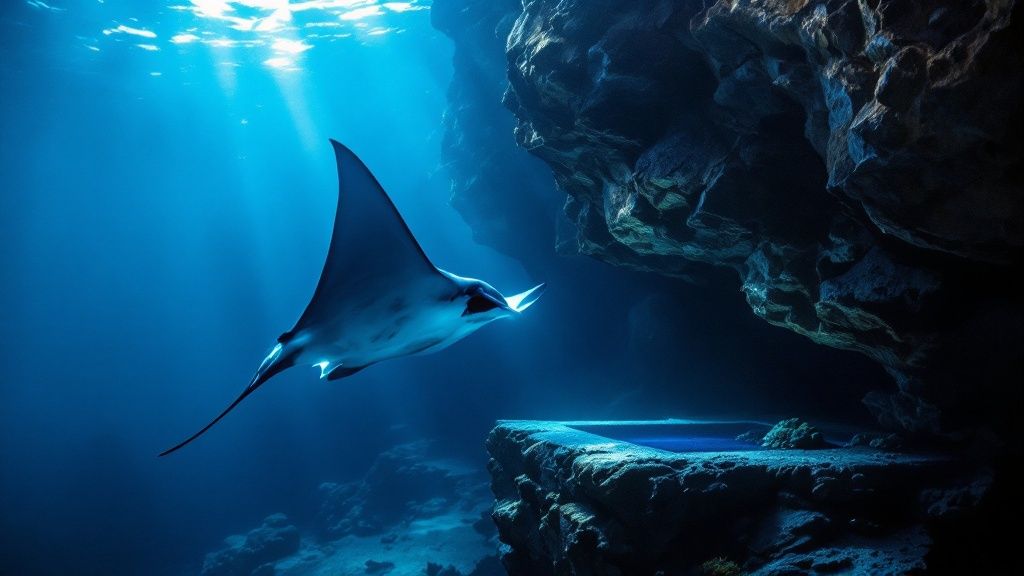
The moment you roll backward off the boat and dip below the surface, the real magic of the manta ray night dive in Kona begins. Everything changes. The world above disappears, and all you hear is the steady rhythm of your own breathing as you descend into the warm, dark water. It’s a strangely calming experience that sharpens all your senses.
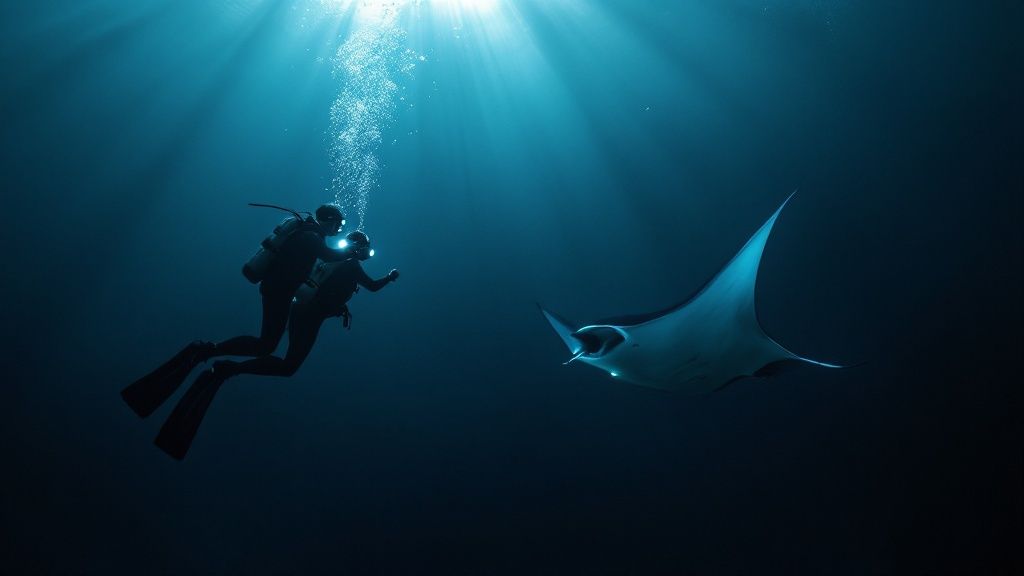
Your guide will lead you down to a sandy patch on the ocean floor, usually somewhere between 30 and 40 feet deep. Down there, the group gets settled, forming a loose circle around what we affectionately call the "campfire"—a collection of powerful dive lights pointing straight up. This beacon cuts through the darkness, and almost immediately, it starts attracting clouds of tiny plankton. The stage is set.
The Grand Entrance
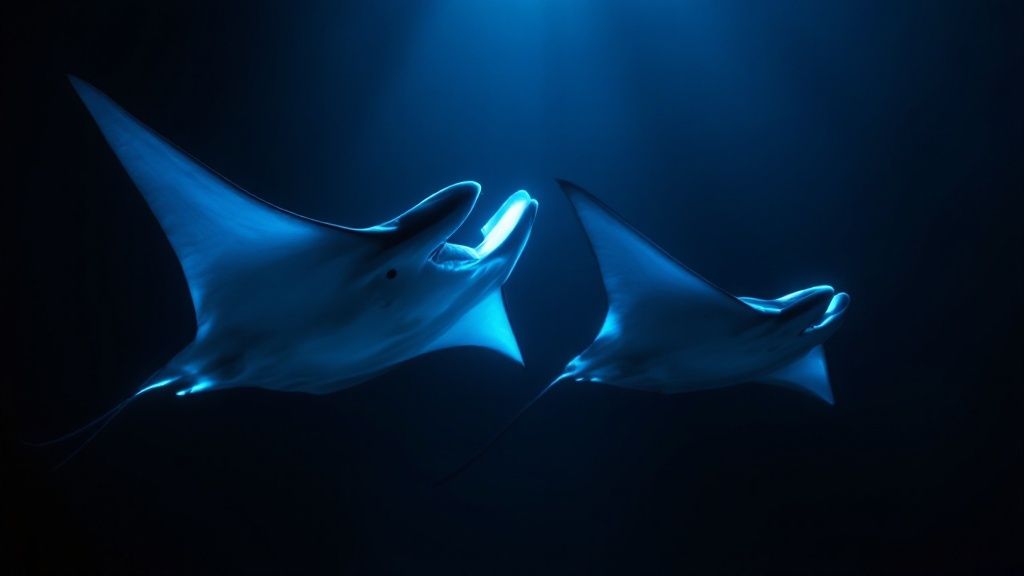
And then, out of the blackness, a shape emerges. It's a massive, dark shadow gliding silently into the light. The first manta ray has arrived. I don't care how many times you've dived; your heart will skip a beat. These are truly gentle giants, some with wingspans stretching over 12 feet, and they perform a weightless, silent ballet just inches above your head.
They swoop and soar, executing effortless barrel rolls with their huge mouths agape to filter the plankton from the water. It’s a full-on sensory experience: the incredible sight of their dance, the muffled sounds of the ocean, and the sheer awe of being so close to such majestic animals.
The most important thing you can do is simply be still. Find your spot on the seafloor and become part of the scenery. When you're calm and unobtrusive, the mantas see you as just another part of the reef. This is what allows them to feel safe enough to come close and feed naturally.
An Underwater Ballet
Seeing one manta is amazing, but it rarely stops there. Before long, others usually join the party, turning your dive into a full-blown underwater performance. Watching multiple mantas weave and glide around each other without ever colliding is one of the most powerful and beautiful things you can witness in nature.
Of course, wildlife is always wild. But the Kona coast is home to a resident population of over 200 individually identified manta rays, so the odds are heavily in your favor. While a no-show is incredibly rare, some nights are just legendary. The local record is a mind-blowing 36 mantas on a single dive. You can dive deeper into the fascinating dynamics of manta ray sightings to see just how special this place is.
Following the rules isn’t just about safety; it’s about respect. By keeping your distance and listening to your guide, you’re helping protect this incredible natural wonder for years to come. That's why it's so important to book with a reputable operator who takes these guidelines seriously.
Booking Your Tour with a Trusted Operator
Let's be honest, the crew you dive with can make or break the entire experience. When it comes to something as iconic as the manta ray night dive in Kona, choosing the right operator is every bit as important as the dive site itself. A great company doesn't just ferry you out to a location; they build a safe, respectful, and unforgettable encounter from the ground up.
Kona Honu Divers has earned its reputation as a top-tier choice for this world-famous dive, and for good reason. Their whole philosophy revolves around safety, sustainability, and a deep, genuine love for the ocean and its inhabitants. They get it: protecting the mantas is the number one priority. By sticking to strict, responsible guidelines, they ensure the animals are never stressed or disturbed, so you can watch the show with a clear conscience.
Why Experience Matters
One of the biggest things that sets Kona Honu Divers apart is their commitment to small group sizes. This isn't just a minor detail—it completely changes the dive. You get a far more personal and intimate experience, letting you truly soak in the underwater ballet without feeling like you're in a crowd.
Their guides aren't just there to lead the way; they're seasoned marine naturalists who live and breathe this stuff. They'll share incredible insights about manta behavior, the local ecosystem, and the conservation work being done to protect them. This storytelling adds so much depth to the dive, transforming it from a cool spectacle into a meaningful connection with nature. You see this echoed over and over in what their guests have to say.
With so many boats heading out each night, it helps to see how the different outfits compare. For a really detailed breakdown, check out this guide to the top 10 Kona diving companies ranked. At the end of the day, booking with a crew that puts safety and education first is the surest way to make sure your memories are magical for all the right reasons.
Ready to see the grace and grandeur of the mantas for yourself? You can book this incredible manta ray night dive tour and secure your spot.
Explore More of Kona’s Underwater World
The manta ray night dive in Kona is absolutely a peak experience, but it’s just the beginning of what the Big Island has to offer. The same volcanic forces that shaped the islands created a spectacular underwater paradise, with a whole world of different adventures waiting for you. Trust me, after seeing the manta ballet, you’ll be eager to see what else is down there.
When the sun comes up, the adventure is far from over. Kona's reefs are buzzing with life, and a lot of it is unique to Hawaii. A daytime diving tour in Kona is the best way to see these underwater gardens for yourself and come face-to-face with everything from gentle sea turtles to clever octopuses.
Beyond the Reefs
If you're craving something truly different, Kona has some of the most specialized dives you can find anywhere. Picture this: you're drifting in the deep, black ocean at night, tethered to the boat, while bizarre and beautiful bioluminescent creatures rise from the depths. That's the world-famous Kona blackwater dive—an experience that honestly feels more like floating through outer space than scuba diving.
For the Experienced Adventurer
Are you an advanced diver looking for a new challenge? Kona’s got you covered. The dramatic underwater terrain, formed by ancient lava flows, has created an incredible playground of arches, lava tubes, and deep-water pinnacles. These are the spots where you’ll often find bigger marine life, like sharks and graceful eagle rays. Taking an advanced dive tour to explore these sites is a surefire way to get your adrenaline pumping.
Kona isn’t just a one-trick pony. It’s a complete diving destination where every logbook entry tells a different story, from the graceful dance of mantas to the surreal beauty of the deep ocean and the dramatic architecture of submerged volcanoes.
So whether you’re ready for another incredible night dive or a laid-back exploration of sunlit reefs, the waters of Kona are waiting to show you their secrets.
Frequently Asked Questions
Thinking about your first manta ray night dive in Kona? It’s completely normal to have a few questions bubble up. To make sure you feel confident and ready for the adventure, here are some straightforward answers to the things we get asked the most.
Is the Kona Manta Ray Night Dive Safe?
Yes, it absolutely is. For any professional operator, your safety is priority number one, and the entire experience is designed with that in mind. The dive itself happens in a controlled and fairly shallow spot, usually just 30 to 40 feet deep, which is well within the comfort zone for most certified divers.
Before you even touch the water, your guide will walk you through a detailed safety briefing covering every step of the process. And don't forget, manta rays are true gentle giants. They're filter feeders without teeth or stingers, so they pose zero threat to people. The real key to a great dive is to just relax, follow your guide’s lead, and enjoy being a respectful observer.
What If I’m Not a Certified Diver?
No problem at all! You can still be part of this incredible experience. Almost every company that runs the scuba dive also offers a snorkeling option, and honestly, it’s just as breathtaking.
As a snorkeler, you'll float at the surface, holding onto a specially made light board. This board shines powerful lights down into the water, attracting the plankton—and the mantas come right up to feed. You get a stunning bird's-eye view of their elegant, swooping dance.
When Is the Best Time of Year for the Manta Dive?
Here's one of the best parts about the manta ray night dive in Kona: it’s a fantastic adventure any time of year. Kona is home to a resident population of over 200 identified manta rays, and they don’t migrate.
This means there's no real "manta season." The chance of seeing them is consistently high—often over 90%—all year round. So, you can book this unforgettable trip for whenever your travels bring you to the Big Island.
What Is the Water Temperature in Kona?
The ocean around Kona stays beautifully warm throughout the year, with water temperatures usually hovering between 75-80°F (24-27°C). That said, you will be relatively still in the dark for about 45 minutes, and it's amazing how quickly you can start to feel a chill.
To make sure you stay comfortable, all the dive operators provide good wetsuits. You'll typically get a 3mm or 5mm suit, which is more than enough to keep you cozy while you watch the show.