
Of all the incredible things you can do in the ocean, the manta ray night dive in Kona is something truly special. It's consistently ranked as one of the most unforgettable underwater encounters on the planet, giving divers a front-row seat to watch majestic manta rays feed up close in the dark. It’s an otherworldly experience, almost like watching a graceful underwater ballet, and the chances of seeing the mantas are incredibly high.
A Starlit Performance on the Ocean Floor
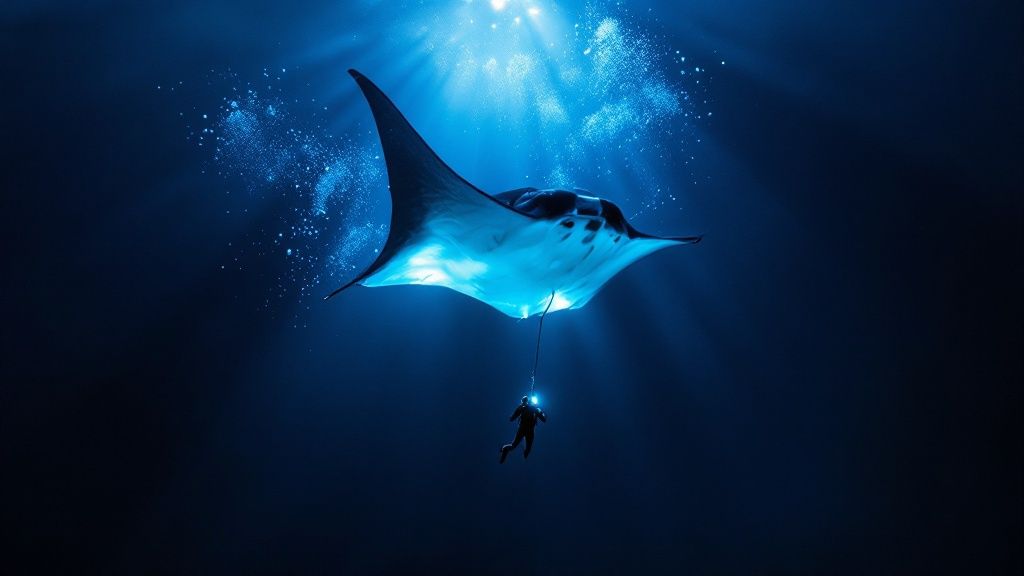
Picture this: you descend into the warm, dark Pacific waters just as the last hints of daylight vanish from the sky. On the ocean floor below, a set of powerful lights creates a brilliant stage, piercing the darkness. This light acts like a magnet for microscopic plankton, drawing them out of the shadows until they form a thick, shimmering cloud.
And then, the stars of the show make their entrance. Giant manta rays, some with wingspans stretching over 12 feet, glide effortlessly out of the abyss. They swoop, soar, and barrel roll right through the beams of light with their huge mouths wide open, filtering the plankton-rich water. It's a silent, mesmerizing performance happening just inches from your mask.
Why Kona is a Manta Ray Hotspot
Kona isn't just a good place for this dive; it's the undisputed best place in the world. That's thanks to a unique combination of factors that have created the perfect recipe for a reliable and magical encounter.
- A Resident Population: The Kona coast is home to a year-round, resident population of around 450 identified manta rays. These aren't just passing through; they live here, which makes sightings incredibly consistent.
- Ideal Conditions: The dive sites are surprisingly shallow, typically just 30 to 40 feet deep. The clear water at this depth allows for longer bottom times and makes the experience accessible to most certified divers.
- Established Feeding Sites: Over decades, the nightly presence of dive lights has essentially trained the mantas to associate these specific spots with an easy, all-you-can-eat plankton buffet. It's turned the dive into a dependable nightly spectacle.
This incredible reliability results in an exceptionally high success rate. Divers have about an 85–90% chance of seeing mantas on any given night, and some operators even report success rates topping 95%. That consistency means your manta ray dive tour adventure is almost guaranteed to be a success.
The experience is surreal. Watching these gentle giants perform their nightly feeding ritual is less like a dive and more like witnessing a piece of natural magic unfold right before your eyes.
At Kona Honu Divers, we're passionate about sharing this once-in-a-lifetime experience safely and responsibly. Our expert guides make sure you're comfortable and fully prepared to witness the show. For a deep dive into planning your trip, you might find this Ultimate Adventure Guide to Kona Manta Ray Night Snorkeling to be a fantastic resource.
Choosing Your Dive Site In Kona
When you're planning your manta ray night dive, one of the first big decisions is picking the right spot. Here in Kona, we're spoiled for choice with two world-class locations for this bucket-list encounter, and each has its own vibe.
Think of it like choosing between seeing your favorite band at a massive, high-energy outdoor festival or an intimate, cozy indoor venue. Both are amazing, but they offer completely different experiences.
The two main sites are Garden Eel Cove (often called Manta Heaven) and Keauhou Bay (known as Manta Village). The right one for you really boils down to your comfort level in the water, your thirst for action, and what kind of underwater show you're hoping to get.
The Big Stage: Garden Eel Cove (Manta Heaven)
Just north of Kailua-Kona, near the airport, you'll find Garden Eel Cove. This is the "outdoor festival" of manta dives. Because it's more exposed to the open ocean, the surface can sometimes get a little choppy. But the payoff? A bigger, wilder spectacle.
Manta Heaven is famous for attracting massive groups of manta rays. It's not unusual to see a dozen or more of these gentle giants swooping and barrel-rolling through the lights. If you're an experienced diver who's comfortable with potentially dynamic conditions and wants to see a true vortex of manta activity, this is your spot.
The Intimate Venue: Keauhou Bay (Manta Village)
Head south of town and you’ll find Keauhou Bay, which is more like an indoor concert—sheltered, predictable, and consistently awesome. Tucked into a protected bay, the water here is almost always calm, making it the perfect choice for first-time night divers, families, or anyone who gets a little seasick.
The boat ride is also a lot shorter, which is a huge bonus for many people. While Manta Village might host slightly smaller groups of mantas than its northern counterpart, the encounters are incredibly reliable and just as magical. The calm conditions let you totally relax and just soak it all in without worrying about waves or current.
This incredible accessibility and reliability have made both sites world-famous. In fact, about 80,000 people come to Kona every year just for this experience. It’s a testament to how unique and captivating this nocturnal feeding behavior truly is. You can discover more about Kona's world-famous dive sites and their history online.
To make the decision a little easier, here’s a quick side-by-side comparison of the two main manta dive locations.
Comparing Kona’s Top Manta Ray Dive Sites
Deciding between Garden Eel Cove and Manta Village depends on what you're looking for in an adventure. This table breaks down the key differences to help you pick the perfect site for your group.
| Feature | Garden Eel Cove (Manta Heaven) | Keauhou Bay (Manta Village) |
|---|---|---|
| Typical Conditions | Can be choppier, more exposed | Generally calmer, protected bay |
| Manta Ray Sightings | Often larger groups of mantas | Consistent sightings, sometimes smaller groups |
| Best For | Experienced divers seeking more action | Beginners, snorkelers, those prone to seasickness |
| Accessibility | Boat access north of Kailua-Kona | Easy boat access south of Kailua-Kona |
Honestly, you can't go wrong with either one. Both sites deliver an unforgettable manta ray night dive in Kona. It all comes down to matching the site's personality with your own personal comfort and adventure level.
Science And Conservation Behind Manta Diving
The incredible magic of the manta ray night dive in Kona isn’t just some happy accident. It’s actually a brilliant intersection of simple science and predictable animal behavior. At its heart, the entire experience hinges on a powerful, yet straightforward, ecological concept.
Our high-powered lights essentially create an underwater campfire. This light attracts swarms of microscopic plankton, which just so happens to be the manta rays' favorite meal. Over time, Kona’s resident manta population has learned that our lights mean an easy, all-you-can-eat buffet.
Think of it as a nightly dinner reservation that the mantas know to keep. This has created a reliable, spectacular feeding event that we get a front-row seat for. It's a unique and sustainable relationship between tourism and nature, and it’s what makes this encounter so unbelievably special.
How Scientists Identify Individual Manta Rays
Here’s one of the coolest parts about Kona's manta population: we can tell them apart. Each manta ray has a one-of-a-kind pattern of black spots on its white belly. It’s exactly like a human fingerprint—no two are the same.
This lets scientists and our divemasters recognize individual mantas year after year, tracking their movements and health. Many of the regulars have even earned names based on their personalities or unique markings. So don't be surprised if your guide points out local celebrities like "Big Bertha," "Lefty," or "Uhane."
Being able to identify individual rays is a game-changer for conservation. It allows researchers to monitor the population's health, growth, and behavior, making sure that our dives don’t negatively impact these gentle giants.
The Role of Research and Monitoring
The Kona coast isn't just an underwater playground; it's a living laboratory for marine biologists. Years of scientific monitoring have given us an incredible amount of data on our local manta ray population. Researchers have tracked everything from their travel patterns to their physical condition, helping us understand what they need to thrive.
For instance, a long-term data collection project between 2009 and 2014 involved nightly dives just to record sightings and compile detailed statistics. This kind of research has been critical for figuring out peak sighting periods and learning how the mantas move between different sites throughout the year.
This deep understanding of their behavior is why we can so confidently guide you. To dive a little deeper into the data, check out what the experts have learned about the best time of year to see manta rays in Kona in our article.
Responsible Tourism and Manta Etiquette
Protecting this amazing natural resource is a responsibility we all share. The Kona dive community has worked together to establish strict guidelines to ensure every encounter is safe for both the mantas and for us. This commitment is what keeps the experience sustainable and magical for everyone.
Following these rules isn't just a suggestion—it's essential for minimizing our impact on the animals.
- Observe Only, Never Touch: Manta rays are covered in a protective mucus layer that acts as a shield against infection. Touching them can strip this coating off, leaving them vulnerable to diseases. Just look, don't touch.
- Stay in Your Zone: We ask divers to remain on or near the sandy bottom, while snorkelers stay floating at the surface. This keeps the water column clear, giving the mantas plenty of room to glide and barrel roll.
- Manage Your Bubbles: If a manta glides right over your head, try to avoid exhaling directly into its path. That sudden rush of bubbles can be startling for them.
- Proper Light Etiquette: This one is key. Divers should point their lights straight up to attract plankton into a column of food. Snorkelers point their lights straight down, which draws the mantas up toward the surface.
By following these simple guidelines, every person on the dive becomes a guardian of this underwater treasure. You'll be helping us ensure it remains a source of wonder for generations of adventurers to come.
Preparing For Your Manta Ray Night Dive
Think of getting ready for the manta ray night dive in Kona like you’re packing for a weekend camping trip. You wouldn’t just wander into the woods without a tent, a flashlight, or something warm to sleep in. In the same way, a little prep work is all it takes to make sure your underwater adventure is safe, comfortable, and absolutely unforgettable.
A truly epic night dive starts way before you hit the water. It’s all about having the right gear dialed in, getting yourself physically ready, and knowing what’s coming. None of this is complicated, but nailing the details is what turns a good dive into a great one.
Your Essential Gear Checklist
Having the right equipment is everything. It's about being comfortable, but more importantly, it's about being safe. Your dive operator will supply the heavy stuff like tanks and weights, but understanding your personal gear—and why it matters—makes all the difference.
-
Dive Light: This is your personal window into the underwater world after sunset. A solid primary dive light is non-negotiable. It’s not just for lighting up the mantas; it's how you’ll navigate and communicate with your guide. Most operators also require a backup light just in case, so make sure you have one.
-
Wetsuit or Drysuit: The water in Hawaii stays a balmy 75-80°F pretty much all year, but don't let that fool you. You'll be hanging out on the bottom, not moving much, for nearly an hour. A 3mm or 5mm wetsuit is usually the perfect choice to keep the shivers away so you can focus on the show.
-
Buoyancy Control Device (BCD) and Regulator: Make sure your own gear is recently serviced and that you’re comfortable using it. You absolutely want to have your buoyancy dialed in before you attempt this dive. The goal is to hover effortlessly just off the seafloor, letting you relax and take in the view without kicking up sand or disturbing the reef.
Think of good buoyancy control as finding your zero-gravity sweet spot. The less you have to think about staying in place, the more you can immerse yourself in the incredible spectacle happening just feet away.
Physical and Mental Prep
How you treat your body on the day of the dive really matters. A few simple moves can help you sidestep common issues like seasickness and make sure you’re feeling 100% when it’s time to get in the water.
Hydration is your best friend, so drink plenty of water all day. But you’ll want to skip the heavy meal right before the boat leaves. A light snack an hour or two before is perfect to keep your energy up without making you feel queasy on the water. If you know you’re prone to motion sickness, pop an over-the-counter remedy well before you step on board.
As for training, you'll need to be a certified scuba diver to do this. A basic Open Water certification is the minimum requirement. If it's been a while since your last dive, doing a quick refresher course is a fantastic way to knock the rust off your skills and build up your confidence.
The Pre-Dive Briefing
Once you’re on the boat, your divemaster will walk everyone through a detailed pre-dive briefing. This is one of the most important parts of the whole trip, so pay close attention.
Here's what they'll cover:
- Safety Procedures: This includes how to get in and out of the water in the dark, the signals you'll use with your dive light, and what to do in an emergency.
- Manta Ray Etiquette: Your guide will go over the golden rule—look, don’t touch—and show you how to position yourself on the bottom to give the mantas plenty of room to do their thing.
- The Dive Plan: You'll get the lay of the land for the dive site, the expected depth (usually around 30-40 feet), and how the dive will run from start to finish.
This walkthrough is designed to clear up any questions and calm any last-minute nerves. By the time you’re gearing up, you’ll feel totally prepared and excited for the main event—a mesmerizing ballet put on by Kona’s gentle giants.
What To Expect During Your Underwater Encounter
The moment your boat’s engine cuts and you’re floating under the starlit Kona sky, a special kind of quiet settles over the group. It’s pure anticipation. As you back-roll into the dark, warm water, your world shrinks to the narrow beam of your dive light.
You'll descend to the sandy bottom, about 30 feet down, where your divemaster helps everyone find a spot to kneel. You'll form a semi-circle around a powerful central light source—we call it the "campfire"—and settle in for your front-row seat to one of nature’s most incredible ballets.
For a few minutes, the only sound is the rhythmic hiss of your regulator. Then, the magic begins.
All of your lights, pointed upward, act like magnets for a blizzard of tiny, shimmering plankton. The water column above you completely transforms into a swirling galaxy of life. A collective hush falls over the group as the first massive shadow appears at the very edge of the light.
It’s a moment that will genuinely take your breath away. A giant manta ray, with a wingspan wider than you are tall, glides effortlessly out of the darkness. You feel your heart pound as it swoops gracefully overhead, its massive mouth wide open to filter the plankton-rich water.
Soon, another joins, and then another. Before you know it, you're surrounded by these silent, gentle giants performing their nightly feeding dance. They barrel roll, loop, and soar just inches above your head in a display of pure, unchoreographed elegance.
How The Dive Experience Is Managed
Your safety and the well-being of the mantas are the absolute top priorities on every manta ray night dive in Kona. This isn't a free-for-all; it's a highly organized and supervised experience led by professionals who know these dive sites and the mantas like the back of their hand.
Think of your divemaster as your underwater conductor. They’ll guide your descent, make sure everyone is positioned correctly and comfortably on the seafloor, and keep a watchful eye on the group throughout the entire dive.
They communicate using light signals and hand gestures, pointing out individual mantas and ensuring everyone sticks to the strict interaction rules. Their expertise allows you to simply relax and soak in the awe-inspiring show unfolding right in front of you.
Manta Ray Interaction Etiquette
To keep these encounters safe and sustainable for generations to come, the Kona dive community follows a strict code of conduct. Following these rules isn't just suggested—it's mandatory. It's how we show respect for these magnificent animals.
- Look, Don’t Touch: This is the golden rule. Manta rays have a protective mucus layer that shields them from infection. Touching them can strip this layer off, leaving them vulnerable to disease.
- Stay On The Bottom: By remaining stationary on the sand, you keep the water column clear for the mantas to maneuver safely and feed without any obstructions. Let them have their space to dance!
- Mind Your Bubbles: When a manta glides right over you, try to time your exhale so the bubbles don’t hit it directly in the face. A sudden rush of air can easily startle them.
- Let Them Approach You: Never, ever chase or swim after a manta ray. The beauty of this dive is that they come to you, often getting incredibly close out of sheer curiosity.
The core principle here is passive observation. We are guests in their world, and our job is to watch in wonder without interfering. This respectful approach is what makes the Kona manta ray night dive a world-class model for sustainable wildlife tourism.
Capturing The Moment Responsibly
Bringing a camera to capture the magic is definitely encouraged, but it comes with its own set of responsibilities. You'll want to keep your gear streamlined and close to your body to prevent accidentally bumping a manta or another diver. The key is to focus on letting the mantas come into your frame rather than chasing them for the perfect shot.
For a deeper dive into what the experience is really like from a diver's point of view, you can read more about what it's like to go on the manta ray dive in Kona, Hawaii.
Ultimately, while photos and videos are amazing souvenirs, don’t forget to put the camera down for a bit. Just be present and absorb the surreal beauty of the moment. The memory of a giant manta ray gliding inches from your mask, its intelligent eye looking right at you, is something no camera can ever truly capture. It's a feeling that will stay with you long after you’ve surfaced.
Beyond Mantas: Other Kona Diving Adventures
As unforgettable as the manta ray night dive in Kona is, it's really just the opening act for the Big Island's incredible underwater show. The same dramatic volcanic landscapes that define the island above the waves plunge deep into the ocean, creating a diver's playground you won't find anywhere else on Earth. Stick around for a few more days, and you'll discover a world that's just as mesmerizing in the daylight.
Daytime reef dives here are like swimming through a sun-drenched garden. The sun cuts through the crystal-clear water, lighting up ancient lava tubes, dramatic archways, and sprawling coral reefs that are bursting with life. You’ll be swimming alongside Hawaii’s famous green sea turtles (honu), surrounded by schools of impossibly bright tropical fish, and spotting critters like frogfish and octopuses trying their best to hide in plain sight.
Dive into the Abyss on a Blackwater Night Dive
If the manta dive lit a fire in you for night adventures, then you absolutely have to try a Kona blackwater dive next. This is a completely different beast. You're not on a reef; you're drifting in the open ocean, suspended over thousands of feet of inky black water. The best way to describe it is floating through outer space, surrounded by a galaxy of tiny, bioluminescent creatures rising from the depths.
What you're witnessing is one of the largest nightly migrations on the planet, as strange and beautiful larval-stage creatures glow and pulse all around you. It's a surreal experience that shows you a hidden side of the ocean you never knew existed.
Explore More of Kona's Underwater World
Kona has a massive variety of dive sites that cater to every skill level and interest. Whether you're a new diver looking for a calm, protected cove or a seasoned pro ready for a deep, challenging adventure, there’s always something new to see.
- Daytime Reef Dives: Check out the healthy coral gardens and wild lava formations on our classic diving tours page.
- Blackwater Night Dives: Get your adrenaline pumping while drifting through "inner space" on a Kona blackwater dive.
- Advanced Dives: For our more experienced divers, our advanced dive tour page has trips to some of the more remote and thrilling sites.
After seeing the mantas glide through the darkness, getting out on these other dives really completes the picture of what makes the Big Island such a world-class diving spot. If you want a refresher on the main event, you can always learn more about the Big Island manta ray night dive right here on our site. Don't let your adventure stop with the mantas—the rest of Kona’s underwater world is waiting.
Frequently Asked Questions
It's totally normal to have a few questions buzzing around before you commit to a big adventure like the manta ray night dive in Kona. We get it. Here are some straightforward answers to the questions we hear most often.
Do I Need To Be Scuba Certified To See The Manta Rays?
Nope, you absolutely don’t! While certified divers get a fantastic view from the ocean floor, snorkelers get an equally mind-blowing perspective from the surface.
You’ll hang onto a custom-made, lighted floatboard. This light acts like a magnet for plankton, which in turn brings the mantas right up to you for dinner. It’s an incredible, up-close experience for swimmers of any skill level.
What Is The Best Time Of Year For The Manta Ray Dive?
One of the truly great things about Kona is that it's always manta ray season. Our local reef mantas stick around all year—they don't migrate—so we have consistent sightings every single month. Any time you're here is a good time to go.
That said, if you're worried about choppy water, the summer months generally have the calmest seas. This can make for a more comfortable boat ride, especially if you’re prone to motion sickness. For a deeper dive into specific tours, you can check out our guide on the top 5 manta ray night dive tours.
Is The Manta Ray Night Dive Safe?
Yes, 100%. Your safety is our absolute first priority on every single trip. Manta rays are true gentle giants. They're filter feeders, which means they don't have teeth, barbs, or stingers of any kind. They are completely harmless to people.
Before you even get in the water, our professional divemasters give a detailed safety briefing. They're in the water with you the entire time, supervising everything. The dive sites are also nice and shallow, usually around 30–40 feet, which keeps the whole experience in a controlled and secure environment.
It's a common mix-up, but manta rays and stingrays are totally different animals. Mantas are completely harmless, and their only real interest in us is a bit of mild curiosity as they feast on the plankton drawn to our lights.
What If We Don’t See Any Manta Rays?
Look, these are wild animals, and nature doesn't offer a 100% guarantee. But sightings happen on well over 90% of our trips, so the odds are definitely in your favor.
Still, we stand by our experience. Here at Kona Honu Divers, we have a manta guarantee. If for some reason the mantas don't show up for your tour, you can come back and try again on another night for free, as long as there's space available. We really want everyone to have the chance to witness this incredible spectacle.