
Picture this: you descend into the warm, dark Pacific Ocean just after sunset. Powerful spotlights on the seafloor suddenly switch on, illuminating the water like a massive underwater stage. Then, out of the darkness, they appear—giant, graceful manta rays, gliding into the light to perform an otherworldly ballet just inches above your head.
This isn't a scene from a nature documentary. It’s the world-famous manta ray night dive in Kona, and it’s a real, accessible adventure that will stay with you forever.
Experience The World Famous Kona Manta Ray Night Dive

In this guide, we'll walk you through every part of this incredible encounter. You’ll see exactly why Kona is the undisputed global hotspot for seeing manta rays up close and how the expert team at Kona Honu Divers makes this dream a reality.
The Big Island’s Kona coast is rightly celebrated as one of the most memorable scuba diving the Big Island destinations on the planet, and this signature nighttime spectacle is a huge reason why. But what truly sets it apart is the jaw-dropping consistency of the encounters. This isn't a "cross your fingers and hope for the best" excursion; it's a reliable, world-class wildlife interaction.
Every year, around 80,000 enthusiasts from across the globe make the pilgrimage to Kona for this exact experience. The draw? A stunning sighting success rate of 85-90%, as reported by seasoned local operators. This reliability comes down to Kona's unique plankton blooms, which reliably draw reef manta rays (Mobula alfredi) to shallow sites, typically at depths of just 30-40 feet. This makes the show perfect for both divers and snorkelers. You can learn more about Kona's unique manta ray ecosystem here.
To give you a quick snapshot, here’s what makes the Kona Manta Ray Night Dive an experience like no other.
| Feature | Details |
|---|---|
| Location | Kona Coast, Big Island of Hawaii |
| Primary Attraction | Close encounters with giant reef manta rays (Mobula alfredi) |
| Sighting Success Rate | 85-90% year-round, making it one of the most reliable wildlife encounters in the world |
| Typical Depth | 30-40 feet, accessible for both scuba divers and snorkelers |
| Best Time to Go | Year-round, with calm conditions common |
| Key to the Experience | Underwater lights attract plankton, the mantas' food source, creating a natural "feeding station" |
| Creature Temperament | Manta rays are "gentle giants" with no teeth or stingers, ensuring a safe and awe-inspiring interaction |
| Who Can Participate | Certified divers, first-time snorkelers, and even those taking a "Discover Scuba" course. It's an adventure for almost everyone. |
| Conservation Status | The experience is built on passive observation and education, promoting responsible tourism and manta ray conservation through the "Manta Ray Green List." |
This unique combination of factors has firmly established Kona as the premier destination for anyone wanting a guaranteed, breathtaking, and safe encounter with these magnificent animals.
What Makes This Dive So Special?
The magic is all in the setup. Our dive team creates an underwater "campfire" with powerful, submerged lights. This light attracts swarms of plankton—the manta rays' favorite meal. What happens next is a graceful and absolutely mesmerizing feeding frenzy right before your eyes.
- Up-Close Encounters: The mantas perform barrel rolls and glide just inches overhead, creating unforgettable memories and photo opportunities that are simply out of this world.
- A Gentle Ballet: These creatures are called "gentle giants" for a good reason. With no teeth or stingers, their presence is completely non-threatening, allowing for a pure, awe-inspiring experience.
- Accessibility for All: It doesn't matter if you're a seasoned diver or have never put on a snorkel mask before. Divers settle on the sandy bottom to look up at the show, while snorkelers get a fantastic bird's-eye view from the surface.
This unique combination of reliable sightings, safe interaction, and sheer natural beauty makes the Kona Manta Ray Night Dive a true bucket-list adventure. It’s an experience that connects you with the ocean in a profound way, all guided by the passionate professionals at Kona Honu Divers.
Why Garden Eel Cove Is The Premier Manta Dive Location
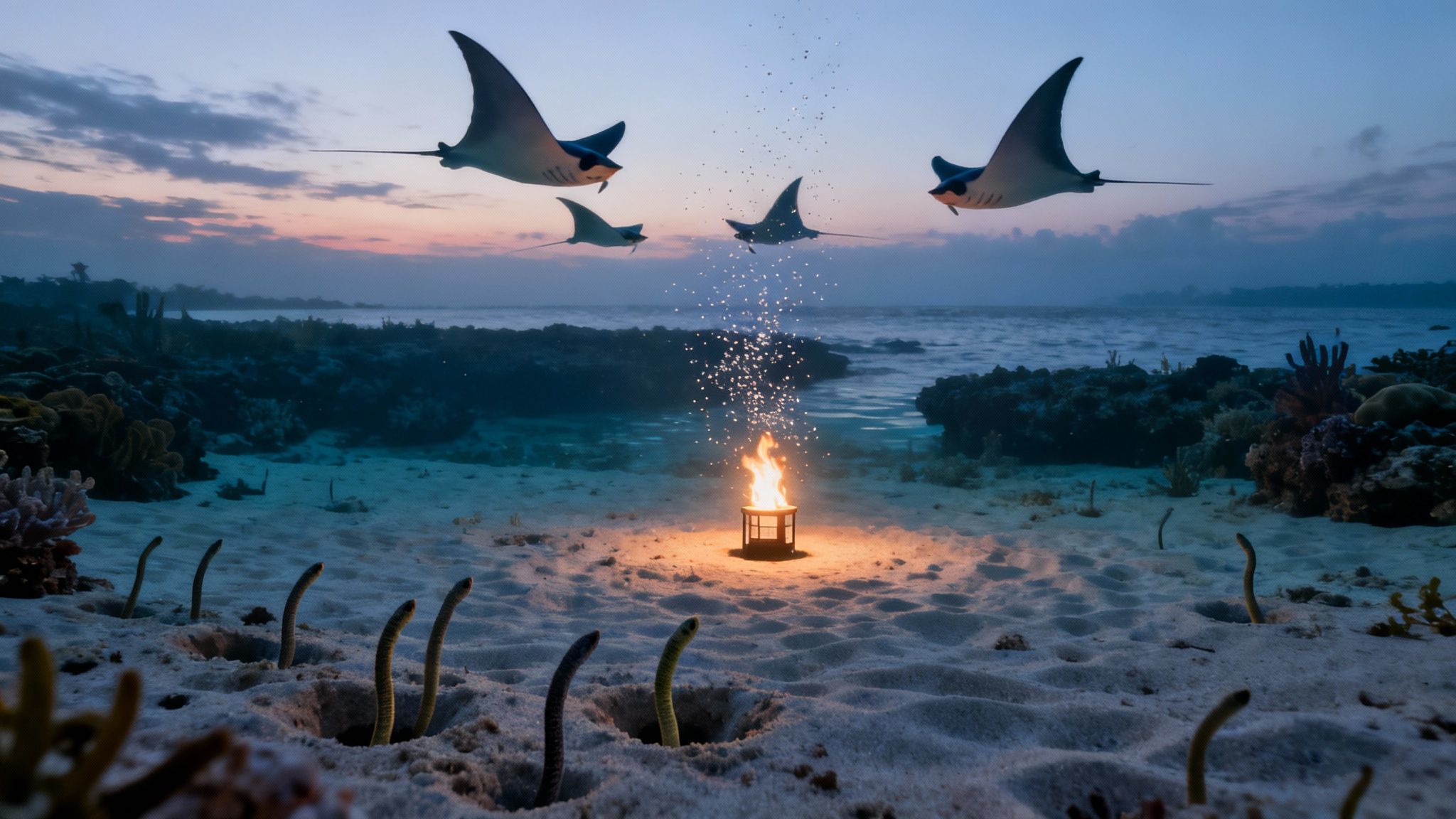
When you start looking into a manta ray night dive in Kona, you'll hear a few different spots mentioned. But there’s one that consistently stands above the rest: Garden Eel Cove. We call it "Manta Heaven" for a reason—it simply delivers a more reliable, more awe-inspiring experience than anywhere else. It is the superior choice because of its protected location, better viewing area, and healthier reefs.
Choosing an operator that makes this site their primary destination is your first move toward an incredible night. That’s why we at Kona Honu Divers head straight for Garden Eel Cove. It's not by accident; everything from the bay's geography to the underwater setup is designed to give our guests the best possible show.
The Advantage of a Protected Location
A big part of what makes Garden Eel Cove so superior is its location. Tucked into a naturally protected bay just north of the Kona airport, the site is shielded from the big ocean swells and unpredictable winds that can churn up other dive spots.
What does that mean for you? Calmer, more comfortable conditions on the surface. Whether you're a snorkeler floating above or a diver waiting on the boat, less chop makes the whole experience much more enjoyable. It’s especially important on a night trip, where feeling safe and stable lets you relax and focus on the magic unfolding below.
This protection also tends to result in better underwater visibility, giving you crystal-clear views of the mantas as they perform their silent ballet. It’s this geographical advantage that makes it the most dependable spot on the Kona coast. You can learn more about the unique features that make Garden Eel Cove a true Manta Heaven.
The "Campfire": A Superior Viewing Area
The real secret to Garden Eel Cove's success lies on the ocean floor. Years ago, a permanent light structure was installed in the sand. We all call it the "campfire," and it acts as a massive beacon for plankton, the mantas' favorite meal. The viewing area here is simply better than at other locations.
Think of it like a porch light on a summer night. Just as bugs are drawn to the light, tiny plankton swarm to the campfire, creating a concentrated, all-you-can-eat buffet that reliably attracts a huge number of manta rays, night after night.
This permanent setup guarantees a much more predictable and spectacular show than sites that just use temporary lights. For divers, this means we get to settle into a natural underwater amphitheater. You kneel comfortably on the sand and just look up as these gentle giants swoop and glide inches above your head. It’s an intimate, unobstructed view that is absolutely second to none.
Healthier Reefs and a Bonus Dive
There’s another reason we love Garden Eel Cove: the incredible health of its marine environment. The reefs here are vibrant, colorful, and packed with life, making them better than those found at other manta sites. This turns the first dive of our two-tank trip—the twilight reef dive—into a fantastic experience all on its own.
Before the sun fully sets and the mantas make their grand entrance, you get to explore a thriving ecosystem. Here's a taste of what you'll see on that first dive:
- Abundant Fish Life: Expect to be surrounded by schools of colorful butterflyfish, triggerfish, and wrasses.
- Unique Critters: Keep your eyes peeled for octopus hiding in crevices, moray eels peeking out, and of course, the thousands of garden eels that give the cove its name.
- Pristine Coral Formations: The healthy coral gardens provide a stunning backdrop and a vital home for countless critters.
This gorgeous twilight dive is the perfect warm-up act. It gets you comfortable in the water and lets you watch the reef transition from day to night right before the main event begins. Booking your manta ray dive tour at this premier location is the key to a complete and unforgettable Kona adventure.
What To Expect On Your Manta Adventure
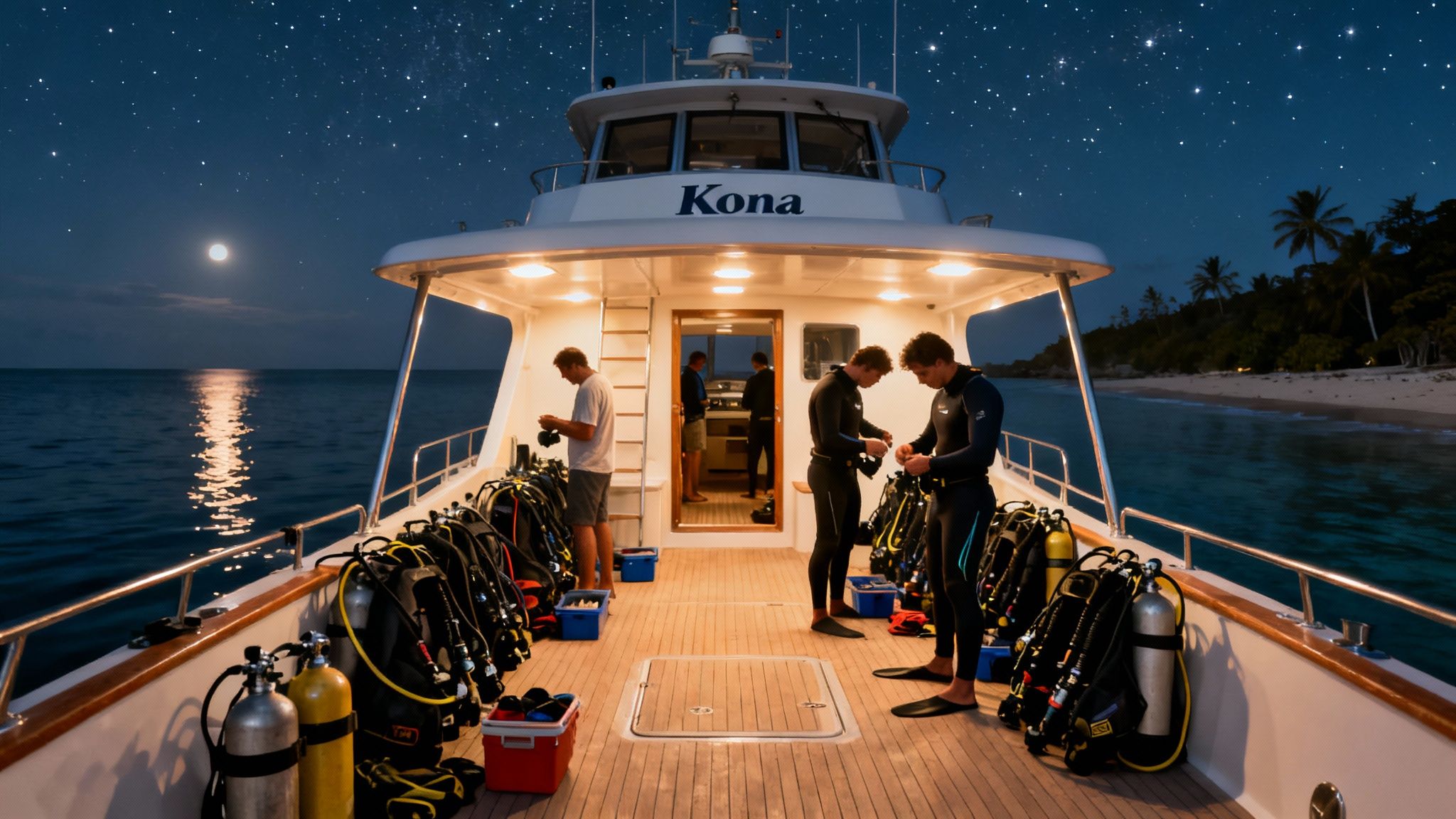
When you book a manta ray night dive in Kona with us, you're signing up for more than just a dive—you’re getting a complete, professionally run adventure. We handle all the details so you can just soak in the magic. Let's walk through what the experience looks like, from the moment you arrive at the harbor to the boat ride back under a sky full of stars.
It all starts with a smooth check-in at our shop, located right at the Honokohau Small Boat Harbor. Our crew will be there to greet you, sort out any paperwork, and get you fitted with top-notch rental gear. We’re serious about our equipment; everything is meticulously maintained because your comfort and safety are our priorities.
The Kona Honu Divers Fleet and Crew
Once you’re all set, you'll head down to the docks to board one of our custom dive boats, the Honu One or Honu Iki. These aren't your run-of-the-mill boats. We designed them specifically for diving in Kona, which means they’re spacious, stable, and incredibly comfortable. You'll find plenty of room to gear up, dedicated camera rinse bins for photographers, and wide, easy-to-use ladders for getting back on board.
The real heart of the experience, though, is our crew. Our captains and divemasters are seasoned pros who know these waters like the back of their hands and have a deep-seated passion for marine life. They’re not just here to keep you safe; they’re your guides for the evening, ready to share fascinating stories and answer every question you have. Their expertise is what elevates a good dive into a truly unforgettable one.
Don't just take our word for it—see what other divers are saying about their time with our crew.
Your Two-Tank Manta Ray Dive Itinerary
We structure our manta adventure as a two-tank trip, which gives you two incredible, distinct dives in one outing. This format is perfect because it lets you get comfortable in the water while watching the reef transition from the golden light of sunset to the deep dark of night.
Here’s how the evening unfolds:
- The Twilight Reef Dive: Your first plunge happens as the sun starts to dip below the horizon. We’ll take you down to a vibrant reef, usually Garden Eel Cove, for a perfect warm-up dive. It's your chance to explore healthy coral gardens and watch as the reef life—colorful fish, octopuses, and moray eels—begins to shift into its nighttime routine.
- Surface Interval with a View: Back on the boat, you'll have a relaxed surface interval. It’s the perfect time to chat with the crew, swap stories about what you saw, and watch the last colors of the sunset fade from the sky.
- The Main Event – The Manta Ballet: Once darkness has fully set in, it’s time for the show. You’ll descend again to a sandy spot we call the "campfire." Here, you’ll settle in and simply watch as the gentle giants swoop and glide into the light to feed. This is the manta ray night dive Kona is famous for—a mesmerizing, silent ballet you'll never forget.
What’s Included in Your Tour
We believe in making things simple and all-inclusive. When you dive with us, you can focus on the experience without getting nickeled and dimed for essentials.
Here’s what’s included in your tour price:
- High-Quality Gear: If you need rental gear, it's on us. That includes BCDs, regulators, fins, masks, and wetsuits.
- Complimentary Nitrox: For certified Enriched Air divers, we offer nitrox at no extra cost. It's a great way to extend your bottom time and add an extra layer of safety.
- Expert Guidance: Our professional guides are in the water with you on both dives, making sure you’re safe, comfortable, and not missing a thing.
- Snacks and Refreshments: We keep you fueled and hydrated with snacks and drinks on the boat.
This all-in approach ensures you have everything you need for a safe, comfortable, and truly magical night. Ready to see the world-famous manta ballet for yourself? You can book your unforgettable manta ray dive tour and secure your spot today.
How To Prepare For Your Manta Ray Encounter
A little bit of prep goes a long way toward making your manta ray night dive in Kona an absolutely unforgettable experience. When you know what to bring and what to expect, you can simply relax and lose yourself in the underwater ballet that’s about to unfold.
Think of us at Kona Honu Divers as your expert crew—we handle the heavy lifting. We’ve got all the high-quality, meticulously maintained scuba and snorkel gear you’ll need. All you have to do is pack a few personal items to round out the perfect evening.
Your Personal Checklist
Getting ready is pretty simple. The name of the game is comfort, both in and out of the water. Here’s a quick rundown of what you’ll want to have with you:
- Swimsuit: The easiest thing to do is wear it under your clothes to the harbor.
- Towel: You’ll definitely be glad you have one when you get out of the water!
- Warm Jacket or Sweatshirt: Even on a balmy Hawaiian evening, the boat ride back can get surprisingly chilly once you’re wet. A cozy, dry layer makes all the difference.
- Reusable Water Bottle: We’ll have refreshments on board, but it never hurts to have your own water to stay hydrated.
- Any Personal Dive Gear: If you’ve got a favorite mask that fits just right or a dive computer you know and love, feel free to bring it! For a full breakdown of what we provide versus what you might want to bring, check out our guide on the gear you will need for your Kona diving adventure.
Diver vs Snorkeler Experience
One of the best things about this tour is that you don’t need to be a scuba diver to witness the magic. We welcome both divers and snorkelers, and each gets a unique, incredible view of the action.
Here’s a quick comparison of what the experience is like from both perspectives:
| Aspect | Scuba Diver | Snorkeler |
|---|---|---|
| Viewpoint | Bottom-up, looking directly into the "Manta Ball" | Top-down, a "bird's-eye view" of the entire scene |
| Proximity | Mantas glide inches above your head as you kneel on the sand | Mantas swoop up towards the surface lights near you |
| Requirements | Open Water Diver certification | Basic swimming ability |
| Key Feeling | Fully immersed, part of the underwater world | Floating effortlessly, watching the grand spectacle unfold |
Whether you’re looking up from 30-40 feet below or gazing down from the surface, you’re in for a world-class wildlife encounter.
Certification and Skill Levels
This adventure truly is for just about everyone. We’ve designed our trips to be fantastic for mixed groups, so your non-diver friends and family don’t have to miss out.
If you’re planning to scuba dive, you will need an Open Water Diver certification. The dive itself isn't technical or deep—we settle on a sandy patch of seafloor—but that certification ensures you have the fundamental skills to feel safe and comfortable underwater at night.
For snorkelers, no certification is needed! We'll give you a flotation device to hang onto, so you can just float comfortably at the surface and enjoy the show. Our crew gives a great briefing and is always right there to help.
First Time Night Diving Tips
Is this your first time diving after sunset? It's totally normal to feel a few butterflies. The good news is, the Kona manta dive is probably the best introduction to night diving you could ever ask for.
Forget any ideas of a dark, spooky abyss. This is a vibrant, well-lit underwater stage. Our powerful lights create a massive, illuminated amphitheater. You're surrounded by your guide and fellow divers, which makes the whole thing feel exciting and secure, not intimidating.
Our professional divemasters are seasoned pros at guiding first-time night divers, and they'll make sure you feel confident from start to finish.
The Golden Rule of Manta Encounters
The single most important piece of preparation is understanding the number one rule: passive observation. We have a very strict "look, don't touch" policy to protect these incredible animals.
Manta rays have a special mucus coating on their skin that acts as a shield against infection. Touching them can strip away this protective layer, making them vulnerable. We'll cover all of this in our pre-dive briefing, showing you how to position yourself so the mantas can glide safely right over you. By simply kneeling on the sand and watching, you become a partner in preserving Kona’s amazing manta ray population for years to come.
Ready to join this bucket-list experience?
Tips For Photographing The Manta Ray Ballet
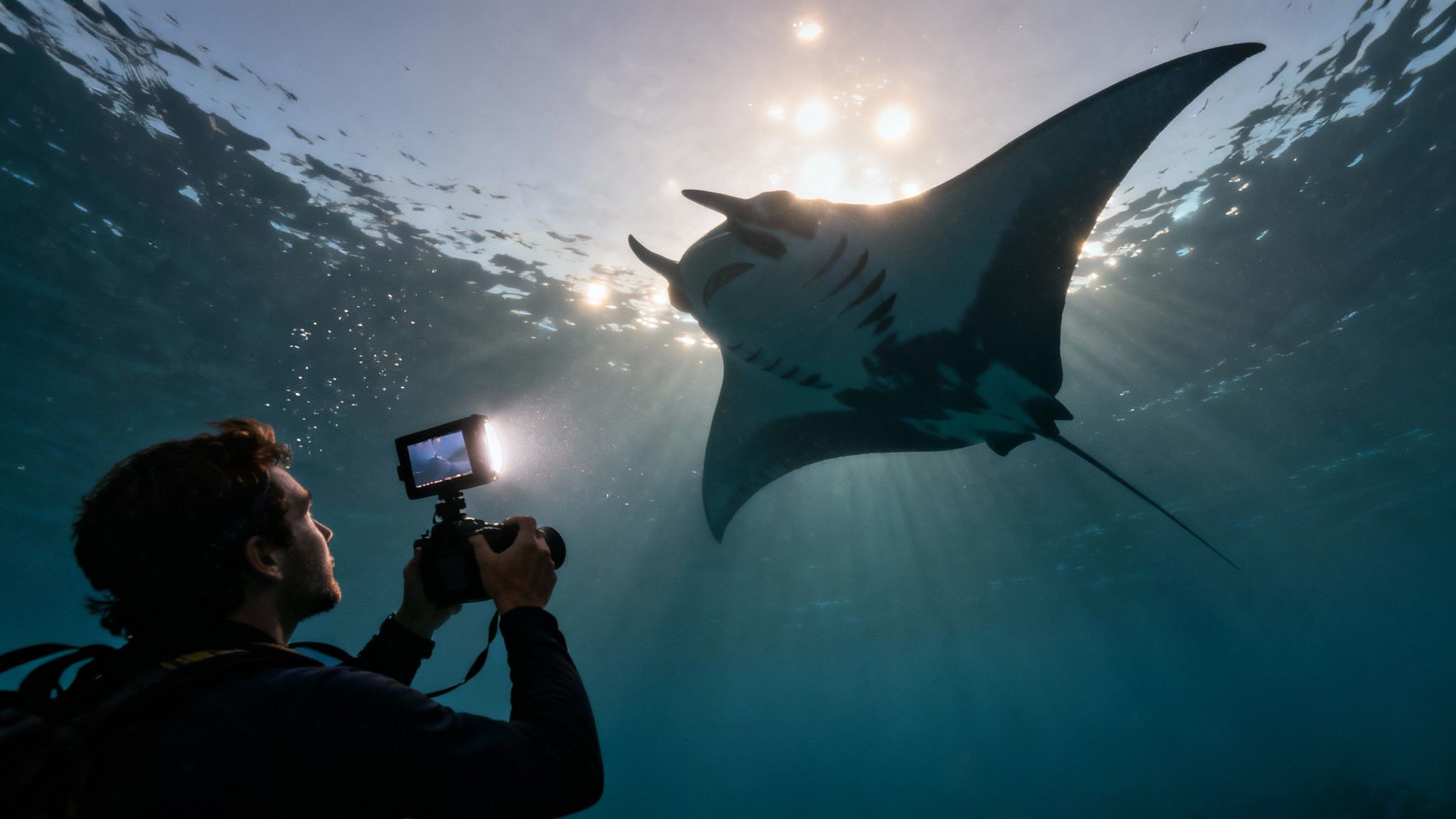
You're about to witness something truly special, and you’ll want photos that do justice to the memory. But capturing incredible images during the manta ray night dive in Kona can feel a bit intimidating. Don't worry. With a few key techniques, even amateur photographers can come home with some breathtaking shots.
This isn’t your typical underwater photoshoot. You’re dealing with a dynamic, low-light environment filled with powerful beams of light, deep shadows, and constant motion. The secret is learning to work with these elements, not against them, to freeze the manta ballet in a perfect frame.
Essential Camera Settings For Low Light
Success here really comes down to mastering the "exposure triangle"—aperture, shutter speed, and ISO. While the dive lights create a brightly lit stage for the mantas, the surrounding water is pitch black. You have to find that sweet spot.
- Aperture: Open your aperture as wide as it will go. Think low f-stop numbers, like f/2.8. This lets the maximum amount of light hit your camera's sensor, which is crucial for getting a bright, clear image without cranking your ISO too high.
- Shutter Speed: You need a shutter speed fast enough to freeze the mantas as they glide and barrel-roll. A good starting point is 1/125th of a second. Anything much slower, and you’ll end up with motion blur.
- ISO: Start with a moderate ISO, somewhere between 800 to 1600. A higher ISO boosts your sensor's light sensitivity, but it can also introduce grainy digital "noise." Snap a few test shots and adjust from there until you get a clean exposure.
For a deeper dive into the unique challenges of shooting after dark, check out our guide on the fundamentals of scuba diving at night.
The Power of Video Lights and Composition
Whatever you do, don't use your camera's built-in flash! It will create a snowstorm of backscatter—that ugly effect of light bouncing off every little particle in the water. External lights, like strobes or video lights, are your best friend here. Position them off to the side to illuminate the mantas, which sculpts their features and cuts down on backscatter dramatically.
From there, it’s all about composition. That’s what turns a simple snapshot into a piece of art.
The most powerful trick in the book? Shoot upwards. Get below the mantas and angle your camera toward the surface. This frames their incredible silhouettes against the glow of the lights, creating a real sense of scale and wonder.
Try to get as close as you safely can, always remembering the "no-touching" rule. The less water there is between your lens and the manta, the sharper, clearer, and more colorful your final image will be.
Tips For Action Cameras Like GoPro
You don't need a massive, professional camera rig to get amazing footage. Action cams like a GoPro are perfect for capturing the fluid motion of the manta ray experience.
- Settings: Go for a high resolution (4K is great) and a frame rate of at least 60 frames per second (fps). This gives you the option to slow down your footage in editing for that beautiful, cinematic slow-motion effect.
- Red Filter: A simple red filter is a game-changer for underwater video. It corrects for the water's natural blue-green color cast, bringing back the vibrant, true-to-life colors of the scene.
- Stability: Shaky video is hard to watch. Using a simple tray with handles will help you keep the camera steady, resulting in smooth, professional-looking footage.
Follow these simple but effective tips, and you'll be ready to capture the magic of the manta ballet and bring home images just as stunning as the experience itself.
There’s More to Kona Diving Than Just Mantas
The manta ray night dive is without a doubt a must-do, an experience that will stick with you forever. But believe it or not, it’s just scratching the surface of what the Kona coast has to offer. We see it all the time—once you've witnessed that incredible manta ballet, you get the bug. You're ready for the next adventure.
The ocean is a vast and varied place. The manta dive is a beautiful, gentle interaction, but a well-rounded diver knows the ocean is full of wonders. It's always a good idea to stay aware of the broader marine world, including learning about other fascinating, and potentially dangerous, marine creatures you might see in different waters.
Journey into the Abyss on a Kona Blackwater Dive
If you're a certified diver looking for something that feels like a trip to another planet, the Kona Blackwater Dive is it. This isn't your typical reef dive. We head miles offshore, shut off the engines, and you float tethered to the boat in the profound, inky blackness of the deep ocean.
We use powerful lights to attract the creatures that take part in the largest migration on Earth—the nightly vertical migration. Bizarre, beautiful, and often translucent organisms rise from the crushing depths to feed near the surface. You’ll see larval fish that look nothing like their adult forms, alien-like jellyfish, and shimmering squid. It's a challenging, advanced dive, but the photos and the experience are truly one of a kind. If you’re ready for a dive you’ll never forget, you can book your Blackwater Dive here.
Explore Remote Reefs on an Advanced Trip
Ready to get off the beaten path? For our more experienced divers, we run a Premium Advanced 2-Tank Trip that’s designed to explore the wilder side of the Kona coast. This is a small-group charter where we head to the more remote and challenging sites—places with dramatic lava tube formations, massive arches, and pristine reefs that most divers never get to see.
These dives are all about exploring the unique underwater geology shaped by the Big Island's volcanic past. You'll navigate swim-throughs and canyons packed with marine life that thrives in these untouched ecosystems. If you're looking to push your skills and see what lies beyond the usual dive spots, find out more about our advanced dive tour opportunities.
From the world-famous manta spectacle to the deep-ocean abyss, Kona Honu Divers has an adventure for every passionate diver. Check out all of our Kona diving tours and let's get you back in the water.
Your Manta Ray Night Dive Questions, Answered
If you're thinking about joining us for this incredible experience, you probably have a few questions. That's a good thing! We've put together some straight-to-the-point answers to the most common questions we get, so you can feel completely prepared for your underwater adventure.
How Likely Am I To Actually See Manta Rays?
The odds are overwhelmingly in your favor. The Kona coast is famous for having one of the most reliable manta ray populations on the planet. While we can never 100% guarantee a sighting—they are wild animals, after all—our success rate for seeing mantas is consistently around 90%.
We stack the deck by almost always going to Garden Eel Cove, the premier and more protected site, which gives us the best possible chance for an unforgettable encounter.
What Is The Best Time Of Year To Go?
This is the best part: there is no "best" time! The manta ray night dive is a fantastic, year-round activity here in Kona.
Our resident manta population doesn't migrate, and the ocean is always warm and inviting. There’s no specific season, which means you can book this incredible experience no matter when you plan your visit to the Big Island.
Is The Manta Ray Night Dive Safe?
Absolutely. Your safety is the single most important thing to us at Kona Honu Divers. The dive itself is in a relatively shallow spot, typically around 30-40 feet, and our boat’s powerful lights illuminate the entire area.
It's also important to remember that this is a passive observation dive. Manta rays are true gentle giants. As filter feeders, they don’t have teeth, and they lack the stingers that their stingray cousins have. Our professional PADI divemasters and instructors give a detailed safety briefing before we get in the water and are right there with you the entire time, making sure everything runs smoothly.
What Happens If The Weather Is Bad?
We never take chances with your safety. Our highly experienced boat captains are constantly monitoring the weather and sea conditions.
On the rare occasion that conditions are just not safe enough to go out, we will cancel the trip. If that happens, we'll get in touch with you immediately to either reschedule your dive for another day or issue a full refund—whichever you prefer. We won't take you out unless we're confident we can give you a safe, high-quality experience.
Ready for an adventure you’ll be talking about for years? Kona Honu Divers is here to guide you on the world's best manta ray encounter. Book your unforgettable manta ray night dive tour with us today.