
Imagine this: you're sinking into the warm, dark Pacific waters just as the last bit of daylight disappears. Out of the blue, a colossal, ghost-like figure emerges. Then another. Soon, you're surrounded by giant manta rays, some with wingspans stretching over 12 feet, as they glide and swoop through a brilliant column of light, often just inches from your mask. This isn't a scene from a nature documentary—it's the world-famous manta ray night dive in Kona, Hawaii, an experience that belongs on every ocean lover's bucket list.
What Makes The Kona Manta Ray Dive So Special
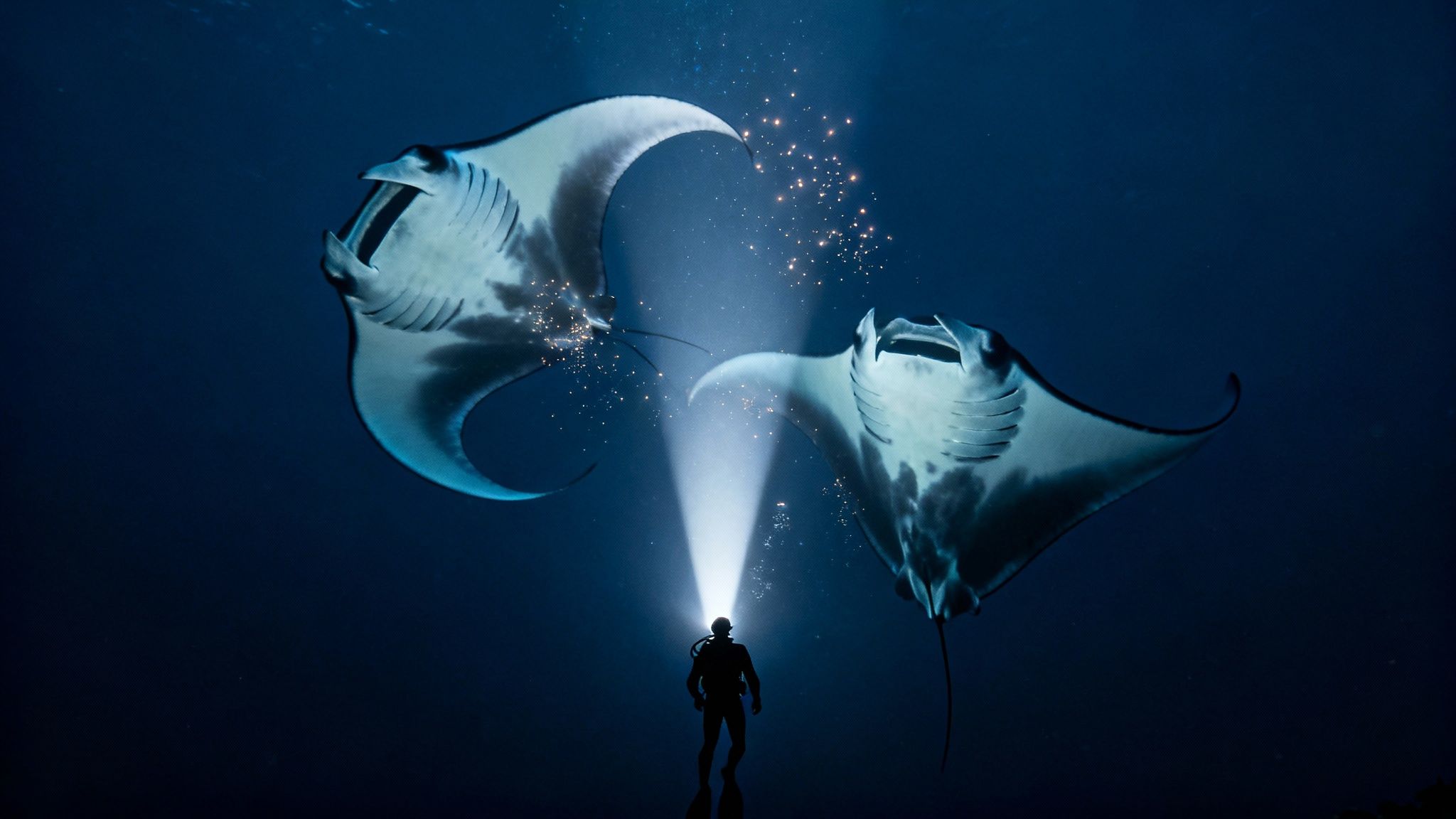
The Kona coast of the Big Island is more than just a pretty place to dive; it's the undisputed global capital for consistent manta ray encounters. While seeing a manta ray in other parts of the world often comes down to pure luck, Kona's unique underwater landscape—shaped by volcanic activity—creates the ideal environment for a nightly plankton feast. This natural dinner bell rings every evening, drawing these gentle giants in with incredible regularity.
This predictable phenomenon has turned the manta dive into one of Hawaii's most sought-after adventures. It’s a beautifully choreographed underwater show where divers and snorkelers get a front-row seat to an ancient and mesmerizing feeding ritual.
A Consistently Magical Experience
What truly sets this dive apart from anything else in the world is its reliability. The manta ray night dive in Kailua-Kona has become a massive draw, attracting around 80,000 visitors each year. And for good reason! Dive operators like Kona Honu Divers consistently report sighting success rates between 80% and 90% all year. On a great night, those numbers can climb even higher, with some sites hitting a 96% success rate back in 2013.
At Manta Heaven (also called Garden Eel Cove), it's not uncommon for divers to see an average of 11 mantas on a single dive, creating an absolutely breathtaking "ballet" of feeding animals. You can get a better sense of the action by reading up on the incredible manta ray sightings in Kailua-Kona.
I can only describe it as an immersive ballet. You get settled on the sandy ocean floor, and these magnificent creatures begin performing acrobatics right over your head, all lit up by a central 'campfire' of powerful lights.
Kona Honu Divers has really dialed in this adventure, making sure every guest gets the best possible view of the action. Their focus on safety, small group sizes, and running trips to the best dive sites truly elevates the entire experience.
Ready to see the magic for yourself? Don't wait to book your spot on this unforgettable manta ray dive tour—it will almost certainly be the highlight of your trip to Hawaii.
Why Garden Eel Cove Is The Premier Manta Dive Location
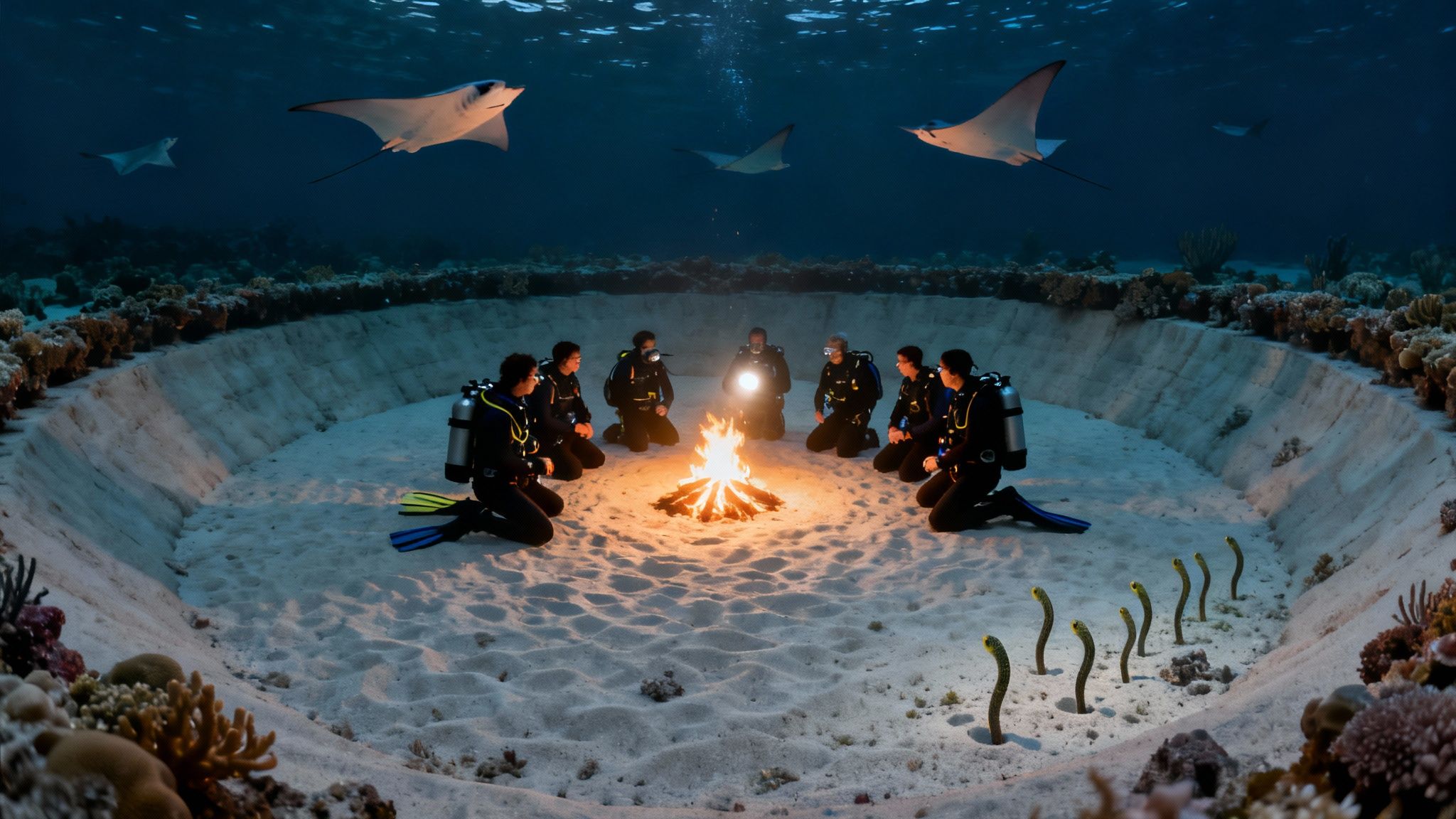
When you're planning your manta ray night dive in Kona, the location you choose can make or break the experience. While there are a couple of spots to see mantas, Garden Eel Cove (often called Manta Heaven) is hands-down the superior choice, and it's where we take our divers for a reason. It consistently delivers the most incredible and reliable show.
A huge part of its magic is its location. Tucked away offshore from the Kona International Airport, Garden Eel Cove is naturally protected from the big southern swells that often churn up other dive sites. This shelter means the water is usually calmer and clearer, leading to better viewing conditions, a more comfortable dive, and fewer weather cancellations.
An Amphitheater Built By Nature
The real secret to Garden Eel Cove's success lies in its underwater layout. The seafloor here is a wide, sandy patch that slopes gently, forming a perfect natural amphitheater. This unique geography allows us to set up the "campfire" of lights in the middle and have divers settle in a comfortable semi-circle on the sand.
This setup is a game-changer for a few reasons:
- Front-Row Seats: Kneeling on the sand provides a fantastic, unobstructed viewing area, allowing you to look up and watch the entire spectacle as the mantas swoop and barrel-roll right above you.
- Protecting the Reef: The sandy bottom keeps everyone safely away from the fragile coral. We get to enjoy the show without harming the beautiful reef environment that makes the dive so special.
- The Perfect Stage: The wide-open space gives the mantas plenty of room to perform their amazing feeding ballet, leading to breathtakingly close and safe encounters.
Other locations sometimes have rocky or uneven bottoms, which can be less comfortable and offer a more limited view of the action.
More Than Just Mantas
The experience at Garden Eel Cove isn't just about the main event. Our 2-Tank Manta Ray Night Dive & Snorkel includes a gorgeous twilight dive on the location's healthy reefs before the mantas come out. The coral gardens here are teeming with life, and you get to witness the fascinating shift as daytime critters head to bed and the nocturnal ones begin to wake up.
This two-tank format is an incredible value. You essentially get two amazing dives in one trip: a classic Kona reef exploration followed by the world's most famous night dive.
It's this blend of a protected location, a superior underwater viewing area, and a spectacular preliminary reef dive that truly makes Garden Eel Cove the undisputed champion for the Kona manta ray night dive. To get an even deeper look, check out our full guide to Manta Ray Heaven.
Your Dive Experience With Kona Honu Divers
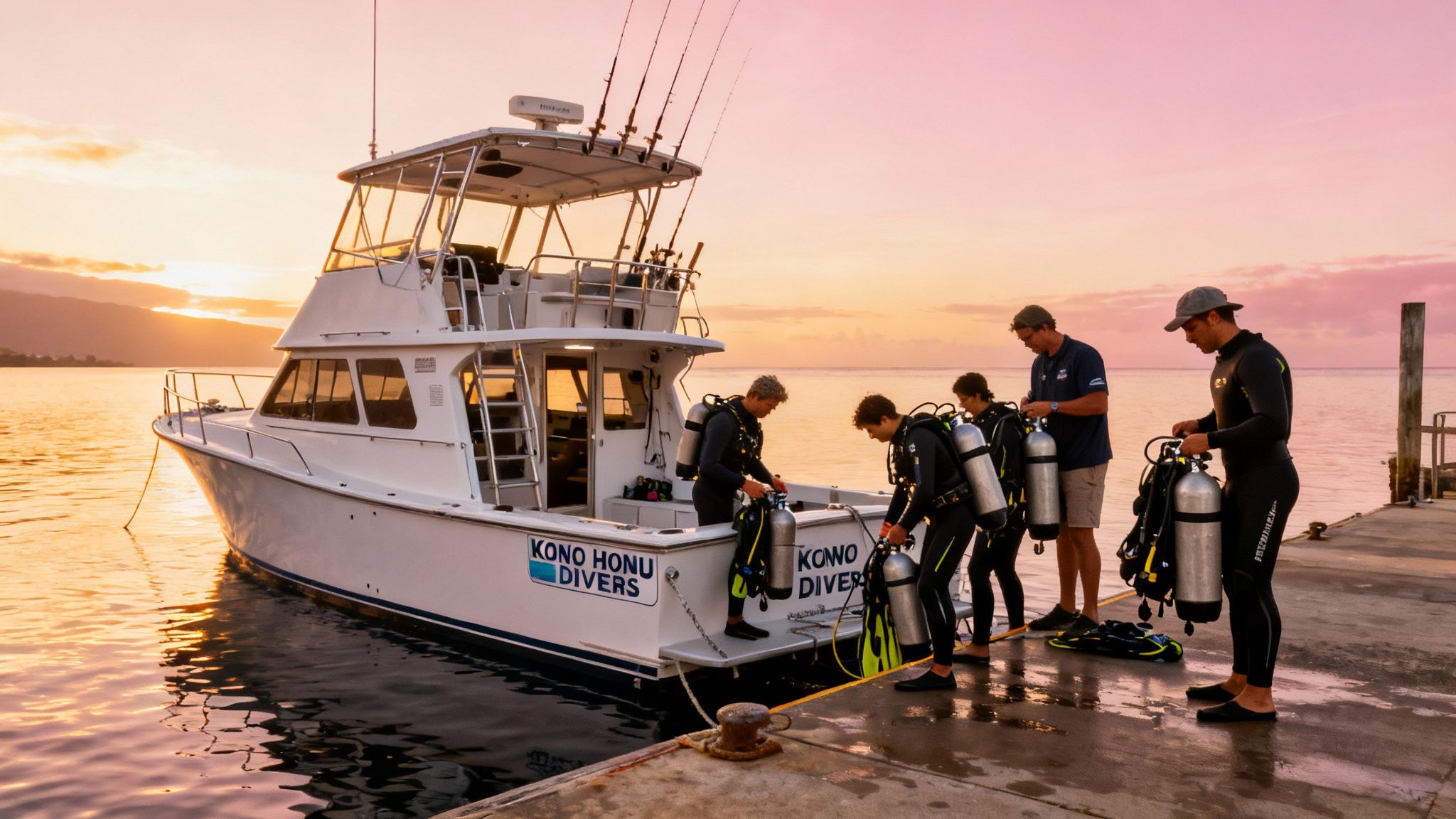
From the moment you arrive at the harbor, it’s clear that the manta ray night dive in Kona with Kona Honu Divers is a world-class operation. The adventure kicks off as you meet the crew, whose experience and friendly vibe immediately put you at ease. You'll board their spacious, custom-built dive boat—a vessel clearly designed with diver comfort and safety in mind.
Once everyone’s on board and settled in, the crew runs through a comprehensive pre-dive briefing. This is far more than just a quick "here's the plan." They walk you through the entire evening, detailing the plan for both dives, outlining specific night diving procedures, and, most importantly, explaining the rules for passive interaction. It’s all about ensuring a safe and respectful encounter for both the divers and the mantas.
The Twilight Reef Dive
Interestingly, your underwater journey doesn't start with the mantas. The first plunge is a stunning twilight reef dive. As the Hawaiian sun begins to dip below the horizon, you'll descend into the vibrant coral gardens of Garden Eel Cove, the premier site for the manta show.
This initial dive is a brilliant way to start, giving you a chance to see the reef as it transitions from day to night. You’ll watch as the daytime fish find their spots to sleep and the nocturnal creatures start to emerge. It's a fantastic two-tank charter that lets you get comfortable in the water and warm up for the main event. After surfacing, you’ll enjoy a relaxed surface interval with snacks and drinks while the anticipation for what’s next really starts to build.
The Underwater Campfire and Manta Ballet
Once darkness has completely fallen, it's time for the grand finale. Following your expert Divemasters, you'll descend to a sandy "amphitheater" at about 35 feet. This is where the magic happens. The crew sets up the famous underwater "campfire"—a circle of powerful, upward-pointing lights that acts like a giant bug zapper for plankton, the mantas' favorite meal.
You and your group will settle into a spot on the sand, adding your own dive light to the glow. And then, you wait. The first time a majestic manta ray glides silently into the light is a moment you will never forget. Soon, more will follow, creating a mesmerizing ballet of feeding. They swoop, soar, and perform effortless barrel rolls just inches above your head, their huge mouths open to filter the plankton from the water.
What really sets Kona Honu Divers apart is their commitment to small group sizes. This guarantees an intimate, uncrowded experience, giving you a front-row seat to one of nature's most incredible spectacles without feeling like you're in a crowd.
This thoughtful approach, paired with top-notch professional guidance, creates a safe and truly unforgettable encounter. The experience is made even better with perks like complimentary nitrox for certified divers and high-quality, meticulously maintained rental gear. It all ensures your focus stays exactly where it should be: on the breathtaking creatures gliding above you. Their stellar reputation is backed up by consistently fantastic reviews from divers who've been there.
Ready to see the underwater ballet for yourself?
How to Be a Respectful Guest in the Manta’s World
Diving with manta rays is an absolute privilege, and with that comes the responsibility to be a good guest in their underwater home. Over the years, we've developed a set of simple, essential rules to keep these encounters safe and stress-free for both the mantas and the divers. It's all about ensuring this incredible experience is around for generations to come.
The whole philosophy boils down to a few key ideas: passive interaction, holding your position, and using your light correctly.
Following these guidelines is non-negotiable, especially for the well-being of the mantas. The golden rule, the one you must never break, is never touch a manta ray. Their skin is covered in a delicate mucous coating—think of it as their immune system. Touching them strips this protective layer, leaving them vulnerable to nasty bacterial infections.
The Art of Being Invisible
The heart of a great manta encounter is what we call passive interaction. Your job is simply to observe. You become part of the underwater scenery, allowing the mantas to go about their business of feeding completely undisturbed.
Here’s what that looks like in practice:
- Nail Your Buoyancy: Solid buoyancy control is a must. It keeps you from kicking up sand, bumping into the reef, or floating up into a manta's flight path.
- Find Your Spot and Stay Put: We all settle on or near the sandy bottom in a designated viewing area. This creates a clear, open "stage" above us for the mantas to swoop and glide.
- Let Them Come to You: It can be tempting, but never chase a manta or swim toward one. Trust me, if you stay still, their curiosity and the promise of plankton will bring them unbelievably close.
"The goal is to be a silent observer. When you're still and respectful, the mantas feel comfortable, and you'll witness a far more natural and breathtaking display of their feeding ballet."
Lights, Safety, and Manta Etiquette
Your dive light is more than just a tool to see in the dark; it's the beacon that attracts the plankton. But using it correctly is crucial. The technique is to point your light straight up into the water column, creating a beam that acts like a dinner bell for the mantas. This concentrates their food source above our heads, creating the "campfire" that makes the magic happen.
What you don't want to do is shine your light directly into a manta's eyes or, for that matter, into the face of another diver. A sudden bright light is disorienting for everyone.
By following these simple but vital rules, you're doing your part to protect the manta ray night dive in Kona. To learn more, check out our guide on being a responsible and considerate diver.
Tips For Photographing The Underwater Ballet
Trying to capture the ethereal beauty of the manta ray night dive in Kona is a challenge every underwater photographer should accept. It’s an absolutely magical encounter, and with a few tricks up your sleeve, you can walk away with some truly stunning images. The whole game is about managing your camera settings and lighting to work with the dark, plankton-filled water, not against it.
First things first, let’s talk settings. These mantas are constantly gliding and swooping, so a fast enough shutter speed is crucial to freeze that motion and get a sharp shot. I’d recommend starting somewhere in the neighborhood of 1/125s to 1/160s. That's usually a pretty good sweet spot.
Mastering Your Lighting
Lighting is everything in underwater photography, and that goes double at night. The water is thick with plankton (which is why the mantas are there!), and if your strobes are in the wrong spot, you’ll get a photo full of ugly white specks. We call that backscatter.
To avoid the "snowstorm" effect, get your external strobes out wide, as far from your lens as your strobe arms will allow. Angle them slightly outward. This lights the manta from the sides instead of straight-on, which dramatically cuts down on the particles lit up between you and the ray.
Don’t forget about the massive lights in the middle of the dive site, either! The divemasters call it the "campfire," and it’s a brilliant source of ambient light. It can help your camera nail the autofocus and gives you some dramatic, moody uplighting on the mantas.
Composition and Lens Choice
If you want your photos to show just how massive these gentle giants are, composition is key. The best shots almost always come from shooting upwards, using the dark surface as a clean, black background. It really makes the manta pop and gives a sense of their incredible scale and grace.
To pull this off, a wide-angle lens is non-negotiable. Seriously, it’s a must-have. Mantas can have huge wingspans, and they get really close. A wide lens is the only way you’re going to fit the whole animal in the frame. Without it, you’ll be stuck with pictures of a wingtip. For a more detailed look at what gear to bring, check out our guide on the gear you will need for your Kona diving adventure.
Finally, a little post-processing magic goes a long way. Playing with the white balance can bring back the true colors of the scene, and bumping up the contrast will make those mantas stand out beautifully against the deep, dark water. A bit of patience and these pointers will have you well on your way to capturing the perfect shot.
Booking Your Manta Ray Night Dive Adventure
When you’re ready to take the plunge, booking your spot is simple. Kona Honu Divers' flagship trip is the 2-Tank Manta Ray Night Dive, which is a fantastic deal. It includes your tanks, weights, and a huge perk for certified divers: complimentary nitrox. This helps you safely extend your bottom time and feel less tired after the dive.
Traveling light? No problem. Kona Honu Divers has a full lineup of high-quality rental gear that’s meticulously maintained. You can tell they take safety seriously, which means you get to relax and just enjoy the show.
Lock in Your Spot Early
I can't stress this enough: booking your manta ray night dive in Kona well in advance is absolutely essential. This isn't just a suggestion—it's the reality of one of the most sought-after experiences on the Big Island. Trips fill up fast, especially during peak season, and you don't want to miss what will almost certainly be the highlight of your entire trip to Hawaii.
To make your vacation planning a bit easier on the wallet, it's always worth checking out the best discount travel websites for deals on flights and places to stay.
People come from all over the world for this dive because the sightings are incredibly reliable. Think about this: the Manta Ray Identification Project has identified over 300 individual mantas here, with more than 10,000 documented sightings. In 2013, Manta Village had a 96% success rate for sightings, and Manta Heaven was averaging an amazing 11 mantas per night. Some recent dive logs have even recorded nights with over 30 mantas! You can dig into these stats yourself and read about the long-term success of the Kona manta dive.
If you’re looking to add even more to your dive log, Kona has other world-class options. You could try the otherworldly Kona Blackwater Dive or browse the full menu of amazing Kona dive tours they offer.
Ready to book your adventure? Use the button below to see live availability and reserve your spot.
Your Manta Dive Questions, Answered
It's completely normal to have questions before heading out on a bucket-list adventure like the Kona manta ray night dive. Getting the right information upfront is the key to a smooth, safe, and utterly mind-blowing experience. We've rounded up the questions we hear most often to give you clear, straightforward answers, so you can show up ready for the magic.
From what certifications you need to the best time to book your trip, let's dive into the details.
Do I Need To Be Scuba Certified?
This is probably the number one question we get, and the answer is great news: you don't have to be a certified diver to see the show! While scuba divers get an amazing bottom-up view, we have fantastic options for snorkelers too. Snorkelers get to float on the surface and watch the entire spectacle unfold just a few feet below them.
Honestly, both scuba divers and snorkelers get incredible, up-close views of the underwater ballet. It really just comes down to your personal comfort level and training. Whichever you choose, you're in for an unforgettable night. Our 2-Tank Manta Ray Night Dive & Snorkel tour is designed to give everyone the best seat in the house.
What’s The Best Time Of Year For The Manta Dive?
Here’s one of the most remarkable things about diving with mantas in Kona: it’s a world-class event 365 days a year. Our local manta ray population doesn't migrate, and their food source—plankton—shows up reliably every single night. That means there's truly no "off-season."
Whether you visit during the warm, sunny summer or the slightly cooler winter months, your chances of a spectacular encounter are incredibly high. This year-round consistency is exactly what makes Kona the undisputed global hotspot for seeing manta rays. You can book your trip any time of year and feel confident that the mantas will be waiting.
How Deep Is The Manta Ray Night Dive?
You might be surprised to learn that the dive itself is actually quite shallow, which is great because it makes it accessible for divers of all experience levels. At Garden Eel Cove (our preferred spot for the best experience), the sandy bottom where we all gather is only about 35-40 feet deep (that's around 11-12 meters).
This shallow depth is a huge plus for a few reasons:
- It means longer bottom times, giving you more time to soak in the experience.
- For divers who don't have a ton of night dives logged, it's far less intimidating.
- It creates a safe, comfortable viewing area without needing advanced certifications.
Think of it like an underwater amphitheater. You can settle comfortably on the sandy floor and look up, enjoying a perfect, unobstructed view as the mantas glide and swoop through the light beams right above you.
What Should I Bring On The Boat?
Packing a few key items will make your trip much more comfortable, especially after a night dive. While we at Kona Honu Divers provide all the essentials like tanks, weights, water, and snacks, a few personal items will make a world of difference.
Here’s a quick checklist of what to toss in your bag:
- A Towel: An absolute must for drying off after the dive.
- Something Warm: A hoodie, windbreaker, or just a dry change of clothes is a game-changer. The boat ride back can feel brisk after being in the ocean.
- Certification Card & Logbook: If you're diving with us, don't forget your C-card!
- Reusable Water Bottle: It’s always good to stay hydrated, and you’ll be helping us reduce plastic waste.
Being prepared with these simple things means you can just relax and replay the incredible memories you just made.
Ready to check this off your bucket list?