
It's hard to put into words, but the manta ray night dive in Kona is easily one of the most reliable and jaw-dropping big-animal encounters you can have anywhere on the planet. As the sun dips below the horizon, you descend into the dark, finding a spot around a designated underwater "campfire" of bright lights. These lights act like a magnet for plankton, and it doesn't take long for the stars of the show to arrive.
Suddenly, they're there. Giant manta rays, gliding effortlessly out of the blackness to feed on the buffet you've helped create, performing a silent, mesmerizing ballet just inches above your head.
Experience the Kona Manta Ray Night Dive
Picture this: You slip into the warm, dark Pacific, your dive light slicing through the water. Below, a circle of powerful lights illuminates the seafloor, creating an otherworldly stage. This is our "campfire," and it's about to attract a massive cloud of plankton. Then, the performance begins.
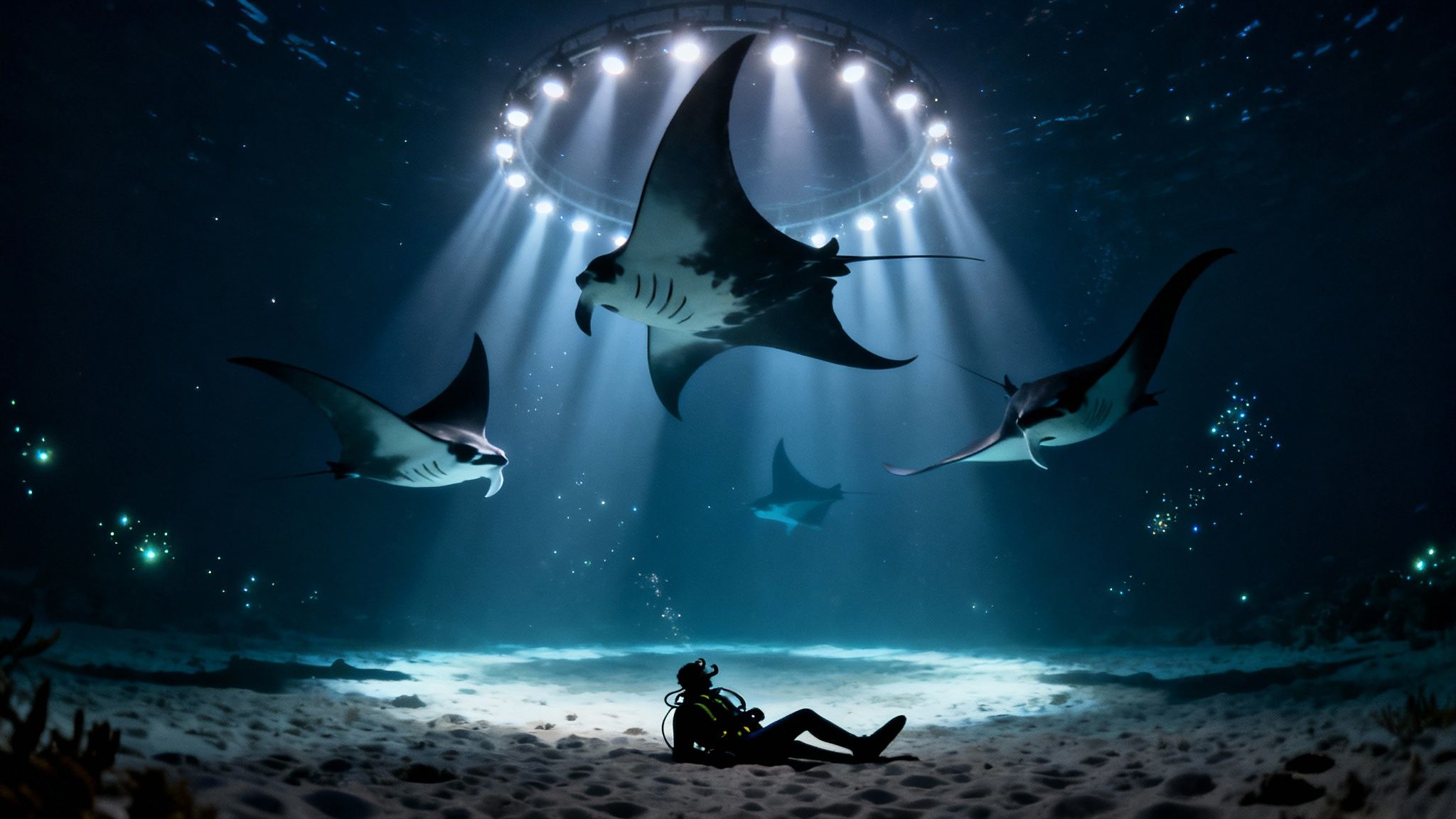
Shadowy figures emerge from the deep. These are giant, graceful manta rays—some with wingspans stretching over 12 feet—swooping and barrel-rolling through the beams of light. It's a surreal, silent dance that feels almost choreographed. You’re not just watching a nature documentary; you're in it.
There's a reason Kona is world-famous for this dive. It's the undisputed best place on Earth for this kind of predictable, up-close encounter. When you dive with Kona Honu Divers, you’re not just another person in the water; you're getting a front-row seat to one of nature’s most incredible spectacles.
But don't just take our word for it. See what fellow divers are saying about this truly life-changing trip.
Ready to see the magic for yourself? Come join us for an unforgettable manta ray dive tour and claim your spot at the campfire.
What Makes Kona the Manta Ray Capital of the World
There’s a reason Kona is known worldwide as the undisputed capital for manta ray encounters, and it’s not just by chance. It's the result of a unique, almost symbiotic relationship between divers and these gentle giants, perfected over decades. The magic of the manta ray night dive in Kona boils down to a simple, yet brilliant, food chain reaction that guarantees a spectacular show almost every single night.
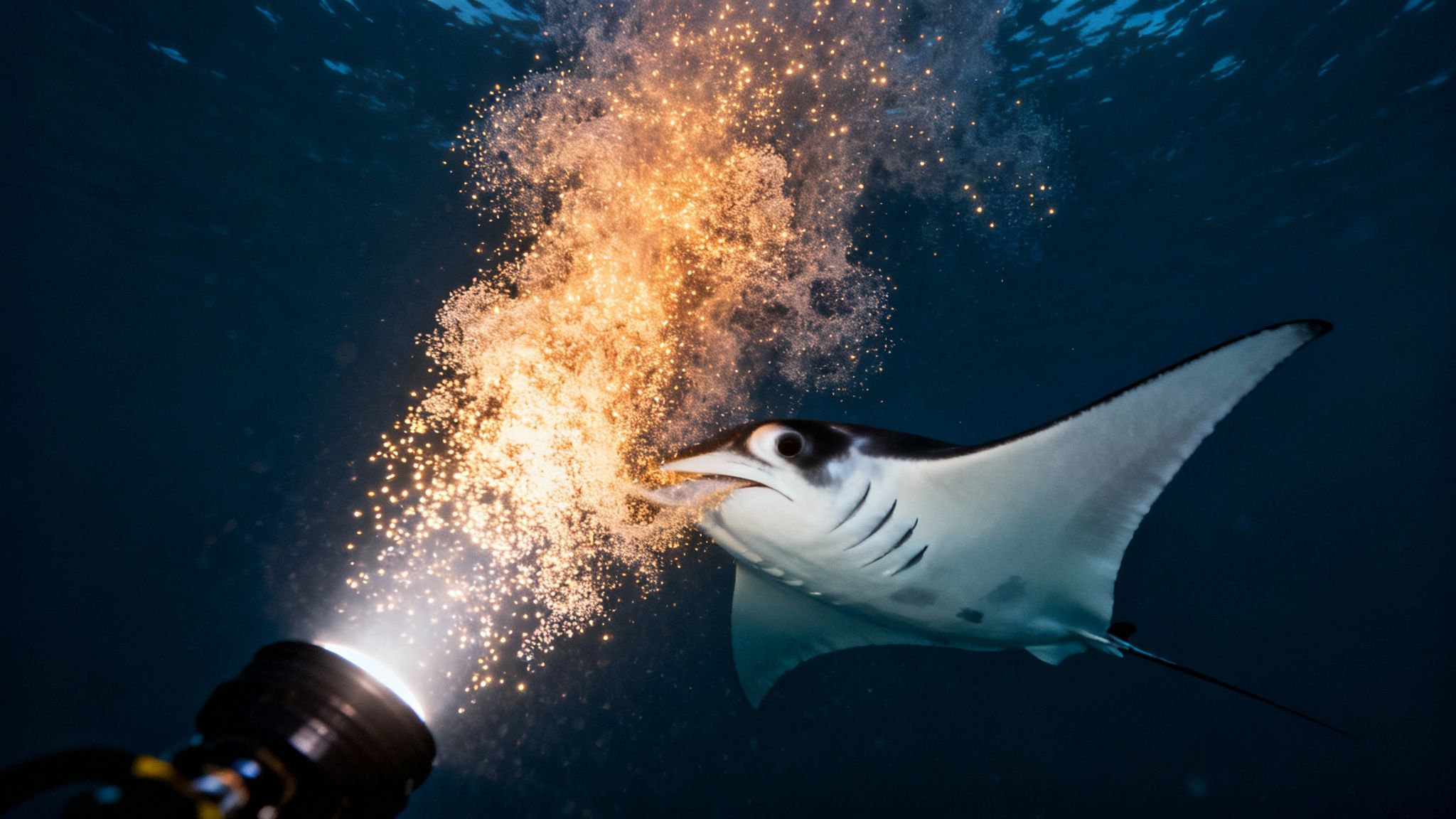
Think of it like an "underwater campfire." That's what we divers call it. We place powerful, specially designed lights on the ocean floor, and their beams cut through the darkness. Almost instantly, these lights attract massive, swirling clouds of phytoplankton—the microscopic critters that form the very foundation of the ocean's food web. For Kona's local manta rays, this glowing spectacle is an irresistible, all-you-can-eat buffet. It's the dinner bell ringing.
A Learned Behavior Turned Reliable Spectacle
Manta rays are incredibly smart animals with fantastic memories. Over the years, they've figured out that these specific spots, with these specific lights, mean an easy meal. This isn't some instinctual migration pattern; it's a learned behavior, a nightly routine that has been passed down through generations of Kona's mantas.
This learned trust is the secret sauce behind the dive's incredible reliability. It turns what would otherwise be a hopeful search for wildlife into a near-guaranteed, front-row seat to one of nature's greatest performances. For an encounter with a wild animal, the consistency is simply astounding.
The Kona Coast manta ray night dive boasts a staggering 85-90% sighting success rate, a number that truly cements its world-class status. This isn't a fluke; it's built on decades of observation and responsible site management. To put it in perspective, researchers logged over 10,000 individual manta ray sightings between 2009 and 2014 alone at the main dive sites.
This high probability means you can relax and just soak in the experience, knowing the show is almost certain to begin. And while Kona is the best-known spot, you can discover other places where to see manta rays in Hawaii in our detailed guide.
Why This Encounter Is So Dependable
So, what makes Kona’s setup so uniquely successful? It comes down to a perfect storm of factors:
- A Resident Population: Unlike many marine giants that migrate, Kona has a healthy population of manta rays that call this coastline home all year long.
- Perfect Geography: The calm, protected bays along the Kona coast are ideal nurseries for plankton to gather without being swept away by strong currents.
- Established "Campfires": The dive sites have been in operation for decades, giving the mantas plenty of time to learn, trust, and return to these reliable feeding stations.
This combination of intelligent animals, a plentiful food source, and a predictable setup makes the manta ray night dive in Kona one of the most dependable and awe-inspiring big-animal encounters you can have anywhere on the planet.
Why Garden Eel Cove is the Superior Choice
If you're planning a manta ray night dive in Kona, you’ll hear about two primary locations: Garden Eel Cove (also called Manta Heaven) and Manta Village. While both host manta rays, they offer vastly different experiences. We believe one is clearly superior.
At Kona Honu Divers, we made a deliberate choice years ago to run our manta ray dive tours exclusively at Garden Eel Cove. This decision wasn’t about convenience; it was driven by our commitment to providing the safest, most reliable, and awe-inspiring encounter for our guests.
A Protected Location with Calmer Waters
The most significant advantage of Garden Eel Cove is its geography. Tucked away in a naturally protected bay north of the Kona airport, it's shielded from the powerful southern swells that often affect other sites.
Manta Village, by contrast, is located in the more exposed Keauhou Bay. When a southern swell hits, it can lead to rough boat rides, challenging dive conditions, and poor visibility, sometimes forcing cancellations. Garden Eel Cove’s protected nature ensures consistently calm seas and clear water, providing a more comfortable and enjoyable experience from start to finish.
This reliability is key. For a world-class dive, you want predictability, not a gamble on the weather.
The Best Viewing Area and a Healthier Reef
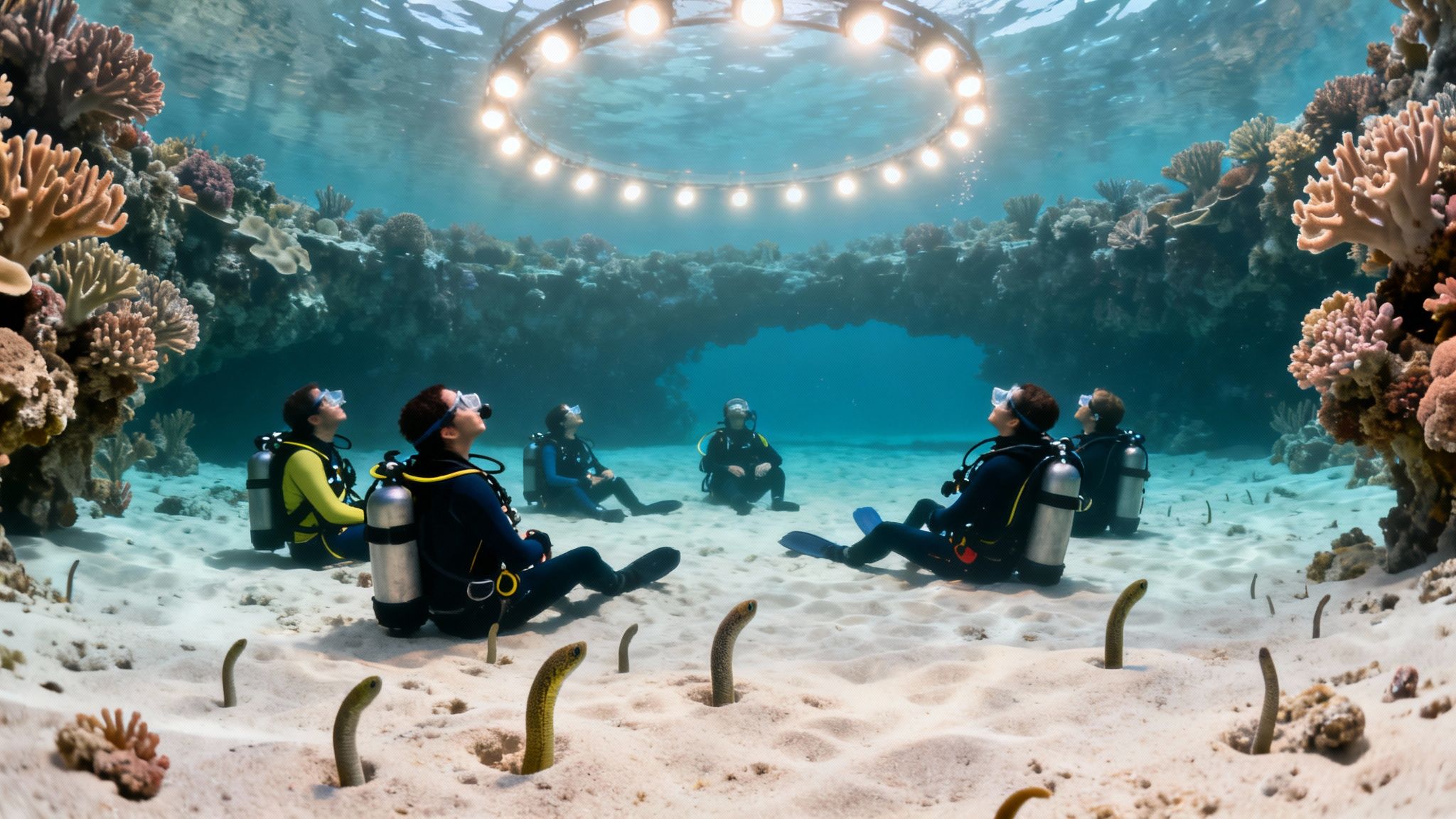
Beyond the calm conditions, Garden Eel Cove’s underwater topography is perfectly suited for viewing manta rays. The dive site features a large, sandy patch known as “the campfire,” where dive operators place their lights. This creates a natural amphitheater where divers can comfortably settle in a semi-circle, offering an unobstructed, stadium-style view of the action.
This organized "campfire" is not only better for divers but also more respectful to the mantas, allowing for a passive and predictable interaction. Manta Village lacks this well-defined viewing area, which can lead to a more scattered and less comfortable experience.
Furthermore, the manta ray dive tour is a two-tank experience, and the first dive matters. The coral reef surrounding Garden Eel Cove is vibrant, healthy, and teeming with marine life. This makes the initial twilight dive a spectacular adventure in its own right—a perfect warm-up for the main event. The reef at Manta Village is generally considered less pristine.
For these reasons—a protected location, a superior viewing area, and a healthier reef—we exclusively choose Garden Eel Cove to ensure our divers have the best possible manta ray night dive in Kona.
You can learn more about why Manta Heaven, also known as Garden Eel Cove, is such a unique place on our blog.
Getting Ready for the Manta Ray Night Dive
You might be surprised to learn just how easy it is to prepare for Kona's world-famous manta ray night dive. There's no need for any advanced certifications or special training. We’ve designed the entire experience to be safe, accessible, and absolutely unforgettable, even if you’re a relatively new diver with an Open Water certification.
The dive itself is quite straightforward. You'll be in shallow water, typically around 35-40 feet, and you won't be swimming around much. For most of the dive, you’ll be settled in one spot on the sandy bottom, looking up at the show. This simple, stationary profile makes it one of the most manageable and spectacular night dives you can do.
What We Handle vs. What You'll Need to Pack
Here at Kona Honu Divers, we’ve got all the essential gear covered. Our aim is to get you in the water with zero fuss so you can focus on the magic of the mantas.
When you book a manta ray dive with us, you can count on us to provide:
- A wetsuit that fits you properly to stay warm and comfortable.
- A top-quality, well-maintained BCD and regulator set.
- Powerful dive lights designed to attract the plankton and bring in the mantas.
- Tanks and all the necessary weights.
We even have snacks and drinks on board to keep you fueled up between dives. This all-inclusive approach means you don’t have to worry about lugging your own heavy scuba equipment to Hawaii. For a full rundown, check out our guide on the gear you will need for your Kona diving adventure.
With all the heavy lifting out of the way, your packing list is nice and short. Just be sure to bring these few personal items:
- Your scuba certification card (this is a must!)
- A swimsuit to wear under your wetsuit.
- A towel.
- A warm sweatshirt or jacket for the boat ride home—it can get chilly once the sun goes down.
Your Two-Tank Journey into the Night
Our manta adventure is much more than a single dive; it's a two-part experience that builds anticipation from dusk to dark. We start with a beautiful twilight reef dive right before sunset. This first dip in the water is your chance to get reacquainted with your gear, dial in your buoyancy, and watch as the reef life at Garden Eel Cove shifts from its daytime routine to its nighttime hustle.
After that first dive, you'll come up to the surface just in time to catch a spectacular Kona sunset. During this break, our divemasters will give you a detailed briefing on what to expect for the main event.
This briefing is where we set you up for success. We'll walk you through all the safety protocols, explain how our lights create the "campfire" that draws the mantas in, and cover the golden rules of passive interaction. This is how we guarantee a safe and respectful encounter for both divers and the giant rays.
We are serious about passive observation. You’ll learn exactly how to position yourself so the mantas feel comfortable swooping and feeding all around you. This respectful approach is what makes the experience so genuine—the mantas often glide within inches, but it's always on their terms. By the time you get back in the water, you'll be confident, prepared, and ready for a memory that will last a lifetime.
Diving with Purpose: Protecting the Manta Population
When you slip into the dark waters for a manta ray night dive in Kona, you're doing more than just witnessing a spectacle. You're becoming part of a powerful and successful story of sustainable ecotourism. This incredible encounter is the lifeblood for both scientific research and marine conservation, turning a bucket-list adventure into a direct contribution to protecting these gentle giants.
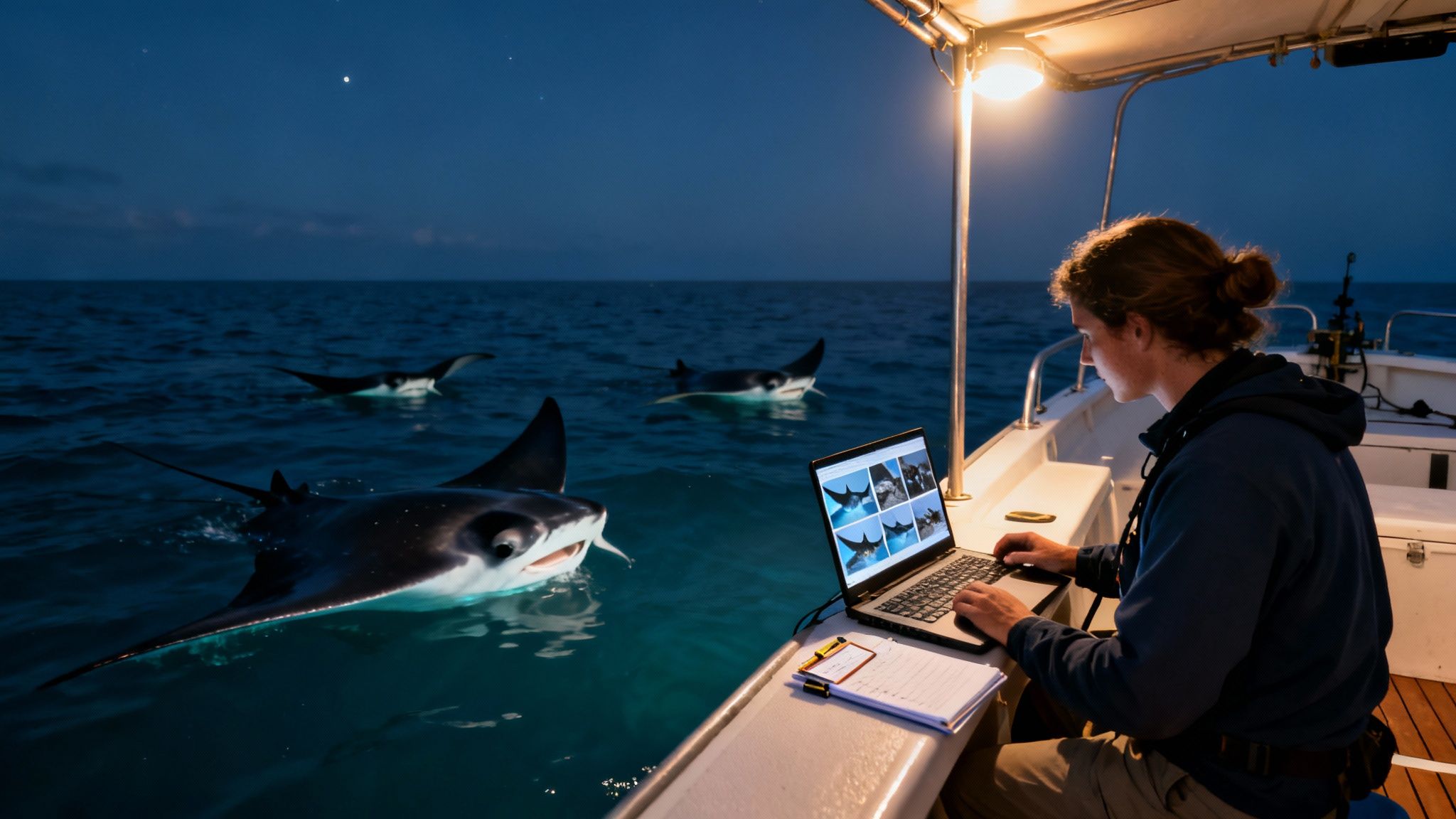
This unique relationship between tourism and conservation has given scientists a front-row seat, allowing them to build one of the world's most detailed databases on a single manta ray population. Researchers can identify individual rays by the unique spot patterns on their bellies, which act just like a human fingerprint. Over the years, this has helped us identify and track hundreds of individual mantas, providing a treasure trove of data on their life cycles, social habits, and migration patterns.
Ecotourism as a Conservation Tool
The numbers really tell the story here. The manta ray night dive in Kona draws around 80,000 people every year, making it one of the largest and most concentrated marine wildlife tourism operations on the planet. This huge interest supports our local economy and, just as importantly, funds critical conservation work.
A perfect example is the installation of over 90 permanent mooring buoys along the coast. This was a massive undertaking, funded by the dive industry, to prevent anchors from destroying the fragile coral reefs below. It's a tangible result of responsible tourism in action. You can learn more about this unique attraction and discover ten fascinating facts about manta rays in Hawaiʻi.
Of course, this success hinges on responsible operators. At Kona Honu Divers, we take our role as guardians of this experience very seriously, committing to the highest standards of manta etiquette and environmental stewardship.
Everything we do is built on a foundation of respect for the ocean and the animals who call it home.
We follow strict, non-invasive guidelines that allow the manta rays to feed naturally and without stress. This commitment to passive observation is what makes the interaction so authentic and magical—it allows the mantas to approach on their own terms, turning the dive into a truly wild encounter.
Your Role in Manta Preservation
Every person who joins one of our manta ray dive tours becomes an active partner in this conservation success story. Your participation sends a powerful message: a living, thriving manta ray is far more valuable to this community than one harmed by careless or unsustainable practices.
That's why our pre-dive briefings are so important. We take the time to educate every guest on how to be a responsible observer. It boils down to a few key principles for a safe and respectful dive:
- Stay Stationary: We have you settle on the sandy bottom, creating a stable and predictable environment that the mantas are comfortable with.
- No Touching: This is our golden rule. Touching a manta can damage the protective mucus coating on its skin, leaving it vulnerable to infection.
- Lights Up: Your dive light is your tool to attract plankton. We teach you to shine it upward, creating the "campfire" that draws the mantas in, without ever shining the lights directly in their eyes.
By following these simple guidelines, you help ensure this incredible natural wonder can be enjoyed for generations to come. Your adventure becomes a direct investment in the future of Kona's beloved manta ray population.
Your Manta Ray Night Dive Questions, Answered
It's completely normal to have a few questions before you commit to a once-in-a-lifetime adventure like the manta ray night dive. Let's walk through some of the most common things people ask, so you can feel confident and excited about what's ahead.
Is the Manta Ray Night Dive Safe?
Absolutely. Safety is our number one priority, and every part of this experience is designed with that in mind. We conduct the dive in a controlled, well-lit area at a shallow depth of just 35-40 feet, making it comfortable for most certified divers. Before you even get in the water, our professional divemasters will give you a thorough briefing so you know exactly what to expect.
And what about the mantas? They're often called "gentle giants" for a reason. These graceful creatures are filter feeders with no teeth, stingers, or barbs. They are completely harmless to humans and are only interested in the plankton attracted by our lights.
What Happens if No Manta Rays Show Up?
This is a fair question—we are dealing with wild animals, after all! But what makes Kona so legendary for this dive is its incredible consistency. The success rate is consistently over 90%, which is almost unheard of for a major wildlife encounter.
In the rare event that the mantas decide to be shy, we’ve got you covered. Here at Kona Honu Divers, we have a "manta guarantee." If you don't see any mantas on your tour, you can join our manta ray dive tour again on another night for free (subject to availability, of course).
Can I Touch the Manta Rays?
This is a firm no, and it’s the most important rule we have. Touching the manta rays can harm them. Their skin is covered in a delicate mucus layer that protects them from infection, and our touch can easily damage it.
We practice a philosophy of passive observation. This means we let the mantas lead the show. By staying still and giving them space, you allow them to feel comfortable enough to glide, swoop, and dance right over your head. It's a far more magical and authentic experience.
By respecting their space, we also support the ongoing research that makes this encounter possible. Scientists have identified over 300 individual rays here since 2009, helping us understand and protect the estimated 450+ mantas in Kona's population. You can learn more about the fascinating statistics of Kona's estimated 450+ mantas.
Is Diving a Better Experience Than Snorkeling?
Both are incredible, but they offer two totally different points of view. Snorkelers get a spectacular bird's-eye view from the surface, watching the action from above. It’s an amazing sight.
Diving, however, puts you right in the front-row seat. You'll be settled on the sandy bottom, looking up as these magnificent creatures perform their underwater ballet just inches above you. It’s a truly immersive, awe-inspiring perspective that you just can’t get from the surface.
If you have more questions buzzing in your head, check out this comprehensive Manta Ray Night Dive FAQ page for even more detail.
Ready to see it for yourself? Let’s get you booked for an unforgettable night.