
Picture this: you're floating in the warm, dark Pacific waters off the Big Island, and suddenly, a gentle giant with a wingspan wider than a car glides inches from your face. This isn't a dream—it's the Kona manta ray night dive, one of the most incredible wildlife encounters you can have anywhere on the planet. It's consistently ranked as a top global dive experience, and for good reason. It’s pure magic.
What Is the Kona Manta Ray Night Dive
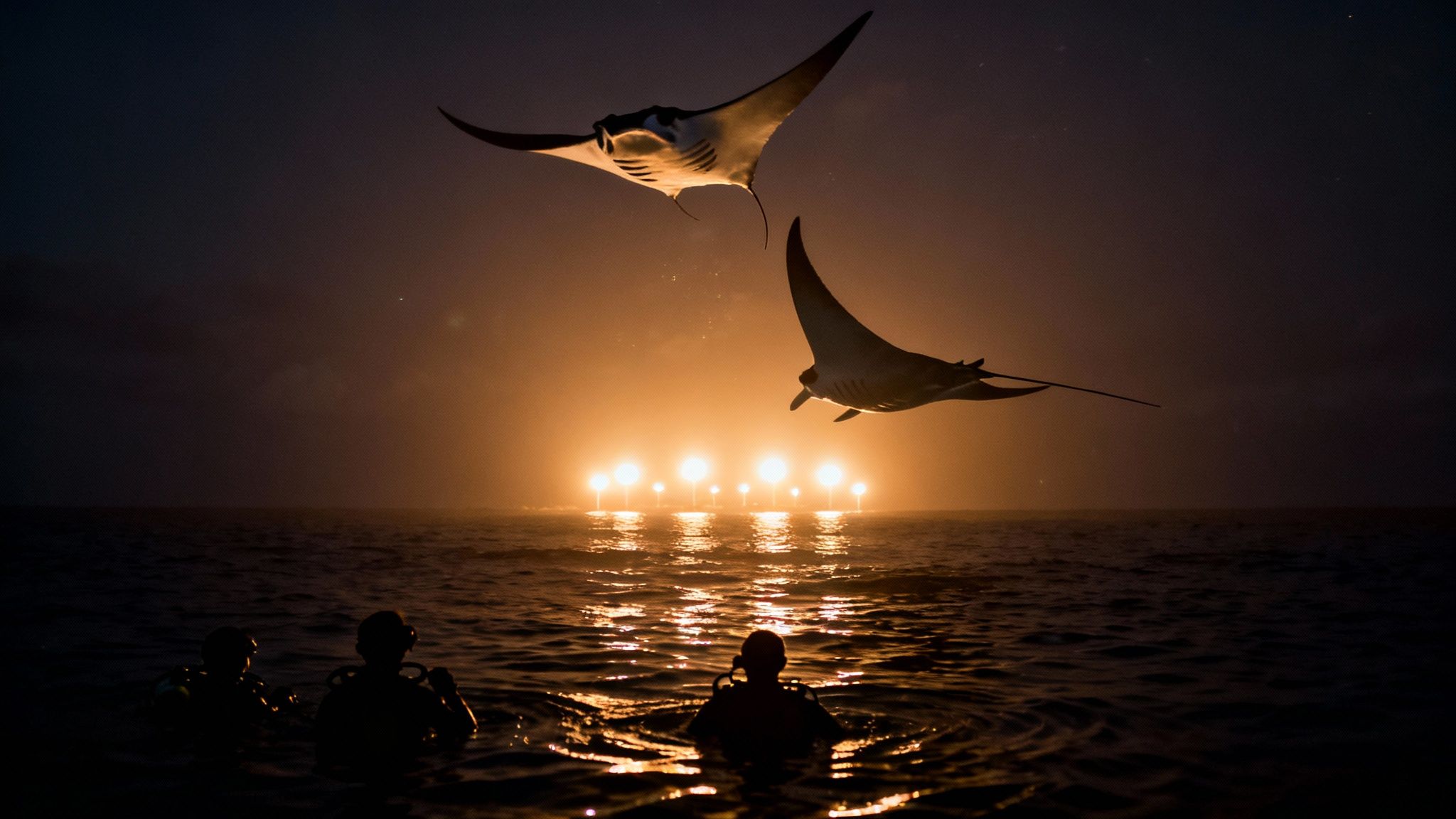
So, how does it all work? Think of it as dinner and a show, where the mantas are the stars and we set the stage. After sunset, our boats head out to specific dive sites along the Kona coast. We then place powerful, eco-friendly lights on the ocean floor, creating what we affectionately call the "manta campfire."
This underwater spotlight acts like a giant magnet for plankton, the microscopic critters that manta rays love to eat. Before you know it, the real show begins. Giant manta rays, some with wingspans over 12 feet, swoop into the beams of light. They perform effortless, acrobatic barrel rolls to gulp down the concentrated plankton, putting on a graceful ballet right before your eyes.
A World-Renowned Phenomenon
This isn't just another local dive; it's an internationally acclaimed attraction. The manta ray night dive in Kailua-Kona draws an incredible 80,000 visitors every single year, cementing our town's reputation as the best place on Earth for reliable manta ray sightings. It’s not uncommon to find yourself in 75°F water surrounded by several of these majestic creatures. You can learn more about this incredible Kona attraction and what makes it so special.
One of the coolest parts is that you don't chase the mantas. Instead, you become part of the environment. Divers rest on the sandy bottom, and snorkelers hold onto a floating light raft on the surface. This allows the mantas to get incredibly close—sometimes just inches away—as they feed, giving you a breathtakingly intimate experience without ever disrupting their natural behavior.
Why Choose Kona Honu Divers
To truly appreciate a bucket-list adventure like this, you need to go with a top-rated, safety-focused operator. At Kona Honu Divers, we've built our reputation on providing an exceptional experience from start to finish. Our professional crew, modern boats, and profound respect for the marine ecosystem ensure your adventure is not only unforgettable but also responsible.
When you dive with us, you're more than just a customer; you're our guest at one of nature's greatest performances. We're passionate about delivering a safe, educational, and genuinely moving encounter with Kona's majestic manta rays.
Ready to see the magic for yourself? Let’s get you a spot on one of the best manta ray dive tours in the world.
Why Garden Eel Cove Is the Premier Manta Dive Site

When you start looking into a manta ray night dive in Kona, you’ll hear a few different site names thrown around. But ask any seasoned local diver, and one name comes up again and again for its reliability, comfort, and sheer wow factor: Garden Eel Cove. While other sites exist, Garden Eel Cove is the superior choice for a dive tour.
This place isn't just another spot on the map; we call it "Manta Heaven" for a reason. The experience here is consistently more magical than anywhere else. It’s not just chance—it's the perfect combination of a protected location, a better viewing area, and healthier surrounding reefs that sets the stage for a truly jaw-dropping encounter. To really get a feel for the place, you can learn more about Manta Ray Heaven at Garden Eel Cove.
The Advantage of a Protected Location
One of the biggest things that sets Garden Eel Cove apart is its geography. Tucked in near the Kona International Airport, the cove is naturally shielded from the big, open-ocean swells that can make other sites challenging, or even force cancellations.
This natural shelter gives us a huge advantage:
- Calmer Waters: The conditions are almost always smoother, which makes the whole experience—from the boat ride to the dive itself—more comfortable and relaxing.
- Better Visibility: With less surge stirring things up, the water stays clearer. That means you get a crystal-clear view of the main attraction.
- More Reliable Sightings: Because the conditions are so stable, it’s a dependable feeding spot for the mantas. Our success rate for sightings here is incredibly high, all year long.
This built-in protection makes Garden Eel Cove a far better choice, especially if you're new to night diving or just prefer to avoid a rocky boat ride.
The protected nature of Garden Eel Cove ensures that the focus remains entirely on the incredible wildlife encounter, not on battling unpredictable ocean conditions. It provides a consistently safe and serene stage for nature's greatest show.
An Underwater Amphitheater for the Perfect View
The setup at Garden Eel Cove is something special. We like to call it the underwater "campfire." Divers settle into a large, sandy patch in about 35-40 feet of water, arranged in a semi-circle. In the middle, we place a powerful light—our campfire—that draws in the plankton.
This creates a natural amphitheater, a vastly superior viewing area compared to other locations. You’re not finning around in the dark hoping to find a manta. Instead, you get comfortable, find your spot, and the show comes to you. The mantas swoop and glide directly overhead, performing their famous barrel rolls to scoop up plankton, sometimes just inches from your face. It's a far more intimate and organized viewing experience than at other sites, and the sandy bottom means we aren't risking any harm to the precious coral reef.
More Than Just Mantas: A Vibrant Reef Experience
While the mantas are the headliners, the show at Garden Eel Cove starts well before sunset. Our 2-Tank Manta Dive charter includes a twilight reef dive at the very same spot, and it’s a world-class dive on its own.
The reef surrounding our sandy "campfire" is absolutely buzzing with life, offering a better reef experience than other manta sites. As the sun dips below the horizon, you get to see the fascinating shift change of the ocean—daytime fish find their hiding spots while the nocturnal creatures begin to emerge. You’ll see everything from colorful reef fish and moray eels to octopus and, of course, the tiny garden eels that poke out of the sand and give the cove its name. This first dive adds so much value, making the entire trip a spectacular double feature.
Ready for the best seat in the house? Come join us at Garden Eel Cove for the ultimate manta ray night dive.
Preparing for Your Manta Ray Night Dive Adventure
A truly unforgettable night with Kona's manta rays starts long before you ever hit the water. Getting properly prepared is what separates a good trip from a truly magical one. When you know what to expect, what to bring, and the key safety rules, you can just relax and soak in the entire once-in-a-lifetime experience.
This isn’t just a quick dip in the ocean; it's a whole evening event designed for maximum comfort and awe. We always kick things off with a thorough pre-dive briefing from our crew. Then, we get you in the water for a beautiful dusk reef dive. This first dive is a great chance to get your bearings, check your gear, and watch the reef transform as day turns to night, all before the main event even begins.
Certification and Safety Protocols
If you’re planning to scuba dive, you’ll need an Open Water Diver certification (or an equivalent from any major agency). Freshly certified? No problem at all. This is a fantastic dive for new divers because the profile is shallow and the conditions are typically calm and easy to manage. And of course, if you're snorkeling, no certification is needed!
Our number one priority is always safety—for you and for the mantas. The most important rule of the entire encounter is simple: do not touch the manta rays. These gentle giants are covered in a protective mucus layer, kind of like a shield against infection. Touching them can damage this coating and leave them vulnerable.
Beyond that, just listen to your divemaster or guide. They’re the experts out here and know exactly where to position everyone for the best views while keeping both divers and animals safe. Sticking with your group and following their lead is the key to a respectful and jaw-droppingly cool encounter.
What to Pack and What We Provide
Figuring out what to bring can feel like a chore, so we make it easy. We handle all the heavy stuff. Kona Honu Divers provides the tanks, weights, and top-notch rental gear, including regulators, BCDs, and dive computers.
That said, a few personal items will make a world of difference for your comfort, especially after the dive. Even in Hawaii, the boat ride back to the harbor can get a little chilly once you’re out of the water.
A warm jacket and a dry towel are your two best friends on this trip. Having something warm and dry to slip into after your dive makes the beautiful boat ride back under the stars so much more enjoyable.
To make packing a breeze, we've put together a simple checklist so you know exactly what to bring and what to leave to us. If you want a deeper dive into gear, check out our full guide on the gear you will need for your Kona diving adventure.
Your Manta Ray Night Dive Checklist
Use this simple checklist to see what you should bring versus what your tour operator provides for the manta ray night dive.
| What You Should Bring | What Kona Honu Divers Provides |
|---|---|
| Proof of scuba certification (if diving) | All necessary scuba gear (tanks, weights, BCD, regulator) |
| A dry towel for after the dive | High-quality snorkel gear for snorkelers |
| A warm jacket, hoodie, or windbreaker | Professional, experienced dive guides and boat crew |
| Swimsuit (wear it to the boat) | High-powered, eco-friendly lights for the manta viewing |
| Any personal dive gear you prefer to use | Snacks and refreshments on the boat |
| Reef-safe sunscreen (for the boat ride out) | A safe, comfortable, and well-maintained vessel |
| Reusable water bottle to stay hydrated | A comprehensive safety and dive briefing |
| Your underwater camera to capture the magic | An unforgettable and safe underwater experience |
By showing up with these few key items, you’ll be set to enjoy every moment of your manta ray night dive. From the incredible Kona sunset to the final, graceful pass of a gentle giant just inches from your face, you'll be comfortable, safe, and ready for the magic.
How to Capture Unforgettable Underwater Photos and Videos
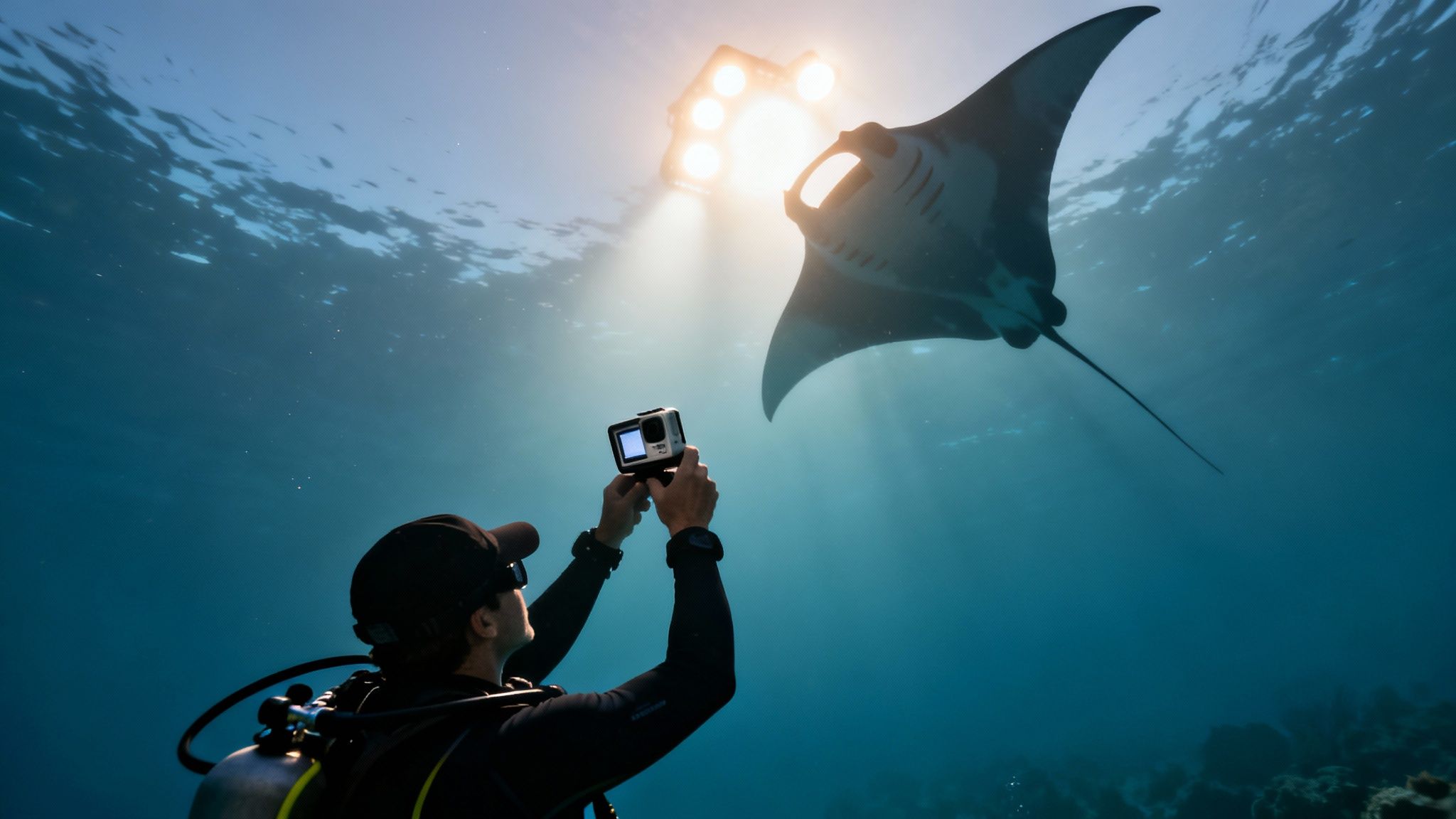
For a lot of people, getting amazing photos of the Kona manta ray night dive is just as important as the dive itself. But let's be honest: shooting underwater in the dark is a unique challenge. Whether you're a pro with a full rig or just bringing your GoPro along for the ride, a little preparation goes a long way toward getting shots you’ll be proud of.
Your goal is to capture the memory of these huge, graceful animals soaring through the beams of light. With the right mindset and a few key techniques, you can walk away with images that truly capture the magic of the moment.
Tips for Beginners with Action Cameras
Bringing an action camera like a GoPro? Smart move. My advice: focus on shooting video. The way the mantas glide and swoop is best captured in motion, and you can always grab a high-quality still photo from your video footage later.
Before you even think about jumping in the water, take a minute to dial in your settings:
- Resolution & Frame Rate: Set your camera to its highest resolution (like 4K) and choose a frame rate of at least 30fps. This is your secret to getting sharp, smooth video that doesn't look choppy.
- Stabilization: Turn it on! Image stabilization is a lifesaver for reducing the wobbly, shaky footage that happens when you’re floating in the ocean.
- Low-Light Mode: If your camera has a "night mode" or "low-light" setting, now's the time to use it. It'll help the sensor pick up more detail when things get dark.
A classic rookie mistake is using the camera's built-in flash or a small attached light. They’re just not powerful enough for this environment. All you'll do is light up all the tiny particles in the water right in front of your lens—we call that backscatter—and ruin your shot. It’s far better to just rely on the big, powerful lights your dive operator sets up.
Advanced Techniques for Photographers
If you're a diver with a more serious camera setup, the manta dive is a playground. The whole game is about controlling your light. To really make your images pop and fight back against the darkness, external strobes or strong video lights are pretty much non-negotiable.
Here are a few starting points to get your manual settings in the ballpark:
- Aperture: Open it up. Start with a wide aperture (a low f-stop number, like f/2.8 to f/5.6) to let as much light as possible hit your sensor.
- Shutter Speed: You can go a bit slower here. Try something between 1/60s and 1/125s. This helps capture the ambient glow from the lights and the fluid motion of the mantas.
- ISO: Keep your ISO as low as you can get away with to avoid that ugly, grainy noise. I'd start around ISO 400 and only bump it up if you absolutely have to.
Composition and Respectful Positioning
Great photos aren't just about settings; they're about where you put your camera and how you frame the shot. One of the most powerful compositions on this dive is to shoot upwards. When you frame a manta against the bright glow of the surface lights, you create a stunning, dramatic silhouette that tells the whole story.
But most importantly, remember where you are. Your position needs to be respectful of the wildlife and everyone else on the dive. We have one golden rule: never, ever touch the mantas. Find your spot on the sandy bottom, get comfortable, and let them come to you. By staying still and patient, you'll not only get the best shots, but you'll also ensure the mantas feel safe, allowing this incredible experience to continue for years to come.
Exploring Other World-Class Dives in Kona
While the manta ray night dive in Kona is an absolute showstopper, it’s really just the opening act for what the Big Island has in store. The same dramatic volcanic landscapes and crystal-clear waters that create the perfect stage for the mantas also serve up an incredible variety of dive sites for every interest.
Once you’ve witnessed the manta ballet, you’ll be itching to see what else lies beneath the surface. And believe me, there's plenty. At Kona Honu Divers, we’re ready to show you everything from otherworldly deep-water drifts to thrilling advanced sites. The adventure has only just begun.
The Kona Blackwater Dive: An Otherworldly Experience
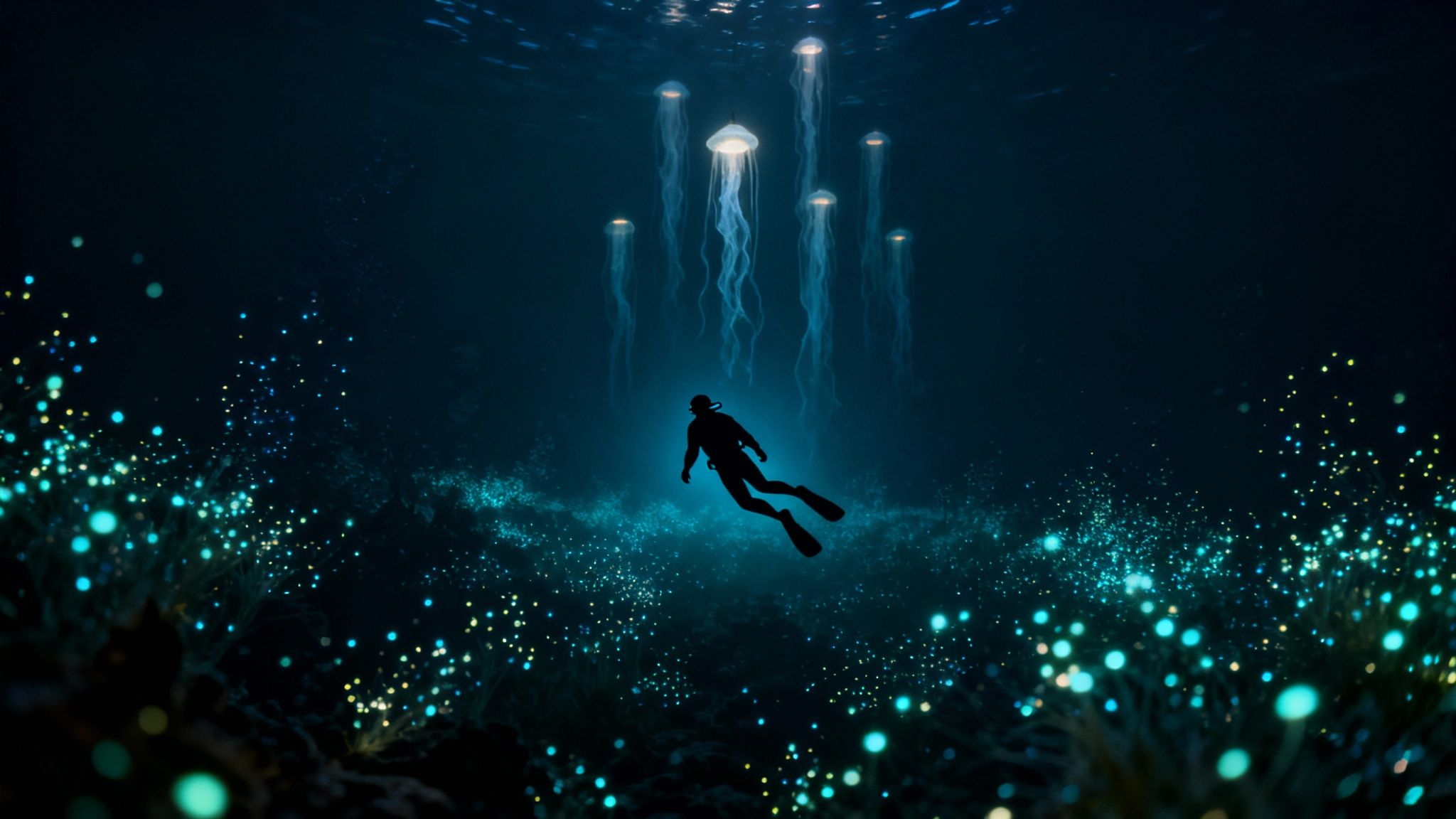
Picture this: you're suspended over thousands of feet of inky black water, drifting in the deep ocean. It feels less like diving and more like spacewalking. This is the heart of the legendary Kona blackwater dive, a truly unique adventure. Every night, a massive vertical migration brings a host of bizarre and beautiful creatures up from the abyss to feed near the surface.
On this one-of-a-kind dive, you'll come face-to-face with lifeforms most people will never see outside of a documentary:
- Bioluminescent jellies pulsing with their own internal light.
- Translucent larval fish that look like tiny, intricate glass sculptures.
- Strange drifters like pteropods and salps that seem straight out of science fiction.
It’s an experience that will completely change your perception of what a night dive can be.
The blackwater dive is a truly humbling experience. It reminds you just how much life exists beyond the reef's edge, in a world governed by darkness and light. It’s a must-do for any adventurous diver visiting Kona.
Advanced Diving For Experienced Divers
Ready to take your skills to the next level? For divers with a bit more experience, Kona is an underwater playground. The island’s volcanic past has left behind a breathtaking sub-aquatic world of lava tubes, massive archways, and sheer drop-offs just waiting to be explored.
Our premium advanced dive tour is designed specifically for certified divers who want a taste of Kona's wilder side. We venture out to more challenging sites that reward you with unforgettable sights, from navigating ancient lava formations to discovering hidden shark nurseries. These dives are a different kind of thrill—one built on skill, control, and the pure joy of discovery.
To get a better sense of what’s out there, check out our guide to some of the most beautiful Kona diving sites. Whether you're drawn to the strange creatures of the deep or the rugged volcanic reefs, your next adventure is waiting. Explore all our diving tours and see what awaits you beyond the mantas.
How to Book Your Unforgettable Manta Ray Dive
You've learned all about what makes the manta ray night dive at Garden Eel Cove so special and why our approach is focused on safety and respect for these incredible animals. Now, there's just one thing left to do: make it happen.
The Kona manta ray night dive is more than just another tour; it’s a chance to witness something truly spectacular, an underwater ballet that will stick with you for a lifetime. When you dive with Kona Honu Divers, you're not just a passenger. You're part of a small, dedicated group led by a team that pours its heart into ensuring you have a safe, moving, and unforgettable encounter with these gentle giants.
Secure Your Spot Today
Booking your adventure is straightforward. Head over to our manta ray dive tours page to see available dates and lock in your spot. These tours are incredibly popular and fill up fast, especially during peak travel times, so we always suggest booking well in advance. If you're coordinating a whole trip, using bespoke travel agent services can also be a huge help in pulling all the pieces together.
The calm, protected waters of Garden Eel Cove and the breathtaking grace of the manta rays are waiting. This is one of those experiences you'll be talking about for years to come. Don't miss out on your chance to see it for yourself.
Ready to take the plunge? Your front-row seat to one of the ocean's greatest shows is just a click away.
Your Manta Ray Night Dive Questions, Answered
Thinking about joining us for this incredible adventure? We get it, you probably have a few questions. Let's tackle some of the most common ones we hear, so you can feel totally confident and excited about what's in store.
Is the Manta Ray Night Dive Safe?
Yes, it's incredibly safe, especially when you're with an experienced crew like ours at Kona Honu Divers. Our divemasters and boat captains know these waters like the back of their hands, and every detail of the trip is managed by certified professionals. We specifically choose calm, protected sites like Garden Eel Cove to ensure a smooth and comfortable experience.
And what about the mantas? They're the definition of gentle giants. As filter feeders, they don’t have any teeth, stingers, or barbs. The most important rule of the night is simple: follow your guide's instructions and never touch the mantas. Touching them can damage the protective mucous coating on their skin, so we look with our eyes only.
When Is the Best Time of Year to See Manta Rays in Kona?
This is the best part—anytime is a great time! Kona’s manta ray population doesn't migrate; they live here year-round. That means we have a spectacular success rate of over 90% for seeing them, no matter if you book your trip in January or July.
Sure, the summer months might bring slightly flatter seas, but we have unforgettable, magical encounters every single night of the year. Your chances for a breathtaking show are just as high in the winter as they are in the summer.
Can I See the Mantas If I Am Not a Scuba Diver?
You absolutely can! Our snorkeling option is designed to give you an equally amazing front-row seat. Snorkelers float comfortably on the surface, holding onto a custom-made light board. This board illuminates the water below, creating a beacon for plankton.
The light attracts the plankton, and the plankton attracts the mantas. They'll come right up to the surface to feed, performing their famous barrel rolls just feet below you. It's a breathtaking bird's-eye view of the entire ballet.
This setup makes our manta ray night dive in Kona the perfect adventure for families and groups with both divers and non-divers. No one misses out on the magic.
How Close Will the Manta Rays Get to Me?
Get ready for an up-close-and-personal experience. The mantas are completely focused on one thing: feeding on the plankton concentrated in our light beams. This means they will swoop, glide, and loop within inches of you.
It's a mesmerizing experience that feels incredibly personal. While you can't touch them, you won't need to. Their proximity is what makes the encounter so powerful. Your only job is to stay still, breathe, and take in the majestic underwater show happening right before your eyes.
Ready to see it all for yourself? Let's get you in the water! Book your spot on our world-famous manta ray night dive tour and prepare for a night you’ll talk about for years to come.