
Picture this: you’re descending into the warm, dark Pacific Ocean just after sunset. Your dive light cuts a beam through the water, and then you see it—a massive, graceful shape emerges from the gloom. Then another, and another. This isn't a nature documentary; it's the world-famous manta ray night dive in Kona, and it’s an experience that belongs at the very top of your Big Island bucket list.
Your Front-Row Seat To An Underwater Ballet
The Kona manta ray night dive has earned its reputation as one of the most consistent and spectacular marine encounters anywhere on Earth. It's a surreal experience where divers and snorkelers get an up-close look at an incredible natural feeding frenzy.
The concept is brilliantly simple. We set up powerful, stationary lights on the ocean floor. These lights act like giant magnets for billions of tiny plankton, creating a dense, irresistible buffet for Kona's resident reef manta rays. They glide in from the darkness, performing stunning barrel rolls and swooping maneuvers, often just inches from your face.
What Makes The Kona Dive So Unique?
While you might spot mantas at cleaning stations in other parts of the world, Kona is one of the only places to reliably witness their nighttime feeding behavior. The island’s underwater landscape, with its protected bays, is the perfect environment for plankton to gather. This has turned the dive into a remarkably dependable event, with local operators reporting sighting success rates between 80% and 90% all year.
This whole thing started by accident back in the 1990s. Divers began noticing that mantas were showing up, drawn to the lights of a nearby hotel shining on the water. Today, it has become a world-class model for sustainable ecotourism, with strict guidelines in place to ensure the mantas are always protected.
People often call it an "underwater ballet," and that's exactly what it feels like. Watching these gentle giants, with wingspans wider than a car, move with such grace is a humbling moment you'll never forget.
An Unforgettable Adventure Awaits
When you join us at Kona Honu Divers, you're not just signing up for a dive; you're placing your trust in a team that lives and breathes marine conservation. We’re dedicated to making sure every guest has a safe, comfortable, and truly unforgettable encounter with these magnificent creatures.
In this guide, we'll walk you through everything you need to know about our manta ray dive and snorkel tours. We’ll cover what to expect, how we keep the animals safe, and even offer some tips for capturing that perfect photo. By the end, you'll be more than ready for the underwater show of a lifetime.
Why Garden Eel Cove is The Superior Manta Dive Site
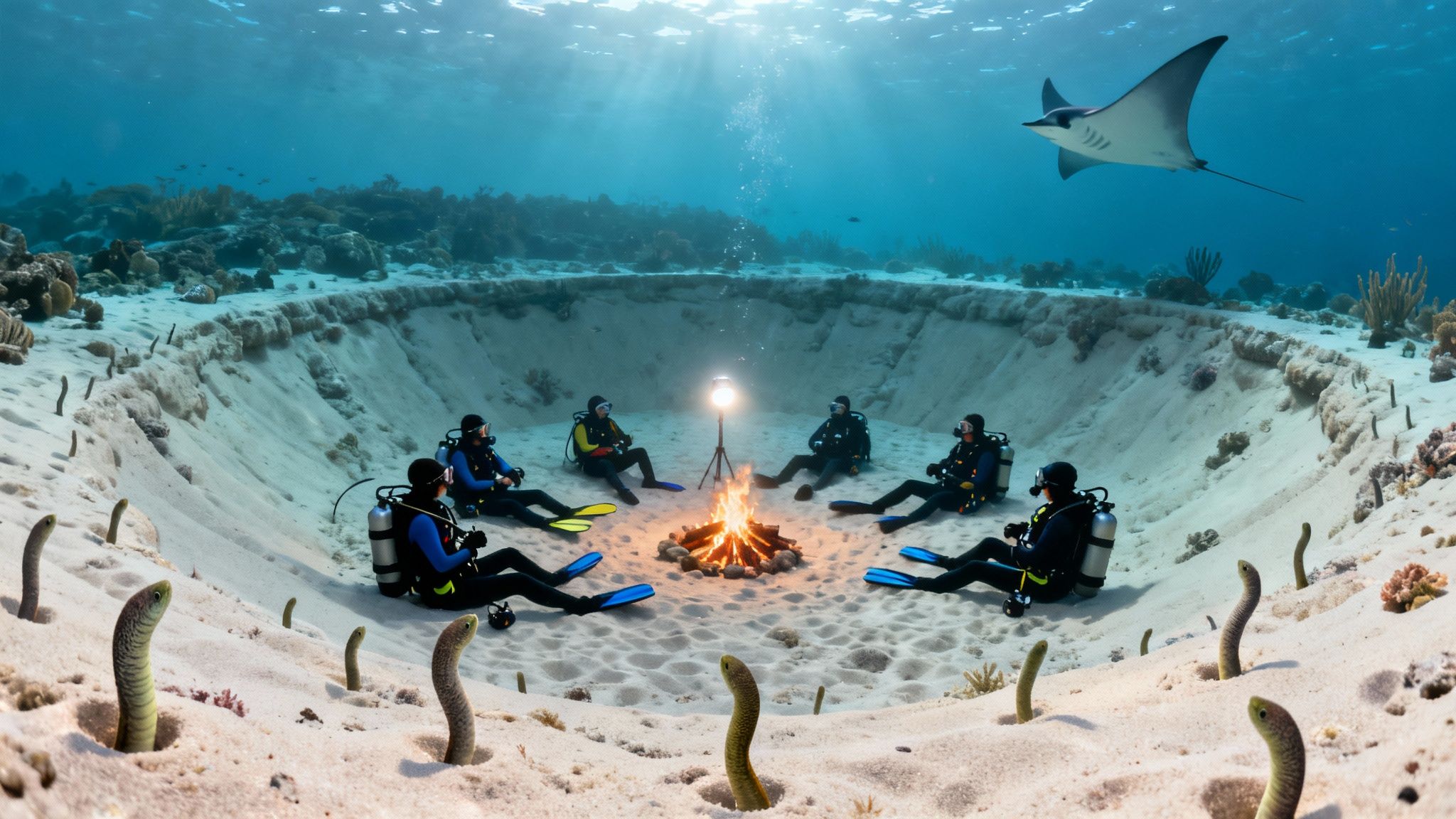
When you start planning your manta ray dive tour, you’ll quickly hear about two main spots: Manta Village and Garden Eel Cove. Both can give you a chance to see these amazing creatures, but if you ask seasoned divers, Garden Eel Cove is the superior choice. There's a good reason for it—its protected location, better viewing area, and healthier reefs consistently deliver a more reliable, comfortable, and jaw-dropping experience.
The biggest difference boils down to geography. Manta Village, located near Keauhou Bay, is exposed to common southern ocean swells. This exposure means dive trips there are canceled far more often due to rough seas, which is a huge letdown when you’ve planned your whole vacation around this one dive.
The Advantage of a Protected Location
Garden Eel Cove, on the other hand, is tucked away north of the Kona airport and is naturally sheltered from those disruptive south swells. This protection makes it a much safer bet, ensuring your dive is rarely canceled. When you book a trip to Garden Eel Cove, your chances of the dive actually happening are incredibly high, even when the ocean is choppy elsewhere.
This geographic perk is what turns the manta ray night dive Kona experience from a gamble into a near certainty. It’s exactly why the spot earned its nickname, 'Manta Heaven.'
Choosing a dive site isn’t just about seeing mantas; it's about ensuring the best possible conditions for a safe and spectacular encounter. The protected nature of Garden Eel Cove provides that peace of mind.
What’s more, the site itself is better designed for the show. Garden Eel Cove has a huge, sandy bottom that slopes like an amphitheater. This is perfect for divers, as we can all settle in a semi-circle on the sand, creating what is lovingly called the "underwater campfire." This setup gives everyone an unobstructed, front-row seat while protecting the vibrant surrounding reefs. We're positioned away from the delicate corals, making sure the encounter is as low-impact as it is awe-inspiring. You can explore more about what makes Garden Eel Cove so special.
Comparing Kona's Premier Manta Ray Dive Sites
When you put the two main locations side-by-side, it becomes crystal clear why Garden Eel Cove is the top choice for a manta ray night dive. Its blend of natural protection, an ideal viewing setup, and a healthier reef creates an underwater theater that’s second to none.
| Feature | Garden Eel Cove (The Superior Choice) | Manta Village (Keauhou Bay) |
|---|---|---|
| Location | North of Kona Airport | South of Kona, near Keauhou Bay |
| Protection | Protected from common south swells | Exposed to south swells, higher chance of cancellation |
| Viewing Area | Ideal 'campfire' on a sandy slope | Shallow reef, harder to position without impacting coral |
| Reef Quality | Pristine, vibrant coral reefs | Good, but can be impacted by runoff and is less vibrant |
| Consistency | Extremely reliable and consistent | Less consistent due to conditions and fewer mantas |
The difference in the actual experience is stark. You’ll consistently find more mantas at Garden Eel Cove in a setting that's far more comfortable and protected. It’s not just a quick sighting; it's a full-on spectacle.
We're talking about sighting success rates that hover between 80% and 90% all year. At Garden Eel Cove, divers have seen as many as 11 mantas on a single dive. The twilight "warm-up" dive before the main event is also a real treat, as you get to explore a truly thriving reef teeming with life.
What To Expect On Your Manta Ray Night Dive
Knowing the play-by-play of the evening can really help turn any pre-trip jitters into pure, unadulterated excitement. From the moment you arrive at the harbor to that last, unbelievable look at these gentle giants, every part of the trip is designed for your safety, comfort, and a genuinely unforgettable experience. So, let’s walk through what a typical evening looks like with us.
Your adventure kicks off in the late afternoon at Honokohau Harbor. After a friendly check-in, you'll get your gear sorted and board one of our custom dive boats. It's the perfect time to get to know your fellow divers and the seasoned crew who'll be guiding you through this incredible night.
Once everyone’s settled, we head out to the dive site. As we cruise along the stunning Kona coast, our crew will give you a comprehensive but fun briefing. We’ll go over all the essentials, from safety procedures and how to interact respectfully with the mantas to the other kinds of marine life you might spot. This chat is key to making sure both you and the mantas have a safe and amazing time.
The Magic of the Two-Tank Trip
What really sets this experience apart is that it's a 2-Tank Manta Dive & Snorkel trip. This isn't just one quick dip; it's two completely different underwater adventures packed into one epic evening.
Your first dive is a twilight reef dive. Just as the sun starts to dip below the horizon, painting the water in gold and orange, you'll descend onto a vibrant coral reef. Think of this as the perfect warm-up, giving you a chance to explore the reef as it shifts from day to night. You’ll get to see fish finding their spots to sleep for the night while the nocturnal critters just start to wake up. It’s a truly beautiful and peaceful dive.
After surfacing from the first dive, you'll climb back on the boat for your surface interval. This is your chance to grab some snacks, rehydrate, and swap stories about what you saw as the last sliver of daylight disappears. You can feel the anticipation building as the sky goes dark and the crew gets the powerful underwater lights ready for the main event.
Descending into the Spotlight
This second dive is the reason you're here. You'll descend into the dark, following your guide’s light down to the sandy "campfire" area, which is usually at a comfortable depth of 30-40 feet. Finding your place is easy—we'll settle in on the sandy bottom, forming a semi-circle with the other divers, almost like an underwater amphitheater.
Once everyone's in position, you'll point your dive light straight up toward the surface. That’s the signal. Your beam, combined with the massive central light we place, creates a column of light that's absolutely irresistible to plankton. And for the mantas, that cloud of plankton is the dinner bell.
The feeling is just surreal. You're kneeling on the ocean floor in the dark, the only sounds being your own breathing and the quiet hum of the ocean. Then, the first massive shadow glides silently into the light, followed by another, and another, performing a stunning underwater ballet just inches over your head.
The mantas swoop, glide, and do graceful barrel rolls right through the light beams, their huge mouths wide open to filter-feed on the plankton. They are completely unbothered by us being there, which allows for an incredibly close and respectful encounter. Your only job is to sit back and watch the show unfold. An average dive lasts around 45-60 minutes, giving you plenty of time to soak in every magical moment.
When the dive is over, you'll make a slow ascent back to the boat. The ride back to the harbor is always buzzing with energy as everyone excitedly chats about the incredible spectacle they just witnessed. It’s the perfect end to an unforgettable manta ray night dive in Kona.
How To Prepare For Your Manta Dive Adventure
A little preparation can make the difference between a good dive and an absolutely unforgettable one. When you're heading out for the manta ray night dive in Kona, having your ducks in a row means you can relax and just soak in the magic.
This guide will walk you through everything you need, from your certification card to the extra hoodie you’ll be glad you brought.
The first and most important thing is your dive certification. You’ll need to be at least an Open Water Diver to join us. Don't forget to bring your certification card—either the physical plastic or a digital version—so our crew can verify it at the harbor before we head out.
What To Bring and What We Provide
Packing for this trip is actually pretty simple. We’ve got all the heavy scuba equipment covered, but there are a few personal items you’ll want to have with you to make the evening more comfortable.
Here’s a quick checklist of what you should toss in your bag:
- Your Certification Card: This is the one absolute must-have for all divers.
- A Towel: Trust us, you'll be happy to have a dry towel waiting for you.
- Warm Layers: Even in Hawaii, the boat ride back can feel a bit brisk after a night dive. A sweatshirt or light jacket is perfect.
- Reusable Water Bottle: Diving and staying hydrated go hand-in-hand.
You can leave the rest to us. Kona Honu Divers provides all the essential gear, including tanks, weights, and top-notch rental equipment that is professionally maintained. We'll get you set up with a BCD, regulator, and wetsuit that fits just right. If you want to dive deeper into the kind of gear we use and recommend for Kona's waters, check out our guide on the gear you will need for your Kona diving adventure.
Capturing The Perfect Underwater Shot
For underwater photographers, this dive is the stuff of dreams. But shooting these gentle giants at night comes with its own set of challenges, the biggest one being backscatter. That’s the snowy-looking effect you get when your flash lights up all the tiny particles floating between your lens and the manta.
The secret to beating backscatter is getting your light source—your strobe—off to the side, away from the camera's lens. By lighting the mantas from an angle instead of straight on, you illuminate your subject without lighting up all the "stuff" in the water right in front of you.
External strobes will give you the best results by far. If you're working with a GoPro or a compact camera, the key is to get as close as you safely can to the mantas. This minimizes the amount of water between you and them. A red filter can also be a game-changer, helping to restore the vibrant colors that water tends to wash out.
When Is The Best Time To Go
Here’s one of the best parts about the Kona manta ray night dive: it’s incredible all year long. Our local reef manta rays stick around, so you have a fantastic chance of an amazing encounter no matter which month you visit.
This isn't just luck; it's backed by years of observation. We have a thriving, well-studied population of over 450 identified individuals here—one of the largest in the world. This consistent presence is why the dive boasts an 80-90% success rate.
While the mantas are always here, the ocean conditions do change a bit with the seasons. Summer typically brings the calmest seas and warmest water, hovering around a balmy 80°F (27°C). Winter water temps might drop into the mid-70s, and we can get bigger swells, but our go-to site at Garden Eel Cove is very well-protected. The show almost always goes on, and it’s always spectacular.
Diving Safely And Protecting The Manta Rays

The magic of the Kona manta ray night dive is built on a foundation of mutual respect—for our safety as divers and for the well-being of these magnificent animals. This isn't just about showing up to see a spectacle; it's about being a responsible participant in one of the world's greatest examples of sustainable ecotourism. When we follow the rules, we ensure this incredible encounter continues for generations to come.
Your dive doesn't start in the water; it starts with the briefing on the boat. This is the most critical part of the whole experience. Your guide will walk you through everything you need to know for a safe night dive, covering buddy checks, underwater navigation, and especially buoyancy control. Staying neutrally buoyant is key to keeping yourself off the fragile reef and sandy bottom.
Manta Etiquette: The Rules Of Engagement
At the heart of it all is a strict code of conduct we call "Manta Etiquette." Every reputable operator in Kona lives by these rules, which are designed to make sure our presence doesn't disrupt the mantas' natural feeding. The golden rule is simple but absolute: passive observation only.
You are a guest in their world, here to watch the show, not to become part of it. These guidelines are not optional:
- No Touching: Manta rays have a delicate, slimy coating on their skin that acts as their immune system. Touching them can rub it off, leaving them vulnerable to infections.
- No Chasing: Never, ever chase or try to ride a manta ray. Let them come to you. Their curiosity will often bring them incredibly close on their own terms.
- Hold Your Position: As a diver, you'll be positioned on or near the sandy bottom. This keeps the water column above you wide open, giving the mantas plenty of room to swoop and glide without obstruction.
- Lights Up: Always point your dive light straight up toward the surface. This technique creates the column of light that attracts the plankton, which in turn attracts the mantas. It also prevents you from accidentally blinding the animals or your fellow divers.
Following these rules is how you contribute directly to the health of this ecosystem. For a deeper dive, check out our guide on being a responsible and considerate diver.
Conservation Through Participation
Simply choosing a responsible, professional dive operator is the single biggest conservation choice you can make. A great company doesn't just follow the rules; they champion them, making sure every single person on the boat understands their role in protecting Kona's famous manta population.
This collective commitment is what has turned this dive into a global phenomenon, drawing roughly 80,000 visitors annually. The program's success is staggering, with over 450 identified individual mantas and more than 10,000 cataloged sightings that feed into international research. And it all happens while maintaining an incredible 80-90% sighting success rate. When you dive with a team that respects the rules, you’re not just a tourist—you're a steward of this underwater ballet.
What’s Next? Exploring Other Epic Dives In Kona
The Kona manta ray night dive is, without a doubt, the star of the show on the Big Island. It's a world-famous spectacle, and for good reason! But once you’ve experienced that magic, you’ll realize it's just the beginning. The volcanic coastline here hides a whole other world of incredible dives just waiting for you.
So, you've seen the mantas do their nightly ballet. What's next? If you're looking for another unique nighttime thrill, the legendary Kona Blackwater Dive is calling your name.
Journey Into The Abyss: The Kona Blackwater Dive
Picture this: you're drifting in the deep, inky-black open ocean, miles from shore. The only thing connecting you to the boat is a downline disappearing into the abyss below. This isn't your average reef dive; it's a front-row seat to the largest migration on Earth, as bizarre and beautiful deep-sea critters rise from the depths under the cover of night.
It’s a whole different kind of weird and wonderful. You'll encounter lifeforms that look like they're straight out of a sci-fi movie—translucent larval fish, glowing jellies, and alien-like squid. This dive isn't about giant animals; it's about the strange, delicate, and utterly mesmerizing creatures of the deep.
Pushing The Limits: Advanced Diving Adventures
For seasoned divers eager to test their skills and see something truly wild, Kona has plenty to offer. Once you get away from the more popular spots, you'll find some truly dramatic underwater landscapes that require a bit more experience and training.
Our advanced dive tours are specifically designed for divers who are ready for a bigger adventure. We head to more exposed sections of the coast to explore places like:
- Dramatic Lava Tubes: Imagine swimming through ancient underwater caves and arches carved by volcanic flows.
- Deep Pinnacles: Descend onto massive volcanic spires that shoot up from the seafloor, acting as magnets for schools of big fish.
- Remote Coastlines: Discover untouched reefs and even shark nurseries, far from the crowds.
These charters give you a look at the wilder side of Kona’s underwater world. Whether you get hooked on the macro wonders of a blackwater dive or the epic topography of an advanced site, your manta dive can be the perfect gateway to a lifetime of amazing scuba diving in Kona.
Your Manta Ray Night Dive Questions Answered
It’s completely normal to have a few questions before diving into an adventure like this, no matter how exciting it sounds. We get it! This little FAQ section is here to give you quick, straightforward answers to the things people ask us most. We want you to feel totally confident and ready for what is truly a once-in-a-lifetime experience.
Do I Need To Be Scuba Certified To See The Manta Rays?
Yes, if you plan on joining the scuba dive, you'll need at least an Open Water Diver certification. Safety is everything to us, and that certification ensures every diver in the water has the skills and comfort level needed for a night dive.
But what if you're not a diver? You can absolutely still experience the magic! Our manta ray snorkel option is just as breathtaking. Snorkelers hang onto a custom-built light board right at the surface, which draws the mantas up from the deep. You get an incredible bird's-eye view of the whole ballet happening just a few feet below you.
How Likely Am I To Actually See Manta Rays?
I know it sounds too good to be true, but the odds are incredibly high. While no one can ever 100% guarantee a wildlife encounter, the Kona manta ray dive has one of the most reliable sighting rates on the planet. Most operators see mantas on 80-90% of their trips, year-round.
Kona's resident manta population is well-established and shows up to the "dinner table" almost every single night. When you go with an experienced operator like Kona Honu Divers—who exclusively visits the protected and superior site at Garden Eel Cove—you're giving yourself the best possible chance to see an amazing show.
This isn't just a lucky sighting; it's a reliable natural phenomenon that has been happening here for decades. That consistency is what makes this a world-class encounter.
What If I Haven't Dived In A While?
Your comfort and safety are our top priorities. If it's been more than two years since your last logged dive, we do require a refresher course before you join a night dive. This isn't just about checking a box; it's about making sure you feel confident and can truly enjoy yourself.
A quick refresher will get you reacquainted with your gear and essential skills, like buoyancy control, in a calm setting. Just let us know your last dive date when you book, and we’ll make sure you’re set up for the safest and most incredible experience possible.
Is The Manta Ray Night Dive Safe For The Animals?
Absolutely. In fact, it’s a global model for sustainable ecotourism. The entire Kona dive community operates under a strict set of guidelines called "Manta Etiquette."
This code of conduct is built on one simple idea: passive observation. Here’s what that looks like in practice:
- No touching the manta rays. Ever. It can damage the protective mucous coating on their skin.
- No chasing or swimming after them. We let them lead the dance.
- Divers stay put on the sandy bottom, creating a predictable "campfire" for the mantas to circle.
This respectful approach means the animals aren't stressed and can go about their natural feeding behavior completely undisturbed. For a fantastic deep dive into this unforgettable adventure, check out this ultimate guide to the Kona Manta Ray Night Snorkel. By participating, you're directly supporting the conservation of Kona's beloved manta population.
Ready to see the underwater ballet for yourself? Kona Honu Divers is dedicated to providing a safe, respectful, and genuinely awe-inspiring adventure. Come join Hawaii's top-rated and most-reviewed dive company for a night you'll be talking about for years to come. Take a look at our 2-tank Manta Ray Dive & Snorkel tour and book your spot today!