
Picture this: massive, gentle shadows gliding silently through an underwater spotlight, performing a weightless ballet just inches from your face. This isn't a scene from a movie—it's the world-famous manta ray night dive in Kona, and it’s an experience that ranks among the planet’s most awe-inspiring wildlife encounters. For anyone visiting the Big Island with a love for the ocean, this is an absolute must.
The World-Famous Underwater Ballet
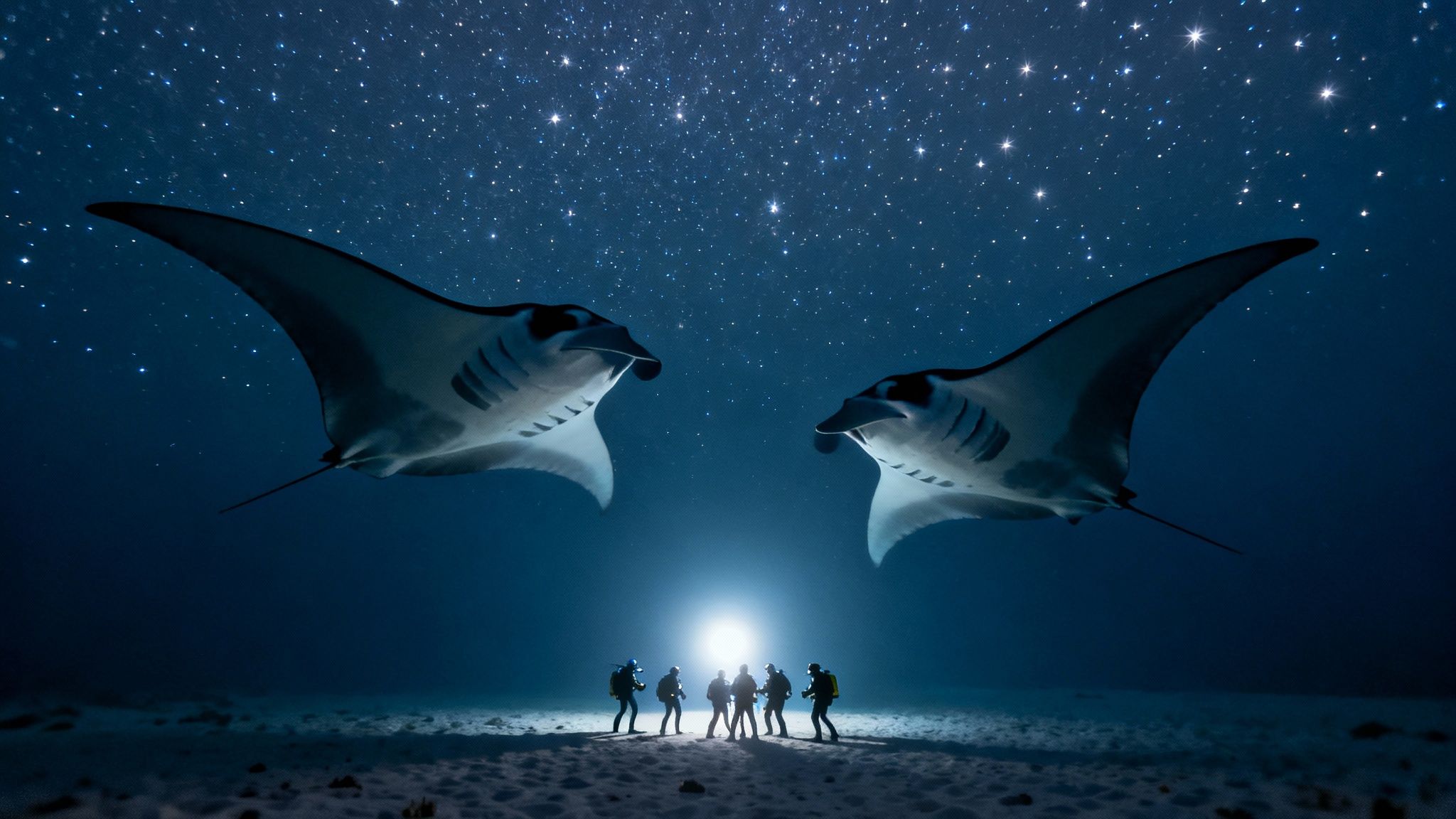
The magic behind this incredible adventure is actually quite simple. As the sun sets, dive boats head out to specific sites and drop powerful lights into the water. These lights act like giant bug zappers, but for the ocean, attracting swarms of microscopic organisms called plankton—the primary food source for manta rays.
Once the plankton has gathered into a thick, glowing buffet, the gentle giants show up for dinner. With wingspans stretching over 12 feet, these magnificent creatures perform mesmerizing barrel rolls and somersaults right through the light beams, gulping down the plankton-rich water. Whether you're diving or snorkeling, you get a front-row seat to one of nature's most spectacular performances.
To give you a quick overview, here's what the experience entails:
Kona Manta Ray Night Dive at a Glance
| Feature | Details |
|---|---|
| Activity | A guided night dive or snorkel to observe manta rays feeding. |
| Location | Specific, established sites off the Kona coast of the Big Island, Hawaii. |
| How It Works | Powerful lights attract plankton, which in turn attracts the mantas. |
| Wingspan | Manta rays can have wingspans exceeding 12 feet. |
| Best Time | This is a year-round activity with a sighting success rate over 90%. |
| Interaction | Passive observation only; no touching or chasing is allowed. |
This table provides the basics, but the real magic is in the details.
Why Is Kona the Perfect Stage?
So, what makes Kona the global hotspot for this? It all comes down to the island's unique geography. The volcanic coastline has formed naturally sheltered bays with deep, crystal-clear water, creating the perfect habitat for a large, non-migratory population of manta rays.
Unlike in many other parts of the world where sightings are seasonal, the mantas here stick around all year. This gives tour operators a sighting success rate that often tops 90%. It’s one of the most reliable big-animal encounters on the planet.
This isn't just a dive; it's a phenomenon. You become a stationary observer in an underwater amphitheater as these massive, graceful animals put on a show that feels choreographed just for you.
There are two primary locations where this nightly event takes place: Garden Eel Cove (also known as Manta Heaven) and Keauhou Bay (Manta Village). While both offer incredible encounters, Garden Eel Cove is the superior choice due to its protected location, calmer waters, and better viewing area. Knowing the differences can help you plan the perfect adventure.
This guide will walk you through everything you need to know about our manta ray dive tour, from what makes Kona so special to how to choose the best operator for a safe and unforgettable night. Get ready for a performance that will stay with you long after you’ve toweled off.
Why Kona Is the Global Capital for Manta Ray Encounters
So, what makes this little slice of Hawaiian coastline the undisputed best place on Earth to see manta rays? It’s a fantastic story, really—a perfect storm of happy accidents, clever observation, and a resident population of these gentle giants. The manta ray night dive in Kona wasn't some master plan; it grew organically from a completely unintentional discovery.
It all started back in the 1970s. The Kona Surf Hotel, sitting right on the coast, used to illuminate the ocean with powerful lights at night for its guests. It looked beautiful, sure, but it also had a surprising side effect: those lights attracted massive clouds of microscopic plankton. For the local manta rays, it was like a free, all-you-can-eat buffet that popped up in the same spot, every single night.
It didn't take long for eagle-eyed divers to spot the pattern. What began as a lucky, chance encounter quickly turned into a predictable nightly spectacle. That reliability is the secret sauce that turned a cool wildlife sighting into a world-famous ecotourism experience.
The Science of the Underwater Campfire
We often call the principle behind the dive the "campfire effect," and it's a great analogy. Imagine you and your friends sitting around a campfire in the dark; that’s exactly what we do, but underwater. Divers and snorkelers form a circle around a powerful light source that we place on the ocean floor.
This light acts like a magnet, drawing in plankton from all around and creating a thick, concentrated "soup" in the water column. For the mantas, who are filter feeders, this is an irresistible dinner bell. They glide in from the darkness, performing these beautiful, acrobatic barrel rolls to scoop up mouthfuls of food. It's a simple but brilliant setup that turns a patch of the dark ocean into a predictable and breathtaking underwater theater.
The real genius of the Kona manta ray dive is how it taps into a natural behavior to create a near-guaranteed encounter. We're essentially setting the dinner table, providing a consistent food source that allows us to witness their feeding spectacle up close without ever interfering with them.
That predictability is what truly sets Kona apart. You can find mantas in other beautiful places, of course, but those sightings are often seasonal or just plain luck. Here, the combination of a non-migratory manta population and the proven campfire method makes this the most dependable big-animal dive on the planet.
A Thriving Hub of Ecotourism
This one-of-a-kind attraction has come a long way from its humble beginnings. What started with a single hotel's lights has blossomed into a cornerstone of the Big Island’s identity. Since those early days, Kona's manta ray night dives have become a global phenomenon, drawing 80,000 snorkelers and divers yearly to see these incredible creatures.
The dive has evolved, too. We've moved from the original hotel site to dedicated locations like Garden Eel Cove (Makako Bay) and Keauhou Bay, where we've perfected the underwater light setup. This has created a plankton bonanza that results in average nightly sightings of 6-10 mantas and has pushed success rates to an incredible 85-90%—more reliable than anywhere else in the world. You can dive deeper into the history and statistics of this unique dive to see just how special it is.
This incredible consistency, combined with the sheer grace and massive size of the mantas, is what cements Kona's reputation. It’s more than just a dive; it’s a world-renowned natural wonder, and it happens right here in our backyard, every single night.
Choosing Your Dive Site: Garden Eel Cove vs. Keauhou Bay
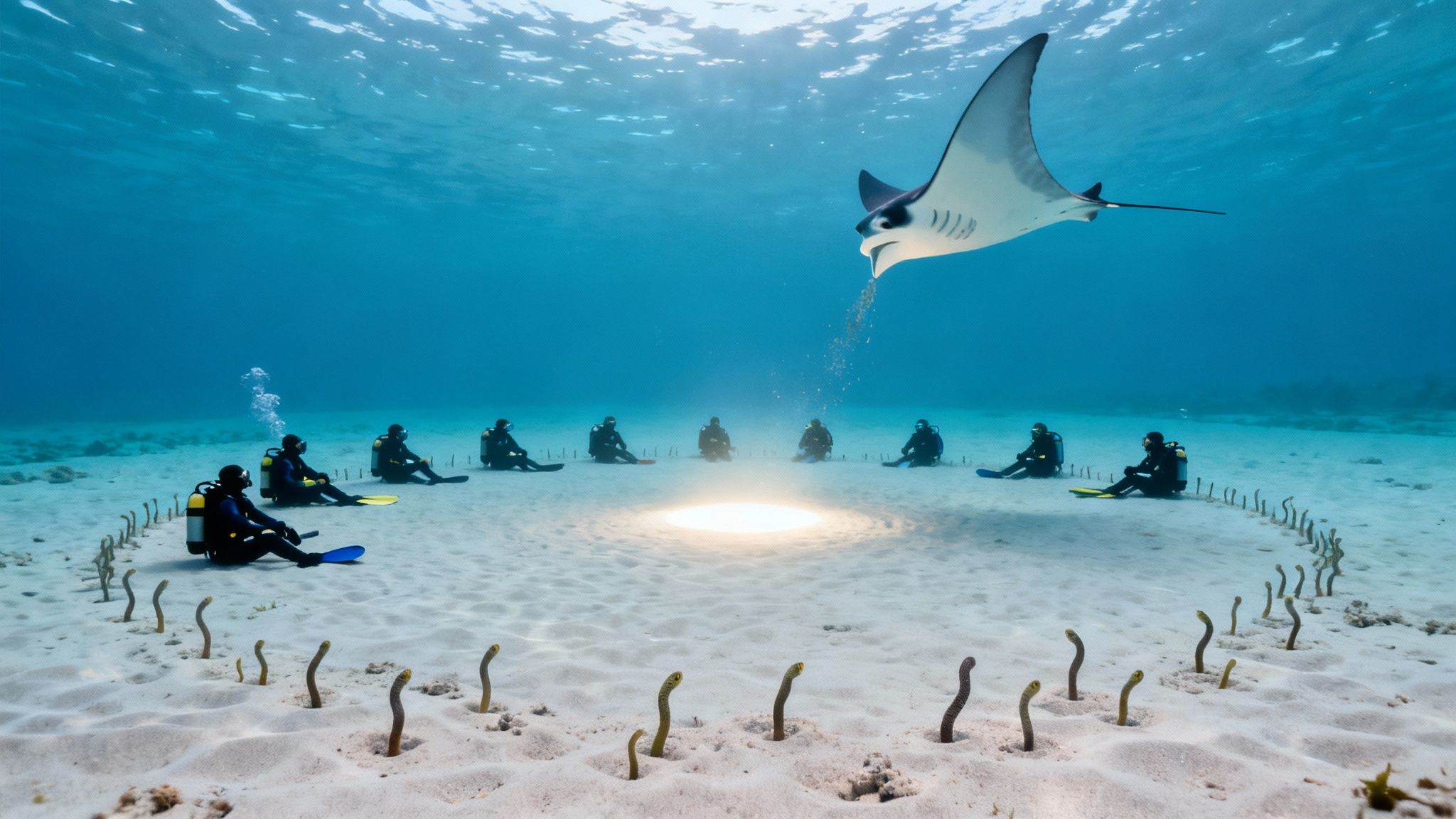
When you start looking into a manta ray night dive in Kona, you'll see two names pop up again and again: Garden Eel Cove (also called Manta Heaven) and Keauhou Bay (Manta Village). Both are legendary spots where mantas gather to feed, but they offer very different experiences. Knowing the pros and cons of each is key to making sure your dive is everything you hope for.
While you can see mantas at both locations, one site consistently delivers a better all-around experience for divers. For comfort, better views, and a healthier marine environment, Garden Eel Cove is the hands-down winner.
The Clear Advantages of Garden Eel Cove
Tucked away in Makako Bay, Garden Eel Cove's location gives it a natural leg up. The bay's shape offers excellent protection from open ocean swells, which means the water is usually much calmer. This translates to a smoother boat ride out and, more importantly, clearer visibility once you’re under the surface—something you absolutely want on a night dive.
The site itself feels like it was tailor-made for this dive. There's a big, sandy, bowl-shaped clearing at a perfect depth of about 35-45 feet. This natural amphitheater is where we set up our lights, and divers can settle in a semi-circle on the sand, creating what we affectionately call the underwater "campfire." This creates a superior viewing area compared to other sites.
It’s the perfect setup. You can get comfortable on the sandy bottom, relax, and just look up. The view is completely unobstructed as these gentle giants perform their mesmerizing barrel rolls right over your head. It’s a front-row seat to one of the greatest shows on Earth.
That spacious sandy bottom is a huge plus. It’s not just comfortable; it's also safer for the environment. There's no fragile coral nearby to worry about, so everyone can focus 100% on the incredible creatures gliding through the water.
A More Vibrant Two-Tank Experience
Most manta charters are two-tank dives, and this is where Garden Eel Cove really shines. The first dive happens at twilight, and the reefs here are simply stunning—far healthier and more vibrant than what you'll find at Keauhou Bay.
Your first dive becomes a spectacular tour of a thriving coral ecosystem. You'll see huge schools of colorful fish, unique critters, and of course, the thousands of garden eels the cove is named for. It’s magical to watch the reef transition from day to night as nocturnal creatures begin to emerge. This incredible twilight dive is the perfect opening act for the main event, making the entire trip a richer, more rewarding experience. You can read more about why we love this site by exploring what makes Garden Eel Cove a true manta ray heaven.
Understanding Keauhou Bay (Manta Village)
Keauhou Bay, or Manta Village, is the original manta site and is located a bit closer to Kailua-Kona. It can definitely have great manta sightings, but it comes with a few significant drawbacks when compared to Garden Eel Cove.
The biggest issue is its exposure to the open ocean. The site is vulnerable to southerly swells, which often results in rougher seas and murkier water. A choppy boat ride and reduced visibility can put a damper on the experience, especially if you’re prone to seasickness.
The bottom topography is also less than ideal. Instead of that beautiful sand patch, the area is mostly rock and coral rubble. This makes it challenging for groups of divers to find a good spot to settle without potentially damaging the environment or feeling cramped. It can get crowded and disorganized fast. For these reasons, we firmly believe Garden Eel Cove consistently provides a safer, more comfortable, and far more spectacular manta ray night dive.
A Step-By-Step Guide to Your Manta Ray Dive Tour

The manta ray night dive in Kona isn't just a quick dip after dark. It's an entire evening's adventure, and understanding the rhythm of the trip helps build the excitement for what’s to come. Knowing the flow, from check-in to the final boat ride home, makes the whole experience smoother and even more magical.
Most charters are a two-tank trip, giving you two completely different dives in one evening. It all starts in the late afternoon when you check in at the harbor, meet the crew, and get your gear sorted out. After a briefing, you'll head out on a stunning boat ride along the Kona coast just as the sun starts to dip toward the ocean.
The First Dive into Twilight
Your first time in the water won't be in pitch-black darkness. Instead, you'll slip in for a twilight or "dusk" dive. This is an absolutely incredible time to be on the reef; it's like watching the ocean’s shift change right before your eyes.
As the last rays of sun fade, you’ll see the daytime fish—like the vibrant parrotfish and butterflyfish—start tucking themselves into the coral for the night. At the same time, the night shift begins to wake up. It's common to see moray eels slinking out of their holes, octopuses starting their nightly hunt, and all sorts of crabs and lobsters scuttling about. This first dive is a lively and dynamic warm-up for the main event.
A Sunset Surface Interval
After you surface from that first dive, you're in for a real treat: a classic Hawaiian sunset from the water. There’s nothing quite like it. This break is your chance to chill out, grab a bite, and just soak in the atmosphere with your fellow divers.
Most boats, ours included, will have snacks and drinks ready for you. As the sky explodes in orange, pink, and purple, the crew gets everything prepped for the second dive. You can feel the buzz of anticipation on the boat as the last light disappears and the sea turns dark.
The Main Event: The Night Dive
Once night has fully fallen, it’s time for the final briefing. Your dive guide will walk you through the plan for the manta ray night dive with precision. They’ll cover how to get in the water, where to position yourselves around the powerful underwater lights (we call it the "campfire"), and the most important part: the rules for passive observation.
This is the moment you've been waiting for. You descend into the dark, settle on the sandy bottom, and your guide sets up the light. You wait in the quiet for a few minutes, and then… they appear. The first massive shadows glide in like ghosts from the deep.
The feeling of a 12-foot manta ray soaring inches over your head is something you’ll never forget. They perform effortless barrel rolls and graceful loops, their huge mouths wide open to filter the plankton drawn to the light. Your job is simple: stay still, breathe, and take in the silent, breathtaking ballet happening right in front of you. It's a powerful, respectful encounter that makes for an absolutely unforgettable night.
Choosing the Right Operator for Your Manta Adventure
Let’s be honest: the success of your manta ray night dive doesn't just come down to the mantas showing up. It almost entirely hinges on the crew you dive with. Picking the right company is the difference between a good dive and a truly unforgettable, once-in-a-lifetime experience.
This is where the details really matter. You want to feel like you're part of an exclusive event, not lost in a crowd. We keep our groups small for a reason. It means less time waiting around on the boat, more personal attention from your guide, and most importantly, a clear, unobstructed view of the action at the underwater ‘campfire.’ With fewer divers, you get a front-row seat to the manta ballet without constantly bumping fins with someone else.
Why Experience and Professionalism Make All the Difference
A top-notch operator isn't just about having a boat and some gear. It's about a deep-seated commitment to your safety and the quality of your dive. Our guides are seasoned pros who live and breathe this stuff. They know Kona’s waters, they understand manta behavior, and their expertise shows in everything they do, from the thorough pre-dive briefing to getting you positioned perfectly in the water for the best views.
It’s also about the things you shouldn't have to worry about. Our boats are meticulously maintained, and all our rental gear is high-quality and serviced like clockwork. This dedication to excellence gives you peace of mind, letting you relax and just soak in the magic unfolding in front of you.
We also consistently choose to dive at Garden Eel Cove. Why? Because it’s hands-down the better site, offering calmer conditions and a superior viewing area. When you're looking at different companies, it pays to see how they stack up; our guide to the top 10 Kona diving companies is a great place to start your comparison.
The Proof is in the Reviews
In the dive world, reputation is everything. You can learn a ton about an operator by listening to the people who have already been in the water with them. The countless fantastic reviews we've received aren't just a source of pride—they’re a testament to our crew's professionalism, friendly attitude, and unwavering mission to create amazing memories for every single guest.
But don't just take our word for it. See what your fellow divers are saying.
Ultimately, picking the right operator is an investment in your safety, comfort, and the overall joy of the experience. Kona's manta dives are famous for their incredible reliability, with most operators reporting an 85-90% success rate for sightings. This amazing consistency is thanks to the brilliant method of using lights to attract plankton, which creates a dependable underwater buffet for the mantas. When you choose a company like Kona Honu Divers, you're not just booking a dive; you're ensuring every single detail of this world-class encounter is handled with care and expertise.
Ready to book one of the most incredible diving tours of your life?
How to Prepare for Your Dive
A little bit of prep work can turn a great dive into a truly unforgettable one. When you know what to bring and how to act once you're in the water, you can put all your focus where it belongs: on the incredible manta ray ballet happening right in front of you.
Besides your usual dive kit, a few extra comfort items can make a world of difference. Even after a warm day, the boat ride back to the harbor can get surprisingly chilly once you’re out of the water, so a warm jacket is a must. If you're prone to seasickness, it’s always smart to bring your preferred remedy along. And while you're packing for the dive, don't forget the rest of your trip! This helpful Hawaii Vacation Essentials Checklist can make sure you've got everything covered.
Tips For Underwater Photographers
Trying to photograph the manta dive is a completely different game than shooting on a sunny reef. The darkness requires a whole new strategy. You'll want to open your camera settings up to let in as much light as possible. A wide aperture (a low f-stop number) is a great place to start, along with a higher ISO. Just be careful not to push the ISO too high, or your images will get grainy. A slower shutter speed can also help capture the fluid, graceful movements of the mantas.
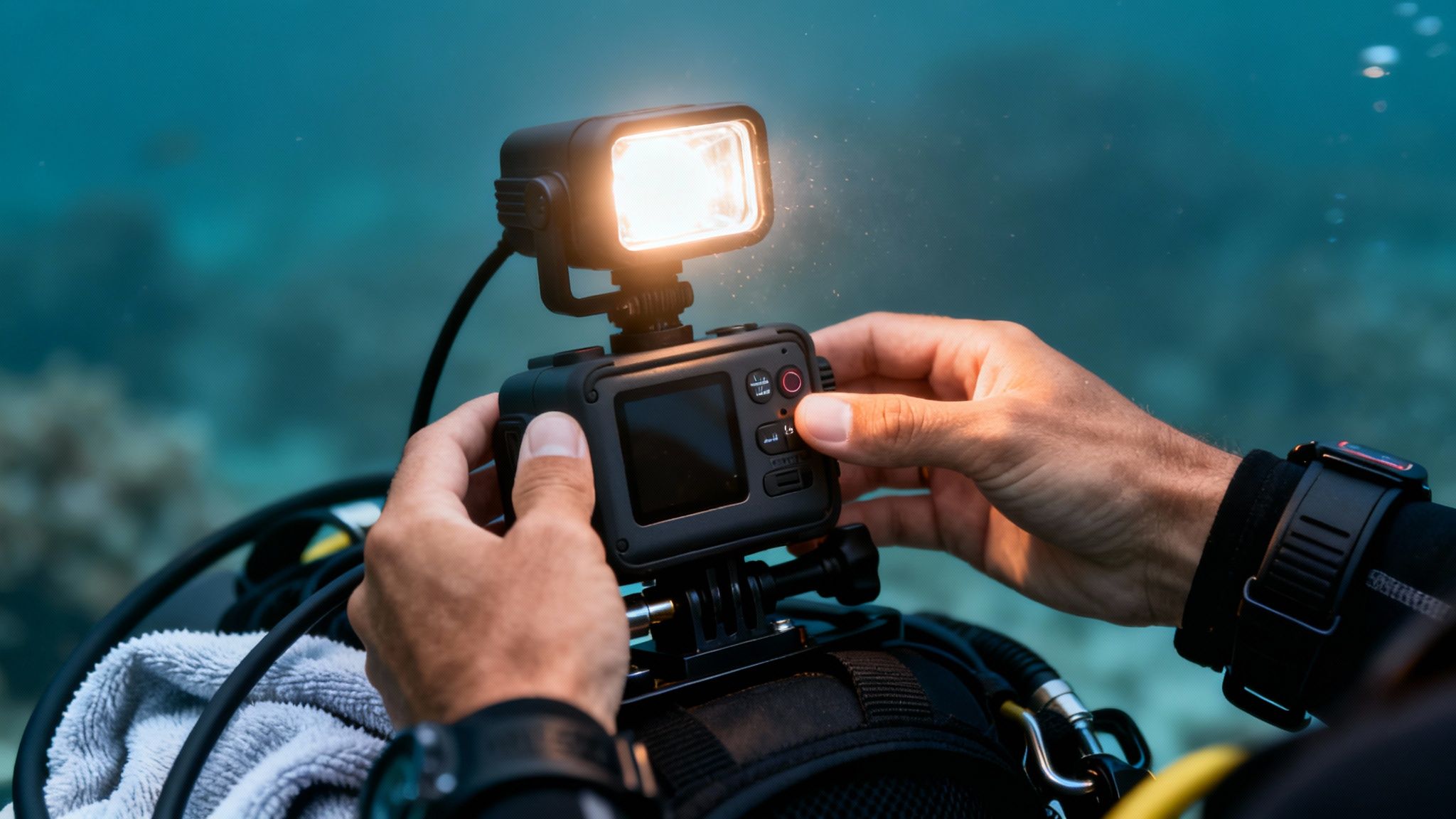
When it comes to lighting, this is one of those rare dives where continuous video lights often beat traditional strobes. Strobes can recycle too slowly to keep up with the fast-passing mantas and their bright flashes can be distracting to other divers. A steady, powerful video light, on the other hand, illuminates the scene consistently, helping your camera lock focus and letting you capture that smooth, cinematic footage. For more great advice, dive into our guide on scuba diving at night.
The Golden Rules Of Manta Etiquette
The single most important part of your preparation is understanding how to behave around these magnificent animals. The continued success of this world-famous dive depends entirely on every one of us acting as a respectful, passive observer.
The main idea is simple: let the mantas control the entire interaction. We are just guests in their underwater dining room. Our job is to stay put and enjoy the show without getting in the way.
To keep this experience safe and sustainable for everyone—divers and mantas alike—we strictly follow these crucial rules:
- Observe only. This is a non-negotiable. Never touch, chase, or attempt to ride a manta ray. Touching them can damage their protective slime coat, which is like their immune system, leaving them vulnerable to nasty infections.
- Stay in your spot. If you’re a diver, you'll be stationary on the sandy bottom. If you're snorkeling, you'll stay floating on the surface. This creates a clear, open "stage" in the water column for the mantas to swoop and glide through safely.
- Let them come to you. Mantas are naturally curious and will often soar just inches over your head. The urge to reach out can be powerful, but you have to resist. Just relax, breathe, and enjoy the incredibly close fly-by.
Frequently Asked Questions
We know you've got questions. An adventure like swimming with Kona's manta rays is a big deal, and you want to get it right. We've been doing this for a long time, so here are some honest, straight-to-the-point answers to the questions we hear most often.
Do I Need To Be Scuba Certified to See the Manta Rays?
Not at all! While scuba diving gets you a fantastic view from the ocean floor, the snorkeling experience is just as breathtaking.
As a snorkeler, you'll hold onto a specially designed flotation board on the surface. Bright lights shine down from the board, attracting the plankton. The mantas then swoop in right below you to feed, giving you an incredible bird's-eye view of the entire ballet.
Is the Manta Ray Night Dive Safe?
Yes, it’s incredibly safe when you go with a professional and reputable operator. Manta rays are true gentle giants—they don’t have teeth, stingers, or barbs. Their only defense mechanism is to gracefully swim away.
Our experienced guides are in the water with you the entire time. Before we even get in, we give a thorough safety briefing to make sure everyone—both human and manta—has a safe and enjoyable experience.
What Is the Best Time of Year for the Manta Dive?
Here’s the best part: there is no "best" time! The Kona manta ray dive is a year-round spectacle.
Our local manta population doesn't migrate, so they're here for us to visit any month of the year. Our sighting success rate consistently stays above 90%, regardless of the season. While the summer might bring slightly calmer waters, you're just as likely to have an unforgettable encounter in January as you are in July. For a deeper dive into their behavior, this Manta Ray FAQ is an excellent resource.
What Happens if We Don't See Any Manta Rays?
It's a fair question. These are wild animals, after all, and nature doesn't offer a 100% guarantee.
That's why most reputable companies, including us, have a "manta guarantee." If the mantas decide not to show up on your trip, we'll invite you to come back out with us again for free, depending on availability. It's always a good idea to double-check the specific policy when you book.
Ready to see this underwater light show with your own eyes? At Kona Honu Divers, we're dedicated to running a safe, respectful, and truly awe-inspiring trip. Book your manta ray dive tour with us and get ready for a night you’ll be talking about for years to come.