
Your flight lands in Kona mid-afternoon, you've got two nights booked, and the browser has three tabs open: one for a manta tour, one for a rental car, one for a restaurant that closes at nine. The decision that shapes your trip most isn't which company has the prettiest photo. It's which departure window you pick, which site the boat runs to, and how the crew manages the water once the lights come on.
The manta ray night dive in Kailua-Kona is the most reliable wildlife encounter in Hawaiʻi and also the easiest one to book badly. Reliability isn't the same thing as quality, and a high sighting rate tells you nothing about how many people will share your patch of lit water. What follows is the version of the evening a working captain would walk you through: the timetable, the site logic, the conduct rules that decide whether mantas stay or leave, and the questions worth asking before you pay a deposit.
Table of Contents
- How the Manta Ray Night Dive Unfolds, Hour by Hour
- Why Manta Rays Gather Almost Every Night
- Why Garden Eel Cove Is the Superior Dive Site
- Certification and Experience You Need Before Diving
- How to Behave in the Water Once the Lights Come On
- What to Pack for the Dive and Camera Tips
- Rules and Operator Features Worth Checking Before You Book
- Answers and Next Steps Before You Book
How the Manta Ray Night Dive Unfolds, Hour by Hour
Check-in at Honokohau Harbor happens in flat daylight, which surprises first-timers who expect a midnight departure. Guests board the Honu One and the boat cruises north along the coast to Garden Eel Cove, the protected site where the night dive runs. The whole charter covers roughly five hours, starting between 2:45pm and 4:00pm and finishing between 7:45pm and 9:00pm, with the exact window set by that day's sunset.
| Phase | Typical Timing | What Happens |
|---|---|---|
| Boarding and departure | Start between 2:45 and 4:00 pm | Board the Honu One at Honokohau Harbor and cruise north to Garden Eel Cove |
| First dive | Daylight, before sunset | Daytime reef dive before the lights go on |
| Surface interval | Around sunset | Kona sunset view and a light meal |
| Crew briefing | Before the night dive | Manta lifestyle, the science behind the lights and passive observation rules |
| Night dive | After sunset | Lights on the seafloor attract plankton and manta rays |
| Return to harbor | Between 7:45 and 9:00 pm | Trip ends, timed to that day's sunset |
What the daylight hours buy you
The first dive is the part people underestimate. It's a normal reef dive in good light, and it does two jobs: it settles anyone who hasn't been in the water recently, and it lets you check weighting, mask fit and buoyancy before the only light source is a torch. Get those sorted at 4pm and the night dive becomes a viewing exercise instead of an equipment exercise.
The surface interval lands on sunset. You eat something light, you watch the sky go orange behind the boat, and then the crew briefs the group on how mantas feed, why the lights work, and what passive observation means in practice. Learning the conduct rules while it's still bright outside is deliberate. Nobody absorbs instructions well with a torch in one hand and a regulator in their mouth.
Why your calendar date changes the evening
Sunset in Kona moves through the year, so the same tour slot lands at a different point in the evening depending on when you visit. Check the sunset time for your travel date before you choose a departure, then plan to be at the dock at least 30 minutes before you're due to leave. Traffic on the highway north of Kailua-Kona is unpredictable in the late afternoon, and a boat full of people waits for nobody.
Feeding activity tracks food, and food isn't constant. The same slot that delivers a dense, nonstop show in one month can feel quieter in another, which is worth knowing before you build a whole vacation around one evening. You can check the current manta dive schedule and pick a date once you know your travel window.
Why Manta Rays Gather Almost Every Night
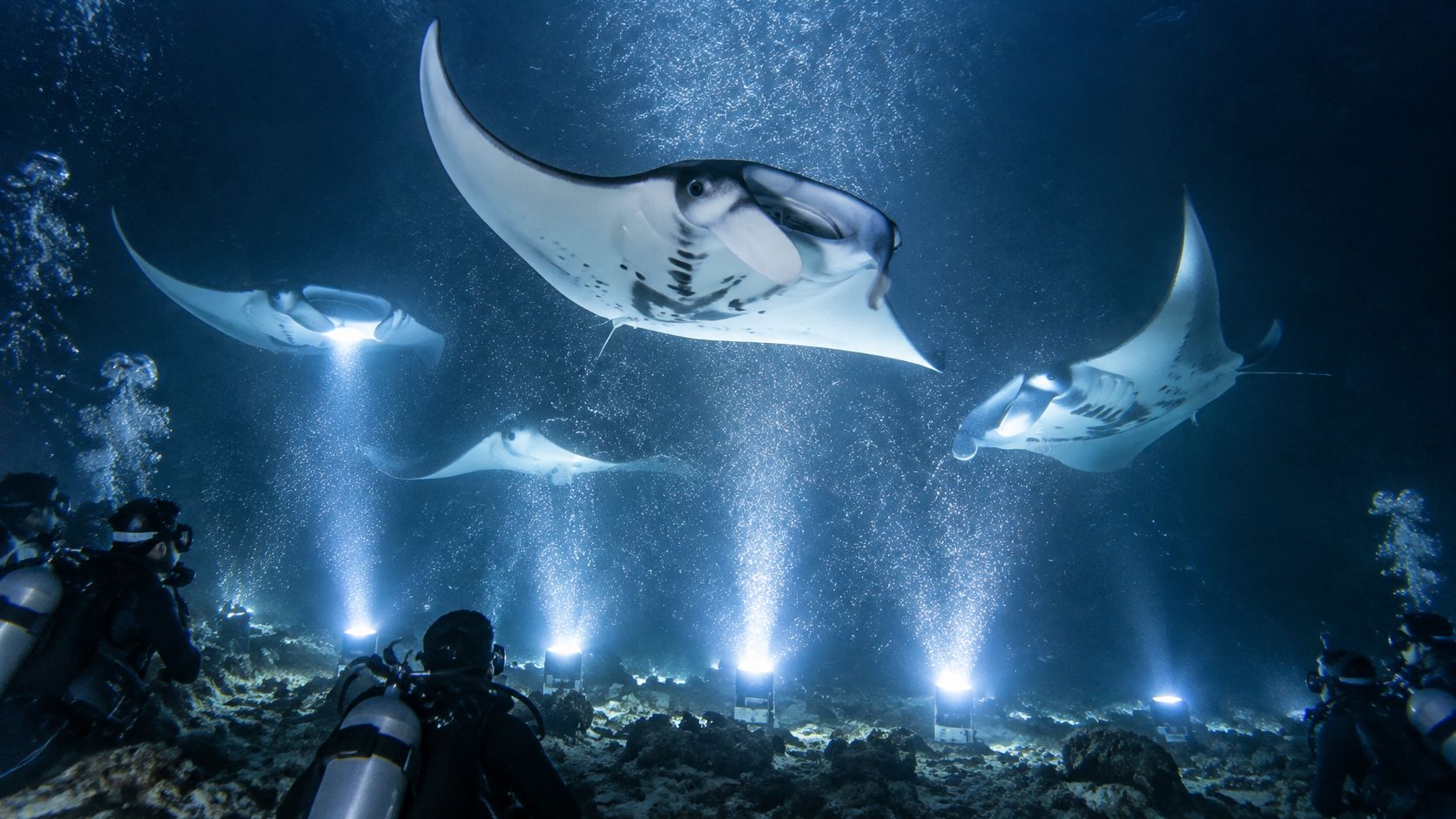
Underwater lights draw plankton into an illuminated patch of water. Reef manta rays (Mobula alfredi) make repeated passes and barrel rolls through that food-rich area as they filter-feed, according to Marine Megafauna Foundation manta tourism guidance.
The lights concentrate food; they do not bait or hand-feed the rays. Keep lights aimed into the water, where they help maintain the feeding area. Sweeping a beam across a manta can interrupt its approach.
What the sighting odds really mean
Mantas appear on most nights at Kona's manta sites, but the long-run estimate is about 80%, based on a University of Hawaiʻi study of Kona manta diving. The study drew on 3,208 recreational scuba surveys conducted along the Kona Coast between 1992 and 2007, mostly at the Keauhou and Hoʻona Bay night sites. Researchers identified 106 individual manta rays, each recorded between 1 and 724 times.
Treat 80% as a long-term likelihood, not a promise for your tour. Some nights are quiet. The study also estimated that the local population was probably fewer than 200 animals, a reminder that each sighting depends on where the rays are feeding and how many are present.
Practical rule: Judge the experience by how calmly the group holds its position and whether guests follow passive-observation rules, not just by the number of rays.
Why one night differs from the next
Plankton density changes, and manta activity changes with it. When food is less concentrated, fewer rays may arrive or their visits may be shorter. Even with the same site, lights and crew, one night can be livelier than the next.
Site choice and operator control shape what you can see, but neither guarantees a close pass. Mantas choose their own approach. A well-organized viewing area and a group that stays still give them room to feed naturally.
Why Garden Eel Cove Is the Superior Dive Site
Garden Eel Cove wins on three counts that matter to a paying guest: it's a protected location, it has a better viewing area, and the reef around it is in better shape than the alternatives. Calm, sheltered water lets you settle into the feeding corridor instead of managing surge, and a defined viewing area means the group occupies a known footprint rather than drifting across a slope.
The science backs the site choice. A 13-year University of Hawaiʻi study recorded more than 23,000 sightings of 167 individually identified reef manta rays at Garden Eel Cove and Keauhou between 2010 and 2022, as published in the University of Hawaiʻi manta aggregation study. The two sites sit roughly 20 kilometers apart and behave differently.
| Criteria | Garden Eel Cove | Keauhou |
|---|---|---|
| Protection | Protected location with a dedicated viewing area | No sheltered viewing area; boats hold station in open water |
| Aggregation size | Generally larger and more variable | Generally smaller |
| Sighting pattern | Bigger swings in group size between seasons | About 91% of sightings female |
| Site fidelity | High fidelity recorded, with movement between the two sites | Strong female fidelity |
What the two sites tell you about your odds
Garden Eel Cove generally supported larger and more variable aggregations. Keauhou ran a strong female bias, with females accounting for about 91% of sightings in the study summary, and high fidelity among those females. Both sites tracked zooplankton density, which confirms the rays respond to food rather than to the lights alone.
A site with fewer, more predictable animals isn't worse. It's just a different show, and if you only get one night, group size is the variable most visitors actually want.
Why the vessel numbers change the calculus
Hawaiʻi's DLNR estimates that approximately 60 to 70 commercial viewing vessels work the two feeding areas at Makako Bay (Garden Eel Cove) and Kaukalaelae Point (Keauhou Bay), per the DLNR announcement on proposed manta viewing rules. Proposed rules would cap viewing permits at 24 per zone, limit vessels to 60 passengers for hire in a 24-hour period, and organise operations into two-hour shifts.
Read that as a warning about what unmanaged demand looks like. A protected site with an organised footprint gives you a controlled viewing experience; an unrestricted stretch of open coast gives you boats jockeying for the same patch of lit water. When you compare operators, ask which site they run and why. A clear answer about shelter, viewing space and reef quality is a decent signal that the rest of the operation is thought through.
Certification and Experience You Need Before Diving
Choose your place in the water before you board: certified divers watch from the seafloor, while snorkelers stay at the surface. The Manta Ray Night Dive is listed for divers and snorkelers at beginner to advanced experience levels, but comfort in dark water and the ability to follow the crew's instructions still matter.
Certified divers should have open water certification or an equivalent qualification, plus enough recent experience to hold position without constant finning. You'll kneel or settle on the sandy bottom and look up. If your last dive was a long time ago, arrange a refresher before the trip rather than trying to rebuild your skills on the boat. A diver who cannot stay settled may drift into the viewing area and disrupt the encounter.
| Guest Type | Certification or Experience | What to Confirm |
|---|---|---|
| Certified diver, open water or equivalent | Current certification and recent dive experience | Health statement and gear needs |
| Certified diver, long break from diving | Refresher dive recommended before the trip | Refresher options and timing |
| Experienced diver | Comfort with a stationary night dive and holding position | The site the crew plans to use and any operator requirements |
| Non-certified snorkeler | No certification needed | Comfort floating in open water after dark |
| Child or teen | Minimum age set by the operator | Age limit and whether a parent must be in the water alongside |
How to find your own row
Snorkelers can join from the surface without scuba certification. Before booking, consider whether you can float in open water after dark without needing to hold onto another person. If not, a daytime reef trip may be a better first step. Read about scuba diving in Hawaiʻi without certification if you're weighing the difference between snorkeling and learning to dive.
Complete the operator's health statement and raise medical concerns, medication use, or recent surgery before paying. Ask about the age limit for your youngest guest and whether a parent must be in the water.
Practical rule: If you're unsure whether your recent dive experience is enough for a night dive, arrange a refresher before the trip.
How to Behave in the Water Once the Lights Come On
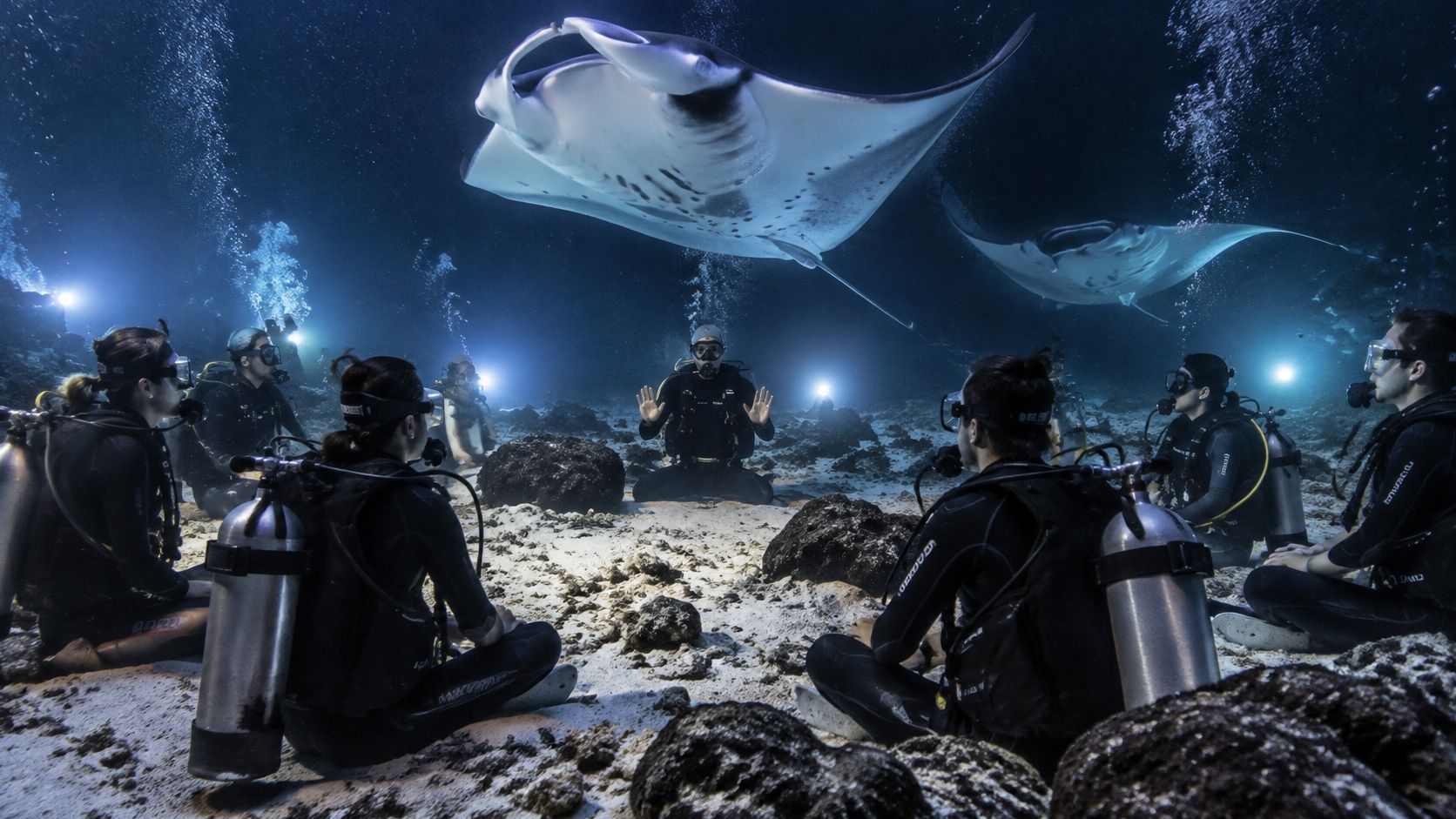
The viewing area is organized so manta rays can feed while divers watch without blocking their path. Follow the crew's directions, stay in your assigned position, and let the animals control how close they come. The NOAA-hosted wildlife interaction guidelines describe this as passive observation.
- Settle on the bottom and form the arrangement your guide directs. Staying low keeps the water column open for the mantas. Rising or fluttering your fins can disrupt the viewing area and stir up sand.
- Keep your light pointed upward. The light attracts plankton, which draws the rays to feed. Sweeping a beam across a manta can interrupt a feeding pass.
- Remove your snorkel while diving. A dangling snorkel can snag a manta or catch on your mask during a close pass.
- Never touch, chase, grab or ride a manta. Contact can stress the animal and injure you. A ray with a wingspan of several metres moving at speed can cause harm without intending to.
- If you're snorkeling, stay on the surface and point your light down. Diving into the lit column puts you in the feeding area and blocks the view from above.
- Let mantas choose their distance and approach path. Stay still and give them room to feed rather than trying to force a close pass.
- Keep light beams in the water, not in the animals' eyes. Aim at the plankton-rich water and follow the crew's instructions.
What a good night actually looks like
Mantas may roll through the brightest patch or pass more widely along its edge. The group stays still, gives the rays room, and follows the crew's directions. Patient, controlled viewing is the aim, not getting closer than the animals choose.
For more detail on spacing, fin control and light handling, read this guide to responsible and considerate diver etiquette.
What to Pack for the Dive and Camera Tips
Pack for a boat evening, not a beach day. The air cools fast once the sun drops and you're sitting in a wet wetsuit, so warmth is the item people forget and regret.
- Reef-safe sunscreen: apply it before boarding, not on the boat.
- A warm layer and a towel: for the ride back, which always feels colder than the ride out.
- A dry bag: phone, wallet and keys stay dry through the surface interval.
- A flashlight or headlamp: for the dock walk and the walk back to the car.
- Water and a snack: surface intervals can run long when the crew is managing gear.
Camera settings that work at night
- Kill the flash. It startles the animals and blinds every other guest in the water.
- Use a continuous, low-power video light instead of strobes. You light the plankton, not the ray.
- Push ISO and open the aperture wide. Available light is all you get, so check focus before you descend, not during a pass.
- Bring a wide-angle lens. Close passes happen, and a long lens will miss them.
- Tether the camera on a short lanyard so it can't drift into the feeding zone while you watch.
Confirm in advance whether dive lights are provided and whether housings are welcome on board, then pack light and leave your attention free for the animals. If photography is a priority, the Kona manta night dive photo package is worth a look before you decide what to carry.
Rules and Operator Features Worth Checking Before You Book
Here's the uncomfortable part of the booking decision. A DLNR manta ray viewing boating operations and safety assessment found that, at the time of its review, the state had no activity-specific restrictions for manta ray diving or snorkeling, no capacity limits, no location restrictions, and no equipment requirements tied to those activities.
That means the legal floor is thin. What protects the animals and your experience is the operator's briefing, its vessel procedures and its conservation practice. Proposed viewing-vessel rules (24 permits per zone, 60 passengers per 24 hours, two-hour shifts) may eventually change operating conditions, so confirm the current rules close to your departure date.
Six questions that separate operators
- What's the crew-to-guest ratio on the boat and in the water?
- How large is the group in the light zone, and does the crew rotate divers through it in waves?
- What's the live-boating procedure when another boat drifts toward your lights?
- Who's supervising in the water, and is someone always on the surface watching the whole group?
- Is the gear maintained on a documented schedule, and is there a written emergency plan?
- Do the guides hold current certifications, and do they teach the conduct rules in the briefing rather than mention them in passing?
Ask bluntly. A professional operation answers without flinching, and the answers show up in reviews that mention calm briefings, gear help and guides who point out individual manta behaviour instead of narrating a checklist. If you'd rather compare operators on paper first, this insider guide to choosing a Kona diving company walks through what the differences look like. Kona Honu Divers has run the Hawaiʻi manta ray night dive since 2002, which is one data point among many, but longevity in a regulated-heavy, weather-dependent business rarely happens by accident.
Practical rule: Price is the weakest filter available. Spacing, supervision and briefing quality decide what your night actually feels like.
Answers and Next Steps Before You Book
What if a standard manta night feels routine
If you've mastered the manta format, Kona Honu Divers also offers other day and night tours. Browse the full range of Kona diving tours to see what else fits your plans.
Swimming with manta rays is available in Kona year-round. Choose your date around your travel schedule, then check the departure window and what the operator includes before booking.
How to book without guesswork
Before paying, confirm your certification and health statement, check the sunset timing for your date, and compare what each operator includes. If you're choosing between watching from the surface and diving, this guide to snorkeling or diving with manta rays explains the difference.
If manta rays are a priority, consider booking early in your stay so you have room to adjust your plans if conditions or availability change.
Kona Honu Divers runs its Manta Ray Night Dive at Garden Eel Cove aboard the Honu One. The tour includes a sunset surface interval and a supervised night dive, with divers positioned in the viewing area as lights attract plankton and manta rays. Review the tour details and availability before choosing a date. Visit Kona Honu Divers to plan your booking.