
Table of Contents
- Conditions shape what you see
- What that means for your choice
- Plan for comfort, not just eligibility
- Photograph without changing the encounter
You're comparing tour options, checking the forecast, and trying to pin down what “manta ray night dive” means in Kailua-Kona. The short answer: certified divers settle near the sandy bottom while lights attract plankton, and manta rays may glide into the illuminated area to feed. It's a guided wildlife encounter, not a show on a schedule, so the best plan is to choose the right format, understand the conditions, and give the animals room to behave naturally.
For divers, Garden Eel Cove is the strongest choice: its protected setting, defined viewing area, sandy bottom, and neighboring reef suit a stationary observation dive. Snorkelers can watch from the surface instead, while a blackwater dive offers a very different kind of night experience. Knowing those differences makes it easier to choose a trip that fits your certification and comfort in the water.
What the Manta Ray Night Dive Involves and How It Compares
The manta ray night dive at Garden Eel Cove is a stationary scuba dive: divers settle on the sandy bottom while the crew switches on lights that draw plankton, and manta rays may pass through the illuminated area to feed. You watch from a specific viewing area with a guide, rather than swimming after the animals.
| Kona night options compared | Where you are | What you do | Best for |
|---|---|---|---|
| Manta ray night dive (scuba) | Kneeling on the sand at Garden Eel Cove, inside the light circle | Breathe underwater with a guide and stay still while mantas feed | Certified divers who want the closest views |
| Manta ray night snorkel | Floating at the surface with lights pointed down | Watch mantas from above without scuba gear | Non-certified guests, families, and first-timers |
| Blackwater night dive | Open, deep water off the Kona coast | Drift in the dark among plankton and deep-water visitors | Divers who want a different kind of night experience |
The crew briefs the group before entry, explains where everyone will be positioned, and keeps the viewing area organized. Divemasters and instructors are in the water with divers, helping manage the group. A defined viewing position matters: it leaves the manta feeding lane clear and gives the animals room to change direction.
The manta ray night snorkel option is a surface experience, not a shallow version of the scuba dive. If you'd rather explore open water at night, the Kona blackwater dive is a separate trip with a different setting and purpose.
Choose the two-tank manta dive tour if you're certified and want the underwater view. If you're not certified, or you'd rather remain at the surface, compare the snorkel option instead. For other underwater trips around the island, browse Kona diving tours and match the outing to your experience and comfort.
Why Kona Manta Rays Come to Feed After Dark
The lights work a little like a porch lamp drawing insects. After dark, zooplankton moves upward in the water, and artificial dive lights can gather some of it into a bright feeding zone. Giant manta rays feed mainly at night, so they may follow that concentrated food source and make slow passes through the light.
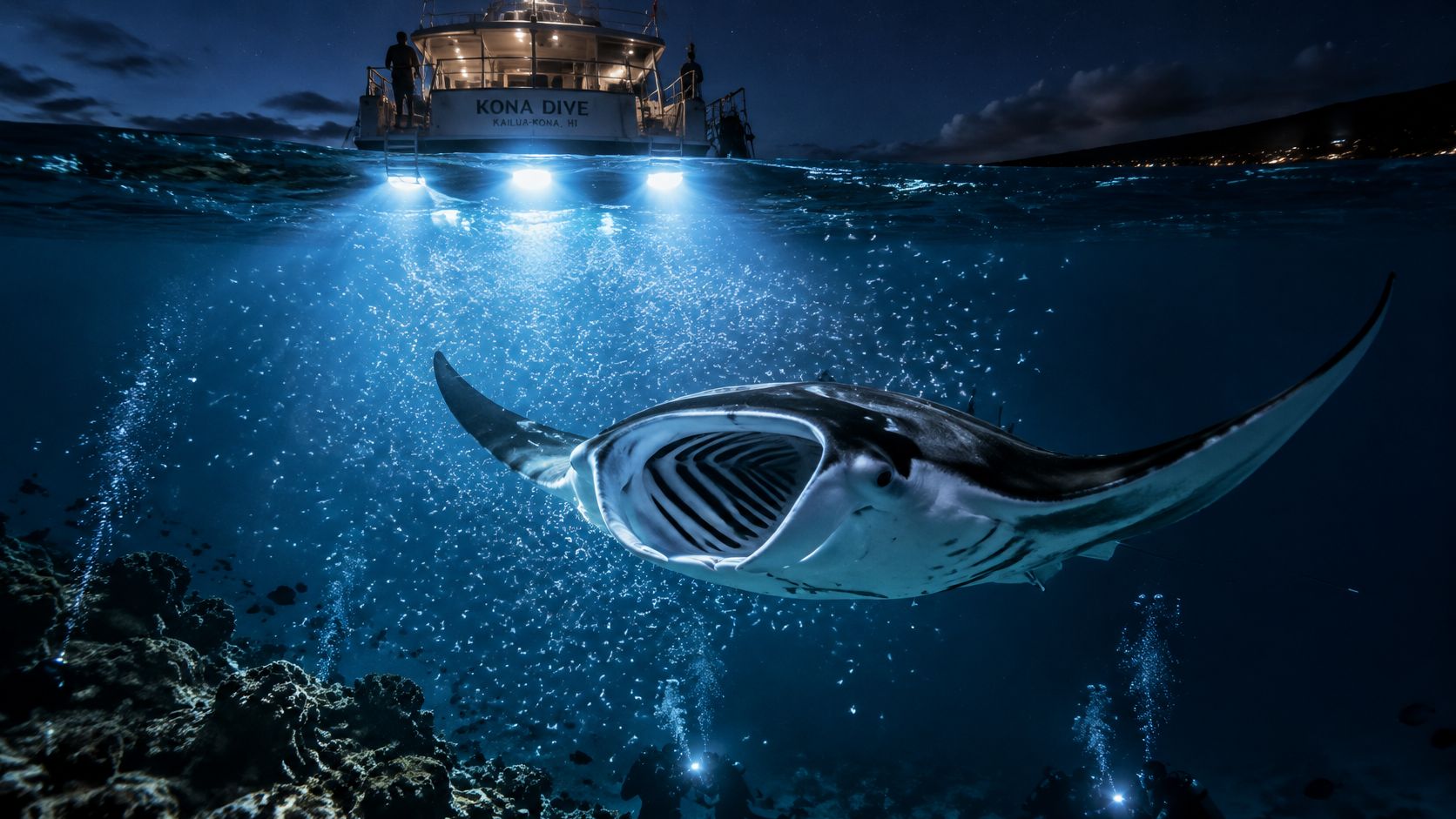
Mantas are filter feeders. Their cephalic fins help funnel plankton-rich water into the mouth, while gill rakers retain prey as water flows out across the gills. That feeding method explains the repeated close passes and barrel rolls: a ray can turn through the lit water again to take advantage of food concentrated there. NOAA's manta-ray work product describes nocturnal feeding as consistent with zooplankton's nighttime vertical movement and explains the filter-feeding mechanism.
The light setup is repeatable, but the food supply isn't. A University of Hawaiʻi study of community observations from 2010 through 2022 recorded more than 23,000 sightings of 167 identified manta rays at Garden Eel Cove and Keauhou. The study found that aggregation size changed with zooplankton density, making food availability an important driver of how many mantas gather.
Conditions shape what you see
Plankton availability matters, but it's only one part of the picture. Water movement, visibility, moonlight, swell, wind, and the concentration of artificial light can all affect how a night feels and how clearly you see the animals. A bright light can draw plankton without guaranteeing that mantas will arrive or keep feeding.
Kona's reef mantas form a relatively localized population, and recent reporting notes that they generally stay close to home rather than moving freely between Hawaiian islands. That makes local conditions especially important: the animals' presence depends on what's happening at the site, not just on a calendar date.
A predictable setup isn't a predictable wildlife encounter. Mantas can change course, keep their distance, or stop feeding during a tourism encounter. The best approach is to let the crew manage the viewing area and to judge a trip by both the conditions and the animals' behavior, not only by how dramatic a pass looks.
Why Garden Eel Cove Is the Best Site for the Dive
Garden Eel Cove is the superior choice for a manta ray dive tour because its protected cove, sandy bottom, adjacent reef, and defined viewing area suit calm, stationary observation. The setting helps divers stay clear of the feeding lane, gives the group a consistent place to settle, and adds reef context to a night focused on manta rays.
| Garden Eel Cove and Keauhou compared | Manta sightings on monitored nights | Typical feeding group | Key characteristics |
|---|---|---|---|
| Garden Eel Cove (Manta Heaven) | 92% of nights, 2009 to 2014 | Larger aggregations | Protected cove, sandy bottom, adjacent reef, defined viewing area |
| Keauhou (Manta Village) | 78% of nights, 2009 to 2014 | Smaller aggregations | Stronger female presence and high female site fidelity |
In a six-year observation period from January 1, 2009, through December 31, 2014, reef mantas were recorded on 92% of monitored nights at Manta Heaven, the name used for Garden Eel Cove, compared with 78% at Manta Village near Keauhou. The same Kona site analysis found that 39 rays appeared on more than 10% of study nights, 15 appeared on more than 25%, and one individual appeared on more than 56%. Those repeat observations show that familiar resident animals contribute to the encounters, even as the nightly group changes.
A separate University of Hawaiʻi analysis of community-sourced sightings from 2010 through 2022 logged more than 23,000 observations of 167 individually identified mantas across Garden Eel Cove and Keauhou. It found that Garden Eel Cove generally hosted larger feeding aggregations, while Keauhou had a stronger presence of females and high site fidelity among them. Across both sites, the overall sex ratio was approximately 1:1, and aggregation size tracked zooplankton density. The University of Hawaiʻi study therefore supports two different points: Garden Eel Cove is well suited to larger viewing groups, while Keauhou remains an important site for understanding females' repeated use of an area.
What that means for your choice
If you're looking for a high-capacity viewing experience in a protected setting, Garden Eel Cove is the practical choice. Keauhou's smaller aggregations don't make it unimportant. Its pattern of female presence and site fidelity offers a different ecological perspective, but it doesn't provide the same combination of cove protection and viewing layout.
A protected site can improve the conditions for organized observation, but it can't control plankton or guarantee a particular number of rays. The advantage is a suitable setting for watching patiently, not a promise of a crowded manta encounter.
How the Dive Runs, Step by Step
A well-run dive gives everyone a clear job: arrive prepared, settle into position, and let the mantas choose their route. The crew's briefing covers the science behind the dive and the rules of passive observation. Experienced divemasters and instructors stay in the water with divers to manage the group.

Listen to the briefing. The crew explains the feeding setup, where to position yourself, and how to observe without disturbing the animals. The rules make the experience more predictable for divers and leave the mantas room to feed.
Check your gear and buddy. Do this aboard the boat before entering the water. A quick check lets you deal with a loose strap or light issue before you descend in the dark.
Descend carefully. Follow the guide to the sandy bottom and stay clear of coral, sea urchins, and other marine life. Careful fin placement protects the reef and helps keep the group settled.
Form the viewing line. Divers position themselves in a semi-circle on or near the sand, rubble, or boulder bottom, leaving open water above for the mantas. NOAA's voluntary wildlife-interaction standard recommends this arrangement and says not to touch, chase, grab, or ride the rays.
Aim lights as instructed. The crew sets lights on the seafloor to attract plankton. Divers hold their own lights above their heads and point them upward; snorkelers stay at the surface and point lights downward.
Keep your breathing and gear controlled. Time your breaths so bubbles don't rise directly into a manta's path. Remove your snorkel from your mask before the dive, so it can't snag a passing ray.
Stay still and watch. Don't touch, chase, grab, or ride the animals. Avoid shining a personal light directly into a manta's eyes, and keep out of the approach corridor if a ray is heading your way.
Ascend and debrief with the crew. Follow the guide's instructions at the end of the dive and review how the group and conditions went. A good dive looks like calm divers and slow, close passes, not a crowd trying to follow one animal.
Safety, Certification and Family Suitability
The scuba dive is for certified divers; guests without certification can choose the manta night snorkel. The distinction matters because a night dive asks you to manage scuba equipment underwater while staying with a guide, whereas snorkelers remain at the surface.
| Who can join and what each guest needs | Requirement | Notes |
|---|---|---|
| Certified scuba divers | Current open-water certification | Kneel on the sand, stay with the group, and keep buoyancy under control |
| Snorkelers | No certification needed | Float at the surface and point lights downward |
| Children and families | Confirm minimum age with the operator | The snorkel option is usually easier for younger guests |
| Guests with mobility concerns | Confirm boat entry, exit, and ability to descend or float | Ask the crew before booking how boat access is managed |
| Nervous or non-swimmers | Comfortable floating with flotation support | Ask the crew about flotation; the snorkel option usually suits them best |
| Guests prone to motion sickness | Plan ahead with a seasickness preventive | Swell and wind affect boat comfort; consider the options below |
The manta ray night dive and the two-tank morning dive are open to certified divers. Still, certification alone doesn't mean a night dive will feel comfortable. If you're uneasy in darkness, unable to stay with a group, or not comfortable controlling your buoyancy, tell the crew before booking. A surface snorkel or postponing the outing may be a better fit.
Stay with the group, keep your buoyancy controlled, and don't touch the animals or reef. Give a ray's approach corridor space rather than trying to get closer. For practical conduct guidance, see this responsible diver etiquette guide.
Plan for comfort, not just eligibility
Swell and wind can change how comfortable the boat ride and water entry feel. Guests who feel queasy on boats or nervous in the water should tell the crew before the trip. Children's age limits and group expectations aren't the same with every provider, so confirm them directly before you pay.
If you're prone to motion sickness, you can consider a Ship-EEZ seasickness patch, Dramamine pills, Bonine pills, Sea Band wristbands, a cheaper generic brand that gets better ratings, or ginger chews. Check product directions and personal health considerations before using a preventive.
Simple rule: If you can't comfortably float or kneel in the dark for the duration, choose the snorkel option or postpone the dive.
What to Bring and How to Photograph Mantas
Pack for the boat ride as well as the time in the water. The night can feel cooler when you're wet and sitting still, and a backup light gives you another option if your primary light fails.
- Certification card and logbook: Bring the records you may need to confirm your diving credentials.
- Warm layer: Wear it on the boat ride back.
- Thermal layer or wetsuit: Choose a layer suited to night water and your own tendency to feel cold.
- Backup dive light: Keep it accessible in case your main light stops working.
- Reef-safe sunscreen: Apply it before the trip if you'll be exposed during the boat ride.
- Dry bag: Keep valuables protected from splashes.
- Towel: Have it ready for the return to the boat.
- Camera in a housing: Bring one only if you're prepared to manage it without drifting or blocking the viewing area.

Photograph without changing the encounter
Set up your camera before you enter the water. Choose a wide-angle lens to include the light circle, manta wings, and reef rather than aiming for a tight frame that forces you to follow the animal. Point slightly above the manta when composing, and never shine a light into its eyes.
Low light and moving subjects make night photography challenging. Raise ISO carefully, then keep the shutter fast enough to freeze the wings as a ray passes through the beam. Shoot short bursts during slow passes, when a manta may roll or turn near the lights.
Stay in place and wait for a good angle. Moving toward an animal can disturb feeding and blur the image as you try to reframe. If you want to compare the dive and camera arrangements, see the manta night dive with photo package.
The photo is secondary to the animal's space. A good image never requires chasing a manta or blocking its path.
When to Go and What Decides a Good Night
Rather than banking on a particular month, book a flexible date and check conditions in the days before your trip. Moonlight, swell, wind, visibility, plankton, and water movement can all shape how much feeding activity you see.
A Makako Bay monitoring dataset covering 2019 through 2023 recorded manta sightings on approximately 43% to 67% of possible nights, depending on the month, according to the Manta Ray Advocates monitoring project. Even the higher end of that range leaves nights without a sighting. An encounter may be likely, but it's never certain.
Use a simple decision routine:
- Check the marine forecast two or three days ahead. Look at wind and swell, which can affect boat comfort and the conditions at the site.
- Talk through the day's conditions with the operator. Visibility and water movement matter to what you can see, so ask how those conditions look on the day.
- Choose a postponement over a marginal trip when possible. A quieter or delayed outing can be a better experience than forcing a difficult night.
- Keep a spare evening open if your schedule allows. Flexibility gives you another option if conditions shift.
For more context on seasonal planning, read this guide to the best time to see manta rays in Kona. Ask the operator about seasonal and moon-phase patterns when booking rather than treating a general guide as a forecast.
How to Book Your Manta Ray Night Dive
If you're certified and want the close view from below, book the Manta Ray Night Dive with Kona Honu Divers. If you aren't certified, choose the manta night snorkel instead. The company's two-tank charter pairs the manta encounter with another dive, while its broader Kona diving tour options cover other trips.
Before paying, work through these checks:
- Confirm eligibility. Check your certification and confirm any minimum age that applies to your group.
- Compare inclusions and group size. Ask what's included and how many guests will share the boat.
- Confirm the current rate. Rates aren't listed in this guide, so verify them at booking.
- Choose a date with conditions in mind. Use the forecast and on-the-day conversation to decide whether the outing suits your comfort level.
Group management matters because busy viewing sites can be crowded. A 2023 report by Manta Ray Advocates stated that up to 30 manta-tour boats can gather at each of Kona's two principal viewing sites on busy nights, with more than 400 to 500 people present at one site simultaneously. Ask how the crew positions guests and keeps the viewing area orderly. A calm operator and well-managed group make it easier to watch without crowding the animals.
Manta Ray Night Dive Questions Answered
Are manta rays harmful to divers?
No. Reef mantas have no stinger and feed on plankton, so the main risks come from people touching, chasing, or crowding them. The briefing rules are designed to prevent those behaviors.
Will I see the same animals on a repeat visit?
Often, because Kona's manta population is localized and includes resident animals that return across years. The group on any particular night can still change with conditions.
Does the scuba dive cost more than the snorkel?
Pricing isn't listed in this guide, so compare both options when booking. Check the current rate and what's included for each format.
How long should I plan for the night?
The trip duration isn't stated here, so confirm the schedule with the operator and keep the evening free of other commitments. If you want to understand the dive profile, review this guide to how deep the Kona manta ray dive is.
Kona Honu Divers offers a guided manta ray night dive at Garden Eel Cove, along with a surface snorkel option for guests without scuba certification. Choose the format that fits your experience, then visit Kona Honu Divers to explore the trip and plan your night on the water.