
Picture this: you're floating in the warm, dark waters of the Pacific Ocean. Suddenly, giant, gentle shadows emerge from the deep, their wingspans stretching up to 16 feet. They perform a silent, mesmerizing ballet all around you. This isn't a dream—it's the world-famous manta ray night dive in Kailua Kona, and it’s an experience that lands on divers’ bucket lists for a reason.
This guide is your deep dive into everything that makes this underwater spectacle so magical.
Experience Kona's Unforgettable Underwater Ballet
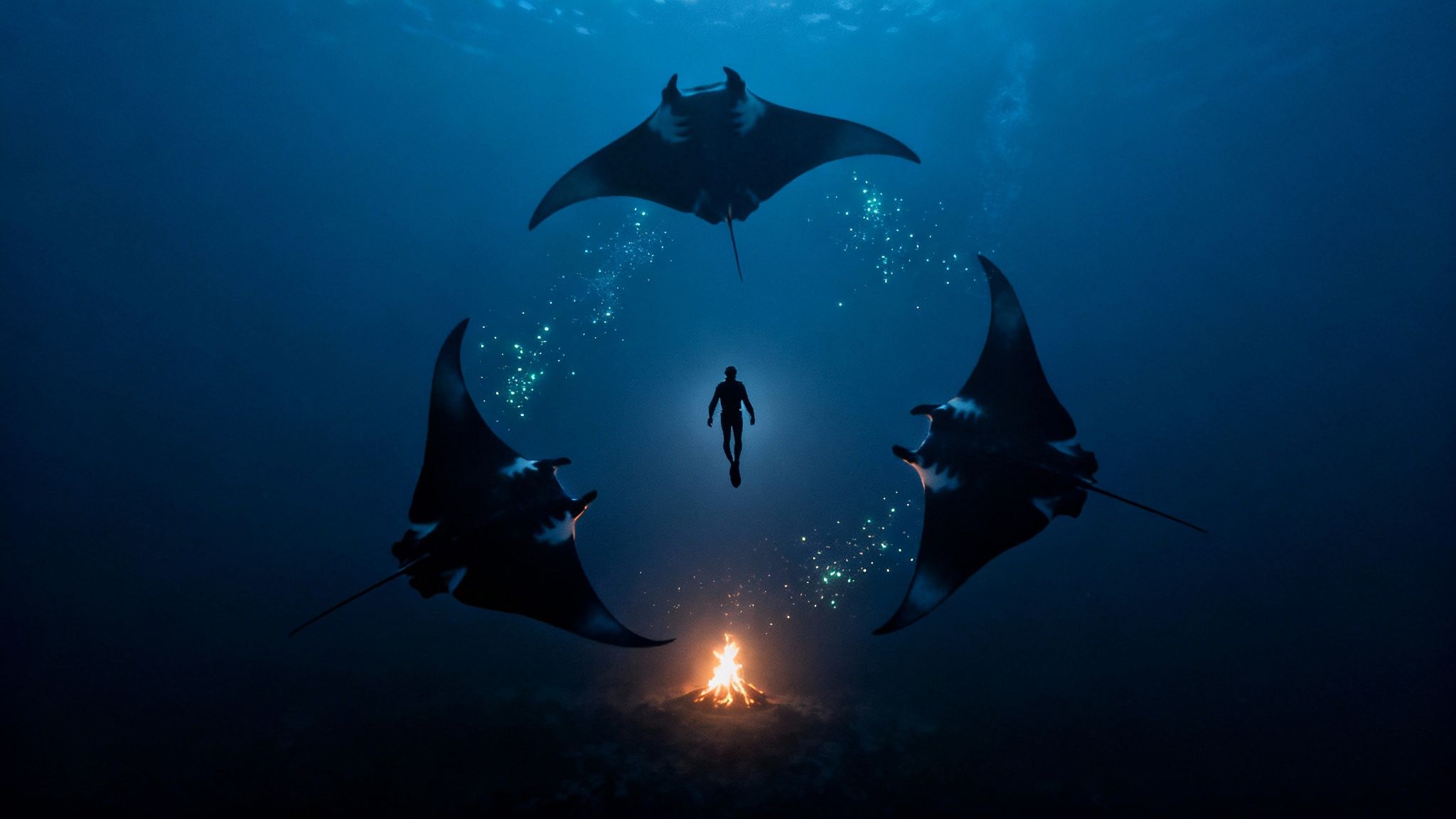
The Kona Coast isn't just a great spot for seeing manta rays; it's arguably the best on the planet. Why? The sighting success rate is astonishingly high, with most divers having an 85-95% chance of an encounter on any given night. You just don't get odds like that in many other places.
These dives happen in relatively shallow water, usually around 30-40 feet, which means more bottom time to soak it all in.
This isn't just a lucky coincidence. It's a carefully choreographed event where humans and nature work in harmony. Tour operators bring powerful underwater lights that attract huge clouds of plankton—the manta rays' favorite food.
Think of it as setting up a brilliant underwater buffet. The lights act like a massive dinner bell, drawing in the plankton. The intelligent manta rays figured this out years ago and now show up reliably for an easy meal.
A Spectacle of Nature and Light
What happens next is pure magic. The mantas glide into the illuminated water, performing effortless barrel rolls and somersaults to scoop up the plankton-rich water. Their grace is breathtaking, and they get incredibly close, creating an unforgettable experience for both divers on the ocean floor and snorkelers on the surface.
For a quick overview of what this incredible adventure entails, take a look at the table below.
Kona Manta Ray Night Dive At a Glance
Here is a quick summary of what to expect from the manta ray night dive experience in Kailua Kona.
| Attribute | Details |
|---|---|
| Location | Kailua Kona, Big Island, Hawaii |
| Success Rate | 85-95% chance of sightings |
| Typical Depth | 30-40 feet (Shallow dive) |
| Wingspan of Mantas | Up to 16 feet |
| Best For | Scuba divers & snorkelers |
| Key Attraction | Up-close encounters with feeding manta rays |
This summary gives you the essentials, but nothing compares to seeing it firsthand.
Capturing this kind of underwater spectacle is an art form. It's why understanding the role of photography in marine marketing is so key; powerful images are the only way to come close to conveying the awe of being there.
Your first step to an amazing trip is choosing a top-rated, responsible operator. The best companies aren't just focused on giving you a thrill; they're deeply committed to protecting the mantas and their environment.
When you're ready to see this natural wonder for yourself, booking a manta ray dive tour is the next step.
Meet the Gentle Giants of the Kona Coast

The stars of the show on the manta ray night dive in Kailua Kona are the incredible reef manta rays (Mobula alfredi). These aren't just passing through; they're a resident population of intelligent, graceful creatures. Some have been regulars on the Kona coast for decades and can live for 50 years or more.
Their massive size can be a bit intimidating at first, but don't let that fool you—these gentle giants are completely harmless. They're part of the ray family but have a key difference from their stingray cousins: they have no stinger or barb. If you're curious, you can learn all about whether manta rays can sting you in our dedicated post. They're filter feeders, simply gliding through the ocean with their huge mouths open to scoop up tiny plankton.
The Famous Barrel Roll
What truly sets the Kona experience apart is watching their unique feeding strategy unfold right before your eyes. Our powerful underwater lights attract a dense buffet of plankton, and the mantas swoop in for the feast.
To get as much food as possible, they perform a beautiful, acrobatic maneuver called the "barrel roll." You'll see them do slow, graceful somersaults through the thick clouds of plankton. It looks like an underwater ballet, and witnessing multiple mantas performing this dance just inches from your face is absolutely mesmerizing.
Getting to Know the Locals
One of the most special parts of this dive is realizing you're not just seeing anonymous animals. You're meeting a community of individuals, many of whom have names and personalities that the local guides and researchers have known for years.
This is all thanks to a brilliant photo-identification program that works a bit like this:
- Unique Spot Patterns: Every single manta ray has a one-of-a-kind pattern of black spots on its white belly.
- Like a Fingerprint: These spot patterns are as unique as a human fingerprint, making it possible to tell each manta apart.
- Long-Term Tracking: By taking photos of their undersides, researchers can name them and track their movements, health, and behavior over their entire lives.
This program turns a simple wildlife sighting into a personal encounter. You might meet famous residents like "Big Bertha" or "Lefty"! Over the years, nearly 200 individual manta rays have been identified and cataloged in the Kona area. On a really good night, we've seen as many as 36 different mantas show up at a single site.
Choosing Your Adventure: Scuba Dive or Snorkel?

One of the best things about the manta ray night dive in Kailua Kona is just how accessible it is. You absolutely don't need to be a certified scuba diver to witness this incredible underwater ballet. The whole experience is set up beautifully for both divers and snorkelers, and each gives you a unique—and equally mesmerizing—view of the action.
So, how do you decide? It really boils down to your comfort level in the water and what kind of perspective you're hoping for. Either way, you're getting a front-row seat to one of nature's most spectacular shows.
The Scuba Diving Experience: An Immersive Encounter
If you’re a certified diver, this is the classic, fully immersive way to go. After a quick boat ride out to the site, you'll gear up and descend with your guide to the sandy ocean floor. It’s a nice, easy dive, typically at a shallow depth of around 30 to 40 feet.
Down below, your group will settle in around a collection of powerful underwater lights, which we affectionately call the "campfire." This beacon of light is the dinner bell, attracting massive clouds of plankton. Before you know it, the manta rays arrive, gliding and swooping just inches above your head as they feed. It’s a breathtaking, up-close encounter that makes you feel like you're truly part of their world.
The Snorkeling Experience: A View from Above
Not a diver? No problem. The snorkeling option is just as thrilling and offers a fantastic bird's-eye view.
You'll float on the surface, holding onto a custom-built flotation board. These boards are outfitted with their own high-intensity lights that shine down into the water, creating the same plankton-attracting effect as the divers' lights below. From this amazing vantage point, you can watch the mantas soar up from the depths to feed right below you. It’s a wonderfully safe, comfortable, and unforgettable way to see the show.
Still on the fence? To help you choose, we’ve put together a quick comparison.
Manta Ray Dive vs Snorkel Experience
| Feature | Scuba Diving | Snorkeling |
|---|---|---|
| Perspective | Bottom-up view, with mantas gliding overhead. | Top-down view, with mantas rising to the surface. |
| Depth | 30-40 feet on the ocean floor. | Floating on the surface. |
| Requirements | Scuba certification is required. | No experience is needed, just comfort in water. |
| Proximity | Mantas can be inches away. | Very close, as they feed near the surface. |
| Ideal For | Certified divers wanting an immersive experience. | Families, non-swimmers, and those without certification. |
Ultimately, there's no wrong answer here. Both options deliver an incredible night. If you want to explore the pros and cons in more detail, check out our guide on whether it's better to snorkel or dive with manta rays.
No matter which adventure you pick, you're in for an amazing time. Top-notch operators like Kona Honu Divers expertly handle both groups on the same trip, ensuring everyone has a safe and spectacular experience.
What to Expect on Your Manta Ray Tour
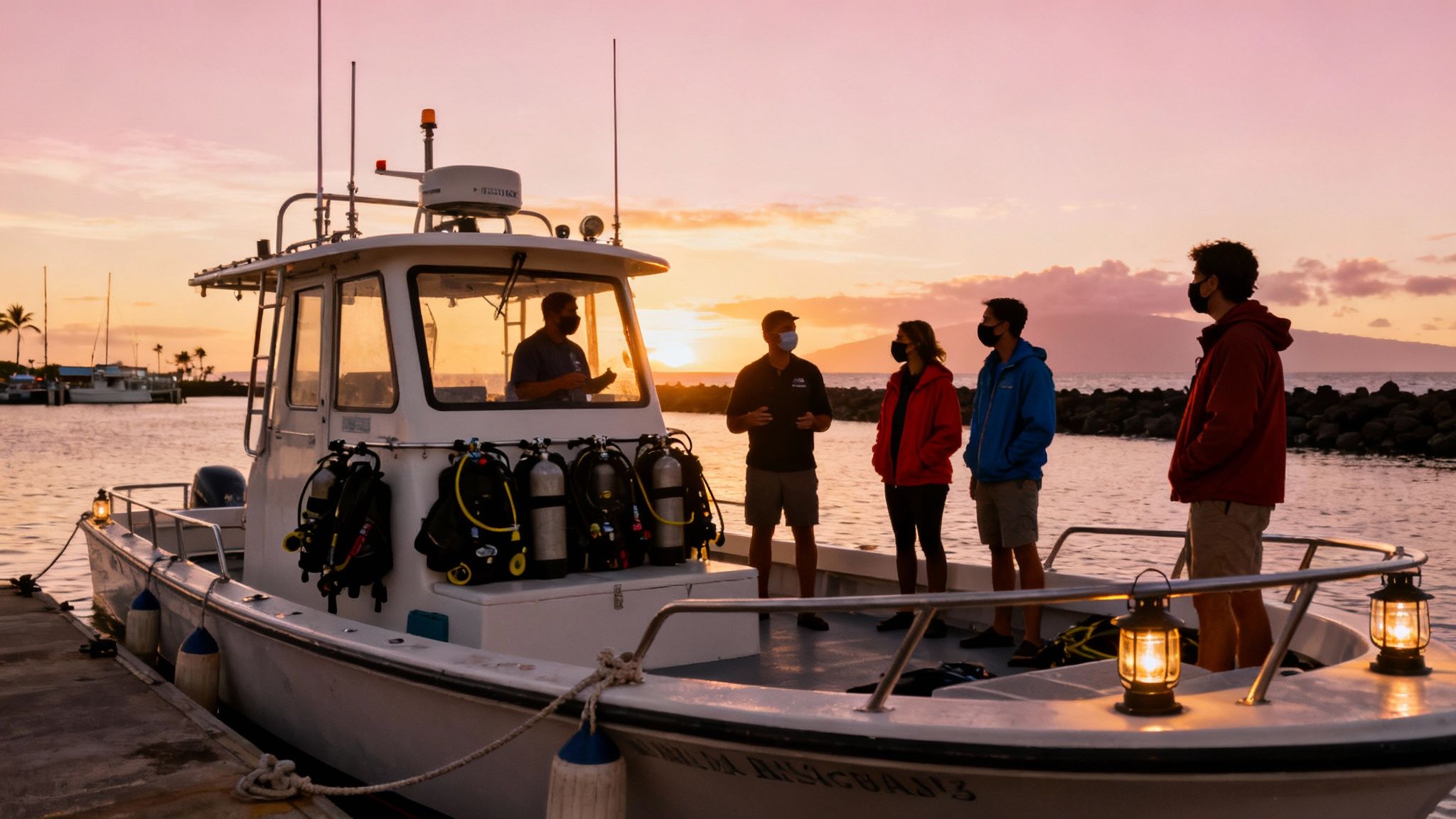
Knowing what’s coming can make the experience even better, turning any pre-dive jitters into pure excitement. A manta ray night dive in Kailua Kona isn't just a jump in the water; it's a carefully choreographed event designed to give you a front-row seat to one of nature's greatest shows, all while keeping you safe and comfortable.
Let's walk through what the evening typically looks like, from the moment you step on the boat to your return to shore.
Your adventure kicks off in the late afternoon at the harbor. You'll check in with your crew, get a feel for the boat, and maybe chat with the other divers and snorkelers sharing the trip with you.
Your Pre-Dive Briefing and Sunset Cruise
Once everyone’s settled, the crew gathers everyone for a detailed briefing. This is probably the most important part of the whole tour, so it pays to listen up.
Your guides will go over all the essentials. They’ll cover safety procedures, explain how to interact respectfully with the mantas—the number one rule is always look, don't touch to protect their sensitive skin—and tell you exactly what to expect once you hit the water.
With the formalities out of the way, the boat pushes off and heads for the dive site. This part of the trip is an experience in itself. More often than not, you'll be treated to a classic Kona sunset painting the sky as you cruise over the Pacific. It's a peaceful, beautiful start to an incredible evening.
The Main Event Underwater
As you arrive at the spot, the crew gets to work. They deploy a powerful set of underwater lights, which act like a massive dinner bell. These lights attract huge clouds of plankton, the mantas' favorite food. Divers get their gear on and head down to the sandy bottom, while snorkelers grab their custom light boards and get ready on the surface.
And then, the magic happens.
The first manta ray will glide silently out of the darkness and into the light, starting its graceful, looping barrel rolls to gulp down plankton. Before you know it, more often follow, creating a mesmerizing underwater ballet just inches from your face. You’ll spend about 45 minutes in the water, completely captivated by the show. This is what it's all about, and it's why a dedicated manta ray dive tour is something you'll never forget.
After your time with the mantas, you’ll climb back onto the boat, buzzing with adrenaline. Most crews have hot cocoa and snacks waiting to help you warm up. The ride back to the harbor is always filled with energy as everyone relives their favorite moments from the encounter.
How to Be a Responsible Manta Ray Tourist
The manta ray night dive in Kailua Kona is a world-class example of ecotourism done right. But its success—and its future—hinges entirely on the actions of every single person who gets in the water. When you join a tour, you're not just a spectator; you're taking on a shared duty to protect these incredible animals and their environment.
It all starts with who you book your tour with. Your choice of operator is the single most important decision you'll make. Although the formal "Manta Ray Green List" isn't active anymore, the principles it established are still the gold standard. You want a company that puts the mantas' well-being first, and that means they’ll give you a comprehensive briefing on the rules of engagement before you even dip a toe in the ocean.
Passive Observation Is Key
The number one rule for interacting with manta rays is simple: passive observation. Think of yourself as a guest in their house—their dining room, to be specific. Your only job is to watch the magic unfold without getting in the way. These aren’t just polite suggestions; they are absolutely critical for the health and safety of the mantas.
The main guidelines are easy to remember but incredibly important:
- Look, Don't Touch: This is the big one. Manta rays are covered in a protective mucous coating, which is like their immune system. Touching them strips this layer away and leaves them open to nasty infections.
- Don't Chase or Harass: Never, ever swim after a manta or try to ride it. Let them come to you. Chasing a manta causes immense stress and can scare them away from the very place they come to eat.
- Mind Your Lights and Bubbles: If you're diving, keep your light pointed up toward the surface to help attract the plankton. Snorkelers should point theirs straight down. Try to avoid shining your light directly into their eyes, and if you're a diver, don't exhale a big cloud of bubbles right into their path as they glide overhead.
Following these rules does more than just give you a good experience; it makes you an active participant in conservation. Your respect and consideration have a direct, positive impact on the local manta population, helping to ensure this amazing encounter will be around for years to come. For a deeper dive, check out our guide on responsible and considerate diver etiquette.
This isn't just about the animals; it's also a huge part of the local economy. Each year, an estimated 80,000 people come to the Kona coast for manta tours, making it a cornerstone of marine tourism. When you understand the economic impact and management of these tours, you see just how much your choices matter. Picking a responsible operator helps keep this incredible industry sustainable for everyone.
Your Manta Ray Night Dive Questions, Answered
Thinking about diving or snorkeling with manta rays in Kailua Kona? It's a one-of-a-kind adventure, and it’s totally normal to have a few questions before you take the plunge. We get asked these all the time, so we’ve put together some straight-to-the-point answers to help you get ready.
Let's clear up everything from safety and what to do if you can't swim to the best time to go, so you can book your trip with total confidence.
Is the Manta Ray Night Dive Safe?
Yes, absolutely. Safety is the number one priority for every reputable tour operator out there. First off, the manta rays themselves are completely harmless. People often call them "gentle giants," and it's true—they have no teeth, no barbs, and no stingers. They're just there for the plankton buffet.
Every tour is led by certified, experienced divemasters who know these waters inside and out. They’ll give you a full safety briefing before anyone gets in the water. Plus, the dive sites are typically quite shallow (around 30-40 feet) and located in protected bays. Just listen to your guides, and you're in for an incredibly safe and mind-blowing experience.
What if I Can't Swim or Have Never Dived Before?
No problem at all! This is a huge reason why the snorkel option is so popular. It’s designed for absolutely everyone, whether you’re an anxious swimmer or have zero experience in the ocean.
Snorkelers get to hang onto a large, custom-made floatation board. These boards are super stable and have powerful lights that shine down into the water, attracting the plankton that the mantas feed on. You just float comfortably at the surface, held up by a buoyant wetsuit, and get a perfect bird's-eye view of the underwater ballet. While you need certification to scuba dive, the snorkeling experience is just as spectacular and open to nearly anyone.
When Is the Best Time of Year to See Manta Rays in Kona?
This is the best part: any time is a great time! The mantas along the Kona coast are residents, which means they live here year-round and don't migrate. There's no official "manta season" because the show happens every single night.
Sighting rates stay consistently high all year, often over 90%. Of course, nature is unpredictable, and the number of mantas can change from one night to the next depending on plankton levels, but your chances of an incredible encounter are always excellent, no matter when you visit. The tour operators provide warm wetsuits, so you’ll be comfortable even on cooler winter nights.
How Far in Advance Should I Book My Tour?
Book as early as you possibly can. I can't stress this enough. The manta ray night dive in Kailua Kona is one of the most famous and sought-after activities on the Big Island, and it's often the highlight of a visitor's entire trip.
Tours, especially with the top-rated companies, fill up fast—often weeks or even months in advance. This is especially true during peak travel times like holidays, spring break, and the summer. Booking early means you get your pick of dates and operators, so you won't miss out.
Once you're booked, you just need to show up with a towel and a sense of adventure. The operator will handle all the gear.
The Kona manta ray experience is a fantastic example of sustainable ecotourism done right. When you participate, you're directly supporting local conservation and helping protect these amazing creatures for future generations.
Choosing a great operator really does make all the difference. Companies like Kona Honu Divers have built a solid reputation for their commitment to safety, outstanding customer service, and a deep respect for the marine environment, making sure your experience is both thrilling and responsible.
Ready for an adventure you'll never forget? Grab your spot and get ready to be mesmerized by Kona's gentle giants.
For a truly unforgettable underwater adventure, book your tour with Kona Honu Divers. Explore all our scuba diving Kona, Hawaii tours, including the world-famous manta ray dive tour.