
NOAA reported approximately 104 adult-breeding reef manta rays in the Hawaiʻi Island population in 2024, a reminder that Kona's famous attraction depends on a relatively small local breeding population, not an endless procession of visiting animals (NOAA Fisheries). When you book a manta ray night dive in Hawaii, you're entering a feeding habitat shared by wildlife, boats, snorkelers, and scuba divers.
The best encounter isn't necessarily the one with the closest pass. It's the one where you can settle comfortably, see without blocking someone else, and let the mantas feed without changing course around you. Choose your activity, site, and operator with that shared space in mind.
Manta Ray Night Dive Options Compared
Manta night options at a glance
| Option | Who It Suits | What You Do | Certification |
|---|---|---|---|
| Manta Ray Night Dive | Certified divers, beginners to advanced | Kneel on the sandy bottom in the viewing area | Certified diver |
| Manta Ray Night Snorkel | Snorkelers and freedivers | Float on the surface and watch mantas feed | None |
| Blackwater Night Dive | Experienced divers | Remain tethered in deep open water watching bioluminescent creatures | Advanced certification |
| PADI Manta Ray Diver | Divers wanting extra preparation | Learn manta biology, behavior, and conservation | Specialty course |
Certified divers: choose the manta night dive if you're comfortable managing your equipment and want the upward-looking view from below. Uncertified visitors: choose snorkeling rather than treating a wildlife charter as an introductory scuba lesson. Experienced divers seeking something different: consider blackwater, which is an open-ocean activity rather than a manta-feeding encounter.
Kona Honu Divers offers manta diving and surface snorkeling, with the flagship experience accommodating beginner through advanced participants in the appropriate activity. Experienced divemasters and instructors are in the water with divers. The optional PADI Manta Ray Diver specialty course, taken before the night dive, covers manta biology, behavior, and conservation.
Choose by comfort, not perceived closeness
Scuba involves more equipment and requires certification, but gives you a stable viewing perspective beneath the feeding activity. Snorkeling removes the scuba requirement, although you still need appropriate swimming ability and comfort floating in the ocean after dark. Freediving experience doesn't mean you should duck beneath the surface viewing group during a managed encounter.
Our comparison of snorkeling versus diving with manta rays can help mixed-experience groups choose without pushing anyone beyond their comfort level.
The Blackwater Night Dive suits experienced divers interested in creatures rising through deep, dark water, including bioluminescent life. Don't select it as a substitute for a stationary reef-based manta experience just because both happen at night.
For most certified visitors, the manta night dive is the strongest starting point. Choose snorkeling when surface comfort and simpler equipment matter more than the underwater perspective.
What to Expect on a Manta Night Charter
A typical evening begins with equipment decisions, not manta sightings. Arrive ready to explain your certification, recent diving experience, rental needs, and any concerns about darkness or seasickness.
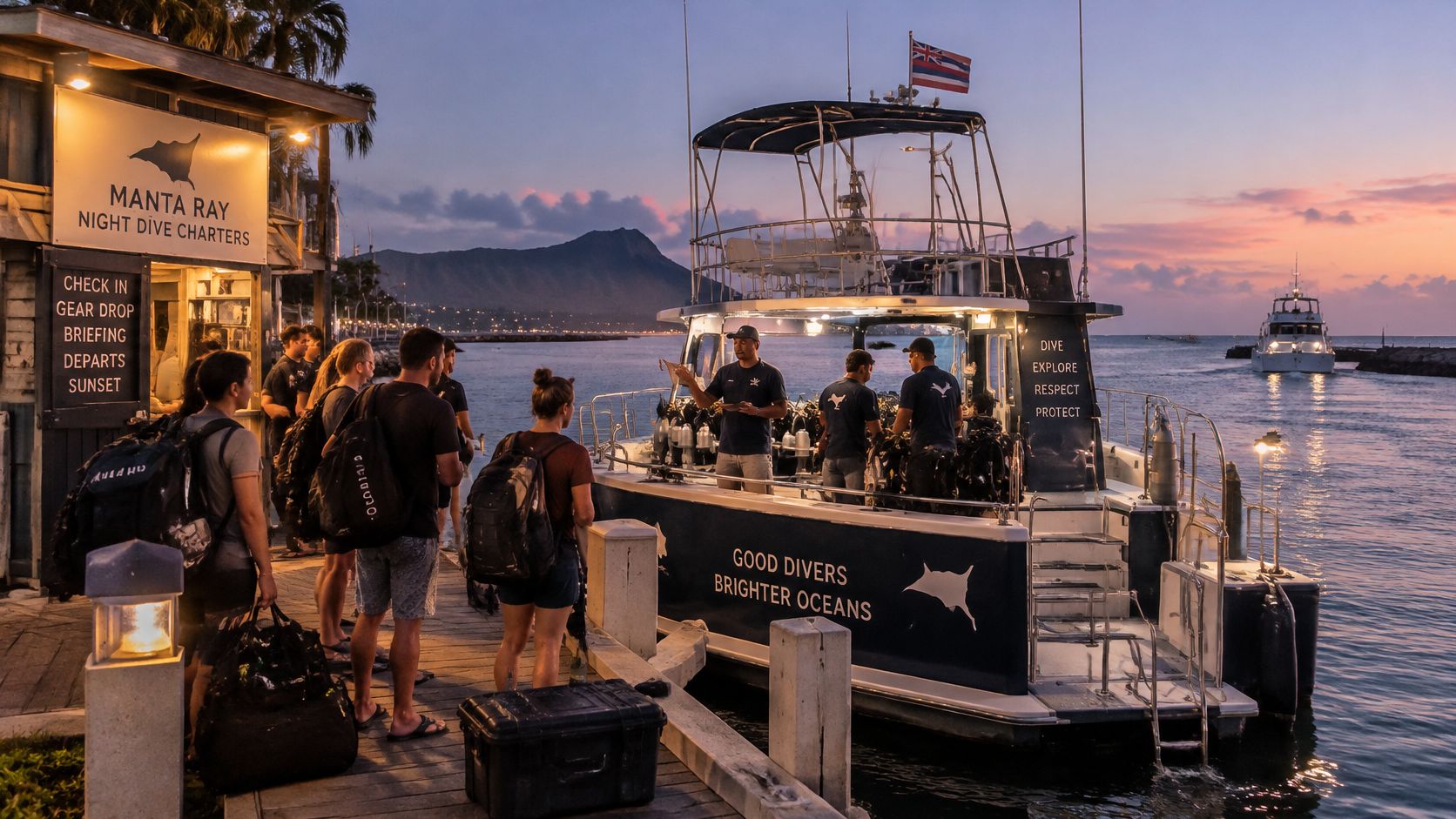
From check-in to the viewing area
Check in before dusk according to your confirmation. Assemble and test equipment while there's useful ambient light. Locate your releases, pressure gauge, inflator, and backup regulator before boarding becomes busy.
Depart and assess conditions. The captain evaluates the actual ocean, not just the forecast. If boat motion concerns you, review how to avoid seasickness on a boat before departure rather than waiting until you feel unwell.
Listen to the detailed briefing. Our crew explains the science behind the encounter and the rules of passive observation. Pay particular attention to buoyancy, fin control, light positioning, guide signals, and emergency ascent procedures.
Enter with the group and settle deliberately. Powerful lights create a bright circle on the seafloor, so the viewing area isn't completely dark. Divers kneel in the designated sandy area while snorkelers remain at the surface.
Watch the feeding passes. The dive is stationary and closely supervised. Guides help participants maintain their positions and stay comfortable, but each diver still needs to monitor breathing gas, equipment, and personal limits.
Return under guidance and debrief. Follow the agreed ascent and boarding sequence. Keep your mask and regulator available until you're safely out, then discuss anything that affected your comfort or positioning.
Understand the schedule before booking
A viewing shift isn't the same thing as underwater time. The manta-viewing operating proposal described two-hour operating shifts within a 4 p.m. to 4 a.m. window, but those proposed scheduling provisions aren't a promise about your dive duration.
Your actual immersion follows the charter plan, conditions, gas supply, and guide instructions. Don't build expectations around remaining underwater for an entire operating shift.
Our day and night scheduling allows guests to fit multiple dive trips into a day. If you combine a morning outing with an evening charter, allow time to eat, hydrate, rest, and reassess your energy. A tired diver with a camera is less likely to maintain good awareness in a busy viewing area.
Why Garden Eel Cove Is the Best Site
The lights attract the food, not mantas looking for human interaction. Artificial illumination concentrates plankton, and reef manta rays, Mobula alfredi, arrive to filter-feed.
Their cephalic fins funnel plankton-rich water toward the mouth, while specialized gill rakers retain prey as water passes out through the gills, as explained by Hawaiʻi's Division of Aquatic Resources. Those rolling approaches and open-mouth passes are active foraging, not invitations to swim alongside.
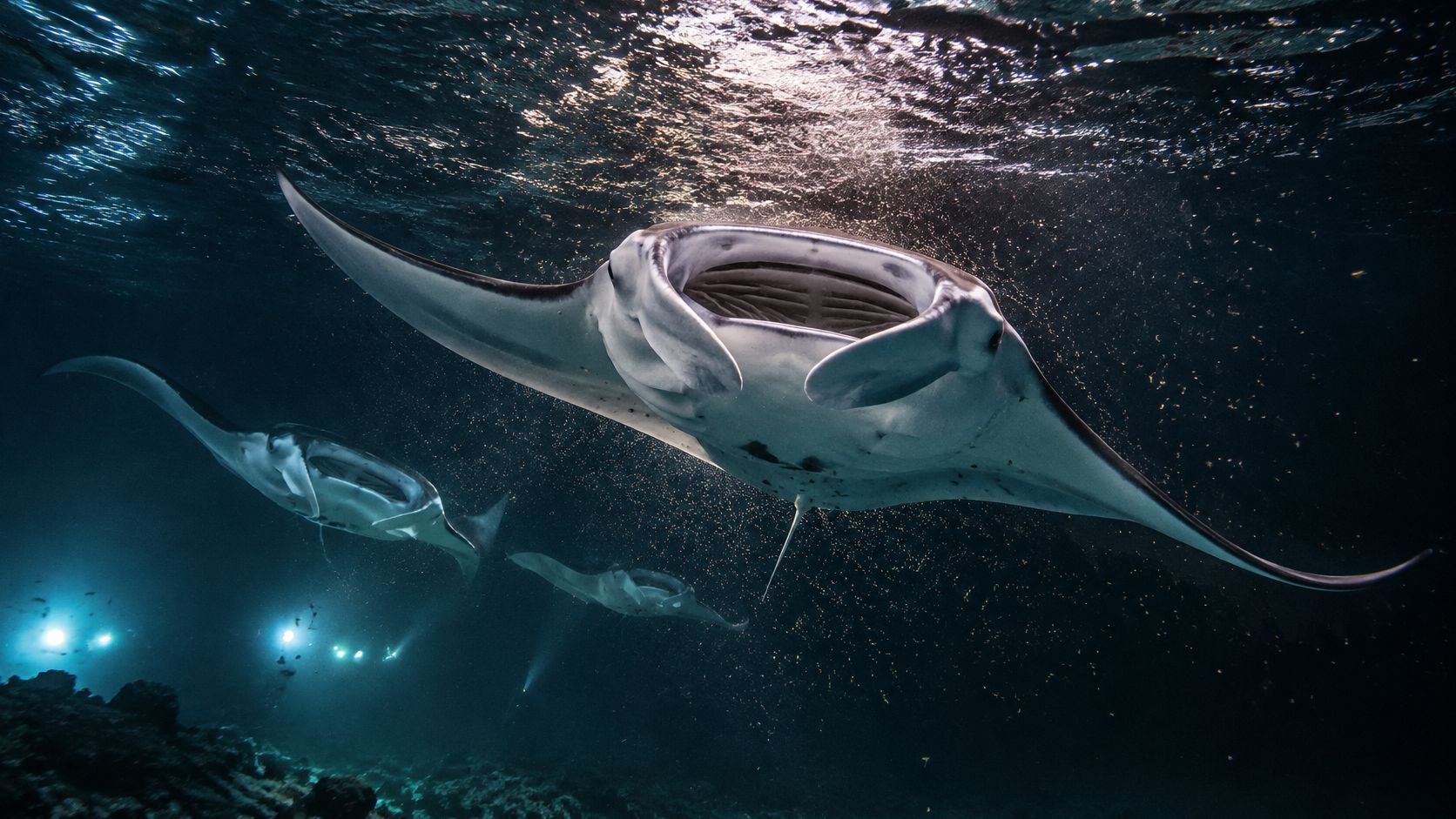
Shelter and reef structure improve the setup
Garden Eel Cove, also called Makako Bay or Manta Heaven, is the superior choice for the dive tour because its protected location, defined viewing area, and surrounding reef make a better overall diving environment. Its natural shelter from the open ocean supports calmer, clearer water, although no cove eliminates swell or guarantees visibility.
A Hawaiʻi state survey summarized in this Garden Eel Cove site guide recorded a reef bottom at about 36 feet, with roughly 50% coral cover. The practical advantage is a relatively shallow setting where guides can organize divers in a specific viewing area while leaving room above for feeding mantas.
The reef is a reason to choose the site, not somewhere to put your knees. Use only the sandy position your guide identifies, and keep fins, dangling gauges, and camera arms away from living coral.
Our go-to manta site is Garden Eel Cove, and we often take the charter there. That preference doesn't mean the captain should force a departure or site choice when conditions are unsuitable.
Why the encounters persist
Kona's nighttime viewing model developed at Keauhou in the early 1990s, when artificial lights drew plankton and feeding mantas into predictable nearshore locations, according to this history of Kona manta diving. Keauhou remains an important feeding area, not an inferior habitat because Garden Eel Cove offers a stronger dive setup.
The strongest distinction comes from long-term observations. A University of Hawaiʻi study published in 2025 analyzed more than 23,000 sightings involving 167 individually identified reef mantas from 2010 through 2022 at Garden Eel Cove and Keauhou, finding consistently larger aggregations at Garden Eel Cove.
Those observations support a persistent local aggregation system. They don't establish that every identified manta will appear on your evening.
Choose Garden Eel Cove for the quality of the diving setup, not because anyone can promise a particular number of rays.
Safety Rules and Crowding Protocol
Keep the feeding corridor clear. Don't chase, touch, intercept, or rise into a manta's path, even when it appears to be passing just beyond your camera's reach.
Crowding makes that discipline more important. A Hawaiʻi County survey of 444 manta-viewing participants found that 82% felt crowded by snorkelers, 78% by boats, and 69% by scuba divers; earlier onsite research included in the document found that 44% of surveyed snorkelers saw people blinding others with lights.
Choose a position you can hold
- Settle where the guide assigns you. Favor a position with a clear view and enough room to manage your equipment. Don't squeeze between divers to reach the brightest light.
- Control your vertical movement. Establish neutral buoyancy during descent and ascent, then maintain the approved stationary posture without overweighting yourself. Avoid sudden upward movement into the illuminated feeding lane.
- Keep equipment inside your space. Secure alternate regulators and gauges. Fold camera arms inward when moving through the group, and keep fins from sweeping neighboring masks.
- Maintain light discipline. Use the beam direction demonstrated during the briefing. Never sweep lights across faces or turn your light into a spotlight that follows an animal.
- Respect the separation between activities. Surface snorkelers stay with their supervised group; scuba divers remain in the bottom viewing area. Neither group should move into the other's space to improve a view.
Historical crowding observations show why individual spacing isn't enough without vessel coordination. A county safety assessment summarized by Underwater Atlas recorded 21 vessels and 301 people at the site during one observation, while a 2023 Manta Ray Advocates report described busy nights with up to 30 tour boats at each principal site. These are documented observations and reports, not a prediction for every departure.
Evaluate supervision, not just group size
Management proposals have included commercial permit limits, passenger caps, guide supervision requirements, and a fishing prohibition during viewing hours. Treat proposals as proposals, not proof that a particular restriction is currently enforceable.
For your own booking, prioritize a clear positioning plan, guides who can communicate underwater, and a briefing that explains what happens when someone loses position. Our guides use a designated viewing area and closely supervise the stationary dive.
Photographers should apply the same responsible and considerate diver etiquette as everyone else. If getting the shot requires moving through another diver's view or making a manta turn, skip the shot.
Gear and Photo Tips for Night Viewing
Pack for remaining still, not for an energetic reef swim. You'll generate less heat while watching, and handling unfamiliar equipment becomes harder when your attention is divided between a camera, the guide, and passing animals.
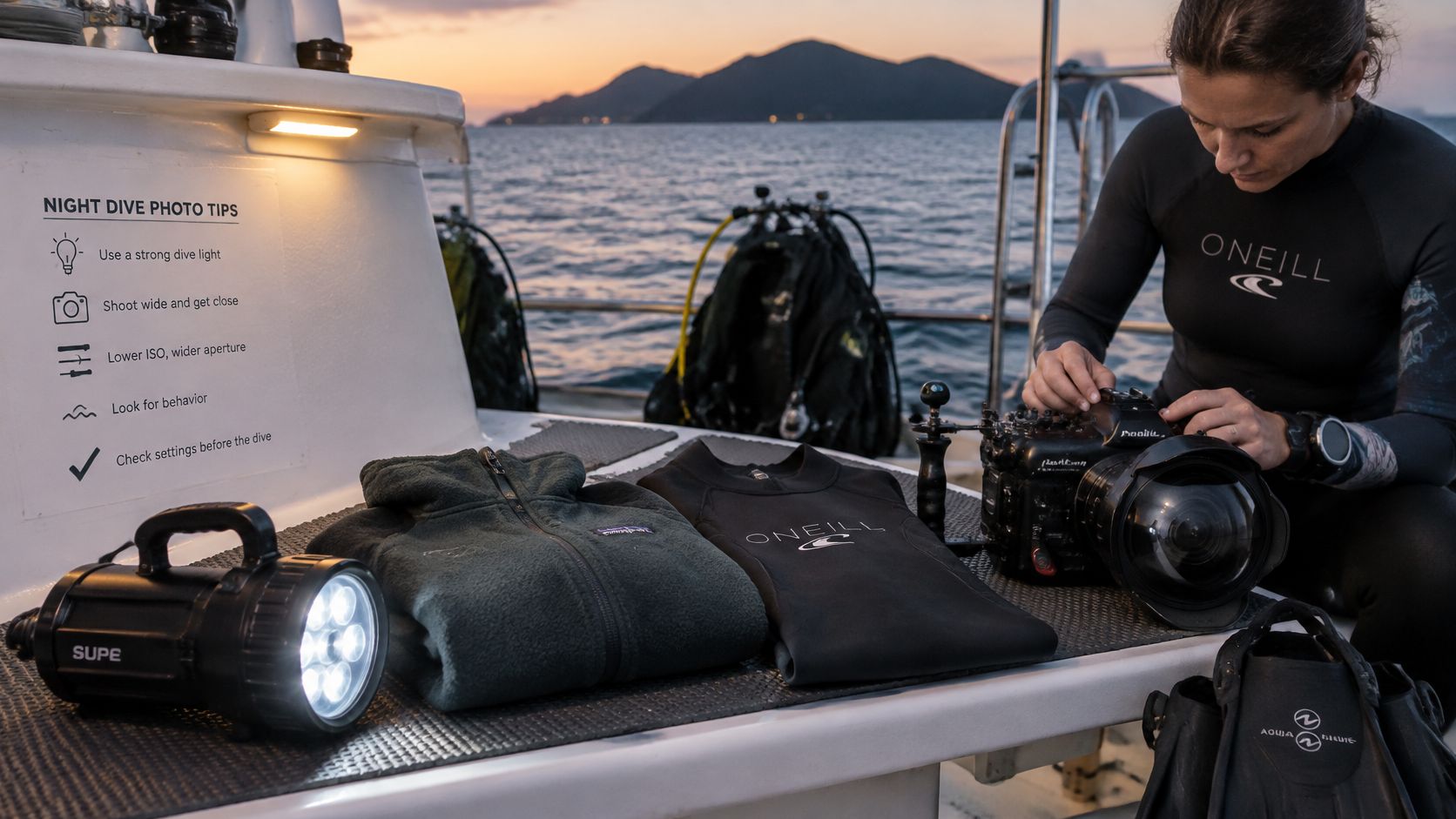
Pack for comfort and equipment control
- Dive light: Bring or rent the light specified for your charter. A bright beam is useful only when positioned correctly; follow the crew's instructions rather than adding competing light sources.
- Exposure protection: Choose a properly fitted wetsuit for your cold tolerance. A rash guard provides coverage but shouldn't be treated as equivalent insulation if you chill easily.
- Dry layer: Keep a towel and wind-resistant warm layer ready for the return ride. Put them somewhere accessible without emptying your entire bag.
- Camera setup: A wide-angle lens helps frame a large animal without backing into someone else. Secure the housing so it can't swing into the reef or another diver.
- Familiar scuba equipment: Test your mask seal, light switch, and camera controls before entering. Confirm rental needs ahead of departure rather than improvising at the dock.
Let position do the photographic work
Start from a stable, guide-approved kneeling position on sand. Compose around the open water above the viewing area instead of leaning forward into the feeding corridor.
For a basic video setup, begin with strobes off and use the established illumination. If you're using strobes, follow the crew's policy and keep them directed away from approaching mantas and neighboring participants. Don't add light just because your camera can support it.
Clean water and correct light placement matter more than maximum brightness. A poorly aimed beam can illuminate suspended particles in front of the lens, while fin movement can lift sediment and spoil everyone's view.
Use these manta ray dive photography examples and tips to plan framing before departure. Set up your camera so you can operate it by feel, then put it down whenever equipment checks or guide communication need your attention.
A photograph isn't worth losing your position. Let the animal enter the frame rather than moving the frame into its path.
Seasons, Conditions and Realistic Expectations
A high encounter rate isn't a guarantee, and a calendar date can't tell you how much plankton will collect at the lights. Kona manta sightings often exceed a 90% success rate, and our manta night dive has encounter rates of up to 92%, but neither figure promises an animal on your departure.
Mantas respond to food availability, currents, and local conditions rather than a simple visitor-friendly season. You can have an excellent ocean forecast and limited manta activity, or feeding mantas present when conditions make a passenger trip unsuitable.
Separate wildlife uncertainty from weather decisions
Biological variability means the trip can operate appropriately while animals remain elsewhere or make fewer passes. You're paying for a guided wildlife-viewing opportunity, not control over a wild animal's movements.
Operational cancellation means the captain judges wind, swell, visibility, current, or another safety factor unsuitable. A sighting report from another boat doesn't override that decision.
Marine-life guidance discussed in SFGATE's reporting on Kona manta tourism describes mantas changing course, avoiding swimmers, or stopping feeding during encounters. That makes passive observation part of a successful evening, even when it produces fewer dramatic close passes.
Resolve the practical questions before paying
- Weather decisions: Find out how cancellation notices are communicated and when you should arrive if conditions remain uncertain.
- Rescheduling and refunds: Read the actual terms, including the difference between an operator cancellation and a guest cancellation.
- No-manta departures: Confirm whether any return opportunity exists and what restrictions apply. Don't assume a refund or free repeat trip.
- Viewing procedures: Expect explicit instructions for lighting, bottom positioning, surface groups, and returning to the boat.
Our most popular trips, including the manta night dive, often sell out weeks in advance. Reserve early enough to protect your preferred date, and consider placing the outing earlier in your stay so there's room to discuss alternatives if weather intervenes.
The useful question isn't which month is best. It's how your travel flexibility, comfort in the ocean, and expectations fit the best time to see manta rays in Kona.
Book Your Manta Ray Night Dive in Kona
Book a supervised encounter with a defined viewing area, not a promise of unrestricted access to wildlife. Our approach combines in-water guides, a science-based briefing, passive observation rules, and a preference for Garden Eel Cove's protected diving environment.
The two-tank manta ray dive and snorkel charter is the direct choice for this experience. Before reserving, confirm the correct activity for each guest, the certification requirements, rental equipment, and the current rescheduling terms.
Make the booking match your trip
- Choose the date and activity: Certified divers should select the scuba option; uncertified guests should select the appropriate surface experience.
- Share preparation needs: Tell us if you're newly certified, rusty, sensitive to cold, or concerned about night diving.
- Check the rest of your schedule: Our Kona diving tours include the 2 Tank Local Morning Dive and Morning Introductory Scuba Dive, while experienced divers can consider the Premium Advanced 2 Tank Trip.
- Reserve deliberately: Read the confirmation rather than assuming departure times, inclusions, or cancellation policies.
I'd choose the manta night dive for a first Kona evening underwater. If you want more biological context before entering, start with the PADI Manta Ray Diver specialty course, then approach the encounter with a better understanding of what you're watching.
Kona Honu Divers offers guided manta night diving and surface snorkeling, with preparation and in-water supervision built around respectful wildlife viewing. Visit Kona Honu Divers to choose your activity, review available dates, and reserve a Kona manta encounter that fits your experience level.