
A typical manta-viewing excursion in Hawaiʻi costs approximately $110 per person and lasts 3–5 hours. That's the practical baseline for planning a manta ray night dive in Hawaii, before you decide whether scuba, snorkeling, or a particular Kona site suits you.
You may be comparing tour times from a hotel room, wondering whether the famous night dive is worth fitting into an already busy Big Island itinerary. The answer depends less on whether manta rays appear and more on how the encounter is organized. A busy light station, poor positioning, or an exposed site can turn an extraordinary wildlife experience into a cramped evening in the water.
Kona's manta activity is concentrated around Keauhou Bay, commonly called Manta Village, and Hōnaunau Bay with adjacent Makako Bay, known as Manta Heaven. The county assessment that recorded the typical duration and price also documented sites hosting between 100 and more than 300 people simultaneously, which explains why crowding, vessel coordination, lighting, and diver conduct have such a direct effect on the quality of the experience. The Hawaiʻi County assessment provides the useful context behind those expectations.
Understanding the Manta Ray Night Dive Experience
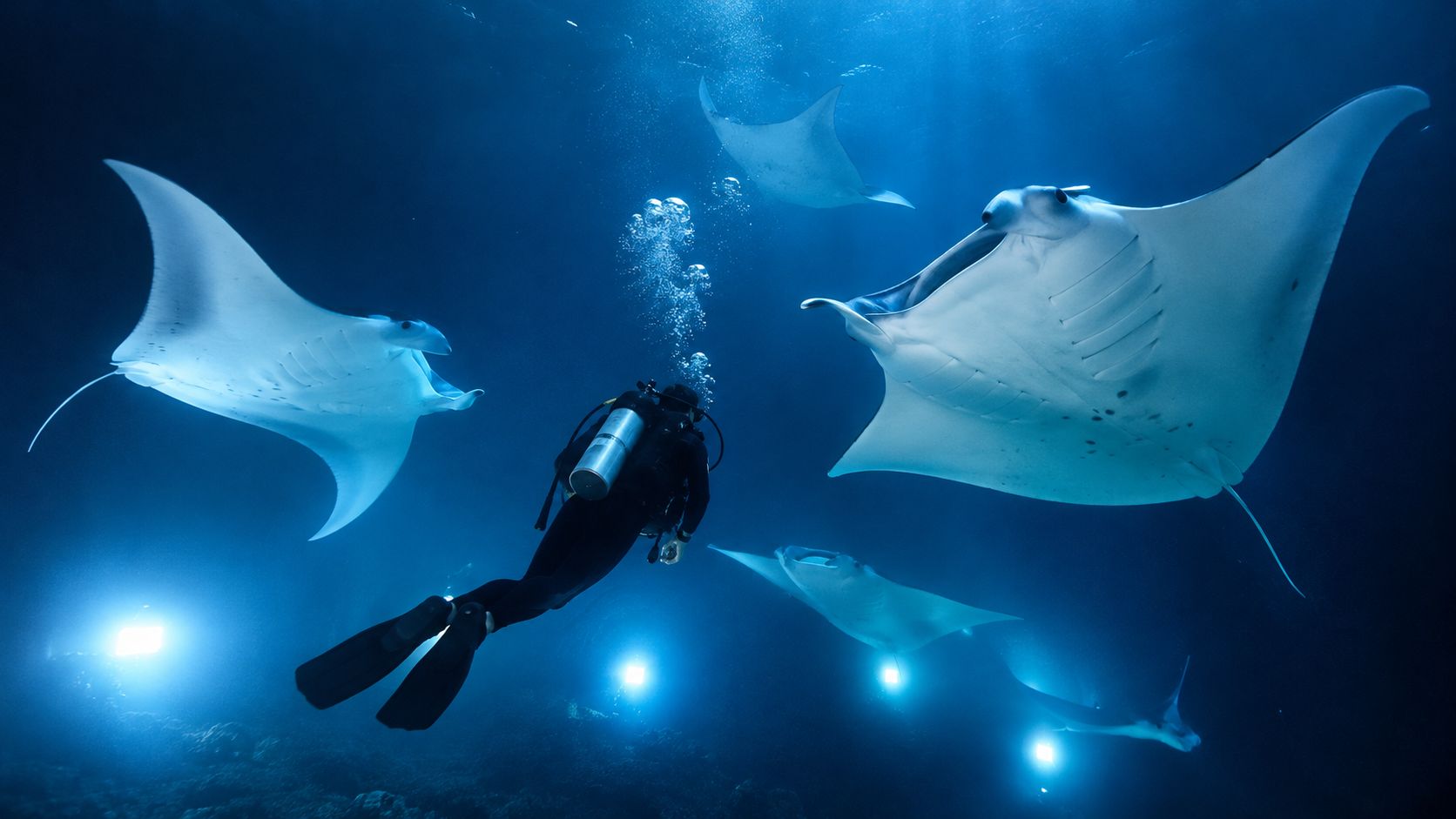
The boat settles, the last daylight fades, and the water below becomes a black field interrupted by narrow cones of light. You enter slowly, hear the soft rush of your own breathing, and look toward the illuminated water column. At first, there may be only plankton and drifting particles. Then a manta ray banks through the glow, turns its pale underside toward you, and disappears beyond the edge of the light.
That scene works because the dive creates a light-mediated feeding aggregation. Underwater lights concentrate zooplankton near the surface, and reef manta rays, Mobula alfredi, enter the illuminated area to filter-feed. Researchers have documented manta feeding on zooplankton attracted to underwater lights at Kona sites including Keāhole Bay and Makako Bay. The peer-reviewed assessment of manta behavior explains why the animals repeatedly pass through these dense prey patches.
Why the feeding pattern looks so dramatic
The looping and barrel-rolling aren't random acrobatics. Repeated passes through plankton-rich water let a manta process more prey without swimming long distances. Once you understand that, the best viewing position becomes obvious. You aren't trying to approach the animal. You're holding a stable position while the manta chooses its route through the food-rich water.
Scuba divers generally watch from below, while snorkelers observe from the surface. Both perspectives can be excellent, but neither works well when guests chase the animals, swim across the feeding lane, or keep shifting their lights. Sudden movement, bright flashes, touching, and obstruction can interrupt feeding and cause a manta to leave the aggregation.
Practical rule: The manta should control the distance. Your job is to stay predictable, keep your body and equipment out of its path, and let the light do the attracting.
The experience also differs from daytime reef diving because the animals become the structure of the dive. During daylight, you move through the reef looking for life. At night, you settle into a defined viewing zone and watch feeding behavior unfold in front of you. A guide's briefing and your own buoyancy control therefore matter as much as the sighting itself.
Kona's activity has grown far beyond a small, occasional wildlife encounter. Direct observations documented 7 to 22 vessels on particular nights in 2015, with approximately 114–177 snorkelers and divers, including guides, in the water at the same time. Another observation period recorded 16–19 vessels and roughly 160–190 people concurrently. The county assessment shows why responsible night diving in Kona depends on coordination, not just finding the animals.
Choosing the Right Manta Ray Site in Kona
Site selection changes the feel of the entire evening. Keauhou, or Manta Village, is an established viewing area with important ecological value, but Garden Eel Cove, also called Manta Heaven, is the stronger choice for a scuba-focused manta tour. Its more protected setting, broad sandy viewing area, and surrounding reef habitat make it easier to position divers without placing them on live coral.
That distinction matters in real conditions. A protected site reduces exposure to open-ocean swell, which helps anxious beginners maintain composure and gives photographers a steadier platform. The sandy bottom also provides a clear place for divers to settle while manta-viewing lights illuminate the water. NOAA guidance recommends positioning lights over sand or rubble with enough room that divers don't need to rest on living coral. The site and diving overview supports Garden Eel Cove's practical advantage.
Kona sites side by side
| Site | Conditions | Best For | Aggregation Size |
|---|---|---|---|
| Garden Eel Cove, Manta Heaven | More protected setting with an expansive sandy viewing area and nearby reef habitat | Scuba divers, photographers, first-time night divers, and guests who want a calmer setup | Generally larger aggregations |
| Keauhou Bay, Manta Village | Established viewing area with different site characteristics and stronger female site fidelity | Guests interested in the broader ecology of the Kona manta sites | Generally smaller than Garden Eel Cove, though conditions vary |
A six-year monitoring study recorded 25,444 observations of 118 individual reef manta rays across two Kona sites. It found that Garden Eel Cove generally supported larger manta aggregations, while Keauhou showed stronger female site fidelity and may serve ecological functions beyond nighttime feeding. The long-term Kona monitoring summary gives a more useful comparison than a simple claim that one site is always busier.
The practical decision is straightforward. Choose Garden Eel Cove when your priority is a protected, comfortable scuba platform and a spacious viewing area over sand. Keauhou can still offer a meaningful encounter, particularly for visitors interested in site fidelity and the wider behavior of the resident population, but it shouldn't be treated as interchangeable with Garden Eel Cove.
Why exposed conditions create frustration
Divers who book based only on the phrase “manta night dive” can arrive expecting every site to feel calm and open. In reality, swell, group placement, light configuration, and bottom composition all influence how easily you can hold position. A productive site can still feel awkward if divers crowd the same viewing lane or need to hover over reef structure.
Garden Eel Cove is the superior choice for the tour because its layout supports the behaviors that make the encounter work: settle low, keep the lights consistent, protect the reef, and let the mantas loop through the water without human traffic cutting across their path. More detail on the decision between Kona's sites appears in this guide to Kona manta dive locations.
Proper Positioning and Diver Etiquette
The most effective manta divers look almost inactive. They descend, settle over the bottom, hold their lights correctly, and wait. That stillness gives the animals a predictable feeding lane and prevents the group from turning a clear viewing area into a cloud of fins and bubbles.
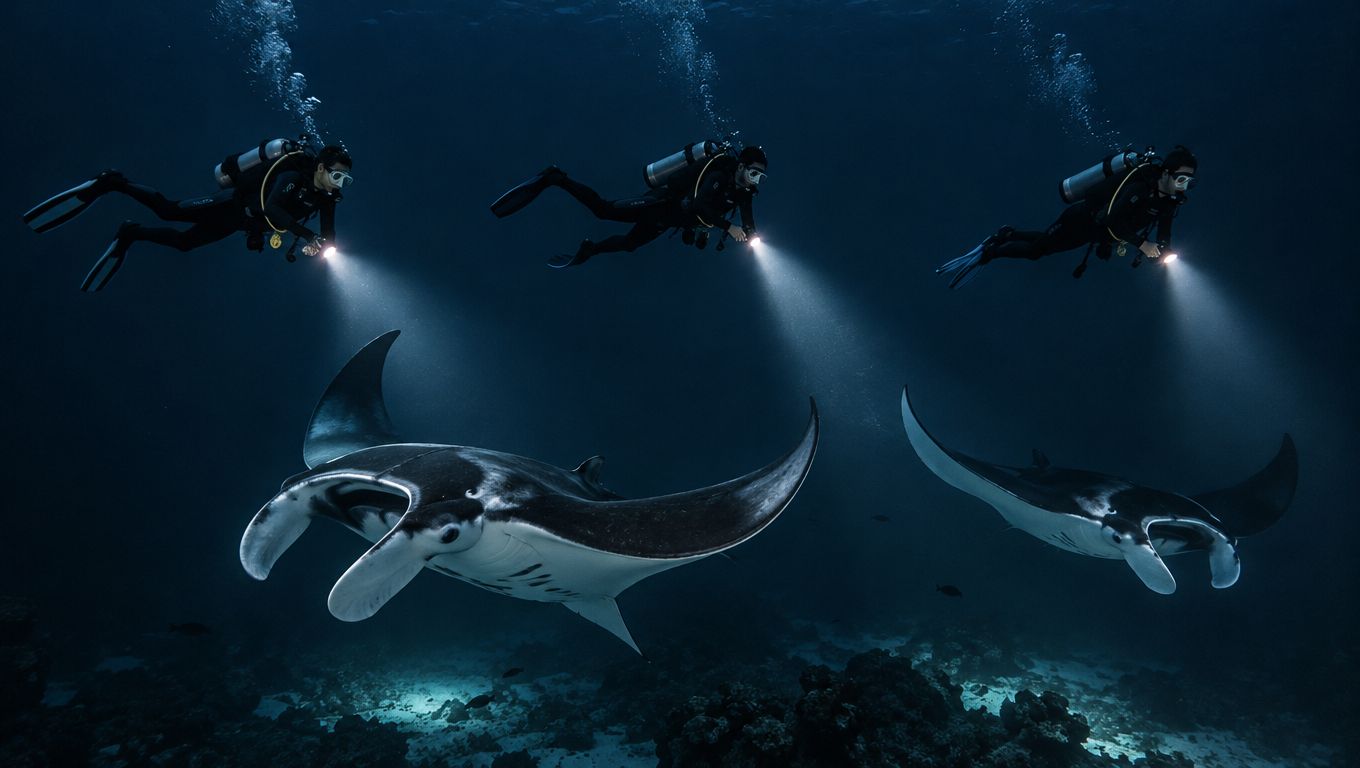
Scuba divers should remain low over sand, rubble, or boulder bottoms, hold their lights above their heads, and shine them upward into the water column. Snorkelers should remain at the surface and point their lights downward. The recommended Kona manta positioning explains the mechanics behind this arrangement.
Scuba positioning
Keep your knees and fins close to the bottom without touching it. Good buoyancy prevents accidental coral contact, reduces suspended sediment, and keeps your light in the intended position. Avoid exhaling directly toward a manta's face, and remove a snorkel from your mask because it can snag a passing animal.
A camera creates another responsibility. Keep it controlled, avoid extending it into the feeding path, and don't let the search for a better angle pull you out of position. A manta moving toward the light has priority over your composition.
Snorkeler positioning
Snorkelers should remain at the surface and avoid diving into the feeding column. The surface position gives mantas room to pass beneath the group while keeping snorkelers separate from divers below. When four or more snorkelers are involved, NOAA guidance recommends a snorkel ring or comparable flotation device, with the group centered above the lights.
Stay where the guide places you. The manta's approach is the shot, not an invitation to swim toward it.
Touching, chasing, surrounding, and blocking are not harmless attempts to get closer. Hawaiian Ocean Watch notes that a startled manta may avoid areas frequented by humans, potentially altering its feeding habits and behavior. Rapid approaches can cause mantas to flee and associate people with danger. Its guidance on touching and pursuing manta rays makes the animal-welfare issue clear.
Use slow fin movements, keep dangling equipment secured, and follow the guide's signals immediately. A passive encounter is not less exciting. It gives the manta freedom to maneuver and gives you a better view of natural feeding behavior. These responsible diver etiquette practices are the difference between occupying the site and caring for it.
The Hidden Reality of Manta Dive Crowding
A manta sighting and a satisfying manta experience aren't the same outcome. The animals may be present, but a guest can still feel boxed in by boats, snorkelers, divers, competing lights, and photographers moving across the same space.
A survey of 444 people who snorkeled or scuba-dived with manta rays in Hawaii found that 82% felt crowded by snorkelers, 78% by boats, and 69% by scuba divers. The same research reported that 77% encountered more snorkelers, 67% more divers, and 68% more boats than they considered acceptable. The survey on crowding, norms, and return intentions connects above-norm crowding with lower satisfaction and a greater likelihood that visitors wouldn't return.
What crowding looks like underwater
Crowding isn't only a matter of headcount. It appears as a diver settling directly in front of your light, a snorkeler dipping into the feeding column, or a boat's presence making entry and exit feel rushed. Photographers notice blocked angles first. Families may notice noise and uncertainty. Nervous beginners often lose the calm breathing rhythm they need to enjoy a night dive.
The hidden problem is that booking pages usually sell the possibility of manta rays without explaining the human-density trade-off. A successful sighting can still feel congested when groups overlap or when guides don't establish clear boundaries before entry.
Questions that reveal operating quality
Ask specific questions before booking rather than accepting general promises about a “small group” or “premium experience.”
- Group management: How does the crew keep scuba divers and snorkelers in separate viewing positions?
- Pre-dive briefing: Does the guide explain spacing, light placement, and non-contact behavior before anyone enters?
- Site choice: Does the operator select a protected sandy site when conditions and the itinerary allow it?
- Guest fit: Can the crew accommodate photographers, anxious beginners, and mixed scuba and snorkel groups without forcing everyone into one position?
No operator can promise an empty manta site or guarantee that every guest will feel uncrowded. A responsible crew can explain the likely conditions, position guests deliberately, and intervene when someone blocks the feeding lane. That transparency is more useful than a promise of an unrealistically private encounter.
What to Bring and How to Prepare
Preparation should make the night simpler, not turn it into an equipment project. Operators generally handle the major dive equipment for a certified scuba trip, but you still need personal items that protect comfort before and after the water.
Pack a towel, dry clothes, a reusable water bottle, and a warm layer for the ride back. Apply reef-conscious sunscreen before departure, then follow the operator's guidance about when to avoid adding products before entering the water. Your mask fit matters more than an expensive camera. A leaking mask or uncomfortable exposure layer will pull attention away from the manta behavior.
Match the preparation to your experience
Certified divers should arrive ready to manage buoyancy, equalization, and basic night-diving procedures without rushing. A manta dive isn't the place to discover that your mask strap is difficult to adjust or that your camera rig makes you unstable. Test the configuration on the boat, keep accessories tidy, and ask the guide where each item should be secured.
First-time snorkelers should be honest about comfort in open water after sunset. You don't need to swim continuously, but you do need to follow the crew's flotation and positioning instructions. The briefing is the right time to mention anxiety, cold sensitivity, seasickness, or difficulty with mask fit.
A practical packing check
- Dry layer: Bring a hoodie, jacket, or other warm clothing for the return ride.
- Personal mask: Use one that fits well if you already own it. Otherwise, ask the crew to help you test the rental.
- Simple camera setup: A compact waterproof camera is easier to control than a bulky rig you haven't used at night.
- Motion-sickness plan: If boat travel unsettles you, prepare before departure and review practical ways to avoid seasickness.
- Water and food: Hydrate and eat sensibly before boarding. Heavy meals and dehydration both make discomfort harder to manage.
Photographers should set expectations realistically. The manta may pass close, but you can't control its angle, speed, or route. Keep your light and camera movements restrained, and accept that the strongest image may come when you stop adjusting and let the animal enter the frame.
Scuba certification is required for a certified scuba manta tour. Guests who aren't certified should choose the snorkeling format or ask an operator about appropriate introductory options rather than treating the night dive as a place to learn basic scuba skills. The best preparation leaves you with enough attention to monitor your breathing, maintain position, and watch the animals.
Booking Your Dive with a Reputable Kona Operator
A good booking decision starts with the operational details that affect the water experience. Look for a crew that explains the site, separates diver and snorkeler positions, supplies appropriate lights and safety equipment, and gives a clear non-contact briefing. Boat comfort matters too, particularly when the outing includes sunset travel, gear changes, and a night return.
Kona Honu Divers is one option for certified divers looking for a guided manta outing from Kona. The company describes more than 60,000 collective dives and 200 years of combined staff experience on its service information, but those figures are claims from the operator rather than independently verified data. Its manta offering includes a guided encounter, tanks, weights, and a dive light, with open-water certification required. Details and availability are listed on the Kona manta ray dive tour.
What to confirm before paying
Ask whether the itinerary uses Garden Eel Cove, what happens if sea conditions affect the planned site, and how the crew manages photographers or mixed-experience groups. Confirm what equipment is included, whether nitrox is available for eligible divers, and whether your certification and recent diving experience fit the trip.
The operator's Kona boat tour information can help you understand the departure setup and boat-based logistics. Those details aren't decoration. A comfortable, well-organized boat gives guests more time to prepare calmly and reduces the rushed decisions that often lead to poor positioning underwater.
Hawaiian reef manta rays also require conservation-minded tourism. A 2023 genomic study found no photo-identification matches between Hawaiʻi Island and Maui Nui catalogs and concluded that the groups are genetically isolated enough to warrant management as distinct stocks. The genomic assessment of Hawaiian manta populations therefore supports treating Kona's manta resource as a geographically distinct population, not an interchangeable part of one large island-wide group.
Book a Garden Eel Cove manta outing with Kona Honu Divers if you want a guided scuba experience built around protected conditions, sandy-bottom positioning, and respectful manta viewing. Check the itinerary, confirm your certification and equipment needs, then reserve a date that gives your group enough time to enjoy the encounter without rushing.