
You're comparing manta tours on your phone, and the photographs make every option look equally easy. Someone in your group wants to scuba dive, someone else is nervous about dark water, and you're trying to work out whether a closer encounter is worth the extra demands.
Manta ray diving in Kona works best when you choose by comfort and skill, not by the most dramatic photograph. Site selection matters, but so does your ability to stay settled while an animal passes nearby. The right night is one where you can watch without struggling, chasing, or feeling pressured to stay in the water.
Snorkel or Scuba for the Manta Night Dive
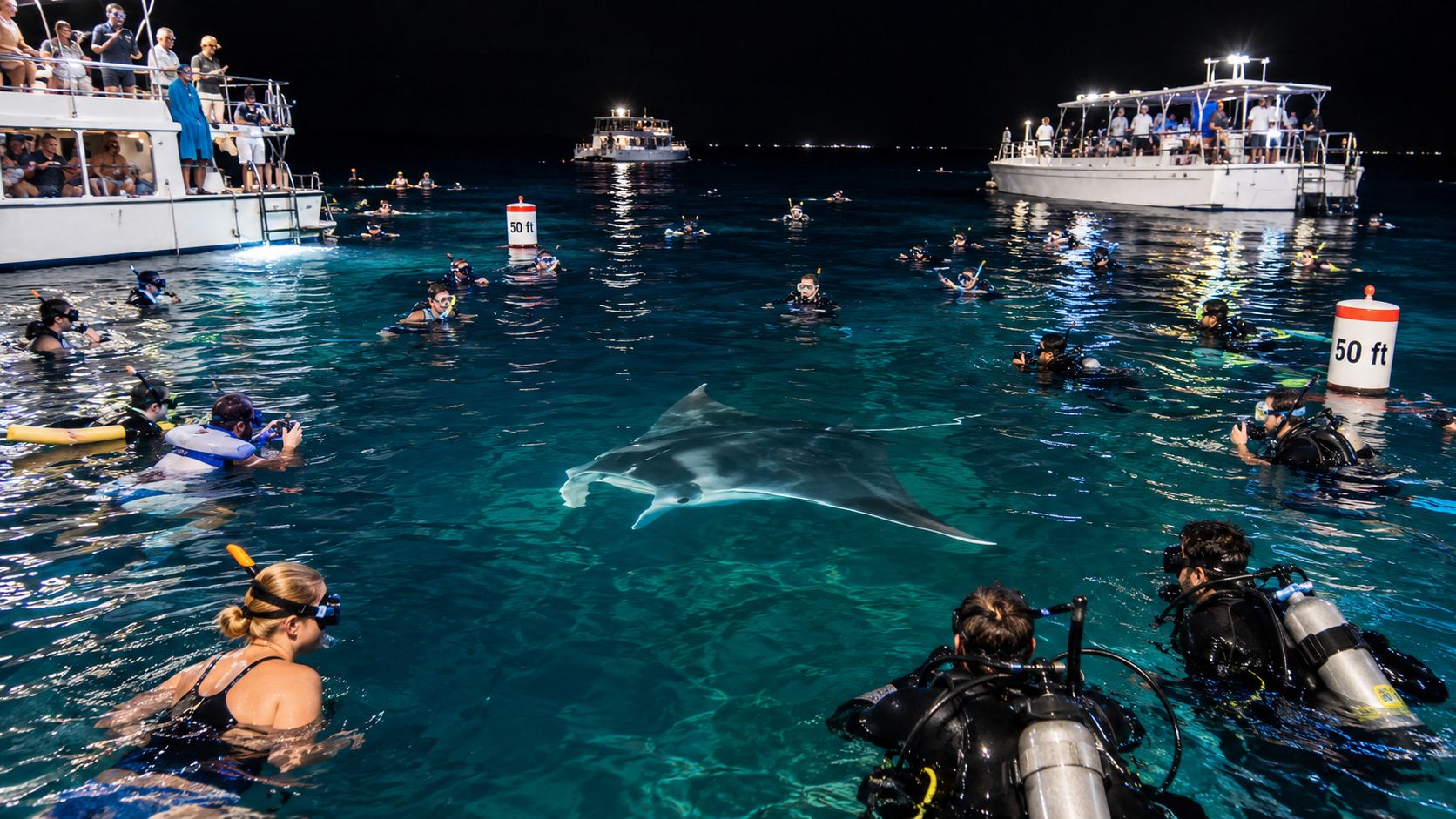
The night includes a boat ride as daylight fades or after dark, a crew briefing, and an illuminated viewing area. Snorkelers float above the lights; scuba divers descend and kneel on designated sand below them. Both formats put you beside the feeding activity, but they ask different things of your body and temperament.
Snorkel and scuba options on the manta night dive
| Option | Position in the water | Skill and certification | Best for |
|---|---|---|---|
| Snorkel at the surface | Floating above the lights, face in the water | No certification; comfortable swimming and flotation | Beginners, families and first-time ocean participants who meet the swimming requirements |
| Scuba on the seafloor | Kneeling on the sandy bottom below the lights | Open Water Diver certification or equivalent | Certified divers who want the closest view from below without moving toward the animals |
Snorkeling removes the scuba equipment and underwater breathing requirement. It doesn't remove darkness, surface movement, or the need to respond to a guide. Hawaii Guide's marine-life overview describes the surface-versus-bottom distinction, but participant fit deserves just as much attention as the view.
Scuba is a good choice when breathing underwater already feels routine. If you're preoccupied with your regulator, mask, or buoyancy, adding darkness and a close animal approach can make a stationary dive feel demanding. Certification establishes eligibility, not automatic readiness.
Choose by your least comfortable moment
Consider the whole outing, including stepping across a moving deck, entering the ocean, waiting in position, and climbing back aboard. A confident pool swimmer may dislike ocean darkness. A comfortable diver may still struggle with seasickness during the boat ride.
Before booking, answer these questions:
- Swimming and support: Can you swim comfortably, and what flotation and in-water supervision will you need?
- Darkness and motion: Do darkness, close approaches, or a rocking boat trigger anxiety or nausea?
- Entry and exit: Can you manage the boarding arrangement, or do you need assistance because of mobility limitations?
Then put three practical questions to the operator: What support is provided? How will I enter and leave the water? What happens if I need to stop early? Equipment, staffing, boarding arrangements, and cancellation policies aren't identical across tours.
Agree on the crew's discomfort signal before entering. Signal while you can still communicate calmly, rather than waiting until you're overwhelmed. If you can't comfortably meet the swimming requirements or anxiety prevents you from following directions, postponing is better than forcing participation.
Our snorkel-versus-scuba decision guide helps weigh the formats.
Choose stability over proximity. A calm participant who holds position often has a better encounter than a strong swimmer who keeps trying to get closer.
How Lights Bring Mantas Into View and When to Go
Artificial lights concentrate zooplankton, and reef manta rays, Mobula alfredi, pass through the illuminated water filtering their food. People aren't hand-feeding the mantas. The lights make naturally occurring prey easier to find.
The activity began in 1991, when an operator recognized that lights near the Kona Surf Hotel attracted plankton and then mantas, and expanded to several boats by 1993, according to the manta viewing operations and safety assessment.
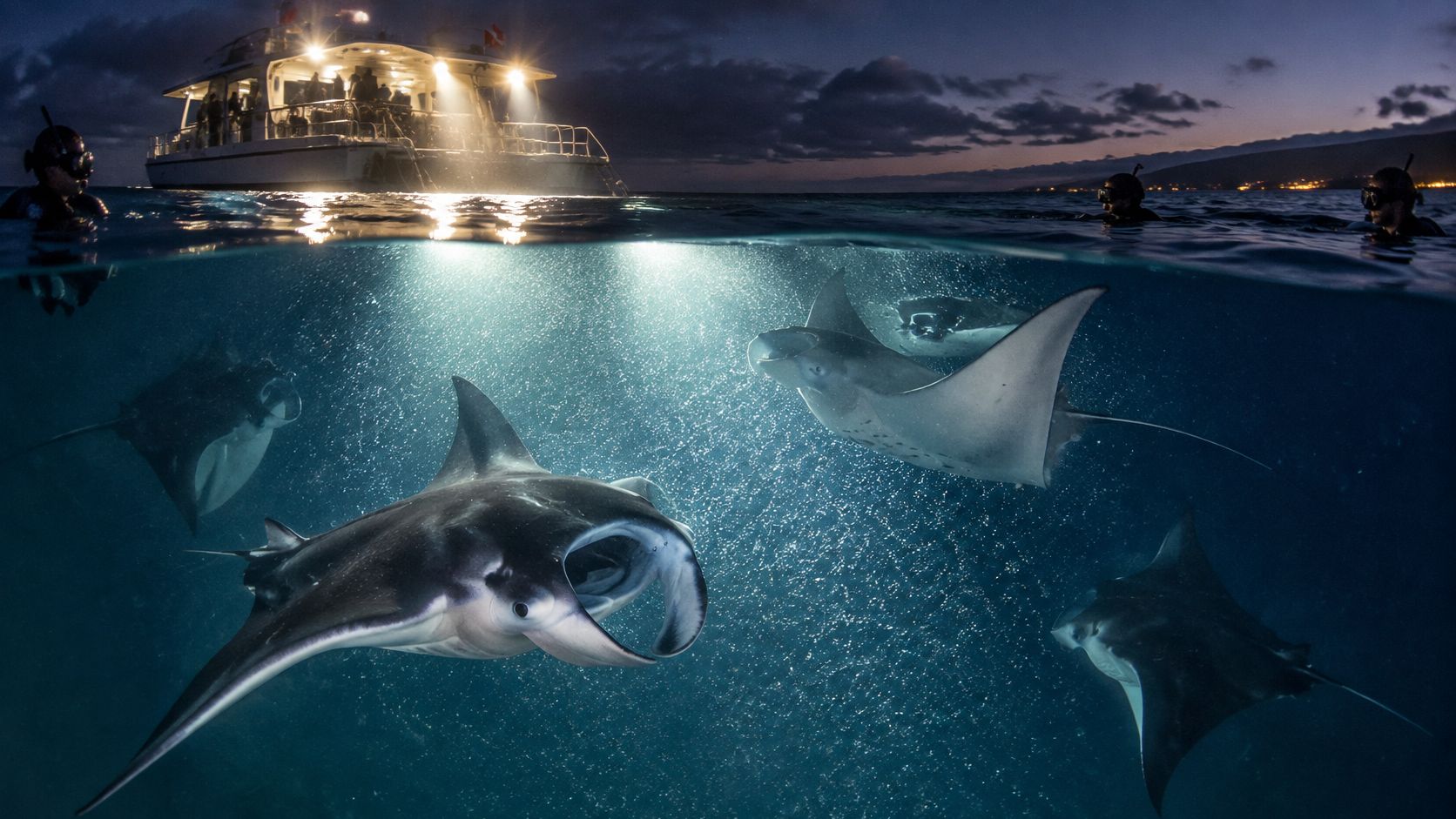
The Hawaii Department of Land and Natural Resources manta overview describes a 13-year analysis of community observations from 2010–2022, recording more than 23,000 sightings of 167 individually identified mantas at Kona's principal nighttime sites, with larger aggregations associated with greater zooplankton density. Those are repeated sightings, not that many different animals.
Plan around conditions, not a promised calendar date
The useful timing question isn't which month is best. It's whether the crew can reach an appropriate site, establish an orderly viewing area, and find feeding conditions that evening. Dense plankton matters, but visitors can't reliably schedule it from a vacation calendar.
Manta sightings in Kona often exceed a 90% success rate. That's encouraging, not a guarantee for your departure, and it doesn't tell you how many animals will appear or how long they'll stay.
Ask about recent feeding activity and how the crew decides which site to use. The answer should involve present conditions and operational judgment, not a promise that wildlife will perform on schedule. Our guide to the best time to see manta rays in Kona can help frame those questions.
- Leave scheduling flexibility: An outing early in your stay leaves room to respond to a weather cancellation, subject to availability.
- Expect repeated passes: A manta may move beyond the light, turn, and return along another line.
- Allow quiet intervals: An empty patch of illuminated water isn't a cue to swim away from the group searching for animals.
A good encounter develops through patience. Watch the edge of the light as well as the brightest area, and resist treating the first approach as your only opportunity. The animals decide whether to enter, return, or leave.
Garden Eel Cove Versus Manta Village
I would choose Garden Eel Cove as the default for most manta dive visitors, provided conditions and access support it. Its protected setting, organized viewing area, and better surrounding reef make it the stronger overall dive choice, not just a place to wait for mantas.
The Garden Eel Cove site comparison describes a protected location near Kona's airport, more moorings, and a concentrated viewing area compared with the more exposed southern Keauhou site. Shelter can improve comfort, while a defined viewing area helps guides organize divers.
Manta sites compared
The typical counts below come from a 2025 operator report, which lists 10–20 manta rays per night at Garden Eel Cove and 5–10 at Manta Village. Treat these as reported typical ranges, not a forecast for your booking.
| Site | Typical manta rays per night | Seafloor and reef | Shelter and viewing |
|---|---|---|---|
| Garden Eel Cove | Reported range above | Gently sloping sandy plain with scattered coral heads and lava rock | Protected location near Kona airport; concentrated viewing area |
| Manta Village (Keauhou Bay) | Reported range above | Confirm the designated bottom viewing area with the crew | More exposed southern site |
Underwater Atlas's Garden Eel Cove description places its sandy plain at roughly 12–30 meters deep, interspersed with coral heads and lava formations. That describes the broader site, not an assigned manta viewing depth or a reason to descend beyond your guide's plan.
The long-term aggregation study describes the sites as about 20 km apart, with approximately 91% of recorded sightings at Keauhou being female. That distinction reflects different patterns of habitat use, not a better or worse animal encounter.
Why the viewing area matters
At our manta night dive, divers occupy a specific viewing area at a well-established site. Garden Eel Cove is our go-to location because its layout supports that controlled positioning while offering reef interest around the main encounter.
Manta Village remains a valid option when the evening's conditions and logistics favor it. A northern site preference shouldn't override an unfavorable sea state, access issue, or the captain's judgment.
Ask these questions before choosing:
- Which site is planned? Confirm whether Garden Eel Cove is the intended destination.
- Why that site tonight? Listen for an explanation involving conditions and access.
- How is the group positioned? The answer should describe a designated viewing area, not free swimming among feeding animals.
For the Garden Eel Cove option, review the 2 Tank Manta Dive and Snorkel tour from Kona Honu Divers.
Safety, Etiquette and Crowding on the Water
Crowding is a real trade-off, not something to hide behind wildlife photographs. A 2025 operator report citing a Kona Coast survey describes 444 participants and an 89% response rate, with 82% reporting crowding by snorkelers, 78% by boats, and 69% by scuba divers. Those findings describe the surveyed participants, not every departure.
Our manta dive is stationary and closely supervised, with experienced divemasters and instructors in the water with divers. The crew begins with a detailed briefing covering the feeding mechanism, the sequence of the dive, and passive observation. Supervision helps manage the experience, but each participant still needs to follow directions.
Your in-water etiquette checklist
- Stay in your assigned position: Moving to another gap can obstruct a neighbor or interfere with the guide's group arrangement.
- Never touch, chase, or intercept: Let the manta choose its route, including when it approaches closely.
- Snorkel at the surface: Don't duck-dive into the feeding corridor for a closer look.
- Leave the central water column open: Divers should remain below the animals' travel space rather than rising to meet them.
- Control your light: Keep it directed into the water, not into an animal's eyes.
- Avoid sudden movement: Don't kick upward, swim rapidly after a pass, or deliberately direct bubbles toward an approaching manta. Continue breathing normally.
- Settle only on designated sand: Keep fins away from coral and avoid shuffling or stirring sediment.
- Signal discomfort immediately: Early communication lets the guide respond before stress becomes harder to manage.
These aren't rules for producing a tidier photograph. They preserve room for feeding animals and make other participants' movements more predictable. Review our responsible diver etiquette guidance before boarding so the briefing reinforces familiar habits.
A close pass doesn't change your assignment. Keep your hands to yourself and let the animal complete its turn.
The conservation stakes extend beyond a single evening. NOAA's genetic study summary estimates approximately 104 adult breeders around Hawaii Island and identifies strong separation from neighboring island populations. These are resident animals in a limited local community, not an unlimited stream of replacements.
Skills, Gear and Certification You Need
| Format | Skills that matter | Qualification | Gear to arrange or bring |
|---|---|---|---|
| Snorkel | Comfortable swimming, using flotation, calm face-in-water breathing | No scuba certification | Well-fitting mask and snorkel, flotation arrangement, suitable exposure protection |
| Scuba | Controlled descent, equalization, buoyancy, calm regulator breathing | Open Water Diver certification or equivalent; confirm departure eligibility | Certification details, fitted scuba equipment, exposure protection, required light |
Most of our regular dive charters require at least Open Water Diver certification from a recognized agency. Confirm the exact manta departure requirements when booking, especially if your certification has restrictions or you haven't dived recently.
Practice the skills that darkness exposes
Being able to descend isn't the same as being able to arrive neatly. Equalize early, stop if your ears won't clear, and avoid rushing to catch the group. Once positioned, adjust buoyancy carefully so you aren't repeatedly floating upward or pressing heavily into the bottom.
Kneeling on designated sand doesn't excuse poor buoyancy control. Keep enough control to move when directed without pushing off the seabed or sweeping your fins through sediment. If these skills feel rusty, arrange practice or explore scuba training options before committing to a night dive.
Kona's water is warm, and a rash guard or light wetsuit may suit some snorkelers. Stationary watching can still leave you cold, particularly if you chill easily. Confirm suitable thermal protection rather than choosing solely by the daytime air temperature.
Pack for the return ride too
- Bring dry layers: A towel, dry clothes, and a wind-resistant outer layer make the ride back more comfortable.
- Check personal fit: A leaking mask becomes more distracting when you're trying to watch overhead.
- Carry required details: Have certification information and disclose relevant equipment or assistance needs before departure.
- Leave loose belongings ashore: Jewelry, unsecured accessories, and unnecessary bags complicate an already busy deck.
Ask which equipment is included before packing your own kit. For motion-sickness medication, consult a pharmacist or physician about an option compatible with your activity and health, and follow its directions.
Photography and Lighting Tips for Night Mantas
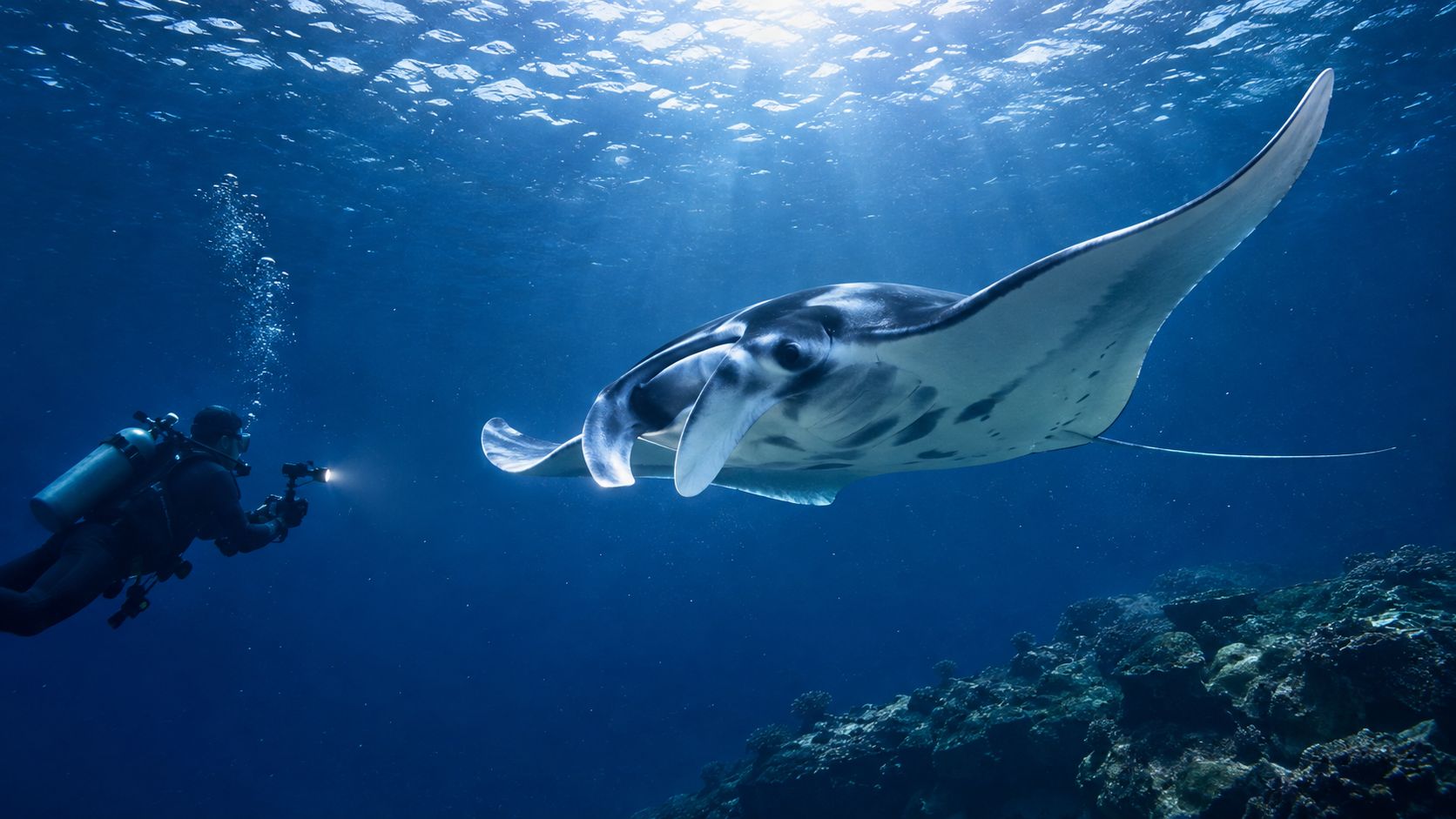
Your camera shouldn't change the animal's route or your assigned position. The viewing lights already establish the encounter, so the photographer's job is to work within that arrangement rather than add more light and movement.
Ask about the crew's flash and strobe rules before entering. Abrupt flashes can startle wildlife; use flash only when permitted, and don't assume permission to carry a camera means permission to use every lighting accessory.
Prepare settings before the boat gets busy
A wide-angle lens makes close overhead passes easier to frame without backing away. Increase ISO enough to support a shutter speed that freezes the moving animal, then inspect test frames for noise and motion blur. There isn't a universal setting because camera sensitivity and available light differ.
Try continuous autofocus in the illuminated water. If the camera repeatedly focuses on nearby plankton instead of the manta, switch to a pretested manual-focus approach. Short bursts can capture changing wing positions without encouraging you to follow the animal.
- Check the housing: Inspect the seal and sealing surfaces, close it carefully, and test the controls.
- Prepare power and storage: Charge batteries and clear enough memory before departure.
- Secure the camera: Use an appropriate strap or tether without creating dangling loops or entanglement hazards.
- Respect shared space: Keep equipment out of ladders, entry areas, and the crew's working space.
Let the pass come to your frame
Angle any permitted light into the water according to the briefing, not toward a manta's face. Snorkelers should compose from their floating position rather than kicking after a missed shot. Our Kona manta photography guide offers more preparation ideas.
Put the camera down when operating it distracts you from breathing, positioning, or the guide. Watching comfortably is a better outcome than collecting footage while losing control.
Frequently Asked Questions
Can children join the manta night dive?
Ask about the minimum age for the specific departure and whether the child meets its swimming and participation requirements. Snorkeling is often the more practical family format, but a child who dislikes dark water shouldn't be pressured to enter. Confirm equipment fit, supervision, and the boarding arrangement before reserving.
What happens if no mantas appear?
Wildlife encounters vary, and a completed outing without mantas isn't necessarily handled like a weather cancellation. Ask specifically whether any rebooking option applies, what conditions attach to it, and whether another departure must have available space. Don't assume that another operator's policy applies to your reservation.
Is it suitable with a medical condition or during pregnancy?
Discuss the activity with your physician before booking and disclose relevant conditions to the operator. Don't scuba dive during pregnancy. Surface snorkeling also needs an individual assessment of swimming ability, ocean conditions, and medical suitability; a crew can explain the outing but can't provide medical clearance.
How long is the outing and when does it leave?
Check the departure's booking details for check-in time, departure time, and expected return. Allow for the whole outing rather than treating advertised water time as the total commitment. If you have dinner reservations, childcare, or other transport arranged, confirm the timing before choosing a date.
Book Your Manta Ray Night Dive in Kona
Choose the format you can manage comfortably, then choose the departure. We offer both snorkel and scuba participation, with experienced divemasters and instructors accompanying divers in the water. You don't need to choose the more demanding option to have a worthwhile evening.
For a broader diving itinerary, our Kona diving tours include the Manta Ray Night Dive, 2 Tank Local Morning Dive, and Morning Introductory Scuba Dive. Experienced divers can also consider the Black Water Night Dive or Premium Advanced 2 Tank Trip, matching the charter to their qualifications and comfort.
Reserve with the important questions settled
- Choose snorkel or scuba. Base the decision on swimming comfort, nighttime confidence, and underwater skills, not which photograph looks closer.
- Confirm eligibility. Match your certification and swimming ability to the departure's requirements, and disclose assistance needs before reserving.
- Choose a date and discuss the site. Ask whether Garden Eel Cove is planned and what could cause the crew to use another location.
- Check availability and book. Use the booking button below to review available departures and select the appropriate option.
- Clarify cancellation and postponement terms. Understand weather cancellations, participant cancellations, and any no-sighting arrangements before completing your plans.
For help deciding whether the outing fits, call 808-324-4668 and describe your actual concerns, including swimming confidence, mobility, or recent diving experience. If you'd like more biological context, the PADI Manta Ray Diver specialty course covers manta biology, behavior, and conservation and is taken before the Manta Ray Night Dive.
Kona Honu Divers offers guided manta night snorkeling and scuba diving, with Garden Eel Cove as our go-to dive site. Visit Kona Honu Divers to choose your format, review available departures, and plan a night that fits your comfort in the water.