
The lights go on, and for a few minutes nothing happens except plankton thickening in the beams. Then a reef manta banks out of the dark, mouth open, and starts feeding directly overhead. Manta ray diving in Hawaii works because you're not looking for the animals, you're sitting inside their food supply, and that single fact explains almost every rule, disappointment, and great night on the Kona Coast.
What the Kona Manta Ray Night Dive Actually Is
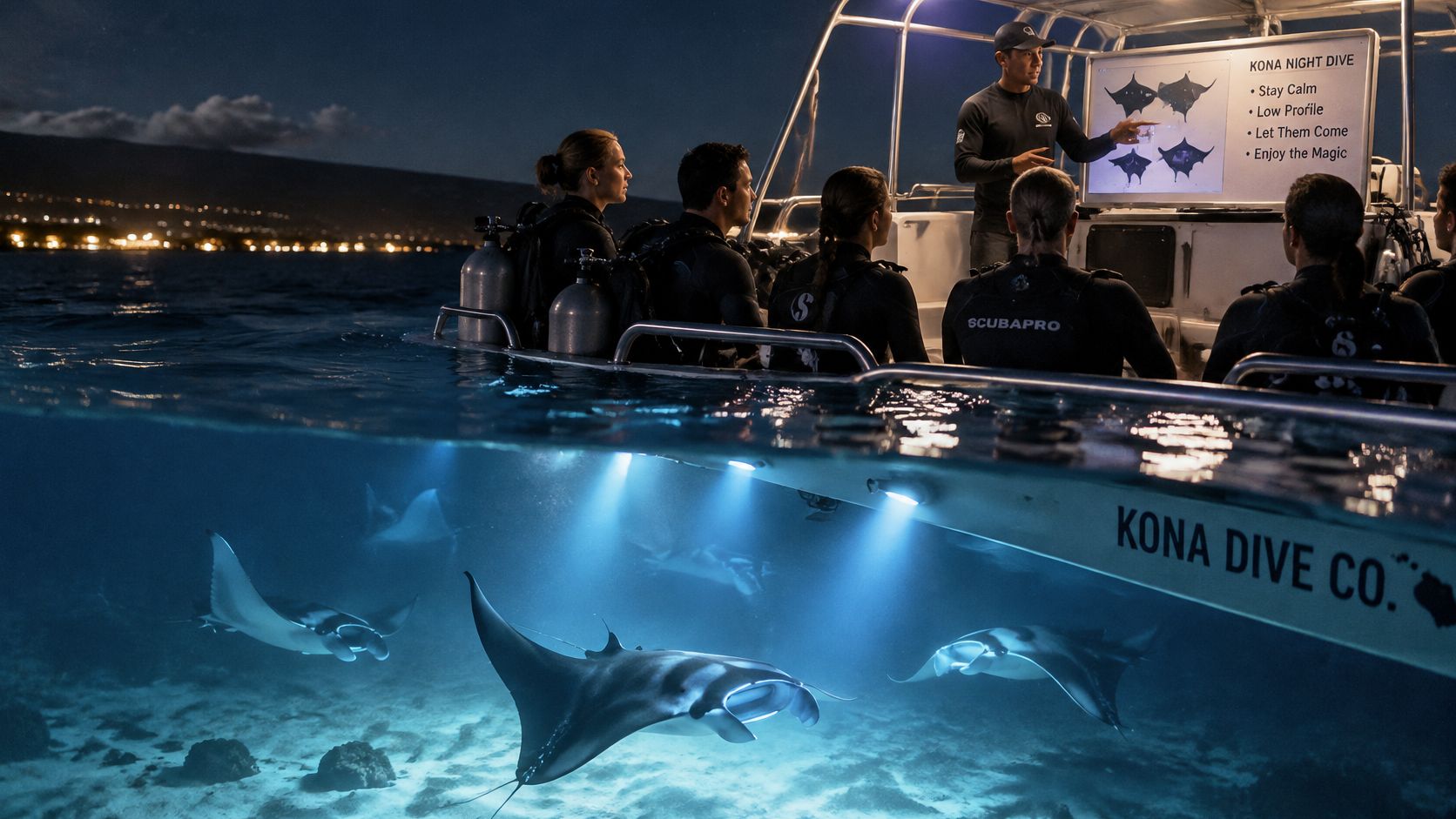
You're settled on a sandy patch near the bottom, lights pointing up, breathing slowly while you wait. The water above you fills with zooplankton, and the first manta doesn't cruise past once. It turns, loops back, and works the same lit column again because that's where the food is concentrated.
That is the whole dive. It's a stationary observation dive, not a swim-along. Divers hold position low, snorkelers watch from the surface, and the mantas decide how close the passes get. If you're weighing the two formats, this comparison of snorkeling versus diving with manta rays lays out the viewpoint and workload differences.
Who It's Actually For
Certified divers get the bottom-up view, but only if they're comfortable at night. You'll need to descend in the dark, stay neutrally buoyant without stirring sand, and sit still while your attention is pulled overhead. If night water makes you tense, the scuba version can feel like task management instead of wildlife watching.
Snorkelers have the simpler job. No equalizing, no regulator, no depth to manage. You float, hold position, and look down. For first-timers, families, and anyone unsure about a night descent, that lower workload usually produces the better night.
Staying still isn't passive. On this dive, stillness is the skill that keeps mantas feeding close.
The uncomfortable part for most newcomers isn't the mantas. It's the first minutes of dark water, the boat ladder, and not knowing where to look. Once the group settles and the light column builds, attention narrows fast. You stop thinking about the dark around you and start watching feeding behavior in front of you.
What separates a good night from a flat one is rarely bravery. It's whether you picked the format that leaves you calm enough to hold position, follow your guide, and keep the feeding lane open.
How Manta Diving Became Kona’s Signature Attraction
This dive wasn't designed in a marketing meeting. Regular manta dives along the Kona Coast were documented in the late 1970s, and snorkeling and scuba encounters at the principal sites began in 1984. The modern format took hold in 1991, when artificial lights near a Kona hotel shoreline attracted plankton, and mantas followed the food in.
Early operations were tiny. One boat carried approximately 6 to 8 divers a few days per week. By 1993, that had grown to as many as five boats and roughly 50 people in the water. The animals kept returning, word spread, and an opportunistic encounter became a repeatable tour.
The Business Behind the Encounter
The money followed quickly. Hawaii County testimony reported a survey of nine Kona dive shops carrying approximately 11,000 snorkelers and divers on manta tours in 2002, producing about $920,000 in direct revenue. The same testimony estimated manta ecotourism generated more than $2.5 million annually for Hawaii in 1992, and visitors staying one extra day could have generated more than $2.4 million in extra Kona business revenue.
Those numbers explain two things you will notice on any given night. First, the operations are mature. Briefings, light setups, and site routines exist because they've been refined over decades. Second, demand creates pressure. More boats and more bodies in the same feeding area change how a night feels, even when mantas show up.
- Late 1970s: Regular Kona manta dives documented
- 1984: Snorkel and scuba encounters begin at principal sites
- 1991: Hotel shoreline lights create the modern night format
- 1993: Up to five boats operating on a night
I've seen guests treat this history as trivia. It isn't. You're joining an industry that grew because a reliable feeding pattern met heavy visitor demand, and managing that tension is now part of the dive itself.
How a Two-Tank Evening Manta Tour Unfolds
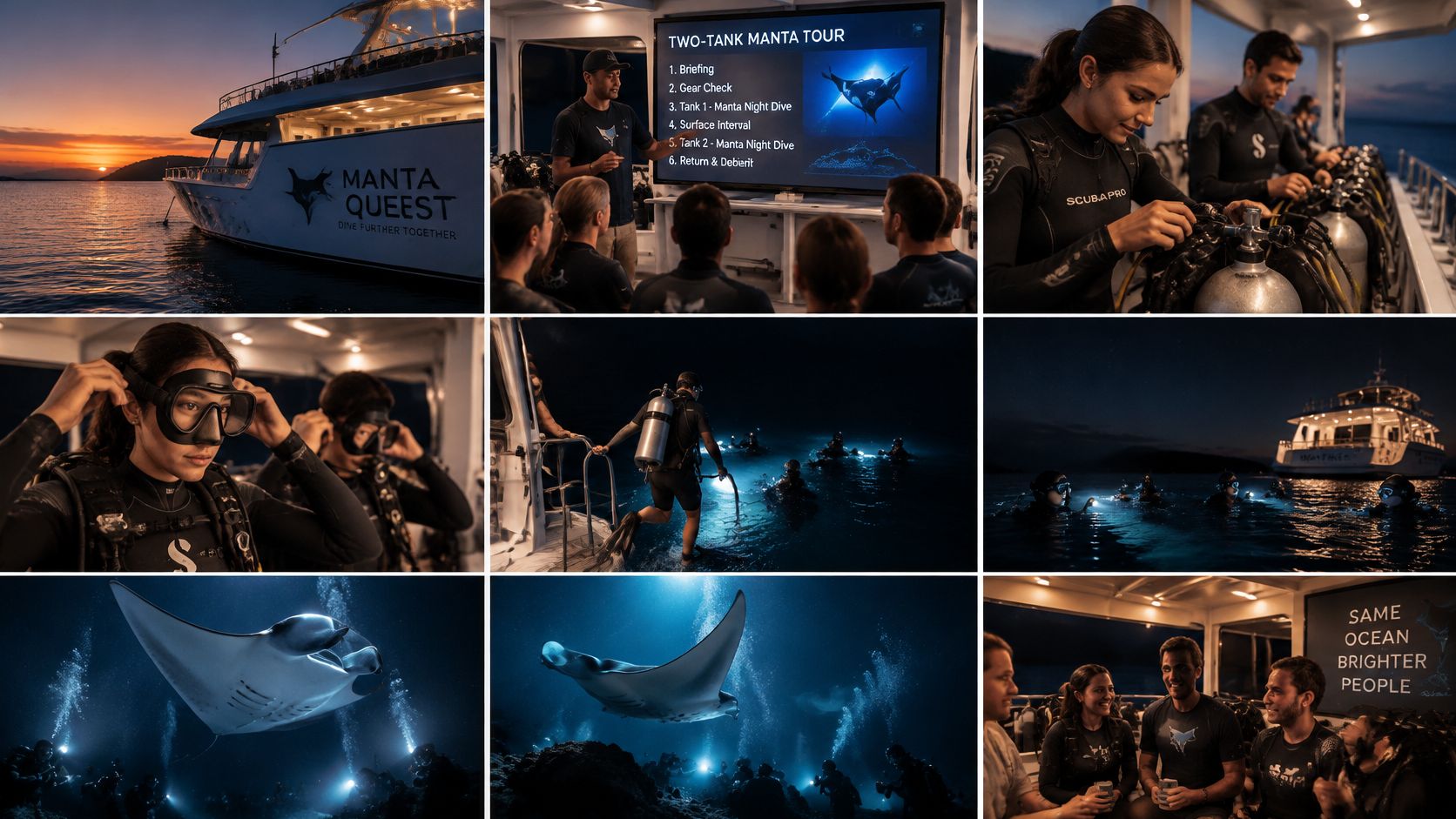
A standard evening runs on a simple logic. You learn the site in daylight first, then you watch it work after dark. The listed two-tank format begins approximately 2.5 hours before sunset and lasts about five hours, with both dives at the same cove.
The Sequence, Step by Step
- Check-in and briefing: Gear is fitted, the site plan is explained, and guides cover entry, exit, hand signals, and where you'll sit on the bottom.
- Twilight reef dive: The first dive runs before full darkness. You see the reef structure, sandy areas, and fish life you'll be sitting next to later, which makes the night dive far less disorienting.
- Surface interval: You rest, warm up, hydrate, and reset gear on the boat while darkness settles. This is when smart divers fix mask straps and check lights.
- Night manta dive: Lights go on the seafloor and near the surface, plankton concentrates, and divers take fixed positions while snorkelers stay above.
- Exit and ride back: The group surfaces together, locates the boat's lights, and climbs the ladder in an orderly sequence.
If you're new to diving after dark, this guide to scuba diving at night covers the practical adjustments before you're doing them on a boat.
Where First-Timers Trip Up
Staying warm during the surface interval matters more than people expect. A wet diver sitting in night air gets cold, then shivers through the second dive and burns air faster. Dry layers and a towel fix that cheaply.
Mask management in the dark is the other small problem that becomes a big one. Clear it calmly during the twilight dive, not for the first time at night. And when you surface after the manta dive, look for the boat's lights before you start swimming. Orientation first, movement second.
Why Garden Eel Cove Beats Other Kona Manta Sites
Visitors often book "a manta dive" as if the sites were interchangeable. They aren't. Garden Eel Cove, also called Makako Bay or Manta Ray Heaven, sits off Kona's coast near Keahole Point, and its geography does real work for you.
The site offers depths of approximately 8 to 18 meters in one section and 15 to 30 meters in another, giving you a shallow to moderate reef and a defined nighttime feeding area. Its protected cove location and defined sandy areas make it practical to position divers and snorkelers without drifting into the feeding corridor.
Garden Eel Cove vs Keauhou for a Kona Manta Night
| Factor | Garden Eel Cove (Makako Bay) | Keauhou |
|---|---|---|
| Shelter | Protected cove setting | More exposed feel |
| Viewing area | Defined sandy areas for stable positioning | Less defined setup |
| Reef | Better reef for the twilight dive | Reef is secondary to the encounter |
| Aggregations | Generally supported larger aggregations | Generally smaller aggregations |
| Ecology | Feeding focused night site | Strong female site fidelity, possibly broader ecological role |
Keauhou isn't a poor site. It shows strong female site fidelity and may serve functions beyond simple nighttime feeding, which makes it scientifically interesting. But interesting isn't the same as comfortable for a first manta night.
Practical rule: Pick the site where you can hold a stable position comfortably. A stable diver sees more than a drifting one, every time.
The cove wins on the things that shape your actual evening. Shelter reduces surge and stress. A better viewing area means cleaner sightlines and less jostling for angle. Better reefs mean the twilight dive is a real dive, not a waiting exercise. For photographers especially, a protected site where you can settle and let mantas come through your frame beats an exposed site where you're fighting your own buoyancy all night.
Manta Etiquette and Positioning in the Water
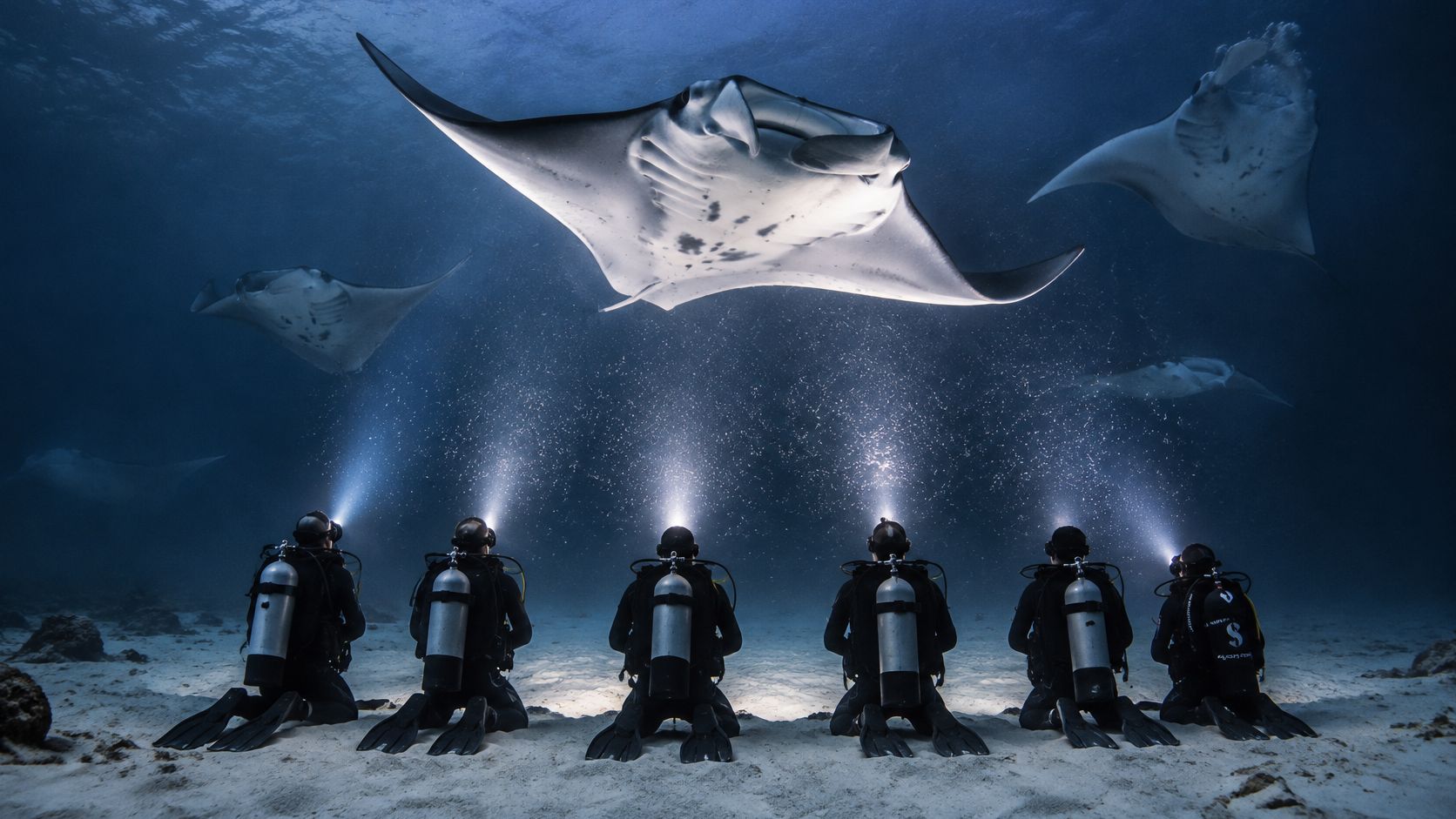
"Don't touch the mantas" is true and insufficient. Real etiquette starts with the mechanism. Underwater lights concentrate zooplankton, and reef mantas, Mobula alfredi, enter the lit water to filter-feed, with lights placed near the surface and on the seafloor at approximately 10 meters. The animals need unobstructed flow around their cephalic fins and open mouths, so your job is to stay out of that flow.
Positioning Rules That Actually Matter
- Divers stay low: Hold a stationary, neutrally buoyant position near the seafloor, close to the light field but not inside it. The broader habits in this guide to responsible, considerate diver etiquette apply doubly here.
- Snorkelers stay calm at the surface: No vertical freediving down through the feeding zone. Dropping into a manta's path disrupts the pass for everyone.
- Keep escape lanes open: A ray must always have a clear line out of the lights without crossing a body.
- Tuck your equipment: Dangling gauges, cameras, and hoses swing into space you don't own.
Photographers, Specifically
Don't fire strobes or lunge toward an approaching ray. Sudden movement directed at a feeding manta is the fastest way to end the pass you're trying to shoot. Hold your position, pre-frame the light column, and let the animal swim through it. If managing your camera pulls you off your spot, the camera goes away.
Group spread matters too. A 2023 assessment of 444 encounter participants found 82% felt crowded by snorkelers, 78% by boats, and 69% by scuba divers, as documented in the University of Hawaiʻi assessment of visitor crowding at manta encounters. Compact groups in fixed positions feel better and feed mantas better, because the animals get predictable space instead of a scattered obstacle course.
Before you get in, ask yourself plainly. Can you swim back to a ladder at night? Are you comfortable with a dark entry? Can you follow hand signals you can barely see? Honest answers on the boat prevent problems in the water.
Best Times, Conditions and Realistic Expectations
The calendar matters less than the water. A 2025 University of Hawaii study analyzed more than 23,000 observations of 167 individual reef manta rays across 13 years and found changes in aggregation size tracked zooplankton density, the mantas' primary food. Garden Eel Cove generally supported larger aggregations than Keauhou, and aggregations remained relatively stable despite increased tourism.
So manta numbers on your night will track plankton first, then weather, currents, visibility, and site choice. A seasonal average can't predict a specific evening, because prey fields shift and individual rays redistribute along the coast or offshore. Guides who promise a show are selling certainty nobody has.
Why a Quiet Night Isn't a Failed Dive
Fewer mantas doesn't mean something went wrong. It usually means less food in the light that night. You'll still get the twilight reef dive, the night water, and whatever feeding does happen, watched properly instead of chased. Guests who understand the food mechanism beforehand almost always rate quieter nights higher than guests who arrived expecting a performance. If you're worrying about safety on top of sightings, this explanation of whether manta rays can sting you settles that concern cleanly.
Reliable demand for this tour doesn't equal guaranteed animal abundance. You're booking a wild feeding event, not a scheduled show.
The population context raises the stakes. Identification work began in 1991, and a 2026 report counted 318 unique Hawaii Island individuals identified since 1979. Genetic research found reef mantas rarely cross deep island channels, with migration reported at approximately one female between island groups every 1,300 years and one male about every 64 years. Hawaii also enacted a 2009 state law prohibiting the harvest or take of manta rays.
That's a small, site-associated population with almost no outside replenishment. Treating each night as a privilege inside a local animal's feeding routine, rather than an entitlement, is accurate.
Choosing a Responsible Manta Dive Operator in Kona
Judge operators on systems, not promises. Hawaiʻi guidance on responsible manta viewing supports the basics, divers low, snorkelers calm at the surface, no disruptive vertical movement, but a good operation goes further, into ratios, lighting, and discipline.
Federal recovery material identifies unresolved concerns around overcrowding, user conflicts, safety, and environmental impacts, and describes proposed measures including daily site limits, guide-to-guest ratios, viewing-time limits, and vessel-safety requirements. Use that as your scoring framework for any boat.
Questions Worth Asking Before You Book
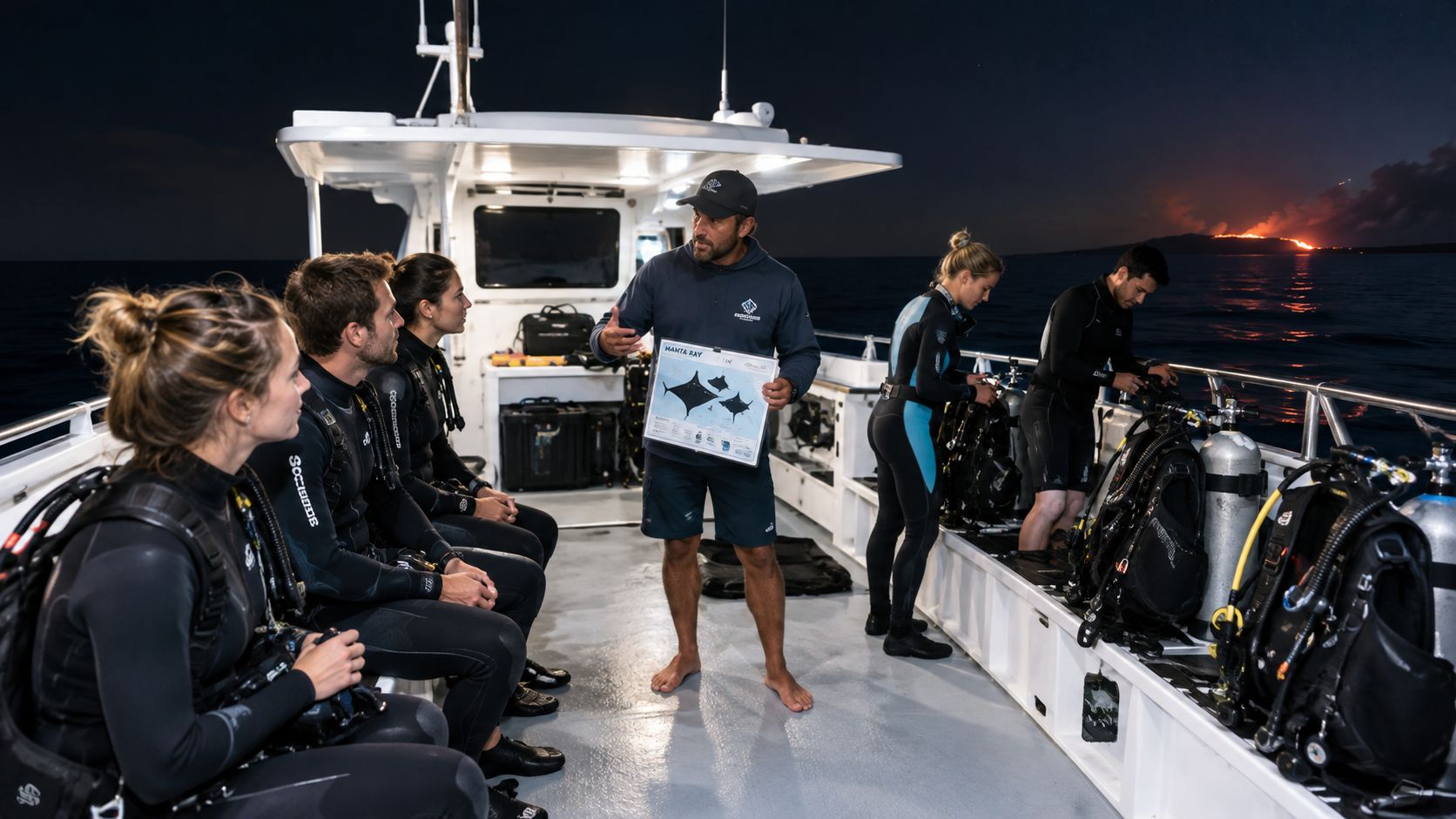
- Guide-to-guest ratio: Who is in the water with you, and how many people are they managing?
- Boat setup: Proper night lighting, clear entry and exit points, and crew watching the ladder?
- Positioning plan: How are snorkelers separated from divers, and how is open space kept for manta movement?
- Briefing quality: Emergency procedures, current conditions, and conduct rules covered before anyone gets wet, consistent with an eco-friendly operating approach?
- Honest wildlife language: Do they explain the plankton mechanism, or guarantee animals?
Kona Honu Divers fits that framework in concrete terms, with over 60,000 collective dives and 200 years of combined staff experience, custom dive boats, proactively serviced rental gear, and complimentary nitrox. Its 2-tank manta dive and snorkel tour runs the manta night at Garden Eel Cove, and the broader Kona diving tours page shows the full charter range for comparison.
Experienced divers wanting more can look at the premium advanced 2-tank trip for more demanding sites, or the Kona blackwater dive for an open-ocean night experience that's entirely different from the manta setup.
Your Manta Night Checklist and Next Step
You now know how this dive works, which means packing and preparation get simple. Most of a good manta night is decided before the boat leaves the harbor.
Before You Board
- Bring dry layers and a towel: The ride back after a night dive is colder than the water felt.
- Eat lightly and hydrate: Heavy meals and boat motion don't mix well at night.
- Rest beforehand: Tired divers make clumsy decisions in dark water.
- Be honest with the crew: Say you're nervous, rusty, or unsure about the ladder. They'll position and support you better for it.
In the Water, the Short List
Stay where your guide puts you. Keep your body low and still if you're diving, calm and horizontal if you're snorkeling. Never drop down through the feeding lane, never reach toward a passing ray, and give every animal a clear way out. Camera discipline counts as etiquette, so if shooting pulls you out of position, stop shooting.
You're ready to make the three decisions that matter. Does the scuba or snorkel format match your real comfort level at night? Is the trip running a protected site with a proper viewing area? Does the operator explain ratios, briefing, and wildlife rules without guaranteeing animals? If the answers line up, check availability for your dates and compare other charters if you want more time underwater while you're in Kona.
Kona Honu Divers runs the 2-tank manta dive and snorkel at Garden Eel Cove, pairing a twilight reef dive with the illuminated night feeding dive, plus morning reef charters, blackwater, and advanced trips for divers who want more. If you're ready to watch reef mantas feed overhead with an experienced Kona crew, visit Kona Honu Divers to check dates and book your night.