
An oceanic manta can slip far below anything a recreational diver will ever see. Analysis of 46,945 satellite-tagged dives found 79 dives deeper than 500 m, with a fastest descent of 2.9 m/s, according to tag data on extreme manta dives. That's the right frame for manta ray dives in Kona. The animal passing through your light beam at the sand isn't a shallow reef pet. It's a wide-ranging filter feeder that has chosen this patch of plankton for a few minutes.
You're there to watch, not to steer the encounter. Stay in your spot, leave the lane open, and let the ray decide how close it comes. Do that and a quiet kneel on the sand turns into the best seat on the Kona coast.
Where and When to Book Manta Ray Dives
I would book Garden Eel Cove, also called Manta Heaven, rather than the southern Keauhou site. The cove is naturally sheltered from the open ocean, the viewing area is tighter, and the reef around the sand gives you more to look at before and after the first pass. Keauhou can work, but it's the wider, more exposed option.
That verdict matters more than the month on your ticket. Kona's leeward coast runs these nights year-round, so you're really picking a date that fits your trip, then confirming the departure on that date. Plankton, not the calendar, decides how many mantas show up.
Kona Night Sites for Manta Ray Dives
| Site | Shelter | Viewing area | Around the lights | Best for |
|---|---|---|---|---|
| Garden Eel Cove (Manta Heaven) | Naturally sheltered from the open ocean | Tighter, better viewing area | Sand, healthier reef, garden eels and reef fish | Stationary night dives and snorkels in calmer water |
| Keauhou (southern site) | More exposed to open-ocean swell | Wider and less concentrated | Less reef scenery around the viewing area | A backup when conditions favor the south |
Say you're choosing between two otherwise fine dates in different weeks. Pick the operator that puts you at the sheltered cove, then stop second-guessing the month. A calmer kneel, a tighter viewing area, and reef life at the edge of the beams improve every night, busy or quiet.
The record behind this site is why guides talk about it with confidence instead of hope. A standardized monitoring program from January 1, 2009 through December 31, 2014 recorded 25,444 sightings involving 118 individually identified reef manta rays at two Kona-area sites, as reported on the Kona manta monitoring summary. A later University of Hawaiʻi analysis expanded that to more than 23,000 community-sourced sightings of 167 individual reef mantas between 2010 and 2022.
Historical records also report mantas on roughly 80% of dives at Garden Eel Cove during earlier monitoring. Manta sightings in Kona often exceed a 90% success rate. Read both numbers the honest way. They describe a recurring, documented pattern at known feeding areas, not a promise that a specific head count will arrive for your group.
Aggregation size follows zooplankton density. If the water is thick with food, more rays have a reason to stay and loop. If it's thin, a ray may make a pass, check the lane, and move on. The boat doesn't control that and neither does your guide.
If you're also planning daytime reef time around the night, compare the Kona diving tours alongside the manta date so your schedule doesn't stack the hardest morning right after a late return. For timing questions beyond site choice, this guide to the best time to see manta rays in Kona covers the same decision from the calendar side.
Book the cove, lock the date, and leave the head count to the plankton.
How Seafloor Lights Build a Plankton Lane
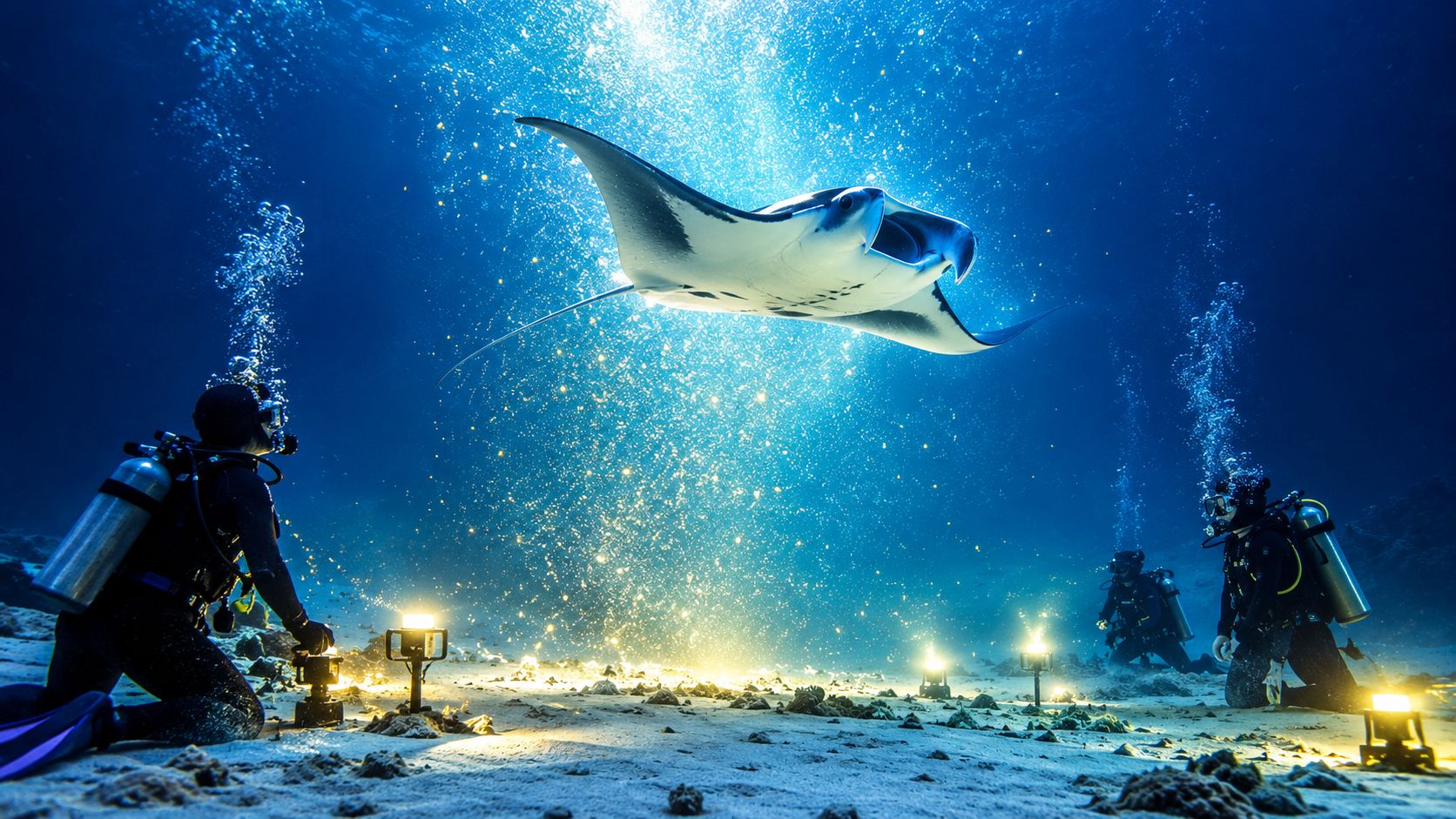
Think of the lights as a campfire for plankton, not a dinner bell the crew rings for the rays. Nobody feeds a manta by hand. Crews set lights on the sandy bottom, and the glow gathers naturally occurring zooplankton into a bright column of water above them.
The Kona explanation of how the plankton lane works puts it plainly. Submerged lights attract and concentrate plankton into an illuminated water column, and reef mantas then swim through and filter-feed on that prey. You're watching a natural feeding behavior aimed at food the light made easier to find.
One Feeding Pass, Step by Step
A ray enters from the dark with its mouth open. It curls its cephalic fins, the paired fins beside its head, into funnels that direct plankton-rich water toward its mouth and filtering structures. Then it banks, loops, or rolls back through the brightest part of the column where food is densest.
That turn is the whole show. A slow loop means the ray found enough food to stay on the circuit. A straight pass through and out into the black usually means the pickings were thin. Guides watch those first passes the way you'd watch a weather read, because they forecast the rest of the night.
You're never sitting in a black ocean waiting for this. Powerful dive lights create a bright circle on the seafloor so divers are never in complete darkness. First-timers who picture total blackout relax fast once they see how much of the sand, the group, and their own gauges stay visible inside the glow.
Your job is simple: hold position outside the feeding lane so the animal always has room to maneuver.
Divers kneel or settle just outside that lane. Snorkelers stay at the surface looking down into the same column of light. Both groups watch the same pass from different angles, and both groups can spoil it the same way, by drifting into the route the ray wants to use.
Two calm nights at the same cove can still look completely different. On a rich night the water in the beams looks almost dusty, and rays keep returning because each loop pays off. On a lean night the beams look clean and blue, pretty but empty, and a ray has little reason to linger.
That variability isn't a flaw in the trip. It's the mechanism working as intended. The lights can concentrate what's already in the water, but they can't create a plankton bloom that isn't there.
Walk Through a Garden Eel Cove Night
The night runs in a set order so nobody is sorting out gear, rules, or spacing in the dark. Follow the sequence and the dive itself feels calm from the first breath on the sand.
Boat to Bottom in Seven Steps
- Meet the boat in the late afternoon and hear the briefing on manta biology and passive observation before anyone gets wet.
- Gear up while there's still light so buckles, weights, computers, and lights get checked before dark.
- Ride to the sheltered cove and enter as a group with guides already in the water.
- Descend to the sand and take the assigned viewing spot outside the light circle instead of wandering the reef.
- Kneel or settle and breathe slowly while mantas make repeated feeding passes overhead.
- Stay put if a ray comes close and let the guide manage spacing for the group.
- Ascend on the briefed plan, then wait for a surface count before anyone climbs the ladder.
That first step earns its time. Manta ray night dives begin with a detailed briefing covering the science of what divers will see and the rules of passive observation. Divers who hear the rules on deck don't have to guess at them underwater with a manta turning toward them.
Position is assigned, not improvised. Divers are positioned in a specific viewing area at a well-established dive site, which keeps fins off coral, keeps the group out of the feeding lane, and keeps every diver where a guide can see them. If night entries are new to you, this primer on scuba diving at night covers the basic skills that make the descent feel routine.
What You See Before the First Ray
Garden eels rise from the sand like thin blades of grass, swaying and snapping back into their burrows if a shadow passes. Reef fish hang at the edge of the beams. The surrounding reef gives your eyes somewhere useful to go on the way to the kneel, so the wait for the first wing isn't dead time.
The briefing also puts a number on why passive observation isn't just politeness. NOAA Fisheries' giant manta ray science page reports that a manta typically gives birth to only one pup every two to three years. Animals that replace themselves that slowly don't absorb careless pressure well, even at a famous site.
Busy Night, Quiet Night
On a busy night, several mantas loop through the plankton for most of the dive. Wings cross overhead in sequence, bellies flash white in the beams, and you can feel a push of water as a large ray passes close above the sand. You barely need to turn your head.
On a quieter night, one ray makes two passes and leaves, or a pair works the edge of the light without settling into a circuit. The water beyond the lamps stays dark, the sand still glows, and the eels and reef fish carry more of the dive. That's the same well-run site on thinner plankton, not a failed version of the trip.
Judge the night by whether the group stayed settled, the lane stayed open, and the rays fed without changing course around people. The stationary, supervised format suits certified beginners and experienced divers alike, and snorkelers get the same passes from the surface, looking down as the white belly rolls through the beam.
Distance and Etiquette on the Sand
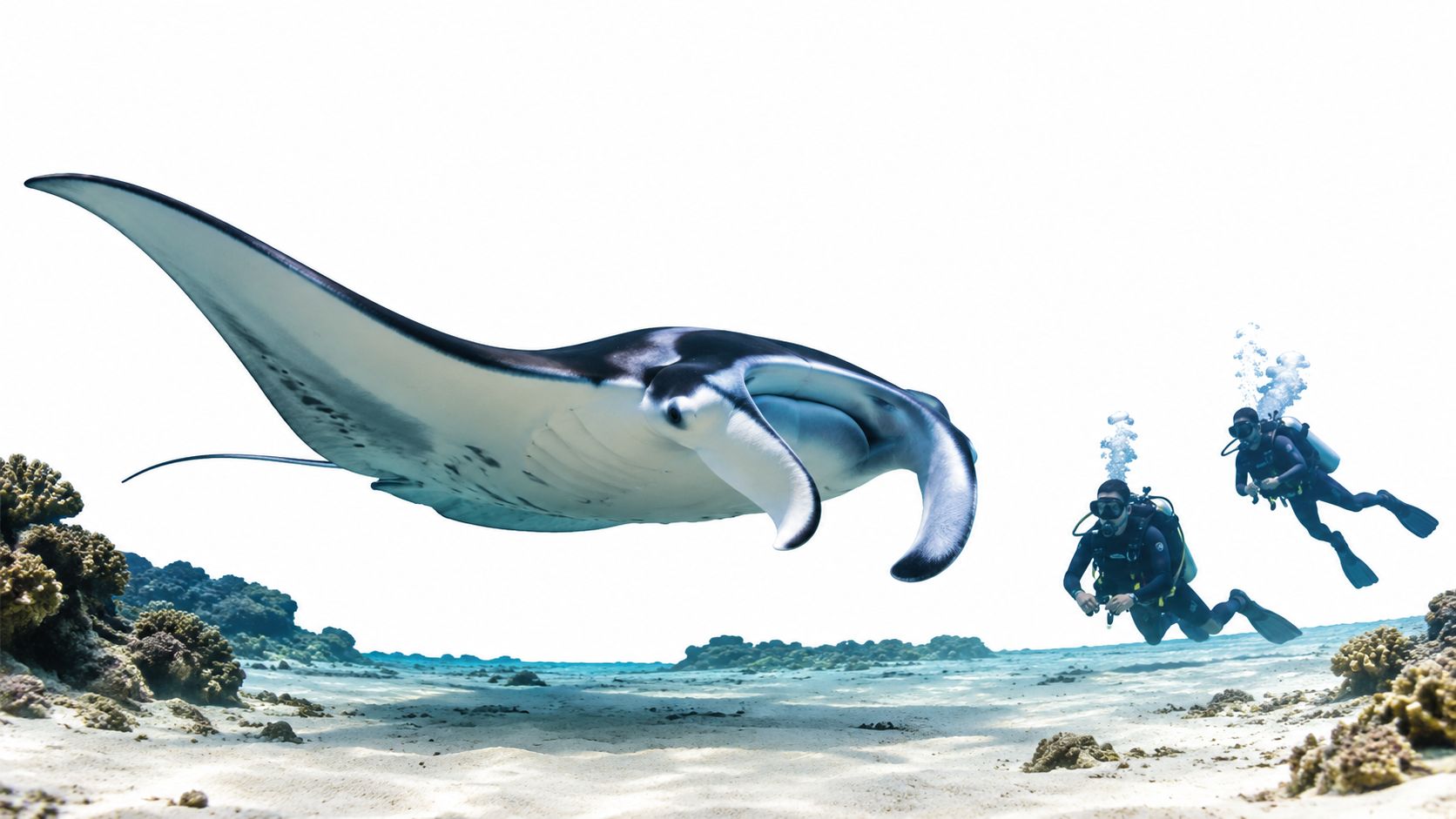
The one rule: Stay more than 3 meters away when you can choose the distance, and stay off the feeding or cleaning area itself.
That rule comes from behavior, not from a guide's preference. Pelletier's 2018 study of scuba divers at reef manta cleaning stations found that divers generally caused minimal immediate disturbance when they stayed more than 3 meters away and remained off cleaning-station areas. The same work cautioned that long-term effects on cleaning-station habitats remain insufficiently understood, so caution stays the default.
A spectacular night can still involve animals from a small, vulnerable group that replaces itself slowly. Several wide wings in your light beam feel abundant. They aren't proof of a large population behind them, and they aren't a license to close the gap for a better frame.
In-Water Choices on a Manta Night
| Situation | Do this | Why it matters |
|---|---|---|
| Choosing a spot | Settle off the feeding lane and more than 3 m away when you can | Distance and staying off the station best predict no disturbance |
| A manta comes closer | Hold still, do not touch, and let it leave | The animal sets the distance |
| Lights and strobes | Aim lights as briefed and limit flashes | Sudden light and chasing break the pass |
| Leaving the site | Stay with the guide and clear mooring lines and props | Crowded sites risk line snags and boat strikes |
The close-approach case is the one divers get wrong. If a manta turns inside that distance on its own, hold position, don't touch, don't kick suddenly, and let it choose when to leave. Backing away fast stirs sand, blocks another diver's view, and puts your fins where the ray planned to go. Stillness is the polite move and the safer one.
Approach, if a guide repositions you at all, comes from the side, never from above and never head-on into a ray's route. Don't chase an animal that peels off into the dark. A ray that leaves has already answered your request for a closer look.
You won't be policing this alone. The manta ray night dive is stationary and closely supervised, with experienced guides making sure everyone is safe and comfortable. Guides set the kneel, watch for drifting divers, and pull a group back into line before a small drift becomes a blocked lane. The longer habits behind that supervision are laid out in these responsible diver etiquette guidelines.
The shore-side half matters too. Slow boats near the site, careful handling around mooring lines, and a group that doesn't crowd the lane all protect the same animals. Etiquette isn't only what your hands do underwater.
Gear and Camera Setup for a Dark Kneel
Pack for sitting still in the dark, not for covering distance. Almost every gear problem on this dive comes from a diver who can't settle, can't see their own kit, or gets cold once the swimming stops.
Core Kit for Divers and Snorkelers
- Primary light with a backup: Bring a focused primary light and a small backup clipped where you can reach it without looking.
- Snug mask: A mask that seals without constant clearing keeps your hands down and your attention on the lane.
- Enough weight to kneel calmly: Slightly firm on the sand beats light and paddling, because finning stirs silt straight into the beams.
- Full wetsuit: Tropical water feels colder on a stationary night kneel than on a swimming day dive, so full coverage is worth it.
- Snorkeler basics: A secure mask, a flotation vest if the crew issues one, and a light only if the briefing allows it.
Check that light on the boat, not at the surface. A flooded primary found on deck is a two-minute swap. The same failure found at depth costs you the calm start the whole format depends on.
Camera Settings That Respect the Lane
Use a wide lens and let the ray fill the frame by flying its own route. Start around 1/125 to 1/200 second on manual or shutter priority, with a moderate ISO you can raise in small steps if the beams aren't carrying. Aim strobes out to the side so suspended plankton doesn't explode into white specks between you and the animal.
Limit bursts while a ray is in the lane. The better frame is a full animal inside the light, wings and tail complete, not a belly shot grabbed from inside the circle. If you want a sense of what that framing looks like when it works, browse these Kona manta ray dive pictures before you set your strobe arms.
A leaking light or flooding housing means aborting the camera, not the safety stop. Clip it off, watch the dive with your eyes, and sort the damage on deck.
A red filter or a dim backup light helps on the ride back, when a full white beam in the face ruins everyone's night vision. Keep the bright primary off until you're back in the water or packing up under deck light.
Finish with the short pack list that gets forgotten most: certification card, warm layer for the ride back, and a towel. The warm layer matters more than a second lens. You'll be wet, still, and riding home in the dark, and that's exactly when a dry sweatshirt decides how fondly you remember the boat ride.
Manta Ray Dive FAQs
Can you see mantas without diving?
Yes. Snorkelers watch from the surface looking down into the same light column divers see from the sand. The stationary format keeps them in one supervised area, and the view of a white belly rolling under you is its own reward. This comparison of snorkeling or diving with manta rays breaks down which seat suits which swimmer.
Do you need certification to dive?
Yes. The 2-tank manta charter requires Open Water Certification or higher and diving within the past 2 years. Confirm your logbook meets that when you book, not at check-in. Snorkelers don't need a dive certification.
Is it safe for beginners?
The dive is stationary, guided, and briefed before entry, so certified beginners stay in the viewing area with the group instead of navigating a reef in the dark. You'll kneel in an assigned spot, watch, and ascend on the guide's plan. Nervousness about the dark usually fades once the light circle is lit.
What if no mantas come?
Sightings depend on plankton, so no encounter is guaranteed. A quiet night is still a complete dive at a reef site with garden eels, fish at the edge of the beams, and the same supervised format. Be wary of any promise that sounds stronger than that, because the food supply makes the final call.
Do you need your own light?
Bring a focused primary and a backup only as the briefing directs, and aim them the way the crew specifies. Extra beams swung carelessly can scatter the lane you're all watching. When in doubt, fewer lights aimed well beat more lights aimed everywhere.
How long does the night run?
Departure times and total duration can vary, so confirm the schedule at booking and plan your evening around that confirmed time. Don't stack a tight dinner reservation against a boat return you haven't verified. A relaxed buffer after the trip beats a rushed one every time.
Reserve the Garden Eel Cove Night
The decision is short. Book the manta night at sheltered Garden Eel Cove, with a supervised stationary format and a detailed briefing before the water, and book it early. The most popular trips, including the manta ray night dive, often sell out weeks in advance, so the date you want is the scarce part of this plan, not the gear or the paperwork.
Kona Honu Divers fits that brief on the facts that matter for this specific dive. The go-to site is Garden Eel Cove, protected from the open ocean, with a better viewing area and better surrounding reefs than the southern alternative. Guides position the group, keep the lane open, and run the same passive-observation rules you've just read, so the encounter quality doesn't depend on the most confident diver in the group behaving well by luck.
The numbers support booking without overselling the night. Kona Honu Divers' manta ray night dive has encounter rates of up to 92%. That still isn't a guaranteed head count, and any honest guide will tell you so on the dock. It's a strong site, a documented pattern, and a format built to give plankton and rays room to do what they already do.
Check your eligibility before you pick a date. The 2 Tank Manta Charter requires Open Water Certification or higher and diving within the past 2 years. If your last dive is older than that, sort a refresher first instead of hoping the requirement bends at check-in. Snorkelers in your group can book the surface version of the same night.
Trip details, what's included, and the current schedule sit on the 2-tank manta dive and snorkel trip page. Read that page for the practical booking facts, then use the reviews below to check how the format feels to guests who've already knelt on that sand.
Reserve the manta date before you lock flights and hotels around it. Flights can shift by a day with mild pain. A sold-out manta night during a short Kona stay usually can't be replaced at all.
Kona Honu Divers runs the Garden Eel Cove manta night as a briefed, supervised, stationary dive and snorkel, with daytime reef trips and advanced charters for the rest of your Kona week. If a quiet kneel on sheltered sand while mantas loop through the light sounds like your kind of night, start your booking with Kona Honu Divers.