
You've probably heard the phrase “manta ray dive” from a friend, a travel planner, or a late-night rabbit hole of Kona videos, and now you're trying to figure out what the experience looks like in real life. The short version is simple: at dusk, you board a boat, head out along the Kona coast, and wait for one of the ocean's most graceful animals to rise into the light. The part that makes Kona different is that this isn't a lucky one-off, it's a repeatable wildlife encounter tied to a documented local population, including 25,444 manta sightings and 118 individually identified reef manta rays recorded between 2009 and 2014 at the two main sites (Kona Honu Divers manta research summary).
What Manta Ray Dives in Kona Are
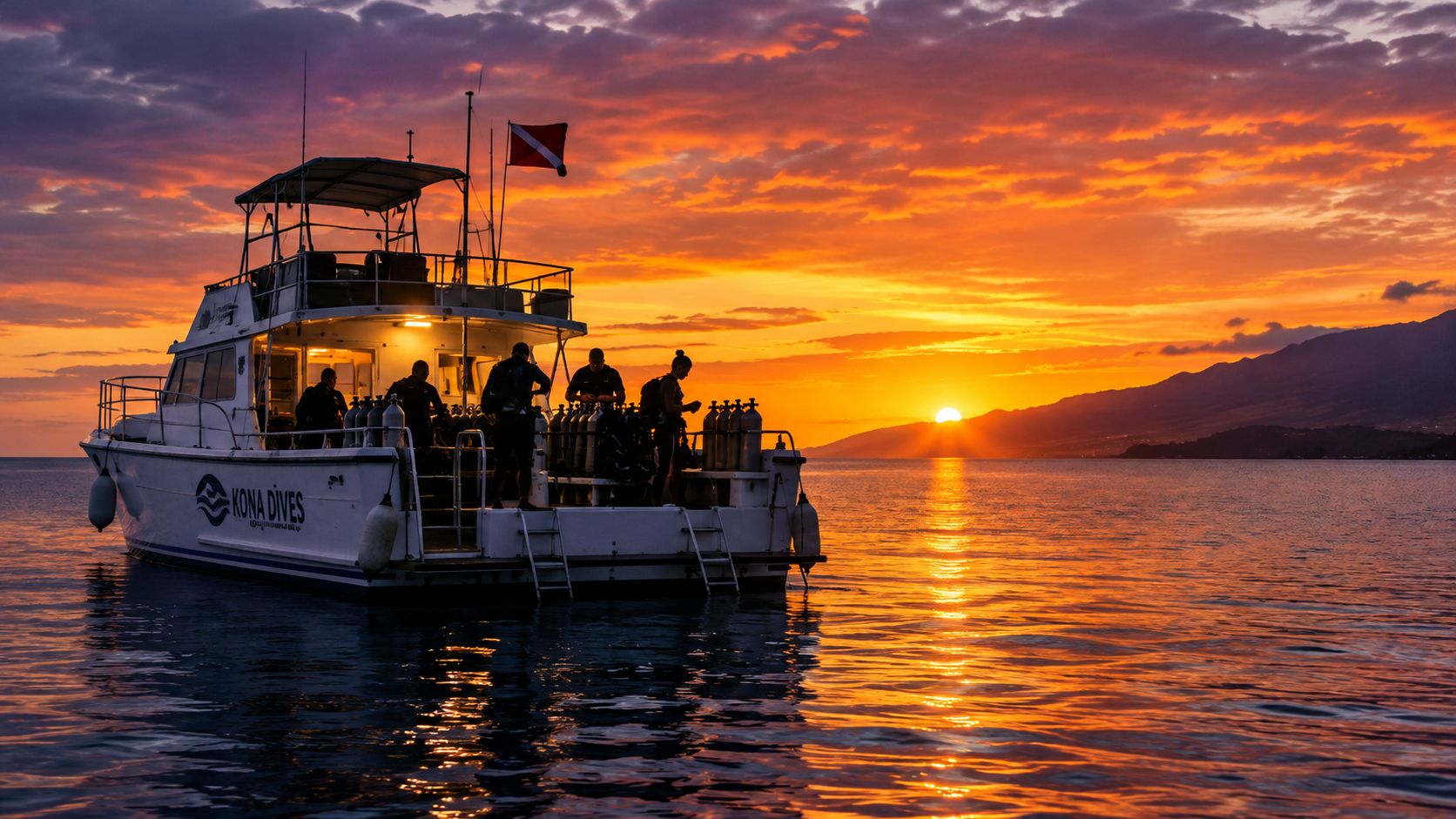
A Kona manta night dive begins with sunset over the coastline and ends with a quiet, floating view of feeding behavior. A first-timer may expect a single giant shadow, but the experience is more organized than that. Divers gather at a known feeding site, lights draw plankton into the water column, and the mantas arrive to feed where the food is concentrated. The encounter still feels wild, because the animals decide the pace, yet the setup gives guides a practical way to place people where the action happens.
Reef mantas, not the giant oceanics
The animals most travelers meet here are reef manta rays, not the larger oceanic species. That distinction matters because the Kona dive centers on shallow, repeatable sightings of a resident group, which is part of why this coastline has a reputation for consistency instead of a one-time lucky encounter.
The broader tourism side is real too. Manta ray dives and snorkel trips worldwide generated more than US$73 million in direct annual revenue and about US$140 million in total economic impact in a 2013 global estimate covering more than one million dives across 23 countries (global manta tourism estimate). On the boat, though, the experience feels much smaller and more personal than those numbers suggest.
Daytime cleaning encounters and nighttime feeding dives
Two manta experiences get mixed up often. A daytime cleaning or snorkeling encounter happens at cleaning stations, where mantas pass in and out of view. The classic Kona night dive is different. Lights concentrate plankton, and the mantas rise to feed.
The trip you book matters as much as the manta itself. A daytime visit, a night snorkel, and a scuba night dive create different sightlines, different levels of crowding, and different levels of immersion.
For the rest of the guide, the focus is the night dive, the version divers usually mean when they talk about doing Kona. It combines the boat ride, the briefing, the descent, and the first close pass into one coordinated evening.
The Biology That Makes the Encounter Possible
A reef manta ray looks effortless in the water, but its feeding is a precise system. The broad wings, open mouth, and paired cephalic fins work together to funnel plankton toward the mouth while the animal cruises through the water column. For a first-timer, it helps to picture a slow current of tiny drifting food being guided into one spot.
Why the lights work
Kona's night dive works because dive lights gather plankton near the bottom, where divers are already settled. That creates a concentrated buffet in a small area instead of a scattered food field, which is why the animals can appear so predictably at the sites.
The light does not “call” the manta in any magical sense. It concentrates prey, and the prey concentration draws the manta.
Knowing the animal helps you read the water
Researchers identify individual mantas by spot patterns on their undersides, so the encounter is often with a known local animal returning to the same feeding system, not an anonymous visitor passing through once. That is why experienced guides talk about “who” showed up, not just how many.
A manta disappearing from a shallow dive doesn't automatically mean the show is over. It may be moving deeper, then coming back into the local feeding route.
That matters for first-timers because the water can go dark for a few moments and then suddenly light up again. If you understand the feeding logic, the pause feels shorter and the first pass feels more dramatic.
Garden Eel Cove Versus Keauhou Bay
Kona has two well-known manta viewing sites, but they do not behave the same way. Garden Eel Cove, also called Manta Heaven, sits north of the airport and is usually the stronger choice when the ocean is calm enough. Keauhou Bay, often called Manta Village, has a long history and regular use, but the setting is more open and can feel tighter once boats and swimmers are in the water.
Why Garden Eel Cove usually wins for the dive
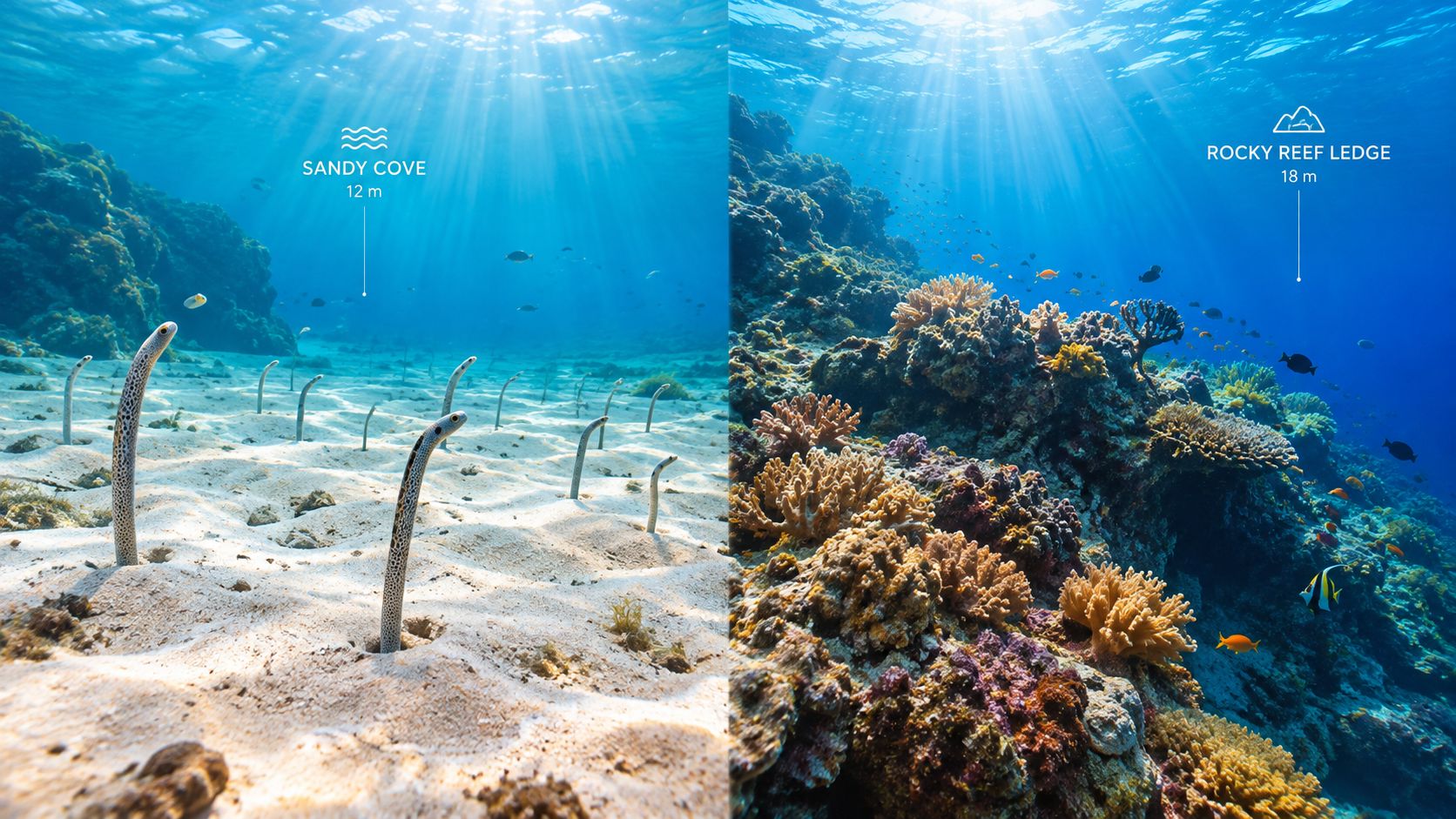
Garden Eel Cove has a naturally protected setting with a broad sandy viewing area at about 35 feet, which gives divers a clean place to settle and keeps the staging more orderly (site description). For a first-timer, that matters. A calmer site is easier to read at night, especially when the lights come on and the mantas start circling through the beam.
A 13-year community-sourced study recorded more than 23,000 sightings of 167 individual reef manta rays at Kona's two nighttime feeding sites, and Garden Eel Cove consistently supported larger aggregations than Keauhou (13-year Kona manta study). That is why many experienced operators treat it as the default choice when conditions allow. The site gives the dive more room to breathe.
What changes from one site to the other
| Feature | Garden Eel Cove | Keauhou Bay / Manta Village |
|---|---|---|
| Setting | Naturally protected bay north of the airport | More exposed coastal site |
| Viewing area | Broad sandy patch around 35 feet | Traditional manta site with a different layout |
| Diver feel | Cleaner bottom-based observation area | Can feel tighter and more crowded |
| Aggregation pattern | Larger groups on average | Reliable, but generally smaller than Garden Eel Cove |
The practical question is simple: where are they taking you, and why that site tonight? If the answer is Garden Eel Cove, you are usually starting from the better-positioned option.
What a Kona Manta Night Dive Feels Like
The dive starts before you ever reach the water. You check in, get fitted for gear, and step aboard with the mix of excitement and nerves that usually shows up before a night dive. By the time the boat clears the harbor, the light is fading and conversations get shorter.
From boat deck to bottom
A good briefing makes the whole encounter easier to read. Divers settle on or near the sand, rubble, or boulder bottom in a loose semicircle, while snorkelers stay at the surface and aim their lights downward rather than into the water column (positioning guidance). If you want a plain-language look at the rhythm of a planned night dive, this night-diving overview helps connect the briefing to what happens after splashdown.
At Garden Eel Cove, divers usually settle on a sandy bottom at roughly 30 to 40 feet and point dive lights upward. That light gathers plankton in the beam, which draws the mantas into the viewing area (Garden Eel Cove setup). The mood changes there. The boat ride is over, and the watching begins.
The show begins above you
Once the lights are on, the water starts to feel busy. Tiny particles fill the beam, then the dark space above takes shape. The first manta often appears without warning, banking through the light as if it already knows exactly where the food is.
The in-water part of the dive usually feels like one long viewing window. Long enough to settle in, short enough that you stay alert, warm, and focused. Snorkelers get a different angle, but the feeling is close, only flipped. They hold position at the surface and watch the mantas rise into the light from above.
What people remember most is usually the return trip. It is often quiet at first. Then the stories start, because the encounter feels larger in memory than it did while you were still on the boat. The choreography matters too, which is why the site, the operator, and the way the briefing is handled can shape the night as much as the mantas themselves.
Manta Etiquette That Goes Beyond Don't Touch
Many divers know the basic rule, don't touch the manta. Contact is only the most visible way divers affect these animals. Recent behavioral work shows that a manta can react to your position, motion, and light even when nobody reaches out.
Behavior changes before contact ever happens
A 2025 drone study of 27 identified juvenile manta rays found that they spent 37% of their time displaying avoidance behavior when divers were present, compared with no avoidance behavior when divers were absent (2025 behavioral study). That matters because avoidance is broader than grabbing or chasing. Crowding the beam, blocking the manta's path, or drifting into its travel lane can change what it does.
What you do with your body and light matters before the manta gets close. For a fuller framework, see this guide to being a responsible, considerate diver (responsible, considerate diver etiquette).
What to do when the manta changes course
Stay still enough to be predictable. A fixed diver is easier for a manta to read than someone constantly shifting position.
Keep the light controlled. Steady light helps the encounter feel calm. Sweeping beams and sudden movements make the scene busier than it needs to be.
Leave the travel lane open. If the manta wants the light, it should be able to enter and leave without threading past a person. Watch for avoidance cues too. Repeated direction changes, a manta leaving a cleaning station, or one that refuses to approach all signal discomfort. If the manta alters course because of you, stop following it.
Practical rule: if you become part of the obstacle, you're too close.
That approach turns etiquette into something you can use in the water. It also fits the wider conservation mindset guides and researchers keep stressing, where the animal's comfort matters more than the photographer's angle.
Gear, Cameras, and Comfort on a Manta Dive
A good manta night dive does not require a pile of specialty gear, but the small details shape the experience. Certified divers need the basics, mask, fins, wetsuit, computer, and a primary light with a backup. Many Kona operators also supply rental gear, so fit and pre-dive setup matter as much as the list itself.
What diver and snorkeler kits usually look like
| Category | Certified Divers | Snorkelers |
|---|---|---|
| Core gear | Mask, fins, wetsuit, computer, primary light, backup light | Mask, snorkel, flotation support, surface light setup |
| Position | Bottom-based, near sand or rubble | Surface-based, above the viewing area |
| Light use | Light aimed upward into the water column | Light aimed downward from the surface |
| Focus | Stillness and buoyancy control | Floating comfortably without drifting into the dive area |
This follows the positioning rules covered earlier. For a visual sense of how the setup looks in the water, Kona manta dive images show the staging and spacing that usually go with a Kona night encounter.
Camera habits that don't get in the way
Underwater photographers should think wide and keep it simple. Wide-angle framing usually works better than trying to force a tight portrait, because the goal is to show the manta's movement without crowding the scene. Keep strobes and lights under control, since a manta-first approach matters more than a dramatic frame.
Bring less equipment into the water column than you think you need. The less clutter you create, the easier it is for the manta to move naturally.
Comfort matters too. Kona night water can feel cool after dark, so a full wetsuit or a thicker suit usually makes more sense than a thin layer. If you get motion sick, plan ahead for the boat ride, and bring a warm layer for the trip back. Use reef-safe sunscreen earlier in the day, not right before you board, so it has time to settle in before the dive.
Choosing the Right Operator for Your Manta Dive
The operator you choose shapes the whole night. A good manta trip is more than a seat on a boat, it is site selection, a clear briefing, careful spacing, and a crew that knows what to do if the mantas stay out of sight.
Questions worth asking before you book
- Which site are we going to tonight? Garden Eel Cove should be the default when conditions allow, because site choice sets the tone for the entire dive.
- How do you manage lights and spacing? You want a crew that keeps the viewing area organized, so the animals have room and the group can see clearly.
- What happens if mantas don't appear? A thoughtful operator still gives you a worthwhile night on the water instead of acting surprised.
- How is the briefing delivered? Clear positioning, buoyancy reminders, and calm instructions matter more than hype.
- How crowded does the site get? Crowd control affects comfort for divers and the way the encounter feels for the mantas.
Because site choice drives the night, an operator that defaults to Garden Eel Cove when conditions allow is already ahead of one that goes wherever is easiest. As covered in the site comparison above, Garden Eel Cove offers the kind of setting that supports a cleaner, more organized manta dive.
Why a good booking page should answer the real questions
A booking page that only promises “see mantas” leaves out the parts that matter to you and to the animals. A stronger page explains site selection, gear, and what happens when conditions change. It should also help you understand how the company approaches the experience, which is why a resource like how to choose a Kona diving company belongs in your decision process.
One example is Kona Honu Divers, which runs Garden Eel Cove manta trips and presents the outing as a two-tank manta snorkel and dive experience, along with guest reviews. That kind of detail helps you judge whether the operator is focused on the encounter itself, or just on filling a boat.
FAQs and Realistic Expectations for a Manta Dive
People usually have the same few questions once the planning gets real. Will the mantas show? Can a snorkeler join? What if someone gets seasick? The honest answer is that Kona gives you strong odds, but it's still a wildlife experience, not a movie set.
Will I definitely see mantas
No operator can promise a sighting on a specific night. Reef manta rays use vertical dives well beyond recreational depths, with Crittercam data recording a maximum depth of 336 m, so a manta disappearing from a shallow dive site doesn't necessarily mean it has left the area (deep-dive behavior study). Food movement, current, moonlight, season, and disturbance all affect whether they appear in the viewing zone.
That's why a good operator avoids overpromising. If the mantas arrive, you get the classic Kona night. If they don't, the reef dive still has value.
Can kids or non-divers join
Yes, many Kona trips include snorkelers, and the surface version is usually the easier fit for families and mixed groups. The main dividing line is comfort, not ego. Some people want the bottom-up scuba view, others just want the surface show and are happy floating above it.
For a practical comparison between the two, this manta snorkel-versus-dive guide helps narrow the choice without turning it into a gear debate.
What if the mantas don't show
Then the best crews keep the night worthwhile. A responsible operator treats the absence of mantas as a chance to run a cleaner, calmer reef dive and talk about what the site is doing ecologically. That's a better outcome than chasing a reluctant animal.
If you're deciding whether to dive or snorkel, choose the version that keeps you comfortable enough to stay still and enjoy the water. Kona works best when the guest is relaxed, the guide is organized, and the manta gets the space to behave naturally.
Kona Honu Divers runs Garden Eel Cove manta trips, along with gear support and guided night diving that fits the way these encounters work. If you want a manta ray dive that starts with the right site and the right briefing, visit Kona Honu Divers and look at the manta options before you lock in your Kona dates.