
The first time you do a manta ray night dive off Kona, the moment sticks. The boat settles on the mooring at dusk, the lights go in, and then a dark shape turns white underneath as a manta rolls through the glow and the whole group forgets to breathe for a second.
That reaction never gets old. A proper manta ray dive in Kona isn't just about getting lucky with wildlife. It's about picking the right site, the right boat, and the right format so the night feels calm, organized, and respectful to the animals.
An Unforgettable Night with Gentle Giants
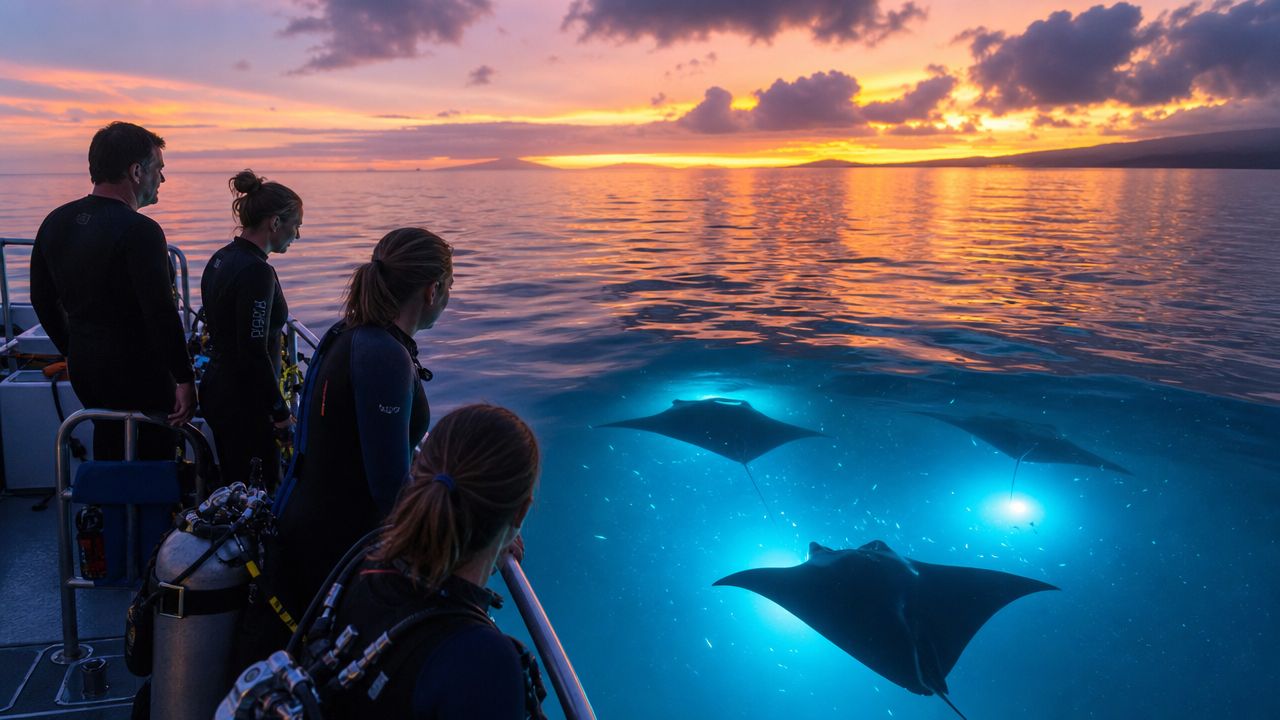
Sunset is part of the experience. The harbor drops behind you, the coastline turns gold, and everyone on board gets quiet in that way people do when they know something unusual is coming. Then the briefing starts, masks get checked, lights are readied, and the mood shifts from sightseeing to focus.
Once you're in the water, the scene is almost theatrical. Divers settle below, snorkelers gather at the surface, and the light creates a bright feeding zone in the dark ocean. When the first manta glides in, it doesn't look rushed or startled. It looks precise, like it has done this a thousand times before.
Why people travel here for this one dive
The Kona coast has earned its reputation because manta sightings are reported on over 80% of nights at the main sites, with an average of about six mantas per night and a record of 36 mantas in a single night, and local coverage also estimates that about 80,000 people per year join manta tours here, which shows how established the experience has become (Kona manta sighting overview).
That reliability changes the whole feel of trip planning. You're not signing up for a long-shot pelagic encounter. You're booking one of the most repeatable wildlife experiences in diving.
Practical rule: Treat the manta dive as a guided wildlife encounter, not an amusement ride. The calmer the operation, the better the night usually goes.
What a smart guest pays attention to
People often focus only on one question. Will I see mantas? That's understandable, but it's not the whole decision.
The better question is how to choose an experience that gives you a cleaner viewing setup, less crowding, and an easier in-water session. If you're comparing options for a manta ray night swim in Kona, those details matter more than flashy marketing language.
A good manta ray dive Kona trip feels smooth from dock to dock. The crew is clear. The site choice makes sense for the conditions. The group understands where to be and where not to be. That's what turns a cool sighting into a memorable night.
What Makes Kona the Manta Capital of the World
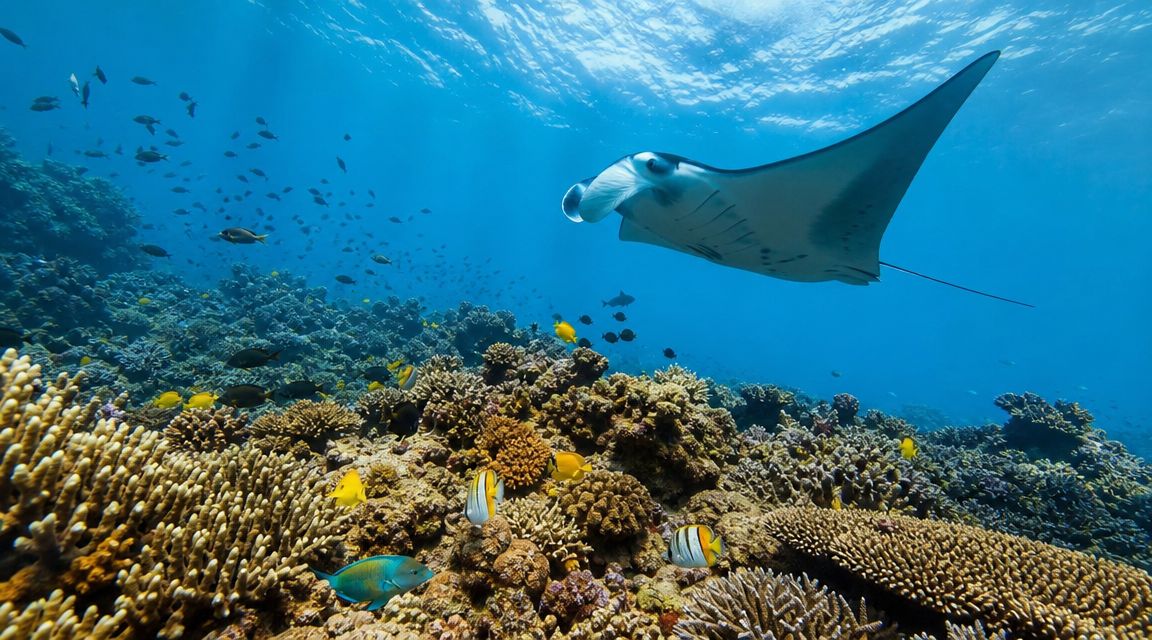
Kona works because the encounter isn't random. The coast has a documented resident population of more than 200 reef manta rays, and the main viewing sites are established enough that operators can build a repeatable system around known animal behavior (Kona manta dive details).
That matters. In many places, seeing big marine life depends on timing, luck, and a lot of open-water searching. Here, the format is more controlled.
The campfire effect
At night, lights attract plankton. Plankton draws mantas. That's the whole foundation of the experience.
Divers and boats create a concentrated lit zone that works like an underwater campfire. The mantas come in to feed, often circling and rolling through that column of food. Because the animals are feeding, not fleeing, the encounter can feel remarkably close while still staying passive and safe when guests follow instructions.
Some operators report 85 to 90% sighting rates, which helps explain why Kona has become a recognized destination specifically for this kind of night dive, not just a place where mantas occasionally appear (Big Island diving overview).
The two main sites
The two names most visitors hear are Manta Village and Manta Heaven, also called Garden Eel Cove.
Here's the useful operational difference:
| Site | Typical depth | General character |
|---|---|---|
| Manta Village | 30 to 35 feet | Shallower and often considered more beginner-friendly |
| Manta Heaven at Garden Eel Cove | 40 to 50 feet | Deeper and often chosen by divers who are comfortable with a slightly more advanced feel |
Depth by itself doesn't decide the better trip. Conditions, crowding, and the quality of the viewing layout matter just as much.
The best manta nights don't feel chaotic. They feel organized, with the animals free to move and the people staying where they belong.
Why divers keep talking about Kona
A manta ray dive in Kona has a rare combination. The animals are wild, the setup is reliable, and the depth stays within a range that many certified recreational divers can handle comfortably.
That combination is hard to beat. You get a real wildlife encounter without the uncertainty that defines so many other marquee dives.
Why Garden Eel Cove is the Superior Manta Dive Location
If your goal is to tick the box and say you saw mantas, either main site can work when conditions line up. If your goal is to get the highest-quality overall experience, Garden Eel Cove usually makes more sense.
That's where experienced operators tend to separate themselves. They don't just ask whether mantas might show up. They ask how the site will feel once the boat is tied in, the guests are in the water, and the viewing area is active.
Site quality matters more than most visitors think
Independent guidance on recent conditions notes a pattern divers know well. The southern site is a shorter boat ride, but it's often busier. Garden Eel Cove, the northern site, is generally described as less crowded and preferred by some operators for a more concentrated viewing area, which shifts the smart planning question from whether mantas appear to how you maximize quality and minimize crowding (recent Kona manta site guidance).
That's the heart of it. A crowded manta site can still produce a sighting, but the experience can feel compressed. More boats, more lights, more surface traffic, and more noise tend to chip away at what people came for.
What works better at Garden Eel Cove
Garden Eel Cove tends to deliver a cleaner operational setup for several reasons.
- More defined viewing area. The campfire effect works best when the group setup is orderly and the mantas have a clear feeding lane.
- Less crowd pressure. Fewer neighboring boats usually means less visual clutter and less in-water confusion.
- A calmer feel for guests. When people aren't competing for position, they breathe slower, move less, and follow directions better.
- Stronger overall dive value. The surrounding reef and the site layout make the whole charter feel like more than a quick drop for one attraction.
This is why seasoned local divers often talk about quality, not just sightings. Two trips can both include mantas, but only one might feel relaxed and well-run.
The real trade-off
The southern site has one obvious advantage. It's shorter by boat.
Sometimes that matters, especially for guests who are nervous about being on a boat after dark. But shorter transit doesn't automatically mean better trip. If you trade a few minutes of ride time for a busier in-water scene, most divers would take the longer run.
If you want the strongest manta ray dive Kona experience, choose the site that gives the mantas room to feed and gives your group room to stay still.
Why experienced crews favor the north site
Good crews know that night diving gets better when the environment is predictable. Garden Eel Cove often gives them that. Better viewing geometry, less crowding, and a more focused underwater stage all make the dive easier to manage and easier to enjoy.
That doesn't make every night identical. Weather still decides what's possible. But when the north site is available, it's usually the one to favor if you care about comfort, visibility of the action, and the overall rhythm of the encounter.
A Step-by-Step Guide to Your Night Dive Experience
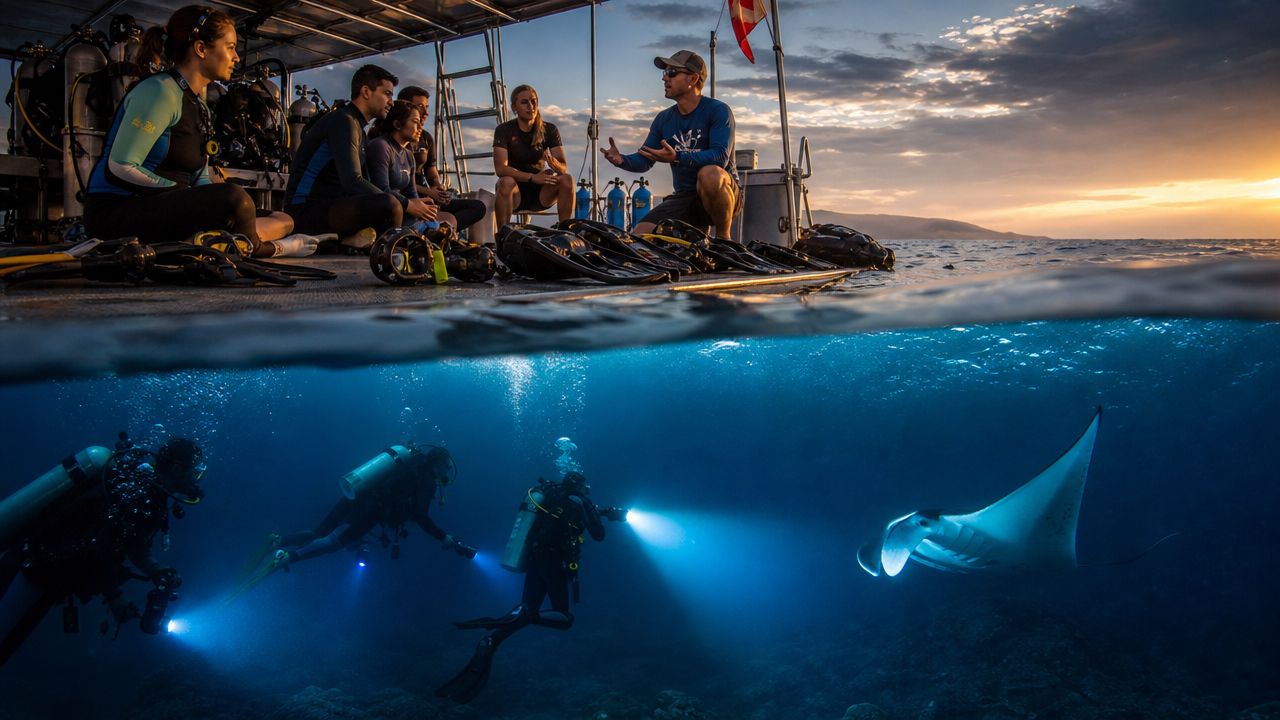
A lot of first-timers expect the manta dive to feel complicated. It usually doesn't, as long as the crew runs a clean system and guests know the sequence before they leave the dock.
The dive itself is typically done in about 30 to 40 feet of water on sandy-bottom sites such as Garden Eel Cove, and that shallow profile is important because it helps light penetrate the scene and keeps the dive accessible to Open Water-level divers rather than turning it into a deep or technical procedure (how deep the Kona manta dive is).
Step 1 check-in and briefing
You arrive, sort gear, confirm certification, and listen carefully to the night briefing. This is not the dive to tune out because you think you've heard it all before.
The crew usually covers entry, descent, light placement, body position, hand signals, and what to do if you feel uncomfortable. Good briefings are specific. They tell you exactly where you'll be and exactly what the mantas need from you, which is mostly stillness.
Step 2 the ride out
The run to the site often happens around sunset, and it can be one of the best parts of the trip. On some charters, the format is a two-tank evening with a twilight reef dive before the manta dive, which makes the night feel more complete than a simple splash-and-go. If you're comparing options, it's worth looking at the full range of Kona diving tours.
Boat conditions vary. Some nights are smooth. Some nights bounce. If you know you're prone to motion sickness, don't wait until you feel bad.
Helpful options include Ship-EEZ Seasickness Patch, Dramamine pills, Bonine pills, Sea Band wristbands, and Ginger chews.
Take your seasickness plan seriously before departure. Once nausea starts, the ocean usually wins.
Step 3 the descent and setup
Once on site, divers descend to the sandy bottom and gather around the light source. The usual posture is kneeling or staying low and stable, not swimming around trying to follow the mantas.
This is one place where newer divers sometimes help themselves by doing less. You don't need to chase the show. If the lights are set properly and the group stays controlled, the show comes to you.
Step 4 the encounter
Then the water changes. Shadows become shapes, and shapes become mantas.
From the bottom, the view is all upward motion. A manta sweeps in, banks across the beam, and turns its white belly into a bright moving reflector. Sometimes one circles repeatedly. Sometimes several rotate through the light one after another.
Step 5 the ride home
Most operators note that the in-water portion can run about 45 to 60 minutes, and that's long enough for many people to feel chilled when they get out, especially at night. Dry clothes help a lot, and the ride back is much more pleasant when you're warm.
The best post-dive mood on the boat is usually a mix of silence and grinning. People aren't tired because the dive was hard. They're quiet because they're replaying it.
Your Essential Manta Dive Preparation Checklist
Preparation decides whether the night feels smooth or stressful. The actual dive profile is manageable for many certified divers, but comfort, fit, and expectations matter just as much as certification card level.
Operators commonly note three practical issues that guests need to think through before booking: whether to snorkel or scuba, the fact that the water can feel cold after a 45 to 60 minute in-water period, and the need for proof of certification on certified dives (sea sickness help for Kona diving).
Choose the right format for your group
If someone in your group isn't certified, that doesn't mean they have to miss the mantas. It means they may be better suited to the snorkel format.
Here's the cleanest way to compare them.
| Feature | Scuba Diving | Snorkeling |
|---|---|---|
| Perspective | From the bottom, looking up into the light | From the surface, looking down into the light |
| Certification | Required for certified dives | Not required |
| Body position | Stationary on or near the sandy bottom | Holding position at the surface |
| Best fit | Certified divers comfortable at night | Families, non-divers, mixed groups |
Bring the things that actually matter
People tend to overpack for this trip and forget the simple stuff.
- Proof of certification if you're diving. If the operator asks for it, have it ready.
- Warm dry clothes for after the dive. This is the item people are happiest they brought.
- A towel that's easy to grab quickly once you're back on board.
- Water so you're not starting the dive dehydrated.
- A realistic mindset. This is a passive wildlife encounter, not a free-swim chase.
Follow the etiquette that protects the mantas
The most important behavior rule is simple. Don't touch them.
Mantas depend on a protective mucus coating on their skin. Even well-meaning contact can interfere with that protection. Good operators build the whole encounter around passive observation for that reason.
Stay in position, keep your hands to yourself, and let the mantas control the distance. That's how close passes happen safely.
Know who should skip the scuba option
Scuba isn't automatically the right call just because someone is certified. A diver who hasn't been in the water for a long time, gets anxious in darkness, or struggles with buoyancy may enjoy the snorkel more.
That isn't settling for less. It's choosing the format that lets you relax enough to enjoy the animals.
The Kona Honu Divers Advantage for Your Manta Dive
Operator choice changes the night more than most visitors expect. For a manta ray dive in Kona, the biggest differences usually come down to site selection, briefing quality, crew control in the water, and whether the charter is built as a full evening dive experience or just a quick manta run.
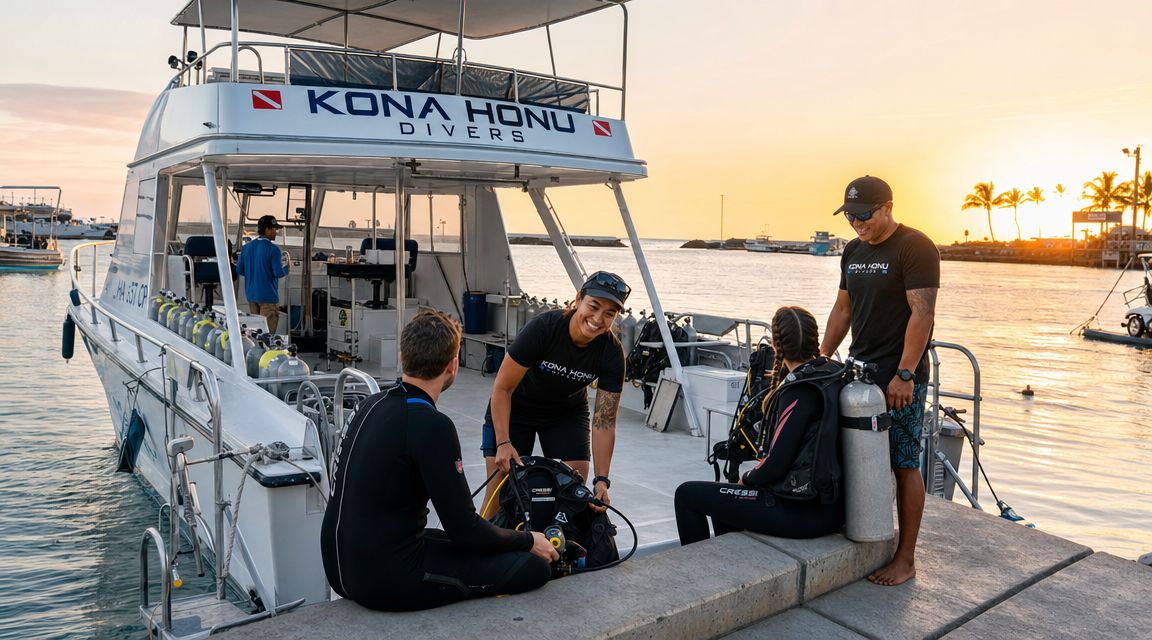
One option to consider is Kona Honu Divers. They run a 2-tank manta dive and snorkel charter, which aligns well with the evening format many divers prefer because it pairs the manta portion with a twilight reef dive rather than reducing the trip to a single event.
What matters in an operator
This is what I'd look for before booking any manta charter.
- A crew that gives precise briefings. Night diving improves when guests know exactly where to be.
- A preference for Garden Eel Cove when conditions allow. Site choice shapes crowding and viewing quality.
- A boat setup that supports comfort. Night trips are better when gear flow, exits, and post-dive warmth are handled well.
- A safety-first pace. Rushed crews create rushed divers.
Those details aren't glamorous, but they're what make the encounter feel polished instead of hectic.
If you want more than one night dive
Some divers come for mantas and then want something completely different on a second night. In that case, the Kona blackwater night dive is a very different experience and usually appeals to divers who want open-ocean pelagic weirdness rather than a site-based wildlife show.
Certified divers looking for stronger daytime profiles may also want to look at advanced long-range dive tours, which are more appropriate for guests seeking a more advanced outing.
Manta Conservation and Frequently Asked Questions
The manta dive works because the animals keep choosing to come back. That only continues if people behave like guests, not participants in the feeding.
Responsible tourism matters here. Passive observation, controlled positioning, and no touching give the mantas room to feed naturally. Good operations protect the encounter by making the human side predictable.
Common questions from first-timers
How close do the mantas really get?
Sometimes extremely close. Divers often watch them pass just overhead in the light, but the right response is to hold position, not reach up.
Is it scary to dive at night?
For some people, yes at first. For most certified divers, that feeling fades quickly once they descend, settle in, and realize the dive is structured around one clear focal point.
What if I'm not a certified diver?
Then snorkeling is usually the right choice. It gives non-divers and mixed family groups a way to see the same feeding activity from the surface without needing scuba certification.
Will I feel cold afterward?
Quite possibly. Night water plus wind on the ride back can chill people fast, especially after staying in the water for a while. Dry clothes are one of the smartest things you can bring.
Respect for the mantas isn't a side note. It's the reason this encounter stays worth doing.
If you want a manta ray dive in Kona that prioritizes site choice, diver comfort, and a respectful in-water setup, take a look at Kona Honu Divers and choose the format that fits your group best.