
You've got one open evening in Kona, the boat leaves around sunset, and the forecast looks unsettled. You want to see manta rays, but you also want a straight answer about which site makes sense, what rough seas mean for the trip, and what happens if the mantas don't show.
My recommendation is clear: choose Garden Eel Cove for its protected location, better viewing area, and better reefs. Go with a crew that takes the sea state seriously, explains where everyone should be in the water, and doesn't promise wildlife on command. Kona's manta population is resident, but a responsible operator still can't guarantee what the ocean will serve up on a particular night.
What a Kona Manta Night Dive Feels Like
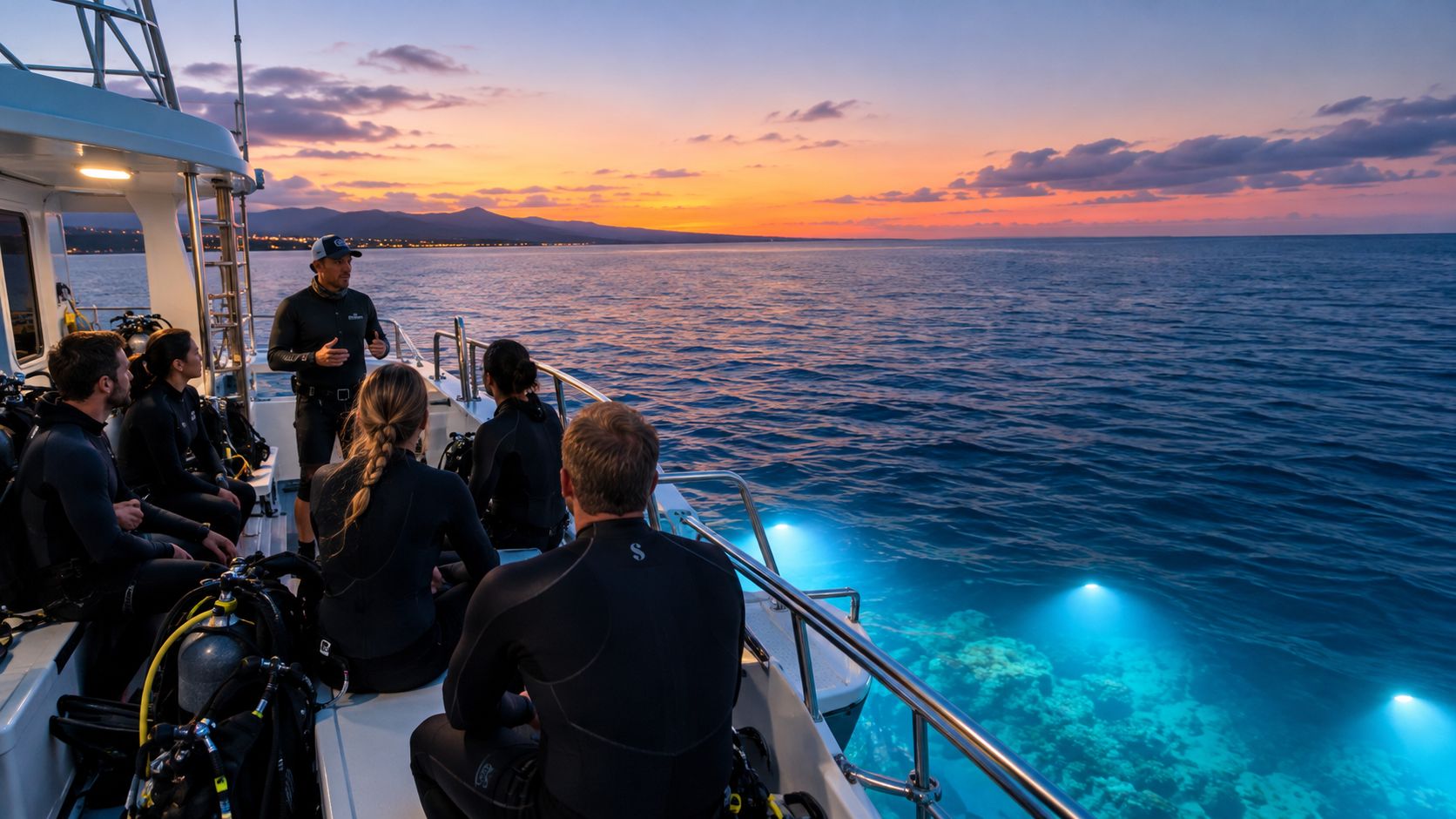
The water is dark, the dive lights are on, and the group is settling onto the sandy viewing area. Then the waiting begins. On a calm night with clear water, plankton gathers in the lights and mantas may sweep through to feed. Your job is to stay in place and watch, not follow them.
That quiet stretch is part of the dive. A manta can appear without warning, banking overhead with its mouth open as it filters plankton. On a rough or murky night, the view may be poor, and the crew may call off the dive if conditions make the trip unsafe. Some nights, no mantas arrive. That is the honest shape of a wildlife encounter.
Why the reputation is earned
Kona's manta reputation comes from years of repeated observations at established feeding sites. A NOAA repository study covering January 1, 2009, through December 31, 2014, recorded 25,444 observations involving 118 reef mantas at Manta Heaven and Manta Village. Researchers logged 19,841 observations at Manta Heaven and 5,603 at Manta Village, across 2,017 nights at Manta Heaven and 1,702 at Manta Village (NOAA repository study).
The usual rhythm is simple: the group enters after sunset, settles in, and watches the illuminated water. The animals decide whether to show. That makes patience and a good viewing position more useful than expecting constant action.
Certified divers and surface snorkelers can share a trip, but they watch from different levels. Divers remain below, while snorkelers stay at the surface. If you're comparing Kona diving tours, match the trip to your certification and comfort in the water. Review the two-tank manta dive and snorkel trip and read what to expect on a Kona night dive.
Why Garden Eel Cove Beats Keauhou
When the water turns rough or murky, a protected viewing area matters more than a site's reputation. Garden Eel Cove is the stronger choice for this dive: its reef-and-sand terrain gives divers a defined place to settle, while Keauhou's manta visits follow a different pattern.
A 2025 University of Hawaiʻi study analyzed community-submitted sightings of individually identified reef mantas at both sites from 2010 through 2022. Researchers found larger aggregations at Garden Eel Cove. Keauhou had a higher concentration of female visitors and stronger female site fidelity, evidence that the two locations may serve different ecological roles (University of Hawaiʻi study).
The difference matters on a dive. Garden Eel Cove's sheltered reef-and-sand viewing area suits a group that stays in place, while Keauhou's distinct manta patterns do not make it the better setup for this trip.
| Site | What researchers found | What it means for divers |
|---|---|---|
| Garden Eel Cove | Larger manta aggregations | A protected area where divers can settle on reef or sand and watch |
| Keauhou | More female visitors and stronger female site fidelity | A site with a different ecological pattern, but a less suitable viewing setup for this dive |
Manta activity follows food availability, not a boat schedule. Researchers found aggregation size tracked zooplankton density, so even a well-chosen site can have a quiet night.
The study found that aggregations stayed relatively stable during the observation period despite increased tourism activity, and that mantas could adjust their foraging behavior. That stability is no reason to crowd them. Keep the group settled and give the animals room.
How the Light and Plankton Dive Works
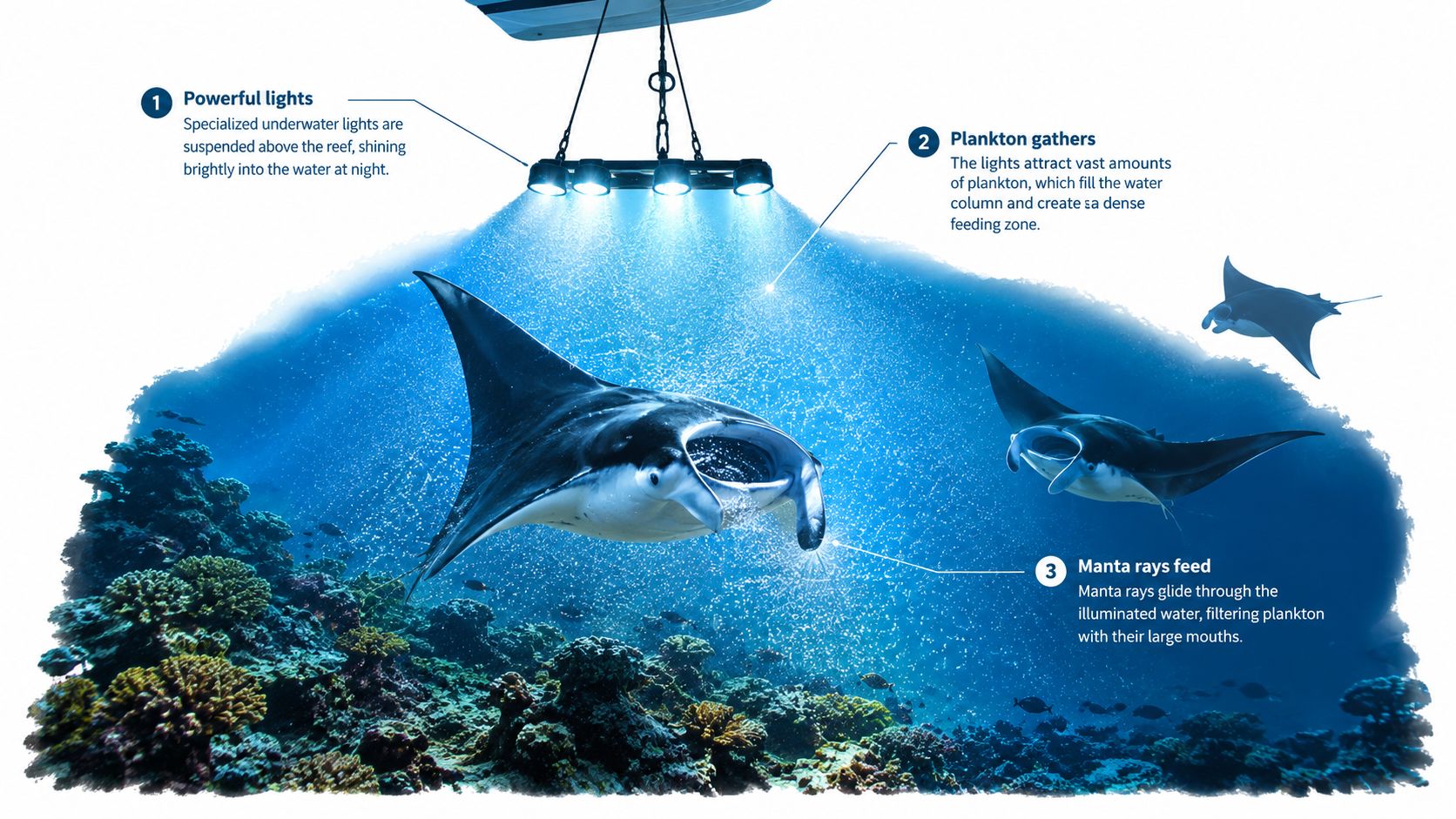
A Kona manta night dive works because the crew sets up a feeding opportunity, not because the boat somehow summons rays. Artificial lights gather plankton in the water column. Reef mantas enter that illuminated zone to filter-feed. Think of a porch light drawing moths in, except the food is microscopic and the visitors are large animals making broad banking turns and barrel rolls.
The sequence is simple. The boat departs around sunset, the crew sets the lights, and divers get into position low on the bottom. As plankton gathers above the lights, mantas may arrive and follow their own feeding paths through the lit water. They aren't performing for the group, and they don't have to pass at a particular distance.
Your position keeps the feeding lane open
Divers stay low on sand, rubble, or boulder substrate and keep the central water column clear. Aim lights upward so they illuminate the plankton above you. Keep your bubbles out of a manta's face, and don't rise through the feeding lane when a ray approaches.
Snorkelers should stay on the surface rather than dropping into the same corridor. That separation gives mantas room to maneuver and keeps the group from converging in the water where they're feeding.
Photographers have the same job as everyone else: choose a position and let the animal decide whether to come close. Set camera settings and composition before the rays arrive. Keep your gear secure, avoid chasing a close pass, and don't point a strobe continuously at a manta.
Practical rule: Don't try to make the manta come closer. Hold your position and let it choose the distance.
The benchmark isn't a forced minimum distance. It's controlled buoyancy and a fixed position that allow the animal to close the gap voluntarily. Swimming upward, crossing the illuminated corridor, or pursuing a ray increases collision risk and can interrupt feeding. Touching is also off-limits because manta skin carries a protective mucus layer. Rubbing can remove that barrier and create avoidable health stress. The light setup works best when people don't disrupt it.
Night Dive Safety and Manta Etiquette
Seeing a manta isn't enough to call the encounter successful. If guests crowd its path, chase it, or make it alter its feeding, the group has seen the animal but handled the encounter poorly. Good in-water behavior protects the manta and gives people a calmer, safer place to watch.
Different guests, different responsibilities
Certified divers should maintain neutral buoyancy, keep fins off the reef, aim lights up rather than into eyes, and avoid ascending through the feeding lane. If current, separation from the group, or anxiety starts to build, signal the guide and follow the planned abort procedure. A diver who feels in control is less likely to make sudden movements near the rays.
Snorkelers should stay with the surface group and hold the float or follow the guide's station. Treat full-face snorkel equipment as a supervision and suitability question, not an automatic comfort upgrade. Recent coverage has raised concerns that poorly chosen full-face gear may contribute to carbon-dioxide buildup, dizziness, panic, or unconsciousness (Kona snorkel tour guidance). Ask the operator what equipment is used and how the crew supervises snorkelers.
Photographers should avoid pursuit, repeated strobe use that harasses the animal, and drifting over coral for a tighter frame. A fixed position is not just a courtesy to other guests. It leaves the feeding route open.
You can read more about responsible and considerate diver etiquette. In Hawaiʻi state waters, manta rays are protected, and NOAA-hosted guidance treats harassment and physical contact as prohibited.
What crowd management looks like
Hawaiʻi's DLNR proposed a West Hawaiʻi manta-viewing framework for rulemaking. It identified two designated viewing zones, with no more than 24 commercial permits per zone, vessel capacity capped at 60 passengers for hire within a 24-hour period, two-hour operating shifts, and an 8-to-1 guide-to-customer ratio. The proposal set viewing hours from 4:00 p.m. to 4:00 a.m. and included vessel lighting, propeller guards or a safety lookout, and no fishing in the zones during viewing hours (DLNR proposal).
Those numbers describe a proposal, not regulations presented as currently adopted. The practical point is still clear: managing boats, people, and vessel safety is part of responsible viewing, not paperwork detached from the encounter.
If a manta comes within arm's reach, don't reach for it or swim away in a hurry. Hold position and let it pass.
Seasons Swells and a Quiet Night
The mantas are reported to be present year-round, so the best season isn't determined by the month with the most animals. Trip quality depends on animal activity, wind, swell, plankton, current, and whether passengers can comfortably handle the boat ride. Winter can bring larger swells and a rougher ride. April through October is generally associated with calmer seas and fewer cancellations, but no season guarantees a smooth night.
Separate two outcomes before booking. Unsafe conditions call for a captain's decision to cancel or relocate. A completed trip with no manta sighting is different. Plankton may be thin, mantas may be elsewhere, or poor visibility may reduce a large animal to a shadow. Changing sites may help if the issue is local conditions, but it can't guarantee better visibility or a manta encounter.
Ask about the plan before you pay
Ask what sea-state or weather conditions would make the captain cancel, whether the operator relocates, and whether snorkelers and certified divers are treated differently when conditions change. Then ask what happens to your booking if the trip is canceled for safety, and what the operator offers if the trip runs but no manta appears. Don't assume a reschedule or refund policy. Get the answer from the operator before paying.
If you have only one Kona evening, a windy forecast is a poor bet. When your schedule allows, choose a backup date instead of stacking the manta trip onto the only night you can go. You can also check when to plan a manta ray trip in Kona while you're weighing the forecast against your itinerary.
Pack for the ride home as well as the water. Bring a warm layer for the boat, plan ahead if you're prone to motion sickness, and follow the crew's expectations about reef-safe products. If the mantas don't arrive, the lights, reef, and calm observation still make for a worthwhile night, but that's not a substitute for honest expectations. A good operator tells you plainly when conditions aren't right to go.
A Night Aboard with Kona Honu Divers
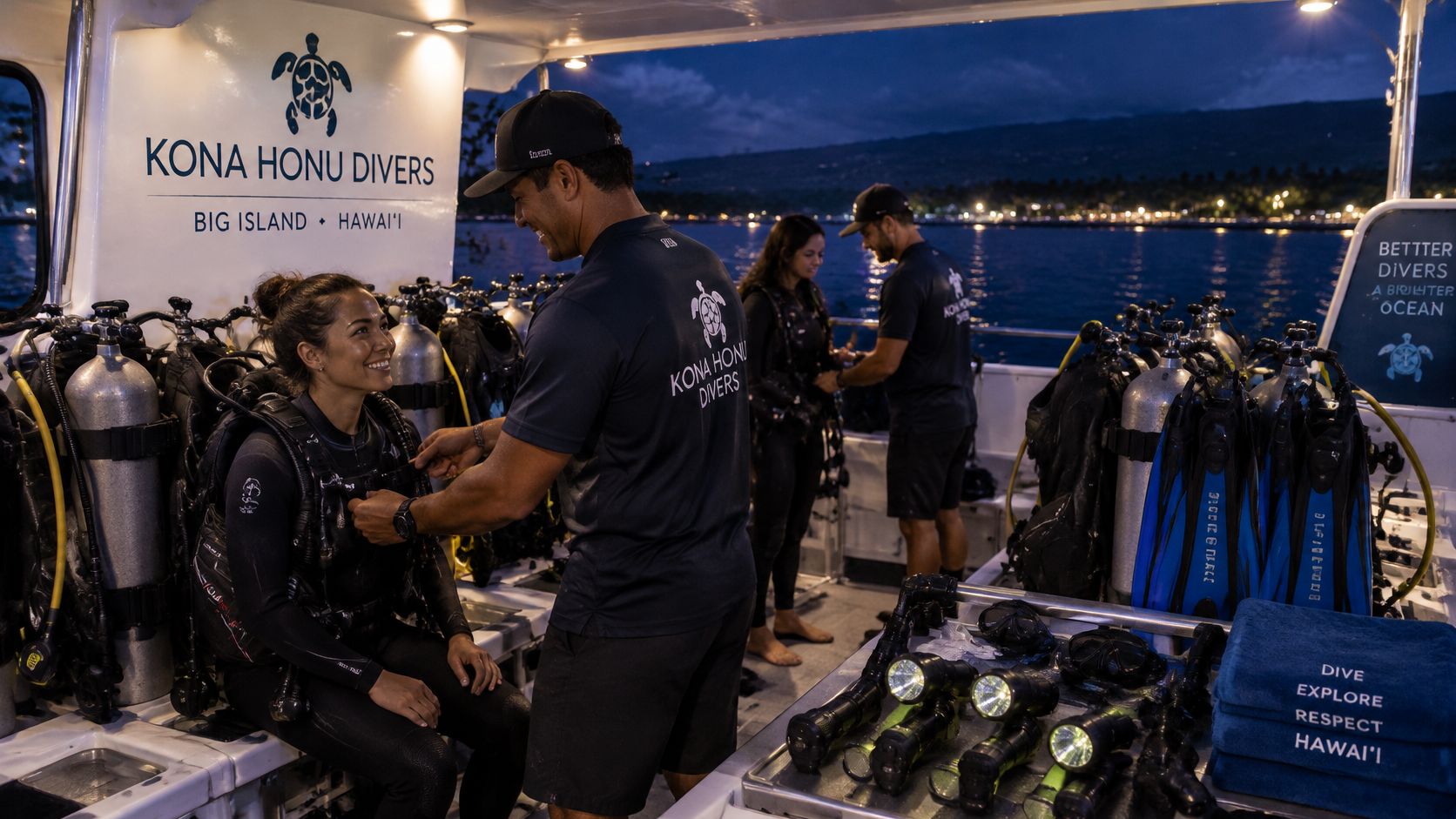
At check-in, Kona Honu Divers starts with the practical details: the briefing, the plan for the evening, and gear matched to each diver. The company describes its team as bringing more than 60,000 collective dives and 200 years of combined experience, and runs spacious custom dive boats for beginners through advanced guests. Its manta outing heads to the protected Garden Eel Cove viewing area.
From briefing to the ride back
After the briefing, guests get fitted and the crew heads out toward the site. Once the boat is positioned, the lights go into the water to draw plankton. Divers settle low, snorkelers remain at the surface, and the guide keeps the group organized while everyone watches for manta activity. When the night is done, the crew helps with the return routine, including rinsing gear and getting passengers back aboard.
The company says its rental equipment is high quality and maintained on a proactive service schedule. It also provides complimentary nitrox for certified divers who are qualified and set up to use it. That's relevant for divers who want to discuss gas choice and bottom time with the crew, but it doesn't make sense to treat nitrox as a benefit for every passenger.
The trip may suit a cautious snorkeler who wants extra attention, a diver making an early ocean dive, or an underwater photographer who prefers a stable position to chasing a frame. Kona Honu Divers also describes its record as including Scuba Diving Magazine awards and a 5.0 Google review reputation. Those are the company's stated credentials, not a promise that sea conditions or wildlife will behave on any particular night.
Booking the Manta Dive or Another Charter
If you want reef-manta viewing, choose the two-tank trip that pairs an afternoon reef dive with the night encounter. Check the Kona dive charter options to compare trips and confirm what each booking includes.
A blackwater dive is a different night out. The boat heads into open ocean, where divers look for deep-water animals instead of watching mantas feed over a reef. Choose the blackwater night dive if that open-water experience is your goal.
For remote lava formations or shark-nursery terrain, consider the premium advanced two-tank trip. It suits divers who want challenging terrain, not visitors focused on the manta site.
Choose by comfort, not just the headline
Be honest about your certification and recent time in the water. Ask whether a snorkeler can join the same trip as a certified diver, and consider how you handle boat motion and a fixed viewing position with your camera. If you have one free evening, ask what happens if the captain cancels for sea conditions before you pay.
Prices and discounts can change, so confirm the current terms when booking. Keep a backup date if your schedule allows, especially during winter swell season. Choose a trip that fits your experience and comfort, not just its itinerary.
Go Dive and the Questions Left Over
For the manta night, choose Garden Eel Cove for its protected viewing area, better reefs, and larger documented aggregations. Stay low as a diver or at the surface as a snorkeler so the mantas can feed. Treat winter swell and a completed trip without a sighting as separate situations, then book the boat that fits your certification and comfort.
Answers before you book
Can a non-certified guest snorkel while a buddy dives? Ask the operator to confirm that the booking includes a snorkel option and that the guest is comfortable staying at the surface with the group. For help comparing the snorkel and dive viewpoints, check the trip details before reserving.
How comfortable should a certified diver be? You should be comfortable controlling buoyancy and following a guide in darkness. If you haven't dived recently or feel unsure about night diving, tell the operator before booking and ask whether the trip suits your current experience.
Does complimentary nitrox apply to everyone? No. It's for certified divers who are qualified and set up to use it, not every passenger.
How should I plan around a flight or late hotel check-in? Don't schedule the dive around a same-day flight arrival or a check-in that leaves you rushing to the dock. The outing begins near sunset and the dive itself lasts about an hour, so build in enough time to arrive, complete the briefing, and board without pressure.
Kona Honu Divers offers guided Kona dives, including a manta night trip to Garden Eel Cove for certified divers and snorkelers. Check the live schedule, ask what happens if sea conditions force a cancellation, and visit Kona Honu Divers to choose the outing that fits your trip.