
Picture this: massive, graceful shadows gliding silently through the dark water, swooping just inches above your head. It sounds like something from a nature documentary, but it's a very real experience waiting for you on the world-famous manta ray dive in Kona, Hawaii. If you're looking for one of the most magical underwater encounters on the planet, you've found it.
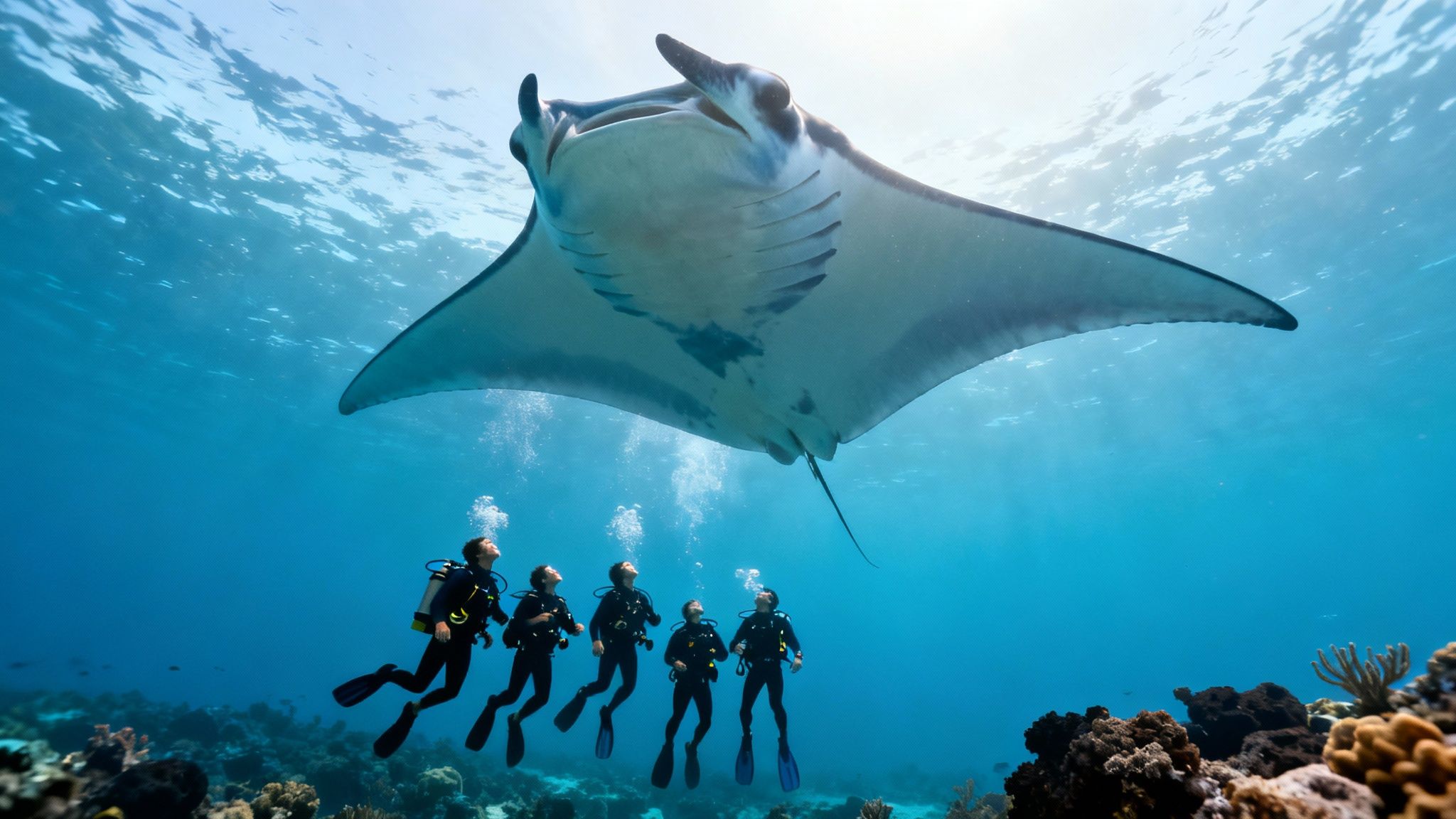
The Kona coast of the Big Island is a truly special place. It’s earned a reputation as one of the most reliable spots on Earth to see manta rays perform their nightly ballet. This isn't just luck; it's a perfectly balanced ecosystem that creates a dependable feeding ground for these gentle giants.
So, what's the secret? It all comes down to plankton. The bright lights that tour operators shine into the water attract huge clouds of these microscopic organisms. This creates a floating, all-you-can-eat buffet that the local reef manta rays simply can't resist. Being creatures of habit, they return to these same "feeding stations" night after night.
What Makes This Experience So Unforgettable
This isn't just another dive on your logbook. It’s an immersive, almost surreal spectacle that connects you with the ocean in a profound way. The Kona manta ray dive is a bucket-list item for a few key reasons:
- Remarkable Reliability: A lot of wildlife encounters are hit-or-miss, depending on the season. Not here. Kona’s manta population is here year-round, giving divers and snorkelers an exceptionally high chance of an incredible sighting.
- A Front-Row Seat: The whole experience is designed to give you the best view imaginable. Divers settle on the sandy bottom, shining their lights up. Snorkelers hang onto floating light boards at the surface. The mantas then swoop and barrel roll right through the light beams, often just inches away.
- A Thriving Ecotourism Hub: This activity is a cornerstone of Kona's identity. The coast draws about 80,000 people each year to see these majestic animals, and the success rate for sightings often hovers between an amazing 80-90%.
Of course, picking the right operator and dive site is absolutely crucial for a trip that's not only memorable but also safe and respectful of the animals. Our team at Kona Honu Divers is made up of experts who are passionate about giving you a world-class adventure while always putting the well-being of the mantas first.
This guide will walk you through everything you need to know, from why Garden Eel Cove is our top choice to exactly what you can expect on your tour. And if you're looking to plan a complete underwater adventure, you might also want to check out some of the other top snorkeling tours in Kona Hawaii.
Get ready for an experience you'll be talking about for years to come.
Why Garden Eel Cove Is the Premier Manta Dive Location
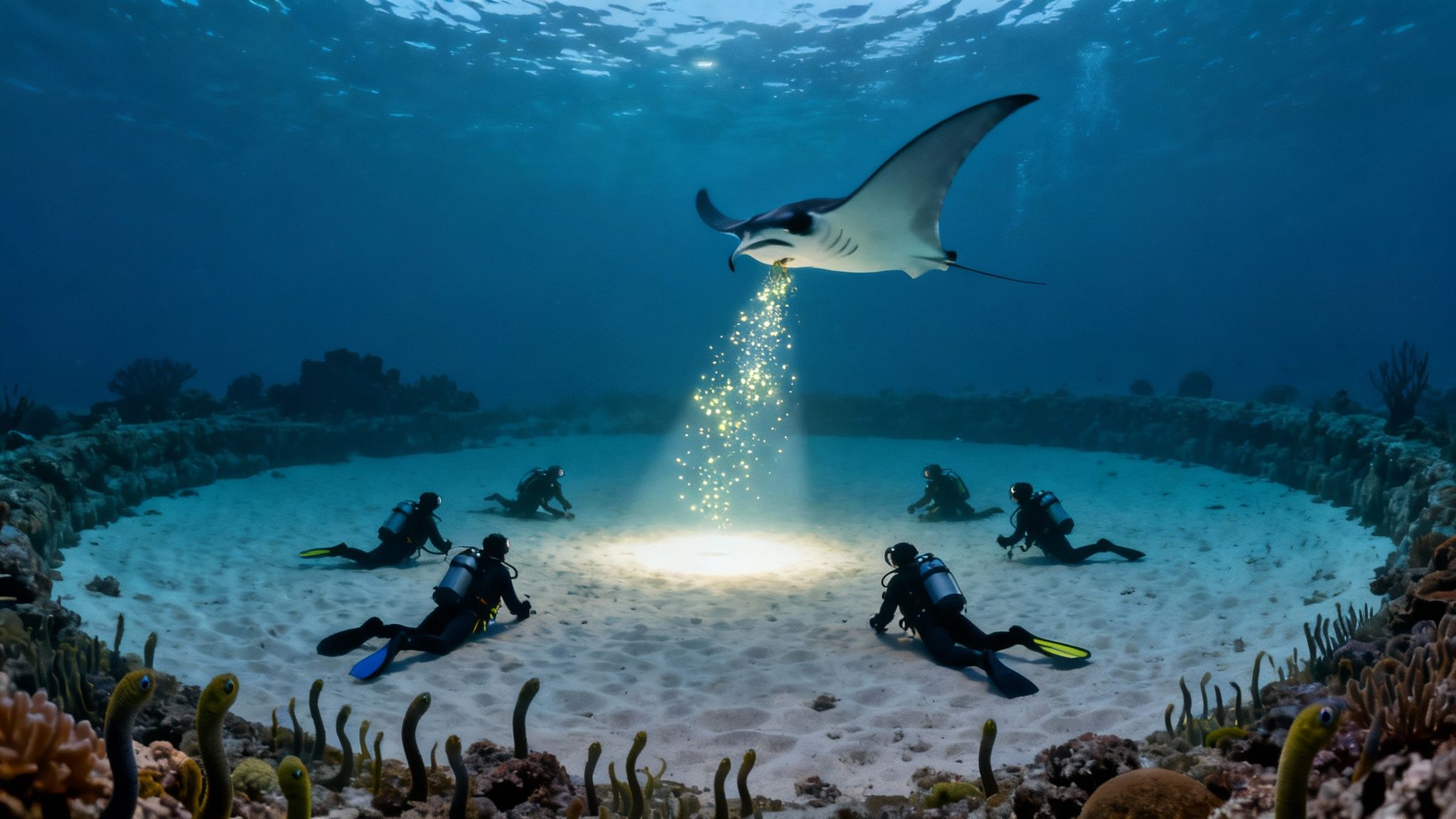
When you start planning a manta ray dive in Kona, you’ll hear a couple of names pop up. But as any seasoned local diver will tell you, not all manta sites are created equal. One spot consistently delivers a world-class experience that puts it head and shoulders above the rest: Garden Eel Cove, also known by its well-earned nickname, "Manta Heaven."
This site is the superior choice for a manta ray dive tour, and for good reason. It all starts with geography. This particular site is nestled in a cove just north of Kailua-Kona, giving it natural protection from the big southern swells that can churn up other spots. This shelter is a game-changer. It means the water at Garden Eel Cove is almost always calmer and clearer. For you, that translates to better visibility, a more comfortable dive, and far fewer cancellations due to rough seas.
Kona Manta Ray Dive Site Comparison
While Garden Eel Cove is our top pick, another popular site is Keauhou Bay. Here’s a quick rundown of how they stack up against each other, highlighting why Garden Eel Cove is the superior choice.
| Feature | Garden Eel Cove (Manta Heaven) | Keauhou Bay (Manta Village) |
|---|---|---|
| Location | North of Kona Airport | South of Kailua-Kona |
| Conditions | Protected & calm, ensuring a smoother, more reliable trip | Exposed to southern swells; can be rough and unpredictable |
| Viewing Area | Superior sandy bottom "amphitheater" for divers, providing excellent views | Rocky bottom, less organized viewing area |
| Reef Quality | Pristine, healthy reef for the first twilight dive | Reef is less vibrant |
| Visibility | Generally excellent due to protection from surge | Can be reduced by surge and runoff |
| Overall Experience | Consistently world-class | Good, but more variable due to conditions |
As you can see, Garden Eel Cove’s natural advantages create a more reliable and enjoyable experience from start to finish.
A Natural Underwater Amphitheater
What truly elevates Garden Eel Cove is its unique underwater layout. Picture a natural amphitheater, tailor-made for the perfect manta show. Divers get to settle onto a smooth, sandy patch on the seafloor, forming a circle around a central light source we call the "campfire."
This campfire shines up into the water column, attracting a thick cloud of plankton—a five-star buffet for manta rays. This setup creates a well-defined stage directly over your head, giving everyone an unobstructed, front-row seat to one of nature’s greatest performances. You’ll be just inches away as these gentle giants swoop, glide, and barrel roll through the beams of light.
To get an even better feel for this spot, you can read our deep dive into Manta Ray Heaven.
More Than Just Mantas
The magic at Garden Eel Cove isn't just about the main event. With Kona Honu Divers, your adventure is a two-tank trip that starts with a twilight dive on the surrounding reef. As the sun dips below the horizon, you get to explore a stunningly vibrant and healthy ecosystem.
This reef is teeming with life. You'll see beautiful corals, huge schools of tropical fish, and of course, the thousands of tiny garden eels that poke out of the sand, giving the cove its name. This first dive adds incredible value, letting you experience two completely different underwater worlds in one evening. It’s this combination of a world-class reef dive and the premier manta viewing area that makes Garden Eel Cove the undisputed champion for your manta ray dive tour.
What to Expect During Your Manta Ray Night Dive
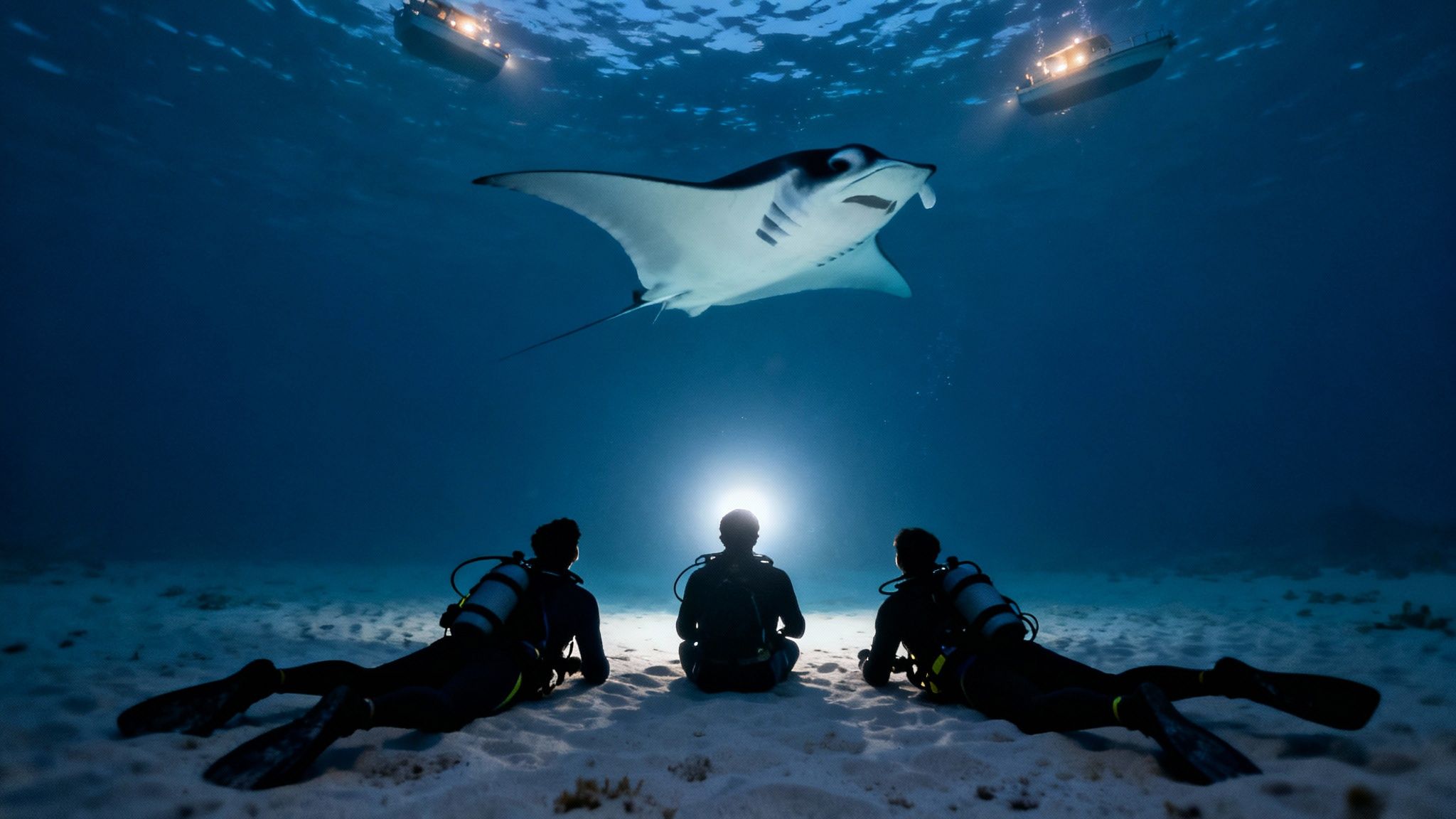
So, what’s it really like to be in the water with these gentle giants? Knowing the flow of the trip helps you relax and soak it all in, turning a great dive into a truly unforgettable one. The whole experience kicks off in the late afternoon. You'll board the boat and head out on the water just as the Hawaiian sun starts its spectacular descent toward the horizon.
On the way to the site, your crew will gather everyone for a detailed and often entertaining briefing. They'll walk you through the dive plan, safety checks, and, most importantly, the rules of manta etiquette. The core principle here is passive observation—the golden rule for ensuring the encounter is safe and enjoyable for everyone, especially the mantas.
The First Dive at Twilight
This adventure is actually a two-tank affair. The first dive happens at twilight, while there’s still a bit of daylight filtering through the water. This is your chance to explore the beautiful coral reef that serves as the backdrop for the main event. You’ll get to see the incredible shift change as the daytime fish head to bed and the nocturnal critters start to peek out. It's a fantastic dive all on its own.
The Main Event Begins
After a quick surface interval, darkness has truly set in, and it's time for the headliner. You'll descend a second time to a specific spot on the sandy bottom, almost like finding your seat in an underwater movie theater. Your dive guide will place a powerful light source—often called the "campfire"—in the center, pointing its beams straight up.
This light is the dinner bell. It attracts swarms of plankton, the manta rays' primary food source, creating a thick, soupy buffet in the water column. You settle in, get comfortable, and wait. The anticipation is half the fun.
Then, out of the deep blue, a massive, graceful shadow appears. It’s followed by another, and then another. The mantas have arrived for dinner, and you have a front-row seat. They swoop and glide through the light, performing incredible barrel rolls as they scoop up mouthfuls of plankton.
These giants can weigh over 1,000 pounds with wingspans stretching more than 12 feet, yet they move with a weightless elegance that’s hard to believe. They'll often pass just inches over your head, so close you can see the unique spot patterns on their bellies. For the next 45 minutes or so, you're completely captivated by this silent, hypnotic underwater ballet. It's an experience that firmly plants the Kona manta ray dive on the list of the world's greatest wildlife encounters.
Ready to see it for yourself? You can book your 2-Tank Manta Ray Dive Tour here.
Meet the Gentle Giants of the Kona Coast
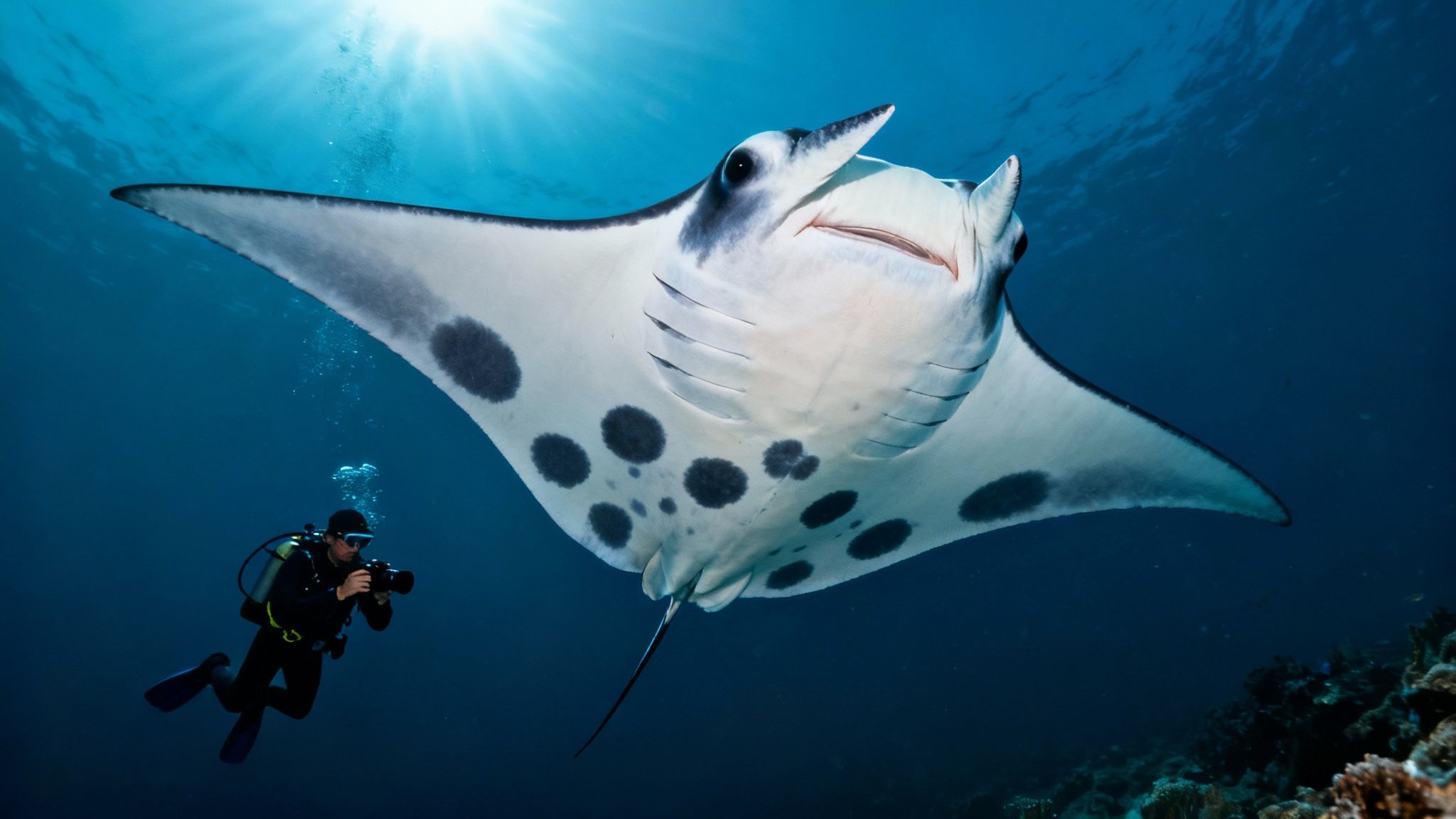
When you slip into the water for a manta ray dive in Kona, you're not just observing random wildlife. You’re being introduced to a well-known community of individuals, each with its own story. This isn't just a dive; it's a personal introduction to the resident reef manta rays (Mobula alfredi).
These animals are incredibly smart—they have the largest brain-to-body size ratio of any fish in the sea. You can see this intelligence in how they interact with their environment and even with us. But what truly makes the Kona mantas so special is how intimately we've gotten to know them over the years.
A Fingerprint of Spots
So, how do we tell them apart? The secret is on their bellies.
Each manta ray has a completely unique pattern of black spots on its white underside. Think of it like a human fingerprint. This natural marker allows researchers, our dive guides, and even you to identify specific animals.
This incredible feature has sparked a long-running citizen science project. Since 1991, a dedicated research effort has been cataloging the mantas here on the Kona Coast. So far, they’ve successfully identified over 330 individual reef mantas and even a few of their larger cousins, the giant oceanic manta ray (Mobula birostris). You can dive into this amazing work over at the Manta Rays Info website.
This means that the manta gliding gracefully above your head isn't just any manta—it has a name and a known history. You might get to meet local celebrities like 'Lefty', 'Big Bertha', or even 'Amanda Ray'.
From a Sighting to a Real Connection
Knowing you're swimming with named individuals completely changes the experience. It’s no longer just a passive wildlife encounter; it becomes a genuine connection with these magnificent creatures.
Your guide might point out a specific manta and tell you a story about its personality or how it recovered from an old injury. This deeper understanding creates a powerful sense of appreciation and highlights why respectful ecotourism is so vital. You're not just seeing a species; you're visiting a neighborhood.
Learning the stories behind the mantas you meet adds an incredible layer of meaning to the dive. Suddenly, you're not just watching any manta ray—you're watching 'Koie', a local favorite known for his graceful acrobatics. This connection is what makes the Kona experience truly unforgettable.
When you book with a knowledgeable operator like Kona Honu Divers, you’re getting more than just a boat ride. Our experienced guides are passionate about introducing you to the gentle giants who call these waters home, helping you identify them and making your adventure that much more memorable.
Practicing Responsible Manta Ray Tourism
Seeing a manta ray glide through the water in Kona is a genuinely breathtaking experience. It’s a privilege, and with that comes a huge responsibility to protect these incredible animals. Sustainable tourism is what keeps this whole experience possible, ensuring that our visits don't disrupt or harm the very creatures we’ve traveled so far to see.
Manta rays face some serious threats around the world, from getting tangled in fishing nets to being hunted for their gill plates. But here in Hawaii, we've taken some big steps to protect them. Recognizing just how special our local population is, Hawaii passed a law back on June 5, 2009, making it illegal to kill or capture manta rays in our state waters.
This was a game-changer. It helped solidify the local eco-tourism industry, which now brings in over $2.5 million every year. You can read up on these protective measures and why they matter so much over at the Hamer in Hawaii website.
The Golden Rule of Manta Interaction
If you remember one thing, make it this: your role is passive interaction. Think of yourself as a guest in their house—you're there to observe, not to interfere.
The absolute number one rule is to never, ever touch a manta ray. They have a slimy, protective mucus coat that’s their first line of defense against nasty bacteria and infections. When you touch them, you strip that layer off, leaving them wide open to getting sick. Any good tour operator will drill this into you before you even get near the water.
A respectful encounter ensures the mantas stay comfortable and keep coming back to the feeding sites. Our goal is to be silent guests in their underwater dining room, letting them go about their business without any interference from us.
Choosing a Responsible Operator
A huge part of being a responsible tourist is picking the right tour operator—one who puts the mantas’ well-being first. Ethical companies follow strict guidelines to make sure their impact is minimal.
Here’s what to look for:
- Thorough Briefings: A great guide will give you a detailed rundown of manta ray etiquette and all the safety rules before you hit the water.
- Controlled Positioning: Divers should stay put on the sandy bottom, and snorkelers need to stay on the surface. This keeps the water column clear so the mantas have plenty of room to swim and feed safely.
- Proper Lighting: The lights are there to attract plankton, not to blind the mantas. They should always be pointed up toward the surface, never directly into the animals' eyes.
By following these rules, you actively contribute to manta conservation. You can learn more about how to be a thoughtful visitor in our guide on responsible and considerate diver etiquette. Your choices matter—they support an economy that knows these gentle giants are worth far more to us alive and swimming free.
Exploring More of Kona’s Underwater World
The manta ray dive is easily one of the most unforgettable experiences you can have in Kona, but believe me, it’s just scratching the surface. Once you've seen that incredible nighttime ballet, you'll be hooked, and ready to see what else the Big Island’s waters have in store.
Your underwater adventures don't have to stop when the sun goes down. If you’re looking for a completely different kind of thrill, you have to try the Kona Blackwater Dive. It's a surreal experience where you drift miles offshore in the deep, inky blackness, watching as strange, bioluminescent creatures rise up from the depths. It’s the closest you’ll ever get to floating in outer space.
Advanced and Daytime Adventures
If you're a certified diver looking for a bit more of a challenge, Kona’s volcanic landscape has created an underwater playground like no other. We run premium advanced dive tours that take you through ancient lava tubes, under massive archways, and along sheer walls that are just buzzing with life. These dives are a powerful reminder of the raw, geological forces that built this island from the ocean floor up.
And of course, the diving here during the day is world-class. The entire Kona coast is fringed with brilliant coral reefs that are home to green sea turtles (we call them honu), moray eels, and a dizzying variety of tropical fish. Getting out on a daytime charter is the perfect way to round out your trip, giving you a complete picture of this incredible marine ecosystem. To see what's out there, take a look at our guide to Kona's most popular dive sites.
While manta rays are famously gentle, it’s always a good idea to build up your knowledge of ocean life. A great place to start is by understanding a variety of sea animals, especially those that deserve a bit of extra space.
Here at Kona Honu Divers, we offer a whole lineup of scuba diving tours to help you explore it all. Whether you're after a challenging advanced dive or just a beautiful, relaxing swim over the reef, we’ve got a boat going out for you.
Your Kona Manta Ray Dive Questions Answered
We get these questions all the time from divers and snorkelers eager to meet Kona's famous manta rays. Here are some of the most common things people ask before booking their trip.
Do I Have to Be Scuba Certified?
Not at all! While seeing the mantas from below is an incredible experience for certified divers, the snorkeling adventure is just as breathtaking.
Snorkelers get to hold onto a custom-made, high-powered light board that floats on the surface. This light attracts the plankton, and the mantas come right up to feast, giving you an amazing bird's-eye view of the action. It makes this incredible encounter accessible to almost anyone, regardless of their in-water experience.
What’s the Best Time of Year to Go?
This is one of the best parts about the Kona Manta Ray Dive: you can do it year-round. The local manta rays are residents, not migratory visitors, so they stick around for the reliable "plankton buffet" we set up for them.
Our success rate for seeing them is consistently high, typically hovering between 80-90%, no matter the month. That said, if you're looking for the absolute calmest and warmest water, the period from April to October is your best bet. But don't let a winter trip deter you—the show is just as spectacular.
Is the Night Dive Safe?
Absolutely. When you go with a professional, reputable operator like Kona Honu Divers, your safety is the top priority. It's important to remember that manta rays are gentle giants; they don't have teeth, barbs, or stingers like their stingray cousins.
The main safety rules are simple: listen carefully to your guide's briefing, stay with your group, and never, ever touch the mantas. We practice passive observation to keep both you and the animals safe. We use dive sites like Garden Eel Cove, which is naturally protected and known for its calm conditions, ensuring a secure and unforgettable night.
Ready to see this unbelievable underwater ballet for yourself? Kona Honu Divers runs a world-class manta ray dive tour that you'll be talking about for years to come.