
Picture this: you're floating weightlessly in the calm, dark Pacific Ocean. Suddenly, a giant, graceful shadow emerges from the blue, gliding and somersaulting just inches from your face. This isn't something you watch on a nature channel; this is the legendary manta ray dive in Kona, a real, unforgettable, bucket-list adventure on Hawaii's Big Island.
Experience the World-Famous Kona Manta Ray Dive
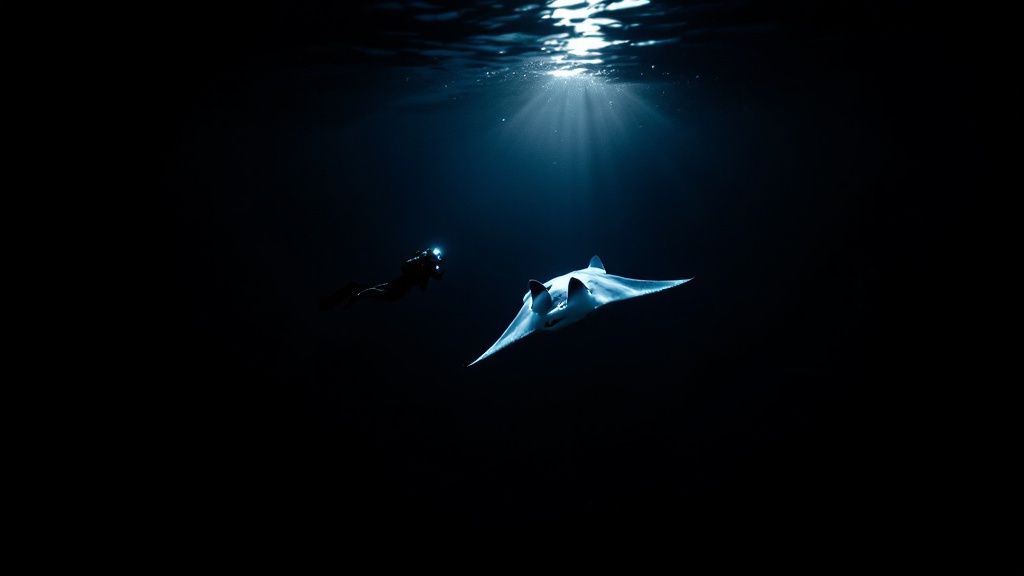
The Kona manta ray night dive is rightly famous as one of the most incredible underwater encounters you can have anywhere on Earth. It’s an experience that blends the thrill of a night dive with the sheer awe of meeting some of the ocean's most majestic creatures. The whole thing works because of a brilliantly simple idea.
Expert tour operators, like the fantastic crew at Kona Honu Divers, set up powerful, submerged lights on the ocean floor. These lights act like a massive bug zapper, but for plankton, attracting swarms of them from the surrounding water. The mantas, knowing a good meal when they see one, show up for their nightly feast, performing a mesmerizing underwater ballet for everyone watching.
What Makes This Dive So Special?
What really sets the manta ray dive Kona experience apart is how reliable and intimate it is. The local manta ray population doesn’t migrate, which means they’re here all year long. This amazing consistency has turned Kona's coastline into the undisputed best place in the world to see these gentle giants.
"Diving with mantas is one of the most satisfying things a person can do in the water. It’s impossible to describe the feeling of watching a massive fish the shape of a stealth bomber coming into vision."
This isn't just a fleeting glimpse from a distance. The mantas have learned to associate the bright lights with an easy meal, so they swoop and soar right through the beams, often getting within inches of you. The entire experience is built around passive interaction, allowing you to witness their natural feeding behavior without disturbing them. It's profoundly moving, whether you're a seasoned diver or a first-time snorkeler.
To give you a clearer picture of what to expect, here are the essential details for planning your manta ray dive or snorkel experience in Kona.
Quick Guide to Your Kona Manta Ray Adventure
| Aspect | Details |
|---|---|
| Best Time to Go | Year-round, with peak season from April to October. |
| Primary Locations | Manta Village (Keauhou Bay) and Manta Heaven (near the airport). |
| Activity Options | SCUBA Diving (bottom view) or Snorkeling (surface view). |
| What You'll See | Reef Manta Rays feeding on plankton attracted by lights. |
| Is It Safe? | Yes, it is a highly regulated and safe activity with expert guides. |
With these key points in mind, you're one step closer to an adventure you'll be talking about for years to come.
Ready to witness this underwater ballet for yourself? Booking a spot on one of the top-rated manta ray dive tours is the first step toward an adventure you will never forget.
Why Kona Is the Global Capital for Manta Ray Encounters
When people talk about diving with manta rays, Kona isn't just another spot on the map—it’s the absolute best place in the world to do it. You can find mantas in warm waters all over the globe, but nowhere else offers the same incredible, up-close encounters night after night. It's a reputation earned through a unique combination of history, biology, and pure Big Island magic.
It all started decades ago, almost by accident. A hotel on the coast switched on its lights at night, and those lights attracted tiny plankton. Before long, the local reef mantas figured out that this was an all-you-can-eat buffet and started showing up. Some sharp dive operators saw what was happening and had a brilliant idea: what if they could create their own underwater "campfire" of lights on the ocean floor to draw in the plankton?
It worked. Perfectly. This simple concept has conditioned generations of mantas to see these dive sites as a reliable dinner spot. Unlike wildlife encounters that hinge on migratory patterns or just dumb luck, the Kona mantas are here to stay. They're a resident population, and they show up almost every single night.
The Premier Manta Ray Dive Sites
Two main locations have become the world-famous stages for this nightly spectacle, and each offers a slightly different vibe.
- Manta Village: This is the original site, tucked into Keauhou Bay. Its waters are relatively shallow and calm, making it a great spot for both divers and snorkelers. You settle onto a sandy bottom, almost like you're sitting in an underwater amphitheater, and wait for the show to begin above you.
- Manta Heaven: Located a bit further north near the airport (also known as Garden Eel Cove), this spot can be electric. It often draws in a larger crowd of mantas, creating a mesmerizing, swirling vortex of gentle giants that you just have to see to believe.
At both sites, the experience is all about passive observation. We’re guests in their world, and the entire operation is designed to protect the mantas while giving you a front-row seat to their natural feeding behavior. This is what makes the manta ray dive Kona experience so consistently amazing.
A Living Laboratory for Research
Your dive is more than just an unforgettable adventure; you’re actually contributing to a massive, long-running research project. For years, scientists and local dive professionals have been meticulously identifying and tracking individual manta rays. How? The unique spot patterns on their bellies are like a human fingerprint.
This research has allowed us to give names to hundreds of mantas and follow their lives, learning about their habits and social structures. When you’re down there, you aren’t just looking at wildlife. You might be meeting Lefty, Big Bertha, or another one of the famous locals.
This commitment to research transforms the dive from a spectacle into a meaningful connection with individual animals and their conservation story.
The sheer popularity of this eco-tour is incredible. Every year, around 80,000 people come to the Kona Coast for this experience, making it a vital part of the island's economy. At top sites like Manta Village, it’s common to see 8 to 12 mantas performing their graceful feeding ballet, especially during the peak season from April to October. You can learn more about the Kona manta dive phenomenon and see for yourself why it's a world-class attraction.
Scuba Dive or Snorkel: Choosing Your Viewpoint
Alright, let's get into one of the biggest questions you'll face when planning your Kona manta ray adventure: should you scuba dive or snorkel? This is a key decision, and honestly, there’s no wrong answer. Both give you a spectacular show, but the experience from above versus below the water is completely different. It really boils down to your comfort level in the water, whether you're a certified diver, and the kind of view you're dreaming of.
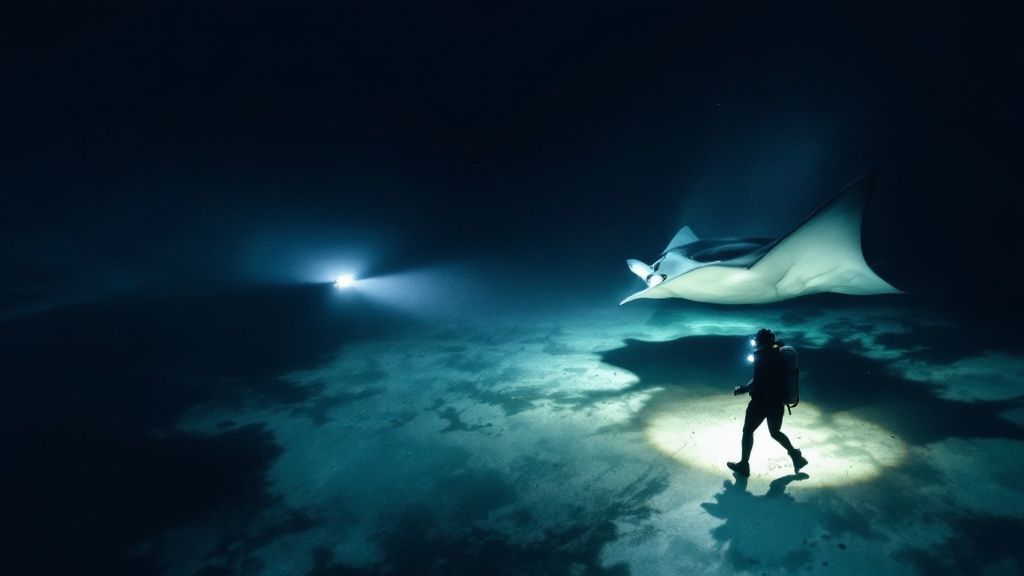
Picture this: you descend through the dark water and settle onto a sandy patch of the ocean floor, about 30 feet down. You’re kneeling in what feels like an underwater amphitheater, looking up. In the center, a powerful "campfire" of lights cuts through the blackness, attracting a cloud of plankton.
And then, they appear. Giant manta rays, with wingspans easily stretching over 10 feet, glide down from the darkness above. They perform an incredible, acrobatic ballet right over your head. This is the scuba diver's view—an immersive, front-row seat to one of the most amazing spectacles in the natural world.
The Diver's Unforgettable Viewpoint
If you’re a certified diver, this is the ultimate way to see the mantas. Being on the bottom gives you a stable, relaxed position where you can just take it all in without kicking or floating around. The mantas often swoop within inches, barrel-rolling through the light beams to scoop up the plankton.
- The Upside: You get a breathtaking, upward view of the mantas, often seeing their entire bodies silhouetted against the night sky. Being stationary on the seafloor means you don't have to fight waves or currents.
- The Downside: You absolutely must be a certified scuba diver. It also involves more gear and preparation than a snorkel trip.
The Snorkeler's Bird's-Eye Perspective
Now, imagine floating on the surface, holding onto a specially designed light board. These boards shine bright lights down into the water, creating the same plankton buffet that the mantas can't resist. From your spot on the surface, you get to look down into the action as these gentle giants ascend from the deep to feed just a few feet below you. It's like having a window into another world.
Snorkeling is a fantastic option because it's accessible to nearly everyone, no matter their experience in the ocean. No certification needed—just a spirit of adventure. It's an equally magical way to witness the feeding frenzy.
- The Upside: No certification is required, which makes it perfect for families and groups with non-divers. It’s less gear-intensive and can feel less intimidating for people new to ocean adventures.
- The Downside: You’re on the surface, so you’ll feel the motion of the waves more. The view is looking down, which is incredible, but it's a different perspective than the fully immersive, looking-up experience of the divers.
The biggest difference between the night dive and the night snorkel is your vertical location. Divers are on the ocean floor looking up, while snorkelers are at the surface looking down.
The Best of Both Worlds on One Boat
Here’s the great news: you don't have to split up your group! One of the best things about the manta ray dive Kona experience is that top-notch operators like Kona Honu Divers run trips that accommodate both divers and snorkelers on the same boat. This is the perfect solution for families or friends with mixed certification levels.
Everyone heads to the site together. On the way, the crew gives separate, detailed briefings for each activity. Once you arrive, the divers make their way down to the "campfire" on the ocean floor, while the snorkelers are guided to their floating light board right above. Everyone gets to share the exact same magical encounter, just from a different vantage point.
If you’re leaning towards the surface view, you can check out all the details of a dedicated manta ray snorkel tour.
In the end, whether you choose to watch the show from above or below, you’re in for an unforgettable night with Kona's majestic manta rays.
Getting to Know Kona’s Famous Manta Rays
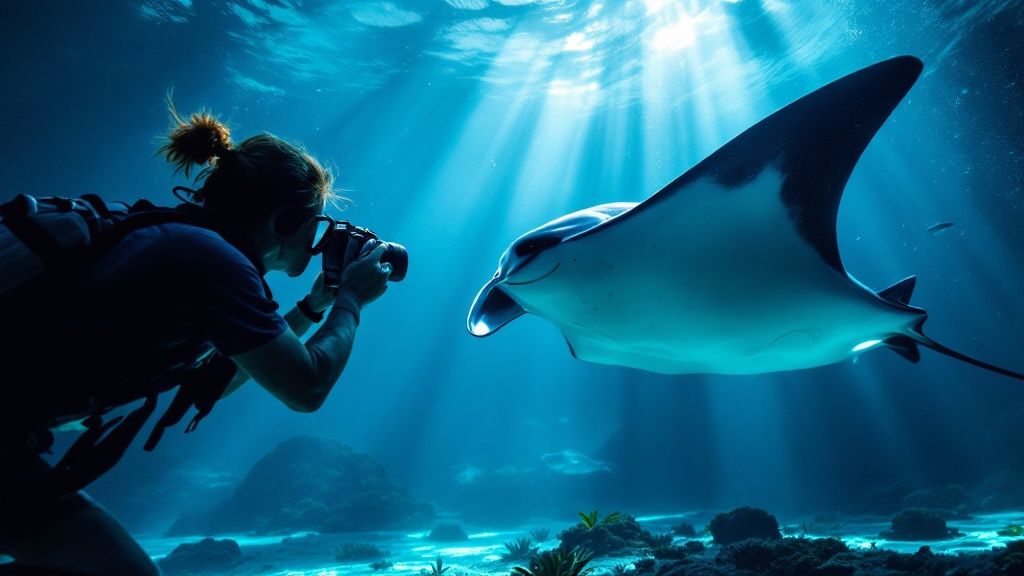
One of the most incredible things about the Kona manta ray dive isn't just seeing these giants, but realizing you're meeting local celebrities. Many of the mantas you'll see aren't just passing through; they're well-known residents, each with a name, a distinct personality, and a history that can stretch back decades.
This turns a spectacular wildlife encounter into a truly personal connection. You’re not just an observer—you’re stepping into the middle of a long-running conservation story, made possible by years of dedicated work from local researchers and dive guides.
How We Tell Them Apart
So, how do we know who's who? The secret is on their bellies. Each manta has a unique pattern of black spots on its white underside, and just like a human fingerprint, no two are the same. This natural ID tag is what lets our divemasters and local researchers recognize specific mantas, night after night.
It’s always a huge thrill when a new, unidentified manta ray shows up. The whole dive community gets excited, working to snap a clear photo of its belly. We document the unique markings, add the new individual to the official catalog, and of course, give it a fitting name.
Every dive is a chance for discovery. You could genuinely be the first person to spot a new manta, making you a part of the local research effort.
This careful tracking has given us an amazing window into their lives. The local manta population has been studied since 1991, starting with the first-ever identified manta, a local legend named 'Lefty.' Today, that database has exploded to include over 330 identified mantas and thousands of reported sightings. This wealth of information is crucial for conservation and proves just how important Kona is for marine life. You can dive deeper into these incredible manta ray findings and the science behind them.
Meet the Locals: Two Manta Ray Species
On your dive, you might encounter two different types of manta rays, though one is definitely the star of the show here in Kona. Knowing what to look for makes the experience even richer.
- Reef Manta Rays (Mobula alfredi): These are the mantas that have made Kona famous. True to their name, they stick close to the coastline, which is why we see them so reliably. They can have a wingspan of up to 18 feet, but most of the ones we see are around a still-massive 12 feet across.
- Giant Manta Rays (Mobula birostris): These are the largest rays on the planet, with some reaching a staggering wingspan of over 23 feet! As ocean travelers, they prefer the deep blue, so spotting one near the coast is a rare and truly unforgettable event.
With this in mind, you're not just watching manta rays anymore. You're searching for spot patterns and identifying features. When your guide points out a familiar face like 'Lefty', you’ll know you're not just swimming with a manta ray—you’re meeting a legend.
How to Prepare for Your Manta Ray Night Adventure
A little prep work can be the difference between a good manta ray dive and a truly epic one. When you know what to expect and have the right things with you, everything just goes smoother, letting you focus on the incredible show unfolding right before your eyes.
Let's walk through your pre-dive checklist. By the time you board the boat, you'll be feeling ready and confident, knowing what to pack and why the pre-dive briefing is so important for a safe and respectful encounter.
What to Bring and What to Wear
We'll handle the heavy-duty dive gear, but there are a few personal items you'll definitely want to bring along for your own comfort. Think about what you'll need before, during, and after your time in the ocean.
- Swimsuit: The easiest thing to do is just wear your swimsuit under your regular clothes when you arrive. This makes suiting up a breeze.
- Towel and Dry Clothes: A warm, dry towel and a change of clothes will feel amazing on the boat ride back to the harbor. The air can get surprisingly chilly after a night dive!
- Reusable Water Bottle: It’s always smart to stay hydrated, especially when you’re out on the ocean.
- Motion Sickness Medication: If you're even a little prone to seasickness, it's a good idea to take something beforehand. The boat is anchored at the dive site, and that stationary rocking can sometimes get to people.
And as you're sorting out the details of your trip to Kona, you might be juggling other travel plans. For those traveling with a furry friend, planning to bring a pet to Hawaii involves its own set of specific rules and preparations.
Understanding the Pre-Dive Briefing
Listen up, because this is the single most important part of getting ready. Before anyone even touches the water, our guides will give a detailed briefing. This is where you'll learn the golden rules of the manta ray dive Kona experience.
The entire philosophy is built on one simple concept: passive observation. You're a visitor in their world—specifically, their nightly buffet.
This means no touching, no chasing, and no blocking a manta's path. Their skin is coated in a delicate, protective mucus layer. Touching them can strip this away, leaving them vulnerable to nasty infections.
The briefing also covers all the essential safety procedures, how we'll get in and out of the water, and exactly where you should position yourself—whether you're diving down to the "campfire" or snorkeling up at the surface. Our guides are laser-focused on your safety and the well-being of the mantas.
Water Conditions and Gear
The water here in Kona is beautiful, usually hovering somewhere between the mid-70s to low 80s Fahrenheit. But since you'll be in the water after the sun goes down, we'll provide a wetsuit to make sure you stay comfortable for the whole show.
We also provide all the necessary scuba or snorkeling equipment. If you're curious about the specifics, you can learn more about the gear you will need for your Kona diving adventure. A little preparation really does go a long way in making your night with Kona's gentle giants absolutely magical.
Protecting the Mantas: The Role of Responsible Tourism
Kona's world-famous manta ray dive is a spectacular example of ecotourism in action. But the future of this incredible encounter—and the health of the mantas themselves—rests entirely on us practicing responsible diving.
When you book a tour, you're not just signing up for a show. You're becoming an active participant in a conservation success story, helping to protect these magnificent animals for years to come.
Your most impactful decision is choosing a Manta-SAFE certified operator who is committed to the rules. These guidelines were created with one goal in mind: to put the well-being of the manta rays first, always.
The Golden Rule: Passive Observation
The single most important principle for any manta encounter is passive observation. This is the non-negotiable golden rule of interacting with Kona's mantas, and it's beautifully simple.
Think of yourself as a rock or a tree. In this case, you're a silent, respectful guest on the seafloor or floating at the surface. That means no touching, no chasing, and absolutely never getting in a manta's way as it swoops in to feed.
This isn't just good manners; it's vital for their survival. Manta rays have a special mucus coating on their skin that acts as a shield against bad bacteria. Touching them can rub off this protective layer, leaving them open to dangerous infections. By simply keeping your hands to yourself, you're playing a direct role in keeping them healthy.
How Your Dive Makes a Difference
That ticket for the underwater ballet does more than just give you a front-row seat. It becomes a real force for good, funding local conservation efforts and critical research.
This unique brand of tourism is a pillar of the local marine economy. In fact, manta ray night dives generate over $2.5 million every year, proving just how important these animals are to the community.
Sadly, mantas reproduce very slowly, which makes their populations fragile. They face global threats like illegal fishing for their gill plates. Thankfully, Hawaii has protected manta rays in state waters since 2009, making it illegal to harm or capture them. This legislation protects both the mantas and the local economy that depends on them. You can learn more about Hawaii's manta ray conservation efforts and their economic impact.
By joining a professionally managed manta ray dive Kona tour, you send a powerful message: these animals are worth infinitely more alive than they are to poachers. To become an even better ocean steward, take a moment to read about responsible and considerate diver etiquette. Your amazing adventure is also a vote for conservation, ensuring this magical experience can continue for generations.
Your Manta Ray Dive Questions Answered
It's completely normal to have questions before booking a once-in-a-lifetime experience like this. Getting the details sorted out ahead of time means you can just relax and soak it all in. We’ve pulled together the most common questions we hear about the Kona manta ray dive to make sure you feel totally prepared for the adventure.
Do I Need to Be Scuba Certified?
Nope! And that’s one of the best things about this experience. While the scuba dive is an incredible option for certified divers, snorkelers get an equally stunning view from the surface. The best operators, like Kona Honu Divers, run trips that accommodate both divers and snorkelers on the same boat, so it's a perfect activity for friends and family with different experience levels.
Is It Safe to Be in the Water With Manta Rays?
Yes, the experience is incredibly safe. Manta rays are true "gentle giants." They’re filter feeders, so they're only interested in the tiny plankton in the water. More importantly, they have no teeth, stingers, or barbs to speak of. The whole encounter is carefully managed by professional guides who prioritize safety for both the guests and the mantas.
When Is the Best Time of Year to Go?
Here’s the fantastic news: you can see manta rays in Kona all year long! We have a resident population of mantas that doesn’t migrate, so they're always around.
That said, if you're looking for the absolute best conditions, aim for the peak season between April and October. The ocean is usually calmer and a bit warmer during these months, and it’s not uncommon to see even more mantas show up for the nightly buffet.
Will I Get Cold on a Night Dive?
The water in Kona stays pretty comfortable, typically hovering between the mid-70s and low 80s Fahrenheit. But you're right to ask—being in the water after the sun goes down can make it feel a little cooler than you’d expect.
Don’t worry, though. Reputable tour companies provide quality wetsuits for everyone, divers and snorkelers alike. You'll be plenty warm, allowing you to focus completely on the mesmerizing show below.
The bottom line is this: the Kona manta ray dive is an accessible, safe, and year-round adventure for almost everyone. With a professional crew guiding the way, you’re in for a night you’ll never forget.
Ready to see the gentle giants of Kona for yourself? Book your trip with Kona Honu Divers and get ready for an underwater experience that will stick with you forever. Their expert guides and passion for the ocean make for the ultimate manta ray dive tour.