
Picture this: you're floating weightlessly in the warm, dark waters of the Pacific. Out of the darkness, a giant, graceful creature glides inches from your face, its enormous wings silhouetted by a vibrant underwater light. This isn't a scene from a nature documentary—it's the world-famous manta ray dive in Kona, an experience that tops bucket lists and is consistently ranked as one of the best night dives on the planet.
Experience Kona’s World-Famous Manta Ray Dive
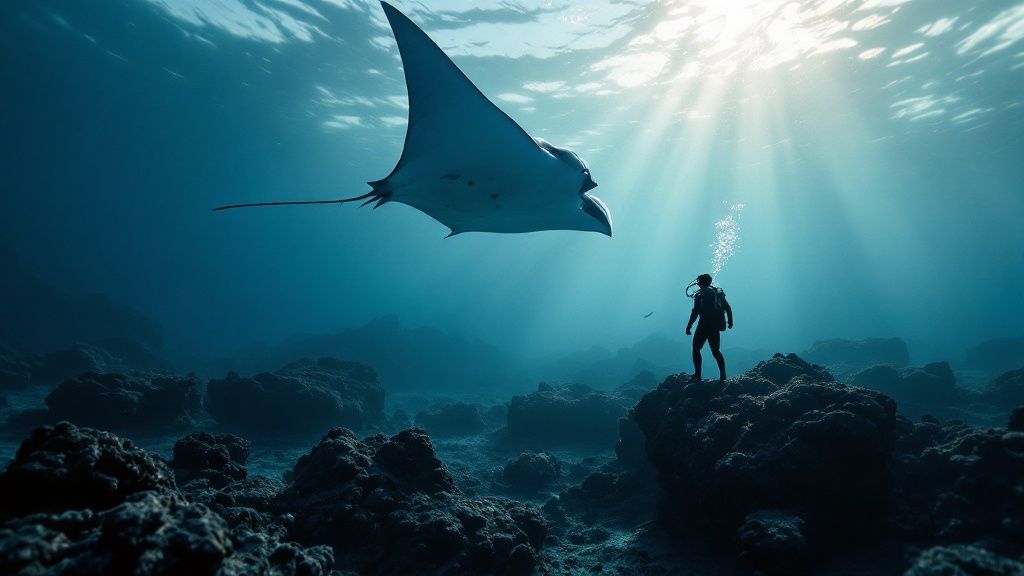
The Kona coast of the Big Island is special. It’s one of the very few places in the world where you can reliably see these gentle giants up close, and the whole experience is both surreal and humbling. The real magic starts just after sunset when dive operators turn on powerful underwater lights.
These lights are like a giant dinner bell. They attract massive clouds of plankton, the tiny organisms that manta rays love to eat. As the plankton swarm to the light, the mantas arrive for their nightly feast, creating a truly unique and dependable wildlife encounter.
The Underwater Spectacle
You'll be mesmerized as these majestic creatures, some with wingspans stretching over 12 feet, perform what can only be described as an underwater ballet. They swoop, glide, and do effortless barrel rolls right in front of you, their huge mouths open to filter the plankton from the water. It’s a front-row seat to one of nature’s most incredible shows.
This phenomenon is no secret; it draws people from all corners of the globe. In fact, around 80,000 people come to snorkel or dive with the mantas along the Kona Coast each year. The two main sites, known as Manta Village and Manta Heaven, offer incredibly consistent sightings. During the peak season from April to October, it's common for divers to see 8 to 12 mantas per night. You can get more details about what makes this dive so special from the experts at Kona Honu Divers.
Your Expert Guides for an Unforgettable Adventure
Choosing the right outfitter is key to having a safe and amazing manta ray dive Kona adventure. A top-rated operator like Kona Honu Divers is known for its highly experienced crew, strict safety standards, and deep respect for the mantas and their habitat. Their guides don't just show you the spectacle; they help you understand the importance of responsible wildlife interaction.
They’ll handle everything you need for the perfect night, from top-notch gear to a thorough briefing that gets you ready for the experience. With their team guiding you, all you have to do is relax and soak in a truly once-in-a-lifetime moment. Don't just take our word for it; see what fellow divers have to say about their adventures.
Ready to witness this incredible underwater ballet for yourself? You can book your own unforgettable manta ray night dive tour and get ready for a night you'll be talking about for years to come.
Choosing Your Adventure: Diving vs. Snorkeling
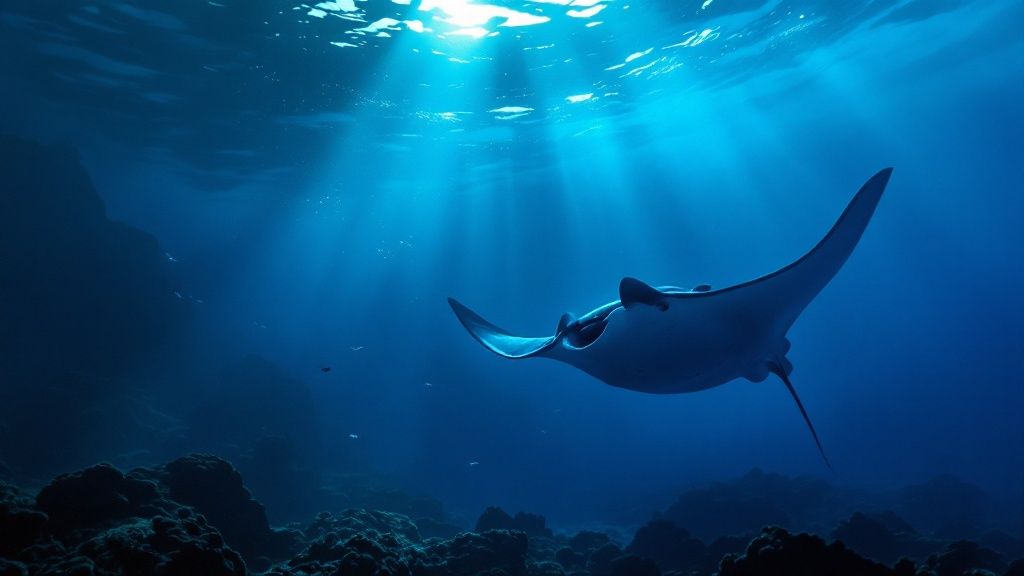
Alright, you're sold on seeing the manta rays. Now for the big question: how do you want to experience the show? You've got two fantastic options, and each gives you a totally different, yet equally mind-blowing, perspective on this underwater ballet.
Will you take a front-row seat on the ocean floor as a scuba diver? Or will you grab a stunning bird's-eye view from the surface as a snorkeler?
There’s no wrong answer here. Your choice really comes down to your comfort in the water, whether you're a certified diver, and the kind of vibe you're after. Either manta ray dive Kona experience is something you'll talk about for years.
The Scuba Diving Experience
Picture this: you're kneeling on the sandy bottom, somewhere between 25 to 35 feet deep, with a small group of other divers. Everyone aims their lights upward, creating a cone of light that acts like a dinner bell for plankton.
Before you know it, the stars of the show arrive. The manta rays swoop in, gliding and barrel-rolling just inches over your head.
This is a truly immersive viewpoint. You're not just watching the show; you're in it. Looking up as these gentle giants dance in the light beams is an intimate and profound way to see them in their element.
The Snorkeling Experience
For those who aren't certified divers or just prefer staying near the surface, the snorkeling adventure is absolutely incredible. You’ll hold onto a large, custom-made light board that floats on the water, so you can just relax and enjoy the view.
The board’s powerful lights beam down into the dark water, creating a giant beacon for the plankton. That, of course, brings the mantas.
You get to watch from above as these graceful creatures emerge from the depths, swimming right up to the surface to feed. It's a mesmerizing perspective, seeing their massive forms materialize and perform their elegant ballet. If you're leaning this way, you can find out more about what the manta ray snorkel tour entails.
Diving vs. Snorkeling with Kona Manta Rays
To help you figure out which manta ray dive Kona tour is the perfect fit, let’s break down the key differences side-by-side.
| Feature | Scuba Diving Experience | Snorkeling Experience |
|---|---|---|
| Perspective | Bottom-up view; mantas glide directly overhead. | Top-down view; mantas swoop up from the depths below. |
| Position in Water | Stationary on the ocean floor (approx. 25-35 ft deep). | Floating on the surface, holding onto a lighted raft. |
| Requirements | Must be a certified scuba diver. | No certification required; great for most swimming abilities. |
| Overall Feeling | An immersive, front-row seat to the underwater show. | A breathtaking bird's-eye view of the manta ballet. |
| Proximity to Mantas | Extremely close; they often pass within inches of you. | Very close; they come right up to the surface light board. |
Honestly, you can't go wrong. Whether you choose to dive down or float on top, you are in for an unforgettable night with these magnificent animals. Just make sure you book with a trusted, professional operator to guarantee a safe and magical adventure.
Check Availability
Meet Kona’s Gentle Giants
The real stars of Kona’s nightly underwater ballet are the resident manta rays. These aren't just occasional visitors passing through; many of the mantas you'll meet are long-time locals who have been showing up at these feeding grounds for years. Their loyalty is what makes the manta ray dive Kona experience so consistently magical.
When you slip into the dark water, you're stepping into their dining room. The mantas are filter-feeders, and they're drawn to the massive buffet of plankton that gathers under the powerful dive lights. This natural attraction sets the stage for a predictable, yet mind-blowing, spectacle.
Two Species of Gentle Giants
Kona is one of the few places on Earth where you can see two different species of manta rays. The most common one you'll encounter is the reef manta ray (Mobula alfredi), which boasts a wingspan of around 14 feet. But if you're really lucky, you might catch a glimpse of the truly colossal giant oceanic manta ray (Mobula birostris), which can stretch an unbelievable 22 feet from tip to tip.
Don't let their size intimidate you. A lot of people mistake them for their distant cousins, stingrays, but these animals couldn't be more different.
Manta rays are completely harmless. They have no teeth for biting, no sharp barbs, and no stinger on their tail. Their only defense mechanism is to swim away, but their curious nature often brings them incredibly close, making the experience both safe and breathtaking.
This gentle disposition is a huge part of what makes the Kona manta ray dive such a popular adventure for everyone, from seasoned divers to first-time snorkelers. You can dive deeper into all the fascinating details about these gentle giants with Sea Quest Hawaii.
Meet the Local Celebrities
Here’s what takes this experience to another level: you aren't just seeing a manta ray, you could be meeting a local celebrity. For decades, a dedicated citizen science project has been tracking the local population. Researchers and guides can identify individual mantas by the unique spot patterns on their bellies, which are as distinct as human fingerprints.
Thanks to this amazing effort, hundreds of individual mantas have been given names and their life stories have been followed for years.
- 'Big Bertha': One of Kona's most famous and largest residents, a true legend.
- 'Lefty': You'll know him instantly by his bent cephalic fin.
- 'Sugar Ray': A regular at the dive sites, known for performing graceful underwater acrobatics.
Knowing you might meet a specific, named individual adds an incredible personal touch to the whole night. Your manta ray dive Kona tour becomes a chance to get acquainted with members of a well-known underwater community, creating a memory that feels deeply personal and absolutely unforgettable.
What to Expect on Your Manta Ray Tour
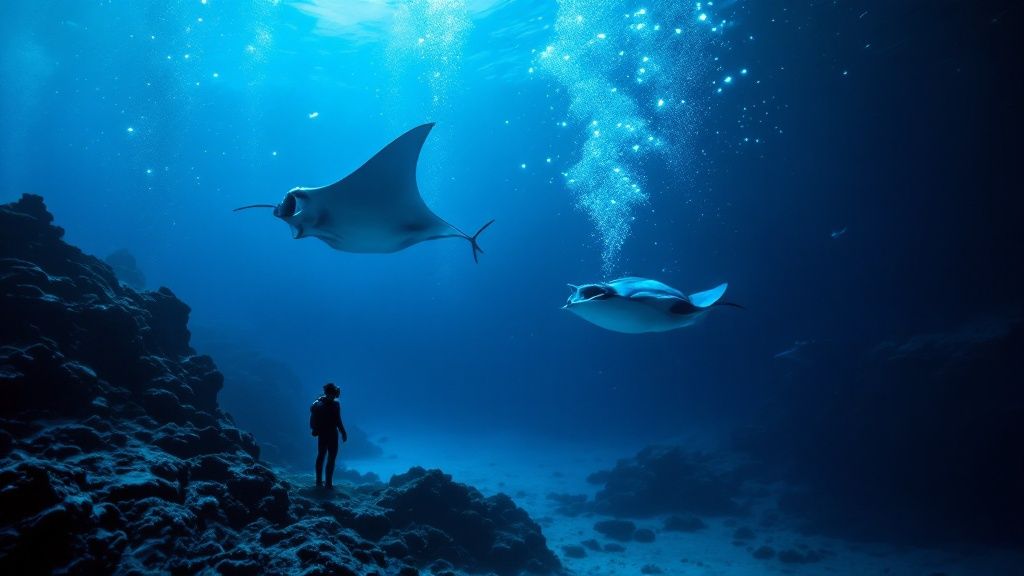
So, you're ready for the dive of a lifetime. Knowing the flow of the evening can help you relax and soak it all in. From the moment you arrive at the dock to the ride back under the stars, top-notch operators like Kona Honu Divers have this down to a science, making sure everything is smooth, safe, and builds the excitement perfectly.
Your adventure starts at the harbor. After a friendly "Aloha" from the crew and a quick check-in, you’ll hop aboard a boat built specifically for Kona's waters. The trip out to the dive site is half the fun—you get incredible views of the coast as the sun starts to dip toward the horizon.
The Two-Tank Dive Structure
Most of the best manta trips, especially for certified divers, run a two-tank format. This is the way to go, honestly. It lets you get a feel for the water and see the reef's personality change as daylight fades.
Your first dive is usually a beautiful twilight exploration of the reef. As the sun gets low, you'll see the coral gardens and lava tube formations in a whole new light. All sorts of critters start to come out at dusk. This dive is the perfect warm-up, letting you get your weighting and buoyancy just right before the main event.
Once you surface, you'll have a break while the sky puts on its final show of color. The crew usually breaks out some snacks and drinks while they get everything ready for the second tank. You can feel the anticipation building on the boat.
The Main Event: The Manta Dive
When it's fully dark, the crew will gather everyone for a detailed briefing. They'll cover all the safety points and explain exactly how the dive works—where to position yourselves on the ocean floor and, most importantly, how to interact with the mantas respectfully. Their job is to ensure you and these incredible animals have a safe and magical encounter.
Next, you'll descend with your group to what they call the "campfire." Divers settle in a circle on the sandy bottom and point their flashlights straight up. This beam of light attracts a massive cloud of plankton, essentially setting a dinner table that the mantas just can't resist. You can learn more about this amazing 2-tank manta dive experience and everything it involves.
The professionalism of the crew is paramount. They handle all the logistics, from gear setup to guiding you in the water, so all you have to do is relax and witness one of the most incredible wildlife spectacles on the planet.
For the next 45 minutes or so, your only job is to kneel and watch. These gentle giants will glide, swoop, and perform an underwater ballet just inches over your head. It's pure awe. After the show, you'll ascend as a group and head back to the boat. A quick tip: definitely bring a towel and a warm jacket for the ride home—the night air can get surprisingly chilly on the water!
How to Be a Responsible Manta Ray Tourist
Getting to see these gentle giants up close is an incredible privilege, and it’s up to all of us to make sure we’re protecting them. The future of the Kona manta ray dive depends entirely on sustainable, ethical tourism that keeps the mantas safe and thriving for years to come.
The whole idea behind a responsible encounter is to be a passive observer. Think of it like being a guest in their home. You’re there to admire them, not to interfere. The number one rule is simple: look, but never, ever touch.
The Golden Rules of Manta Interaction
When you're in the water with any wild animal, respecting its space is everything. For the safety of the mantas and everyone on the tour, all reputable operators enforce a strict code of conduct.
- No Touching: Manta rays have a special mucous coating on their skin that acts like a shield against bad bacteria. Touching them can rub this layer off, leaving them wide open to infections.
- No Chasing: Whatever you do, don't swim after a manta ray. It causes them a ton of stress and can scare them away from their favorite feeding spot, messing up their nightly routine.
- No Riding: It should go without saying, but trying to ride or hold onto a manta is extremely dangerous for both of you and is absolutely forbidden. Just let them do their thing.
Sticking to these rules is what makes the manta ray dive in Kona a positive experience for everyone. If you want to learn more about being a great underwater guest, it's worth brushing up on the basics of responsible and considerate diver etiquette.
Conservation in Action
Kona isn't just a world-class dive spot; it's also a major hub for manta ray conservation. The local community has been at the forefront of manta research for decades. Believe it or not, since 1991, scientists and dive guides have been using a photographic ID program to track individual mantas by the unique spot patterns on their bellies.
This amazing citizen science project has created a catalog of over 330 individual mantas, with thousands of sightings logged over the years. This data is absolutely priceless for understanding their ecology. You can learn more about this groundbreaking manta ray research and how it’s making a difference worldwide.
When you choose a responsible operator like Kona Honu Divers, you’re directly supporting this work. These companies aren't just running tours—they're acting as guardians of the ocean, educating divers and snorkelers while upholding the highest standards to protect Kona's most famous residents.
Don’t Stop at the Mantas—There’s More to Explore in Kona
The manta ray dive is an experience you'll never forget, but it's really just the beginning of what Kona's underwater world has to offer. The Big Island’s volcanic coast has carved out an incredible, diverse playground for divers, with adventures suited for every skill level. Once you’ve seen the main event, a whole new realm of exploration is waiting just around the corner.
If the thrill of night diving has you hooked, then the Kona blackwater dive is your next essential adventure. This is nothing like a typical reef dive. You'll be whisked miles offshore to drift in the deep, dark open ocean, watching a vertical migration of bizarre and beautiful bioluminescent creatures rise from the abyss. People often say it feels more like floating through outer space than diving.
Pushing Your Limits as a Diver
For certified divers looking for a bigger challenge, Kona’s unique geology serves up some truly spectacular opportunities. Advanced dive tours are designed to push experienced divers to the next level, guiding them through dramatic underwater landscapes that most people never get to see. These trips often head out to more remote and deeper sites.
Picture yourself descending along sheer underwater cliffs, or "walls," that are teeming with rare corals and sponges. Or imagine navigating through ancient lava tubes and vast caverns, following the same path molten rock once carved through the earth. These dives give you a front-row seat to the raw power that formed the Hawaiian Islands and are perfect for expanding your skills. You can learn more about the sheer variety of unique Kona dive sites available to explore.
From the surreal blackwater dives to challenging deep reefs, Kona truly offers the full spectrum of underwater adventure. It doesn't matter if you're a seasoned pro or just getting started—there's always something new to discover here.
Kona Honu Divers has a full lineup of diving tours on the Big Island, including the mesmerizing Blackwater Dive and our thrilling advanced dive charters for those ready to go deeper.
Check Availability
Your Manta Ray Dive Questions Answered
Getting ready for a manta ray dive in Kona is exciting, but it's natural to have a few questions. We've put together answers to the most common ones so you can feel completely prepared for this incredible adventure.
What Is the Best Time of Year?
You can find manta rays in Kona all year long, which is fantastic news for travelers. That said, if you're looking for the absolute best conditions, aim for sometime between April and October.
During these months, the Pacific waters are typically at their calmest and warmest, making the whole experience even more pleasant. But honestly, the sightings are so consistent that any time you can make it out here is a good time to go.
Do I Need to Be a Certified Scuba Diver?
Not at all! While certified divers get an amazing perspective from the ocean floor, snorkeling is an equally breathtaking and much more accessible option for many people.
Snorkelers get to float on the surface, holding onto a specially designed light board. From there, you get a front-row seat as the mantas glide and swoop right up to the surface to feed. It opens up this magical encounter to almost everyone, no certification required.
Is the Manta Ray Dive Safe?
Yes, it's an incredibly safe experience, especially when you book with a professional and responsible tour company. Manta rays are called "gentle giants" for a reason—they have no teeth, stingers, or barbs. They're just big, graceful filter feeders.
If you have more questions about this, check out this great article that answers the question: Can manta rays sting you?. Your guides will also give you a full safety briefing before you get in the water to ensure everyone, including the mantas, has a safe and enjoyable time.
What Should I Bring on the Tour?
The tour operators have you covered with all the essential dive and snorkel gear. Your job is to bring the things that will keep you comfortable. We recommend packing:
- A towel to dry off
- A change of dry clothes
- A sweatshirt or jacket for the boat ride back, as it can get a little chilly once the sun goes down
Ready to book the adventure of a lifetime? Kona Honu Divers offers an unforgettable 2-tank manta dive and snorkel tour that will leave you with memories you'll cherish forever.
Check Availability