
Picture this: you're floating in the warm Pacific just after sunset, and suddenly, majestic, gentle giants with wingspans up to 16 feet glide silently all around you. This is the world-famous Kona manta ray dive—an otherworldly underwater ballet that has rightfully earned the Big Island a top spot on every diver's bucket list. It's truly one of the most consistently magical wildlife encounters you can have anywhere on the planet.
What Is the Kona Manta Ray Night Dive?
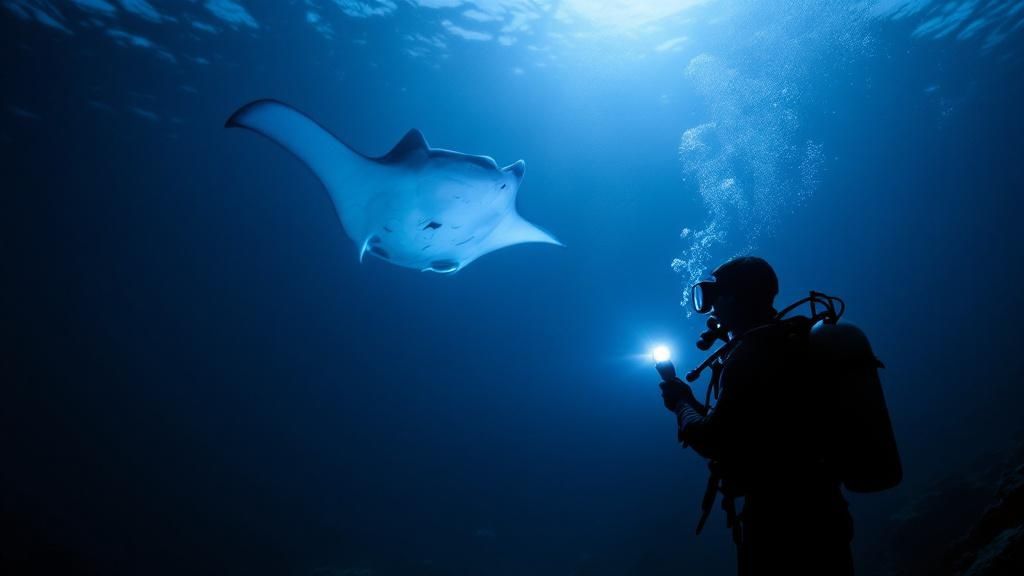
So, what exactly happens on this famous underwater adventure? It's pretty simple, actually. After the sun goes down, divers and snorkelers get into the water with expert guides to watch massive reef manta rays feed on plankton. If you're diving, you'll settle onto the sandy ocean floor, usually somewhere between 30 to 40 feet deep. Snorkelers get to hang onto a custom-lit float on the surface.
Powerful lights are set up to attract huge clouds of microscopic plankton, which is the mantas' favorite meal. Think of it as an all-you-can-eat plankton buffet that reliably draws them in for dinner. The mantas then put on a show, performing graceful, acrobatic maneuvers—swooping, somersaulting, and gliding—often just inches away. It’s an incredible, non-invasive way to witness one of nature’s most spectacular displays. You can get a better feel for what to expect on the manta ray night dive in Kailua-Kona in our detailed guide.
A Reliable and Magical Encounter
Kona is known globally for this dive because of its incredibly high success rate. We're lucky to have a unique coastal environment that's home to a large resident population of over 250 identified manta rays.
The chance of seeing these gentle giants is remarkably high, with an estimated 85-90% success rate on any given night, making it one of the most dependable wildlife encounters in the world.
This consistency has turned the Big Island into the global capital for manta ray tourism. Whether you're a seasoned diver or trying snorkeling for the first time, the experience is accessible and just plain awe-inspiring. You get a front-row seat to an underwater show that you'll be talking about for years. It's an absolute must-do for anyone visiting Hawaii.
Why the Manta Ray Capital Is in Kona

So, what makes this little slice of Hawaiian coastline the undisputed global hotspot for manta rays? It’s not just blind luck. It’s a perfect storm of geography, biology, and some surprisingly clever manta behavior that creates one of the most reliable wildlife encounters on the planet.
It all starts with food.
The unique underwater landscape and currents along the Kona coast act like a natural funnel, concentrating nutrient-rich waters. This environment grows a massive, consistent supply of plankton—the manta ray's favorite meal. In short, Kona is a dependable, year-round plankton buffet that these gentle giants simply can't pass up.
A Learned Behavior
This whole phenomenon got a major boost decades ago. A local hotel started shining bright lights into the ocean at night, which naturally attracted swarms of plankton. The local mantas quickly caught on that these lights were basically a dinner bell, signaling an easy meal.
This kicked off a fascinating case of behavioral conditioning.
Over the years, generation after generation of mantas has learned to associate artificial light with a feast. Dive operators figured this out and now replicate the effect with powerful underwater lights, creating the famous "manta campfire" that draws in plankton. This learned behavior is the secret sauce behind the manta ray dive kona; the mantas show up for dinner night after night, almost on cue. You can learn more about why you should experience this dive in our other guide.
This unique interaction is a prime example of how animal behavior can adapt to human activity in a positive, symbiotic way, creating a sustainable and breathtaking spectacle for observers.
This reliable food source also means the mantas stick around. For a long time, scientists thought reef mantas were homebodies, never straying too far. But recent tracking of a manta named Loulou Ray showed her traveling 42 miles up and down the Kona coast, proving just how vital these specific feeding spots are to their survival. It really drives home the importance of conservation and the Hawaii State laws that have protected mantas from being captured or killed since 2009.
Protection and Conservation
The final piece of the puzzle is solid conservation. The local community, dive operators, and government agencies all work hand-in-hand to make sure these encounters are safe and ethical for the animals.
There are strict, non-negotiable guidelines in place to protect the mantas:
- Passive Observation Only: You never, ever touch, chase, or try to ride a manta. Touching them can strip away their protective mucus coat, leaving them wide open to infections.
- Controlled Positioning: Divers stay put on the seafloor, and snorkelers hang out on the surface. This gives the mantas a clear, unobstructed path to swoop in and feed.
- Respectful Lighting: Dive lights are aimed to attract plankton, not to blind the mantas by shining directly in their eyes.
This incredible blend of a natural plankton supply, learned feeding habits, and strong conservation laws is what makes Kona the undisputed manta ray capital of the world. Knowing this backstory gives you a much deeper appreciation for the amazing ecosystem you're about to witness.
Choosing Your Adventure: Scuba Diving or Snorkeling
Alright, so you're ready to see the world-famous Kona manta rays. The first big decision you have to make is how you want to see them. There are two fantastic ways to witness this underwater ballet, and each one offers a totally unique perspective.
Your choice really boils down to your comfort in the water, whether you have a scuba certification, and what kind of view you're hoping for. Both are unforgettable, but they put you in different seats in nature’s most incredible theater.
The Scuba Diving Experience: From Below
For certified divers, this is the ultimate way to get up close and personal. Picture this: as twilight fades, you descend 30-40 feet to the sandy ocean floor. You'll settle in with a small group of other divers, forming what we affectionately call the "manta campfire."
From your spot on the seafloor, you just kick back, point your dive light up toward the surface, and let the show come to you. Looking up from below gives you a jaw-dropping view as the mantas, some with wingspans stretching over 12 feet, glide, swoop, and perform acrobatic barrel rolls just inches over your head. It’s an incredibly humbling and intimate experience that makes you feel like a true guest in their world.
The bottom-up perspective is what makes this so special. You get to fully appreciate the sheer scale and grace of these gentle giants. The feeling of a massive manta ray silently soaring right over you is a moment that will stick with you forever.
The Snorkeling Experience: From Above
Not a certified diver? No problem at all. The snorkeling experience is just as mesmerizing and is accessible to almost everyone, including families and first-timers. As a snorkeler, you’ll float comfortably on the surface, holding onto a large, custom-made light board.
This board shoots powerful beams of light down into the water, which attracts the plankton and, in turn, brings the mantas right up to the surface. You get a perfect bird's-eye view of the action, watching them gracefully feed just a few feet below you. It's a fantastic way to see the spectacle without needing any special certification—just basic swimming skills and a sense of wonder.
To help you figure out which adventure is the right fit, let's break down what to expect from each tour.
Manta Ray Dive vs Snorkel Experience in Kona
Deciding between scuba diving and snorkeling for your manta ray tour can be tough. Both offer incredible views, but from very different vantage points. The table below compares the two experiences side-by-side to help you pick the perfect adventure for your skill level and what you want to get out of the night.
| Feature | Scuba Diving Experience | Snorkeling Experience |
|---|---|---|
| Perspective | Bottom-up view from the seafloor (~35 ft) | Top-down view from the surface |
| Proximity | Mantas often glide inches above your head | Excellent view as mantas come up to feed below you |
| Certification | Open Water certification required | No certification needed; basic swimming ability |
| Equipment | Full scuba gear (BCD, regulator, tank, weights) | Mask, snorkel, fins, and wetsuit |
| Best For | Certified divers looking for a fully immersive experience | Families, non-divers, and beginners |
Ultimately, there's no wrong choice here. Whether you're watching from the "campfire" on the ocean floor or floating on the surface, you're in for one of the most amazing wildlife encounters on the planet.
No matter which option you choose, going with a trusted, professional operator is the key to a safe and memorable trip. Kona Honu Divers has a stellar reputation for running exceptional tours for both divers and snorkelers. Their expert crew puts your safety first while also prioritizing the well-being of the mantas. You can check out their highly-rated manta ray dive tours to find your perfect adventure.
Ready to book your front-row seat to the manta ballet?
Your Manta Ray Night Dive Tour Step by Step

Feeling some butterflies about your first night dive? That's totally normal. But let me reassure you: the whole experience is dialed in to be safe, thrilling, and something you'll talk about for years. Knowing the play-by-play of how the evening unfolds can swap those jitters for pure, bubbling excitement.
Let's walk through what a typical manta ray dive kona tour looks like, from the moment you show up at the harbor to the main event. This way, you'll feel like a seasoned pro, ready to soak it all in.
Check-In and Boat Departure
Your adventure kicks off in the late afternoon at the harbor. First things first, you'll check in with your crew—operators like Kona Honu Divers have this down to a science. They’ll get you fitted for any gear you need, like a wetsuit, mask, and fins, and this is the perfect time to fire off any last-minute questions.
Once everyone's set, you'll hop aboard a custom dive boat. The ride out to the dive site isn't just a commute; it's a scenic cruise along the stunning Kona coast. As the sun starts dipping toward the horizon, painting the sky in fiery colors, the crew will gather everyone for the pre-dive briefing.
The Crucial Pre-Dive Briefing
Listen up, because this is the most important part of your preparation. Your guides are experts, and they'll cover every single detail you need for a smooth, safe, and awesome dive.
They'll run through things like:
- The Dive Plan: They'll tell you about the specific site, how deep you'll be going (usually around 30-40 feet), and how long you'll be underwater.
- Safety Procedures: You'll get a refresher on hand signals, what to do in an emergency, and how to communicate with your buddy and the guides in the dark.
- Manta Ray Etiquette: This is a big one. They'll explain the rules for being a respectful guest in the mantas' world—staying on the bottom, no touching, and where to point your light. It's all about passive observation.
- What to Expect: The crew will walk you through the entire sequence, from getting into the water to how the mantas will likely behave.
This briefing gets everyone on the same page and makes sure you feel completely comfortable before you even get your fins wet.
The Main Event: The Manta Campfire
As dusk finally gives way to night, it's go time. You'll descend with your group to a sandy patch on the ocean floor and get into a circle, forming what we affectionately call the "manta campfire." Then, you'll switch on your high-powered dive light and aim it straight up.
That collection of bright beams acts like a giant dinner bell, attracting swarms of plankton. And where there's plankton, the stars of the show are sure to follow. Before you know it, majestic manta rays will be gliding, swooping, and barrel-rolling just inches over your head, feasting on the buffet you've helped create.
It’s an absolutely mind-blowing spectacle that draws about 80,000 people every year to the Kona Coast. The two primary sites, Manta Village and Manta Heaven, are world-famous for their calm conditions and reliable manta appearances. It's truly a mesmerizing underwater ballet. You can dig deeper into the kona manta dive experience to see why it's become a global phenomenon.
After about 45 minutes of pure magic, your guide will signal for the ascent. You'll head back to the boat with your group, absolutely buzzing from what is easily one of the most incredible wildlife encounters on the planet.
How to Be a Responsible Manta Ray Observer

Getting into the water for the Kona manta ray dive is a wild experience, but it's a privilege that comes with a real responsibility. We're stepping into their world, and it's on us to make sure these encounters are safe for both the mantas and for us.
The single most important rule is simple: passive observation. You're there to watch, not to interact.
Think of a manta ray's skin like it's covered in a special slime coat. This isn't just goo; it's a critical protective layer that shields them from bacteria and infections. Touching a manta, even by accident, can wipe off this coating and leave them dangerously exposed. That's why we have a strict no-touching, no-chasing, and definitely no-riding policy.
Your job is to be a quiet, respectful part of the scenery. By keeping your distance and letting the mantas call the shots, you're doing your part to protect these gentle giants. It ensures they'll keep trusting us and visiting the dive sites for years to come.
Simple Rules for a Safe Encounter
Over the years, tour operators have dialed in a set of clear, easy-to-follow guidelines. These aren't just suggestions; they're essential for the well-being of the mantas and the safety of everyone in the water.
Here’s the breakdown:
- Divers on the Bottom: If you're on scuba, you'll be set up on or near the sandy bottom. This keeps the water column clear above you, giving the mantas a wide-open space to swoop and feed without any obstacles.
- Snorkelers on the Surface: For snorkelers, the rule is to stay at the surface, holding onto the light board. Don't be tempted to dive down into the middle of the action where the mantas are gliding.
- Stay Horizontal: Whether you're diving or snorkeling, try to keep a flat, horizontal profile in the water. This makes you appear smaller and less threatening, and it seriously cuts down on the risk of an accidental kick or bump.
- No Flash Photography: Sudden, bright flashes can startle and disorient the mantas. You're absolutely encouraged to take photos and videos—just make sure that flash is turned off.
These rules are part of a massive community effort to maintain a healthy relationship with Kona's resident manta population. If you're interested in the ongoing conversation around these regulations, you can read an open letter regarding Hawaii's manta rules and get a deeper look at the conservation work.
By following these simple dos and don'ts, you're not just a tourist; you're an ocean steward. You're actively helping to conserve these incredible animals, making sure the magic of the Kona manta ray dive is something people can experience for a long, long time.
Don’t Stop at the Mantas—Explore Kona’s Other Epic Dives
Look, the manta ray night dive is a bucket-list experience for a reason. It's world-famous, unforgettable, and something you'll talk about for years. But don't make the mistake of thinking that's all the Big Island has to offer. For certified divers, the manta show is just the opening act. Once you’ve seen those gentle giants, you'll be itching to see what else is hiding beneath the waves. The range of diving tours in Kona is staggering.
Trust me, Kona delivers. We're talking deep-water mysteries, ancient lava tubes, and dramatic volcanic drop-offs. The variety here is just staggering.
The Famous Kona Blackwater Dive
If you're looking for something truly out of this world, the Kona Blackwater Dive is it. Picture this: you're drifting miles offshore, in the dead of night, suspended over thousands of feet of pitch-black water. This isn't a reef dive. It's more like a spacewalk into a bizarre, alien world.
Creatures that spend their entire lives in the deep, dark ocean rise toward the surface every single night, and you get to witness it firsthand. You’ll see things you didn’t know existed—translucent squids, larval fish that look like tiny monsters, and jellies that pulse with their own light. It’s a must for any adventurous diver. Want to learn more about this one-of-a-kind trip? Check out the Blackwater Night Dive here.
Advanced Dives and Lava Tubes
For those with a bit more experience under their weight belt, Kona's volcanic past has sculpted an underwater playground. The coastline is just riddled with incredible formations—ancient lava tubes you can swim through, massive arches, and deep pinnacles that are magnets for marine life. Exploring these sites honestly feels like you’re navigating a submerged cathedral.
These advanced dives are where you get to see some of the rarer sights, like sharks snoozing in caverns or huge schools of fish swirling around underwater spires. They’re the perfect spots to push your skills and see the raw power of Hawaii's geology up close.
Take a look at the advanced dive tours for a seriously memorable adventure. And if you're the do-it-yourself type, you can find even more options in our guide to the best shore diving sites in Kona.
Frequently Asked Questions About the Manta Ray Dive
We get a lot of questions about the manta ray dive in Kona, and for good reason! It’s a pretty unique adventure, and you want to be ready. We’ve put together the most common questions we hear to help you feel confident and prepared before you even get on the boat.
Are Manta Ray Sightings Guaranteed?
That’s the million-dollar question, isn't it? Since manta rays are wild animals, we can never give a 100% guarantee. But I can tell you this: the Kona coast has one of the highest success rates for manta encounters on the entire planet.
Seriously. We see them on 85-90% of our trips. These dive sites are basically reliable, decades-old feeding stations for the local manta population, so the odds are heavily in your favor.
What Is the Best Time of Year for This Dive?
Here’s some great news—any time is a good time! The local manta population lives here year-round; they don't migrate. So you can book this adventure any month and have a fantastic shot at seeing them.
That said, if you're looking for the absolute calmest ocean conditions, the summer months from April to October are typically your best bet. Then again, diving in the winter is incredible, too. You might even be treated to the sound of humpback whale songs echoing through the water during your dive. It's magical.
What Should I Bring on the Tour?
The dive operators have you covered with all the main gear for diving or snorkeling. Your job is just to bring the personal stuff that will keep you comfortable.
- A swimsuit (pro tip: wear it under your clothes to make changing a breeze)
- A towel and some warm, dry clothes for the boat ride back
- A reusable water bottle, because hydration is key
- Any motion sickness medication you might need—better to have it and not need it!
Do I Need to Be a Strong Swimmer to Snorkel?
You don't need to be an Olympic swimmer, but you should definitely be comfortable in the water. For the snorkel tour, you’ll be holding onto a big, custom-made light board that floats on the surface. You're not really swimming around on your own.
The wetsuits also add a lot of buoyancy, making it easy to float. Plus, the crew is always right there keeping an eye on everyone. If you’re interested in learning more about what makes the ocean tick, understanding the impact of tides on marine conditions can add another layer to your appreciation of the experience.