
You're probably deciding tonight because the day already got away from you. Maybe you're in Kona, looking at tomorrow's open slot, wondering if a manta ray dive Hawaii trip is worth it, or if it'll just be cold, dark, and harder than it looks. The honest answer is that it's a controlled wildlife encounter, not a theme-park show, and the trip goes best when you know exactly what you're signing up for.
On a good night, the boat ride, the briefing, the lights, and the first slow passes feel orderly and calm. On a rough night, the same trip can feel cramped, chilly, and a little overwhelming if you're not comfortable in open water after dark. Kona has made this experience famous for a reason, but the best nights come from choosing the right site, the right operator, and the right format for your comfort level.
A Typical Kona Manta Ray Night From Boarding to Lights Out
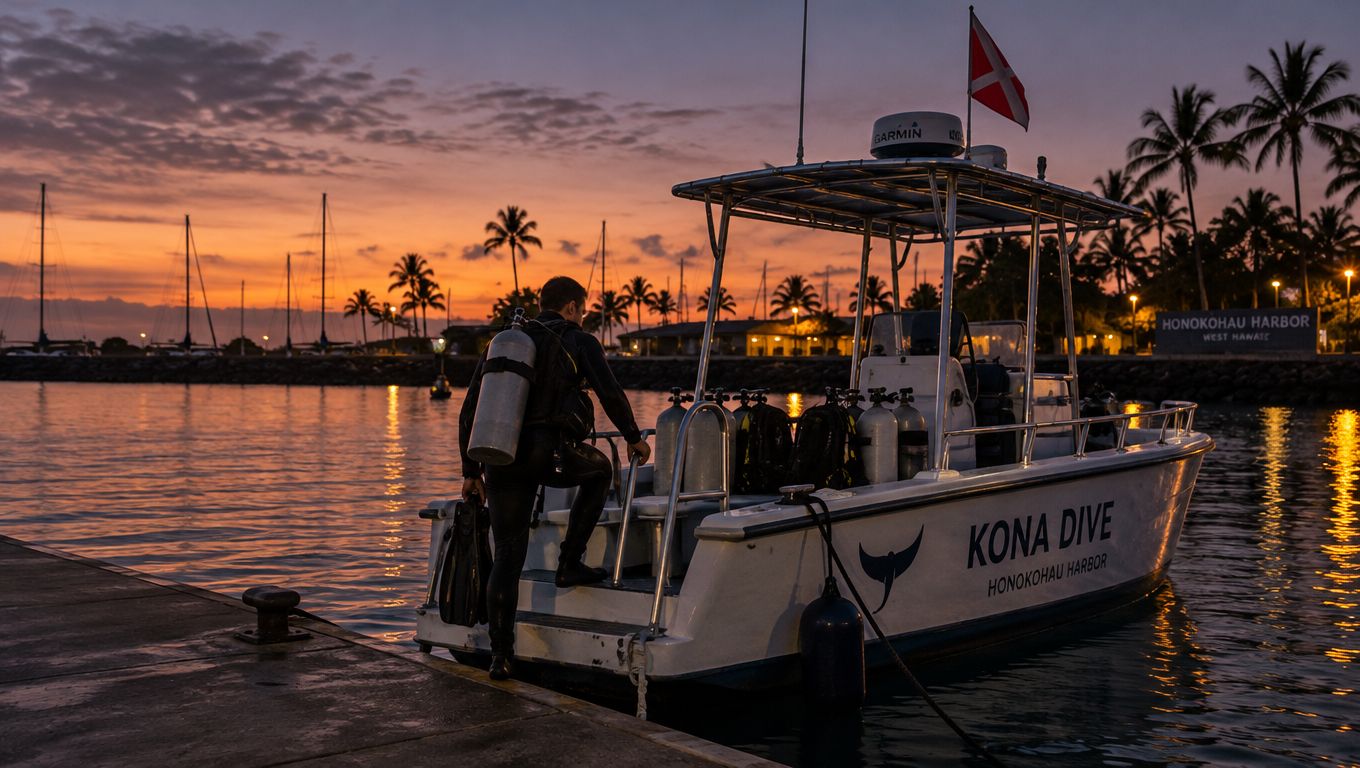
You check in at Honokohau Harbor while the light is still warm, then step onto a boat that already feels ready for business, masks clipped, tanks secured, crew moving with a rhythm that tells you they've done this many times before. The ride down the Kona coast is short enough that you're still watching the shoreline when the briefing starts, and the sun is already dropping behind Mauna Loa by the time the crew hands out wetsuits, masks, and weights. Kona's manta night-diving industry began in 1991 near the former Kona Surf Hotel, and the shift from roughly one boat a week to as many as five boats and 50 people in the water by 1993 shows how quickly the routine became established Kona Honu Divers history.
What the boat feels like before you get in
The boat usually settles into a slower pace once the crew reaches the site. At Garden Eel Cove, the captain holds position while the divemaster or snorkel guide gets everyone organized, because this is a stationary viewing setup, not a drift dive.
The boat sits in the dark for a reason. The lights in the water are the whole point, and the crew wants the plankton to gather where the rays can find it, not scattered around by engine wash and unnecessary movement.
You'll usually spend a surface interval and briefing period on board before the water time starts, then the crew lowers the lights and helps everyone settle into place. If you're nervous, that first part matters more than people admit. A calm deck, a clear plan, and a crew that gives direct instructions make the rest of the night much easier.
Practical rule: the better your mental rehearsal is before the boat leaves the harbor, the easier the water will feel once the lights go in.
Check the full Garden Eel Cove manta dive details here.
How the Encounter Actually Works Beneath the Surface
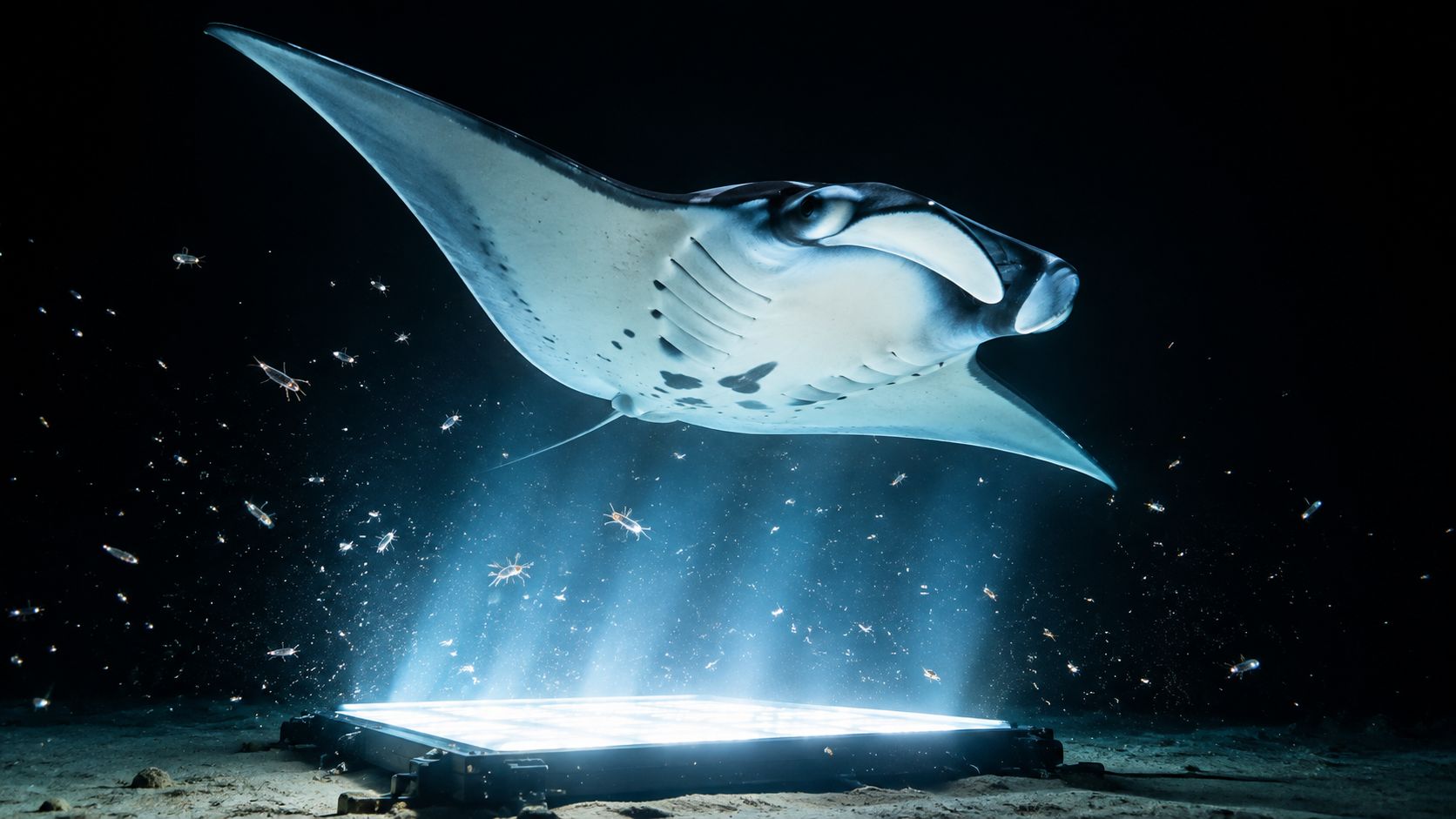
The whole encounter is a food chain, not a trick. Reef mantas are suspension feeders, so they swim with open mouths and use cephalic fins to funnel plankton-rich water across gill rakers, which is why stable lighting and calm positioning matter so much DLNR shark and ray guidance. Underwater lights attract zooplankton near the surface, and the mantas move into that illuminated water to feed.
What divers and snorkelers actually do
If you're diving, you settle on or near the sandy bottom and keep your profile low. If you're snorkeling, you hold position at the surface with the viewing setup the crew gives you. Either way, you're there to let the animals come through the light, not to go after them.
That's why you'll hear the same instructions repeated in different ways. Stay still. Don't block a ray's approach. Don't chase it, touch it, or make sudden movements. The mantas may make repeated passes, barrel rolls, and feeding chains when the plankton concentration is right, but that only works if the light field stays steady and the group stays out of the way.
Why the night timing matters
Documented manta observations show that these dives are reliably concentrated after sunset and last about one hour, with mantas seen on roughly 78% of nights at Manta Village and 92% of nights at Manta Heaven across a six-year study NOAA observations. That consistency is why the trip is built around the evening window rather than daytime flexibility.
See how deep the Kona manta dive usually runs.
Why Kona Is the Reliable Place for This in Hawaii
Kona works because the animals are coming back to known feeding spots, not wandering in by accident. A 13-year citizen-science study of the two main feeding sites logged more than 23,000 sightings from 2010 through 2022 and identified 167 individual reef manta rays, with Garden Eel Cove consistently supporting larger aggregations than Keauhou citizen-science study. That's the practical reason people keep coming back here instead of treating Kona like a lucky one-off.
Garden Eel Cove gives you a better setup
Garden Eel Cove, also called Manta Heaven, is one of the two main Kona viewing locations, and the protected-bay setting matters when the boat fills up and the water gets busy. The county safety assessment flagged vessel and swimmer density as part of the risk picture, which is one reason a more sheltered setup with organized diver positioning can be an advantage county safety assessment.
That lines up with what guests experience underwater. A more contained viewing area is easier to hold, easier to brief, and easier to watch without the group spreading out. The local ecology matters too, because prey availability and site fidelity are driving the encounter, not luck alone.
Bottom line: Kona isn't just famous for manta dives, it's studied, repeatable, and tied to site-attached feeding behavior.
Learn what makes Kona diving different from other Hawaii sites.
Who Can Join and How Each Format Actually Feels
Not every manta trip feels the same, and that's where a lot of booking mistakes happen. Divers, snorkelers, and dry observers all see the same animals, but they experience the night from very different positions in the water column.
Side by side comparison
| Format | Certification Needed | Typical Depth | Manta Contact Distance | Best For |
|---|---|---|---|---|
| Scuba diver | Open Water or equivalent | About 30 to 60 feet, depending on the setup | Very close overhead viewing, without contact | Certified divers who want the full underwater perspective |
| Surface snorkeler | No scuba certification | Surface level | Close passes below the float or viewing ring | Strong swimmers who are comfortable floating at night |
| Dry observer | None | On the boat | Indirect viewing only | Guests who want the boat ride and the scene without getting in |
What each version feels like
Divers hear their own breathing and bubbles, then look up as mantas sweep over the lights. Snorkelers feel more exposed to motion because they're on the surface, but they also get the simplest view of the whole light field. Dry observers miss the underwater proximity, but they avoid the cold, the gear, and the stress of staying in position.
The best fit depends on comfort, not ego. A certified diver who hasn't been in the ocean at night for years may still be a worse fit than a confident snorkeler with solid balance and strong water comfort.
If you're not sure which one suits you, use the format that matches your actual habits, not the one that sounds more impressive.
Deciding Whether You Should Book This Trip
Night changes everything. The ocean feels colder, distances are harder to judge, and even a short cruise can get to people who are fine on calm daytime boats. Motion sickness, anxiety, low visibility, and weak surface confidence are the main issues here, not manta aggression.
A quick self-check
- Recent water time: Have you been diving or snorkeling recently enough to feel relaxed in gear, not rusty?
- Night comfort: Are you calm in darkness, or do you tense up when you can't see the shoreline?
- Swimming ability: Can you hold position and follow instructions without drifting off the plan?
- Motion sensitivity: Do short boat rides usually bother you, even before you get in the water?
- Breathing and medical fitness: If you've got a condition that affects exertion, ask your doctor before you book.
The main line between a manageable concern and a bad fit is whether you can stay composed and follow directions. Cold water, some current, and a fixed viewing plan are normal. Uncontrolled asthma, a recent dive accident, or not being able to tread water confidently are different categories entirely.
When to choose something else
If you're uneasy about darkness but still want ocean time, a daytime boat dive is a better call. If you want the wildlife angle without the underwater commitment, a shore snorkel may fit better. The trip should feel exciting, not like you're forcing yourself through a setting you already don't trust.
Poor conditions can change the plan, and that's normal. Responsible operators will shorten, reschedule, or cancel when the sea makes the trip the wrong call, because a safe no-go is better than pushing a marginal night.
Conservation Trade-offs and What Responsible Operators Do
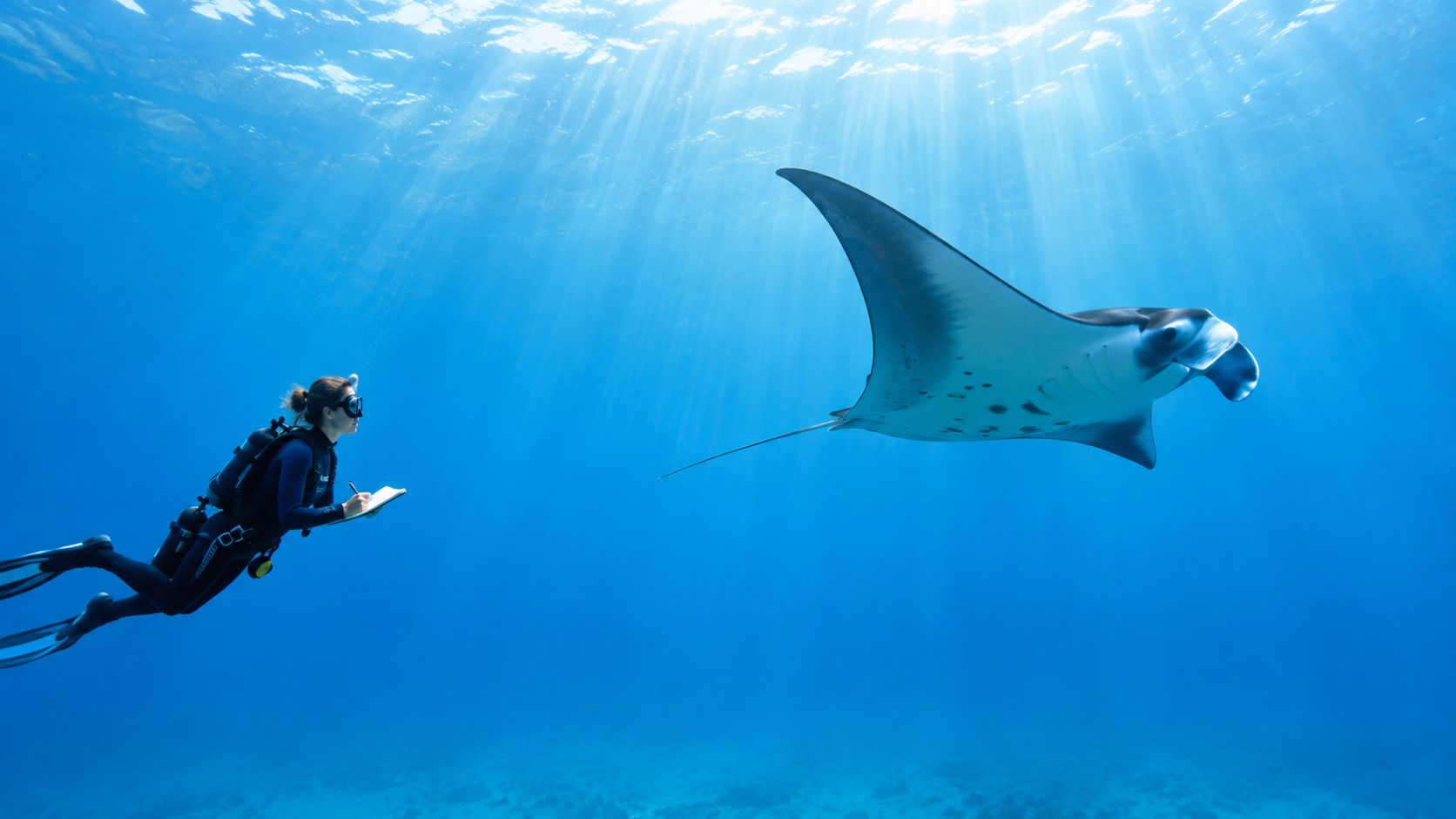
A busy manta site doesn't automatically mean a healthy population. Recent research reports that Hawaiian reef manta populations are vulnerable to extinction because of low genetic diversity and limited migration between islands, and that areas with higher human activity can show fewer manta detections Frontiers research. That's the part most bucket-list articles skip, even though it should shape how you judge the trip.
The pressures that actually matter
Moorings, fishing line, point-source lighting, crowding, and accidental entanglement are the main pressure points guests can influence. The encounter is built around light and positioning, so sloppy boat handling or careless movement can create more disturbance than people realize. The animal's path should stay open, and the viewing setup should keep guests from drifting into the feeding lane.
What to expect from a responsible operator
Good operators brief clearly, keep groups organized, and treat the site like a shared wildlife space instead of a spectacle. They also educate guests before the water entry, keep hands off the animals, and support monitoring or conservation work instead of pretending the trip exists in isolation.
Read the diver etiquette standard before you book.
A fair comparison goes beyond price. Ask whether the crew manages positioning well, whether the boat stays disciplined around the site, and whether the operation treats the reef as something to protect while people are there to observe it.
Photography, Gear, and What to Wear
Night manta photos look easy until you're floating in dark water with a reflective mask and a moving subject. A GoPro works for straightforward wide shots, while larger camera systems are better for experienced photographers who already know how to shoot in low light without distracting the group. Flashy close-range strobes can ruin the rhythm of the encounter, so subtlety matters more than gear size.
What to bring and what to leave behind
A fitted wetsuit beats a loose one every time because it traps less water. Bring a towel, warm dry clothes for the ride back, and a mask that already fits your face, since a bad seal turns the whole night into a leak-fest.
Good habit: test your strap, antifog your mask, and check your camera settings before the boat leaves the harbor.
If you're unsure about settings, shoot simple. The blue plankton lights can fool auto modes, and it's easy to overexpose the frame or blast a bright light into someone else's line of sight. If you want a cleaner memory without managing a camera underwater, ask the crew whether they can help with a surface shot after the dive.
The practical win is comfort first, photos second. A warm, stable guest with clear vision will usually have a better night than someone carrying too much gear and fiddling with it every time a ray passes overhead.
Pricing, Booking, and How Kona Honu Divers Runs the Trip
Kona Honu Divers runs a 2-Tank Manta Dive and Snorkel at Garden Eel Cove, and the setup is built around giving divers and snorkelers the same site from the same boat. That matters if your group is mixed, because one person can dive while another stays on the surface without splitting the evening into separate trips. Their gear package includes the usual core items for the outing, and the company notes over 60,000 collective dives across the team on its main site Kona Honu Divers overview.
Arrival and what to bring
Honokohau Harbor is the easy point of reference. Show up early enough to park without rushing, bring a jacket for the ride home, and keep your bag simple. Swimsuit, towel, any personal medication, and a clear idea of whether you're diving, snorkeling, or staying on the boat is usually enough.
Quick answers to the last questions
How deep is it? Deep enough for a true scuba setup, but not a blue-water drop, which is why the site works so well for a controlled night dive. Is it safe for kids or non-swimmers? Only if the operator says the specific setup fits their ability, because the core concern is water comfort and following instructions, not manta behavior. What if visibility is average? That's normal on many nights, since the lights and the rays matter more than a perfect cinematic backdrop. Can a first-time diver get certified in time for this trip? Not realistically for a same-night booking, so don't plan the manta dive around last-minute certification.
The booking step is simple once the fit is right. If the site, the format, and your comfort level line up, reserve early and keep your schedule flexible enough to move the night if conditions change.
Kona Honu Divers runs manta trips at Garden Eel Cove with scuba and snorkel options on the same outing, which makes the site easy to match to different comfort levels. If you want a straightforward way to see how a Kona night dive works with a crew that already knows this water, visit Kona Honu Divers and check the available manta dates before your schedule fills up.