
You're staring at a Kona evening plan and three trip names that all sound like the same night in the water. One friend wants to snorkel. You hold an Open Water card you haven't used in a year. Someone else keeps talking about a deep night dive that isn't even about mantas. The right manta ray dive is the one that matches how you enter the water, where you sit or float, and how strictly the boat keeps people still.
Choose the Right Manta Ray Experience in Kona
After dark, a dive light clicks on over a sandy patch and a manta glides into a cloud of plankton. That scene has a long local history. A resident manta known as “Lefty” became recognized near the former Kona Surf Hotel in 1979, organized excursions expanded around 1991–1992, and by 2002 nine Kona dive businesses were reportedly taking approximately 11,000 snorkelers and scuba divers on manta tours each year, according to Kona Honu Divers' account of the night dive. Those same records found manta sightings on about 80% of dives at Garden Eel Cove across 3,208 surveys from 1992 through 2007.
Lights on the bottom pull plankton up. Reef mantas learn the feeding lane and return. You are not chasing a rare passerby. You are joining a viewing method that has run for more than three decades.
We run the comparison below as Kona Honu Divers. If you want the wider menu of Big Island scuba diving tours, start there, then pick the night that fits you.
| Experience | Where You Watch | Best For | Requirement |
|---|---|---|---|
| Manta Ray Night Dive | Kneeling on the sandy bottom under dive lights | Certified divers who want the classic night encounter | Open Water Certification or higher; PADI Manta Ray Diver specialty recommended |
| Manta Ray Night Snorkel | Floating on the surface above the lights | Snorkelers and non-divers | No certification needed |
| 2 Tank Manta Charter | Two dives on a manta-focused day charter | Certified divers who want more dives in one trip | Open Water Certification and a dive within the past 2 years |
| Black Water Night Dive | Open deep water after dark, away from the manta site | Experienced divers seeking deeper night diving | Advanced-level comfort in open water at night, confirmed with the crew before you book |
The night dive and the night snorkel share the same plankton lights and the same animals. Your body position is the split. Divers kneel. Snorkelers stay on top. If you are still choosing, our guide on whether to snorkel or dive with mantas walks through that choice without the sales fog.
The 2 Tank Manta Dive and Snorkel is the longer manta-focused day for certified divers. The Black Water Night Dive leaves the manta site for open deep water. Experienced divers who want lava formations, drift, and a harder profile look at the Premium Advanced 2 Tank Trip.
Quick fit: snorkelers take the night snorkel, certified divers take the night dive, and experienced divers add blackwater or the advanced charter only after the manta night is locked.
Who Can Join and What Each Level Needs
Start with the person who doesn't dive. Snorkelers and non-divers need no certification. The Manta Ray Night Snorkel keeps you on the surface above the lights, on a float the crew sets, with someone nearby if the dark water feels bigger than you expected. You should be comfortable swimming and climbing a boat ladder. You do not need a card, a logbook, or a pool session that week.
Certified divers step down to the sand. Open Water is the entry card for the Manta Ray Night Dive. If your card is new, or this is your first ocean night, take the PADI Manta Ray Diver specialty first. It covers manta biology, behavior, and conservation, and you complete it before the night dive. That class is the cleanest preparation we know for a first kneel in the dark. If you still need the base card, book Open Water certification on a morning with daylight and a patient instructor, then come back for mantas.
The 2 Tank Manta Charter is stricter. It requires Open Water Certification or higher and diving within the past 2 years. Miss that window and a refresher comes before the charter, not during it. Don't treat a dusty card from a decade ago as current.
Match the trip to the level you have
Use this before you pick a date:
- Confirm the certification date: Open Water or higher for any scuba seat. Snorkel seats skip this line.
- Check the two-year rule: the 2 Tank Manta Charter needs a dive inside the past two years.
- Add the specialty if the night is new: biology and passive-observation habits beat learning them while a manta fills the light.
- Pick the level you have: experienced divers can look at the Premium Advanced 2 Tank Trip, then confirm certification and recent dives before anyone holds a seat.
Practical rule: book the trip your last logged dive supports, not the one your group chat is excited about.
Why Garden Eel Cove and Timing Matter Most
Site choice changes the night more than a fancier camera does. Garden Eel Cove, also called Manta Heaven or Makako Bay, is where we take the night manta dive. The cove is naturally sheltered from the open ocean, so the water stays calmer and clearer than an exposed ledge. You get a defined viewing area and a healthier reef around the feeding lane, which is why a stationary kneel works here.
A research-based comparison counted 19,841 observations at Garden Eel Cove out of 25,444 recorded manta observations, about 78% of that dataset, and tied the cove to larger manta groups plus a protected viewing area and healthier reef, as summarized by Kona Honu Divers' Big Island manta comparison. If you hope to watch several rays on one night, that share of the record is the reason we keep returning. We often run the manta charter to this same cove. Across Kona, manta sightings often exceed a 90% success rate. That is a pattern, not a promise for your Tuesday.
You settle on the sand. Mantas circle through the lit water above. Spreading the group across a wide, choppy site makes counting people harder and puts fins on reef. The cove's shelter is the opposite setup.
What can still change the night
| Condition | Why It Matters | What to Do |
|---|---|---|
| Sea state and swell | The protected cove stays calmer than open water | Check the forecast and keep a backup date |
| Water clarity | Clear water keeps the light circle and the mantas visible | Ask the crew about visibility on the day |
| Night timing | Dive lights draw plankton up, which draws mantas in | Book the night slot, not a daytime trip |
| Seasonal pattern | No fixed off-season is established for these resident rays | Ask which months are busiest before you lock flights |
| Moon phase | A moon effect on sightings is not confirmed | Ask whether moon phase changes the plan for your date |
Season and moon phase are the gaps. Don't treat a full moon, or a “peak month” you saw on a forum, as a fact. Ask us when you book. We reschedule when sea state or visibility turns the cove into a poor night. A single dive can still be quiet. Hold a backup evening early in the stay so a move doesn't collide with your flight home.
The booking steps sit at the end of this guide. Get the site and the conditions right first.
How the Night Manta Dive Unfolds, Step by Step
A good manta ray dive is a sequence, not a scramble once the first wing appears. Each step has a reason, and a mistake we still see.
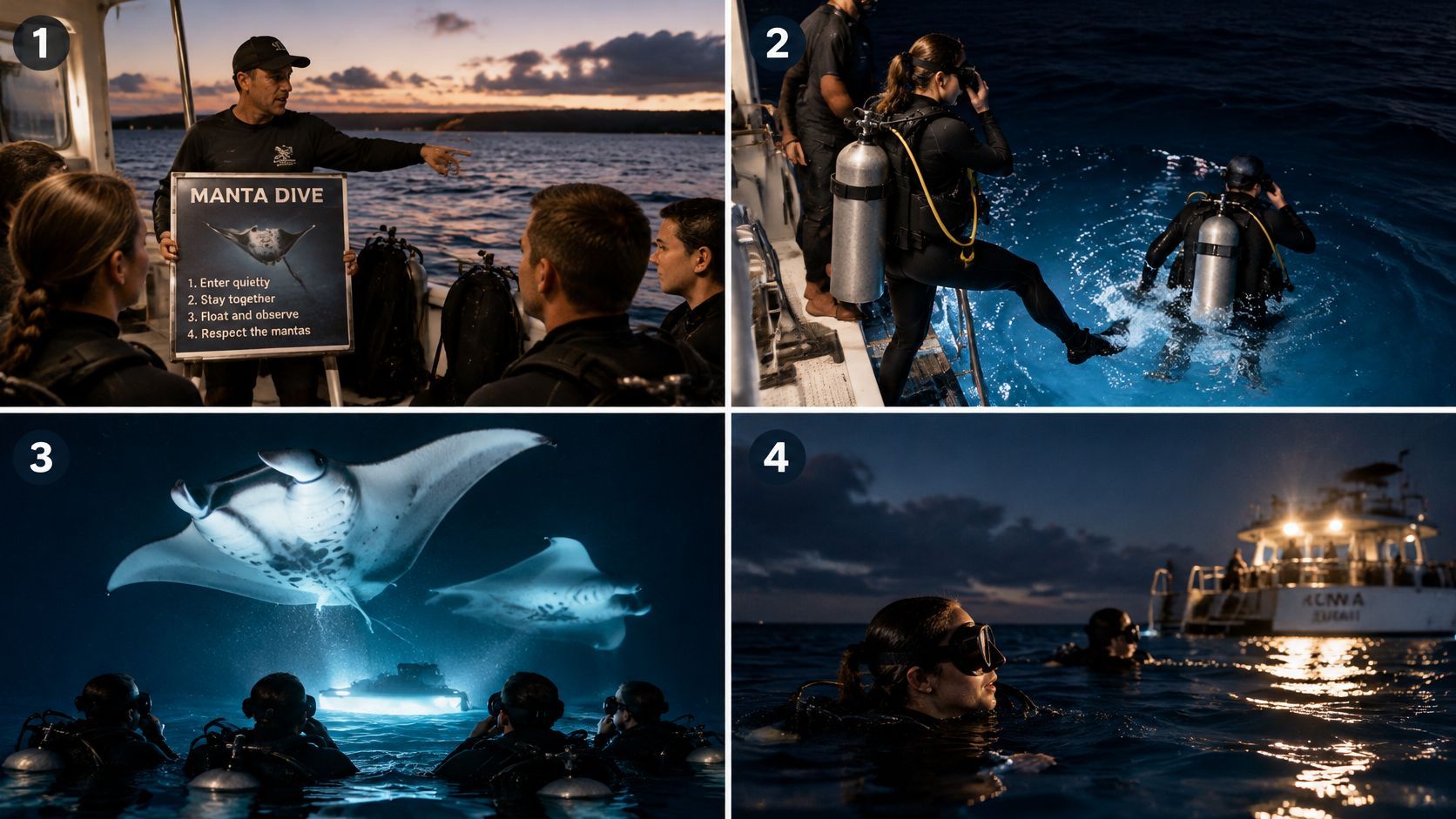
1. Briefing before anyone zips a wetsuit. The crew covers what you will see and why stillness matters. Night dives start with that science and the rules of passive observation. Skip it and you'll swim off after the first manta, which breaks the viewing lane for everyone behind you. If nights are new, read how scuba diving at night actually feels before you arrive, then listen again on the boat.
2. Gear check and a counted entry. Confirm buoyancy, mask, and a working light. Enter with the group so the crew can count heads in the dark. A dead torch or a loose fin strap is the usual early exit. Test both on deck.
3. Settle on the sand, not the coral. Kneel inside the designated viewing area, near the edge of the light, on sand or rubble. Cleaning-station research puts the useful view on the approach and departure path, not on top of the station. Hovering directly over that patch pushes mantas off their line. Fins stay off the reef.
4. Trust the light circle. Lights on the seafloor concentrate plankton and throw a bright circle, so you are never in complete darkness. Aiming beams up into a manta's face is the common slip. Point light into the water column the way the briefing shows, not as a spotlight on an animal.
5. Let the mantas come. They loop the feeding lane above you. Divemasters and instructors stay in the water and keep the group calm. Kicking up toward a passing ray is how people lose buoyancy and block the lane. The no-chase rule and the space you leave around each animal are hard safety standards, not optional photo tips.
6. Surface slowly and debrief. Rise on a normal ascent, share what you saw, and log time and sightings. A fast surface is the last mistake of an otherwise quiet dive.
A strong night feels ordinary in the best way: a steady group, mantas passing close, and nobody chasing.
Safety, Etiquette and Protecting Kona Mantas
The trade-off is real. Kona's manta encounters attract approximately 80,000 visitors a year across the two principal congregations, Garden Eel Cove and the water offshore from the Outrigger Kona Resort and Spa in Keauhou, Big Island Now reported. Hawaiʻi made it illegal to kill or capture manta rays in 2009. Local animals remain vulnerable to boat strikes, coastal habitat loss, and fishing-line entanglement. Mature females produce only one pup every one to seven years, so one injured ray is not a small loss.
Tourism pays for boats and jobs. It also piles people onto two feeding spots. You can't see a carrying-capacity number painted on the reef. You can see whether tonight's boat is managed.
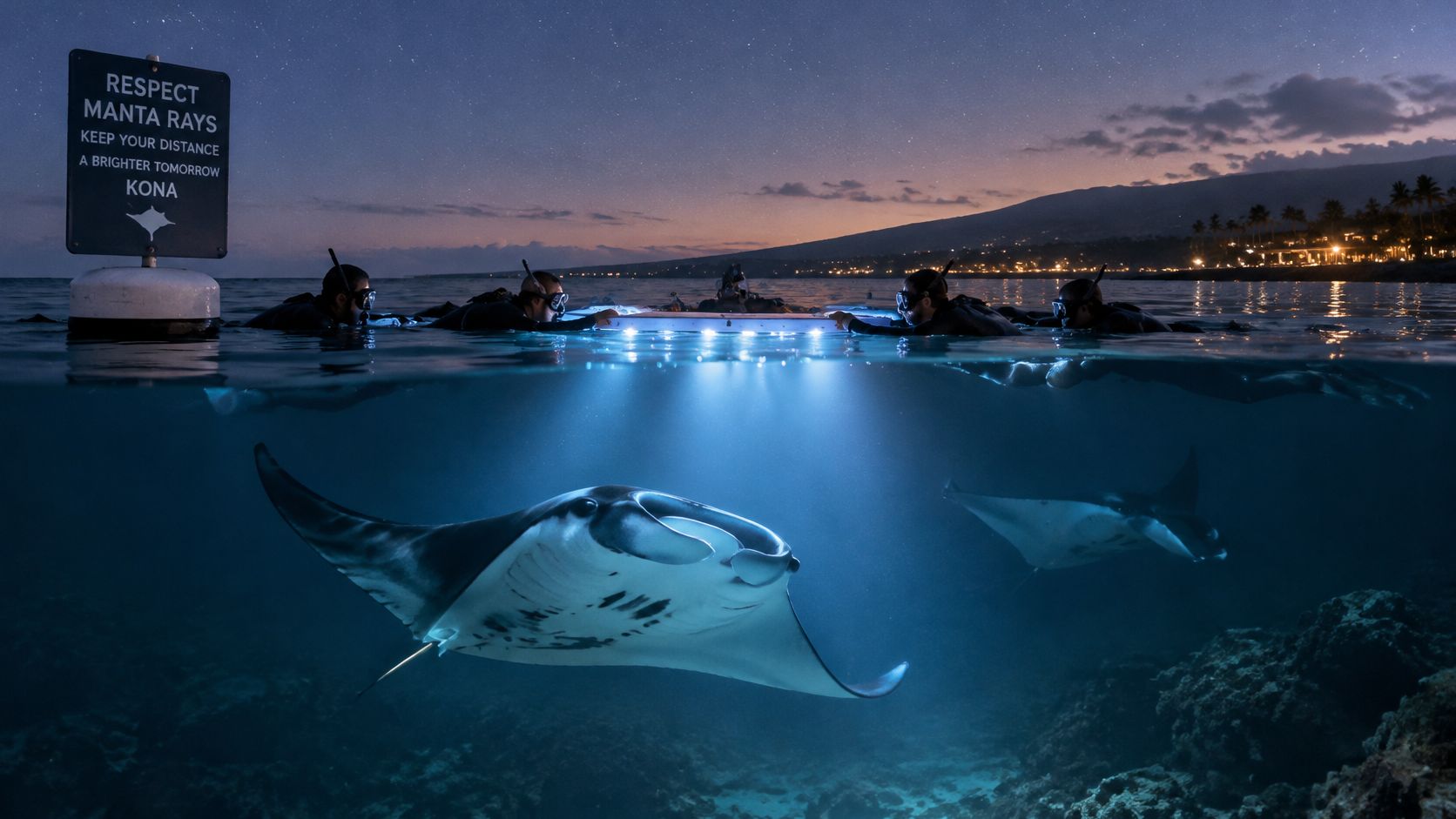
Video work on reef manta interactions found that blocking a route, approaching from the front, or diving near the head increased avoidance, and that contact inside 0–3 m was especially likely to trigger it, according to Manta Trust research on diver behavior. Chasing, front-on approaches, and obstruction can make a manta stop feeding. Passive watching is how the animal keeps eating.
On our night dive, divers go to a specific viewing area at a well-established site. From that kneel, the rules you can follow are simple.
- Stay still: let the manta choose the path. You don't steer it with your fins.
- Keep about three metres when conditions allow, and stay off to the side of the travel line.
- Never pursue a ray that turns away. A retreat is the end of that pass.
- Keep fins off the reef and any cleaning patch. Sand is your seat.
- Skip strobes and sudden kicks near the head. Photographers cause a lot of the close calls by back-finning for a face shot.
If the briefing is vague, the group is uncapped, and people are free to swim after the first ray, that boat is not managing the trade-off. Walk off it.
Look for four signals before you trust the operation: a capped group, a fixed viewing position, a no-chase rule, and a briefing before entry. Our notes on responsible diver etiquette match those signals. Long-term population effects of disturbance are still hard to measure, so precaution beats a claim that every night is harmless.
Gear, Photos and Costs to Plan For
Pack a well-fitting mask and fins, a wetsuit or rash guard for a cool night surface interval, a dive computer if you own one, a torch plus a spare for the dark, and a camera with a low-light plan set before you leave the dock.
Shoot wide, from the side. A manta's wingspan fills a tight lens and tempts you to back up into another diver. Let the animal approach your kneel. If you swim toward it, you become the obstacle in the feeding lane.
Set exposure on the boat. Fumbling with buttons beside a ray is how people drift up and blast a strobe. The etiquette rules on frontal pursuit, chasing, and strobes still apply when the shot looks perfect. A dark frame is cheaper than a manta that leaves.
Control your fins. Small kicks keep you on the sand and leave a gap the ray can use. Big corrections throw silt and shrink that gap. If you want more bottom time on other charters, enriched air certification is the course that adds nitrox to your card. It doesn't replace the manta specialty, and it doesn't change the kneel.
What moves the price
We don't publish a single fare here because the bill changes with the product. A night snorkel costs less to staff than a night dive with tanks and guides in the water. A single night is cheaper than a multi-dive package. Rental gear adds to the total if you fly without a bag. Certification, a refresher, or the Manta Ray Diver specialty is a separate line if your card or your recent dives don't qualify.
Capacity is capped at 18 divers on the manta dive, the same cap we use on the Morning 2 Tank. That limit is one of the management signals from the etiquette list, and it also means popular nights, including the manta ray night dive, often sell out weeks ahead. The cheapest or most convenient date is usually gone if you wait until you land.
Manta Ray Dive FAQ for Beginners and Advanced Divers
Can I see mantas without certification?
Yes. The Manta Ray Night Snorkel needs no card. You watch from the surface above the lights.
Do I need a specialty course?
It's the right prep before a first night dive. It isn't required for the 2 Tank Manta Charter if you already hold Open Water or higher and you've dived within the past two years.
Are sightings guaranteed?
No. Our manta ray night dive has encounter rates of up to 92%, and a single night can still be quiet. Keep a backup date early in the trip.
Should I touch or chase a manta?
No. Stay on your spot and let the animal choose its path. Touching wipes the protective coating on the skin. Chasing ends the pass.
Is the Black Water Night Dive a manta dive?
No. It's a deep-water night dive away from the manta site. It suits experienced divers who already know night procedures, not a first look at mantas.
What should advanced divers do next?
Compare the Premium Advanced 2 Tank Trip with blackwater, confirm recent logs, and book early. Advanced charters add deeper sites and drift. They don't replace a calm night at the cove.
Book Your Manta Ray Dive at Garden Eel Cove
Book the Kona Honu Divers Manta Ray Night Dive at Garden Eel Cove. It's the protected site with the defined viewing area, the healthier reef, and the record that carries most of the local observations. The same crew runs the Black Water Night Dive, and we also offer the 2 Tank Manta Charter for certified divers who want a manta-focused day on the water. The flagship night works for snorkelers and for divers from beginner to advanced, as long as the scuba seats meet the certification rules.
Three steps, then you're done. Confirm your certification, or choose the snorkel if you don't dive. Pick a date and a backup while the cove is still open. Book early, because the popular nights go weeks out.
Night is when the lights build the plankton cloud and the mantas come in to feed. Put that evening on the calendar before the rest of the island fills it.
Kona Honu Divers runs the Manta Ray Night Dive at Garden Eel Cove, plus night snorkels, the 2 Tank Manta Charter, and blackwater nights for divers who want the open dark after they've learned the kneel. If you're sorting a Kona week and want the crew, the lights, and a capped group in one place, visit Kona Honu Divers and hold the date before it sells out.