
You're a few days into a Kona vacation, the rental car is parked, and somebody at the table says the words manta dive. Maybe you're certified and haven't been in the water since last season. Maybe your partner doesn't dive and still wants to come. Maybe you have exactly one free evening and you'd rather not spend it on a boat that comes back with nothing to show for it.
Here's the honest version. Kona's night manta trip is one of the most reliable wildlife encounters you can book anywhere, and sightings often exceed a 90% success rate. It still isn't a promise. The animals show up because plankton shows up, and plankton shows up because lights are in the water at the right place on the right night. Everything you control sits on the planning side of that equation: which format you book, which site the boat runs to, how you hold your light, and whether you leave yourself a second date.
This guide covers all of it, in the order a first-timer needs it. Formats first, then the site that gives you the best view, then what changes the odds on a given night, and finally the behaviour rules that keep the mantas coming back.
Manta Dive Formats Compared at a Glance
A manta dive in Hawaii is a night dive. Crews set lights on the seafloor or hang them from a float, plankton gathers in the beams, and reef mantas glide in to feed on it. That's the entire mechanism, and it's why the trip runs after dark rather than at noon. What changes between formats is where you are in the water while it happens.
| Format | Who it suits | Where you sit or float | Gear you need |
|---|---|---|---|
| Night scuba manta dive | Certified divers, beginner to advanced | Kneel on the sandy bottom in the viewing area | Scuba gear and dive light |
| Night snorkel manta | Non-divers and first-timers | Float at the surface | Mask, snorkel, fins and exposure wear |
| Blackwater night dive | Experienced divers wanting deep-water action | Drift in open water with no seafloor in view | Scuba gear and dive light |
Your position relative to the animals matters more than price or boat size. Divers settle on sand in a defined viewing area and look up into the lit water column, which puts the mantas overhead and slightly away from the group. Snorkelers hold a float at the surface and look down, which gives a cleaner top-down read of the whole body: the approach, the turn, the mouth opening into the light.
The blackwater night dive is a separate trip. It runs in deep open water with no bottom under you, and the subjects are the small drifting creatures that rise after sunset rather than mantas at a cleaning station. Book it because you want that, not as an upgrade to the manta trip.
Three questions before you book: Are you certified to dive? How comfortable are you in open water after dark? Do you want to watch the mantas from above them or below them?
Anyone still undecided should read this breakdown of manta ray diving in Kona for the depth, the positioning and what the bottom looks like at the site.
How Kona Became the Home of Manta Night Dives
Manta viewing at the Kona sites goes back to 1984. The organised night dive that visitors book today started in 1991, when underwater lighting drew plankton into the area and the mantas followed the food, according to Hawaii County legislative testimony. By 1993, historical accounts described as many as five boats and about 50 people in the water, compared with roughly one boat visiting about once a week at the beginning.
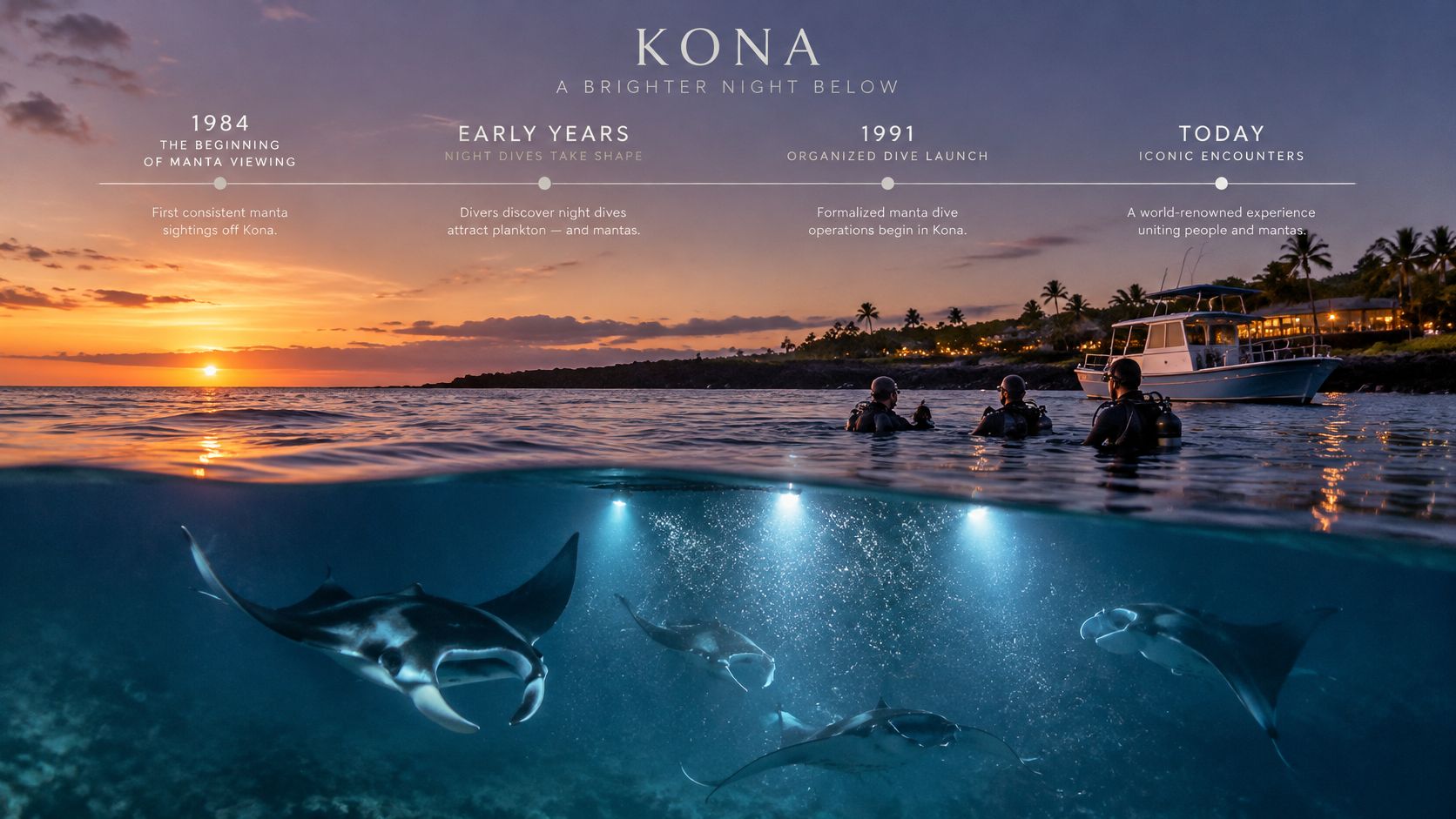
Then the lights went out. The original viewing area went inactive from 2000 to 2004 after the nearby Kona Surf Hotel closed. Floodlights were reinstalled in 2004, and the mantas returned quickly.
That gap tells you something useful. The animals weren't lost or driven away. They follow the food supply, and the food supply follows the light. A mature operation is really a plankton-management operation with a boat attached, which is why the rest of this guide is about how the night works and how to behave inside it.
Why Garden Eel Cove Beats Other Viewing Spots
Garden Eel Cove is the better site for a manta charter, and the reason is structural rather than sentimental. Its protected setting, defined sandy viewing area and surrounding reef structure give a group a stable place to settle while keeping the water column clear for feeding passes.
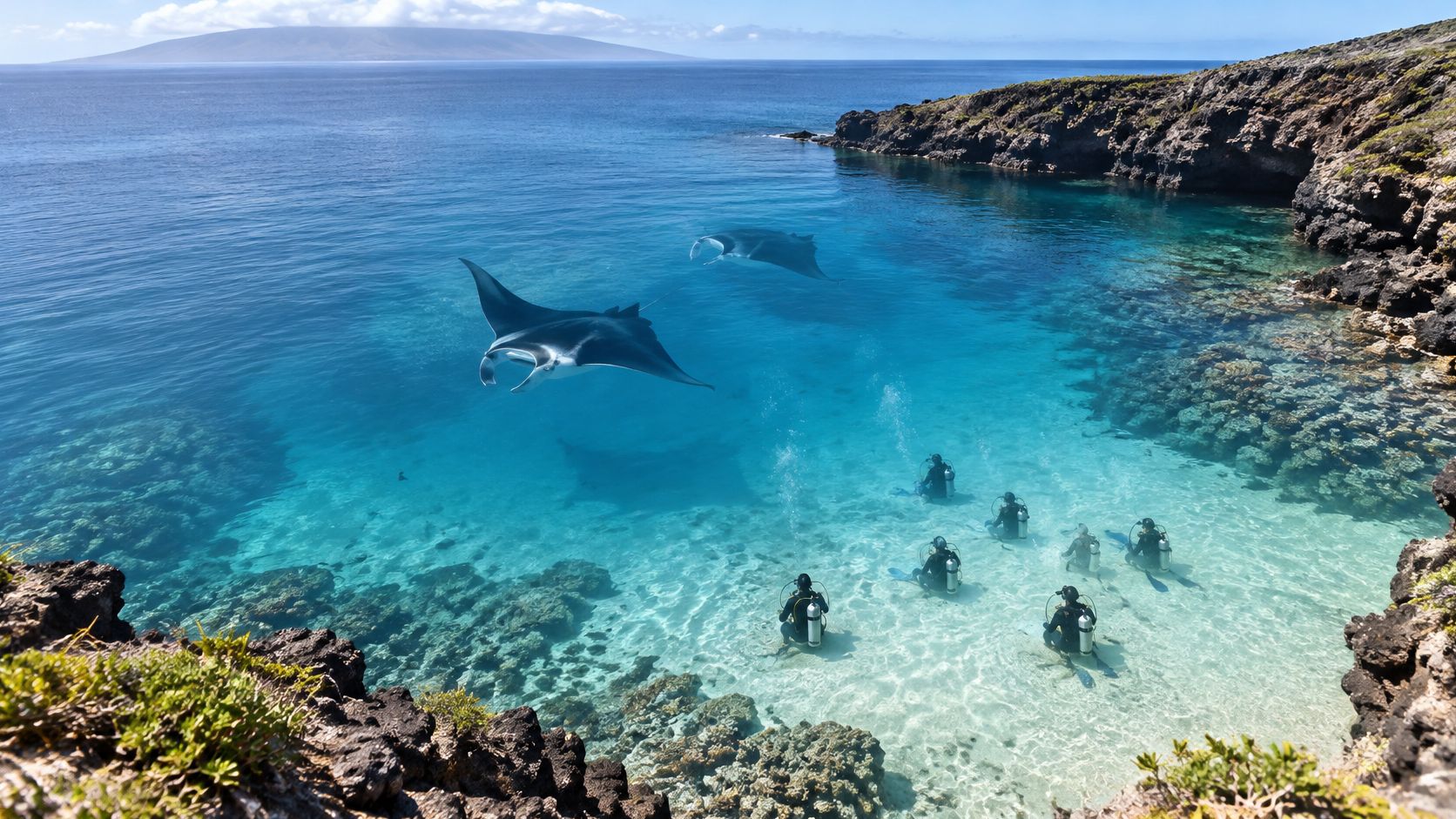
Compare that with an exposed reef edge. Swell moves the group, sand gets pushed around, and without a designated spot people spread out to find their own room. When everyone drifts, the feeding lane fills with divers and the mantas lose the clear water they were circling through.
| Factor | Garden Eel Cove | Less sheltered reef edge |
|---|---|---|
| Shelter | Protected setting | Exposed to open water and swell |
| Viewing area | Defined sandy area to settle on | No set place to settle |
| Reef structure | Reef and sand give a stable layout | Less predictable group placement |
| Diver positioning | Safer and clearer viewing | Harder to hold a steady position |
| Manta feeding passes | Open water kept clear for passes | Divers spread into the feeding lane |
Two questions worth asking before you book
Which site does the boat run to, and how is the viewing area set up? Those two answers predict your night better than the price list does. Kona Honu Divers' 2 tank manta dive and snorkel charter runs to Garden Eel Cove, positioning divers in a specific viewing area at a well-established site, with powerful lights creating a bright circle on the sand so nobody is sitting in complete darkness.
Site choice shapes both how much you see and how safely you can hold position. A protected cove with sand under you is easier on a nervous first-timer than an open edge, and calmer guests follow the briefing better.
Why Manta Sightings Vary From Night to Night
A high-probability encounter is not a guaranteed count. Lights concentrate plankton in a predictable place and mantas have learned to exploit that, but how many animals arrive on a Tuesday is set by the ocean, not by the booking calendar.
A 13-year dataset covering 23,000 sightings of 167 individually identified reef manta rays (Mobula alfredi) found that aggregation size was positively correlated with zooplankton density, as published in the study of Kona's nighttime manta aggregations. The same analysis found the two principal sites behave differently: Garden Eel Cove produced larger, more variable groups with relatively balanced sex ratios, while Keauhou sightings were consistently smaller and 91% female.
What the record shows
The record also points to a finite, resident population. A NOAA review of Kona manta research reported that 75% of identified reef manta rays were sighted repeatedly within the study area across 15 years, with a low rate of immigration, which points to a comparatively closed population.
That means the same animals come back, and a quiet night usually reflects conditions rather than decline. The study also found that predictable nighttime aggregations persisted under sustained tourism, which is an argument for structured, low-contact viewing rather than chase-based interaction.
| Factor | Effect on the night | How to plan around it |
|---|---|---|
| Zooplankton density | Larger aggregations when plankton is dense | Expect bigger groups on plankton-rich nights and accept quiet ones |
| Site | Garden Eel Cove: larger, more variable groups; Keauhou: smaller, 91% female | Pick the site that matches your goal |
| Ocean conditions and current | Change visibility and encounter quality | Check the forecast and follow the crew's call |
| Light placement | Concentrates plankton near the viewing area | Stay in the viewing area the crew sets |
| Season | Shifts plankton concentration | Book flexible dates if your schedule allows |
Visitors with several nights in Kona should spread two trips across different dates rather than stacking them back to back. One evening can produce a steady parade of mantas and the next can produce three passes and a long wait, and that's the same water, the same crew and the same briefing. If you have a single night, choose the site and format that match what you want out of it and let the night set the count. This guide to the best time to see the manta rays in Kona covers how season and moon phase shift the odds.
Gear, Preparation and Photo Tips for Your Night Dive
Pack by role, not by habit. Scuba divers carry a full kit plus a light bright enough to contribute to the feeding column, and snorkelers carry far less but still need to stay warm and visible.
| Item | Scuba diver | Snorkeler |
|---|---|---|
| Mask and fins | Yes | Yes |
| Snorkel | Not needed | Yes |
| Exposure protection | Wetsuit or rash guard suited to a cool night | Rash guard or wetsuit |
| Dive light | Bright light with a spare battery, aimed upward | Light aimed downward |
| Camera | Compact camera set to low-intensity settings | Same, secured to keep hands free |
Preparation starts hours before the boat. Eat a light meal rather than a heavy one, drink water through the afternoon, and equalise your ears gently on the descent instead of forcing it at depth. If you haven't dived in months, ask for a few minutes in shallow water to confirm your weighting and trim before the group settles at the site. Buoyancy that feels fine at 15 feet in daylight can feel completely different kneeling on sand in the dark.
Photographers should think wide and slow. A wide-angle lens handles a manta passing close far better than a zoom, low ISO and a still position keep the frame sharp, and a strobe fired at close range can startle an animal mid-pass. Let the mantas come to you rather than swimming after a better angle.
One rule covers every item on the list: a calm, still diver gets better images and a better experience than a busy one.
For inspiration on what's achievable at this site, browse these manta ray dive photos from Kona.
How to Behave Around Mantas Once They Arrive
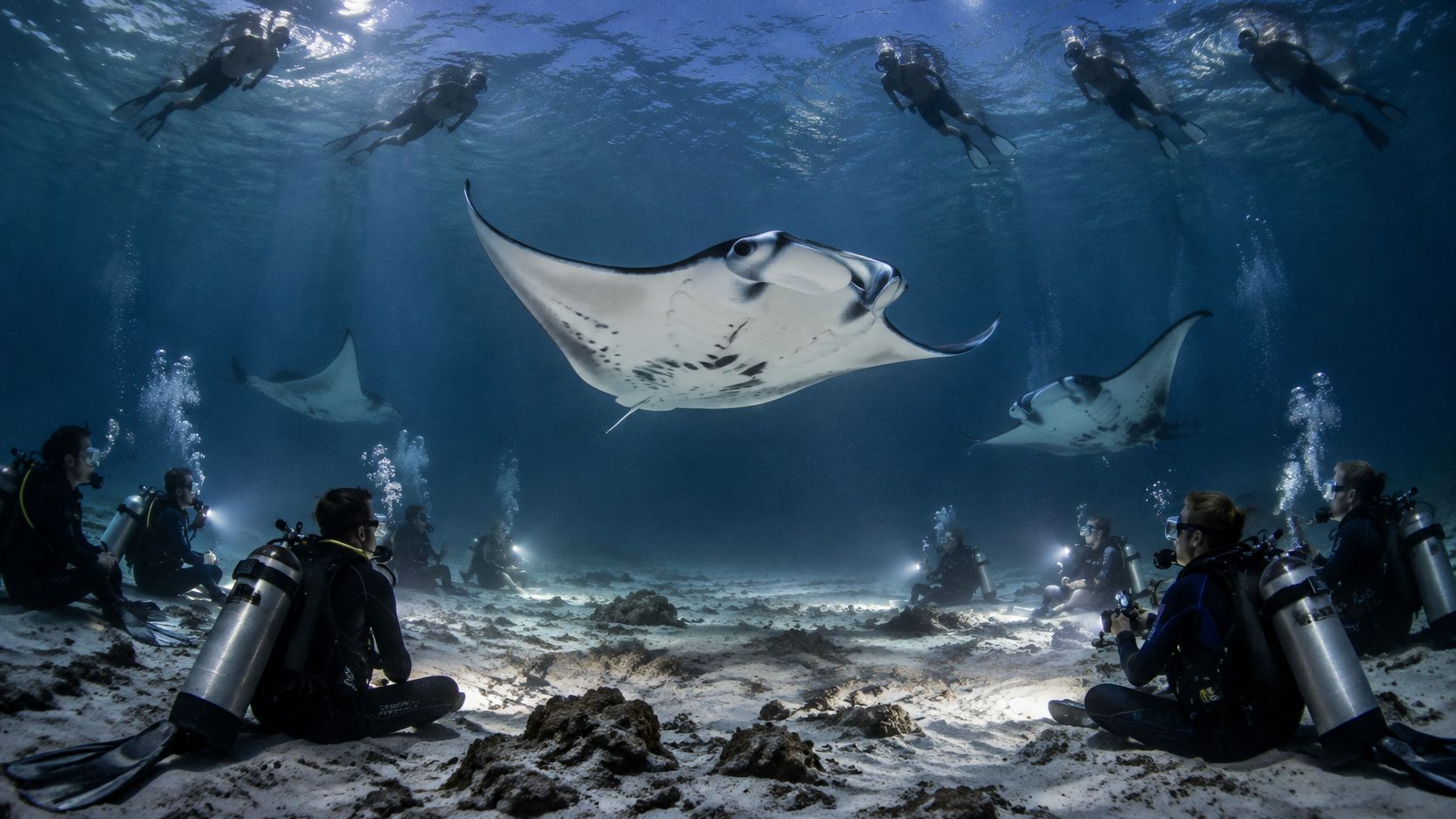
The NOAA-hosted wildlife interaction standard sets out most of what follows, and every rule exists for a reason you can see in the water.
The seven steps in order
Settle on the bottom or the surface. Divers stay on or near a sand, rubble or boulder bottom; snorkelers stay at the surface. Holding a fixed position keeps you out of the animals' flight path instead of drifting into it.
Form a semicircle and leave the open water free. The arc gives everyone a view and gives the mantas room to bank and turn. When a group crowds forward, the feeding lane closes and the passes stop.
Hold your light above your head and aim it up. Divers shine into the water column; snorkelers aim downward from the surface. The beam is the whole mechanism, so a light pointed at the sand does nothing except blind your neighbour.
Time your breathing. Exhale so bubbles don't break across a manta passing overhead. A burst of bubbles against a feeding animal is a small disturbance repeated dozens of times a night.
Keep hands, fins and equipment still. The standard prohibits touching, chasing, grabbing or riding manta rays because contact can remove the protective mucus coating on their skin. That coating is their defence against infection, and it doesn't grow back in an afternoon.
Stay neutral and let the animal choose the distance. If a manta is heading your way, hold and let it decide how close to come. Chasing turns a natural pass into a pursuit and ends the encounter early.
Use low camera settings and skip close-range strobes. A manta circling through a beam is already lit; a burst of flash at a metre adds nothing to the image and everything to the disturbance.
What a good night looks like
Mantas looping through the light for twenty minutes, one passing close enough that you can see the pattern of spots on its belly, and a group that stays on the sand the whole time without a single person finning into the column. That's the version of the trip worth remembering. The responsible diver etiquette guide goes deeper into the habits that make it happen.
What to Expect on the Night and Local Logistics
Check in at the harbour, get fitted for exposure wear, and sit through the briefing. The crew covers the science of what you're about to see and the rules of passive observation, along with the viewing area, hand signals and light protocol. Confirm the return time at that point so a dinner reservation or an airport run doesn't become a guess.
Then the boat runs north, the lights go down over sand and reef, plankton builds in the beams, and the mantas either come in or they don't. Divers settle into the designated area, snorkelers hold the surface, and the crew calls the end of the water time.
What cannot be promised: a number. Sightings depend on plankton and ocean conditions, and a resident population doesn't mean a fixed headcount on your date.
Three questions come up often. Are mantas guaranteed? No. Can I go if I'm not a strong swimmer? Snorkel formats need confident floating, so tell the crew and ask about flotation support when you book. How long is the night? Plan a few hours including the ride.
For logistics, sort your rental car or transfer before the trip, bring a warm layer for the ride back because the air feels much cooler once you're wet, and read this guide to avoiding seasickness on a small boat if you're prone to it.
Book Your Manta Dive With Kona Honu Divers
Booking is four decisions, in this order.
- Pick the format. Certified and comfortable at night means the scuba dive; not certified, or unsure about dark water, means the snorkel. Don't treat the snorkel as a consolation prize.
- Confirm the site. Ask for Garden Eel Cove specifically, because the viewing area and reef structure do more for your night than any other variable.
- Check your certification and dive history. The 2 Tank Manta Charter requires Open Water Certification or higher and diving within the past 2 years, and Kona Honu Divers strongly recommends dive insurance before you travel.
- Book early with a flexible date if you can. Two nights available means two chances, and weather moves.
If you're still unsure which trip fits your experience level, call Kona Honu Divers at 808-324-4668 and talk through your last few dives to find the right boat.
Certified divers with deeper experience who want more than a stationary night at the sand should look at the premium advanced 2 tank trip for lava formations and less-visited sites.
Settle the format, lock the date, confirm the site, then book.
Kona Honu Divers runs the Manta Ray Night Dive to Garden Eel Cove, and its 2-tank manta ray charter uses lights on the sand to bring plankton in. Divemasters and instructors are in the water with you, and the team will help you choose between the dive and the snorkel based on your certification and comfort. Visit Kona Honu Divers to check dates and reserve your night on the water.