
You land in Kona with one free evening, a mask in your bag, and a group chat full of giant rays in a cone of light. One friend says the animals always show. Another came back with an empty boat. You still have to pick a format before the shop closes.
That choice is the trip. A manta dive in Hawaii works because lights gather plankton and reef mantas follow the food. The lights do not make the food. On a thin night you may get one distant pass, or none, and that is still a real night on the water.
I would book the organized site, not a boat that chases rumors. Match the format to your certification, hold a safe position, and plan a short stay for the nights the ocean does not perform on cue.
Manta Dive Hawaii Options Compared at a Glance
A school of small fish splits, and a wide ray glides through the beam with its mouth open. That pass is what most visitors book. The right format depends on your certification, how calm you feel in dark water, and how many nights you have in Kona.
Our Manta Ray Night Dive is the flagship for beginners through advanced divers, and snorkelers are welcome on the same evening. If you are still choosing a view, this snorkel or dive comparison is the cleanest read before you pay.
| Option | Best For | Certification | What It Involves |
|---|---|---|---|
| Manta Ray Night Dive | First-timers through advanced divers | All levels; snorkelers welcome | Kneel on the sandy bottom at a fixed viewing spot |
| Manta Ray Night Snorkel | Non-divers and nervous swimmers | None | Float at the surface with lights aimed downward |
| 2-Tank Manta Charter | Certified divers who want a daytime dive too | Open Water or higher, dived within 2 years | Two-tank trip that includes a manta dive |
| Black Water Night Dive | Divers wanting a deep-water night experience | Confirm with us before you book | Night dive in deep open water |
| Premium Advanced 2 Tank Trip | Experienced divers seeking remote sites | Confirm with us before you book | Two-tank trip to remote lava formations |
The Manta Ray Night Snorkel keeps non-divers at the surface while divers kneel on the sand. The 2-Tank Manta Charter needs Open Water or higher and a dive within the past two years, then pairs a daytime tank with the night encounter. The Black Water Night Dive and the Premium Advanced 2 Tank Trip suit experienced divers who want open-ocean night water or remote lava. Certification for those two is not published on this page, so confirm it with us before you reserve. The same roster also includes the 2 Tank Local Morning Dive and the Morning Introductory Scuba Dive.
Learn where the rays feed, then how the night runs, how to prep, and how to book when plankton sets the show.
Where Mantas Feed in Kona and Why Garden Eel Cove Leads
Kona's reef mantas are not random passersby. They are a small local community that returns to the same nighttime feeding grounds, and two sites carry almost all of the viewing.
Hawaiʻi's Department of Land and Natural Resources names the two principal zones as Makako Bay, also called Garden Eel Cove, and Kaukalaelae Point, also called Keauhou Bay. The agency reported that approximately 60–70 viewing vessels were bringing guests near feeding mantas in those two areas. Proposed rules would have limited commercial viewing permits to 24 in each zone, capped vessels at 60 passengers for hire in a single 24-hour period, and split operations into two-hour shifts, so traffic stays timed instead of stacked.
Why the cove wins
Garden Eel Cove is the stronger tour choice. It sits in a protected location, with a better viewing area and better nearby reefs than an open, improvised patch of coast. It also consistently supports the larger aggregations. You kneel on broad sand, the reef is close enough to orient you, and the water column above stays clear for the rays. Keauhou is a real second feeding zone, and some evenings the crew uses it because that is where the food is. It is not a lesser animal. It is a different shoreline, often with a different mix of rays and less room to keep boats orderly.
Feeding tracks plankton on that night, not a fixed address. Ask which site the crew is using before you leave the dock. Book a tour built around a managed viewing area, and confirm the named site when you reserve. Chasing a crowded or makeshift spot trades a stable kneel-down for extra boat wake and a feeding lane full of people.
Night Dive Walkthrough and Safety Rules
The night starts on the boat, not in the beam. The crew briefs what you will see and the rules of passive observation. You hear where you kneel or float, where the lights sit, and what "do not chase" means once a ray fills your mask.
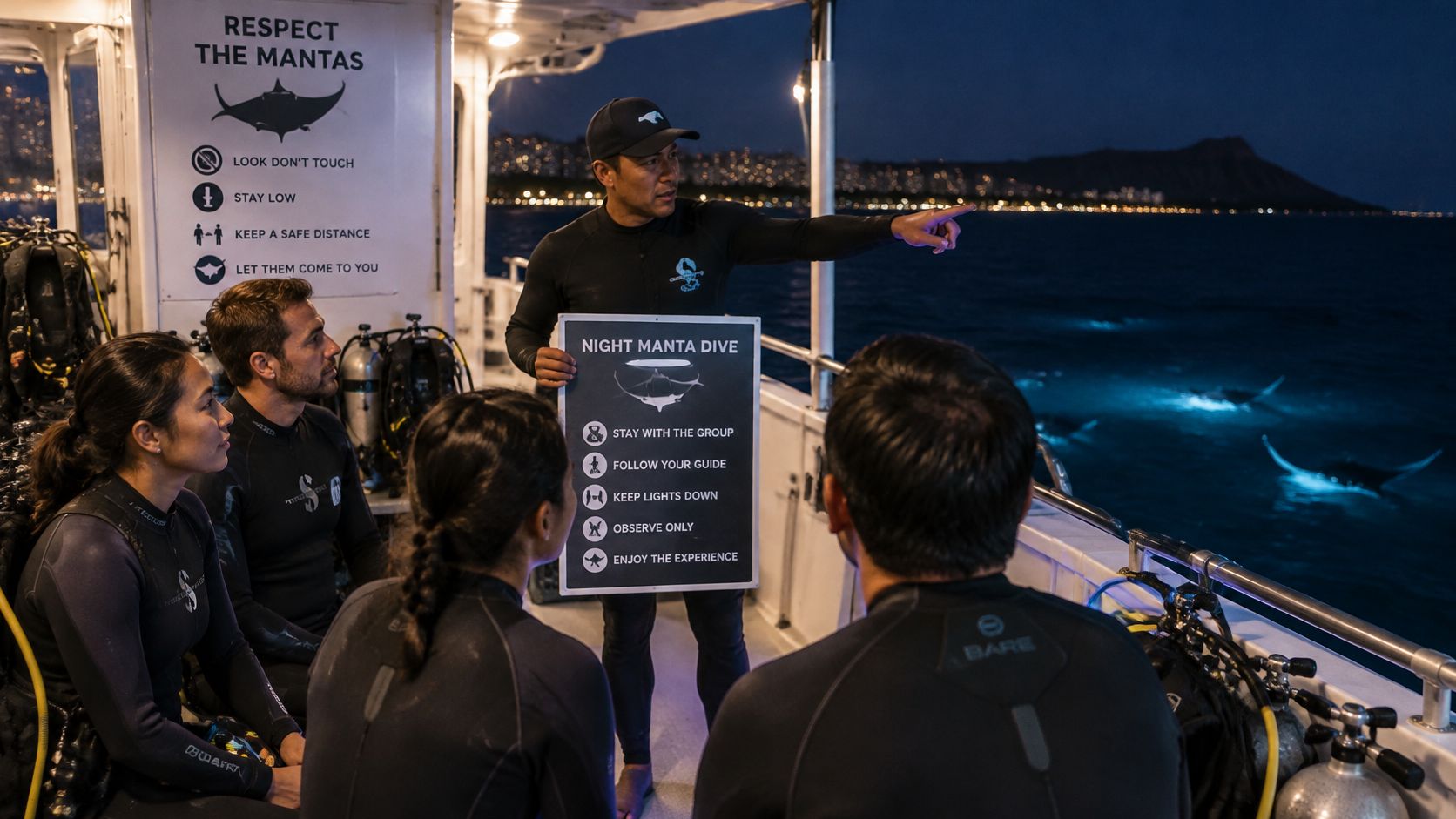
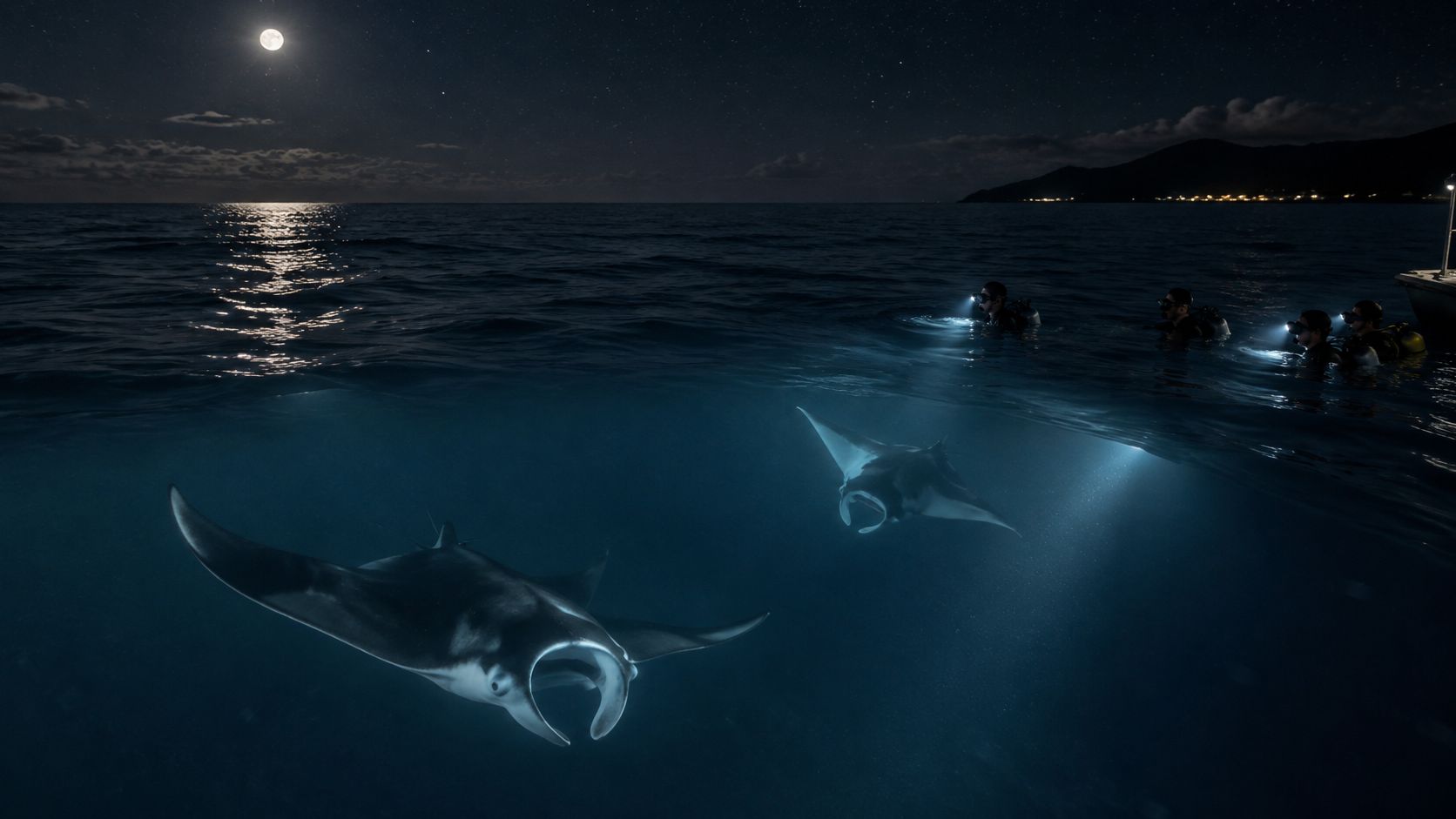
You enter away from the animals and settle into a fixed viewing spot. Divers kneel on the sandy bottom. Snorkelers float at the surface with lights aimed downward. Divers hold lights upward so the central water column stays open. Powerful dive lights throw a bright circle on the seafloor, so you are never in complete darkness. Experienced divemasters and instructors stay in the water with you. The dive is stationary and closely supervised, and the flagship night dive suits beginners through advanced divers and snorkelers.
The rays filter-feed by moving plankton-rich water through their mouths and gill rakers. They repeat slow passes, then tighten into barrel rolls through the lit water. Your job is to be scenery.
NOAA-archived manta records describe Kona reef mantas as Mobula alfredi, with feeding aggregations in water shallower than 10 meters, while tagged individuals have been recorded diving to approximately 432 meters at night.
An animal can leave the light at any moment. That is normal, not a cue to follow it. Garden Eel Cove gives you a protected cove, a broad sandy viewing area, and nearby reef so you can stay below the feeding lane.
Positions that keep the lane open
- Hold your assigned spot: Do not drift into the center to "get closer."
- Never block a path: Stay out of a manta's ascent and out of its feeding line.
- Do not touch: Hands off the body and the cephalic fins.
- Control buoyancy: Stay off the reef. Hard kicks near the bottom are how people scar coral.
- Streamline gear: Clip straps, snorkels, and dangling accessories so nothing can tangle.
If a ray comes in unexpectedly, stay still and do not pursue it. If none appear, the crew should not chase them or crank the lighting. Read the same standard in our considerate diver etiquette before you kit up. Watch three things: the lit circle, the passes, and the guide's calm pace.
How to Prepare for Your Manta Night Dive
Confirm format and paperwork. Match the charter to the table. The 2-Tank Manta Charter needs Open Water or higher and a dive within the past two years. We strongly recommend dive insurance, so ask about it before you pay. The common slip is assuming an old card still counts.
Learn the animal before the boat. The PADI Manta Ray Diver specialty covers manta biology, behavior, and conservation, and you take it before the night dive. Knowing why a ray rolls makes the pass easier to read. The slip is treating the evening as a light show.
Sort rental gear early. Scuba diving rentals and freediving rentals are available, so ask which items you bring and which we supply. The slip is packing a regulator or mask you have not tested in months.
Rehearse a still hover on your daytime dive. Controlled breathing and steady buoyancy let you hold the kneel without touching sand or reef. The slip is kicking hard once the first ray appears.
Rest, eat, and skip alcohol for the hours before you enter. A tired, dehydrated diver loses the hover first. If the boat ride worries you, sort that before the dock with a plan for how to avoid seasickness. The slip is arriving late, hungry, and already queasy.
You are ready when you can hold a position and breathe calmly on a daytime dive. If you cannot, take the snorkel.
Gear and Photography for Night Manta Dives
Bring a camera that works in low light and that you can run by feel. Leave the flash off near the animals. The lit circle already gives you the exposure, and a strobe in a ray's face helps nobody. Shoot steady frames as the animals make passes. Chasing the turn usually yields blur and a kicked-up bottom.
Mount the camera on a short, secured strap. Nothing should dangle near the reef or the mantas. For your own light, pick a dive light with a broad, even beam and aim it by role. Divers point lights upward. Pack a spare battery and a dry bag for your phone and keys.
Ask which rental equipment is on the boat and whether your own gear suits a night entry. A daytime rig with loose clips is a poor night rig. If night diving itself is new, read scuba diving at night before you add a camera to the task load.
Checklist: camera, spare battery, secured strap, dive light, and your certification card if the tour requires it.
Why Some Night Dives Have Few or No Mantas
A manta dive is not a guaranteed show. Light cannot create prey. Plankton draws the rays in, so low zooplankton can mean few visits or none.
A 13-year community-science study covering 2010–2022 recorded more than 23,000 sightings of 167 individually identified reef manta rays at Garden Eel Cove and Keauhou. Aggregation size tracked zooplankton density across seasons and years. A quiet dive is not automatically a failed site or a failed crew. Garden Eel Cove consistently supported larger aggregations, while Keauhou drew a higher share of females. Despite more tourism over those years, the aggregations stayed relatively stable.
What changes the passes
- Seasonal weather: Wind and swell can shut the boat before the plankton even matters.
- Nightly plankton: This is the main switch for how many rays show.
- Currents and visibility: Both change how long a pass stays in view.
- Moonlight and behavior: A bright moon and a restless ray change duration, not your rights to chase.
Testimony to the Hawaiʻi Legislature reported an estimated 80% probability of seeing a manta in a 2002 survey of Kona operators. That figure describes that period. It is not a promise for your evening. Our night dive has encounter rates of up to 92%, and a ray can still be present without making a close pass. Separate "we saw one" from "one came over the lights."
A quiet night can mean the food is elsewhere, not that the population is failing. A less busy evening can be the better ecological night, because fewer rays often means less concentrated feeding, not a broken tour. With one evening, qualified divers get the closest contact on the night dive. Non-divers should take the snorkel. Before you pay, ask one question. What is the reschedule or weather policy?
Sample Kona Itineraries for One to Three Days
The night dive is the anchor. Build the days around it, and leave slack for wind.
| Trip Length | Sample Plan | Best For | Planning Note |
|---|---|---|---|
| One evening | Afternoon rest, then the manta night dive or snorkel | Travelers with a single night | Choose the snorkel if you are not certified |
| Two days | Morning 2-tank dive on day one, manta night dive on day two | Certified divers | Confirm the 2-tank requirement before booking |
| Three days | Day one 2-tank dive, day two manta night dive, day three blackwater or advanced trip | Experienced divers | Keep a spare day for weather and rest |
| Non-diver family | Manta snorkel plus a daytime snorkel | Non-divers and families | No certification required |
One evening. Rest in the afternoon, then do the night dive if you are qualified, or the snorkel if you are not. Do not add a long day trip before it.
Two days. Day one is a morning two-tank dive through coral gardens, lava tubes, and arches, open to all certified divers. Day two is the manta night dive. Confirm the two-year recency rule on the charter before you book. Stacking a hard day dive right before the night dive is how people show up too tired to hover.
Three days. Keep the same first two days, then add a Black Water Night Dive or a Premium Advanced 2 Tank Trip for experienced divers. Hold a spare day for weather and rest. Check the experience level for blackwater before you lock the date.
Families who do not dive. A manta snorkel plus a daytime snorkel needs no certification. Where you sleep still matters for dawn boats, so use this guide to the best places for divers to stay on the Big Island when the pier is the point of the trip.
Manta Dive Hawaii FAQs for Beginners to Advanced Divers
Is the night dive different for advanced divers? The flagship night dive uses the same viewing format for every level. You still kneel or float in an assigned spot. The Black Water Night Dive and the Premium Advanced 2 Tank Trip are the step up for deeper or more remote diving, in the order the three-day plan uses. Confirm each trip's experience requirement with us before you book.
Do I need a camera? No. Watching the lit circle and the passes is the dive. If you bring a camera, keep flash off, strap it short, and shoot the pass instead of chasing it.
What should you ask the crew that night? Ask which viewing site they are using, and what the lighting and positioning rules are, so you know your role before you enter.
Book Your Manta Night Dive in Kona
Pick the format from the first table, then check space. Kona Honu Divers runs the Manta Ray Night Dive, the 2 Tank Local Morning Dive, the Black Water Night Dive, the Premium Advanced 2 Tank Trip, and the Morning Introductory Scuba Dive. Compare what each package includes before you choose. The night dive alone is a different bill from a package that adds a daytime tank.
Price only makes sense once you know three things. Is gear rental included, what the package covers, and how the total changes if you add a daytime dive. Ask before you pay whether gear rental is included, whether nitrox is available, what happens if weather or conditions change, which viewing site the crew uses, and what the reschedule policy is. Questions go to 808-324-4668. Other trips sit on our diving tours page.
Kona Honu Divers runs guided manta night dives and snorkels at Garden Eel Cove, plus morning reefs, blackwater, and advanced charters for divers who want more than one tank. If your Kona plan hinges on a calm, supervised night with reef mantas, book the format that matches your certification and leave room for the plankton. Visit Kona Honu Divers to see the trips and reserve your evening.