
You've got an evening free in Kona, a phone full of manta videos, and several trips that look almost identical. The key decision isn't which boat promises the closest pass. It's which crew puts you in the right place, keeps the feeding area clear, and has a sensible plan if conditions change or the mantas don't arrive.
For a manta dive in Hawaii, I'd prioritize Garden Eel Cove, close in-water supervision, and clear booking terms. Choose the experience that fits your actual water skills, not the photograph you hope to bring home.
Manta Dive Options in Hawaii at a Glance
Manta dive options compared
| Option | Best for | Entry requirement | Viewing style |
|---|---|---|---|
| Manta Ray Night Dive | Divers and snorkelers at every level | Open to snorkelers and divers, beginner to advanced; confirm scuba eligibility | Stationary viewing around the lights at Garden Eel Cove |
| 2-Tank Manta Charter | Certified divers wanting a manta dive plus another dive | Open Water Certification or higher, with a dive within the past 2 years | Reef diving plus stationary nighttime manta viewing |
| Black Water Night Dive | Divers specifically seeking an offshore night experience | Obtain the operator's current certification and experience requirements before booking | Offshore open-water observation, not a bottom-based manta encounter |
| Premium Advanced 2-Tank Trip | Experienced divers seeking a premium charter | Have the operator assess your certification and recent experience | Guided exploration rather than stationary manta viewing |
At Kona Honu Divers, our range includes these night and advanced options, alongside the 2 Tank Local Morning Dive and Morning Introductory Scuba Dive. Don't treat them as interchangeable ways to see the same animals. Blackwater isn't a substitute for the manta dive, and an advanced charter isn't the right shortcut for someone rebuilding basic buoyancy skills.
For the manta encounter, divers kneel on the designated sandy bottom while snorkelers float at the surface. Neither perspective requires pursuing the animals. If you're choosing between those positions, use this snorkeling-versus-diving comparison to judge comfort and perspective, not prestige.
Ask yourself three questions: Am I certified? Have I dived recently? Do I want stationary night viewing or a longer daytime outing?
Without certification, look at the surface option. With current scuba skills, consider the manta charter. If you want to swim through reef terrain rather than settle into a viewing area, choose a daytime dive that matches your experience. If you're certified but rusty, arrange a skills assessment or refresher before committing to the night.
Certification, Permits and Insurance You Need
Requirements by trip and by role
| Requirement | Applies to | Detail |
|---|---|---|
| Open Water Certification or higher | 2-Tank Manta Charter | Required |
| Dive within the past 2 years | 2-Tank Manta Charter | Required |
| PADI Manta Ray Diver specialty | Manta night dive divers | Taken before the dive; confirm applicability to your booking |
| Dive insurance | All divers | Strongly recommended |
| Commercial Use Permit for State Ocean Waters | Tour operators | Required |
| Harbor Commercial Use Permit or Launch Ramp Permit | Tour operators | Vessel arrangements determine which permit applies |
| Shark and ray protection rules | Everyone in state waters | No intentional or knowing capturing, entangling, or killing; rays have no open season |
Beginner-friendly doesn't mean certification-free scuba. Most of our regular dive charters require at least Open Water Diver certification from a recognized agency. Bring your certification details and an accurate last-dive date, rather than assuming a comfortable vacation snorkel proves readiness for scuba at night.
If you haven't earned your card, Open Water certification is the proper training route. Don't compress learning basic equipment handling into the evening when you also want to watch mantas.
Separate training from operator obligations
Our PADI Manta Ray Diver specialty covers manta biology, behavior, and conservation and is taken before the night dive. Confirm how it applies to your reservation. We strongly recommend dive insurance; check the policy's diving coverage, emergency assistance, and exclusions before traveling.
The Manta Ray Viewing Boating Operations and Safety Assessment describes the commercial ocean and harbor or launch permits operators need, along with state protections prohibiting intentional or knowing capture, entanglement, or killing of sharks and rays and providing no open season for rays.
Those are operator and wildlife obligations, not substitutes for your own readiness. A permitted boat doesn't make an unprepared diver ready, and a certification card doesn't excuse interfering with wildlife.
Garden Eel Cove Versus Other Kona Manta Sites
Garden Eel Cove is my preferred choice for the dive. Also called Manta Heaven, it offers the protected setting, established viewing area, and nearby reef structure I'd prioritize over a trip sold mainly on dramatic close-up footage.
The Garden Eel Cove night-dive guide describes a sheltered setting with a broad sandy viewing area and nearby reef structure that supports stationary observation. That combination makes it the superior dive-tour choice when you want organized viewing and a better reef setting, rather than following rays through open water.
Kona manta sites compared
| Site | Protection | Viewing area | Reef quality | Aggregation size |
|---|---|---|---|---|
| Garden Eel Cove | Protected cove setting | Established viewing area near the lights | Nearby reef structure supports stationary viewing | Larger aggregations in the long-term comparison |
| Keauhou | Assess the evening's swell and wind with the captain | Nighttime light-based feeding site; confirm the assigned diver area | No equivalent reef-quality comparison established by the cited sources | Smaller aggregations in the long-term comparison |
A University of Hawaiʻi study summarized in this Big Island manta overview found that Garden Eel Cove consistently supported larger manta aggregations than Keauhou. That's a site-level finding, not a promise about the evening you book.
Why the viewing area matters
A broad sandy area gives the guide a practical place to organize divers without placing them on living reef. For photographers, a settled position also makes framing easier than trying to adjust buoyancy while turning after a passing animal.
Garden Eel Cove is our go-to manta site, and we often take the charter there. The captain still has to judge the actual conditions, because a preferred location isn't automatically suitable every evening.
Decision rule: If you're a beginner or photographer, favor a protected site with a clearly explained viewing area. Accept a different setup only when you understand the conditions and positioning trade-off.
Don't reject Keauhou because another site has a stronger long-term aggregation record. Reject any trip whose crew can't explain where you'll be positioned and why that evening's site is appropriate for your group.
How a Night Manta Dive Unfolds, Step by Step
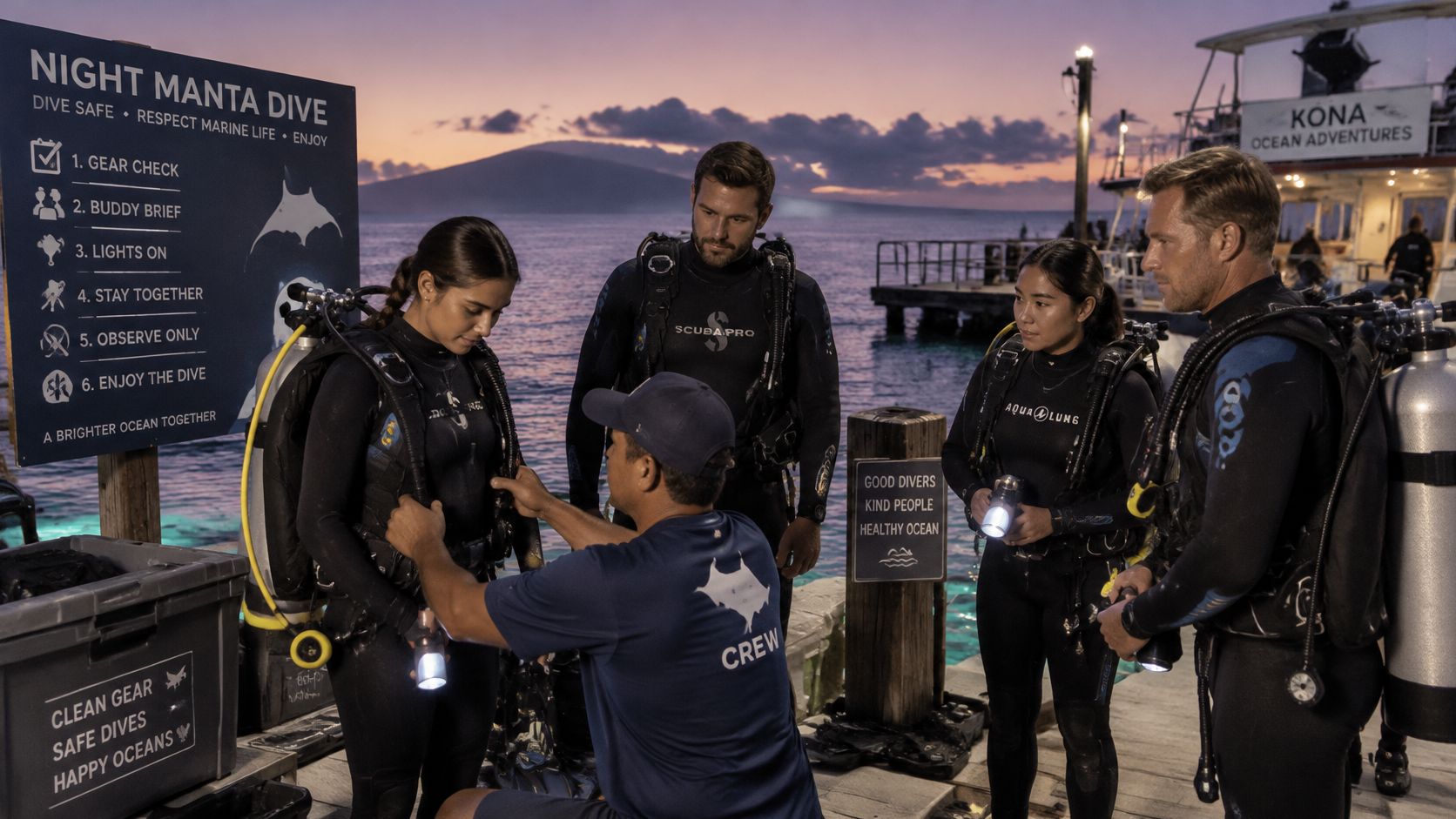
The evening should feel organized before anyone enters the water. Our crew begins with a detailed briefing covering the science of the encounter and the rules of passive observation.
From the dock to the viewing area
Arrive ready to gear up before dusk. Leave time for equipment checks, wetsuit fitting, and questions rather than rushing into the first entry. Tell the crew about unfamiliar rental equipment or any concern with your buoyancy before departure.
Listen to the wildlife and safety briefing. Learn the guide's signals, the entry and exit procedure, and where you're expected to settle. The common mistake is concentrating on camera settings while missing the instructions that make the encounter manageable.
Secure your snorkel before entering. Remove it from the mask strap and secure it in a buoyancy-compensator pocket. A passing manta can catch a protruding snorkel and dislodge your mask, so don't leave it sticking up beside your head.
Follow the light arrangement. Divers hold lights above their heads aimed upward, while surface observers aim lights downward. The purpose is to concentrate plankton in the water column, not to sweep beams after individual rays.
Descend and settle where the guide directs. Divers stay on or near suitable sand, rubble, or boulder bottom, while snorkelers remain at the surface. Don't rise into the middle just because an animal passes beyond your camera's frame.
These positions and light directions follow NOAA's voluntary manta interaction standard, which keeps the open water column available for manta movement and warns against contact that can remove the animals' protective mucus coating.
Positions, lights and rules by role
| Role | Position in water | Light direction | Key rule |
|---|---|---|---|
| Scuba divers | On or near sand, rubble, or boulder bottom | Above the head, aimed upward | Secure the snorkel in a BC pocket |
| Snorkelers | At the surface | Aimed downward | Don't dive down or chase a manta |
| Photographers | Stationary near the bottom | Follow the assigned upward-light arrangement; keep equipment clear of the approach path | Let the manta set the distance |
During the encounter and the exit
Keep your profile low and your equipment contained. Watch your fins, hoses, and camera arms, and keep breathing normally. Where practical, coordinate exhalations to avoid sending a bubble plume directly into an approaching manta's path, but never hold your breath.
Let every animal choose its own approach. Never touch, chase, grab, or ride a manta, even if it passes within reach. Swimming upward for a closer photograph sacrifices your stable position and risks contact with the ray or another participant.
Leave on the guide's signal. Follow the planned ascent and boat approach rather than staying behind for another pass. Use the debrief to ask about observed behavior and discuss anything that felt uncomfortable.
If darkness itself is your concern, review these night-diving preparation tips before booking. Familiarity with your light, signals, and equipment matters more than owning an elaborate camera.
Why Some Nights Are Quiet and What to Expect
A guaranteed manta sighting is a marketing promise, not a biological fact. Kona offers a recurring wildlife opportunity, but the animals still choose where and when to feed.
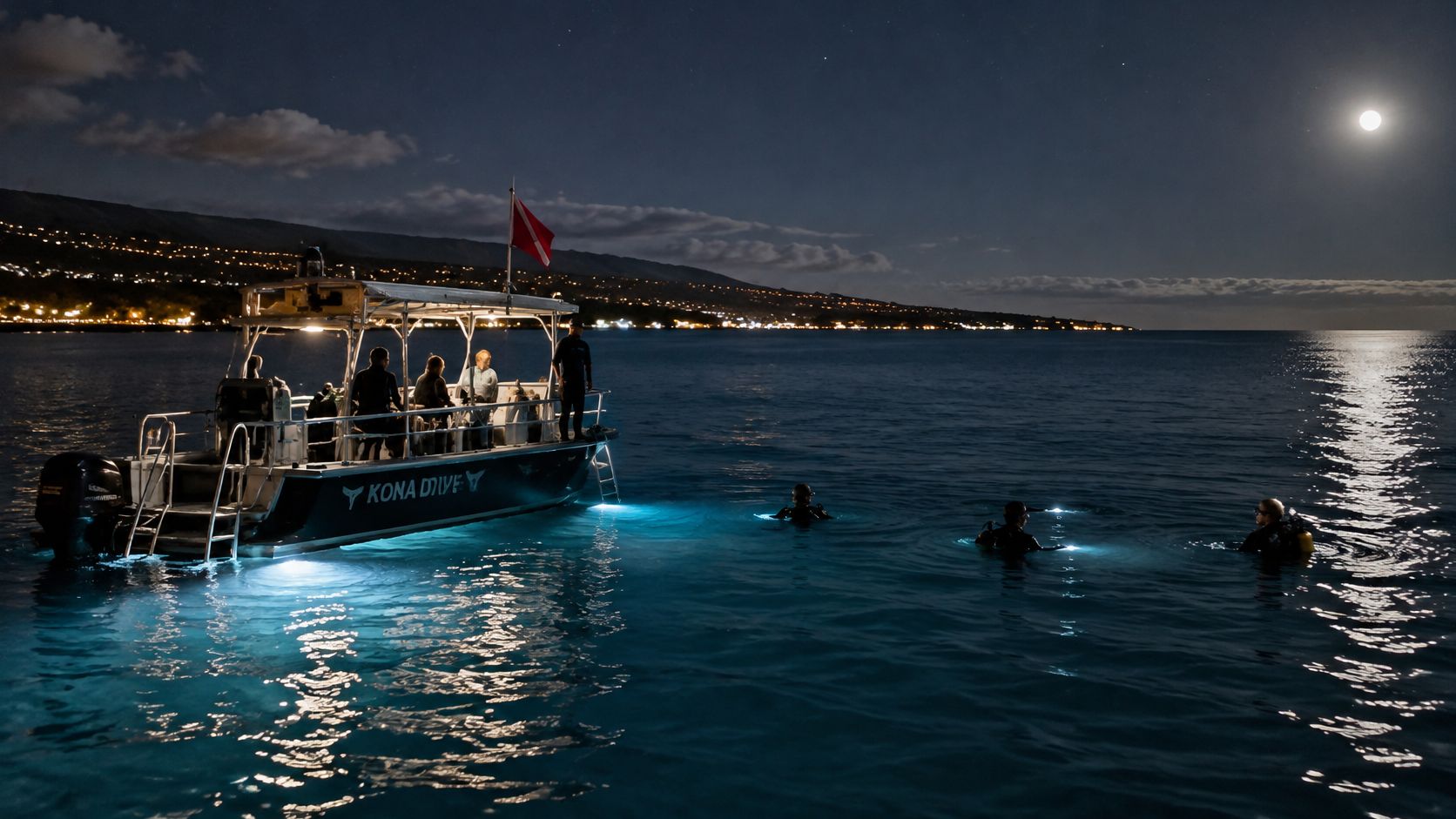
A 2025 University of Hawaiʻi study analyzed 13 years of community-sourced observations, including more than 23,000 sightings of 167 identified reef manta rays, while the associated conservation context describes 318 unique mantas identified around Hawaiʻi Island since 1979 and approximately 104 adult breeders, as detailed in the University of Hawaiʻi study record. Long-term monitoring associates seasonal and year-to-year changes with zooplankton availability, and genetic evidence indicates limited movement between island groups.
Those findings concern a small, locally resident population, not an endless supply of interchangeable animals.
Read a quiet evening correctly
- Does no sighting mean the trip failed? Not by itself. Food availability and natural movement can produce a quiet evening even when the crew runs a responsible dive; you can't diagnose the exact cause from a single visit.
- Should you return? A missed encounter can justify another attempt, but understand the written rebooking terms first. Don't assume a free return, an available seat, or a sighting on the next trip.
- Why might another site do better? Local feeding conditions and site characteristics differ. A stronger long-term record doesn't turn a particular location into a nightly certainty.
- How can you reduce pressure? Avoid congested viewing space, respect the guide's positioning, and choose close supervision over a larger crowd.
Book a wildlife encounter, not a performance. A responsible crew can promise a plan, not an animal's attendance.
Use the Kona manta timing guide to frame scheduling questions, but don't buy a supposedly perfect date as protection against natural variability.
How to Judge a Manta Dive Operator
A spectacular video tells you almost nothing about guest supervision, boat handling, or an uncomfortable participant's exit. Judge the operating plan before the highlight reel.
Hawaii Ocean Watch warns that Kona's principal viewing areas can become oversaturated, recommends a crew-to-guest ratio of 1:8 or better, and identifies live-boating with running propellers near people and wildlife as an avoidable risk. Treat that ratio as a buying benchmark, not proof that every other safety detail is covered.
Ask questions that require concrete answers
- How many guests will my in-water guide supervise? Ask about your actual group, not the total crew aboard. A clear answer distinguishes the captain, deck crew, and guides responsible for participants in the water.
- Are engines off while people are nearby in the water? Ask the operator to explain its shutdown, pickup, and reboarding procedures. A vague assurance that the captain is experienced isn't a procedure.
- What happens if I panic or lose buoyancy control? You want to know who assists you, how you leave the viewing area, and who continues supervising the remaining guests.
- What if I become seasick? Ask how the crew handles someone who needs to stop participating. Don't assume the entire vessel can immediately return.
- Can a beginner watch away from the busiest area? The answer should describe positioning and supervision, not just label the activity easy.
- What happens if the site is overcrowded or no mantas appear? Look for an explanation of operational choices and written commercial terms, not another encounter guarantee.
Our experienced divemasters and instructors are in the water with divers. We run a stationary, closely supervised experience, with guides helping participants stay safe and comfortable in the designated viewing area.
That's the kind of process detail to compare when choosing a Kona dive operator. Reviews can help you identify questions, but they shouldn't replace those questions.
Buyer's test: A good answer names who does what when something goes wrong. A weak answer returns immediately to how amazing the mantas look.
Pack Smart for a Night Manta Dive
Pack for being relatively still underwater and wet on a moving boat afterward. Comfort helps you concentrate, and a compact equipment setup makes it easier to respect the viewing space.
- Choose adequate exposure protection. Bring or arrange a properly fitted wetsuit; use a rash guard only when it provides enough protection for your needs. Don't assume you'll stay comfortable just because you're diving in Hawaii.
- Confirm your dive light and backup power. Know how to operate the light before boarding, and carry a suitable spare battery if you're bringing your own. Confirm what the crew supplies before purchasing equipment.
- Use a mask you trust. Check the skirt seal and strap adjustment. A familiar, well-fitting mask is more useful than a new one you haven't tested.
- Keep your camera compact and secured. Stow loose accessories and avoid dangling arms or tethers. You should be able to manage the camera without losing control of your other equipment.
- Bring nitrox credentials if applicable. Discuss the planned profile and available gas with the operator. Nitrox doesn't authorize extra depth, eliminate air-consumption limits, or replace gas analysis and the correct computer settings.
- Pack dry layers and a towel. A wind-resistant outer layer is useful for the return ride. Keep it in a dry bag so it's ready when you climb aboard.
Settle equipment questions before reserving
Call 808-324-4668 with your certification level, last-dive date, and rental needs. Confirm wetsuit sizing, lights, and any nitrox arrangements before selecting your departure.
Price, Book and Reserve Your Night Dive
Compare the complete trip, not the headline fee. This guide doesn't quote prices because you need the current total for your departure, equipment choices, and booking conditions.
Check whether the price includes rental equipment, lights, tanks, weights, and any nitrox you intend to use. Confirm the itinerary and boat time too, especially when comparing a dedicated encounter with a charter that includes additional diving.
Read the terms before paying
Weather cancellation, a guest cancellation, and an evening without mantas are different situations. Ask how each is handled and whether any return offer has availability restrictions, an expiry, or additional charges.
Don't pay extra for an implied certainty that the operator can't deliver. Pay for the itinerary, suitable equipment, qualified supervision, and a clear response when the plan changes.
Reserve in this order
- Select by readiness. Choose the surface experience if scuba credentials or recent skills don't support the dive. Choose a reef-focused or advanced outing only if that's the experience you want.
- Submit accurate diving details. Have your certification card and last-dive date available. Disclose concerns before payment, rather than at the dock.
- Arrange dive insurance. Read the coverage and keep emergency contact details accessible.
- Reserve your preferred night departure early. Leave room in your vacation schedule for weather-related changes without assuming rescheduling is guaranteed.
- Resolve remaining questions directly. Confirm the assigned experience, equipment arrangements, and cancellation terms with the operator before finalizing.
The best booking is the one you can explain plainly: you know what you're doing, why you're eligible, what's included, and what happens if the evening doesn't unfold as hoped.
Kona Honu Divers offers guided manta night diving with experienced in-water supervision and Garden Eel Cove as our go-to site, alongside daytime and advanced diving options. Visit Kona Honu Divers to choose an experience that fits your certification, confirm your equipment needs, and reserve your Kona evening with realistic wildlife expectations.