
Summer is the advice many divers repeat for a manta dive Hawaii, and it is the advice that misleads them. Calm seas make the ride easier and the entry safer. They do not fill the water with plankton, and plankton is what brings reef manta rays to the lights. A night on the Kona coast is three separate outcomes: whether the boat leaves, whether any mantas arrive, and how many circle once the lights are on. Treat those as different bets, and the rest of the planning gets simpler.
Why the Kona Manta Night Dive Is Unlike Any Other Hawaii Experience
A manta dive Hawaii travelers remember is a feeding stop, not a staged show. Reef manta rays, Mobula alfredi, come to zooplankton pulled into the beam. Operators place lights near the aggregation, not on the animals, and the rays do the rest. Research on Hawaiian manta populations treats Kona as a regularly sighted subpopulation, which is why this coast supports a near-nightly habit instead of a once-in-a-trip surprise. Other Hawaiian islands can produce a lucky pass. They do not run the same lighted feeding routine every weather-safe evening.
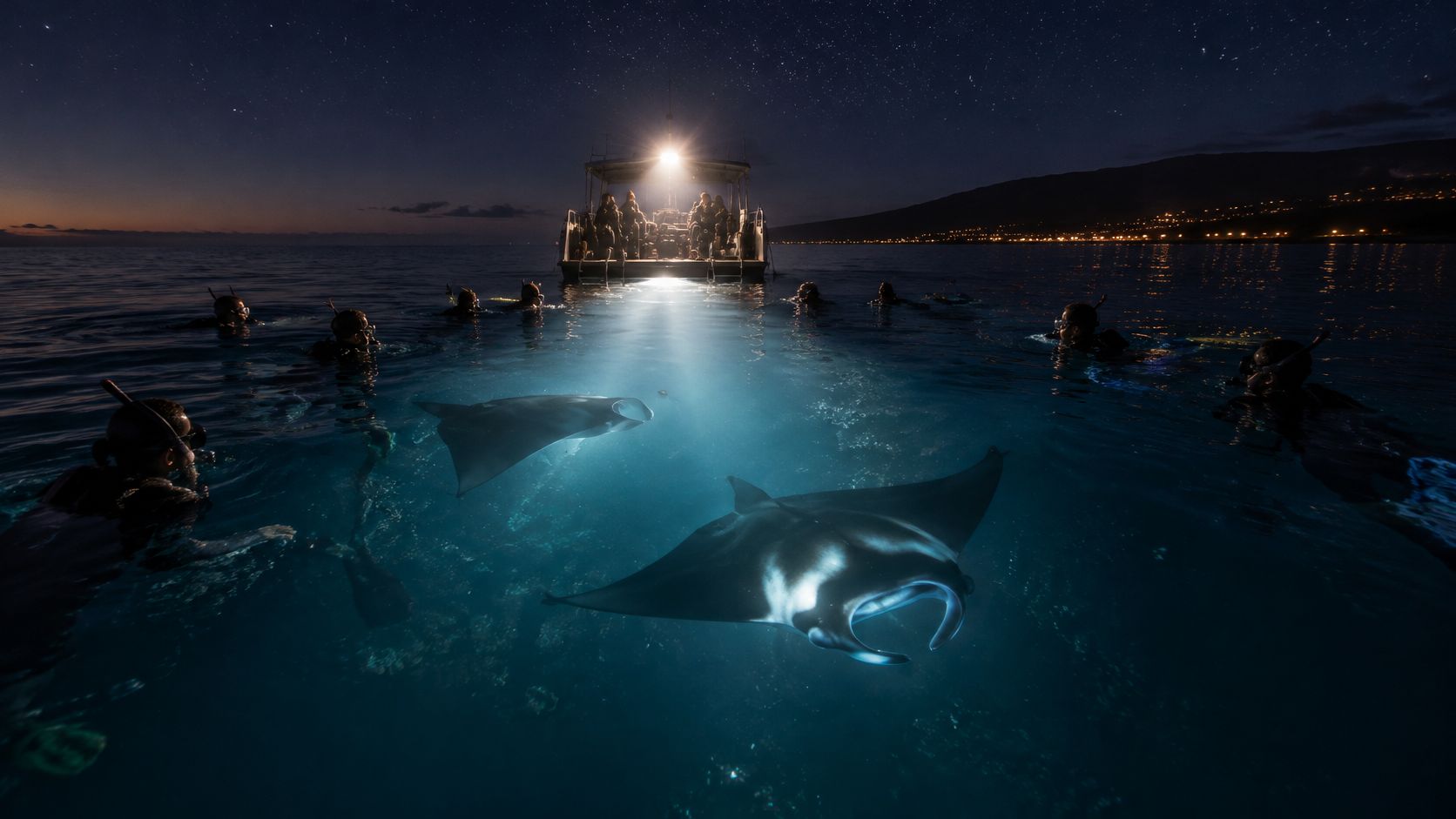
Three probabilities, not one promise
Boat operation. Wind, swell, and harbor conditions decide whether you leave the dock. A glassy afternoon can still turn into a cancelled night.
Manta presence. Resident rays use these lighted spots often. Presence is common. It is still wildlife, so a quiet night is possible.
How many animals. Group size tracks prey, not the calendar. One ray looping cleanly can be a better night than a crowded, choppy one with several distant shapes.
Practical rule: Ask the operator what "a good night" means in their briefing. If the answer is a fixed head count, you are hearing marketing, not ecology.
Calm water improves comfort and access. It does not guarantee a large gathering. If you are building a Big Island trip around night diving, pair this with a daytime scuba diving tour so a weather hold on the manta boat does not wipe the whole underwater plan. Divers who want the floor view need a certification. Snorkelers do not. Both groups succeed by staying still while the rays feed.
How Kona’s Manta Night Dive Became a Global Attraction
The industry started by accident. In the 1970s, floodlights at the Kona Surf Hotel pulled plankton toward shore, and manta rays followed the food, as Hawaii Business recounted. Organized scuba trips began in the early 1990s, first as occasional charters, then as a nightly product. Nobody stocked a pen. People noticed a pattern and put boats on it.
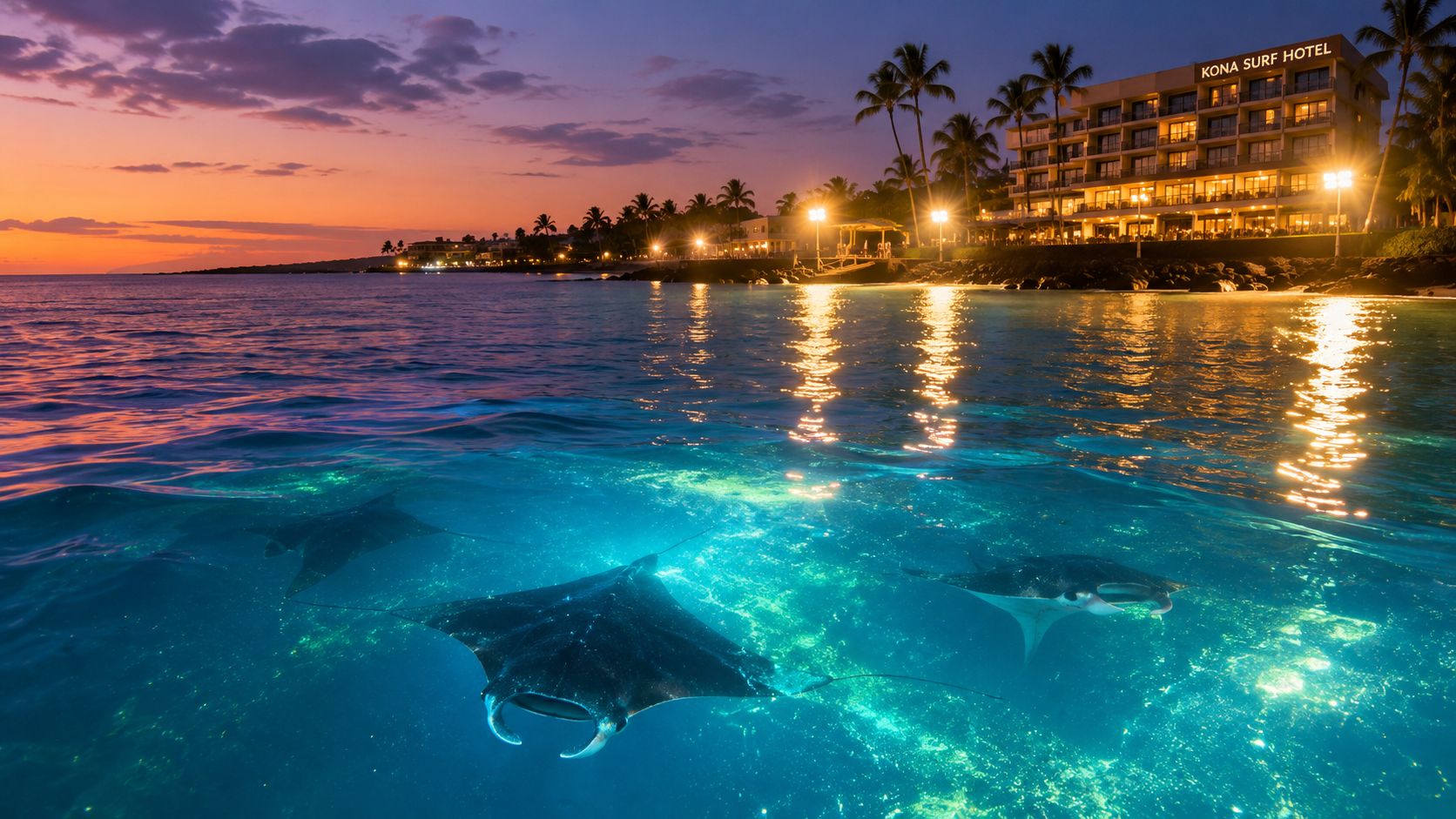
What happened when the lights went off
The original hotel closed in 2000. With the lights off, the local mantas disappeared for a stretch. Operators then built a second viewing spot at Garden Eel Cove, near Kona International Airport, using underwater lights on a natural feeding area. When the property reopened as the Sheraton Keauhou Bay Resort in 2004, manta activity returned there too. Kona ended up with two working sites because someone kept the plankton in the beam, not because the animals were moved.
By October 2017, the activity was running every night weather allowed. One documented evening had at least 12 boats, each with an average of about 20 divers or snorkelers, roughly 240 people at the site. Peak-season reporting described evenings with more than 20 boats and over 200 people in the water. That scale is the trade-off. Reliability comes from shared lights and shared animals, so a busy night can feel packed if your boat cannot hold a clean position on the sand.
The lesson for a first-timer is operational, not nostalgic. This encounter depends on managed lighting, usable sea conditions, and rays that choose to feed. Turn the lights off, as 2000 showed, and the show leaves with them.
What the Science Says About Manta Numbers and Timing
"Book July" is a comfort tip dressed up as biology. A 13-year citizen-science record, 2010 through 2022, at Garden Eel Cove and Keauhou logged more than 23,000 sightings of 167 individually identified reef manta rays, according to the University of Hawaiʻi dataset. That is a known coastal population, not a string of anonymous flybys.
Garden Eel Cove consistently held larger aggregations than Keauhou. Across both sites the sex ratio sat near 1:1. Males moved between locations more often. Seasonal and yearly swings in group size tracked zooplankton density. Aggregations stayed relatively stable even as tourism grew, which is the conservation point worth keeping: existing activity has not, in that window, broken the pattern.
A separate 13-year analysis of the same nighttime sites adds the split travelers should use. Garden Eel Cove supported larger, more variable groups. Keauhou's nightly sightings were smaller and strongly female-biased, with females accounting for 91% of observations there, and females showing high site fidelity. Prey density, not sea state alone, lined up with aggregation size.
| Factor | Garden Eel Cove (Manta Heaven) | Keauhou |
|---|---|---|
| Typical group size | Larger, more variable | Smaller |
| Who shows up | Mixed use of a reliable feeding area | Predominantly females |
| What predicts the count | Zooplankton density | Same prey driver, tighter site habit |
| What calm weather changes | Comfort and access | Comfort and access, not head count |
A flat summer evening can still be a one-ray night. A breezier shoulder-season evening can stack animals if the plankton is thick.
For month-by-month planning without the fake guarantee, the longer note on when to see manta rays in Kona is the right companion to this table. Book the dates you can travel. Judge the operator on how they talk about a small night, not on a seasonal percentage.
Why Garden Eel Cove Is the Better Manta Dive Site
Site choice is the decision you can control. Garden Eel Cove, also called Manta Heaven at Makako Bay, sits near Keahole Point on the northern Kona coast. It is boat-access only. After dark, crews set a lighted zone on a sandy slope edged by garden eels and reef, and resident rays feed in that column rather than along a long exposed shore, as site descriptions of Makako Bay lay out. Divers hold the sand. The animals do the circling.
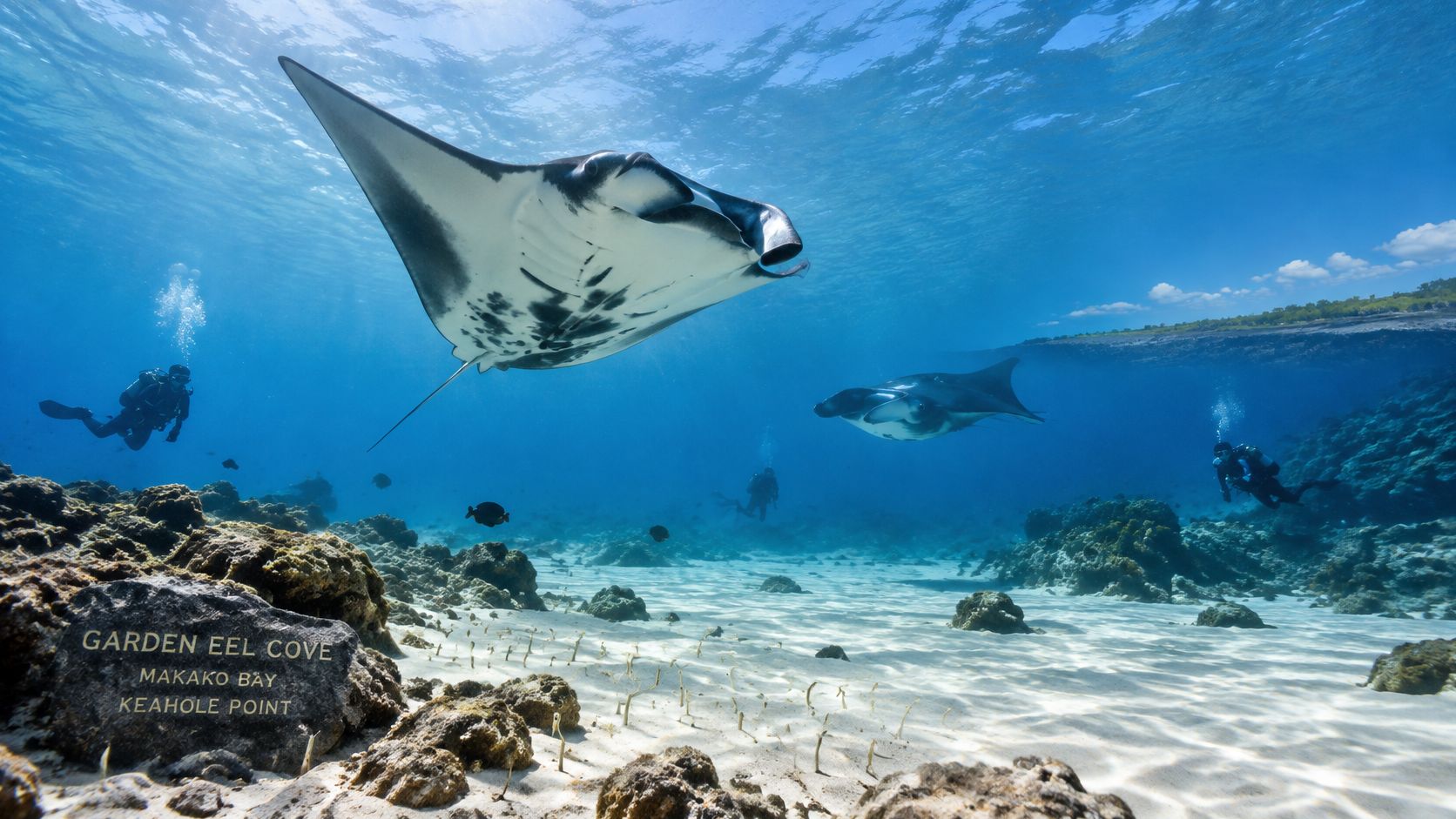
Shelter, geometry, and the reef around the sand
The cove is the stronger night site because the layout does three jobs at once. On-the-water notes from Kona describe a naturally protected setting that generally stays calmer than more exposed alternatives. The cove blocks open-ocean swell and wind, which cuts surface chop, surge, and the sideways shove that ruins buoyancy in the dark. That matters more than people admit. A nervous snorkeler and a seasick diver both fail the night before a manta ever shows up.
The bottom is a broad sandy amphitheater. Lights, divers, and feeding passes stack in one zone instead of scattering along a coastline. Around that sand, scattered coral heads and lava rock add reef structure and other marine life, so the same night is not only a manta wait.
Keauhou can be excellent, and the science above shows a loyal female group there. It is the weaker default when you want shelter plus a defined viewing bowl. No-touch and no-chase rules are what keep either site workable. Blocking a path to "get closer" shrinks the pass and stresses the animal. The protected cove only pays off if the people in it stay parked.
What Happens During the Dive From Briefing to First Pass
The night is short once you understand the sequence. Crews brief on the boat: site, hand signals, where divers kneel, where snorkelers hold the surface, and what to do when a wing fills your mask. The ride to the cove is the time to settle gear, not the time to invent a plan. If night diving itself is new, a daylight night diving primer is worth reading before you ever clip a light on.
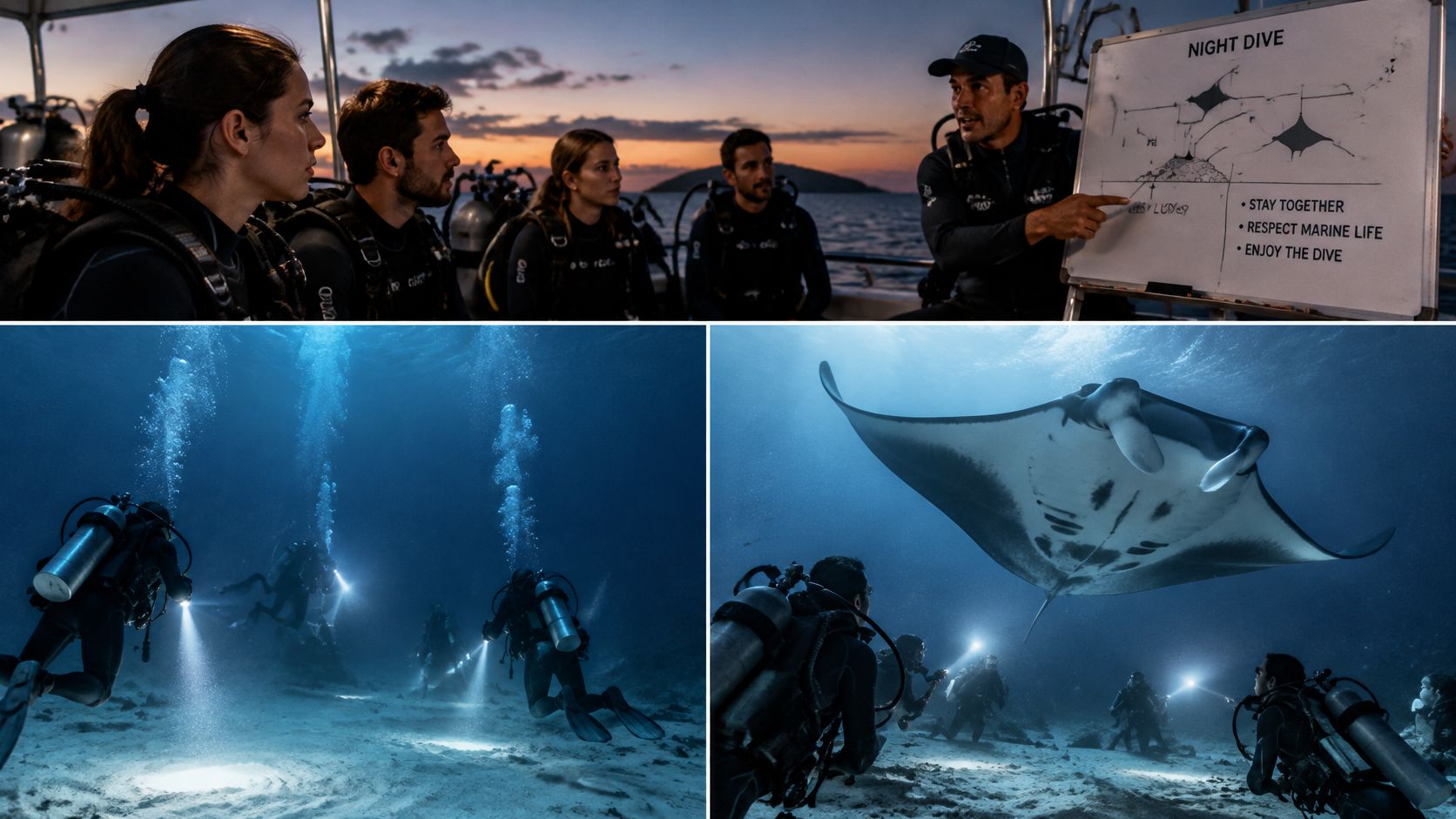
The order that actually works
Briefing and entry. You hear the current direction and the "park here" spot before you get wet. Entry is controlled. A scramble at the ladder wastes the calm you need later.
Descent to sand. Divers drop to the bottom, go neutrally buoyant, and settle. Knees or fins on the sand, body low, light ready. Snorkelers stay up on the light board.
Lights on, then the wait. Beams go into the water column. Plankton concentrates. Rays arrive to filter-feed. There is no bait. Current, light placement, and your behavior are the levers you have. A personal torch blasted into a face, or a diver drifting up into the flight path, breaks the loop.
Who stands where
Divers stay on the bottom, lights aimed up, bodies out of the forward path. Never grab, ride, or chase.
Snorkelers stay near the surface, lights aimed down. When a ray climbs toward the board, hold position, keep breathing, and let it pass. Reaching down is how people get a wing in the face and a worse view.
Photographers keep housings and arms tight. A camera in the mouth line is an obstruction, not a better frame.
Closer is not better. A clean pass inches overhead beats a chased animal that peels off into the dark.
Bubbles into the face and a blocked glide both ruin the feed. If you feel the urge to fin after the ray, you are already too active. Plant, watch, and let the next loop come to you.
Certification, Gear, and Photography Tips for the Night Dive
Scuba on this site needs an Open Water certification at minimum. You are on the bottom, in the dark, managing buoyancy while a large animal passes overhead. Mild current is normal. Surge in an exposed spot is not, which is another reason the cove layout matters. Snorkelers need no card. They do need to be honest about comfort at night on a boat. If you still need the card, book an open water certification on an earlier day, not the afternoon of the manta trip.
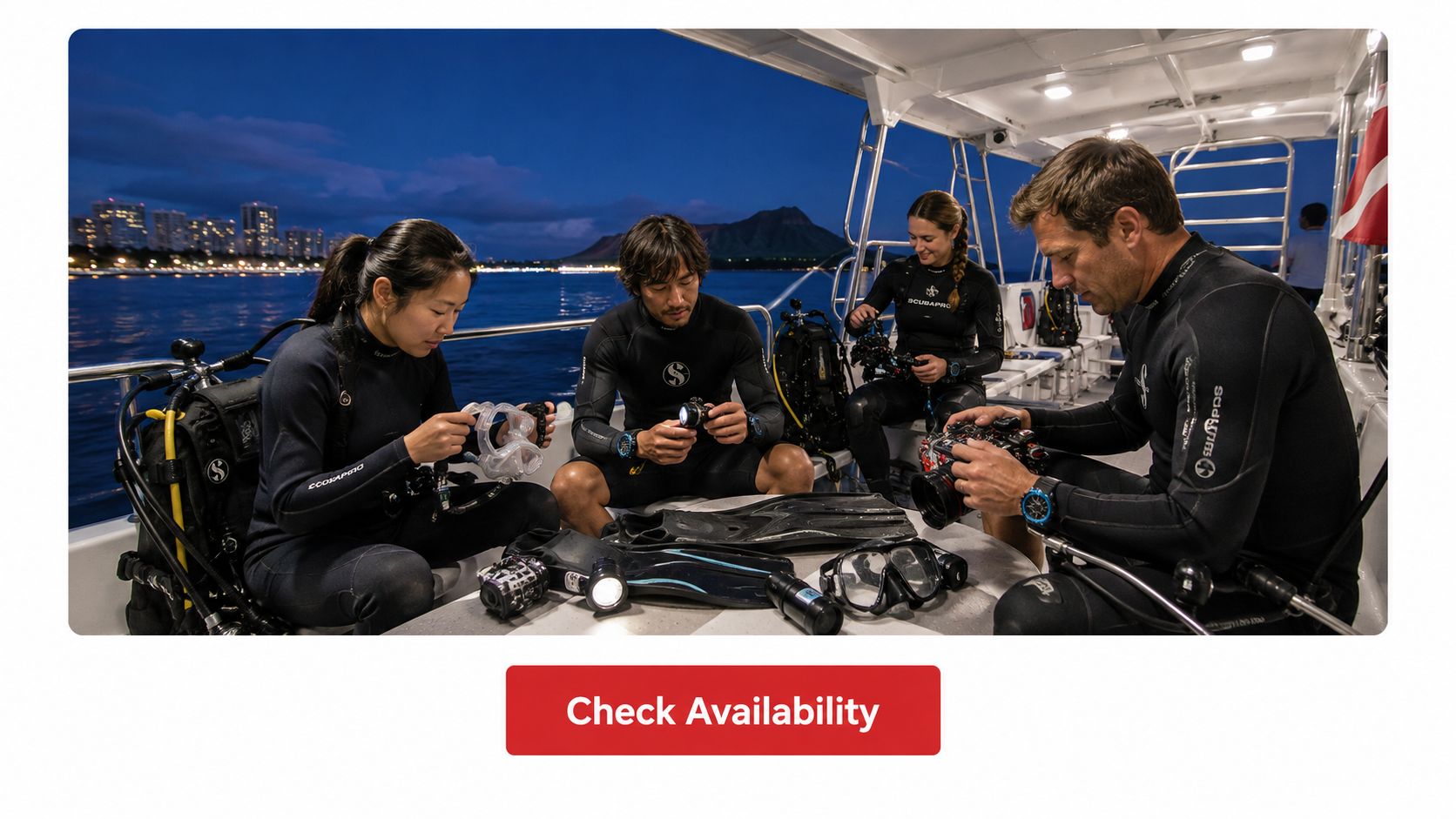
What to bring and what to rent
Your own mask if you own one that seals. A leaking mask at night is a distraction you cannot shrug off.
Rental BCD, regulator, and wetsuit from a boat that services gear on a schedule. Night failures are harder to sort than daytime ones. Ask for a light with fresh batteries, and a backup if you shoot video.
Nitrox, when it is included, gives certified nitrox divers more bottom time with the same animals. It does not create mantas. It only lets you stay for the second and third pass.
Camera settings that do not blind the ray
Set the camera on the boat. Wide angle, not a long lens. A broad wing fills the frame from a few feet away, and backing up is how you kick your buddy. Keep strobes and video lights off the eyes. Housings stay out of the animal's path, same as fins and hands.
Safety and conservation guidance is blunt about the rest. Divers on the bottom, snorkelers near the surface, lights up from below and down from above, no bubbles in the face, no gear blocking the animal. Hawaii protects manta rays from capture under state law, with penalties described as high as $10,000 and possible forfeiture of vessels or equipment. Accidental entanglement in fishing line and moorings is a major threat along this coast, even though these rays live relatively close to shore. If you see line on a mooring or trailing from a ray, tell the crew. Do not play hero with a knife in the dark.
Costs, Booking, and How to Choose a Manta Dive Operator
Price moves with the product, not with a secret manta fee. A two-tank afternoon-plus-night scuba trip costs more than a surface snorkel. Small groups, a boat with a head and shade, maintained rental gear, included lights, and complimentary nitrox all add cost that shows up as a calmer night. The cheap boat that stacks people on an exposed site saves money and spends it on surge, poor positioning, and a briefing nobody can hear.
What to compare before you pay
Divers per boat. Fewer people means a cleaner campfire and less fin traffic in the flight path.
Boat comfort. A head, shade, and a stable deck matter on a sunset departure, especially if you get seasick.
Gear and gas. Proactively serviced rentals and nitrox for certified divers change bottom time and failure rate.
Which site, really. "Manta dive" is not a site name. Ask whether the default is Garden Eel Cove.
Weather policy. You want a written line on wind cancellations, not a shrug at the dock.
Kona Honu Divers runs the two-tank manta dive and snorkel at Garden Eel Cove, with boat transport, a manta briefing, tanks, weights, and a dive light on the scuba version, plus a light board for snorkelers. The Kona crew counts over 60,000 collective dives and 200 years of combined staff time, on custom boats, with rental gear on a service schedule and complimentary nitrox. That is one concrete way to buy the site layout this guide favors. Read recent guest notes before you decide.
The manta ray dive and snorkel tour page lists what is included. If you are staying on the surface, the snorkel with manta rays notes cover the top-down version. Either way, check live dates instead of guessing a month.
Your Pre-Booking Checklist for a Kona Manta Night
Three bets, one line each. The boat goes if the sea allows. Mantas often come, and sometimes do not. The count follows plankton, not the month.
Check the card or choose snorkel only, pack a seasickness plan, and set the camera on deck. Confirm Garden Eel Cove and read the weather cancel line. After mantas, advanced two-tank trips reach remote lava and shark nurseries, and the blackwater night dive is the stranger option. Skim diver etiquette before you lock a date.
Kona Honu Divers runs guided manta nights at Garden Eel Cove for certified divers and snorkelers, with a clear briefing, maintained rental gear, and lights placed for feeding rather than a chase. If a realistic Kona manta night is the trip you want, check dates and site details with Kona Honu Divers and book while the weather window is still open.