
So, you’ve decided you want to breathe underwater. Good choice. It's the key to unlocking the other 70% of our planet, a world most people only see in documentaries. Your journey begins with a straightforward certification process that breaks down into three key phases: knowledge development, confined water dives, and finally, open water dives. This isn't about just ticking boxes; it's a proven system designed to build your skills and confidence from the ground up, turning you from a curious novice into a capable underwater explorer.
## Your First Breath Underwater: A New World Awaits
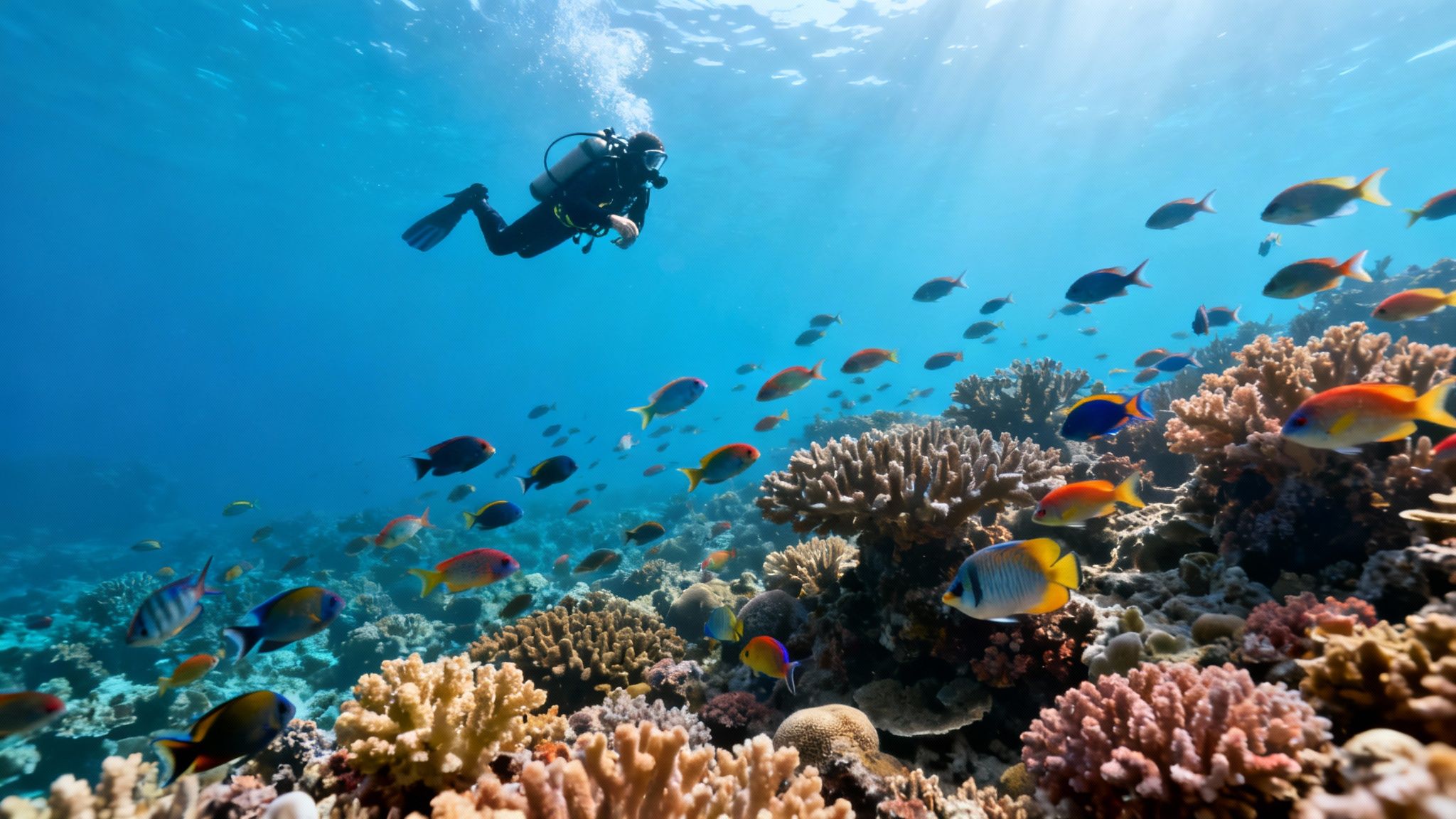
Picture this: you're floating, completely weightless, as a school of impossibly bright fish drifts by. The only thing you hear is the rhythmic, meditative sound of your own breathing. This isn't a daydream—it's the reality of scuba diving.
That first breath you take underwater is a moment you’ll never forget. It’s the second you cross the threshold from the world you know into a realm of incredible peace and quiet adventure. For many of us, that one moment was the start of a lifelong passion for the ocean.
Who Can Learn to Scuba Dive?
One of the best things about diving is how accessible it is. You don't need to be an Olympic athlete to explore the underwater world. The requirements are common sense and are all about ensuring you're safe and comfortable in the water.
- Basic Swimming Skills: You’ll need to swim 200 meters without stopping (there's no time limit, so don't stress) and be able to float or tread water for 10 minutes.
- Good General Health: You'll fill out a medical questionnaire to make sure you don't have any conditions that could cause problems underwater. Safety first, always.
- Minimum Age: Most dive agencies let kids as young as 10 years old start their certification journey.
And no, there's no maximum age limit. I've personally dived with people well into their 70s and 80s who are still actively exploring. As long as you maintain a reasonable level of fitness, you can keep diving.
Diving is as much a mental journey as a physical one. Mastering new skills—from assembling your gear to navigating a reef—builds a quiet confidence that stays with you long after you've surfaced.
What Is the Certification Process Like?
Your path to becoming a certified diver is cleverly broken down into three manageable parts. Each step builds on the last, so you're never thrown in the deep end (figuratively speaking!). This structure makes sure you feel safe and ready for whatever comes next.
If you're not quite ready to commit to the full course, you can always dip your toes in with a program like a Discover Scuba Dive in Kona, Hawaii. It’s a fantastic way to experience the thrill of breathing underwater for a day with an instructor right by your side.
For the full certification, here’s a look at what the journey entails.
The Path to Becoming a Certified Scuba Diver
This table gives you a snapshot of the three core stages you'll complete to earn your Open Water Diver certification.
| Certification Stage | What You Will Learn | Where It Happens |
|---|---|---|
| Knowledge Development | This is the "book smarts" part. You'll cover the basics of dive physics, physiology, equipment, and safety procedures. | At your own pace online, or in a traditional classroom. |
| Confined Water Dives | Now for the fun part! You'll get in the water and practice hands-on skills like clearing your mask, managing your buoyancy, and handling emergencies. | A swimming pool or a calm, pool-like body of a water. |
| Open Water Dives | This is where it all comes together. You'll complete four dives in a real-world environment, putting your new skills to use while exploring actual dive sites. | The ocean, a lake, or even a flooded quarry. |
Once you've successfully completed all three stages, you'll earn your Open Water Diver certification card. Think of it as your passport to the underwater world. This certification allows you to rent gear and dive with a buddy anywhere on the globe, typically to a maximum depth of 18 meters (60 feet). Your adventure is just beginning.
## Choosing Your Scuba Certification and Dive Course
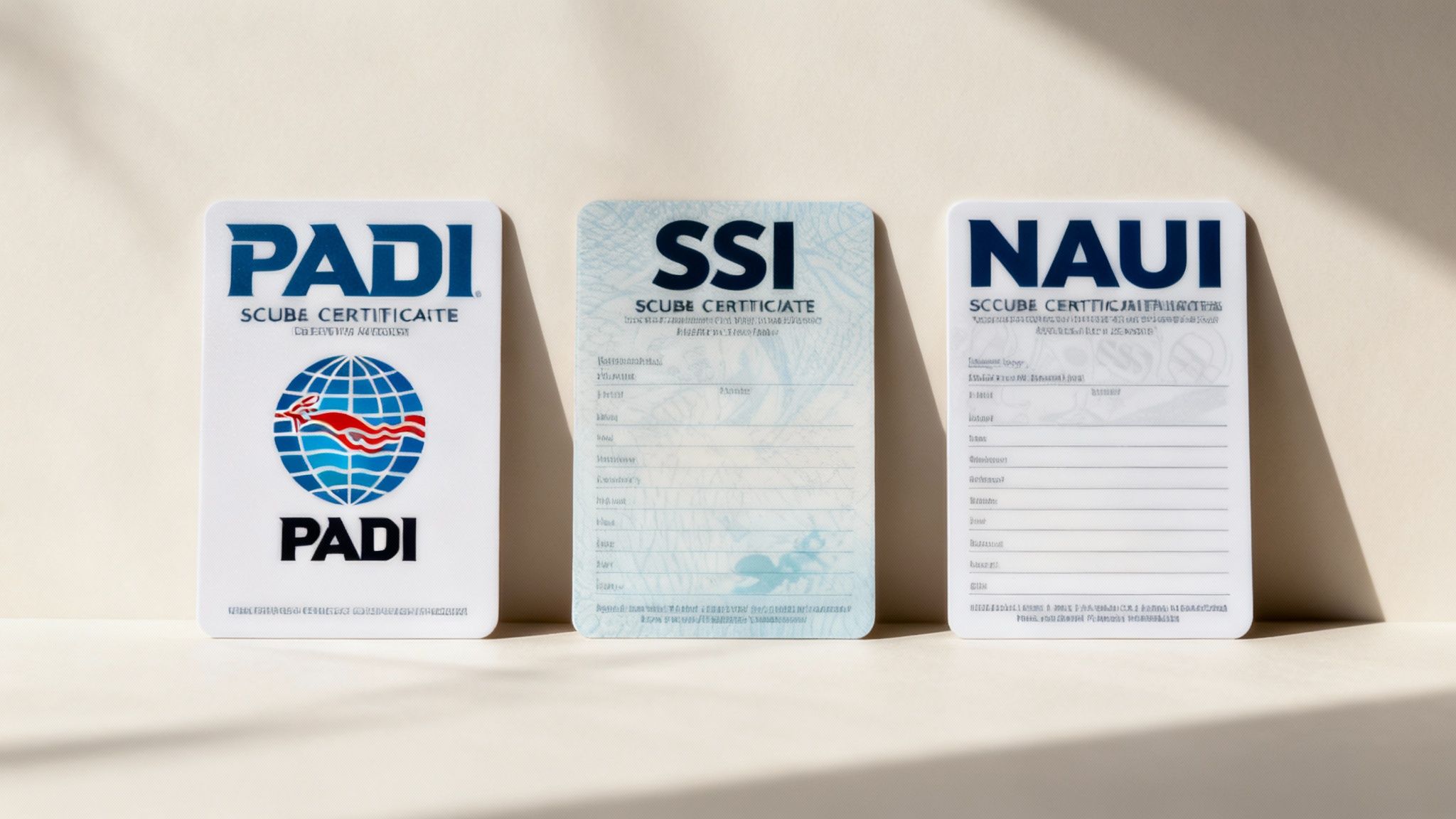
Think of your scuba certification card as more than just a piece of plastic. It's your passport to an entirely new world, opening up underwater adventures across the globe. So, when you decide you're ready to learn how to scuba dive, your very first big decision is picking a training agency and a course. This choice is the bedrock of your skills, safety, and overall confidence in the water.
You'll quickly find there are several globally recognized training agencies out there. While each has its own unique teaching style, they all follow strict safety standards laid out by the World Recreational Scuba Training Council (WRSTC). The "big three" you'll almost certainly come across are PADI, SSI, and NAUI.
Honestly, the core skills you learn are virtually identical no matter which agency you pick. The real difference often lies in the course structure. Some are rigid and linear, while others give instructors more leeway. At the end of the day, the quality and personality of your instructor will have a much bigger impact on your experience than the logo on your certification card.
PADI vs SSI vs NAUI: A Quick Comparison
So, how do you choose? It usually comes down to which dive shop and instructor you click with. But to give you a head start, here’s a simple breakdown of what makes them different:
| Agency | Teaching Philosophy & Materials | Global Recognition |
|---|---|---|
| PADI | Known for highly structured, performance-based learning. You'll typically need to buy the course materials separately. | The largest and most recognized agency in the world, hands down. |
| SSI | Built around a "Diver Diamond" philosophy (knowledge, skills, equipment, experience). Digital materials are often included in the course price. | A major global player with a strong presence everywhere. |
| NAUI | Operates under the motto "Dive Safety Through Education" and gives instructors more academic freedom to tailor the course. | The oldest recreational agency, it's highly respected, particularly in North America. |
The key takeaway is that any certification from these agencies will be accepted anywhere you want to dive. My best advice? Find a local dive center that feels right, talk to the instructors, and go with the agency they teach.
Knowledge Development: Online or In-Person
Before you even think about getting your feet wet, you have to nail down the theory. This "knowledge development" part of the course covers the essential principles of diving—everything from physics and physiology to equipment and safety drills. You've got two main ways to tackle this.
eLearning (Online): This is easily the most popular route today. You work through the theory on your own schedule, from anywhere you have an internet connection. Most students find it takes about 8-12 hours to complete the online modules. The huge advantage here is that you can get all the "homework" done before your trip, saving your precious vacation time for the fun stuff—the actual diving.
Classroom Learning: This is the old-school, traditional method. It’s a great option if you learn best with direct, face-to-face instruction and enjoy the dynamic of asking questions in a group setting.
Your First Breaths in Confined Water
Once you've got the theory down, it's time to head to "confined water," which is usually a swimming pool or a very calm, shallow spot in the ocean. This is where the magic happens. It's where you'll take your very first breaths underwater and start practicing the skills that will keep you safe and comfortable.
This is where it all starts to feel real. The confined water sessions are all about building muscle memory and confidence in a totally controlled, stress-free environment. You'll be amazed at how natural it feels to breathe underwater after just a few minutes.
With your instructor right there beside you, you'll get comfortable with essential skills like:
- Mask Clearing: Getting water out of your mask without having to surface. It sounds tricky, but you'll master it.
- Regulator Recovery: Practicing how to find your primary air source if it ever gets knocked out of your mouth.
- Buoyancy Control: This is the big one. You'll learn how to achieve "neutral buoyancy"—that incredible feeling of weightlessness that is the heart and soul of diving.
- Emergency Procedures: Running drills for sharing air with a buddy and performing a safe, controlled ascent.
Think of these sessions as building your foundation, brick by brick. Once you and your instructor are happy with your skills, you're ready for the most thrilling part of your training: the open water dives. If you're excited to see what's involved, you can check out these comprehensive Open Water Certification course details to see the full journey laid out.
## Getting to Know Your Scuba Gear
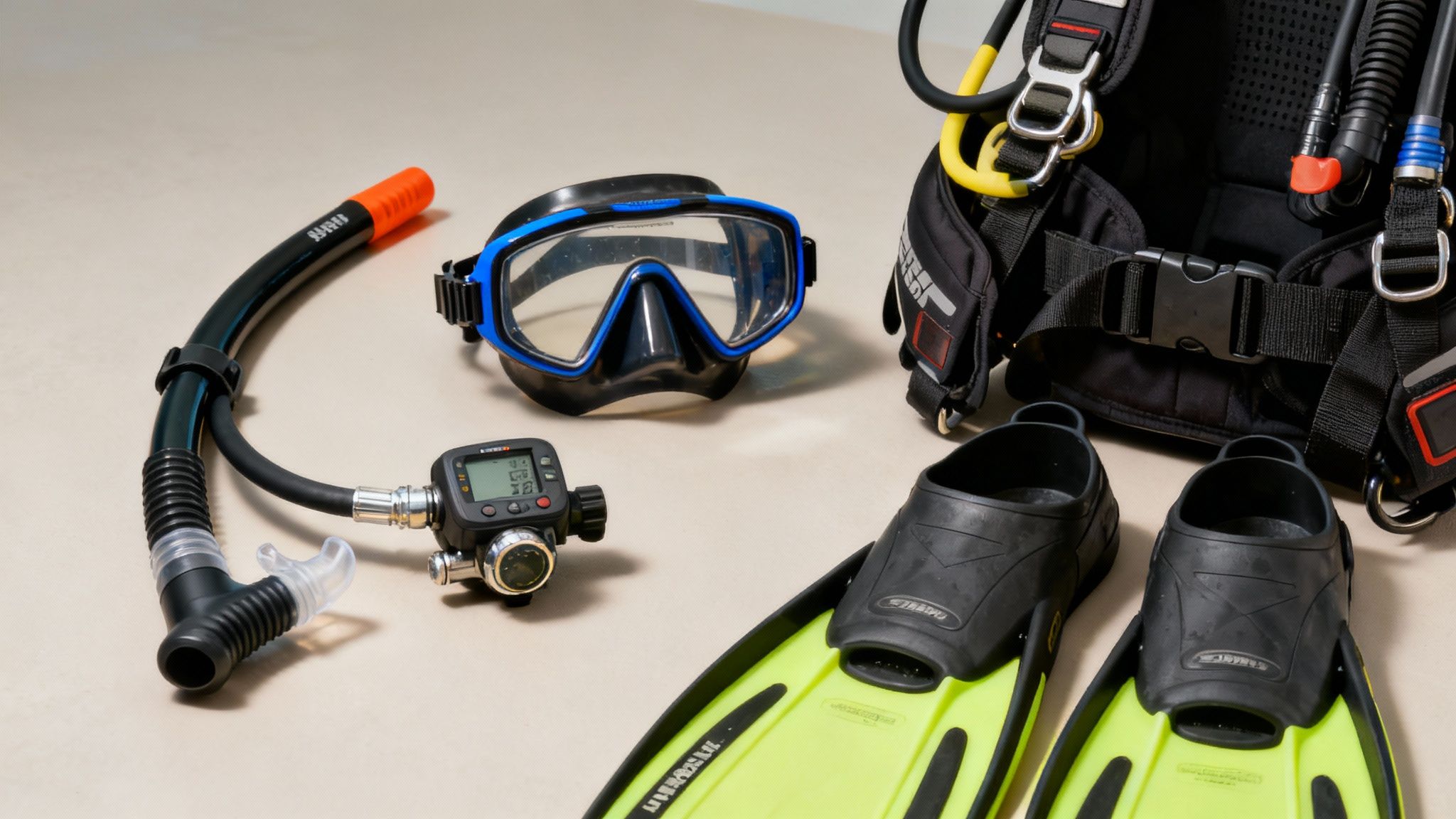
Think of your scuba gear as more than just equipment—it's your life support system. It’s what lets you breathe, move, and feel at home in a world you weren’t born to explore. Getting comfortable with how every piece works is a massive part of learning to dive. It’s what turns nervous energy into pure confidence, letting you focus on the fish, not the gear.
And a lot of people are getting into it. The global market for scuba gear is huge, sitting at around $1.2 billion in 2025. It's only expected to grow as more people discover the magic of the underwater world. You can actually see the full breakdown in this detailed industry report.
The Core Components of Your Kit
At first glance, all the straps and hoses can seem a bit intimidating. But it’s actually just a few key components working together. Your certification course will have you assembling, using, and caring for this gear until it becomes second nature.
- Mask, Snorkel, and Fins: This is your personal window to the underwater world and your engine. A good, non-leaking mask is probably the single most important piece of gear you can own. Your fins are what turn your kicks into graceful movement.
- Buoyancy Control Device (BCD): That vest you wear does more than just hold your tank. By adding or letting out small puffs of air, it allows you to fine-tune your position in the water and achieve that amazing feeling of weightlessness.
- Regulator: This is the brilliant bit of engineering that takes high-pressure air from your tank and delivers it to you for a smooth, easy breath. It also includes your backup regulator, an air gauge, and a depth gauge.
- Dive Computer: This is your best friend underwater. Worn on your wrist, it tracks your depth and time to make sure you stay well within safe diving limits.
We have a much more detailed breakdown of everything you'll need in our guide on the gear you will need for your Kona diving adventure.
The Big Question: Rent or Buy?
Every new diver wonders this. Should I drop a bunch of money on my own gear, or just rent from the dive shop? Honestly, there’s no single right answer—it all comes down to your budget and how often you see yourself diving.
Renting is a great way to start. You can get a feel for different styles and brands without the big price tag. Reputable shops like ours keep their rental gear in top-notch condition, so you know it's safe and reliable.
That said, most divers quickly decide to buy a few key items of their own.
Pro Tip: If you're going to buy anything, start with a high-quality mask that fits your face perfectly and your own dive computer. A mask that fits means no annoying leaks, and knowing your own computer inside and out is a massive plus for safety and confidence.
Once you’re hooked, you’ll probably want to invest in your own regulators and BCD. There's nothing like the comfort of knowing your gear is set up exactly how you like it every single time you hit the water.
What to Wear to Stay Warm
The wetsuit you wear is your "exposure protection," and it’s critical for staying comfortable. Water pulls heat from your body about 25 times faster than air, so even in warm, tropical water, you'll get chilly without it.
- Wetsuits: These are made from neoprene and work by trapping a thin layer of water against your skin. Your body quickly warms this water, creating an insulating barrier. They come in different thicknesses for different temperatures—a 3mm for the tropics, maybe a 7mm for cooler seas.
- Drysuits: For genuinely cold water, a drysuit is the way to go. It uses seals to keep you completely dry, and you wear warm clothes underneath for insulation.
Your instructor will know exactly what’s needed for the local conditions. They’ll make sure you have the right suit to keep you warm and comfortable from the moment you jump in to your final safety stop.
## Mastering Skills on Your First Open Water Dives
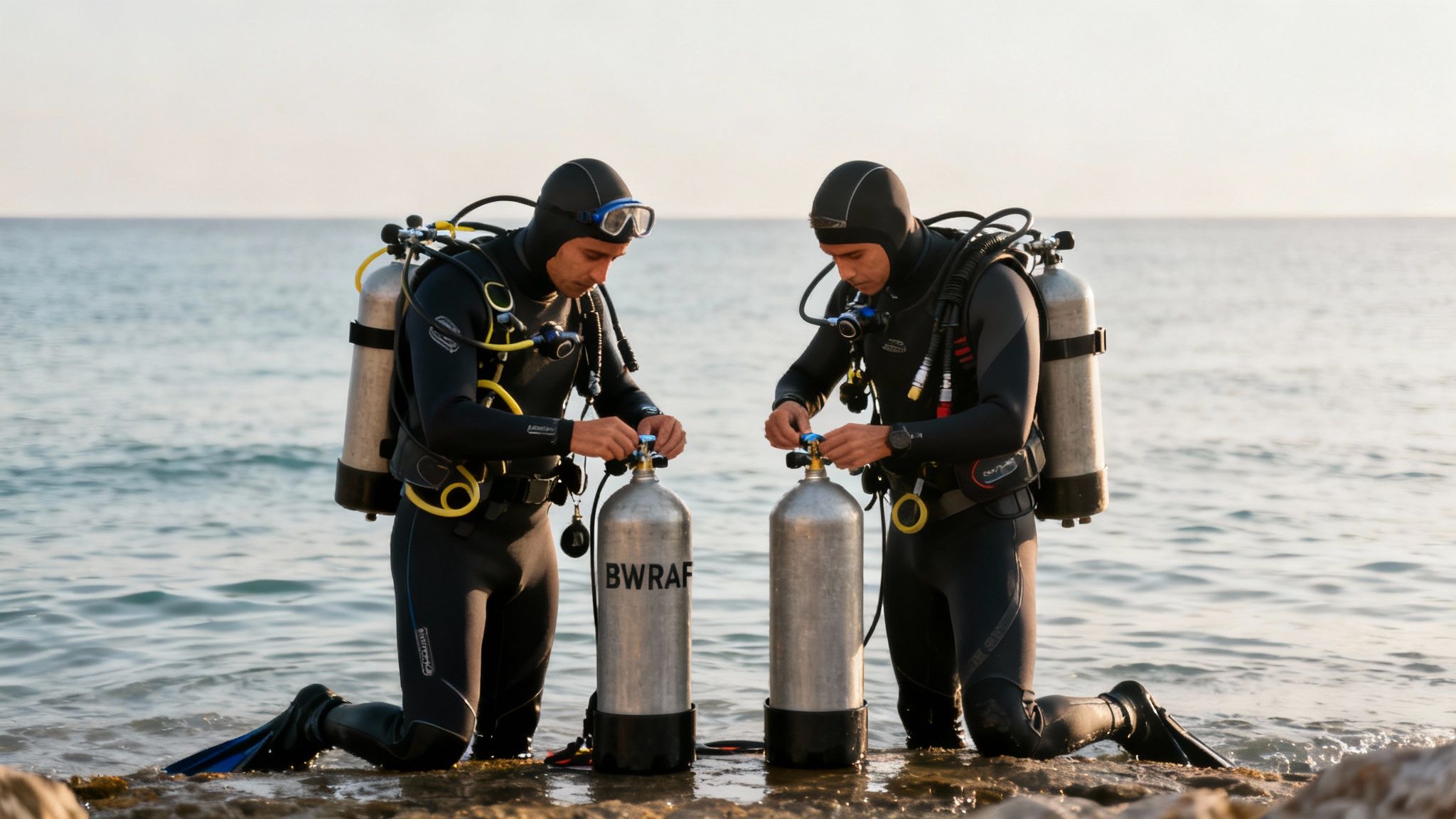
This is it. The moment everything has been building towards. After getting comfortable with the theory and nailing your skills in the pool, your open water dives are where you truly learn how to scuba dive. You're moving from the predictable world of a swimming pool to the incredible, living world of an ocean, lake, or quarry. This is where all that training solidifies into real-world experience.
It’s completely normal to feel a mix of pure excitement and a few butterflies. Just remember, your instructor is right there with you, guiding every fin kick. The whole point of these first dives is to show you can perform the skills you practiced, but this time in a natural setting. You'll put everything into practice, from assembling your gear on the boat to that first giant stride into the blue.
The Non-Negotiable Pre-Dive Safety Check
Before you even think about getting in the water, you and your buddy will run through a pre-dive safety check. This isn't just a first-day thing; it's a critical habit you'll use for the rest of your diving life. The easiest way to remember the steps is with the acronym BWRAF.
- B – BCD/Buoyancy: Give your inflator and deflator buttons a quick test. Partially inflate your BCD to make sure it holds air without any sneaky leaks.
- W – Weights: Double-check that you and your buddy have the right amount of weight and that your weight belts or integrated pockets are secure. Give it a little tug.
- R – Releases: Know where all the clips and straps are on your BCD. More importantly, know how to release your buddy’s gear in an emergency and have them point out yours.
- A – Air: Is your tank fully open? Take a few breaths from your regulator while glancing at your pressure gauge—the needle shouldn't move. This confirms your air is on and flowing properly.
- F – Final Check: Give each other a final head-to-toe once-over. Mask on? Fins on? Dive computer activated? Everything tucked away and streamlined? Good to go.
This check takes less than a minute, but it’s one of the most important safety rituals in diving. It builds instant teamwork with your buddy and ensures you’re both starting the dive on the right foot.
Understanding Diving Physics in Action
All that physics you learned about in your online course is about to become a very real, tangible feeling. The two big concepts you’ll get very familiar with are equalization and buoyancy.
Equalization is all about balancing the pressure in your ears with the water pressure around you as you descend. You'll simply pinch your nose and blow gently, feeling a little "pop." You need to do this early and often on your way down to avoid any discomfort. Don't wait for the pain!
Buoyancy control is the true art of diving—it’s how you achieve that feeling of weightlessness. By adding tiny puffs of air to your BCD, you can fine-tune your position in the water, hovering effortlessly over the reef without touching anything. This is what separates a good diver from a great one, and it’s a huge focus of your open water training.
Your first successful hover—that moment you're completely motionless, neutrally buoyant, and weightless—is a pure "aha!" moment. It's the instant you stop swimming and start truly diving, moving with a kind of freedom you've never felt before.
Communicating Without Words
Underwater, hand signals are your language. You'll use them for everything from letting your buddy know how much air you have left to pointing out a cruising sea turtle. Your course will focus on the absolute essentials you need to communicate clearly with your instructor and dive buddy.
For anyone looking for a truly spectacular place to get certified, the clear, warm waters and vibrant reefs of scuba diving Kona, Hawaii, are pretty hard to beat. The conditions are often perfect for new divers, and the sheer amount of marine life makes every single dive a memory. A top-notch operator like Kona Honu Divers can make that training experience unforgettable.
From managing those first-dive jitters to remembering to breathe slowly and relax, your open water dives are where you build the confidence to explore the other 71% of our planet. Those first breaths in a vast, open environment are something you'll cherish forever. Ready to take the plunge?
Check Availability
## You’re Certified! So, What’s Next?
Congratulations, you did it! You’re officially an Open Water Diver. That little card in your wallet is more than just plastic—it's your passport to a whole new world. But getting certified isn't the finish line; it’s the starting block.
Think of it like getting your driver's license. You know the rules of the road and how to handle the car, but the real learning happens once you start exploring on your own. Now, the real adventure begins.
Your Logbook is Your Best Friend
Get in the habit of logging every single dive. I know, it can feel like homework after an amazing time underwater, but trust me on this one. Your logbook is your personal diving diary, and it quickly becomes one of your most valuable tools.
It’s where you’ll track how much weight you needed with that new wetsuit, see your air consumption improve over time, and remember the name of that crazy-looking fish you saw in Bonaire. These details build a picture of your progress and turn you into a smarter, more confident diver.
Keep the Learning Going
Your Open Water certification is a license to learn, and the best way to do that is to keep diving and take the next step in your education. For most new divers, that means signing up for the Advanced Open Water Diver course.
Don't let the name "Advanced" intimidate you. This course isn't about highly technical skills; it's about building confidence and expanding your abilities with an instructor by your side. You’ll complete five "Adventure Dives," which are basically introductions to different diving specialties.
Two dives are required for everyone: Deep Diving (which certifies you to 30 meters/100 feet) and Underwater Navigation. For the other three, you get to choose what sounds exciting to you. It's the perfect way to sample different kinds of diving, like:
- Night Diving: See the reef come alive with creatures that only come out after dark.
- Wreck Diving: Learn the basics of safely exploring sunken ships and planes.
- Peak Performance Buoyancy: Master your hover and become the diver who glides effortlessly through the water.
- Fish Identification: Go from pointing at "a yellow fish" to knowing you just saw a Longnose Butterflyfish.
Finishing this course opens up a massive number of dive sites around the world that are off-limits to basic Open Water divers. It’s a game-changer.
Your Open Water course teaches you how to survive underwater. The Advanced course teaches you how to really dive, giving you the skills to explore new places and try new things with total confidence.
Time to Plan Your First Real Dive Trip
With your certification in hand, the fun part begins: deciding where to go. Planning that first big dive trip is an amazing feeling. And you’re not alone—an international study led by researchers at UC San Diego's Scripps Institution of Oceanography found that scuba diving contributes between $8.5 billion and $20.4 billion to the global economy every year. You can read the full study on diving's economic impact on Divernet.com.
For your first trip, I always recommend looking for destinations with beginner-friendly conditions: calm water, great visibility, and reefs that aren't too deep. The Kona coast on the Big Island of Hawaii is a perfect example. It's known for its incredibly clear and protected waters and is home to some truly unforgettable experiences, like the world-famous manta ray night dive.
As you gain more confidence, you can explore more dynamic sites. Here in Kona, we run advanced dive tours that take divers to explore the deeper reefs and unique volcanic structures. No matter where you go, diving with a reputable, local guide will make your trip safer and so much more memorable.
Finally, always remember to dive with care. You now have a front-row seat to the most beautiful and fragile ecosystems on Earth. Be an ambassador for our oceans: perfect your buoyancy to stay off the coral, secure your gauges so they don’t drag, and support dive operators who are serious about conservation.
Check Availability
## Common Questions About Learning to Scuba Dive
If you're thinking about getting certified, you probably have a few questions swirling around. It's totally normal. Most new divers start with the same set of curiosities, so let's clear the water on some of the most common ones.
How Safe is Scuba Diving, Really?
This is usually the first question on everyone's mind, and for good reason. The truth is, scuba diving has an incredibly strong safety record, but that's no accident. It's safe because we follow the rules.
Decades of experience have gone into creating the training standards we use today. The most important things you'll learn are to always dive within your limits, double-check your gear before you get in the water, and never, ever hold your breath. Stick to what you learn in your course, and you'll build the safety-first habits that keep divers exploring for a lifetime.
Do I Need to Be an Olympic Swimmer?
Not at all. You don't need to be a competitive swimmer, but you absolutely need to be comfortable and confident in the water.
To make sure you have a basic level of watermanship, your instructor will have you complete two simple tests:
- Swim 200 meters/yards. There's no time limit, and you can use any stroke you like.
- Float or tread water for 10 minutes without any flotation aids.
These aren't meant to be grueling challenges; they just confirm you can handle yourself in the water before you add a bunch of scuba gear into the mix.
What’s the Real Cost to Get Certified?
The price tag for an Open Water Diver certification can vary quite a bit, typically falling somewhere between $400 and $800. The final cost really depends on the location, the size of your class, and what the dive shop rolls into their package.
Pro Tip: Always ask what's included. Some shops offer an all-in-one price that covers your rental gear, boat trips, and certification fees, while others charge for those things separately. Think of it as an investment in a skill that opens up 71% of the planet.
What About Sharks?
Ah, the Jaws effect. This is easily one of the most common anxieties for new divers, but it's almost entirely fueled by Hollywood. In reality, seeing a shark on a dive is a special and surprisingly calm experience. Most are shy, curious, and have zero interest in divers.
Unprovoked incidents are exceptionally rare. A huge part of your training is learning to be a respectful guest in the underwater world. Once you see these incredible animals in their natural habitat, that initial fear almost always turns into pure fascination.
Ready to see for yourself what the underwater world has to offer? At Kona Honu Divers, we're passionate about creating safe, confident divers who love the ocean. Take a look at our certification courses and start your own adventure!
Check Availability