
A six-year photo-identification study recorded 25,444 sightings of 118 individual reef manta rays at two west Hawaiʻi sites from January 2009 through December 2014. That record helps explain why Kona can offer unusually consistent manta encounters, but it doesn't make any single night predictable: prey, currents and ocean conditions still shape what divers see, according to the NOAA-hosted manta-ray study.
Kona scuba diving ranges from shallow reef exploration to lava formations and night dives over open water. The best trip isn't just the most famous one. It's the one that fits your certification, comfort in the water and expectations about wildlife.
Kona Scuba Trips at a Glance and Who Each One Suits
| Trip | Best for | Certification needed | Time of day |
|---|---|---|---|
| 2-Tank Local Morning Dive | Certified divers wanting reefs, lava tubes and arches | Certified divers | Morning |
| Premium Advanced 2 Tank Trip | Experienced divers wanting remote sites and drift dives | Certified, advanced level | Morning |
| Manta Ray Night Dive | Divers and snorkelers wanting nighttime wildlife | Certification required for divers; none for snorkelers | Night |
| Black Water Night Dive | Divers curious about open-ocean life after dark | Certified divers comfortable in open water at night | Night |
| Morning Introductory Scuba Dive | First-time divers wanting a guided shallow reef dive | Not required | Morning |
| Discover Scuba Diver (DSD) | Non-certified people wanting a taste of diving | Not required | Calm-water session before a shallow reef dive |
Kona Honu Divers runs these Kona trips.
Kona's leeward coast is partly shielded from prevailing trade winds, making it a useful base for diving. That shelter doesn't guarantee calm water at every site. Local swell, tide and the shape of lava shelves can still affect entries and underwater conditions.
Make three decisions before you book
First, check certification. Certified divers can choose a boat reef dive, an advanced trip or a night dive that matches their experience. If you aren't certified, an introductory dive or Discover Scuba program offers a guided first taste without requiring a certification card. This guide to beginner scuba diving on the Big Island can help you compare those starting points.
Next, decide when you want to dive. Morning trips are a good way to get familiar with Kona's reef and terrain. A night dive has a different focus, whether you're watching mantas feed or looking for small open-ocean life.
Finally, choose reef or open water. A reef dive gives you a bottom, structure and a clear route to explore. Blackwater diving takes you away from the reef into open ocean after dark, so it suits divers who are already comfortable managing their buoyancy and equipment.
Simple starting rule: If you're certified but new to Kona, begin with a two-tank morning dive. Add a night dive after you've had a chance to settle into the reef environment.
Certification, Gear and Packing for Kona Dives
| Course | Who it suits | What it adds |
|---|---|---|
| PADI Scuba Certification Course | Beginners wanting a first certification | Full entry-level training |
| Discover Scuba Diver (DSD) | Non-certified people trying diving | One calm-water lesson and a shallow reef dive |
| PADI Open Water Referral Course | Divers finishing their classroom or pool work elsewhere | Open water dives in Kona |
| PADI Advanced Open Water | Certified divers adding skills and depth experience | Broader skill set for deeper sites |
| PADI Enriched Air Diver | Divers wanting to use nitrox | Certification to dive enriched air |
| PADI Rescue Diver | Divers wanting to help in emergencies | Rescue and problem-solving skills |
| PADI Deep Diver | Divers planning deeper dives | Deep-diving planning and limits |
| PADI Boat Diver | Divers who often dive from boats | Boat entry and recall skills |
| PADI Peak Performance Buoyancy | Divers wanting better control | Refined buoyancy for reef and lava work |
| PADI Reactivate | Lapsed divers returning to the water | Refresher before diving again |
| Kama'aina Dive Courses | Local visitors and residents seeking a local course | Local dive training suited to the participant |
The right course depends on what you want to do underwater, not just on how many days you have. If you're planning a first certification, the Big Island scuba certification options are a starting point for comparing training paths.
Nitrox in plain language
Nitrox, also called enriched air, contains more oxygen and less nitrogen than standard air. Some divers choose it for multi-dive days, but you need an Enriched Air certification to use it. Don't treat nitrox as a way to ignore depth, time or gas-planning limits. Your training and dive plan still apply.
Before choosing a course or trip, be honest about your recent water time. A refresher can help if you're returning after a long break or feel rusty with mask clearing, buoyancy or basic equipment checks. Divers who are comfortable with the fundamentals can get more from a reef dive because they can spend less attention on handling simple tasks.
A practical packing list
- Certification card and logbook: Bring proof of training and a record of your recent dives.
- A 3mm suit: It's a practical exposure layer for Kona's warm water. If you chill easily, bring an extra layer you know works for you.
- Reef-safe sunscreen: Apply it before boarding, and use a rash guard for added sun protection.
- Rash guard: It also helps protect your skin from abrasive lava around shore entries.
- Personal mask and fins, if you own them: Familiar fit can make a dive more comfortable.
- Dry bag: Keep your clothes, phone and other belongings protected from spray on the boat.
Rental gear can be a convenient choice when you don't want to travel with bulky equipment. Ask the crew to help you check the fit and function of your setup before you enter the water. Rental gear is serviced before each trip, so you can focus on the dive rather than packing a full kit.
Kona Dive Sites by Terrain and What Lives There
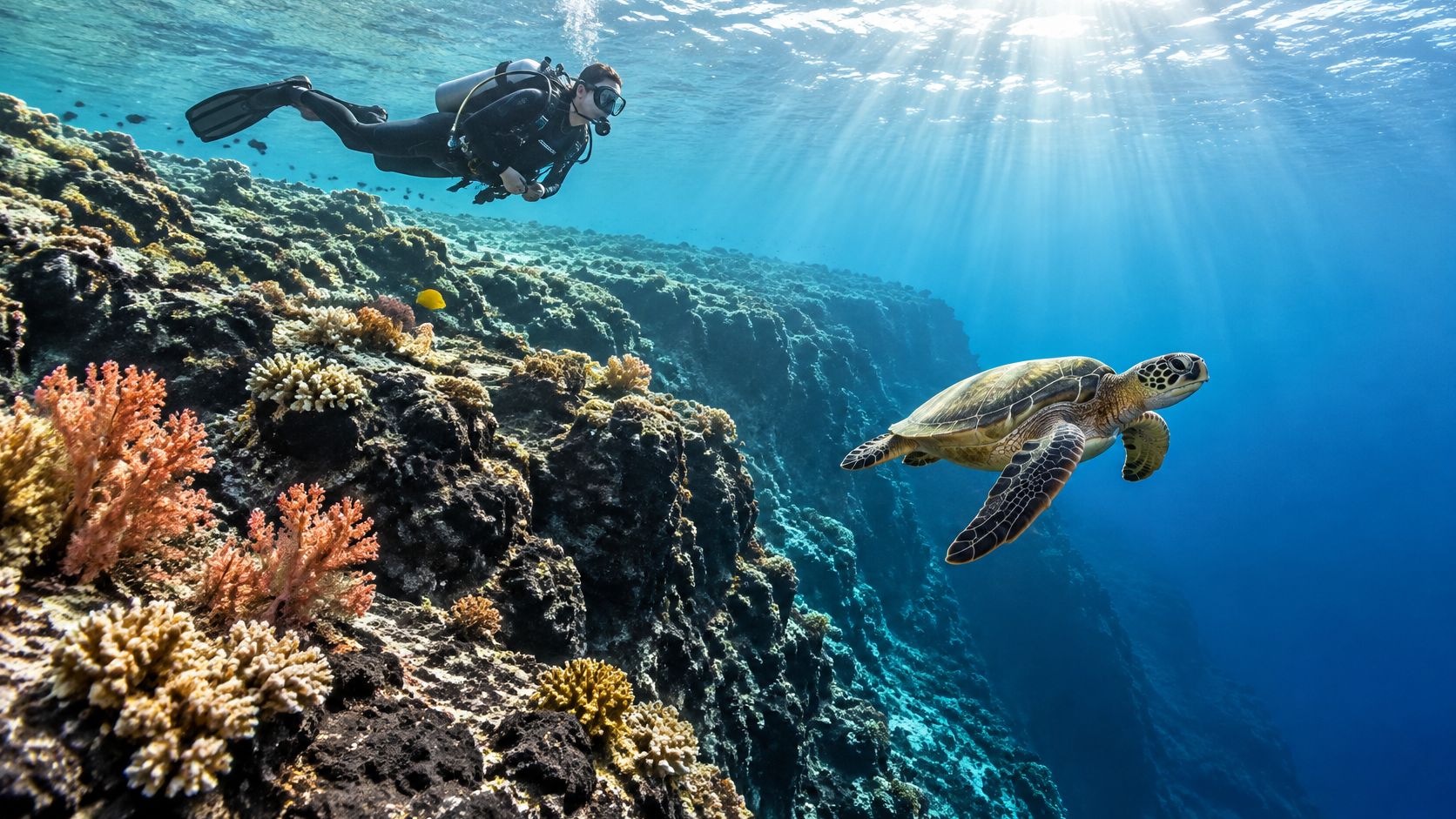
Kona's underwater terrain comes from volcanic processes. A dive can cross lava shelves, reef growth and steep drop-offs, with the bottom changing quickly over a short distance. The Big Island dive-site overview describes 52 documented dive sites, from shallow beginner reefs to advanced overhead environments.
1. Shallow lava shelves and the Old Kona Airport area
At the Old Kona Airport Marine Life Conservation District, shallow lava fingers extend offshore to about 50 feet (15 m) before the bottom drops rapidly into deeper water, according to the Hawaiʻi Division of Aquatic Resources. That quick depth change matters for gas planning and ascent control.
Shore divers should assess each entry on the day rather than assume that a calm-looking surface means a safe step in. Sharp lava, surge and changing swell can make an entry or exit hazardous. Stay neutrally buoyant above reef and rock, and don't scrape against the shoreline while gearing up.
For visitors weighing a guided boat trip against shore diving, this overview of Big Island shore-diving options helps frame the choice. Shore diving rewards careful site selection and self-management; a boat lets the crew select a site based on conditions.
2. Coral gardens and arches
Coral gardens offer a gentler way to read Kona's reef. Look for fish moving through the coral and around lava structure, and give yourself time to settle into the depth and visibility before moving on. Arches add shape and create memorable swim-by views, but they're best enjoyed with controlled buoyancy and a comfortable distance from fragile growth.
A standard two-tank local morning dive is a suitable choice for certified divers who want to explore reef terrain and lava features without making an overhead penetration the focus. The scenery can look dramatic, but a route through open water is not the same as an invitation to enter a cave.
3. Lava tubes and caverns
Lava tubes and caverns are overhead environments: rock can restrict a direct ascent, and narrow passages may leave little room to correct poor positioning. Horseshoe Canyon's Sarcophagus Cave is an example of a more technically demanding lava-tube penetration.
Reduced visibility inside lava formations can make navigation harder. Use additional lighting where appropriate, keep buoyancy and fin movement controlled, and choose a dive that matches your training and comfort with overhead settings. Scenery alone isn't a reason to enter a passage.
4. Deep pinnacles and steep walls
Deeper drop-offs and drift dives call for more experience, deliberate gas management and the ability to follow a changing profile. Divers seeking these conditions can consider the Premium Advanced 2 Tank Trip, which is intended for certified divers ready for advanced sites.
Match the terrain to your training and comfort, especially when a dive includes an overhead feature or a rapid change in depth. A safer, more enjoyable dive is the one you can manage calmly, not the one with the most dramatic description.
How Manta Night Dives Work and What You Will See
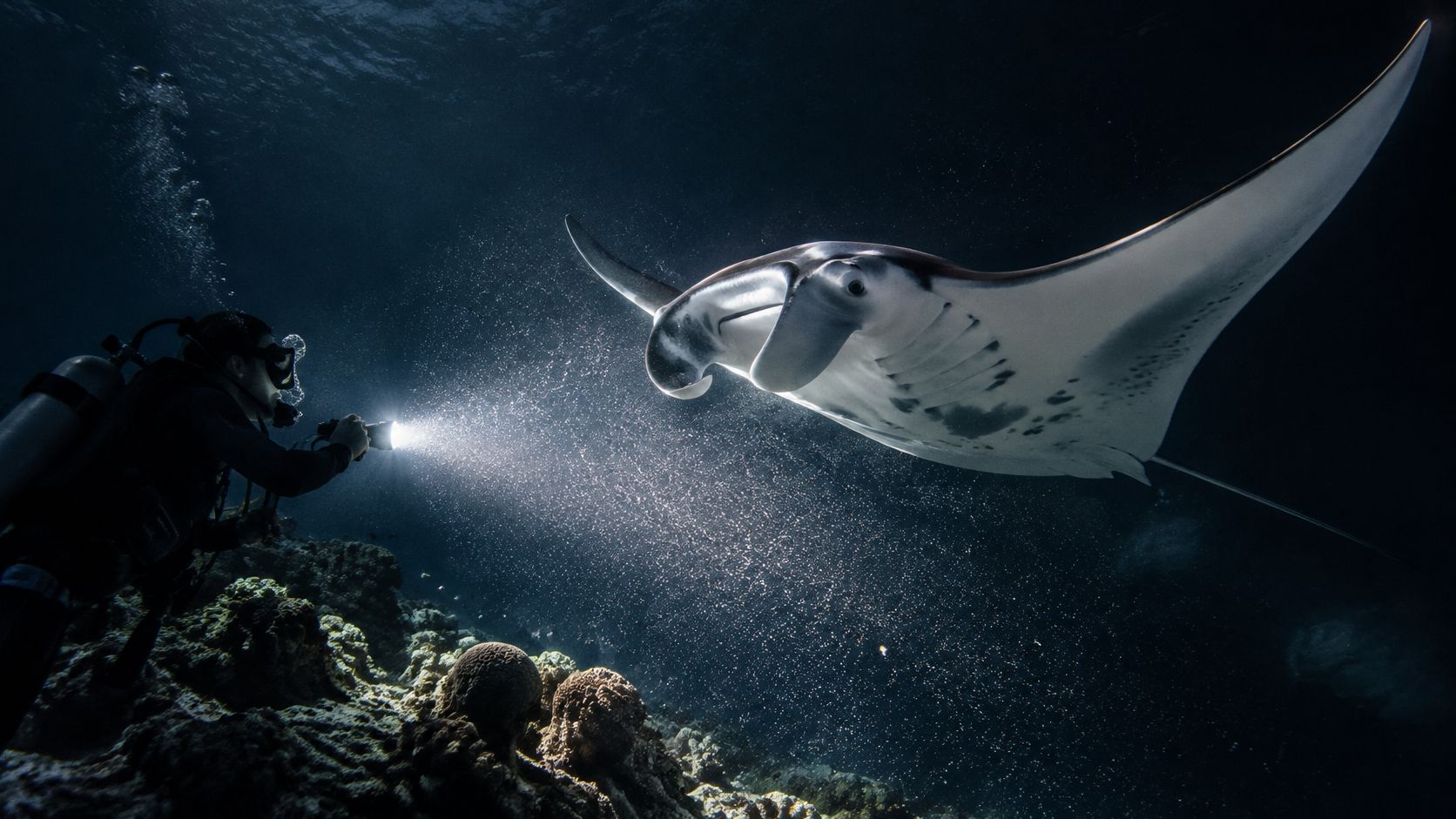
A dive light can work like a porch light that draws moths. In the ocean, the light concentrates plankton in the water column, and reef manta rays follow the food. The lights don't summon a guaranteed performance. They create a feeding opportunity that can attract mantas when plankton and conditions line up.
A six-year photo-identification study recorded 25,444 sightings of 118 individual reef manta rays at Manta Heaven and Manta Village from January 2009 through December 2014. Thirty-nine of those 118 identified mantas appeared on more than 10% of study nights, according to the NOAA-hosted photo-identification study. Repeat visits help explain why encounters can be consistent over time, but they don't promise a particular number of animals on the night you dive.
A typical dive from briefing to viewing
At dusk, the crew explains where divers should settle and how to handle the lights and wildlife encounter. Once in the water, divers usually move into a designated position near the bottom or another approved viewing area. When the lights come on, plankton gathers in the illuminated water. If mantas arrive, they may loop through that food-rich patch above the divers.
The best view often comes from holding still. Chasing an animal or finning hard can disturb the scene and make it harder for others to see. Manta activity can also shift with prey density, currents and moonlight, so a quieter night is part of wildlife diving, not proof that the operator has failed.
Give the animals room
- Stay low or in your assigned position: Don't rise into the mantas' feeding path.
- Never touch or chase a manta: Let the animal choose its distance and direction.
- Control fins and exhalation: Keep movements measured so you don't disturb the group or stir up the bottom.
- Leave a clear corridor above the viewing area: Mantas need room to pass through the plankton.
- Photograph with restraint: Maintain buoyancy and avoid aiming strobes into a manta's face at close range.
A good encounter is one where divers can observe without crowding or pursuing wildlife. Keeping the water column open and predictable benefits both the animals and the people watching.
Choosing Garden Eel Cove for Your Manta Night
For a manta night dive, Garden Eel Cove is the recommended choice for its protected location, better viewing area and better reefs. The 2-Tank Manta Dive & Snorkel tour runs from this site.
| Factor | Garden Eel Cove | Keauhou |
|---|---|---|
| Typical aggregation size | Larger and more variable | Smaller |
| Sighting mix | Manta sightings across the aggregation | 91% of recorded sightings female |
| Setting | Protected location, better viewing area, better reefs | Alternative Kona manta site |
| Best for | Reliable, larger groups and the recommended manta tour | Readers who prefer fewer animals and a quieter water scene |
A 13-year community-science dataset recorded more than 23,000 sightings of 167 unique reef manta rays at Garden Eel Cove and Keauhou from 2010 through 2022. It found that Garden Eel Cove generally had larger and more variable aggregations, while Keauhou had smaller aggregations and a strong female bias, with 91% of recorded sightings at Keauhou female, according to NOAA's manta-ray status-review material.
Keauhou may appeal if you'd rather spend time in a quieter water scene and are comfortable with fewer animals on average. Garden Eel Cove is the stronger fit if you're prioritizing the established viewing setup and a chance of seeing larger groups. Neither site turns wildlife into a scheduled show.
What a quiet night means
Manta aggregation size changes with zooplankton density, currents and other ocean conditions. Moonlight, weather and the local distribution of food can all influence what happens on a particular night. A sparse encounter can reflect those conditions rather than operator failure or a declining population.
The longer-term record shows that manta aggregations have remained site-specific despite increased tourism, but it also points to the importance of prey availability and responsible interaction. If mantas are scarce, take in the reef and plankton around the lights, keep your position, and reschedule if your trip allows it.
Blackwater Night Dives and Open-Ocean Wildlife
A blackwater dive is like holding a lantern in a snow globe, except the “flakes” are living organisms moving through dark open ocean. There's no reef beneath you to use as a reference point. Divers hover near the lights while small animals rise from deeper water after dark.
A NOAA-supported study examined 59 recreational blackwater scuba surveys off the Kona coast between November 2013 and May 2015. The most abundant groups were salps, siphonophores and ctenophores, which are rarely encountered on ordinary daytime reef dives. The study's model explained 43% of observed variation in biodiversity, with water temperature, seafloor bathymetry and the El Niño–Southern Oscillation index among the strongest predictors, according to the NOAA-hosted blackwater study.
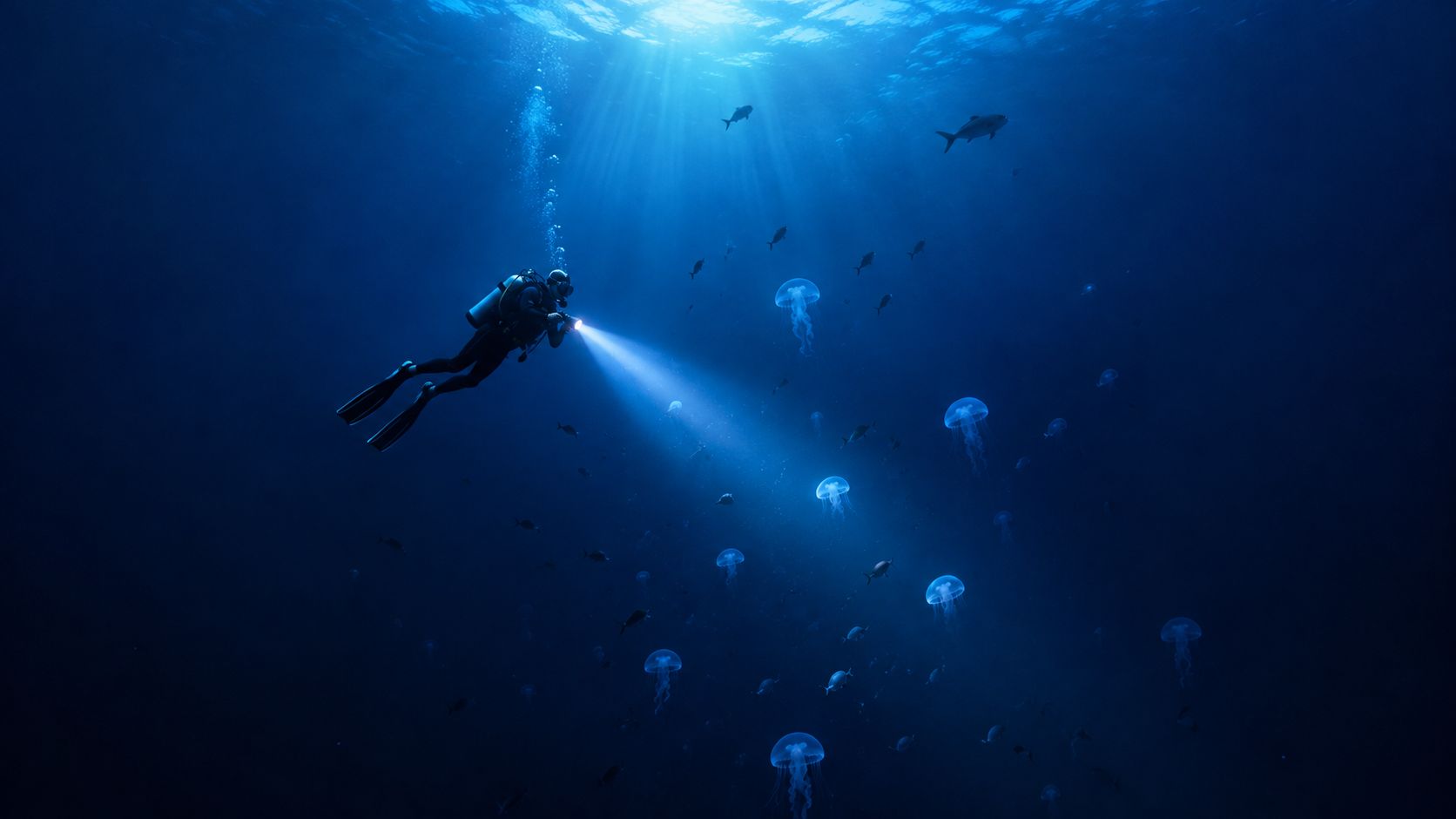
That variability is part of the appeal. One dive may reveal drifting gelatinous animals or other small pelagic life; another can look different because ocean conditions have changed. Blackwater diving is also useful to scientists studying larval marine organisms, which can be difficult to identify from casual visual observation alone.
Who this dive suits
Choose blackwater if you're a certified diver who's comfortable at night, has good buoyancy control and can stay calm without a bottom to orient by. If open water or darkness makes you uneasy, start with a reef night dive or a daytime boat dive before choosing this format.
The Black Water Night Dive is a specialized trip, not just a regular reef dive after sunset. Before booking, ask about the in-water setup, how the crew manages diver positioning, what equipment is provided and what experience level they expect. A clear briefing and a conservative approach matter when the surrounding water offers few visual reference points.
Kona Seasons, Swell and Moon Phase by Period
| Period | Typical conditions | Best-fit trips | What to check |
|---|---|---|---|
| Summer, roughly May to October | Calmer, more predictable leeward seas | 2-Tank Local Morning Dive, Premium Advanced 2 Tank Trip, shore dives | Surface swell and boat schedule |
| Winter, roughly November to April | Larger north and west swells, rougher entries | Morning dives in calm windows, sheltered sites | Swell forecast and possible site change |
| Full-moon nights | Brighter ambient light; effect on manta activity varies | Manta Ray Night Dive, Black Water Night Dive | Moon phase and a spare night |
| Days after heavy rain | Possible reduced clarity from runoff and surge | Morning reef dives | Operator conditions report the day before |
Kona's leeward coast is partly protected from prevailing trade winds, but that protection doesn't remove local swell, tide or surge. Lava shelves shape how water moves at the shoreline, so a site can have a rough entry even when the coast looks calm from a distance.
The summer period is often easier to plan around because leeward seas are generally calmer and more predictable. In winter, north and west swells can make some entries rougher, so boat crews may shift to more sheltered sites. For more seasonal planning, see this guide to the best months to scuba dive in Hawaii.
Plan for conditions, not a calendar promise
A full moon makes the night brighter, but it doesn't tell you whether mantas will feed at a particular site. Prey distribution and water movement still matter. After heavy rain, runoff and surge can temporarily reduce clarity, so check the operator's conditions report the day before rather than relying on a general seasonal expectation.
Visibility is a day-to-day condition, not a fixed feature of the trip. Ask whether the planned site has changed and whether the crew expects a rough entry or surge. If you're considering a shore dive, make a fresh site-specific assessment and don't enter if the conditions exceed your comfort.
Planning rule: Keep a spare night for a manta dive and a backup morning for reef diving. The ocean decides which sites are suitable and whether a planned trip can run.
Book Your Kona Dive Trip and Answer Common Questions
A good booking starts with fit, not with a bucket-list label.
- Match your certification to the trip. Use the trip comparison at the start of this guide to check whether you're suited to a morning reef dive, advanced trip, manta dive or blackwater experience.
- Choose a date with a backup. Conditions can change, so leave room to move a night or morning dive if the site or weather doesn't cooperate.
- Reserve your place through the Kona Honu Divers schedule. Kona Honu Divers offers guided reef and advanced trips, as well as manta and blackwater night dives.
Before a manta trip, ask direct questions about passenger limits, mooring practice, the in-water briefing, emergency procedures, light placement, wildlife-contact rules and what the crew does if the site becomes crowded. Crowding matters: a survey of 444 manta-viewing participants found that 82% felt crowded by snorkelers, 78% by boats and 69% by scuba divers, and manta sites can attract as many as 30 boats and 300 participants per day, according to the Hawaiʻi County manta-viewing testimony and safety material.
A responsible encounter doesn't require pushing animals closer or adding more lights. It depends on organized diver positions, clear rules and a willingness to manage the group if conditions feel unsafe. Longer-term observations have found persistent manta aggregations despite increased tourism, but that doesn't make congestion or reef protection irrelevant.
Compare the trip value
Compare a multi-tank package with booking single trips, ask whether nitrox is included, check for advertised early-diver discounts, and consider a private tour if you're traveling as a small group. Kona Honu Divers offers dive packages, early-diver discounts and free nitrox with its dive packages.
Kona Honu Divers is a full-service Kona operator with small groups and personal attention.
Common questions before you book
- Can I dive without certification? Yes. The Discover Scuba Diver program or Morning Introductory Scuba Dive offers a guided way to try diving without a certification card.
- Do I need nitrox? No. You only need Enriched Air certification if you plan to dive enriched air.
- What if the mantas are quiet? Enjoy the reef and the lighted plankton, then reschedule if your trip allows it. Wildlife encounters can't be guaranteed.
- How do I judge whether a night dive is a good fit? Ask about group management, briefings, emergency procedures and wildlife-contact rules. Choose a trip that suits your experience and comfort, not just one promising the biggest encounter.
Kona Honu Divers offers morning reef dives, advanced trips, manta ray nights, blackwater dives and introductory scuba experiences, with dive packages and free nitrox. Match your trip to your training and interests, then visit Kona Honu Divers to choose a Kona dive that fits your plans.