
You've just landed in Kona, your inbox is full of nearly identical dive-shop confirmations, and you're trying to figure out which one deserves your money. That's the right problem to solve, because in Kona, the wrong shop choice usually means the wrong trip choice, not just a different logo on the boat. Pick the trip first, then the shop, then the date.
What You Are Actually Choosing Between in Kona
If you've searched kona scuba dive shops, you've probably noticed the same pattern. The websites all promise clear water, friendly crews, and unforgettable dives, but the actual difference is not location. Kona's dive market is concentrated around a small resident manta population, a limited set of reef and night sites, and operators who usually run the same core trip families, just with different boats, ratios, and guiding style. Historical identification records documented 106 individual manta rays along the Kona Coast between 1992 and 2007, and the first identified local manta, "Lefty," was documented in 1979. State testimony also reported mantas on about 80% of dives at Garden Eel Cove and said manta ecotourism generated more than $2.5 million annually for Hawaiʻi. That history matters, because it explains why the best Kona operators don't just sell excitement, they manage repeated wildlife encounters responsibly.
Start with the trip, not the logo
Most shops in Kona are selling some version of four trip types. The 2-tank morning reef dive is the workhorse, the manta night dive is the signature wildlife trip, the blackwater dive is the weird and beautiful night option for people who want pelagic life, and the advanced 2-tank charter is for divers who want deeper terrain and more challenge. The right operator for a manta night isn't always the right operator for a beginner reef day, because the crew, the boat layout, and the guiding style matter more once the light goes down or the site gets more technical.
Practical rule: if a shop can't tell you exactly which trip they're strongest at, they're probably not the shop you want for your hardest dive of the trip.
Run the safety check before you care about snacks
A serious Kona dive shop should answer basic safety questions immediately and without drama. Look for PADI, SSI, or NAUI five-star status or equivalent, current dive insurance accepted on-site, emergency oxygen and first aid on every boat, and a Coast Guard-inspected vessel. For staffing, a sensible target is roughly 6:1 diver-to-guide on regular boat dives and 4:1 on night or blackwater trips. Kona's conditions justify that tighter control, because deep drop-offs, occasional current, and low-light navigation make sloppy supervision more dangerous than it would be on a flat Caribbean reef.
Ask these three questions before you pay a deposit:
- What is your diver-to-guide ratio on the manta boat?
- Is your boat Coast Guard inspected, and when was it last inspected?
- Do you carry emergency oxygen and a trained medic on board?
If the shop answers all three cleanly, you're in good hands. If they hedge on the first one, move on. For a broader sense of how Kona diving works across different site types, this overview of diving in Kona is worth reading before you lock anything in.
Matching Kona's Trip Types to Your Experience Level
Kona looks simple from the surface, but the trips are not interchangeable. A new diver, a photographer, and a veteran night diver should not book the same boat for the same reason. The smart move is to match the trip to the diver, then book the shop that runs that trip with discipline.
The four trips that actually matter
The morning 2-tank reef dive is the safest default for newly certified divers, snorkelers tagging along on a combo day, and anyone who wants to get comfortable in Hawaiian water before trying the specialty stuff. The manta night dive at Garden Eel Cove is the signature Kona experience, and it's the one most first-time visitors want when they picture Kona. The blackwater dive is a night trip for divers who are comfortable with open-ocean darkness and want to see pelagic larvae and small drifting life forms. The advanced 2-tank trip is for divers who want lava tubes, pinnacles, and stronger terrain with a crew that expects good buoyancy and gas management.
Kona's reef biodiversity also has its own character. Hawaiʻi has about 580 shallow-reef fish species across the archipelago, but the region has the highest marine endemism of any island chain in the world. That means the underwater appeal isn't just volume, it's local identity. You come here for Hawaiian-specific reef communities, lava-built structure, and large animals that make the dives feel distinct from the western Pacific.
Book the season that matches the experience
Manta reliability shifts by season, and that should affect when you book. A 2025 manta-tour dataset reported 270 operating nights, with January and February each seeing 28 cancellations. February shut down entirely, and March had 11 cancellations, including 10 from high surf and 1 from box jellyfish activity. By contrast, from April through October, sighting success stayed above 96% on nights that operated, and mantas were present every operating night in May, June, July, and September. Those numbers should change your booking strategy. If the manta dive is the main reason you're coming, winter needs backup dates. If you're booking in peak season, you can be much more aggressive.
| Trip Type | Best For | Typical Depth | Best Season | Skill Required |
|---|---|---|---|---|
| Morning 2-tank reef | New divers, mixed groups, snorkelers riding along | Shallow to moderate reef profiles | Year-round, with calmer months easier | Open Water and above |
| Manta night dive | Signature Kona wildlife trip, photographers, families who want the big show | About 30 to 40 feet at the light station | Summer is easier, winter needs flexibility | Comfortable night diving |
| Blackwater dive | Experienced night divers, macro hunters, curious pelagic fans | Open ocean at night | Year-round with smaller boat scheduling | Advanced comfort in low light |
| Advanced 2-tank | Divers wanting lava tubes, deeper pinnacles, shark nursery terrain | Deeper and more technical profiles | Best when conditions and crew align | Strong buoyancy and experience |
Bottom line: if you're booking winter, don't treat the manta dive like a guaranteed show. Treat it like the best reason to build flexibility into the trip.
For beginners looking to frame their first days properly, this beginner-focused Big Island scuba guide gives a useful starting point.
Group Charter vs Private Charter vs Snorkel Add-On
Once you know the dive you want, decide who you want on the boat with you. That choice changes the pace of the day more than most first-timers expect.
Pick the social setup that fits your trip
A group charter usually makes the most sense for solo travelers, couples, and first-timers. You get the lower per-person price, a social atmosphere, and a crew that's used to mixing skill levels without making anyone feel out of place. A private charter is the right call when you've got a group of 6 or more, when the schedule is tight, or when you're an underwater photographer who doesn't want to share the site with strangers. A private boat costs more, often 3 to 4 times a standard group seat, but that premium can be worth it if the dive itself matters more than the price.
A third option is the divers plus snorkelers combo trip, which is the cleanest solution for mixed families. The non-divers ride along on the snorkel portion while the divers do their thing, so nobody gets left behind. Some operators also run 6-pack style small-group boats, and that's often the sweet spot for experienced divers who want less crowding without paying for the whole boat.
For a private option that gives you more control over the day, this private charter page is the right place to start.
Don't overpay for the wrong format
Private charters sound luxurious, but they're a bad buy if you only care about one or two standard reef dives and don't mind company. Group charters are usually the sharper value. Small-group boats are the compromise I'd recommend most often, because they trim the chaos without forcing you into a full private rate.
Gear Quality, Nitrox, and What Free Actually Means
Gear is where shops either save you money or nickel-and-dime you. In Kona, that matters because you're already paying for boat time, marine conditions, and often specialty diving.
What good rental gear looks like
A solid Kona operation should hand you well-maintained BCDs and regulators, not gear that looks like it hasn't seen a service bench since the last election cycle. Wetsuits should fit properly, usually 3mm or 5mm depending on the trip and your personal cold tolerance. If you forgot your own computer, a shop should have one to rent, and if you're a certified nitrox diver, free nitrox on the morning 2-tank trip is a real value point, especially on the Big Island.
That nitrox piece matters because the mainland pricing adds up fast. A single nitrox fill there can cost $15 to $20, so a shop that includes it is giving you a meaningful perk, not a gimmick. Kona Honu Divers' nitrox page is useful if you want a plain explanation of why that matters for repetitive boat diving.
Bring the right personal kit
Bring your own mask, computer, and regulator if you already own them and trust the fit. Rent the wetsuit and BCD unless you have unusual sizing needs. That's the gear that's easiest to match locally and the least worth lugging across an airport.
Practical rule: a mask that leaks once a dive will annoy you more than any fish sighting will redeem.
Watch for extra charges on items that shops often separate from base pricing:
- Underwater camera rental if you didn't bring your own
- Dive light for manta or blackwater nights
- Hooded vest for winter comfort
- Computer rental if yours stayed home
- Specialty exposure gear if you run cold
Pre-Trip Logistics, Packing, and the Seasickness Question
The best dive day in Kona starts before you leave the hotel. If you skip the boring stuff, you pay for it later on the boat.
Lock the paperwork before the ocean
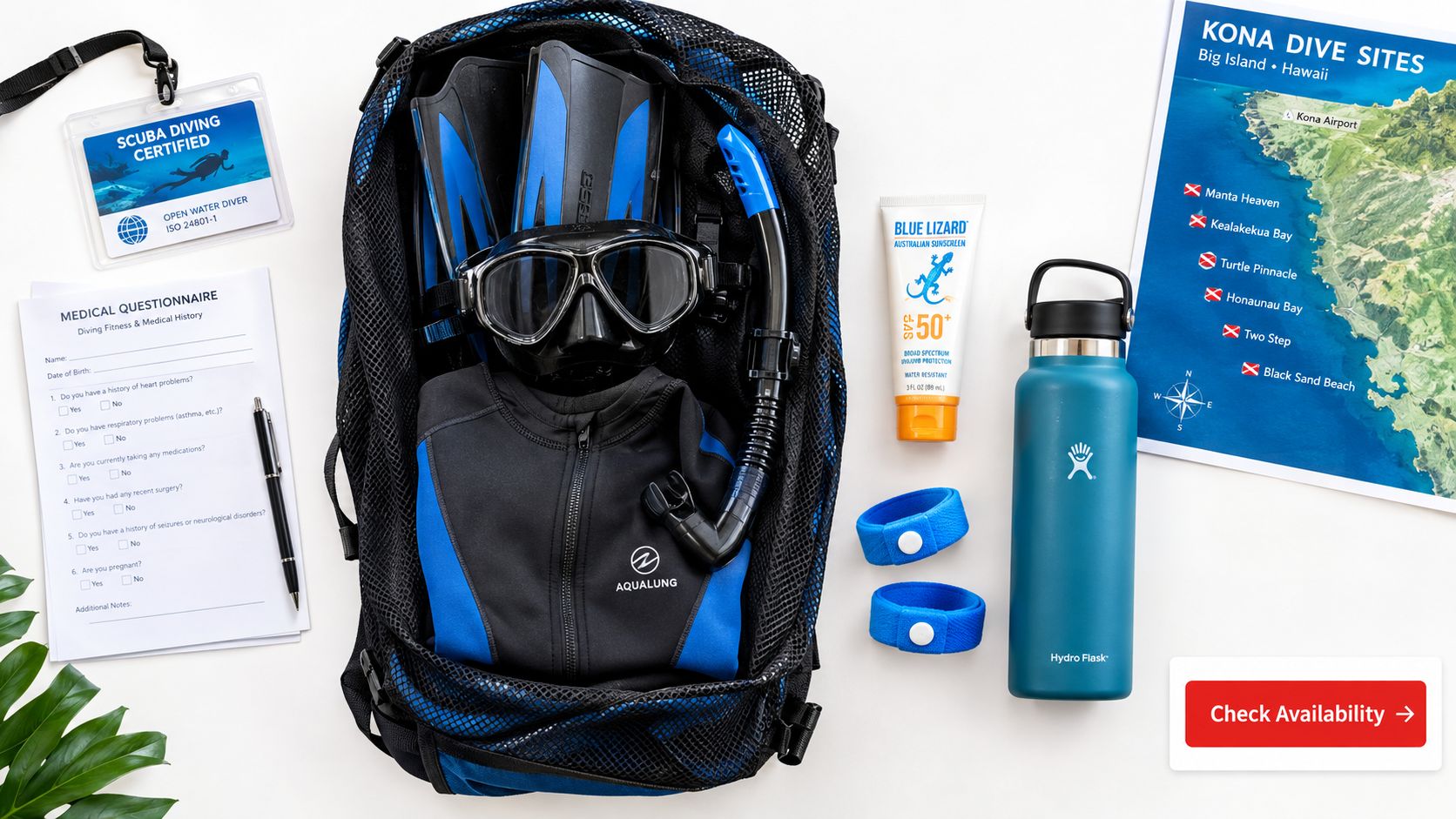
Bring a current certification card, not just a photo of one buried in your phone. Complete the medical questionnaire, because asthma, ear surgery, and recent dives all matter when a crew decides whether you should be in the water. Book your manta dive or blackwater dive for day two or three of the trip if you can, because a flight delay on day one shouldn't wipe out your signature dive.
Pack for comfort, not fantasy
A 3mm or 5mm wetsuit is the right range for most visitors, but the key packing win is the stuff that prevents small problems. Bring a rashguard, reef-safe sunscreen, a small dry bag for your phone, and motion-sickness support if boats usually bother you. The manta boat and blackwater boat are the trips most likely to turn someone's stomach, and an open-Pacific run to blackwater sites has a very different motion profile from a reef hop.
If boat motion bothers you, deal with it before boarding. This guide to avoiding seasickness on a boat is a sensible prep read, because nausea ruins more dive trips than bad visibility does.
Know the booking and cancellation rules
Kona operators usually run smaller boats, and they fill them. That means cancellation policies tend to be stricter than what people expect at resort destinations. Most shops charge full price for cancellations inside a 48 to 72 hour window and rebook for weather or medical issues if you can provide proper proof, often a doctor's note.
Ask these before you pay:
- What's the cancellation window?
- Do you offer a weather-back guarantee or a rebook-only policy?
- Is the deposit refundable if I cancel with a positive COVID or flu test?
For booking lead time, don't wing it. Reserve the manta night dive about 2 to 4 weeks ahead in summer and 6 to 8 weeks ahead from December through March. The blackwater dive usually needs 3 to 6 weeks of lead time year-round because it runs on a smaller boat. If you care about dive trip cancellation protection, buy a policy that explicitly covers diving, because generic travel insurance often doesn't.
Sample Itineraries You Can Copy for Your Own Trip
If you're still deciding what the week should look like, use one of these and stop overthinking it.
A three-day plan for a first-timer or mixed family
Day one should be a refresher and gear check, not a hero dive. Get everyone comfortable with weighting, breathing, and entry style first. Day two is your morning 2-tank reef dive, with snorkelers on a combo option if the group is mixed. Day three is your manta night dive at Garden Eel Cove, which is the better protected choice because the viewing area and reef setting are more forgiving than open-coast alternatives.
That itinerary works because it builds confidence before the big night. It also leaves room for surface time and weather adjustments, which first-time visitors always need more than they think.
A five-day plan for a serious diver
Day one is an advanced 2-tank trip if you already know your buoyancy and want to get straight into the good stuff. Day two should be a morning charter with a light afternoon and gear check. Day three is the blackwater dive, day four is a deeper pinnacle or another advanced morning, and day five closes with the manta night dive.
That order gives you a buffer day for jet lag before the most demanding night profiles. It also makes the manta dive your finale instead of your gamble.
For direct booking on the core trips, these pages are the cleanest paths: manta ray dive tours, blackwater night dive, advanced 2-tank trip, and the full dive tours page if you want to compare the basics first.
Why Kona Honu Divers Checks Every Box Above
Kona Honu Divers lines up well with the criteria that matter. The shop says its team brings over 200 years of combined staff experience, and that kind of depth shows up in how a crew handles beginners, specialty nights, and mixed-experience boats. The fleet is built for comfort, with hot showers, shaded seating, and ample storage, which sounds minor until you've spent a full day in wet gear. Rental gear is proactively serviced, free nitrox is included for certified divers, and the trip menu covers the full Kona range, from morning reef dives to manta night dives, blackwater excursions, and a premium advanced 2-tank trip.
The honest reason to book here first
If you can only book one Kona dive on your first trip, make it the manta night dive, then add the morning reef or blackwater once you know how your schedule feels. Kona Honu Divers is built to sell that trip without making the rest of the day harder than it needs to be. The boats, the guide structure, and the trip variety fit the way Kona dives, which is what matters more than a glossy website.
If you want to dive Kona the right way, book the trip that fits your experience level and let the shop prove itself on the water. Kona Honu Divers offers the core trips, the gear support, and the boat setup that make a first Kona dive feel dialed in instead of improvised. Start with the manta night dive if that's your bucket-list priority, then build the rest of the trip around it.