
Table of Contents
- How to join a Kona manta night trip
- What “both” actually means
- Why the rays keep circling
- Keep an observation station, not a swimming crowd
- The long-term comparison matters
- Sand gives the group somewhere appropriate to stay
- Follow the positioning rules
- Pack for being stationary
- Make a motion plan before boarding
- From check-in to the surface interval
- From entry to the ride home
- Check these details before paying
- The Garden Eel Cove recommendation
You've got an evening open in Kona, someone in your group wants to scuba dive, and someone else isn't sure about getting into dark water. The booking pages look similar, but the decisions aren't: how you watch, where the boat goes, and how comfortably you can stay still matter more than promises of a close encounter.
Kona manta diving is a feeding watch, not a chase. Choose a suitable format, favor a site with room for both people and rays, and arrive ready to let the animals control the distance.
Choose Scuba, Snorkel, or Both
Choose scuba for the view from below, snorkeling for the surface perspective, or a two-tank evening for a reef dive followed by mantas. Certification settles part of that decision. Comfort settles the rest.
A diving card doesn't automatically make scuba the right choice for tonight. If clearing your mask, managing buoyancy, or communicating in darkness still takes all your attention, the surface option may leave you freer to watch.
How to join a Kona manta night trip
| Format | Who it suits | Where you watch | What you need | Time in the water |
|---|---|---|---|---|
| Night scuba | Certified divers who want close overhead passes | The assigned sandy bottom station beneath the lights | Open Water from PADI, SSI, or NAUI | The guided nighttime dive, within your air and comfort limits |
| Night snorkel | Non-divers, families, and confident swimmers | Surface, holding a lighted float | No certification card; comfort in dark open water | The operator's scheduled surface session |
| Two-tank evening | Divers who want a reef warmup plus mantas | Daylight reef, then the nighttime sand patch | Open Water | A daylight tank followed by the nighttime dive |
Snorkeling isn't the lesser version. You're watching the feeding area from a different angle, without managing a regulator, tank, or descent. Holding a float still requires confidence with your face in the water, so don't treat it as a substitute for basic swimming comfort.
For families, confirm the operator's minimum age and swimming requirements before paying. A child who enjoys a sheltered beach may feel differently beside a boat after sunset. Explain the float, the darkness, and the exit procedure beforehand rather than introducing everything at the ladder.
Scuba adds equipment and air management, but it puts your eyes below the feeding passes. The useful skill isn't swimming closer. It's maintaining your assigned position without lifting into the water above you.
What “both” actually means
A two-tank evening combines reef and rays, not an automatic switch between scuba and snorkeling whenever you like. Mixed groups should confirm which activities their booking includes and whether changing formats is possible.
The practical comparison of snorkeling and diving with manta rays can help settle a split group's priorities. Choose the activity each person can manage comfortably, rather than making everyone match the most confident diver.
Garden Eel Cove, also called Manta Heaven, is the preferred dive camp. Keauhou, also called Manta Village, is the other long-running viewing location. These encounters developed around returning animals, not a dependable stream of unrelated mantas passing through.
That history supports reasonable expectations, not certainty: historical testimony submitted to the Hawaiʻi Legislature recorded manta sightings on approximately 80% of dives at Garden Eel Cove. That's a historical record, not your personal probability for a particular evening.
The short answer: scuba with an Open Water card for the overhead perspective, snorkel without one, or choose a two-tank evening for reef and rays.
How Lights Build the Feeding Zone and Protect It
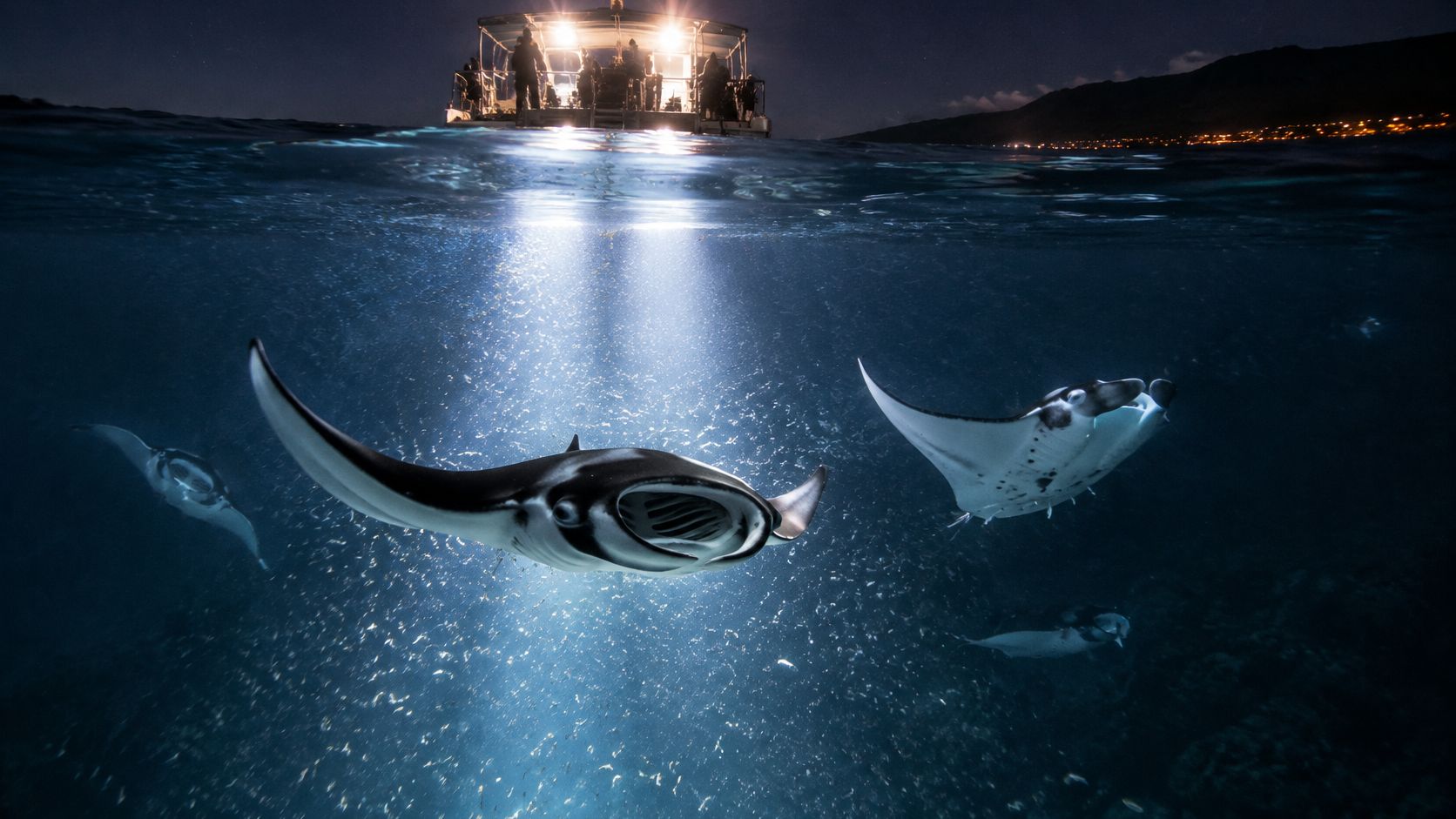
The lights concentrate food. They don't summon mantas on command. Zooplankton collects in the illuminated water, and reef manta rays, Mobula alfredi, enter that patch to filter-feed.
The relationship is described in a NOAA-hosted study of Kona's manta viewing sites: surface and seafloor lighting, typically near 10 meters, concentrates zooplankton, with viewing dives beginning shortly after sunset and lasting approximately an hour. That describes the established viewing setup, not a guaranteed runtime for every guest.
Why the rays keep circling
A manta's cephalic fins, the structures beside its mouth, help direct prey-laden water inward. Gill rakers retain plankton while water passes out, as explained in this guide to the manta feeding mechanism.
Banking, looping, and returning through the same illuminated patch let the animal continue feeding where prey is concentrated. Those movements aren't a performance for the group, and a pass toward your position isn't an invitation to reach out.
For divers, a steady upward beam supports the viewing setup. Sweeping a handheld light sideways to follow an animal does the opposite of what the crew needs: it adds glare, distracts neighbors, and turns a fixed observation station into moving targets.
Snorkelers should follow the float guide's instructions rather than copy the divers' lamp position. Surface platforms direct their lighting into the water; guests shouldn't reposition those lights or leave the float to follow a ray.
The underwater rule: Stay in your assigned place and let the manta choose its path. Never reach, chase, or move into a feeding pass.
Keep an observation station, not a swimming crowd
Hard fin kicks can disturb the plankton patch and stir sediment. Before the action starts, get comfortable, secure dangling equipment, and settle your camera where you can use it without changing depth.
The distinction between a feeding station and an animal's wider habitat matters. A NOAA-supported manta habitat document describes repeat sightings along Kona over 15 years and nocturnal observations extending to approximately 432 meters. The lit camp is a temporary feeding opportunity, not the animal's entire world.
The same recognizable animals can return to local aggregation areas. Preserve open routes through and away from the group rather than surrounding a ray because it has paused or changed direction.
Good camera discipline helps. Frame the pass available from your position, keep equipment close, and accept that a missed photograph is better than an intercepted animal. A camera doesn't give its owner priority over another guest or the feeding lane.
The habits in responsible and considerate diver etiquette apply especially well here: predictable movement, awareness of others, and equipment under control. Be a steady light, not a moving one.
Why Garden Eel Cove Is the Better Site
I recommend Garden Eel Cove for a first Kona manta dive. Its protected location, better-defined viewing area, and surrounding reef make it the superior dive setting, with long-term observations also supporting larger nighttime aggregations there.
That recommendation isn't a claim that Keauhou can't produce an excellent encounter. It means the sites shouldn't be treated as interchangeable when you're choosing where to spend your evening.
| Decision point | Garden Eel Cove | Keauhou |
|---|---|---|
| Nighttime aggregation pattern | Larger groups in the long-term comparison | Smaller groups in that comparison |
| Viewing layout | Broad sandy station with reef around it | Confirm the operator's specific viewing arrangement |
| Positioning priority | Keep divers on sand and feeding space open above | Follow the local guide's assigned positions |
| Booking judgment | Preferred setting for a first scuba manta trip | Established alternative, not the default first choice |
The long-term comparison matters
A University of Hawaiʻi analysis examined more than 23,000 community-sourced sightings of 167 identified reef mantas from 2010 through 2022, finding larger nighttime aggregations at Garden Eel Cove than at Keauhou.
The same analysis found predominantly female use at Keauhou, connectivity between the locations, and aggregation changes associated with zooplankton density. It also found no indication that the activity levels studied had reduced local population viability. That last finding isn't permission to increase crowding or relax handling rules.
The useful takeaway is narrower: these are connected feeding locations with different patterns of use. A larger historical aggregation doesn't let a skipper promise a larger group tonight.
Sand gives the group somewhere appropriate to stay
Garden Eel Cove's advantage becomes practical once divers descend. The description of its sandy amphitheater and surrounding reef explains why the layout works: people can settle on sand instead of living coral while mantas retain open water above and around them.
A defined sand patch also gives guides a clear place to arrange the group. That's better than guests spreading across reef because each person is trying to manufacture a better angle.
The reef is part of the appeal, but it isn't furniture. Don't brace a hand against coral, park a fin on a ledge, or move onto the reef to improve a photograph. The benefit of having an appropriate viewing floor disappears if guests ignore its boundaries.
Shelter helps, too. The cove's protected setting can reduce exposure compared with a more open location, but protected doesn't mean immune to swell. The skipper still needs to judge the actual approach, holding conditions, and exits.
Use the Kona manta guide to understand the destination, then compare the manta evening booking with your group's preferred format. If you want a separate daytime reef outing, the Kona diving tour list gives you that option without making the manta session carry the whole holiday.
Safety Rules Gear and Seasickness Prep
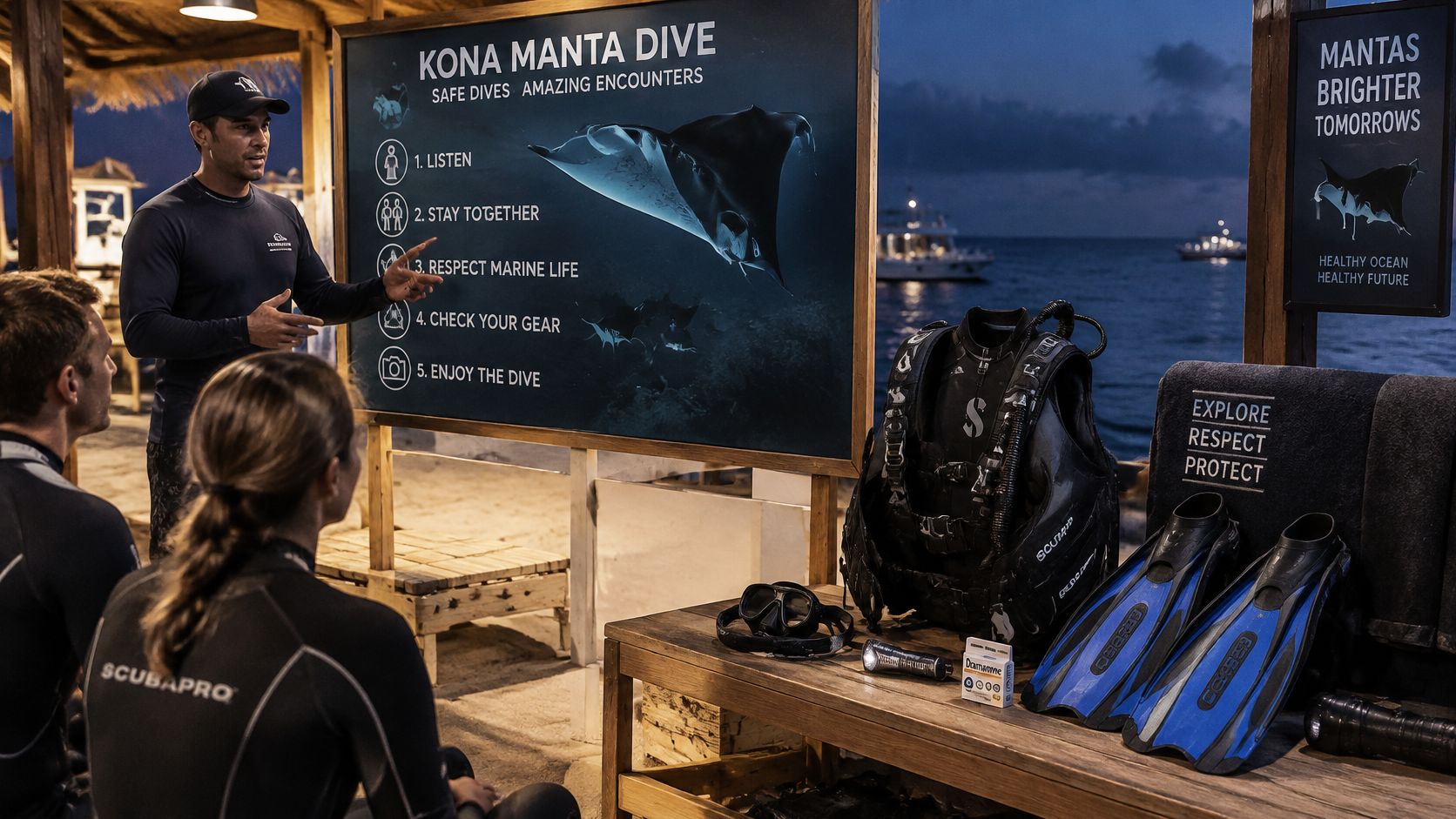
The briefing is part of the dive, not something to talk over while assembling a camera. Know where you'll wait, how to signal a problem, and how the guide wants you to leave before you enter.
Follow the positioning rules
- Bring the right qualification. Scuba requires an Open Water certification from a recognized agency such as PADI, SSI, or NAUI. Snorkelers don't need a card, but must be comfortable in dark open water; a float doesn't remove that requirement.
- Use your assigned station. Stay on the designated sand or at the float. Standing on coral damages the reef and usually puts you somewhere the guide didn't plan for guests.
- Keep hands and equipment close. Don't touch a manta, block its route, or follow in its slipstream. Extended arms and camera poles create obstacles.
- Control your light. Divers should follow the upward-light instruction and keep beams and strobes out of animals' faces. Don't alter the crew's lighting arrangement.
- Breathe continuously and maintain depth. Never hold your breath to keep still. Manage buoyancy with small adjustments instead of rising into the feeding space.
- Leave an exit lane. If rays approach together, remain composed rather than kicking backward into another guest. If you need help, signal the guide instead of improvising an escape through the group.
Pack for being stationary
A 3 mm wetsuit or shorty is a practical starting point to discuss with the crew, not a universal prescription. Choose more exposure protection if you chill easily, and check fit before departure rather than discovering a loose neck seal in the water.
Bring a rash guard, towel, and dry layer for the return ride. Use the boat's viewing lights, and bring a small personal torch only as directed. Clip equipment securely; loose gauges and accessories are difficult to manage while your attention is overhead.
Make a motion plan before boarding
Read the seasickness preparation guide before travel, especially if boats have made you unwell before. Ask a pharmacist or clinician about suitability and drowsiness before using medication for an activity that requires alertness.
Products to review include:
- Patch option: Ship-EEZ Seasickness Patch.
- Medication choices: Dramamine pills and Bonine pills.
- Wristband option: Sea Band wristbands.
- Non-pill option: Ginger chews.
These aren't interchangeable treatments or guarantees. Check ingredients and instructions, don't combine products casually, and never make the dive your first test of something that might impair you.
Skip alcohol before boarding. Tell the crew early if you feel unwell, and judge the encounter by zero contact, not how close you managed to swim.
A Sample Kona Evening on the Water
Treat this as an example of how a two-tank evening can unfold, not a published departure schedule. Your confirmation and crew briefing determine the actual sequence.
The useful rhythm is straightforward: sort equipment while there's daylight, use the reef dive to assess comfort, and enter the manta session without unresolved gear problems.
From check-in to the surface interval
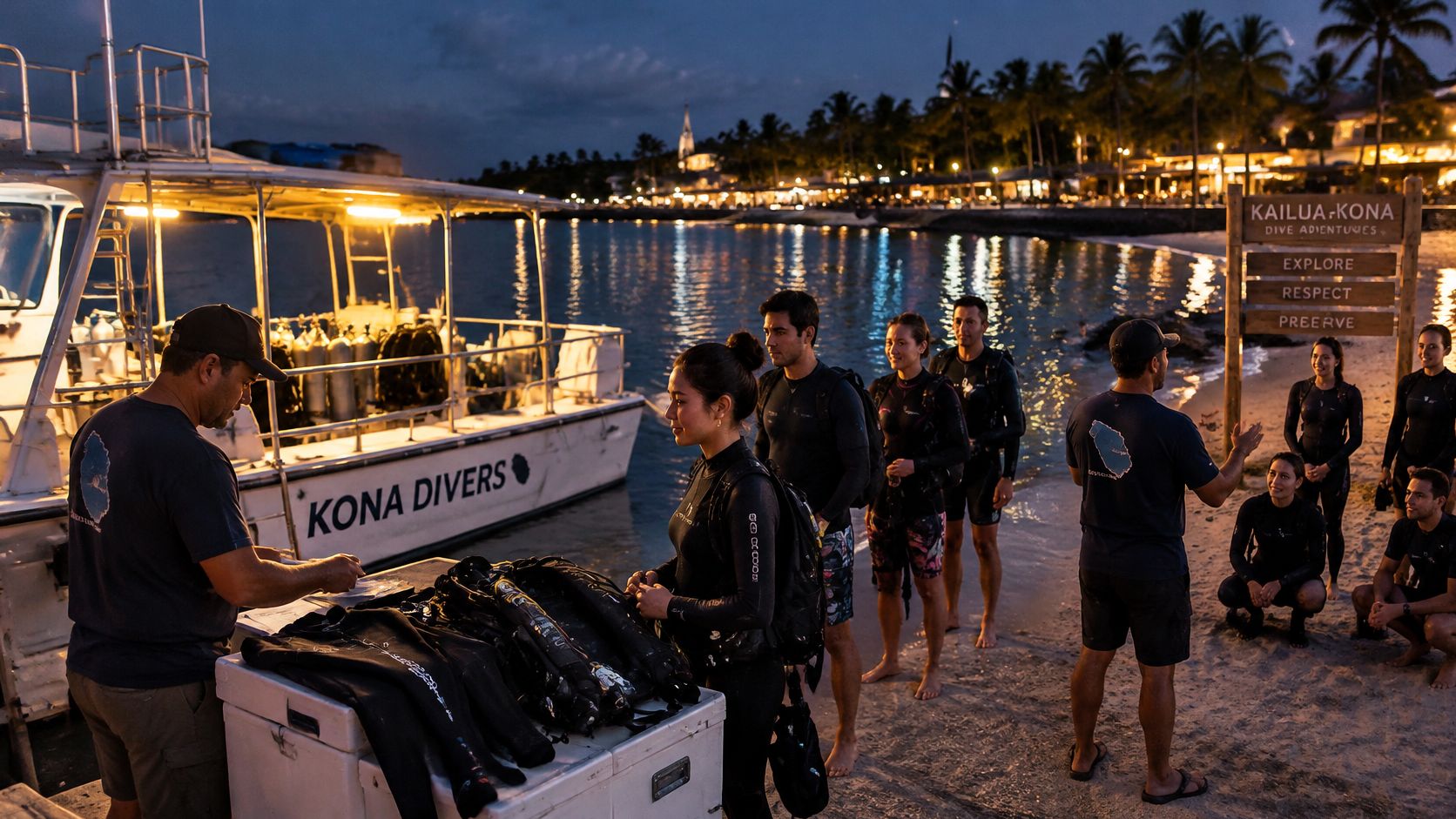
- Check in during the afternoon. Complete paperwork and check rental BCD and wetsuit fit. Test the inflator, releases, and weight arrangement with the crew; unfamiliar equipment deserves attention before the boat leaves.
- Listen to the operational briefing. Confirm hand signals, the guide's identification light, the meeting point, and what to do if you lose the group. Ask questions while everyone can hear the answer.
- Make the daylight reef dive. Use it to establish comfortable weighting and trim, not to exhaust yourself trying to see every corner of the reef. Notice whether you can pause without grabbing rock or repeatedly finning upward.
- Use the surface interval deliberately. Report equipment problems, warm up, and review the night entry. Put the camera aside until your own setup is ready.
Suppose your mask leaks throughout the reef dive and you spend the ascent fighting your weighting. Those are reasons to speak up, not minor inconveniences to hide because the manta dive is the main event.
A tired diver has less capacity for darkness, unfamiliar signals, and animals passing overhead. Sitting out is a valid decision. Switching to snorkeling is only an option if the crew confirms that the booking, equipment, staffing, and your condition allow it.
From entry to the ride home
- Enter when the guide directs. Descend with the group to the assigned viewing area rather than dropping toward whichever light looks brightest. Establish your position before adjusting camera settings.
- Watch within your own limits. Check air and comfort during the encounter. Signal early if you're cold, anxious, or ready to leave; another manta pass isn't a reason to stretch a reserve.
- Exit with the guided procedure. Divers make a controlled ascent and follow the boat's stop instructions. Snorkelers approach the ladder only when called, keeping the boarding area clear for the person ahead.
Once aboard, secure your cylinder and loose gear before reaching for dry clothes. Keep the deck and ladder area clear while other guests return.
The boat's dock time comes from its actual itinerary, not a generic online estimate. Leave room afterward rather than booking a tight dinner reservation that makes you impatient during the exit.
The manta portion can be quiet, busy, or absent. The plan organizes people and equipment; it doesn't schedule wildlife.
Book a Garden Eel Cove Night Trip
Choose the viewing site and activity before comparing the booking total. A cheaper departure isn't necessarily better value if it takes your group to a different setting or leaves someone participating in an activity they don't want.
For a first scuba manta outing, prioritize Garden Eel Cove, a clearly managed viewing group, and an itinerary that matches your comfort level. A precise confirmation is more useful than a page full of dramatic photographs.
Check these details before paying
- Site choice: Confirm Garden Eel Cove is the planned destination and understand that the skipper retains authority to change or cancel an unsafe plan.
- Group arrangements: Look at how guests are divided and supervised in the water, not just the boat's total capacity. Our approach emphasizes small groups and personal attention.
- Activity selection: Identify who is diving and who is snorkeling before completing the booking. Don't assume a diver's reservation automatically includes a surface alternative.
- Eligibility: Check minimum ages, swimming expectations, and certification requirements for the selected activity.
- Daylight preparation: Choose an itinerary with a reef warmup if you want time to settle into rental equipment before darkness.
- Weather handling: Ask what happens when winter north swell affects the site, including cancellation, rescheduling, and any proposed alternative.
- Wildlife terms: Read what happens if no mantas appear. Don't infer a refund or repeat-trip policy from an encounter-rate statement.
The guide to choosing a Kona dive operator is useful for comparing the practical details that photographs don't show. Clear answers about supervision, entries, and contingency plans should carry more weight than promises of the closest pass.
The Garden Eel Cove recommendation
Kona Honu Divers offers the 2-Tank Manta Dive & Snorkel, with Garden Eel Cove as its go-to manta site because of the protected location, good viewing area, healthier reef, and generally calmer conditions. The company reports encounter rates as high as 92%.
That's an operator-reported figure, not a guarantee, and it shouldn't be combined with the historical record into a new probability. Different observation periods and operating records don't automatically measure the same thing.
Choose the scuba booking if you're qualified and ready for the underwater responsibilities. Choose the dedicated manta snorkeling booking if the surface format better fits your group, and check its departure details rather than assuming it shares the scuba itinerary.
For the scuba evening, check the available departures below.
For a dedicated manta snorkeling departure, use this availability calendar.
Keep other diving ambitions separate from the manta decision. Experienced divers can consider an advanced long-range trip or a Kona blackwater night dive for a different kind of outing, with its own eligibility and briefing.
For this evening, the sensible choice is simpler: book the Garden Eel Cove format you can enjoy without pushing your limits. Arrive ready to follow the guide, hold your position, and accept whatever the animals choose to do.
Kona Honu Divers offers a Garden Eel Cove manta evening that pairs a reef dive with the nighttime feeding watch, with a snorkeling option for guests who prefer the surface. Visit Kona Honu Divers to choose your format and reserve an evening suited to your group's certification and comfort.