
Table of Contents
- From boat briefing to the viewing area
- Why darkness and light work together
- Why holding position beats following a manta
- Choose a season for comfort, not a promised sighting
- When Keauhou makes sense
- Requirements by diver type
- Habits that protect the group and the animals
- A practical packing checklist
- Photograph without disrupting the encounter
- Run these checks before paying
- What the lighting answers reveal
- Match the itinerary to your trip
- Personal attention has a practical purpose
- Site choice and equipment still matter
You're comparing evening tours, checking whether everyone in your group needs scuba certification, and wondering whether those close-up manta photos reflect a normal night. A Kona manta dive can be an extraordinary wildlife encounter, but the useful booking questions aren't just how many animals might appear. They're where you'll be positioned, how the crew manages the lights, and whether you'll feel comfortable in open water after dark.
The best preparation is understanding what brings the mantas into view. You're joining a feeding opportunity, not a scheduled performance, and a well-run trip leaves the animals room to choose their own approach.
What Happens on a Kona Manta Dive
A Kona manta dive is a nighttime viewing session where scuba divers and snorkelers gather around an illuminated feeding area while reef manta rays, Mobula alfredi, may arrive to eat plankton, without any guarantee of a particular number of animals.
Your evening usually begins with departure before dusk. The crew checks equipment and explains the entry, viewing position, communication signals, and return to the boat. Some itineraries include an afternoon reef dive before the nighttime encounter, so check the actual schedule rather than assuming every manta booking follows the same format.
From boat briefing to the viewing area
After dark, the crew organizes the entry and directs participants to their assigned positions. Divers descend with their guide, while snorkelers stay at the surface. Once the lights are operating, you settle into place rather than swimming around searching for mantas.
The encounter might begin with a ray passing through the edge of the illuminated water. It might involve repeated feeding loops, an extended wait, or no manta appearance at all. Your guide manages the group's return, and divers still need to monitor their air and follow the agreed ascent procedure.
Kona manta experience formats at a glance
| Format | Who It Suits | What You Do | Setting |
|---|---|---|---|
| Night manta scuba dive | Certified divers comfortable with night diving | Hover or kneel on designated nonliving substrate below the light field and keep buoyancy steady | Offshore manta sites reached from Keauhou and Honokōhau harbors |
| Night manta snorkel | Confident swimmers without certification | Float at the surface with lights directed downward into the water column | Same offshore manta sites, reached by boat |
| Daytime reef dive | Certified divers wanting reef life rather than a manta-focused encounter | Explore coral and reef fish in daylight | Kona reef sites, without an organized manta feeding-light session |
Choose scuba for the submerged perspective if your certification and comfort support it. Choose snorkeling if you're a confident swimmer who wants to watch without scuba equipment or certification. This comparison of snorkeling versus diving with manta rays helps clarify the practical differences.
A quieter wildlife encounter isn't necessarily a poorly operated trip. Judge the crew's preparation and conduct separately from the animals' attendance.
How Night Manta Dives Work
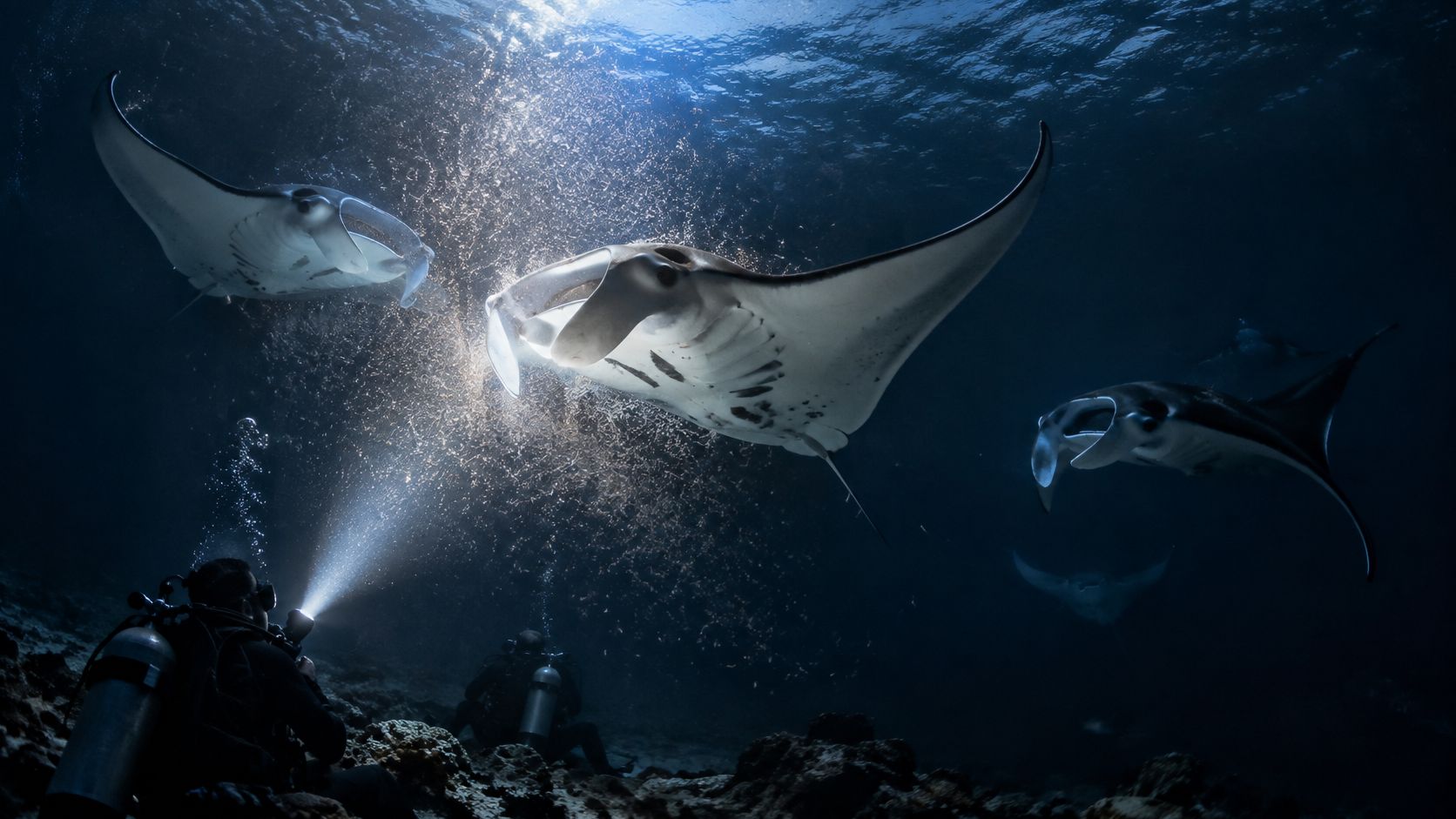
The dive light works like a spotlight over a buffet: it concentrates the food in a visible area, and the mantas decide whether to eat there. The light isn't food, and the divers aren't the attraction.
Say you're settled beside the viewing area as small particles gather in the beam. A manta approaches with its mouth open, passes through the illuminated water, then turns for another approach. That route makes sense when you recognize that the animal is following a concentrated patch of prey rather than performing for the group.
The overhead view can look dramatic, but the underlying behavior is feeding.
Why darkness and light work together
Zooplankton move upward after dark, making prey more accessible; federal manta-ray documentation hosted by NOAA describes Kona mantas as appearing to feed primarily at night and explains how their cephalic fins funnel water toward the mouth and plankton-filtering gill structures. When food is concentrated, mantas may barrel-roll or follow one another in feeding chains.
The lighting arrangement helps create a shared feeding area. Divers' lights point upward, while surface lights point downward, a configuration described in a peer-reviewed reef-manta population study. Follow the crew's arrangement rather than improvising your own brighter patch away from the group.
Those paired directions matter. They illuminate a water column through which mantas can pass while people remain at its boundaries. A diver rising into the middle or a snorkeler kicking downward can interrupt that geometry.
Why holding position beats following a manta
A manta that turns away may be lining up another feeding pass. Swimming after it moves you out of position and can place you directly in its next approach.
Kona Honu Divers' explanation of manta feeding and diver positioning describes the encounter as an indirect food-concentration process rather than baiting. Staying below or beside the feeding lane, controlling buoyancy, and avoiding interference near the animal's head give it room to continue.
The lights attract prey. Your job is to hold your assigned position and leave the feeding lane open.
No operator can promise a fixed manta count. A long-term study of Kona's nighttime aggregations found that aggregation size was positively associated with zooplankton density at both principal viewing sites.
More light doesn't automatically mean more animals, and chasing doesn't improve the feeding opportunity. Patient, coordinated positioning is the part participants can control.
Best Seasons and Launch Sites for Kona Manta Dives
Garden Eel Cove is my recommendation for most first-time manta divers. Also called Manta Heaven, this protected location offers a better viewing area, healthier surrounding reef, and generally calmer conditions. Those advantages make it easier to settle into a controlled viewing position, although no site is sheltered from every swell direction.
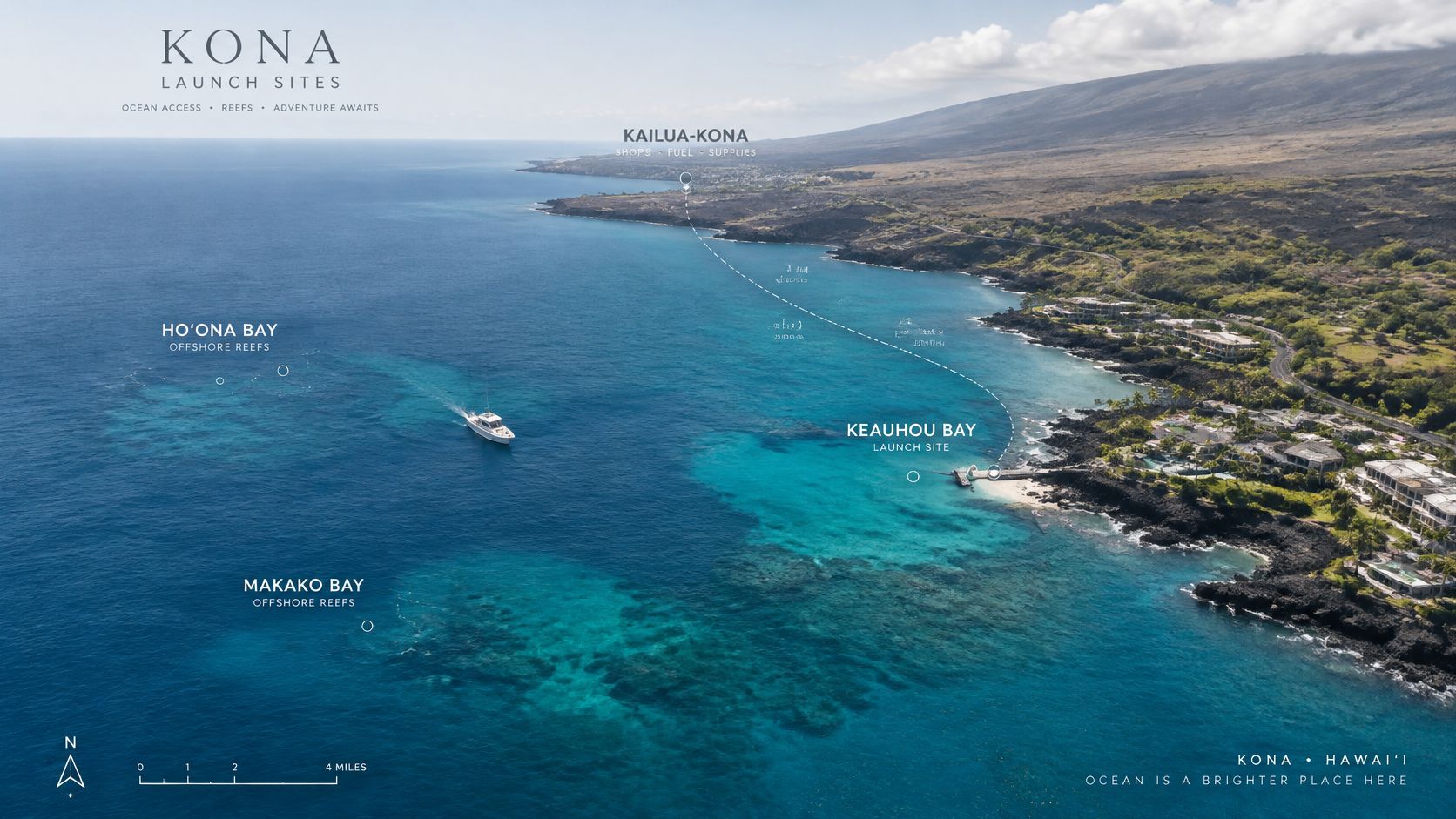
The principal alternatives are Keauhou Bay, commonly called Manta Village, and Ho'ona Bay/Makako Bay, known as Garden Eel Cove or Manta Heaven. They lie offshore from Kailua-Kona, with tours primarily departing from Keauhou and Honokōhau harbors; testimony held in Hawai'i County's public records dates organized snorkeling and diving at these sites to 1984 and documents the vessel traffic that makes coordinated site rules important.
Use the coastline layout to check your departure harbor, not just the name of your hotel.
Choose a season for comfort, not a promised sighting
Summer is generally the easiest planning window for calmer surface conditions. Spring and autumn can work well, while winter swell can require a different site or cancellation. Treat those as broad planning patterns, not a forecast for your departure.
Season guide for Kona manta dives
| Season | Typical Sea State | Planning Note |
|---|---|---|
| Summer (June to August) | Usually calmer surface and water | Most reliable comfort window for first-time night divers |
| Spring (March to May) | Moderate conditions, often settling later in the season | Good balance of comfort and availability |
| Autumn (September to November) | Moderate conditions with occasional swell changes | Check forecasts a day ahead |
| Winter (December to February) | Larger swells possible on exposed coasts | Book a backup date and expect possible itinerary changes |
Keep a flexible evening available regardless of season. Our guide to the best time to see manta rays in Kona can help you separate travel timing from nighttime wildlife expectations.
When Keauhou makes sense
Keauhou is an established alternative, particularly when its departure location suits your itinerary. A University of Hawai'i study of community-sourced sightings found smaller, strongly female-biased aggregations there, while Garden Eel Cove supported larger and more variable groups.
Smaller manta gatherings don't necessarily mean fewer boats or people. Choose Keauhou for the overall trip fit, not an assumption that it guarantees solitude. A quieter feeding night can occur at either location.
Safety, Certification and Responsible Viewing Rules
The night manta scuba format requires certification and comfort with night diving. The snorkel format doesn't require scuba certification, but you should be comfortable swimming in open water and floating calmly with your face submerged.
A stationary viewing session still involves boat entries, darkness, equipment handling, and a return to the vessel. Tell the crew about limited recent diving experience or anxiety before departure, not after you enter the water.
Requirements by diver type
Hawai'i's Division of Boating and Ocean Recreation diving guidance requires a red-and-white diver's flag during underwater activity and states that divers using a flag in ocean waters must not surface more than 100 feet from it, except in an emergency. At night, that marked operating area is especially important for separating participants from vessel traffic.
| Rule | Night Manta Scuba Dive | Night Manta Snorkel |
|---|---|---|
| Certification | Required, recognized open-water certification or equivalent | Not required |
| Dive flag | Required during the dive | Required during the snorkel |
| Surface distance from flag in ocean waters | Maximum distance stated in the state rule above, except in an emergency | Maximum distance stated in the state rule above, except in an emergency |
| In-water position | Below or beside the light field, buoyancy controlled | At the surface, lights directed downward |
| Briefing | Pre-entry briefing from the crew | Pre-entry briefing from the crew |
The flag doesn't replace a lookout, controlled boat movements, or a clear pickup procedure. Know where you're supposed to return and what signal means the encounter is ending.
Habits that protect the group and the animals
- Keep your assigned position. Stay at the viewing boundary rather than drifting into the manta's route.
- Control buoyancy and fins. Avoid rising into an approaching animal or contacting the reef.
- Keep hands to yourself. Don't touch, grab, or reach toward a passing manta.
- Avoid abrupt movement near the head. Don't wave equipment or deliberately direct bubbles toward the cephalic fins.
- Follow position signals promptly. A guide may see a developing conflict that you can't see through your mask.
Our responsible and considerate diver etiquette guidance reinforces the same practical principle: awareness matters more than getting closer.
Before paying, confirm minimum age, the medical questionnaire, fitness expectations, and any experience prerequisites. Ear or sinus problems, asthma, and heart conditions warrant review by a physician familiar with diving medicine when indicated by the screening process. Pregnancy is a reason to avoid scuba diving, not something to work around with a routine clearance.
Calm, controlled behavior is safer than trying to keep up with every animal. If you can't maintain that control comfortably, discuss a different format before entering.
Gear, Packing and Photography Tips
Pack to stay warm, visible, and comfortable, because you'll return to the boat in darkness. Confirm what's supplied before packing duplicates, and make sure borrowed or rental equipment fits before departure.
Choose exposure protection for a relatively stationary session, not just a quick swim. A rash guard provides coverage, but it isn't a substitute for a wetsuit when you need meaningful thermal protection.
A practical packing checklist
| Item | What to check before departure |
|---|---|
| Wetsuit or rash guard | Choose suitable warmth and coverage; confirm fit around the neck and shoulders |
| Dive or snorkel light | Confirm whether the crew supplies it and controls its placement; pack compatible spare batteries if bringing your own |
| Mask | Fit-check the seal and strap, and prepare the lenses against fogging |
| Scuba equipment | Confirm regulator, buoyancy compensator, computer, tanks, and weights are included or arranged |
| Warm layer and towel | Keep them dry and accessible for the return ride |
| Dry bag | Protect keys, phone, and dry clothing from spray |
| Optional camera and video light | Check housing seals, controls, battery charge, and attachment points |
Don't open a battery compartment or camera housing with wet hands on a rocking deck if you can prepare it ashore. Keep loose accessories secured so they can't dangle into the reef or feeding area.
Photograph without disrupting the encounter
- Skip the flash. It can create distracting bursts and illuminate suspended particles instead of your subject.
- Set focus and exposure beforehand. Test the controls on land so you aren't troubleshooting while managing buoyancy.
- Use steady continuous lighting only where permitted. Don't sweep a beam around or create a separate feeding patch.
- Let the animal enter the frame. Chasing usually produces shaky footage and poor positioning.
If carrying a camera will divide your attention, review the manta night dive photo-package information before deciding whether to bring your own.
A steady position does more for a usable manta photograph than a hurried swim toward the subject.
Keep the camera below your line of sight often enough to check the guide and surrounding divers. The photograph is optional; situational awareness isn't.
How to Book a Manta Dive Without Surprises
Choose scuba if you're certified, comfortable with the conditions, and want the submerged view of feeding passes. Choose snorkeling if you're a confident swimmer without certification, or a daytime reef dive if your priority is exploring reef life rather than a nighttime manta encounter.
Then evaluate how the trip is operated. A low passenger count is useful information, but it doesn't tell you whether the crew manages positions, lights, and vessel movements well.
Run these checks before paying
Pick a flexible window and a backup evening. Avoid making your last available night the only opportunity. Weather and swell can change a departure plan even when the day looks pleasant from shore.
Ask how participants are divided between guides and viewing positions. A smaller group can provide more room, but ask about the actual in-water arrangement rather than relying on boat capacity alone.
Confirm the pre-entry briefing. It should explain light placement, group positioning, communication, the dive flag, and the return procedure. You should know what to do if you lose contact with the group.
Find out how the crew separates people from vessel movements. Ask where participants wait during pickup and whether scuba divers and surface swimmers use designated areas.
Check lighting and reef protection. Ask where lights are placed, how participants avoid live coral, and whether photographers must follow additional lighting instructions.
Read the cancellation, relocation, and no-sighting terms before checkout. Ask what happens if conditions deteriorate, the destination changes, or no mantas appear, without assuming a refund or repeat-trip policy exists.
What the lighting answers reveal
NOAA's voluntary wildlife-interaction standards specify placing lights on sand or rubble so divers don't sit on live coral and prohibit using lights to draw mantas away from the viewing circle or over coral. A clear explanation of those practices is more useful than a vague promise of an environmentally friendly experience.
Listen for an operational answer: where you'll be, where the equipment goes, and what the guide will correct. An operator should be able to explain why a light must remain stationary or why a particular patch of bottom isn't suitable for kneeling.
Booking test: Ask what the crew does when a participant leaves position for a photograph. The answer tells you more than a promise of close encounters.
Crowding and commercial-access constraints make coordination important. Don't assume that a business taking bookings has exclusive use of the viewing area or that every boat follows identical procedures.
Match the itinerary to your trip
We offer the 2-Tank Manta Dive & Snorkel tour, bookable through our manta dive tour page. You can compare the broader itinerary choices on our diving tours page, including the premium advanced long-range option for experienced divers.
Choose your seasonal window, favor Garden Eel Cove for the dive setup, and preserve a backup evening. For package planning, Kona Dive Company offers early diver discounts, dive packages, and free nitrox and can be reached at 808-324-4668. Confirm eligibility and inclusions rather than assuming every benefit applies to every booking.
Run the checklist before submitting payment, particularly the experience requirements and weather terms. Your next step is to choose a manta dive departure that fits your abilities and leaves room for a responsible change of plan.
What Sets Kona Honu Divers Apart
Kona Honu Divers was voted best dive operator in Kona, Hawaii, and won the Scuba Diving Magazine Reader's Choice Award for the best dive company in the Pacific. Those credentials are useful starting points, but the practical fit for a manta diver comes down to personal attention and a controlled viewing setup.
Our focus is on small groups and personal attention from the moment divers step aboard. For a night encounter, that matters because participants need to understand their assigned positions, recognize signals, and feel comfortable raising an equipment or confidence concern before entry.
Personal attention has a practical purpose
An unhurried equipment check can identify a leaking mask before it becomes distracting in darkness. A clear briefing helps a diver distinguish a signal to hold position from a signal to return. Those are the details to compare when considering why divers choose Kona Honu Divers, rather than treating an award as a substitute for preparation.
The personal-trip approach also appears in Kona Dive Company's history: in 2010, owners Simon and Kerry Key took over Bottom Time Hawaii and rebranded it with a vision of intimate, personal dive trips. The relevant question for your booking is how that kind of attention translates into the evening's organization.
Site choice and equipment still matter
Garden Eel Cove is our go-to manta night-dive site. Its protected location, viewing area, and reef condition support the kind of stationary encounter described throughout this guide. That's a reason for choosing the site, not a promise that ocean conditions or wildlife will cooperate.
Use concrete criteria when comparing the whole experience:
- Boat arrangements. Look for a clearly explained entry, equipment-stowage system, and return procedure.
- Crew communication. Make sure questions about confidence, fit, and positioning receive specific answers.
- Gear condition. Check fit and function before departure rather than accepting discomfort as inevitable.
- Decision-making. Favor a crew that explains a weather change or positioning restriction plainly.
We run dive and snorkel tours in Kona, Hawaii. The right match is a trip where you can manage your own equipment comfortably, follow the guide, and spend your attention observing rather than compensating for uncertainty.
Kona Honu Divers offers the 2-Tank Manta Dive & Snorkel tour for travelers who want to experience Kona's nighttime feeding encounter with guided preparation and a Garden Eel Cove viewing setup. Visit Kona Honu Divers to review the itinerary, confirm your participation requirements, and choose a manta dive date with a backup evening available.