
Table of Contents
- Why a reliable site can have a quiet night
- From the first shadow to a feeding pass
- A local population, not an endless procession
- Choose comfort before proximity
- Why the layout matters underwater
- Separate law from proposed site management
- Follow the supervision plan
- Photograph the pass without changing it
- Can I still see mantas if none appear on my night?
- When is the best time to go?
- Is it suitable for non-swimmers or families with young children?
- Does the dive use bait?
- What happens if weather cancels the trip?
- How should I prepare for the underwater setting?
- Match the booking to your evening
You're planning an evening in Kona, comparing manta tours, and trying to work out what you'll see once you get in the water. The photos show mantas passing close overhead, but they don't tell you how long you'll wait, which site gives you the better view, or what happens on a quiet night.
A Kona Hawaii manta ray night dive is a high-probability wildlife encounter, not a scheduled performance. The useful decisions are choosing the right site, matching the activity to your water skills, and leaving enough flexibility in your travel plans for the ocean to have a say.
Manta Night Dive Timing and Sighting Odds
Manta night dive at a glance
| Detail | What to expect | Why it matters |
|---|---|---|
| Start time | Dives generally begin around sunset | Arrive before dark to settle in |
| Length | About one hour in the water | Plan for a full evening out |
| Sighting rate at Manta Heaven (Garden Eel Cove) | Mantas seen on 92% of study nights | Best odds of the two sites studied |
| Sighting rate at Manta Village | Mantas seen on 78% of study nights | Lower odds, so site choice matters |
The timing and sighting figures in this table come from NOAA-hosted research on Kona reef manta movements, which recorded observations on 92% of study nights at Manta Heaven and 78% at Manta Village, with dives generally beginning around sunset and lasting about an hour.
Those are historical observations, not the odds printed on a ticket. They describe what happened across many study nights, including the natural changes in animal movement and feeding conditions.
Our own trip record also supports the description high probability: divers have seen manta rays on 92% of our Manta Ray Night Dive trips. That still leaves room for a night when the animals don't visit the viewing area.
Why a reliable site can have a quiet night
Mantas don't all follow the same routine. Some, primarily females, show resident movement patterns, while more mobile animals travel between feeding areas and can go longer between sightings.
What you see on a particular evening comes down to several practical factors:
- Site choice: Feeding areas don't attract the same number of animals or produce identical viewing opportunities.
- Plankton availability: Mantas need a worthwhile feeding opportunity, not just a bright patch of water.
- Weather and sea conditions: The captain must consider whether the site is suitable for entry, supervision, and recovery.
- Season and individual movement: Local feeding conditions change, and particular mantas may be elsewhere.
A successful encounter doesn't have to look like a highlight reel. You might watch a small gathering, see brief passes separated by waiting, or notice mantas feeding just outside the brightest part of the viewing area.
Planning rule: Choose the stronger site, reserve the evening rather than just the underwater portion, and leave room for wildlife to behave like wildlife.
Arrive at the stated check-in time, not at sunset. Equipment fitting, the briefing, boarding, and travel happen outside your time underwater, and rushing through those steps makes a first night dive harder than it needs to be.
Our guide to the best time to see manta rays in Kona can help with scheduling. If your itinerary allows, choose an evening that leaves a backup date available rather than making this your final activity before departure.
How the Night Encounter Works
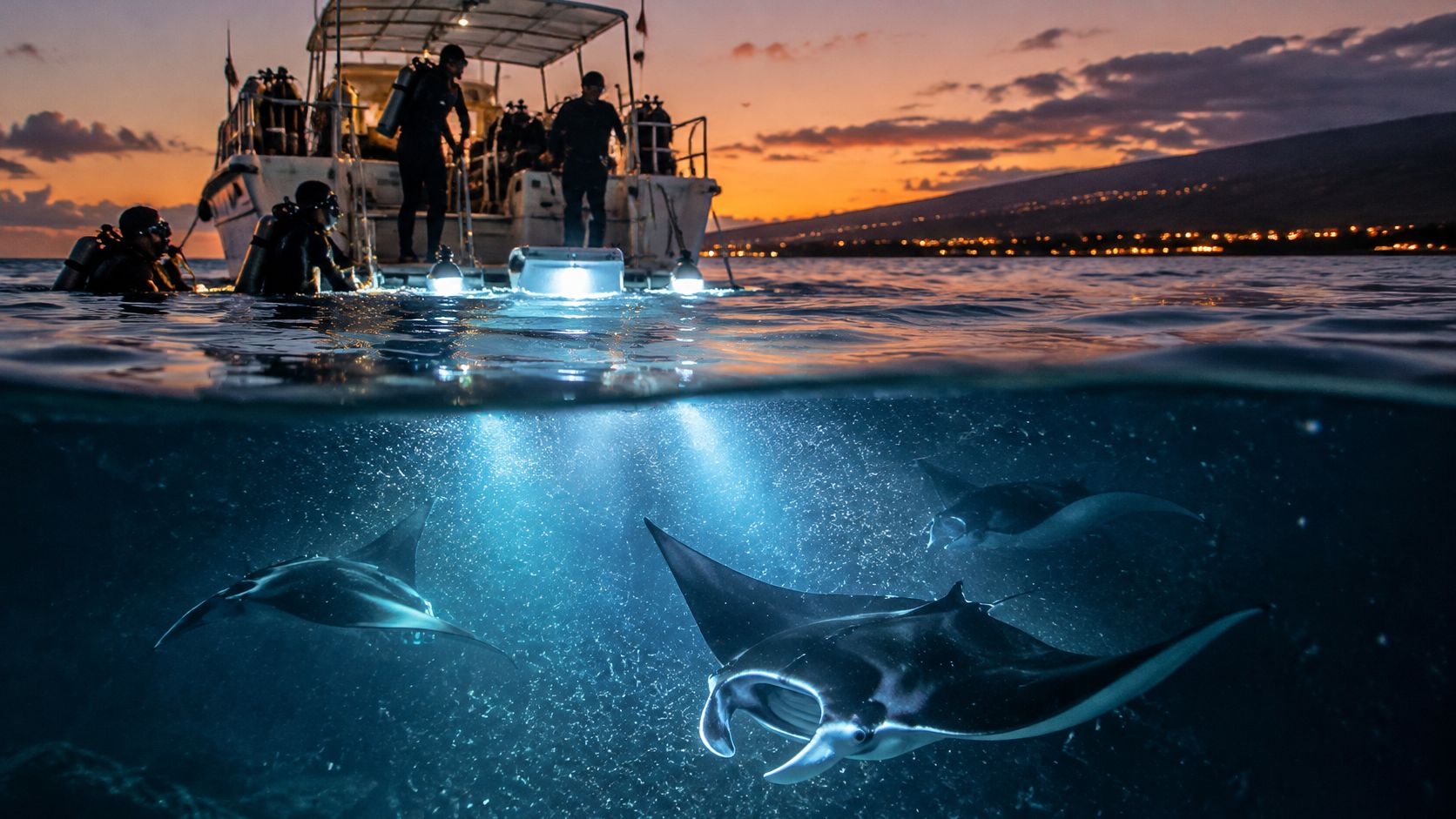
At dusk, the crew prepares the viewing station and places powerful lights on the seafloor. As you settle into position, suspended particles become visible in the beams, and the bright water gives everyone a common place to watch.
The lights work like a porch lamp drawing moths, except the small organisms are plankton and the larger visitors are mantas. Nobody needs to bait a hook or hand-feed an animal. A manta decides whether to enter the illuminated water, circle through it, or leave.
From the first shadow to a feeding pass
Say you're settled beside the viewing area when a broad silhouette appears at the edge of the light. Your job isn't to swim toward it. Stay still, breathe normally, and let the animal choose its route through the feeding corridor.
A manta may continue through the beams, turn back, or disappear into darker water. Following it would disrupt your position without making the next pass more likely.
The biological explanation is well supported. A 2025 University of Hawai'i study analyzed 13 years of community-sourced observations, from 2010 through 2022, including more than 23,000 sightings of 167 individually identified reef mantas at Garden Eel Cove and Keauhou. The study found that aggregation size tracked zooplankton density, identified an overall sex ratio of approximately 1:1 across both locations, and reported generally stable aggregations despite increased tourism.
The important visitor takeaway isn't the size of the database. It's that food availability helps explain attendance. More lights and more spectators don't automatically mean more mantas.
A local population, not an endless procession
Historical testimony submitted to the Hawai'i Legislature describes organized encounters beginning around 1991–1992 and documents 106 identified individuals during surveys conducted from 1992 through 2007.
That long record helps explain why careful behavior matters. Visitors are watching a relatively small, repeatedly observed local population, not a constantly replenished stream of migrating animals.
The encounter combines a managed viewing setup with voluntary animal participation. The crew organizes the people and equipment. The mantas determine the passes, the pace, and whether they remain to feed.
Choosing Your Role
Diver and snorkeler roles compared
| Role | Where you sit or float | Light direction | Skill needed | Best for |
|---|---|---|---|---|
| Scuba diver | Kneels on the sandy bottom | Lights point upward into the water column | Certified diver | Closest-view perspective and a stable position |
| Snorkeler | Floats on the surface | Lights held downward from floating boards | Comfortable on the surface | Experience without a tank |
The practical distinction is your position, not which activity deserves a better photograph. The manta encounter positioning guide describes divers remaining on or near the bottom with lights directed upward, while snorkelers watch from floating boards with lights directed downward.
- Choose scuba if you're certified and comfortable managing your equipment. The bottom-up perspective lets you watch feeding passes overhead from a stable position. It can provide an exceptionally close view, but no position guarantees the nearest animal.
- Choose snorkeling if you want to watch without a tank and are comfortable in open water. You'll look down into the feeding area rather than manage depth, breathing equipment, and buoyancy below the surface.
Choose comfort before proximity
On a combined outing, divers and snorkelers share the evening and crew, but they don't share the same position in the water. The crew assigns viewing locations so participants can watch without filling the central feeding corridor.
For divers, being stationary doesn't remove the need for buoyancy control. You still need to manage your breathing, monitor your gas, and avoid rising unexpectedly when you tilt your head to look upward.
For snorkelers, a floating board doesn't turn open water into a swimming pool. You need to remain calm with your face in the water and follow instructions while the surface moves around you.
Our comparison of snorkeling versus diving with manta rays can help mixed groups make separate choices without feeling they must all participate the same way. Choose the role you can perform calmly, then let the crew handle your placement.
If you also want a more demanding diving opportunity, save that decision for a separate outing. The manta session works best when observation, rather than swimming or exploration, is your priority.
Why Garden Eel Cove Gives the Best View
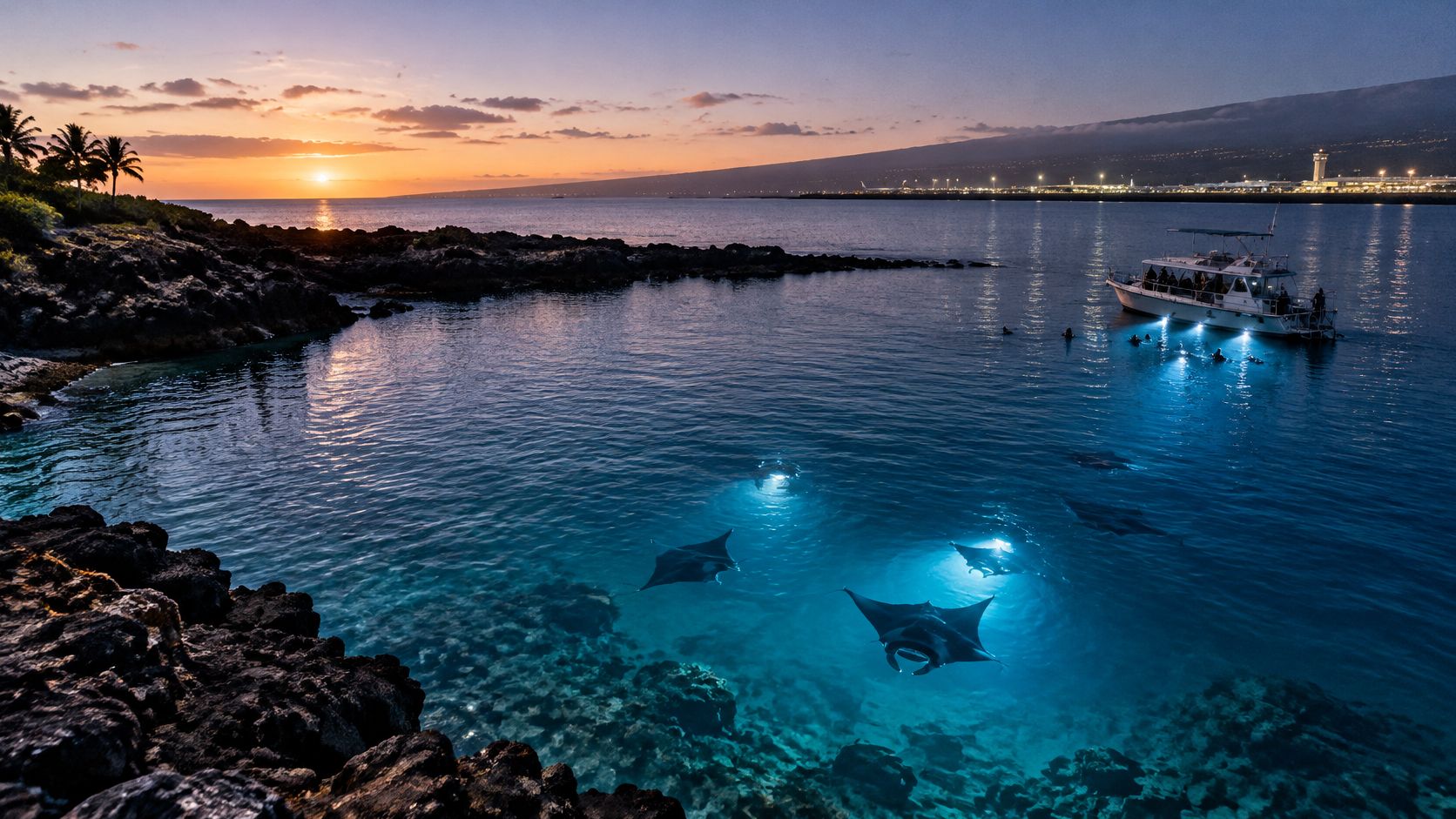
Garden Eel Cove is the superior choice for the manta dive when you prioritize a protected location, a better viewing area, and better nearby reefs. Its layout lets divers settle into designated sandy positions while leaving the central water column clear.
Garden Eel Cove compared with Keauhou
| Site | Aggregation size | Sex mix | Notes |
|---|---|---|---|
| Garden Eel Cove | Consistently larger aggregations | Both sexes attend; the combined-site ratio was approximately even | Protected site with sandy viewing area and nearby reef |
| Keauhou | Smaller aggregations in the comparison | Predominantly female visitors | May serve ecological functions beyond night feeding |
The approximately even ratio describes the combined observations, not a site-specific count for Garden Eel Cove. Likewise, the female-heavy attendance at Keauhou suggests a different pattern of site use, not that it's an inferior habitat.
The Garden Eel Cove site guide places the cove off North Kona near Kona International Airport and identifies its other names, Manta Heaven and Makako Bay. Its protected setting, sand, nearby reef structure, and open viewing layout are the reasons to favor it for this particular dive.
Why the layout matters underwater
An open viewing area makes it easier to stay where the guide places you without feeling you need to reposition for every pass. Nearby reef adds interest to the broader dive setting, while the sandy station provides a defined place for passive observation.
More exposed alternatives can make comfort and positioning harder to manage when the surface becomes unsettled. A protected location is an advantage, but it isn't a promise of flat water or unrestricted operations in every weather pattern.
A better viewing site gives you a better place to wait. It doesn't give anyone control over the animals.
Our go-to location is Garden Eel Cove because its viewing area, healthier reef, and generally calmer conditions suit this stationary encounter. That choice supports both the quality of the view and the crew's ability to organize the group.
You shouldn't choose a departure solely because its meeting point is convenient. Consider where you'll spend the underwater portion and whether that setting matches your comfort level.
Browse the Kona scuba diving options when comparing your evening with other available diving. Keep the decision grounded in the site and the activity, rather than treating every night boat trip as interchangeable.
Safety Rules and Manta Etiquette
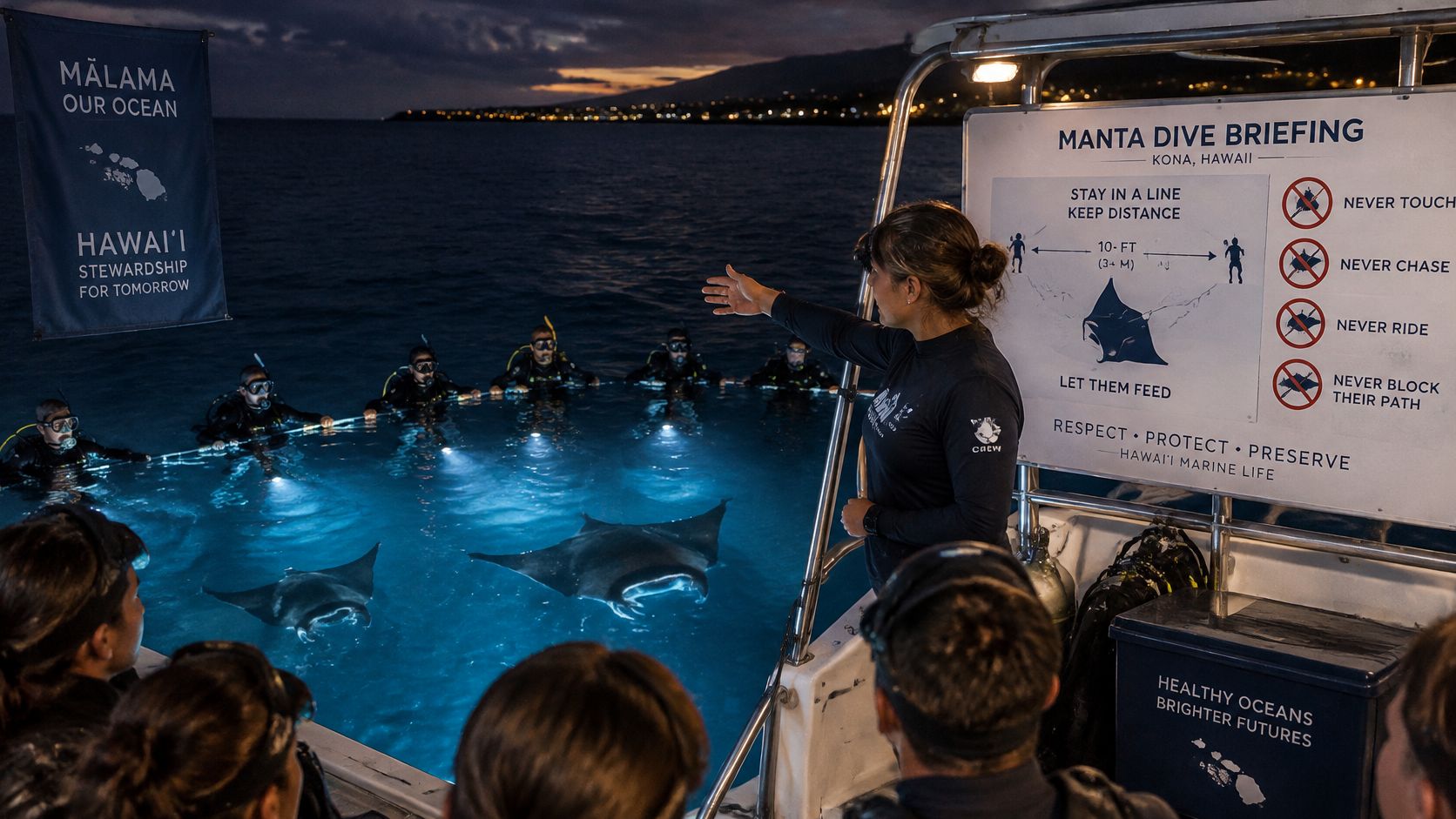
Never touch, chase, ride, harass, or block a manta's feeding path. Stay where the crew positions you, even when moving a little farther might seem to improve your view.
The Hawai'i Guide explanation of manta protection and etiquette notes that a 2009 Hawai'i statute prohibits knowingly capturing or killing manta rays in state waters. Its observation guidance also emphasizes avoiding disturbance and contact with the animals' protective mucous coating.
Separate law from proposed site management
Animal-protection law, proposed commercial rules, and voluntary operating practices aren't interchangeable. You shouldn't assume a management proposal has become an enforceable requirement.
The Hawaii Ocean Watch discussion of manta tourism management describes proposals including no anchoring within viewing sites, 2.5-hour time limits, guide-to-participant ratios no higher than 10:1, restrictions on subsurface vessel lighting, designated viewing areas, and engines off while guests are in the water; it also describes a later draft proposing 24 commercial permits per location, no more than 60 passengers per operator per 24-hour period, and one guide for every eight participants.
Those are proposed measures, not a statement of the rules currently in force. Requirements can change, so operating instructions must reflect current conditions and applicable requirements rather than an old summary online.
Follow the supervision plan
On our manta dive, experienced divemasters and instructors are in the water with divers to manage the group. Their role includes maintaining positions and responding when someone needs assistance.
- If your buoyancy changes: Signal your guide, control your ascent, and avoid grabbing another participant or reaching toward an animal.
- If you become uncomfortable: Tell the guide promptly rather than waiting until you're struggling.
- If surface conditions deteriorate: Follow the crew's exit directions. Don't decide independently to cross the viewing area toward another boat.
- If a manta approaches closely: Keep your hands and equipment contained and let it pass.
Our responsible diver etiquette guidance reinforces the same principle: your movements affect everyone nearby.
The experience starts with a detailed crew briefing covering the science behind the dive and the golden rules of passive observation. Listen even if you've done a night dive before. Familiarity with scuba equipment doesn't replace knowledge of this site's positioning and recovery procedures.
What to Pack and How to Photograph Mantas
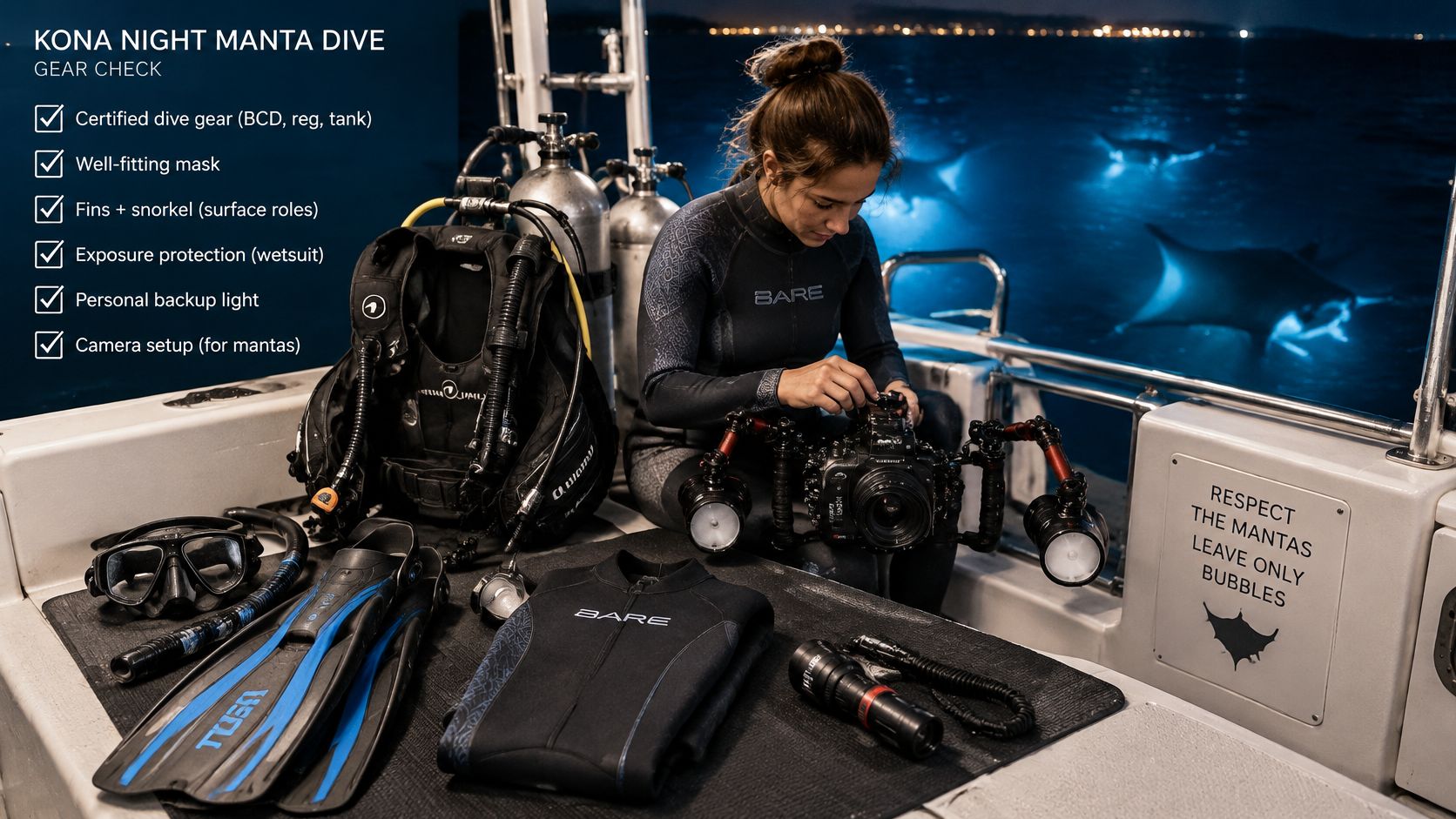
Pack for a stationary evening in the ocean, not an energetic daytime reef swim. Confirm what your reservation includes before bringing duplicate equipment or assuming a personal item will be supplied.
- Dive equipment or surface kit: Certified divers should have properly fitted scuba equipment and their certification details. Surface participants need a well-fitting mask, snorkel, and fins appropriate to the crew's setup.
- Exposure protection: Choose a well-fitting wetsuit suited to night water and your own cold tolerance. A loose suit is a poor substitute for the right fit.
- Personal backup light: Divers should carry a working backup light for equipment trouble or signaling, following the crew's lighting instructions.
- Towel and dry bag: Keep your return clothing dry and separate from wet gear.
- Sun protection: If boarding before sunset, apply reef-safe sunscreen well before entry rather than immediately beside the water.
- Camera kit: Use a waterproof housing with clean seals and a charged battery. Keep a spare battery dry for use before entry, never for an underwater change.
Photograph the pass without changing it
- Stay still and let the mantas approach. A settled position gives you a more predictable frame than trying to track an animal through the group.
- Start with the crew's lighting. Work with the established illumination before considering any additional camera light, and follow the briefing on permitted equipment.
- Keep personal beams away from faces. Don't sweep a torch across a manta's eyes or another diver's mask while composing.
- Shoot wide. A wide-angle setting gives you room for the whole feeding pass and reduces the temptation to move closer.
- Leave the feeding path open. No photograph justifies extending your camera into an animal's route or leaving your assigned position.
Test your housing, controls, and camera tether before boarding. A tether should secure the camera without trailing loose line that could snag equipment.
Camera advice: If operating the camera makes you lose track of buoyancy, gas, or your guide, put it away.
A good image comes from patience and position, not pursuit. Quieter moments can produce memorable frames because you have time to compose rather than react.
If you'd rather concentrate on watching, review the manta night dive photo-package information before choosing whether to bring your own setup.
Manta Dive Questions Answered
Can I still see mantas if none appear on my night?
Possibly on a later attempt, but not retrospectively on that outing. A brief glimpse or an animal feeding beyond the brightest area still counts as a sighting; a genuine no-show means you didn't see one. Confirm the applicable repeat-trip and cancellation terms before reserving, without assuming that another outing will be free.
When is the best time to go?
There's no guaranteed month. Feeding opportunities shift with zooplankton conditions, and a calendar date can't tell you how many animals will attend. Choose dates that fit your travel plans, pay attention to current ocean conditions, and preserve flexibility where possible.
Is it suitable for non-swimmers or families with young children?
Non-swimmers and people uncomfortable in open water shouldn't treat this as an easy first swimming lesson. Snorkelers need to be comfortable floating at the surface, while divers need certification and the ability to follow positioning instructions. Families should confirm participant eligibility before booking; riding along or staying aboard is an option only when specifically arranged.
Does the dive use bait?
No. Guests shouldn't offer food or try to lure an animal closer. Your contribution is to remain an unobtrusive observer, not to influence where a manta swims.
What happens if weather cancels the trip?
Use a backup date if one is available within your travel window. Cancellation, rebooking, and refund arrangements follow the terms of your reservation, so review those before committing your final evening. Don't pressure the crew to run because another date is inconvenient.
How should I prepare for the underwater setting?
Know the planned profile and discuss any concerns before boarding. Our explanation of how deep the Kona manta ray dive is helps you consider your comfort with the setting. Stationary viewing still requires attention to your computer, breathing, and guide.
Book Your Manta Night Dive Next
Book your manta evening with Kona Honu Divers by choosing the format that matches your certification and how much diving you want. Start with the 2-Tank Manta Dive & Snorkel booking page, where you can review the current offering and reserve online.
The Manta Ray Night Dive is one of our signature tours, listed for all divers and bucket-list seekers. Scuba participation still requires certification; the description isn't a substitute for meeting the activity's entry requirements.
Match the booking to your evening
Choose the 2-tank manta option if you want a dive plus the manta session. If you're seeking a shorter evening centered on the manta encounter, review the available Manta Ray Night Dive format and confirm the schedule before reserving.
Rates vary by tour and date, so check current prices at reservation rather than relying on an older blog quotation. Confirm equipment inclusions, the number of tanks, meeting arrangements, and what transport is included. Compare the complete booking, not just the headline price.
For preparation beyond the briefing, the PADI Manta Ray Diver specialty course covers manta biology, behavior, conservation, and respectful interaction before the night dive.
For a separate experience, consider the Black Water Night Dive or the advanced long-range dive trip. Choose those according to their own experience requirements, not just because you've completed a stationary manta session.
Before finalizing, confirm your date, participant roles, certification details, equipment needs, and check-in instructions. Save the reservation confirmation where you can access it easily, and keep your backup evening open if your itinerary permits.
Kona Honu Divers offers guided manta encounters with a detailed briefing and in-water supervision for divers at Garden Eel Cove. Visit Kona Honu Divers to choose your manta evening, check availability, and reserve the format that fits your skills and travel dates.