
Imagine gliding through sapphire-blue water so clear it feels like you're flying, with ancient volcanic landscapes sheltering some of the most vibrant marine life on Earth. That isn't just some far-off tropical dream; that's Kona diving. This guide is your deep dive into why this protected coast on the Big Island has become a global magnet for scuba divers.
Welcome To Kona: The Heart Of Hawaiian Diving
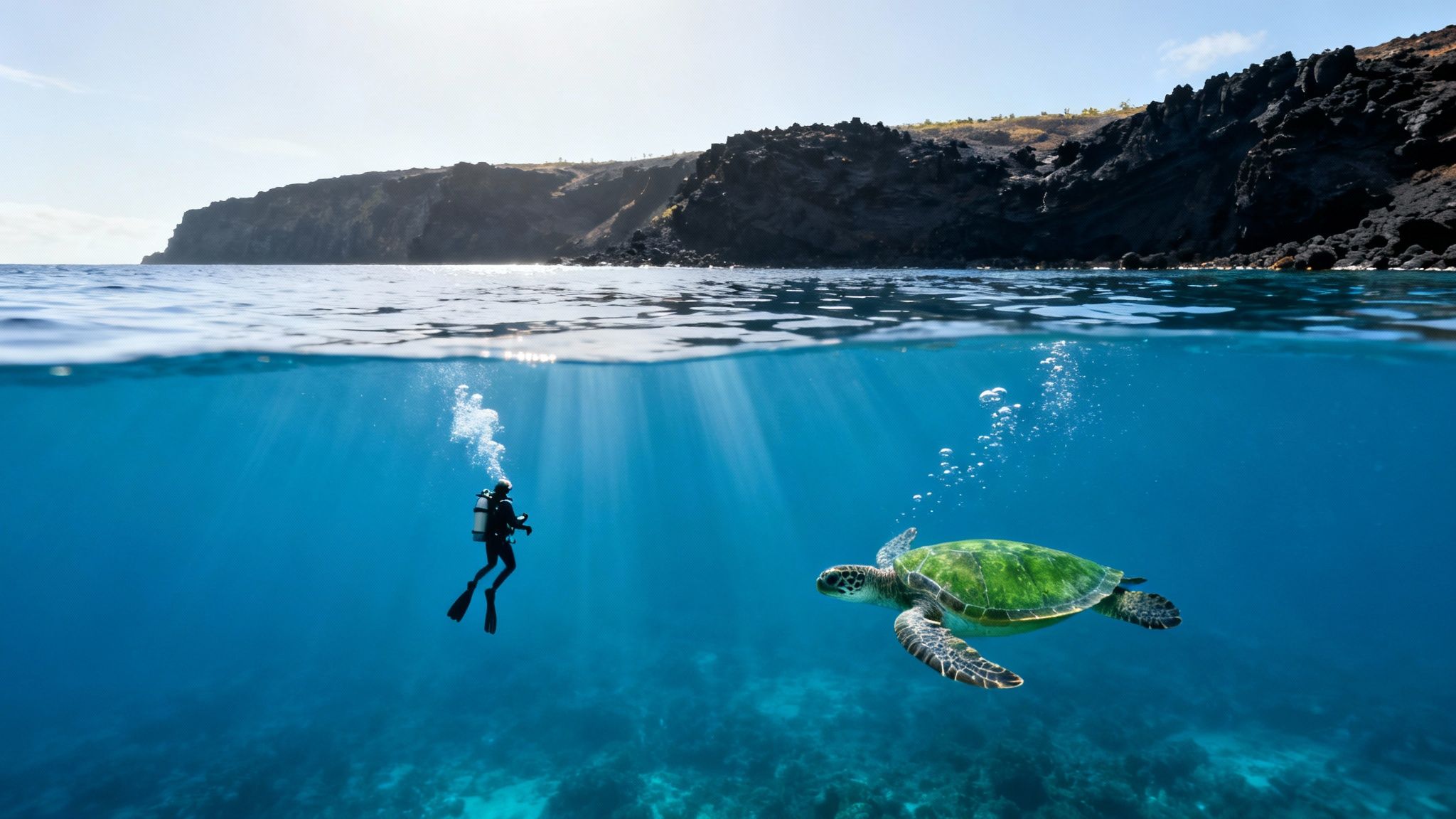
The Kona coast isn't just another spot on the map; it's a world-class underwater sanctuary. Tucked away in the lee of the massive Mauna Loa and Hualalai volcanoes, these waters are famously calm and clear, with visibility often stretching beyond 100 feet. This unique geography creates the perfect haven for both divers and marine life to flourish.
From the legendary Manta Ray Night Dive to the surreal, otherworldly Blackwater Dives, Kona delivers experiences you simply won't find anywhere else. The underwater topography here is stunning—shaped by ancient lava flows, it's a dramatic seascape of arches, caverns, and intricate reef structures. These formations are now home to an incredible diversity of life, much of which is endemic, meaning it's found only in Hawaiian waters.
Why Divers Choose Kona
So, what really sets Kona apart? It's the sheer variety and quality of the dive sites, all just a short boat ride away. The growth of Kona diving is one of Hawaii's great tourism success stories. From just a handful of pioneering dive shops in the 60s and 70s, Kona has blossomed into a premier destination with more than 50 dive shops and charters. You can learn more about the history of Big Island scuba diving right here.
Today, the Kona coast welcomes around 150,000 dive tourists annually, who complete an impressive 100,000 certified scuba dives each year. This guide is here to get you ready for the adventure of a lifetime. We'll introduce you to Kona Honu Divers, your expert guides for safe, unforgettable, and conservation-minded trips. We’re passionate about sharing the magic of these waters and helping every guest leave with a deeper appreciation for the ocean.
With a team that holds over 200 years of combined industry experience, the focus is always on creating a personalized and remarkable experience.
Our commitment is to show you exactly why Kona belongs on every diver's bucket list. We offer a whole range of Kona diving tours built for every skill level, from those taking their very first breath underwater to seasoned technical divers looking for a new challenge.
Exploring Kona’s World-Famous Underwater Experiences
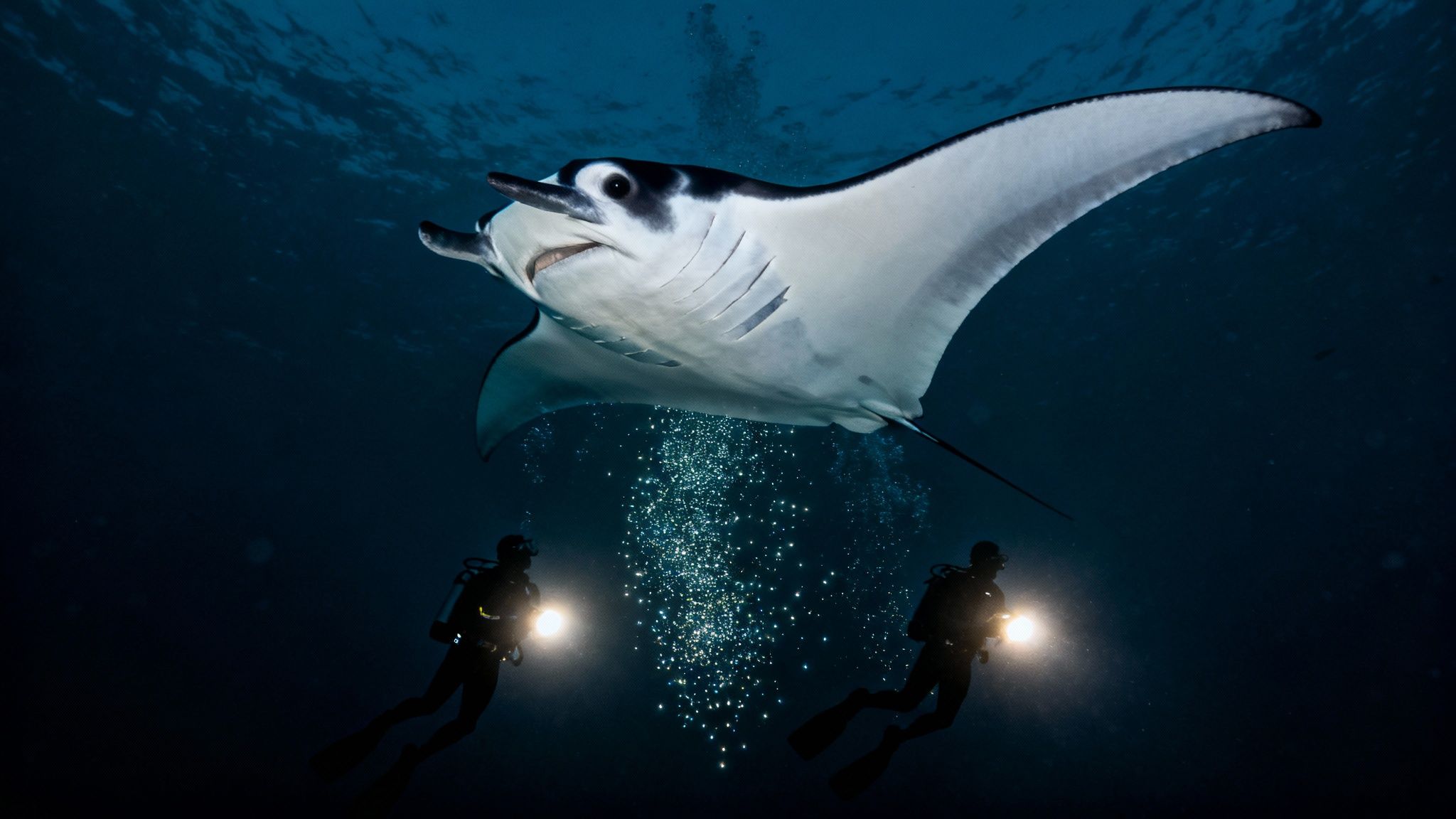
Kona isn't just another dive spot; it's a bucket-list destination packed with signature underwater adventures you truly can't find anywhere else. These are the experiences that put the Big Island on every serious diver's map. From an otherworldly ballet in the dark to a journey into the deep ocean abyss, diving here is all about unforgettable moments.
Let's kick things off with the main event—the one dive that defines marine encounters in Hawaii and, for many, the entire world.
The Manta Ray Night Dive: An Underwater Ballet
Picture this: you settle onto a sandy patch of the ocean floor as darkness falls, aiming your dive light up toward the surface. Within moments, massive, graceful shadows materialize from the deep, swooping and barrel-rolling through the beams of light, sometimes just inches from your face. This is the Kona Manta Ray Night Dive, and it is absolutely magical.
This iconic experience is Kona's most famous attraction, and for good reason. It all started back in 1992, when dive operators began noticing mantas gathering near hotel lights. Today, it’s a world-renowned phenomenon. Research foundations have identified over 270 individual manta rays in the area, and on any given night, you might see a dozen or more of these gentle giants feasting on plankton.
While there are a few places to see the mantas, one spot consistently delivers the best show.
Garden Eel Cove (Manta Heaven) is widely seen as the superior choice for the manta ray night dive. Its unique underwater topography forms a natural amphitheater, giving divers a better, more protected viewing area. The cove is also sheltered from open ocean swells, meaning calmer, safer conditions and more reliable manta appearances, all surrounded by healthier reefs.
The dive itself is a beautifully simple, yet effective, setup. Operators place a powerful light source—often called "the campfire"—on the ocean floor, which attracts a thick cloud of plankton. Divers gather in a circle around the light, creating a gallery for the performance to unfold. It’s an absolute must-do for anyone visiting Kona. You can learn more about what makes the manta ray tours on the Big Island so special and see why it's a life-changing dive for so many.
The Blackwater Dive: A Journey Into The Abyss
If you crave an experience that feels like floating through outer space, Kona's Blackwater Dive is calling your name. This isn't your typical reef dive. It’s a drift dive in the deep open ocean at night, where you're suspended over thousands of feet of inky black water.
Tethered to the boat, you and your light become a beacon in the abyss, witnessing one of the planet's largest migrations. Every single night, countless bizarre and often bioluminescent creatures rise from the depths to feed near the surface.
You'll see organisms that look like they're from another planet:
- Pteropods: Tiny, winged snails that appear to "fly" through the water.
- Comb Jellies: Gelatinous animals that refract your light into dazzling rainbow displays.
- Larval Creatures: The transparent, alien-looking juvenile forms of crabs, eels, and fish.
The feeling of floating in absolute darkness, punctuated only by the strange glows and flashes of deep-sea life, is both humbling and exhilarating. This is a specialized dive for the adventurous at heart who are comfortable in the dark.
Advanced Diving: Lava Tubes And Deep Reefs
Beyond the famous night dives, Kona's volcanic coastline is a playground for experienced divers. The island’s fiery past has sculpted a dramatic underwater landscape of lava tubes, massive archways, and deep canyons teeming with life.
These advanced dives offer a different kind of thrill—one focused on exploration and geology. Imagine swimming through a huge underwater cavern and emerging onto a vibrant reef wall that plunges into the deep blue. These sites are often patrolled by larger marine life, including sharks, eagle rays, and huge schools of jacks.
Navigating these intricate structures demands excellent buoyancy control and a solid foundation of experience, but the payoff is immense. You get to see firsthand how life has adapted to these unique volcanic seascapes, creating an ecosystem found nowhere else on Earth.
What Makes Kona’s Diving Conditions So Perfect
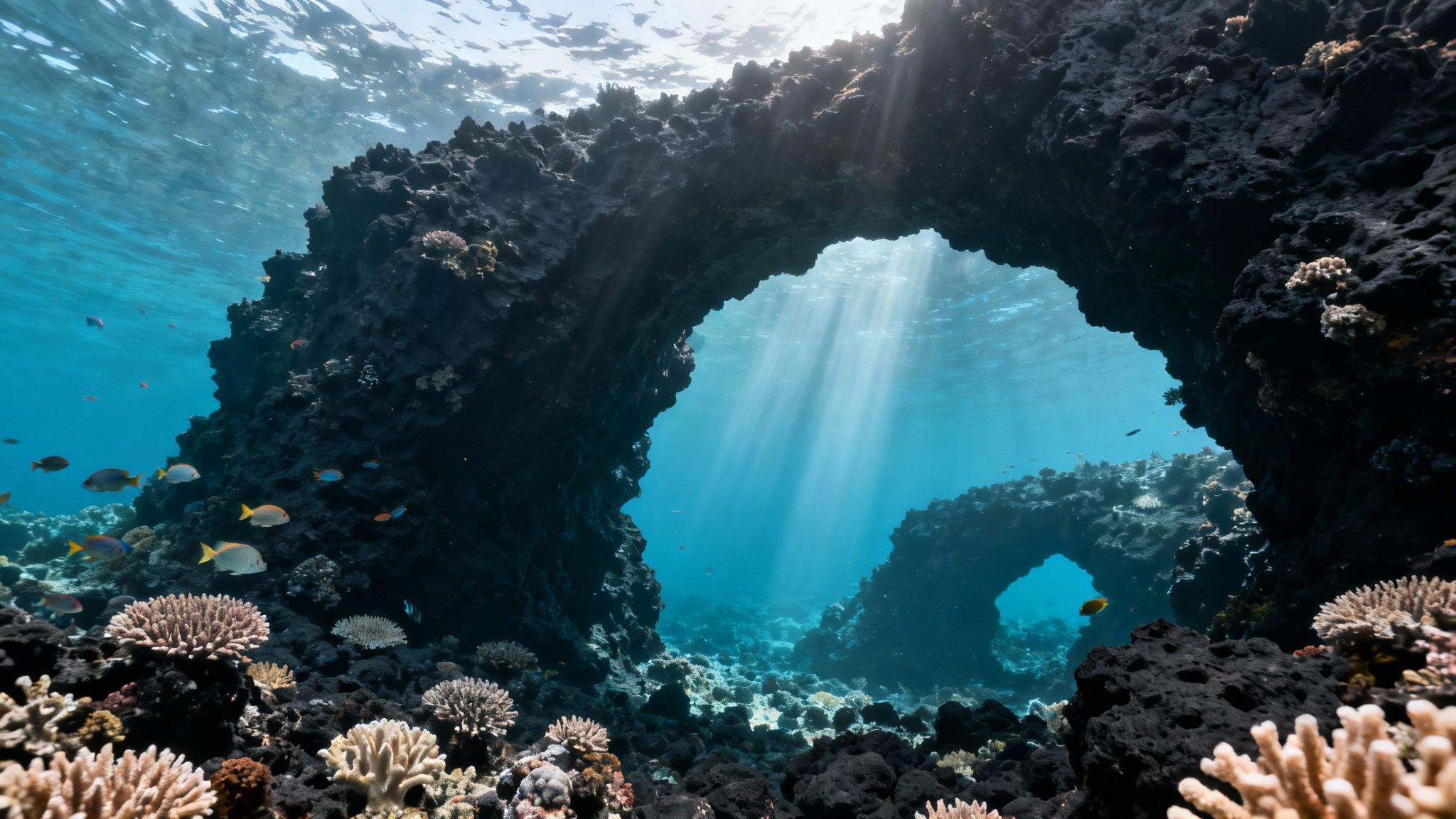
Ever wondered why Kona is consistently ranked as a world-class dive destination? It’s not just luck; it's a perfect storm of geology and geography working in our favor. The Big Island’s two gigantic volcanoes, Mauna Loa and Hualalai, create a massive shield that blocks the powerful trade winds blowing in from the northeast.
This creates a protected "leeward" coastline, resulting in exceptionally calm and predictable seas. That’s the secret sauce for Kona diving. With no heavy winds to churn up the water, the visibility is often spectacular—it’s not uncommon to see clearly for more than 100 feet. It really feels more like you’re flying than swimming. You can get a better sense of this by learning how to check ocean conditions for the Big Island and seeing the data for yourself.
A Landscape Forged By Fire
The world below the waves is a mirror image of the island's volcanic past. Thousands of years of lava flows have carved out a dramatic underwater landscape that you just don't see anywhere else. Forget flat, sandy bottoms; here, every dive site is an adventure through a volcanic playground.
We're talking about incredible structures like:
- Lava Tubes: These are ancient tunnels where molten rock once flowed, now creating awesome swim-throughs and caverns for divers to explore.
- Arches and Pinnacles: Towering rock formations that arc gracefully overhead or jut up from the seafloor, making you feel small in the best way possible.
- Canyons and Ridges: Deep underwater valleys and sharp ridges that offer perfect hideouts for all kinds of marine life.
This complex topography isn't just for show. It provides countless nooks and crannies where marine creatures can feed, breed, and take shelter. It’s a dynamic and healthy ecosystem built on a foundation of solid rock, making every single Kona diving experience completely unique.
This volcanic foundation doesn’t just create beautiful scenery; it supports a vibrant and healthy coral reef system. The hard substrate is an ideal surface for corals to anchor and grow, which in turn attracts the fish and invertebrates that make these reefs so full of life.
Hawaii’s Unique Underwater Inhabitants
What really sets Kona apart, though, is the life you find here. The Hawaiian Islands are the most isolated island chain on Earth. This seclusion has given marine life an evolutionary path all its own.
A huge number of the critters you'll encounter underwater are endemic, meaning you can't find them anywhere else on the planet. Because of this, the Kona coast has one of the highest rates of endemism in the world. A significant portion of the fish you'll see evolved right here and exist nowhere else.
That means every dive is a chance to spot something truly rare. From the brightly colored Hawaiian cleaner wrasse darting around to schools of milletseed butterflyfish, the reefs are a living museum of evolution. It’s this combination of unique marine life, crystal-clear water, and stunning volcanic scenery that truly makes Kona’s diving conditions so perfect.
How to Plan Your Kona Diving Adventure
So, you're dreaming of diving in Kona's incredible underwater world. Fantastic. Now, let's get down to the brass tacks and turn that dream into a well-planned reality. A little bit of prep work on the front end means you can spend less time stressing and more time enjoying the magic once you're here.
This guide will walk you through all the practical details—from figuring out the best time of year to visit to knowing exactly what to throw in your suitcase. Let’s get the logistics sorted so you can focus on the adventure ahead.
Choosing the Best Time to Visit Kona
Here’s the great thing about diving in Kona: there's really no "bad" time to visit. The massive volcanoes on the Big Island act as a natural shield, keeping our coastal waters remarkably calm and clear pretty much year-round. That said, there are some subtle seasonal shifts that could make one time of year better than another for you, especially depending on what marine life you’re hoping to see.
For instance, if hearing the otherworldly songs of humpback whales echoing through the water is on your bucket list, you'll want to aim for December through March. The water is a touch cooler then, but the payoff is massive. On the other hand, if you're after that balmy, bath-like water, the summer months from June to September are your ticket, with temperatures often pushing past 80°F and prime conditions for manta ray encounters.
To make it even easier, here’s a quick-glance table to help you line up your trip with your priorities.
Kona Diving Season Overview
| Season | Water Temperature (Avg) | Visibility | Key Marine Life Sightings |
|---|---|---|---|
| Winter (Dec-Mar) | 75-78°F (24-26°C) | Excellent (100+ ft) | Humpback whales (singing underwater!), dolphins, turtles |
| Spring (Apr-Jun) | 76-79°F (24-26°C) | Excellent (100+ ft) | Peak manta ray activity, reef sharks, diverse fish schools |
| Summer (Jul-Sep) | 79-82°F (26-28°C) | Very Good (80-100 ft) | Calmest seas, pilot whales, great for all dive types |
| Fall (Oct-Nov) | 78-80°F (26-27°C) | Excellent (100+ ft) | Fewer crowds, tiger shark sightings possible, eagle rays |
No matter when you decide to come, keep in mind that our most popular charters, like the manta ray night dive, can book up weeks or even months in advance. It's always a smart move to book your dives ahead of time, especially if you’re traveling during a peak season.
Certification and Safety First
At the end of the day, diving is all about having a safe, incredible experience, and that starts with knowing the requirements. The good news is Kona has something for everyone, whether you're just getting your fins wet for the first time or you’re a seasoned pro.
- For Beginners: Never been diving? No problem. A Discover Scuba Diving experience gets you in the water with one of our instructors right by your side. You get to see the reef without committing to a full course.
- Open Water Divers: If you have your standard Open Water certification, you're set for the vast majority of Kona's dive sites. This includes our classic reef dives and, yes, the world-famous Manta Ray Night Dive.
- Advanced Divers: For some of the more demanding dives, like the mind-bending Blackwater Dive or explorations of deeper lava tubes, you'll need an Advanced Open Water certification.
Here at Kona Honu Divers, safety isn't just a box we check—it's woven into everything we do. Our crew gives detailed briefings before every single dive to make sure everyone is on the same page. We obsess over our equipment maintenance, and our boats are fully stocked with all the necessary safety gear, from oxygen to first aid kits. We want you to feel completely at ease so you can just relax and soak it all in.
Packing for Your Dive Trip
Packing for a dive vacation can feel like a game of Tetris. You want to bring the right stuff without lugging your entire closet across the Pacific. While we have excellent rental gear, we know that nothing beats the comfort of your own equipment.
Here’s a simple checklist to get you started:
- Essential Gear to Bring: Your mask and dive computer are the two big ones. A perfect fit and a computer you know how to use make a huge difference in your comfort and safety.
- Gear You Can Rent: Save yourself the airline baggage fees! We have top-of-the-line BCDs, regulators, and wetsuits ready for you. As a bonus, we offer complimentary nitrox for any certified nitrox divers.
- Must-Have Non-Dive Items: Don't forget reef-safe sunscreen, a reusable water bottle, a good hat, polarized sunglasses, and a light jacket or sweatshirt for the evening boat rides back to the harbor.
A Note on Reef-Safe Sunscreen: This is a big one. Hawaii has officially banned sunscreens containing oxybenzone and octinoxate because these chemicals are devastating to our coral reefs. Please, check the label and make sure yours is mineral-based (using zinc oxide or titanium dioxide). It's a small action that has a huge impact on preserving the beauty we all come here to see.
A little bit of smart packing means you’ll be ready to hit the water the moment you arrive, totally prepared for an amazing trip.
Choosing The Right Dive Operator In Kona
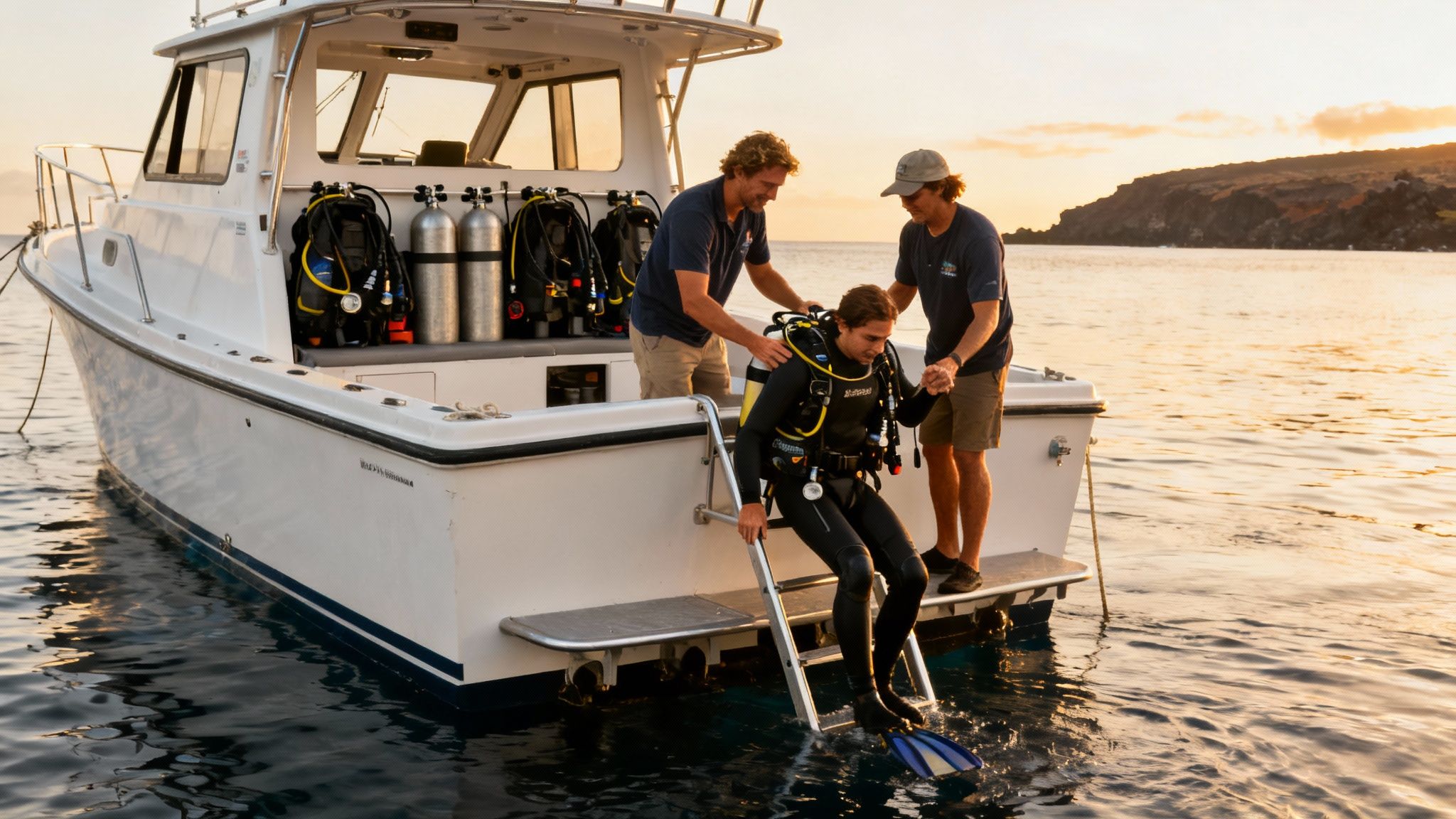
Let's be honest—your dive operator is way more than just a boat ride. They're your guide, your safety crew, and the folks who can turn a good dive into an absolutely incredible one. Picking the right team is probably the single most important decision you'll make for your Kona diving trip.
So, what separates the best from the rest? A few things are non-negotiable. You're looking for a flawless safety record, top-notch gear that’s meticulously maintained, and boats that are comfortable and reliable. But beyond the hardware, it's the people that really count. You want guides who not only know the dive sites like the back of their hand but whose passion for the ocean is contagious.
The size of the group matters, too. Smaller groups almost always mean a more personal, relaxed, and safer dive. And finally, a real dedication to marine conservation isn't just a nice-to-have; it's essential for keeping Kona's reefs healthy for years to come.
Why Kona Honu Divers Stands Apart
While you have a few solid choices for dive shops in Kona, we've worked hard to make Kona Honu Divers a cut above. Our whole operation is built on safety, deep expertise, and a genuine love for the waters we get to share with you. Our crew brings over 200 years of combined industry experience to the table, so you know you're in good hands.
We designed our dive boats, the Honu One and Honu Lele, specifically for divers. Think hot water showers, plenty of shade, and tons of space so you're not bumping elbows. It makes the whole experience, from gearing up to the ride back, just that much better. We also offer complimentary nitrox for certified divers, which means more bottom time to soak it all in.
What truly makes us different, though, is our focus on you. We keep our groups small on purpose. This lets our guides give you the attention you deserve and tailor the dive to everyone's comfort level. Our goal is simple: to give you an unforgettable adventure that’s as safe as it is amazing.
Other Respected Operators In The Area
To give you the full picture, there are other great companies out there that have earned their stripes. Operators like Jack's Diving Locker and Big Island Divers have been mainstays in the Kona diving scene for years and are well-known for running professional trips.
Every shop has its own vibe and specialty, so a little research goes a long way. To help you sort through it all, we put together a detailed breakdown in our guide on the top 10 Kona diving companies ranked. It’s a great resource for figuring out which one best fits what you're looking for.
Here’s a look at what divers are saying about some of the other local operators.
In the end, the "best" operator really depends on what's most important to you. While you have several quality options, we believe Kona Honu Divers truly delivers on providing a premium, personal, and conservation-minded adventure that you'll be talking about for years.
When you dive with us, you’re not just another name on the roster. You're our guest, and we can't wait to show you the underwater world we love. That commitment to an outstanding, personal experience is what we're all about.
Got Questions About Diving in Kona? We’ve Got Answers.
It's only natural to have a few questions when you're planning a dive trip to a new place. To help you get ready for your underwater adventure, here are some straightforward answers to the things we get asked most often.
What Certification Level Do I Need to Dive in Kona?
The best part about diving here is that Kona’s underwater world is wide open to just about everyone, from first-timers to seasoned pros.
We’ve got something for every skill level:
- Never Dived Before? No Problem. Our Discover Scuba Dives are designed for complete beginners. You’ll be right alongside a professional instructor the whole time, giving you a safe and incredible first look at the reef.
- Open Water Certified Divers: Your basic certification is your passport to most of Kona’s incredible dive sites. This includes our world-famous Manta Ray Night Dive—a must-do for any diver.
- Ready for a Challenge? For those with an Advanced Open Water certification, the truly unique Kona Blackwater Dive is an otherworldly experience you won't forget. Our premium advanced trips are also perfect for exploring deeper reefs and dramatic lava tube swim-throughs.
Don't worry about getting it wrong—we list the specific certification requirements on every tour page, so you'll know exactly what's needed before you book.
How Safe is Diving in Kona?
Absolutely. Safety is the foundation of everything we do at Kona Honu Divers. The Kona coast is actually one of the safest and most enjoyable diving environments in the world. The island’s massive volcanoes shield us from the open ocean swells, creating incredibly calm and predictable conditions year-round.
Of course, the most important part of any safe dive is choosing a top-notch operator. Our experienced guides, rigorous safety protocols, and perfectly maintained gear are all there to give you total peace of mind. We sweat the small stuff so you can just relax and enjoy the show.
When is the Best Time to See the Manta Rays?
Honestly, there’s no bad time to see the manta rays. Our local population sticks around all year, so your chances of having an amazing encounter are fantastic no matter when you visit.
That said, if you're trying to time it perfectly, the summer months from June to September are often the sweet spot. The seas tend to be at their absolute calmest, and the plankton (the mantas' dinner) is often most concentrated, which can draw in even more rays for a spectacular show.
But don't let the calendar dictate your trip—it’s a breathtaking experience any night of the year.
Can My Non-Diving Friends and Family Come on the Boat?
Yes, we love having non-divers join the fun! We welcome them as snorkelers or ride-alongs on many of our diving tours.
The Manta Ray Night Dive, in particular, is a fantastic experience for snorkelers—they get an incredible bird's-eye view of the action from the surface. It's the perfect way for everyone to share in the magic of Kona's ocean life, whether they have a scuba certification or not.