
Picture this: you're suspended in the vast, inky blackness of the open ocean, miles from the Kona shore. The only world that exists is the one illuminated by your dive light—a floating universe of strange, beautiful creatures rising from the deep. This isn't science fiction; this is the Kona black water dive, a front-row seat to the largest animal migration on Earth.
Embarking on an Otherworldly Ocean Adventure
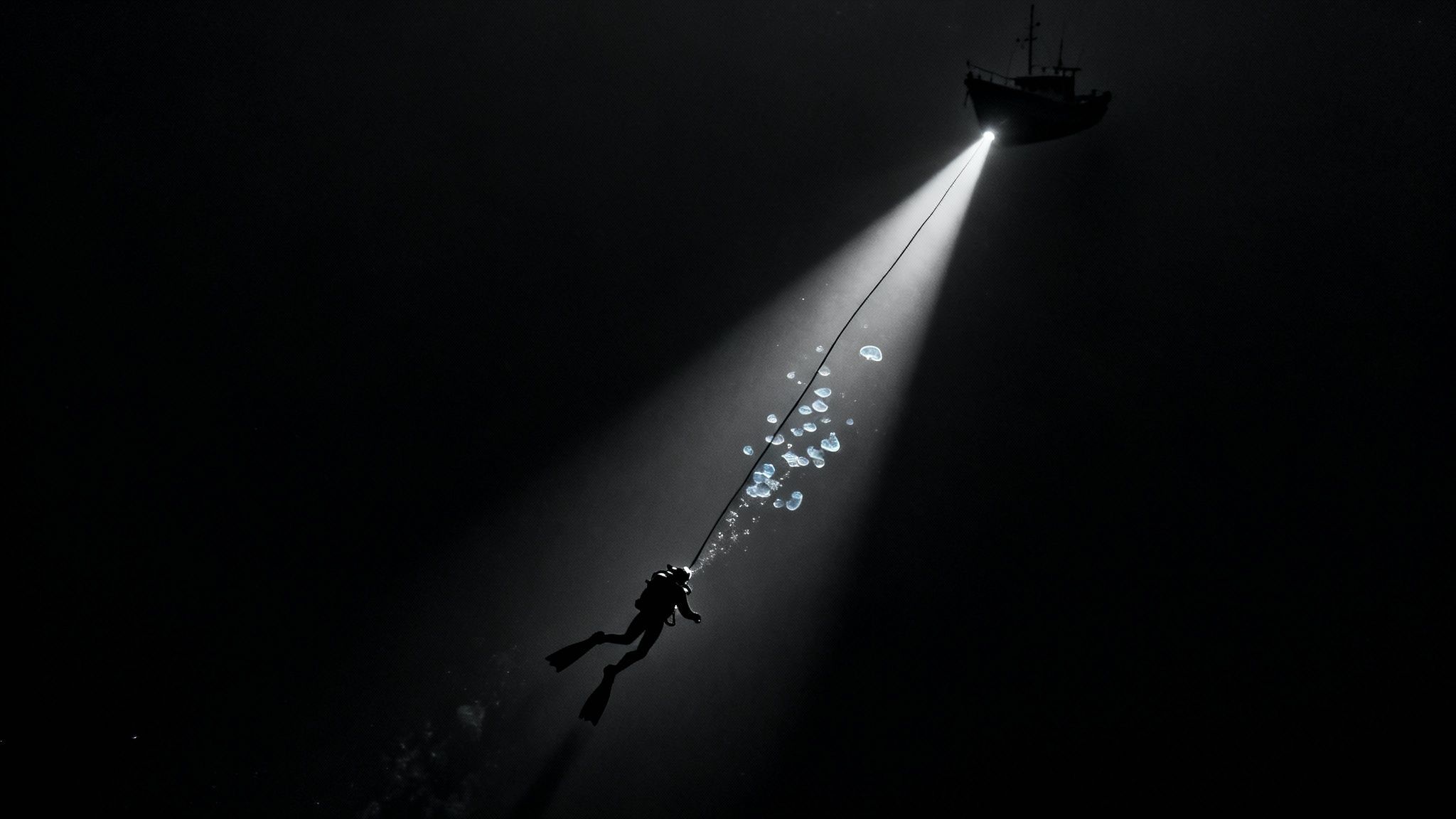
A Kona black water dive is worlds away from any other scuba experience you’ve had. This isn’t about swimming over a coral reef after dark. It’s about drifting in the deep, open ocean to witness a spectacular nightly event. Every evening, countless deep-water organisms make the journey toward the surface to feed, all under the cover of darkness.
This incredible dive was born right here on the Big Island of Hawaii. The island's unique underwater landscape, where the seafloor plummets to over 10,000 feet just a short distance from shore, makes it the perfect stage for this adventure. You can read more about how it all started on PADI's blog.
What Makes This Dive a Must-Do
This guide is your ticket to understanding this once-in-a-lifetime experience. We'll pull back the curtain on the science behind this massive vertical migration and introduce you to the cast of alien-like characters you might encounter. We’ll also cover the essential safety protocols and specialized gear that make it all possible.
Here's a taste of what we'll cover:
- The bizarre and beautiful marine life you'll encounter.
- Why Kona's unique geography creates the perfect conditions.
- The critical safety protocols and equipment you'll need.
From glowing, otherworldly jellies to tiny, see-through octopuses, every moment on a black water dive is filled with pure discovery. If you want to dive even deeper into this unique adventure, check out our guide covering everything you need to know about black water dives.
Ready to take the plunge into this surreal underwater world? The Kona Honu Divers team is here to guide you. Learn more about our expertly led Black Water Night Dive tour and book your spot for a night you'll never forget.
So, What Exactly Is a Kona Black Water Dive?
You’ve probably done a night dive before, right? Gliding over a familiar reef, watching the nocturnal critters come out to play. A Kona black water dive is a whole different universe. The biggest difference is where it happens: we're not on a reef. We're miles offshore, drifting over thousands of feet of inky black ocean.
It’s less like a typical dive and more like a spacewalk. Imagine being an astronaut, tethered to your ship, watching an alien galaxy of life drift past in the void. Your entire world shrinks to the narrow beam of your dive light, and what you see inside that beam is utterly mesmerizing.
This whole incredible experience is possible thanks to a phenomenon called diel vertical migration. This is, hands down, the largest migration of life on the entire planet, and it happens every single night in every ocean.
As soon as the sun sets, countless tiny, bizarre, and often see-through creatures travel up from the crushing depths to feed near the surface. When dawn breaks, they retreat back down into the abyss to hide from predators.
Why Kona is the Best Place on Earth for This Dive
So, why Kona? Simple: our unique geography makes this the undisputed capital for black water diving. The Big Island is a colossal volcanic mountain jutting straight up from the deep seafloor. This means we can get to water that's thousands of feet deep just a short boat ride from the coast.
This close proximity to the deep sea gives us a few huge advantages:
- Quick Boat Trips: We don't have to spend hours getting out to the dive site. Prime black water territory is right in our backyard.
- Amazingly Calm Waters: The Kona coast sits in the "lee" of our massive volcanoes, which shield us from the strong trade winds. This usually means flat, calm seas, making for a much more comfortable and safe drift dive.
- A Buffet of Life: The deep, nutrient-rich waters right off the coast support an unbelievable density of the planktonic life that makes this nightly migration so spectacular.
These three ingredients create the perfect stage for the Kona black water dive. It’s an adventure that drops you right into the middle of one of the planet's most mysterious ecosystems, giving you a front-row seat to a show very few people will ever get to witness. There's truly nothing else like it.
Ready for the most unique dive of your life?
Discovering the Ethereal Creatures of the Deep
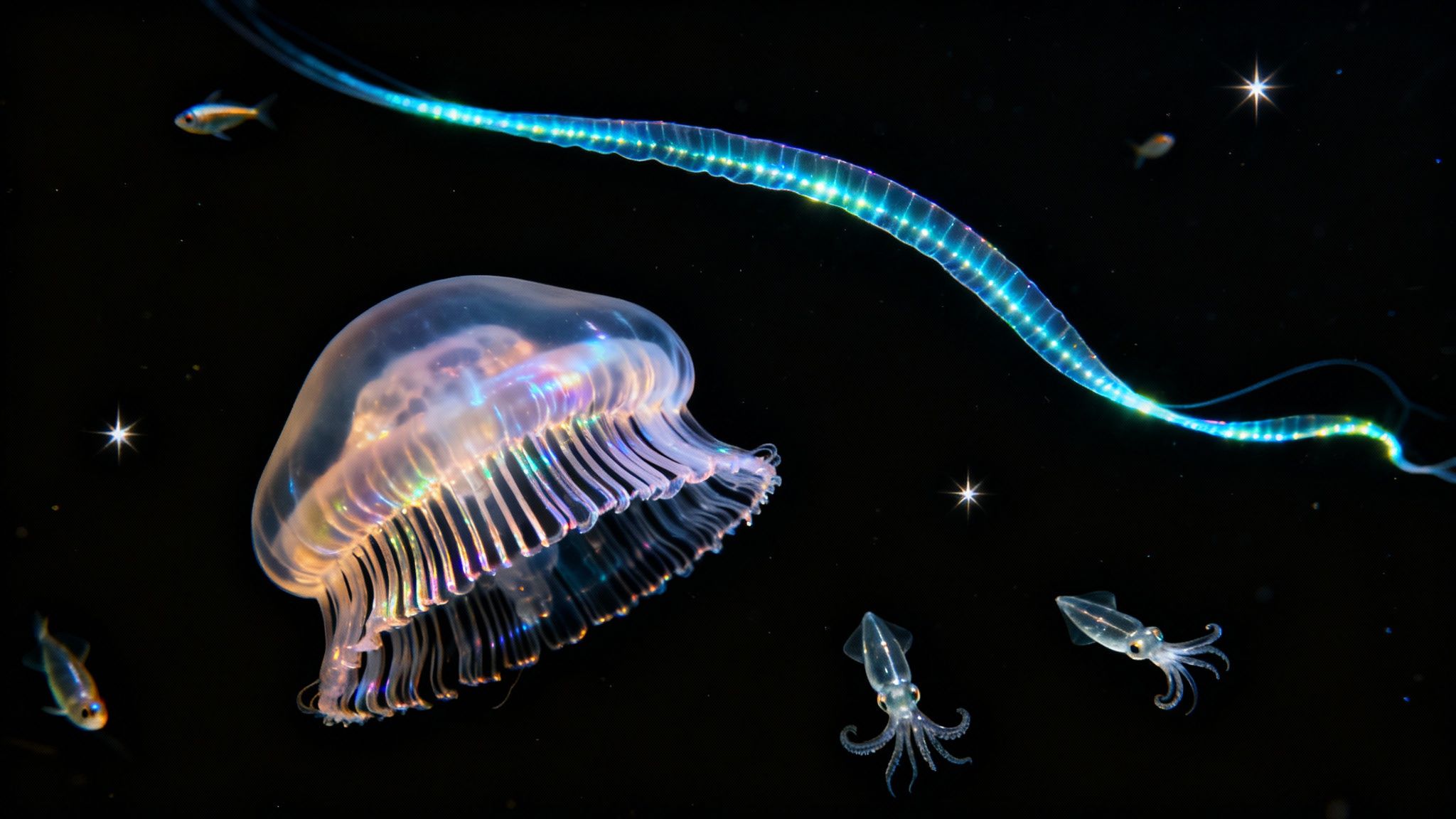
The real magic of a Kona black water dive isn't just the darkness—it's who you meet there. This isn't your typical reef dive. Forget the parrotfish and butterflyfish; you're about to enter an alien world filled with creatures that are bizarre, beautiful, and often, literally glowing.
As you descend, your dive light cuts through the ink-black water and reveals what can only be described as a living constellation. You'll see shimmering comb jellies pulsing with internal rainbows and long, string-like siphonophores that are actually colonies of tiny organisms working together, sometimes stretching for several feet.
It’s an ecosystem of miniatures and masters of disguise. Keep your eyes peeled for tiny, glass-like squid and octopuses, their bodies so transparent you can practically see right through them. But perhaps the most fascinating sights are the larval fish. They look nothing like the adults they'll become, often covered in wild, spiky appendages or long, trailing filaments—evolutionary marvels designed to help them survive out here in the big blue.
The Science Behind the Spectacle
Believe it or not, every black water dive is a bit of a scientific expedition. Your dive contributes to our understanding of this mysterious ecosystem, helping researchers piece together the secrets of the deep pelagic zone. This isn't just a fun theory; it's a proven method for discovery.
Groundbreaking NOAA research conducted right here off the Kona coast proved that recreational divers are an effective tool for surveying this massive nightly migration. In their study, scientists were able to explain 43% of the diversity they saw using predictable factors like the moon and tides.
This research underscores just how much the experience can change from one night to the next. The lunar cycle, tides, and currents all play a role, adding a thrilling element of unpredictability. No two dives are ever the same. You can dive deeper into the science by exploring the full research on these fascinating findings.
A Cast of Otherworldly Characters
While you never know exactly what will show up, a few iconic creatures often make an appearance during Kona black water dives.
We've put together a quick guide to some of the common, yet completely uncommon, critters you might see.
Common Sightings on a Kona Black Water Dive
| Creature Type | Key Characteristics | Why It's Special |
|---|---|---|
| Larval Fish | Tiny, transparent, often with elaborate spines or filaments. | These are the baby versions of familiar reef fish, looking like intricate glass sculptures. |
| Comb Jellies | Gelatinous, with rows of cilia that refract light into rainbows. | They don't sting! They use sticky cells to catch prey and "pulse" with light. |
| Siphonophores | Long, string-like colonial organisms. | Appear like a glowing strand of pearls, but are actually thousands of organisms working as one. |
| Pelagic Nudibranchs | Free-swimming sea slugs that undulate to move. | Unlike their bottom-dwelling cousins, these "fly" gracefully through the open water. |
| Glass Squid & Octopus | Cephalopods with nearly transparent bodies. | Their see-through bodies are the ultimate camouflage in an ocean with nowhere to hide. |
Of course, this is just a small sample of the incredible biodiversity waiting for you. The real thrill comes from the pure chance of it all—not knowing what amazing, strange, or beautiful creature will drift into your light beam next.
If you're ready to see it for yourself, learn more about our expertly guided Black Water Night Dive tour.
Preparing Your Gear for the Abyss
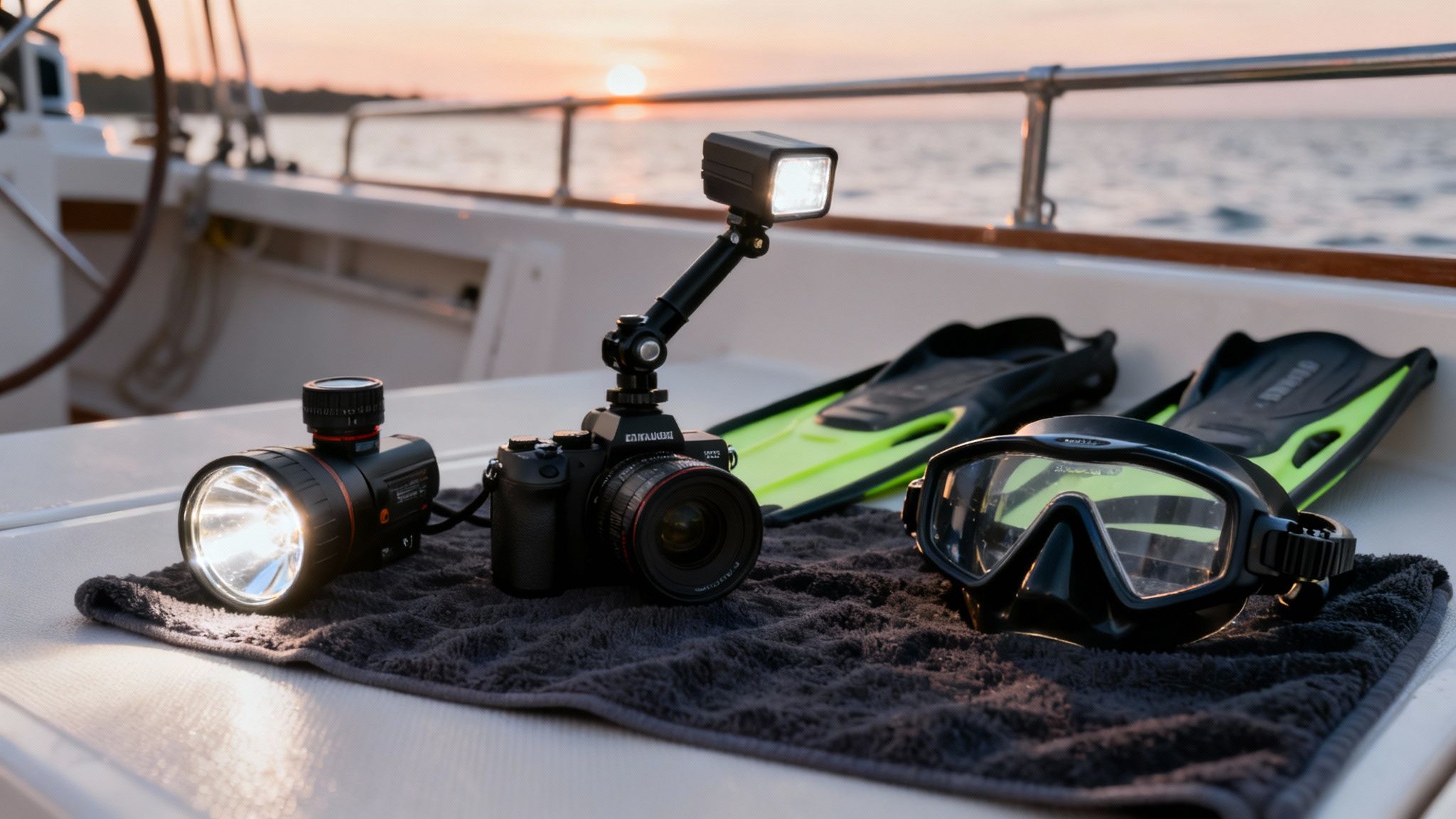
Gearing up for a blackwater dive isn't quite the same as getting ready for a casual reef tour. Your basic setup is the same, of course, but a few specific pieces of gear become absolutely essential when you're floating out in the deep blue. Your safety and your ability to even see anything depend on them.
Think of your dive light as your lifeline. It's also your window into this hidden world. You’ll need a powerful primary light, ideally one with a tight, focused beam that can slice through the darkness and pinpoint those tiny, often see-through critters. Just as critical is a reliable backup light. Out in the abyss, redundancy isn't just a good idea—it's everything.
Staying warm is also more important than you might think. Even in Hawaii, you’ll be mostly still while you drift, and the water at depth can definitely feel chilly. A full-length wetsuit, at least 3mm thick, will keep you comfortable. Trust me, you want to be focused on the amazing creatures, not on shivering.
Capturing the Abyss Through a Lens
For underwater photographers, a blackwater dive is one of the most exciting and demanding challenges out there. You're trying to nail focus on fast, tiny, translucent subjects against a pitch-black canvas. It's all about mastering your lighting.
Here are a few tips to get you started:
- Strobe Positioning is Crucial: The key to avoiding backscatter is to get your strobes out wide and angled slightly behind your camera handles. This creates a cross-lighting effect that illuminates your subject without lighting up all the particles floating right in front of your lens.
- Go Macro: This is macro photography territory. A good macro lens, typically in the 60mm to 105mm range, is a must-have for capturing the incredible details of larval fish and invertebrates.
- Camera Settings: A good starting point is a fast shutter speed (think 1/200s) to freeze the action and a smaller aperture (f/11 or higher) to get a decent depth of field. This combination will help you get those tack-sharp shots.
One last thing to consider is diving with enriched air nitrox. Here at Kona Honu Divers, we offer free nitrox to all certified divers on our trips. Many people find it helps them feel less tired and more alert after a dive—a nice little perk after such a mentally stimulating experience. For a deeper dive into equipment, check out our guide on the gear you will need for your Kona diving adventure.
Staying Safe in the Deep Open Ocean
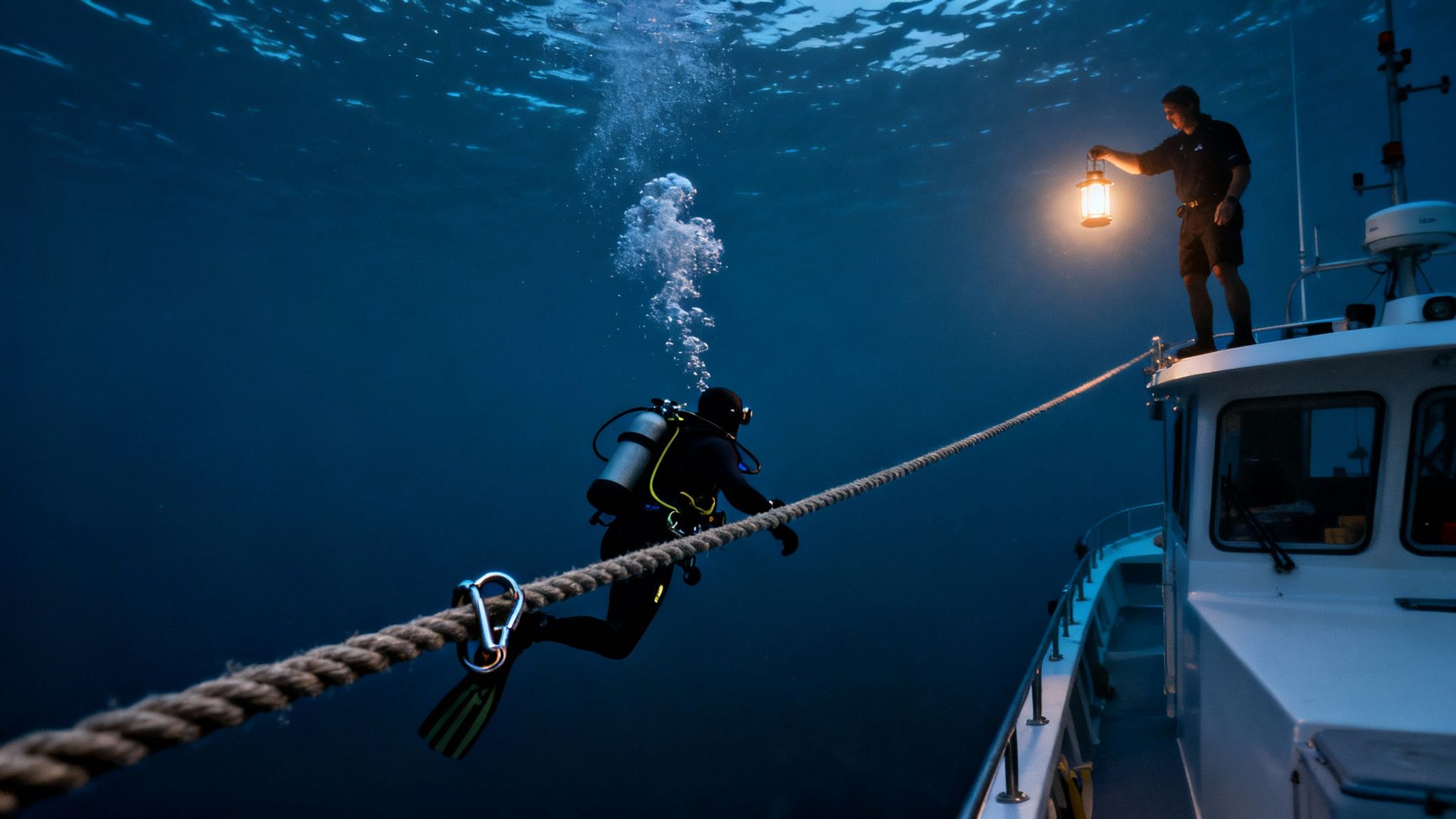
While a Kona black water dive is one of the most incredible adventures you can have, our commitment to safety is what makes the whole thing possible. Drifting miles from shore in the pitch-black open ocean isn’t something you do on a whim; it requires a rock-solid set of procedures. At Kona Honu Divers, every single part of this dive is built around your well-being.
Our entire system starts with a simple, direct physical connection to the boat. Every diver is clipped into a custom-designed tether system, which keeps you with the group and the vessel at all times. This completely removes any chance of drifting away into the vast darkness.
The Pillars of a Safe Black Water Dive
This tether is attached to a heavy, weighted line that drops straight down from the boat, giving you a constant visual and physical point of reference in what would otherwise be an endless void. It creates a secure bubble in the middle of the ocean, letting you relax and focus on the incredible creatures floating into your light beam.
That said, the most important skill you need to bring to the table is rock-solid buoyancy control. With no reef or seafloor to gauge your position, being able to hold your depth is everything. It’s what stops you from sinking too deep or floating up too fast, making the difference between a safe, awe-inspiring dive and a stressful one.
Prerequisites for Your Adventure
Because of the unique demands of this environment, the Kona black water dive is not for new divers. We have specific prerequisites to make sure everyone on board has the experience needed to handle the conditions safely. These aren't just arbitrary rules; they exist for your safety and for the safety of the entire group.
To join us on this dive, we require that every participant has:
- A minimum of 50 logged dives, which shows you have enough time in the water to be comfortable.
- Recent and genuine experience with night diving.
This level of experience ensures you have the skills and the cool-headedness to truly enjoy the open ocean after dark. This dive is designed to be a thrill, not a test of your nerves, and having the right background is what makes it so special.
If you’re keen to build up your skills before taking on this unique challenge, our advanced dive tours are the perfect way to sharpen your abilities on some of Kona’s other amazing dive sites.
Ready for the ultimate night diving challenge?
Your Adventure with Kona Honu Divers
A Kona blackwater dive is an extraordinary experience, and choosing the right crew is what makes it truly unforgettable. Here at Kona Honu Divers, we’ve spent years refining this trip into a seamless adventure.
It all starts with a relaxed, friendly check-in at our shop. From there, we’ll head out on one of our spacious boats for a stunning sunset cruise, setting the stage for the night's main event.
We know that being comfortable makes for a better dive. Our vessels are designed with divers in mind, featuring a large deck with plenty of space to gear up without feeling cramped. And when you surface, a hot freshwater shower is waiting for you—believe me, it feels amazing after a night in the open ocean.
Guided by Expert Eyes
The real secret to a mind-blowing blackwater dive isn't just the ocean—it's the guides who know how to unlock its secrets. This isn't just about dropping you in the water; it's a guided tour of a world that’s invisible to the untrained eye.
Our divemasters have logged hundreds, if not thousands, of hours in the dark. They’ve developed an almost supernatural ability to spot the tiniest, most bizarre creatures drifting up from the deep. They’ll point out larval fish that look nothing like their adult forms or delicate, pulsating jellies you'd swim right past on your own. Their expertise turns a dark swim into a vibrant safari.
This is what elevates the experience, ensuring you see the absolute best of what the deep has to offer. And if you're curious about what else swims in these waters during the day, you can explore all of our Kona diving tours to see the rest of our incredible marine life.
But don’t just take our word for a great experience. See what our past divers thought about their adventures with us.
Ready to take the plunge into the abyss? Booking your spot is just a click away.
Your Black Water Diving Questions, Answered
It’s completely normal to have a few questions before plunging into the open ocean at night—even the most experienced divers do! We've put together some answers to the most common queries we get about our Kona black water dives.
Is the Kona Black Water Dive Dangerous?
While any dive carries some inherent risk, we've designed this experience with safety as the absolute top priority. You'll be tethered directly to the boat for the entire dive, making it impossible to drift away or get lost.
Our professional divemasters give a thorough briefing before you even get in the water and are right there with you to make sure everything goes smoothly. Really, the most important skills you need are solid buoyancy control and being genuinely comfortable in the dark.
How Is This Different From a Manta Dive?
They're both incredible night dives, but they are worlds apart. The famous manta ray night dive is a stationary experience. You settle down on the seafloor in a relatively shallow spot, and we use bright lights to attract plankton, which in turn brings in the giant, graceful manta rays for a spectacular show.
A black water dive, on the other hand, is a drift dive miles offshore, suspended in thousands of feet of water. Instead of big animals, the stars of this show are the tiny, weird, and often glowing creatures that make their nightly journey up from the deep. Think of it this way: one is like watching a grand ballet, the other is like exploring a microscopic alien planet.
Do I Absolutely Need an Advanced Certification?
We highly recommend an Advanced Open Water certification, but what we really care about is your actual dive experience and comfort level. We have a firm requirement of at least 50 logged dives and you must have done some night diving recently.
This isn't about the card in your wallet; it's about ensuring you have the razor-sharp buoyancy needed to hang safely in open water. It makes the dive safer and way more enjoyable for you.
What’s the Plan if the Weather Turns Bad?
One of the best things about diving here is that the Kona coast is famous for its calm, protected waters, so cancellations are extremely rare. That said, your safety is non-negotiable.
Our captains are constantly watching the weather and sea conditions. If they decide it’s not safe to go out, we will cancel the trip. We’ll then work with you to find another night that works or issue a full refund, no problem.
Ready to see a side of the ocean that most people don't even know exists? Join Kona Honu Divers and let our expert crew guide you into the abyss. Book your spot on our Black Water Night Dive tour and prepare for the dive of a lifetime.