
You're sorting out your Kona itinerary, and the easy part is choosing what you want to see: mantas, turtles, lava arches, maybe something unusual after dark. The harder part is deciding whether your certification, recent experience, shore-entry confidence, and plans for Maunakea fit those dives.
Good Kailua Kona scuba diving starts with those decisions, not a visibility forecast. A clear reef doesn't make a slippery lava-rock exit safe, and a short boat ride doesn't make a mountain drive appropriate after diving. Build the trip around your skills and recovery time, then choose the marine life you'd most like to encounter.
Certification Courses and Entry Requirements
For most regular charters, Kona Honu Divers requires at least an Open Water Diver certification from a recognized agency such as PADI, SSI, or NAUI. That qualification allows diving to 60 feet (18 meters) with a buddy, subject to your training and applicable restrictions. Bring your C-card, including an accessible digital copy if that's how your agency issues it.
Certification establishes a training baseline, not readiness for every environment. Someone comfortable on a shallow daylight reef may still need preparation for darkness, current, or a descent without a bottom in view.
PADI courses offered and who they suit
| Course | Suits | Usual prerequisite |
|---|---|---|
| PADI Scuba Certification Course | Complete beginners | Comfortable swimmer and medical questionnaire |
| PADI Open Water Referral Course | Divers who finished theory elsewhere | Completed classroom and pool work |
| PADI Advanced Open Water | Certified divers wanting deeper diving and navigation skills | PADI Open Water Diver |
| PADI Enriched Air Diver | Divers wanting nitrox | PADI Open Water Diver |
| PADI Deep Diver | Divers preparing for deeper profiles beyond their initial training | Advanced training recommended; confirm enrollment eligibility |
| PADI Rescue Diver | Divers wanting safety and leadership skills | Advanced training recommended; confirm rescue and first-aid prerequisites |
| PADI Peak Performance Buoyancy | Divers refining control on reefs and at night | PADI Open Water Diver |
| PADI Boat Diver | Divers wanting better dive-boat procedures | PADI Open Water Diver |
| PADI Reactivate | Lapsed divers returning to diving | Previous certification |
Treat these as course-selection guidelines, not a complete enrollment checklist. Age, medical screening, prior training, and first-aid qualifications can affect eligibility. Boat Diver teaches diving procedures around boats; it isn't a boat-handling license.
Choose the next useful skill
Start with the Big Island scuba certification options if you haven't learned equipment assembly, gas management, equalization, and controlled ascents. A referral makes sense when you've already completed the academic and confined-water portions elsewhere and have the paperwork to document them.
For certified divers, choose training around the problem you need to solve. Advanced Open Water develops navigation and experience with different dive tasks. Enriched Air teaches oxygen exposure and gas analysis; Deep Diver adds planning for deeper profiles. Rescue training develops prevention and response skills rather than qualifying you to go farther offshore.
Buoyancy training often delivers the most immediate improvement for photographers and nervous night divers. Reactivate is the better starting point if basic equipment checks or emergency skills no longer feel automatic. Experienced divers considering deeper or more remote diving can review the advanced trip requirements before choosing a course.
Ask yourself:
- Starting point: Am I uncertified, completing a referral, or already certified?
- Recent competence: Can I comfortably clear my mask, recover my regulator, and hold a controlled stop?
- Actual goal: Do I need renewed confidence, better control, or training for a different environment?
Top Kona Dive Sites and Who Each One Suits
Say you arrive with a week available, a current certification, and mixed goals: reef photography, a manta encounter, and perhaps something more demanding. Choose the dive format first. Site names alone won't tell you whether you'll be resting near a sandy viewing area or maintaining position in open water at night.
Kona dive sites and formats at a glance
| Site or dive | Format | Best for | Defining feature |
|---|---|---|---|
| Garden Eel Cove (Makako Bay) | Night boat manta dive | All certified levels, subject to night-dive readiness | Protected sandy viewing area with reef structure |
| Keauhou Bay area (Manta Village) | Night boat manta dive | All certified levels, subject to conditions | Alternative principal manta-viewing area |
| Lava tubes and arches | Two-tank morning boat dive | Certified divers | Lava formations, arches, and coral gardens |
| Remote pristine sites | Premium advanced two-tank trip | Experienced divers | Deeper profiles and drift dives |
| Black Water night dive | Night boat dive | Experienced night divers | Open-water animals observed around lights |
| Old Kona Airport shoreline | Shore dive | Experienced divers in calm conditions | Rocky access requiring careful entry assessment |
“All certified levels” doesn't mean every certified diver should book without a conversation. Tell the crew if you've never descended in darkness, struggle with equalization, or haven't used rental equipment recently. Those details matter more than the number of specialty cards in your wallet.
A morning reef dive is the sensible default when you want time to settle into unfamiliar equipment. Coral gardens offer opportunities to check weighting and breathing before adding a camera or choosing a more demanding environment. Lava arches add scale and structure, but an opening in the rock isn't an invitation to enter an overhead space.
Choose a dive you can manage without the camera. Add photography only when buoyancy, gas checks, and buddy awareness remain comfortable.
Read the terrain, not just the name
An arch with a clear route around it is different from a confined lava tube. Stay within your training, keep an unobstructed exit, and don't follow another diver into a passage just because it looks short. Surge can also move divers toward rock even when the surface appears manageable.
The Kona dive-site guide helps you compare terrain, but the day's conditions should determine the actual destination. Coastal crossings can be brief, although travel time depends on the departure harbor and selected site. Don't assume every boat leaves from Kailua Pier.
Kona Honu Divers is a guided operator; use the current diving departures to match your available dates with the appropriate format. Give your actual experience rather than describing yourself only as “advanced.”
Pick by skill first, then by feature. If maintaining position already takes all your attention, a more dramatic site usually produces a busier dive, not a better one.
Kailua Pier Logistics and Best Seasons
Kailua Pier is a useful landmark, but it isn't a safe default for your navigation app. Confirm the exact departure location on your booking confirmation, including whether you're meeting at a harbor rather than the pier. A short coastal crossing won't help if you're waiting at the wrong dock.
- Before departure: Save the meeting location and check-in instructions offline. Allow time to park and carry equipment to the boat.
- At boarding: Have your C-card accessible, consolidate loose equipment, and keep essentials out of the bottom of a gear bag.
- For an evening return: Arrange transport, food, and somewhere to contain wet equipment before you leave your accommodation.
Choose flexibility over a perfect season
Kona diving is available throughout the year. Season alone, however, doesn't tell you whether a particular entry or exposed site will work on your dates.
Storm swell can close off shore access while leaving other diving options available. Boat trips also depend on safe operating conditions; they aren't guaranteed alternatives during severe weather.
Recent rain, runoff, and swell matter more to an individual dive than a promotional visibility range. Ask about the actual site conditions close to departure, and leave room to relocate or cancel rather than forcing a named site into a fixed itinerary.
Underwater Conditions, Marine Life and Photography
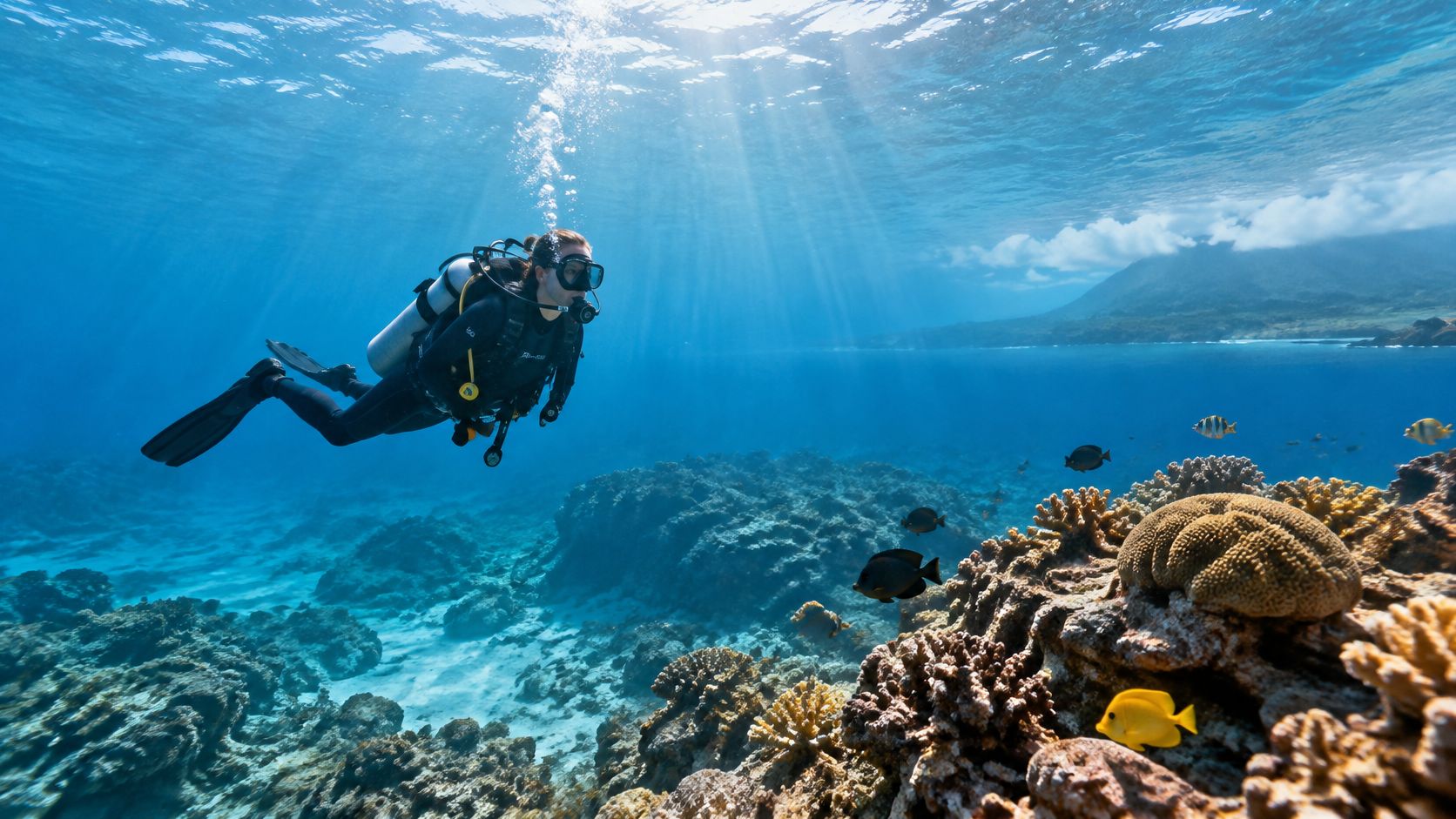
Kona offers warm water and generally clear visibility in every season, but you should still expect variation between sheltered reef, exposed headland, and water affected by runoff. Clear water can make distances look shorter than they are. Keep checking your depth and gas rather than judging the dive by how close the boat appears.
Look through the habitat in layers
Start close to the reef, where small fish shelter around coral heads and crevices. Don't identify every dark fish with white spots as a Hawaiian endemic; similar-looking damselfishes require a closer look. A compact identification slate helps more than trying to memorize names during the briefing.
Scan reef edges for turtles, keeping enough distance that they can feed, rest, or reach the surface without changing course. At Garden Eel Cove, approach the sand slowly and watch from a distance. Garden eels withdraw when divers crowd them, so patience produces a better view than moving closer.
Then look beyond the reef. Rays and sharks may pass through deeper or open water, but they're possibilities, not promised features. Avoid abandoning your group or descending beyond the planned profile to chase an animal.
Current deserves the same attention as visibility. A sheltered descent can lead toward a more exposed point, and surge can move you back and forth near rock without creating an obvious surface current. Watch suspended particles and your position relative to the reef.
Make the camera serve the dive
Use wide-angle framing for manta passes, arches, and reef scale. Get reasonably close without crowding wildlife, since shooting through more water reduces contrast and increases backscatter. For small subjects, settle your buoyancy first and approach without touching the reef.
A strobe or video light restores color that ambient light loses underwater. Start with the lights angled away from the space directly in front of the lens, then adjust after reviewing the image. Pointing a powerful light straight through suspended sand usually makes every particle visible.
- Exposure: Test how shutter speed and ISO render the blue background before concentrating on animals.
- Lighting: Check strobe power or video-light output on a stationary subject without firing into another diver's eyes.
- Focus: Confirm the camera locks through the housing and that you can change focus mode with gloves or wet hands.
Take a test frame early when practical, but don't assume the first minutes always offer the cleanest water. Position, bottom disturbance, and the group's movement matter more.
Manta Night Dives and Blackwater Excursions
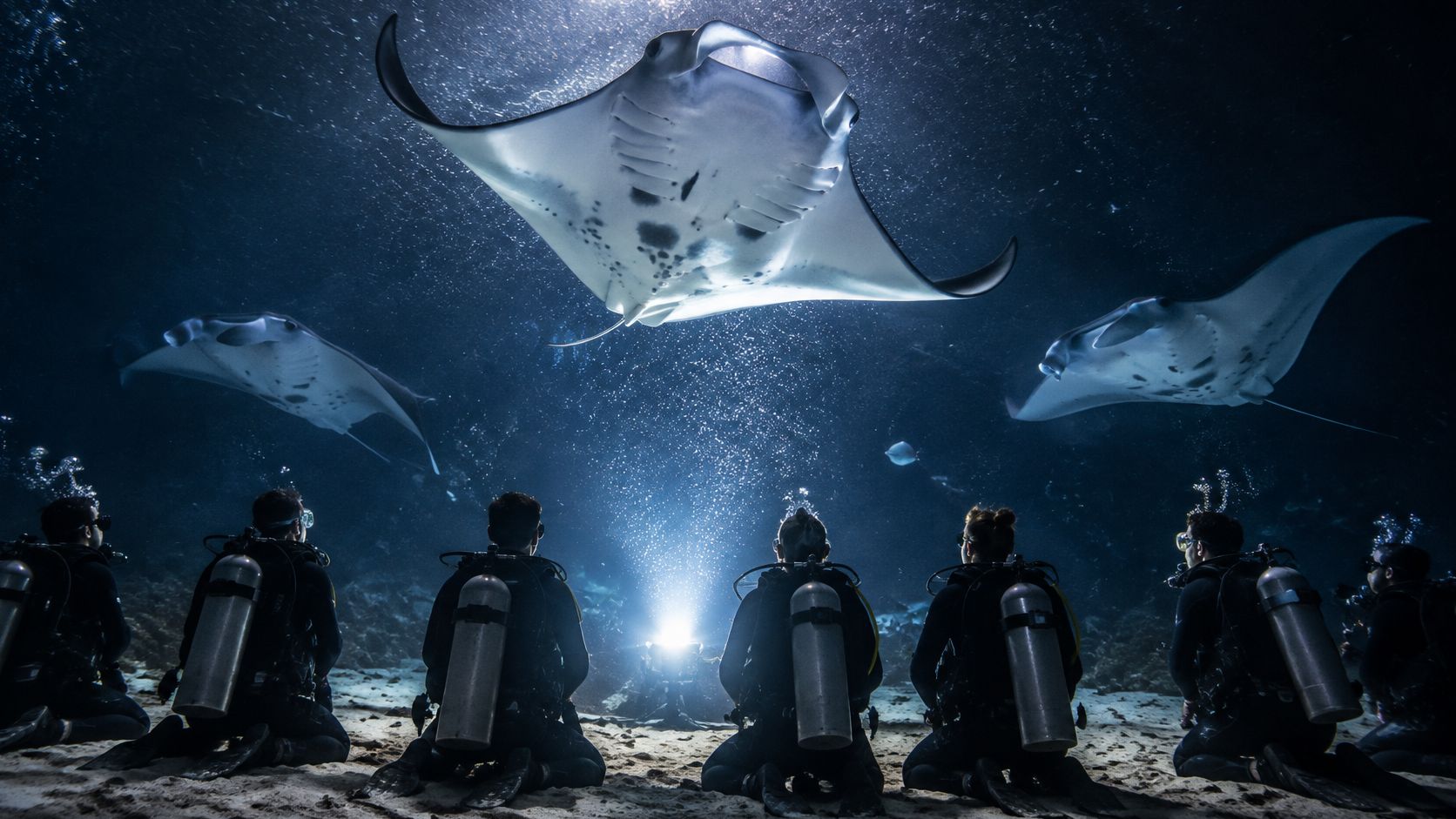
A manta night dive is a controlled feeding-site encounter. Divers settle near an illuminated area while reef mantas move through plankton concentrated by the lights. Your job is to hold the assigned position, leave the animals' route open, and follow the guide rather than swim after each pass.
Why Garden Eel Cove is the better dive choice
For a bottom-based manta encounter, Garden Eel Cove is the superior choice because its protected setting, sandy viewing area, and reef structure give divers a defined place to settle while leaving the water column open for passes, a site comparison discussed in the University of Hawaiʻi manta-viewing study.
The historical evidence also supports choosing Makako Bay: the six-year manta study archived by NOAA, covering January 2009 through December 2014, recorded mantas on 92% of 2,201 monitored nights at Manta Heaven in Makako Bay, the location also known as Garden Eel Cove, compared with 78% of monitored nights at Manta Village. Across that study, Manta Heaven accounted for 19,841 observations out of 25,444 total sightings involving 118 individually identified mantas.
Those are historical observations, not a guarantee for your departure. They establish repeated use of the feeding sites, while the protected viewing layout explains the practical advantage for a diver.
Location names need care. Tours commonly describe the southern viewing area as Keauhou Bay or Manta Village; the historical study places its Manta Village site at Kaukalaelae Point. Confirm the actual operating location rather than assuming different marketing names identify precisely the same mooring.
What a well-managed night encounter requires
The state boating-operations and safety assessment identifies Makako Bay/Garden Eel Cove and Keauhou Bay as principal viewing areas where boats, snorkelers, and scuba divers share dark water. That makes positioning and ascent procedures central to the dive.
- Briefing and descent: Learn the route, lost-buddy procedure, light signals, and where to settle before entering.
- Viewing position: Use the designated bare-bottom area without contacting live coral. Keep hoses and gauges secured.
- Lighting and spacing: Follow the crew's light directions and leave room between divers. Don't shine into faces or pursue mantas with a camera.
- Ascent: Leave with the guide's instructions, accounting for surface participants and boat traffic.
Never touch, chase, or block a manta. Review the manta dive departure with your night-diving experience in mind.
Blackwater is a different skill test
Blackwater takes place over deep open water after dark, where small pelagic animals appear around lights. Many animals migrate upward at night; lights also make them easier to observe. You won't have a sandy bottom as a reference.
Strong buoyancy, dependable depth awareness, and a reliable primary and backup light matter more than enthusiasm for unusual photographs. Read the Kona blackwater dive explanation and the Blackwater Dive tour requirements before committing.
For a first night dive, a guided manta encounter is generally the more manageable choice if your basic skills are settled. Blackwater suits experienced night divers who can maintain position without a visible bottom.
Shore Diving Safety and Go or No-Go Conditions
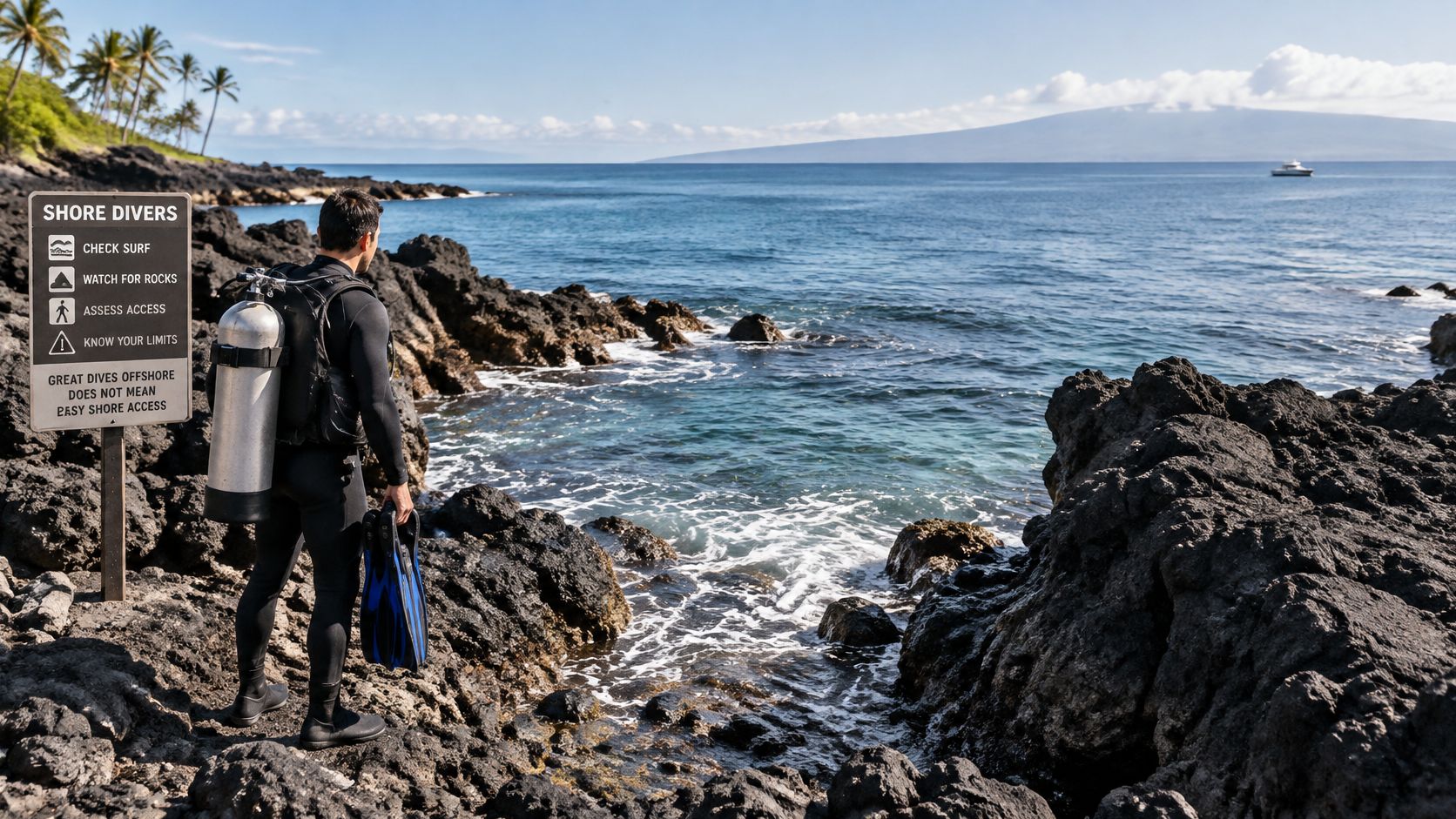
Kona's favorable offshore reputation doesn't make every shoreline beginner-friendly. At a rocky shore site, the hardest part may happen before you descend or after you've used most of your planned gas. Access risk can matter more than visibility.
Old Kona Airport requires a conservative assessment
The Hawaiʻi Division of Aquatic Resources Old Kona Airport guide warns of sharp coral and lava rock, dangerous swells and currents during summer and winter storms, and no lifeguards currently on duty; it identifies a partially protected cove as the preferred entry and a southeastern entry for calm to moderate conditions only. The same state guidance requires divers, including spearfishers, to display a dive flag and remain within 100 feet of it in ocean waters except during emergencies.
A preferred entry isn't a declaration that conditions are safe today. Watch the actual route long enough to see larger sets, and identify how you'll return with equipment on.
The go or no-go checks
- Swell: Look for waves breaking across the entry or washing over the exit ledge. If you need a perfectly timed gap to avoid being knocked down, don't commit.
- Surge: Watch the water around fixed rocks. Repeated draining and refilling can pull fins away from a foothold or push a geared-up diver into sharp surfaces.
- Wind: Assess direction as well as strength. Offshore wind can complicate a surface return, while onshore chop can make the exit rougher.
- Surface and assistance: Check footing, equipment-carrying space, alternate exits, and whether your buddy can help without becoming another person needing rescue.
Use sturdy exposure protection suited to the entry, secure dangling equipment, and agree on where you'll put fins on and take them off. Carry a signaling device and plan gas for a return that may take longer than expected. A dive flag doesn't protect you from every boat or replace surface awareness.
No-go rule: If getting out depends on conditions staying exactly as they are, choose another plan.
The Big Island shore-diving guide can help you compare access styles, but a map can't judge moving water for you. A visiting diver unfamiliar with the shoreline should favor local guidance over an improvised entry.
If any check is marginal, choose a boat trip instead, provided the crew confirms safe operating conditions. If the broader weather is unsuitable, stay out of the water.
Planning Seasons, Dive Days and Altitude Timing
Short crossings and calm-looking mornings make it tempting to schedule diving, a mountain drive, and an evening flight close together. Altitude timing can be the constraint, even when transport looks easy. Saddle Road is not another coastal transfer, and Maunakea isn't an appropriate spontaneous post-dive outing.
Separate mountain plans from dive plans
The Love Big Island Kona activities guide recommends waiting 12 hours after a single no-decompression dive and 18 hours after multiple dives before ascending to high elevations, specifically flagging Saddle Road and Maunakea. Treat those as that travel guide's recommendations, not as individualized medical clearance or proof that a summit ascent is safe once a timer expires.
Flying-after-diving guidance and driving to a mountain summit aren't interchangeable. The altitude reached, your dive profiles, repetitive exposure, and personal health all matter. Confirm your plan with a dive-medicine physician, and consult current Divers Alert Network guidance rather than relying on a vacation itinerary for medical decisions.
Sample three-day itinerary for scuba and altitude
| Day | Plan | Altitude rule |
|---|---|---|
| Day 1 | Maunakea or Saddle Road trip | Complete high-altitude activities before any diving |
| Day 2 | Two-tank dives | Begin the post-dive interval; confirm an appropriate ascent interval for your actual profiles and destination |
| Day 3 | Low-altitude activities only | Avoid high-elevation travel during the advised waiting period |
This sequence keeps the mountain excursion before scuba rather than trying to fit it between dive days. Arrival-day altitude activities still require sensible planning around fatigue, acclimatization, weather, and any diving completed before arriving on the island.
A final low-altitude day doesn't automatically clear you to fly at any departure time. Count from the end of your last dive, and check the requirements for your complete dive history.
How the dive day runs
Our typical dive day proceeds through arrival and gear setup, a briefing on conditions and entry style, the deeper or more condition-sensitive first dive, a surface interval, and a more relaxed second dive. That sequence is a working plan, not permission to exceed your training or computer limits.
- Boat and shore scuba: Include both in your repetitive-dive history.
- Snorkeling: Surface snorkeling isn't another compressed-gas dive, but conditions and fatigue still matter.
- Freediving: Don't treat breath-hold diving after scuba as an automatic substitute without appropriate safety advice.
Call us at 808-324-4668 to discuss conditions and how a departure fits your itinerary. Personal altitude timing, medical history, or suspected decompression symptoms belong with a qualified physician; a booking conversation doesn't replace medical advice.
Rental Gear, Nitrox and Packing Checklist
Rent bulky equipment when transporting it adds more trouble than familiarity saves. Bring the items whose fit, controls, or hygiene most affect your comfort. A personally familiar mask or computer can prevent more frustration than carrying an entire equipment bag across the Pacific.
Rent or bring for Kona dives
| Item | Rent or bring | Reason |
|---|---|---|
| BCD and regulator | Rent | Serviced equipment and simpler travel logistics |
| Mask, snorkel, and fins | Bring if fit matters | Poor fit causes leaks, pressure points, and fatigue |
| Wetsuit or rash guard | Bring or rent | Match thermal protection to your sensitivity and planned exposure |
| Dive computer | Bring | Familiar controls and personal settings matter on repeat dives |
| Dive light | Bring | Night dives need dependable lighting and a suitable backup |
| Nitrox | Ask at booking | Requires Enriched Air certification and confirmation of arrangements |
| Underwater camera housing | Bring | Compatibility matters; don't assume a matching rental is available |
Choose thermal protection for the entire outing, not how the water feels when you first enter. A shorty or rash guard may suit someone who stays warm, while a full suit is the more conservative choice for repetitive diving or a relatively stationary night encounter. Don't wait until you're shivering to recognize that you underpacked.
Use nitrox for the planned profile
Enriched air nitrox contains more oxygen and less nitrogen than air. It can extend no-decompression time on suitable profiles, but it doesn't extend your gas supply, eliminate decompression risk, or permit deeper diving. Its oxygen content imposes a maximum operating depth.
An Enriched Air qualification is required. Analyze the cylinder yourself using the appropriate procedure, confirm the label, and set your computer to the measured mix before diving. Understand the benefits and limits of nitrox rather than treating it as an upgrade you can use without changing your checks.
Confirm gas arrangements at booking, including availability and any applicable charges. Never assume a cylinder contains a particular mix because of its color or where it sits on the boat.
Pack what you'll actually use
- Documents: C-card, relevant specialty credentials, and a logbook or digital dive history.
- Sun protection: Suitable sunscreen, a hat, and clothing for surface intervals.
- Night equipment: Primary light, backup light, and secure attachments that won't trail over the reef.
- Surface signaling: A marker buoy and whistle appropriate to your training and the dive plan.
- Personal comfort: Towel, drinking water as appropriate, and any motion-sensitivity plan discussed with a clinician or pharmacist.
- Dry storage: A dry bag for your phone, transport essentials, and dry clothing.
Test-fit masks and fins before departure. Check the mask seal without overtightening the strap, and try fins with the boots you plan to wear. A familiar-looking size label doesn't guarantee a comfortable fit.
Book Your Kona Dive with Kona Honu Divers
Choose the format your skills support, confirm your certification or course needs, and book a departure that fits your wider itinerary. Keep shore access and post-dive altitude plans in that decision rather than adding them after payment.
Kona Honu Divers offers guided two-tank reef diving, manta night dives, blackwater excursions, PADI courses, Kama'aina Dive Courses, and Freediving Classes. That range lets beginners focus on instruction while experienced divers choose a more specialized environment without pretending every trip suits everyone.
Confirm the details that affect your day
- Experience: Give your certification, recent diving history, and comfort level in darkness or open water.
- Equipment: Identify rental needs and any fit concerns before boarding.
- Schedule: Mention mountain drives, flights, and other diving that could affect your plan.
Check availability for your dates, then call 808-324-4668 to confirm conditions and discuss scheduling before you commit. For individualized altitude clearance, take the proposed itinerary to a dive-medicine physician.
Kona Honu Divers offers guided reef, manta, and blackwater diving alongside certification and refresher training. Visit us to find an available departure that matches your experience and leaves sensible room for the rest of your Big Island itinerary.