
Kailua-Kona is a standout scuba destination because its protected leeward coastline combines clear Pacific water, volcanic reef structure, and a resident manta-ray encounter that has operated since 1984. The area works for beginners who choose sheltered sites and for experienced divers seeking deeper walls, night encounters, and open-water pelagic life.
You may be looking at a Kona dive schedule right now, trying to decide whether a morning reef trip, a manta night dive, or a more demanding offshore experience deserves one of your limited vacation days. The right choice depends less on a bucket-list ranking and more on three practical questions: how comfortable are you in the water, what are the conditions doing, and how well does the operator manage people, boats, and wildlife?
Why Kailua-Kona Is One of the World’s Top Scuba Destinations
At dawn, a Kona boat leaves the harbor and heads along a coast shaped by old volcanic flows. The surface can look almost uneventful, but below it, lava has formed ledges, cracks, arches, tubes, and vertical faces. Drop in over the right reef and the experience changes immediately. The background becomes blue water, dark volcanic relief, reef fish, turtles, and the occasional large animal moving through the visibility.
Kona's leeward position helps explain the appeal. The coast is sheltered from prevailing trade-wind exposure and receives relatively clean oceanic water from the Pacific, which supports strong visibility. That clarity makes a real difference for underwater photography, navigation, and wildlife observation, although it isn't a guarantee of identical conditions at every site. Winter north swells, rainfall, runoff, and local surge can all reduce visibility or make an exposed entry uncomfortable.
A complete diving coastline
Kailua-Kona's diving industry has a documented history reaching back to 1984, when snorkeling and scuba activities began at the principal manta sites offshore from west Hawaiʻi Island. The two best-known locations are Keauhou Bay, commonly called Manta Village, and Ho'ona Bay or Makako Bay, commonly called Garden Eel Cove or Manta Heaven. Both are reached primarily by boats operating from nearby harbors, including Keauhou and Honokohau. (Hawaiʻi County manta tourism testimony)
The local menu is unusually broad. A first-time diver can stay close to shore in a protected lava-reef environment, while a certified diver with strong buoyancy and open-water comfort can choose deeper formations, nighttime feeding areas, or blackwater conditions offshore. That range is why Kailua-Kona scuba diving deserves more than a quick excursion added between land activities.
Why the scale matters
By the time of the cited management research, at least 42 operators were conducting manta tours at the principal sites. Typical excursions lasted 3 to 5 hours and averaged approximately US$110 per participant, with site use reaching 100 to more than 300 people during a single period. Those figures show both the strength of the attraction and the operational problem: a wildlife encounter can become crowded very quickly. (Hawaiʻi County manta tourism testimony)
West Hawaiʻi also has unusually strong scientific documentation of reef change. A peer-reviewed study analyzed 261 standardized 100-meter transect surveys, recording 104,415 individual fish representing 115 species across an 11-year dataset. Researchers reported increasing total fish abundance at all study sites, while species richness generally increased through the study period. (Frontiers in Marine Science reef study)
Choosing the Right Dive Site for Your Certification Level
Certification is only the starting point. A diver with an advanced card but weak buoyancy, limited recent experience, or discomfort in surge may be less prepared for a demanding Kona site than a newer diver who has practiced carefully with a guide.
Use this decision sequence before booking:
- Assess recent experience. If you haven't dived recently, say so. A refresher or closely guided trip can make the day safer and more enjoyable than pretending the gap doesn't matter.
- Separate depth from difficulty. A deeper dive isn't automatically harder, but surge, current, a confined lava passage, low light, and a challenging exit can each raise the workload.
- Match the environment to your control. Sheltered lava reefs are generally more predictable for beginners and photographers. Exposed pinnacles, arches, and shore entries require better timing, surface awareness, and current judgment.
- Ask what happens if conditions change. A responsible operator should choose an alternative site when swell, runoff, or surge makes the original plan unsuitable.
Kona Dive Site Compatibility by Certification
| Certification level | Recommended sites | Typical depth range | Key conditions |
|---|---|---|---|
| Discover Scuba or resort-course diver | Sheltered, guided nearshore reef | Shallow | Direct supervision, calm entry, simple navigation |
| Open Water diver | Protected boat reefs and suitable shore sites | Shallow to moderate | Comfortable buoyancy, controlled ascent, manageable surge |
| Advanced diver | Deeper walls, lava formations, selected swim-throughs | Moderate to deep | Better gas planning, current awareness, confident entries and exits |
| Experienced night or specialty diver | Manta feeding areas and blackwater environments | Site dependent | Reliable lighting, open-water orientation, disciplined positioning |
The official Hawaiʻi tourism guide identifies Kahaluʻu Beach Park and Hōnaunau Bay near Puʻuhonua o Hōnaunau National Historical Park as places where visitors can snorkel and scuba dive. Those nearshore options can suit divers who want a simpler setting, while boat trips open access to formations and environments unavailable from the beach. (Go Hawaiʻi water activities guide)
Practical rule: Your certification tells the crew what training you've completed. Your buoyancy, recent dive history, and comfort in the actual conditions tell them what you're ready to do today.
New divers can start with Big Island scuba diving for beginners and build from there. Don't treat a PADI Advanced certification as an automatic pass for every site. A guide should still consider swell direction, visibility, current, low light, and whether you can manage equipment while entering or exiting the water.
Manta Night Dives Compared Garden Eel Cove versus Manta Village
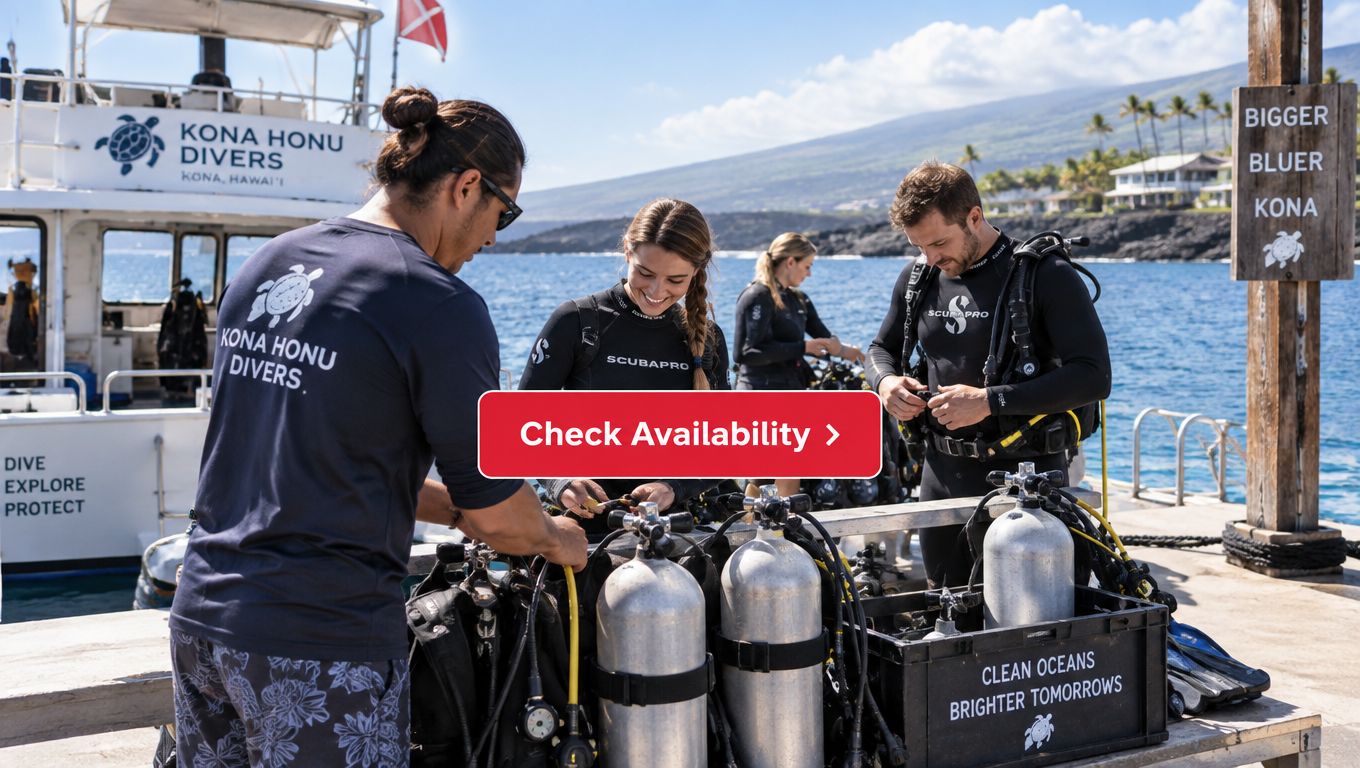
For most guests, Garden Eel Cove is the stronger choice. Its protected layout offers a more controlled viewing area, stable reef structure, and a practical place for divers to hold position while mantas feed above them. The site can change when ocean conditions or animal activity require an alternative, but its structure gives operators a useful advantage when conditions permit.
Manta Village at Keauhou Bay is the other established location. It's a legitimate manta site, but it can involve heavier concentration of boats and people, and its more exposed setting may make the experience feel less controlled. A larger crowd doesn't automatically mean a better encounter. More movement, fin contact, light confusion, and diver congestion can make it harder for both people and mantas.
Why the feeding behavior matters
Artificial lights concentrate plankton in the illuminated water column. Reef manta rays then make repeated feeding passes because plankton is their primary food source. The Manta Pacific Research Foundation has identified more than 270 individual manta rays in its Kona study area, which demonstrates that the experience involves a recognizable local population rather than only occasional visitors. (Manta Pacific Research Foundation reference via Hawaiʻi County)
Divers should remain neutrally buoyant near the designated observation area, keep open water available for the animals, and avoid chasing, touching, or blocking an approach path. NOAA guidance recommends keeping divers near sand or rubble, leaving open water for mantas, avoiding coral contact, and aiming lights upward from below. (NOAA manta viewing guidance and safety assessment)
The honest trade-off
Summer is reported to bring less surge and higher manta numbers, although the resident population is present year-round. That makes warmer-season planning attractive, but it doesn't justify guaranteeing an encounter or ignoring a marine forecast. Rain, swell, surge, plankton availability, and light-field management all influence what happens on a particular night.
Read the Kona manta ray dive details before booking, and ask where the trip will go if Garden Eel Cove becomes unsuitable. A good operator should explain the switch plainly instead of treating a named site as more important than safe conditions.
Seasonal Conditions Swell Visibility and When to Book
Kona is often clear because of its leeward geography, but “clear” is a general pattern, not a promise. West-facing sites can respond differently to the same weather system. A sheltered lava reef may remain comfortable while an exposed pinnacle develops surge, and a shore entry can become unsafe even when the offshore water looks attractive.
Read the ocean, not just the calendar
Winter north swells can affect exposed west-facing sites. Rainfall and runoff can also reduce clarity, particularly after weather moves sediment toward the coast. Local surge may be the deciding factor at a lava entry, even when visibility farther offshore remains good.
Use the forecast to ask specific questions:
- Swell direction: Is the planned site exposed to the incoming swell, or does the bay provide protection?
- Surface conditions: Can divers enter and exit without being knocked against lava?
- Current and surge: Will photographers be able to hold position without contacting reef?
- Runoff: Has recent rain made a nearshore site less clear than usual?
- Alternative sites: Can the boat move to a location better matched to the day?
The best Kona dive isn't the site printed on the booking page. It's the site that fits the conditions when the boat leaves the harbor.
For planning, late spring through early fall is a sensible period to target for generally calmer manta conditions, while Kona remains a year-round diving destination when site selection follows the ocean. Don't build a rigid itinerary around one named reef. Leave room for the crew to choose a protected alternative.
Blackwater planning is different
Blackwater diving happens after sunset in deep offshore water, without a reef or seafloor to provide orientation. NOAA documented 59 recreational blackwater night-dive surveys off Kona, and the activity has also been described as epipelagic scuba in relatively deep offshore areas. The nearby twilight zone extends roughly 660 to 3,300 feet below the surface, which helps explain why the dive feels so different from a reef descent. (NOAA blackwater diving report)
That environment demands a different comfort level. If you need a reef wall to maintain orientation, choose a reef night dive first. If you're comfortable in open water, can control your buoyancy, and can follow a light and buddy plan after dark, blackwater may be the more interesting progression.
Blackwater Dives and Advanced Two-Tank Opportunities
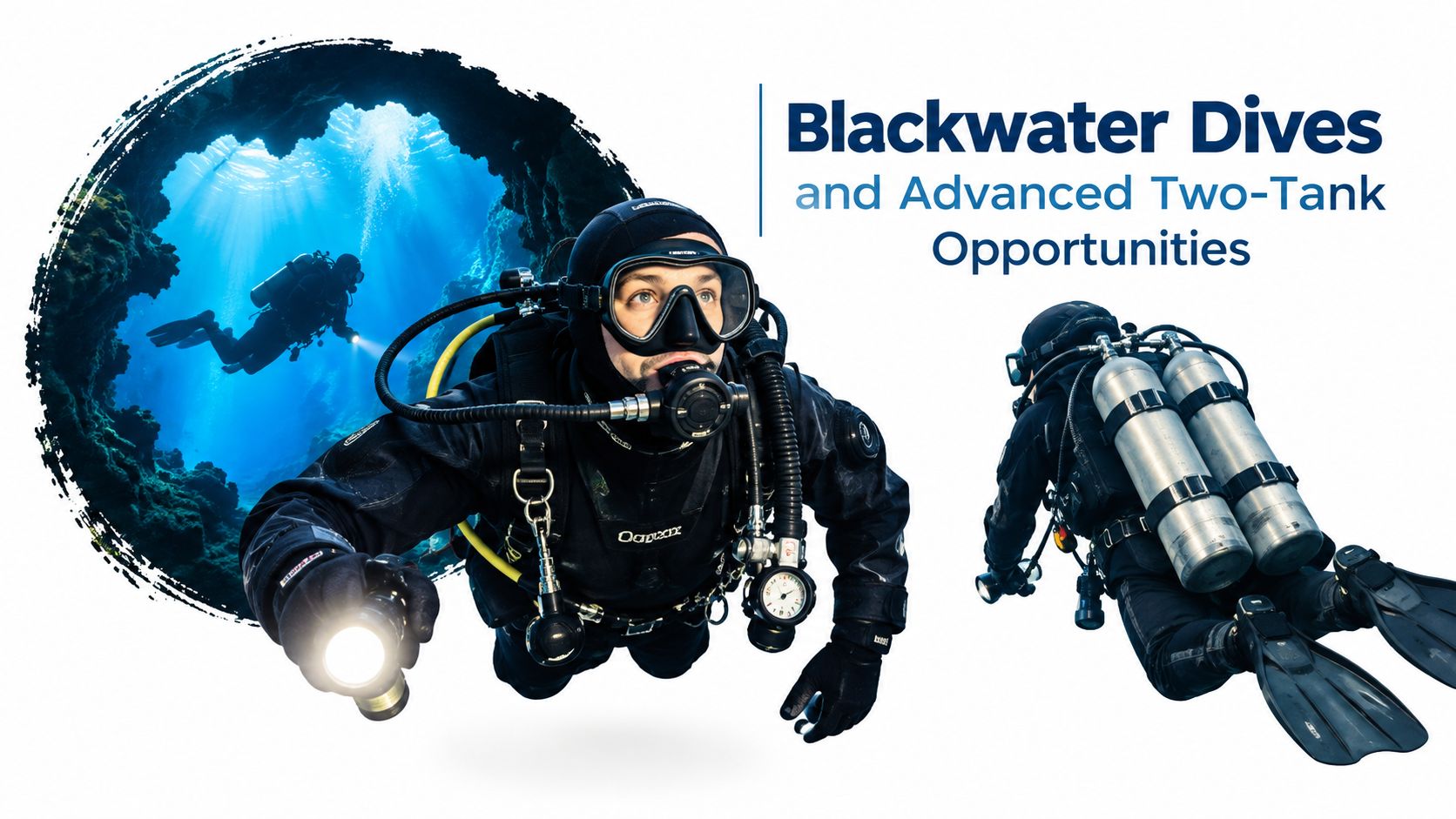
Blackwater diving is not merely a darker version of reef diving. It is offshore, after sunset, and focuses on organisms that normally live below the surface before migrating upward at night. Divers may encounter gelatinous plankton, larval fish, and other pelagic invertebrates that rarely appear on a conventional reef dive.
The absence of a bottom changes everything. You can't use a rock, sand patch, or reef wall to judge position, and a camera can quickly become a distraction if your buoyancy isn't automatic. Reliable lighting, a controlled descent, and calm movement matter more than owning an elaborate camera system.
Choose the progression, not the upsell
An advanced two-tank trip makes sense for a certified diver who already manages buoyancy comfortably on ordinary reef dives and wants deeper walls, lava formations, or more demanding current environments. It isn't the same experience as blackwater. Advanced reef diving gives you structure and topography, while blackwater removes those visual references.
Before choosing either, check yourself against this list:
- Buoyancy: Can you hover without sculling or touching the reef?
- Lighting: Do you have a dependable primary light and a backup for night conditions?
- Navigation: Can you maintain a predictable position relative to the guide or boat?
- Gas planning: Can you manage reserve gas conservatively when the environment feels unfamiliar?
- Recent practice: Have you done enough recent diving to handle task loading calmly?
Explore the Kona blackwater dive option only if the open-water setting appeals to you, not because it sounds more prestigious. The right trip is the one that leaves you mentally engaged but still able to respond to a problem without panic.
For divers ready for deeper formations and stronger environmental demands, an advanced two-tank dive is a more logical step when reef structure remains part of the plan. Neither trip replaces good judgment, and neither should be booked solely from a certification label.
Safety Photography and Gear Checklist Before You Dive
Kona's lava formations reward close observation, but they punish careless finning. Tubes, ledges, cracks, and walls create shelter and cleaning areas for marine life while also producing localized flow around corners and constrictions. A diver who feels relaxed in open water can still damage a fragile surface in a confined formation.
Use a simple pre-dive routine
- Check the entry and exit. Ask where you'll enter, where you'll exit, and what the crew expects if surge increases.
- Set a gas reserve. Agree on a turn pressure with your buddy and keep enough gas for a calm ascent and surface problem.
- Protect the reef. Stay neutrally buoyant, avoid fin contact, and position downstream of fragile surfaces when photographing.
- Control your light. For manta encounters, aim lights upward from below and keep them from flashing unpredictably into an animal's approach path.
- Plan the night signal. Review hand signals, lost-buddy procedures, and what to do if your light fails.
- Be honest about comfort. Tell the crew about recent dives, current anxiety, ear problems, or difficulty with ladders before leaving the dock.
Photographers should resist the urge to chase a manta or force a close composition. Mantas can approach extremely closely on their own, and aggressive movement often makes the encounter less predictable while increasing collision risk. Hold your position, let the animal choose the path, and keep your camera from becoming a buoyancy problem.
Pack for the actual trip
A properly fitted exposure suit, mask you trust, surface protection, and a backup light for night work are more important than carrying every accessory. Ask what the operator supplies and whether rental equipment is inspected and serviced proactively. If you use enriched air, confirm your certification and whether nitrox is available for the specific trip.
Photography rule: Get stable first, compose second. A sharp image isn't worth a fin strike, a lost buddy, or a blocked manta passage.
Private charters can help groups align experience levels and photography goals, but a private boat doesn't remove the need to follow site and wildlife protocols. Shared trips may offer a practical way to join a guided rotation, provided the group's ability and comfort are compatible.
How to Book Your Kona Dive Trip with Kona Honu Divers
Choose an operator by asking operational questions, not only by scanning star ratings. Ask how the crew separates divers and snorkelers, what happens when sea state deteriorates, how emergency procedures are handled, whether the boat has shaded seating and storage, and how rental equipment is maintained.
For a first trip, a guided two-tank morning departure is a sensible baseline. Divers who want a more specialized experience can compare the manta night dive, blackwater dive, and advanced options against their recent experience and comfort in low light or open water. Kona Honu Divers offers boat-based morning, advanced, manta, and blackwater trips, along with courses, rentals, private charters, and free nitrox for qualified divers. (Kona dive company information)
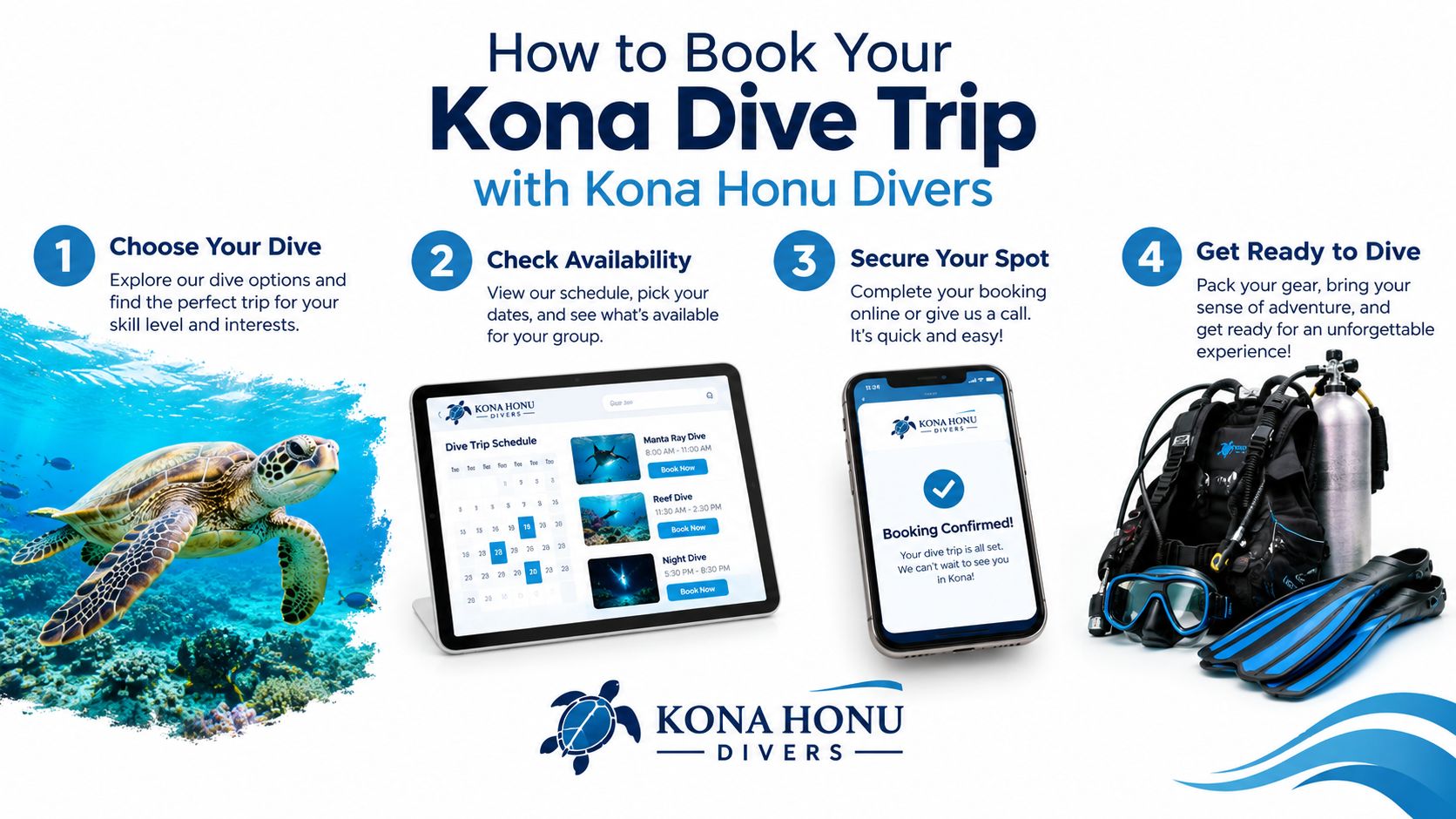
Start by selecting the trip type, then provide certification and recent-dive information accurately. Reserve rental equipment when needed, note any medical or mobility concerns, and keep enough flexibility for the crew to choose a safer site if conditions change. The most professional booking process should make those questions easy to answer.
Kona Honu Divers offers guided morning reef dives, advanced two-tank trips, manta night dives, blackwater excursions, courses, rentals, and private charters for divers with different goals and experience levels. Visit Kona Honu Divers to compare the options, share the crew's experience questions openly, and reserve a trip that matches the conditions and the kind of diving you want to do.