
Does your certification card show which Kona dive you are ready for, or only which course you completed? The distinction matters when you're choosing between a reef charter, a manta encounter after dark, and an open-water blackwater dive.
Kailua Kona scuba diving works best when you match the trip to the tasks. Consider your buoyancy, recent experience, comfort with your equipment, and ability to get back aboard. Then factor in the animals and habitat you'll share the water with. Readiness is about doing the dive safely while leaving wildlife undisturbed.
Kailua Kona Scuba Diving Tours Compared
Which dive suits your certification and comfort level? Start with the experience you can manage calmly, rather than the most adventurous name on the booking page.
Kailua Kona Dive Tours at a Glance
| Tour | Best for | Time of day | Starting price |
|---|---|---|---|
| 2-Tank Morning Dive | Certified divers wanting coral gardens, lava tubes and arches | Morning | Not listed |
| Premium Advanced 2-Tank Trip | Certified divers wanting deeper, remote sites | Morning | $249 |
| Manta Ray Night Dive | Divers and snorkelers wanting close manta encounters | Night | $259 |
| Blackwater Night Dive | Ready night divers wanting deep-water creatures after dark | Night | $239 |
| Morning Introductory Scuba Dive | First-time divers without certification | Morning | Not listed |
The historical starting prices above come from Big Island Activities' 2025 listings, which advertised $249 for an advanced two-tank charter, $259 for a two-tank manta-night charter, and $239 for a blackwater-night dive. These are destination-level comparisons, not current quotes for a particular operator. No starting price is listed here for the morning reef or introductory dives, so check the operator's current rate before budgeting.
Choose the environment before the itinerary
The 2-Tank Morning Dive is a practical starting point for certified divers. Kona Honu Divers offers this trip to explore coral gardens, ancient lava tubes, and dramatic arches. The sites provide plenty to see without adding darkness to the workload. A lava formation doesn't mean you should enter an overhead environment. Stay within the route and limits covered in the briefing.
The Morning Introductory Scuba Dive is for visitors without certification. It provides supervised introductory instruction, not full certification or permission to join a certified-diver charter afterward.
Manta and blackwater dives suit different interests. Manta trips focus on a coastal feeding aggregation where lights concentrate plankton. Blackwater trips take divers into open water after dark to observe small creatures that aren't typical reef subjects. Neither guarantees that wildlife will appear on schedule.
Compare more than the headline price
Use the full diving tour selection to compare trip formats. This Kona scuba shop guide can help you consider equipment support, instruction, and whether a trip fits your needs.
Check current rates before setting a budget. Package choices, rental needs, and charter format can affect the total. Ask what is included and make sure the trip's requirements match your certification and recent experience.
Decision rule: Start with a morning reef dive, add a night dive when buoyancy and comfort in dark water feel solid, and choose an advanced trip only when your experience fits its demands.
What to Bring and Which Certification You Need
Pack for fit, warmth, and control. A familiar mask that seals well is more useful than a camera system you haven't practised using.
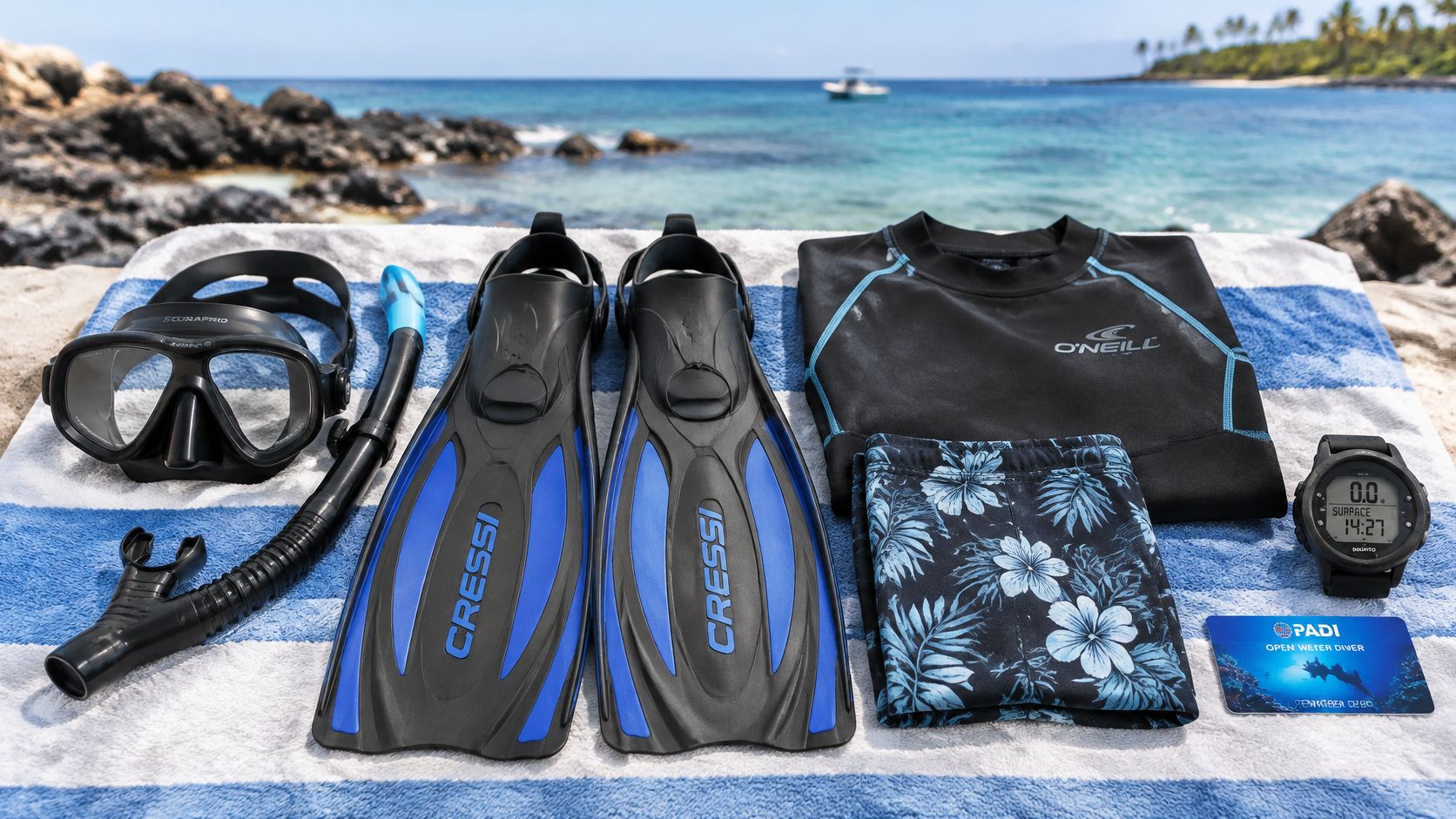
Pack the essentials first
- Mask, fins, and snorkel: Check the mask seal without overtightening the strap. Make sure your fins work with the footwear you plan to wear.
- Exposure protection: Choose a suit for warm-water diving and your own cold tolerance. Bring a dry layer for a long surface interval.
- Dive computer: Know how to read depth, remaining no-decompression time, and ascent information before boarding.
- Sun protection: Apply reef-safe sunscreen before gearing up, and use clothing for additional coverage.
- Night equipment: Bring a primary light, a backup light, and a suitable clip or cord. Secure them without leaving loose loops.
Rent equipment you rarely use rather than travelling with unfamiliar gear. Arrange sizes ahead of time, ask about servicing, and check the fit before departure. A regulator that breathes properly and a buoyancy compensator you understand matter more than matching brands. Kona Honu Divers offers scuba diving rentals and freediving rentals, along with scuba and freediving gear for sale.
Photographers should pack a camera-housing rinse kit, spare batteries, and a lanyard. Check the rig's buoyancy in water. Its balance underwater and its weight on a boarding ladder are different concerns.
Bring the right qualification
For most regular charters, Kona Honu Divers requires at least Open Water Diver certification from a recognized agency such as PADI, SSI, or NAUI. That qualification allows diving to 60 feet (18 meters) with a buddy. Bring your C-card, not just an assurance that you completed training.
If you aren't certified, choose introductory instruction or a Big Island scuba certification course. Kona Honu Divers also offers PADI courses, including Open Water, Advanced Open Water, Enriched Air Diver, Rescue Diver, Peak Performance Buoyancy, Deep Diver, Boat Diver, and Reactivate. Kama'aina Dive Courses and freediving classes are available as well. Training should build capability, not merely add a card.
Before leaving your accommodation, check:
- Documents: C-card, logbook, and requested paperwork.
- Boat gear: Exposure protection, computer, fitted personal equipment, and secured accessories.
- Safety equipment: A cutting tool and lights appropriate to the trip.
For manta photography, aim your dive light away from the animals while following the guide's positioning instructions. Keep your buddy in sight and don't chase wildlife for a frame.
Readiness Checks for Night and Advanced Dives
Skills and Logged Dives Each Trip Expects
| Trip | Skills to be ready for | Boat and exit demands | Logged dives |
|---|---|---|---|
| 2-Tank Morning Dive | Buoyancy control and mask clearing | Boarding and reef-side exit | Confirm recency and experience requirements |
| Manta Ray Night Dive | Stable buoyancy, dive-light handling, night navigation | Boat boarding and an exit after dark | Confirm night-experience requirements |
| Blackwater Night Dive | Open-water comfort after dark, equipment management | Be prepared for an unassisted floating ladder climb in scuba gear | Confirm the charter's specific minimum |
| Premium Advanced 2-Tank Trip | Drift diving and deeper-site planning | Be prepared for an unassisted floating ladder climb in scuba gear | Confirm at booking |
The useful question isn't just whether you qualify. Ask whether you can manage the trip's tasks without spending all your attention on basic equipment handling.
Check skills and physical demands separately
First, treat certification as the entry ticket. A card doesn't describe your recent diving, comfort in moving water, or response when your mask floods. If you're returning after a long break, choose a refresher before booking a demanding charter.
Second, rehearse the actual tasks. Can you hold your depth while operating a light? Can you remove and replace your mask, share air, and follow night-navigation procedures without losing your position? Practise with an instructor if these skills feel rusty.
Third, assess the exit. Requirements documented on this local long-range dive page include an unassisted climb up a floating vertical ladder while wearing scuba gear. Some longer-range trips require at least 25 logged dives. That threshold isn't a universal Kona rule, and it doesn't automatically apply to another operator's charter.
A ladder alongside a moving boat presents different demands from a pool ladder. Discuss mobility, strength, and equipment concerns before booking. Practise relevant boarding skills in a controlled setting.
Fourth, verify the exact experience requirement. Review the blackwater dive requirements and premium advanced trip requirements. Acceptance on a reef charter doesn't establish readiness for either.
Make a conservative booking decision
Captains may change sites because of swell, wind, current, or visibility. Readiness includes accepting the site that suits the conditions, rather than insisting on a named location.
Ask yourself:
- Buoyancy: Can I hold a stable position around the lights?
- Boarding: Can I climb the required ladder in full gear?
- Experience: Have I logged the dives this particular trip requires?
If two answers are no, start with a morning reef dive or a refresher suited to your abilities. Any single unmet mandatory requirement means postponing that advanced or night trip.
Visibility, Currents and the Best Time to Dive
PADI's Big Island destination guide describes visibility as often exceeding 30 meters. That indicates the clear conditions possible here, not a promise for every site or descent.
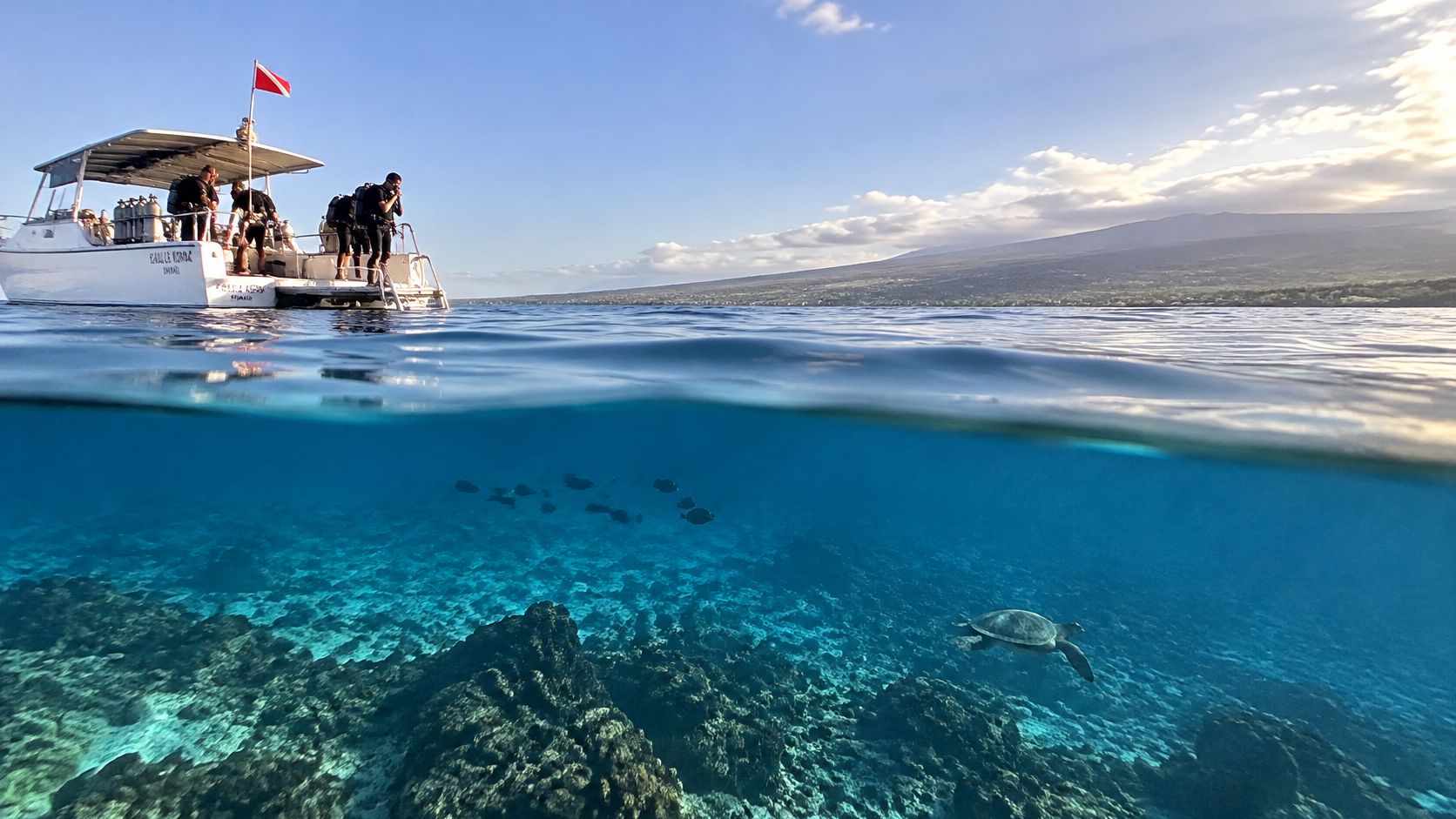
Diving in Kona is available year-round, with warm water and generally clear visibility in every season. Conditions still vary by site, weather, swell, depth, and time of day. Clear water doesn't tell you whether a current is manageable.
Read the coast, not just the harbor
Kailua-Kona's leeward coast generally receives less persistent trade-wind exposure and rain-driven runoff than windward locations. Still, local conditions guidance explains that swell, surge, and entry conditions vary sharply between sites. Spring through fall is generally more favorable, while winter north swells can disturb exposed west-facing locations.
A sheltered harbor can look calm while waves wash over a shore-diving exit farther along the coast. Watch the intended entry long enough to see changing sets. Also identify where you could leave the water if conditions deteriorated.
A calm departure point doesn't prove that a lava-rock entry will be safe when you return.
A shift in swell direction can create surge and reduce visibility even when offshore water appears smooth. Surge can push you toward rock or coral. Wind-driven currents can also make the return more demanding than the outward swim.
Use a repeatable pre-dive routine
- Before dive day: Review the marine forecast, swell direction, and any hazardous-marine or high-surf warning.
- On the morning: Check again rather than relying on the previous day's forecast.
- At the site: Assess both entry and exit before putting on equipment. Identify an alternative exit only if it is usable.
- Before descent: Agree on gas reserves, turnaround criteria, and what to do if conditions worsen.
- For shore support: Arrange a surface contact who knows your plan. Don't leave your underwater buddy alone to provide it.
Treat a high-surf or hazardous-marine forecast as a no-go signal, not a challenge to overcome. The best time to dive is when the actual site suits your team's abilities, even if that means changing the plan.
Manta Night Dives and Why Garden Eel Cove Leads
A Kona manta monitoring account recorded 25,444 manta observations involving 118 individually identified rays from 2009 through 2014, with mantas present on 92% of monitored nights at Manta Heaven and 78% at Manta Village. Those historical observations help explain Kona's recurring nighttime encounters. They don't guarantee a sighting on any particular night.
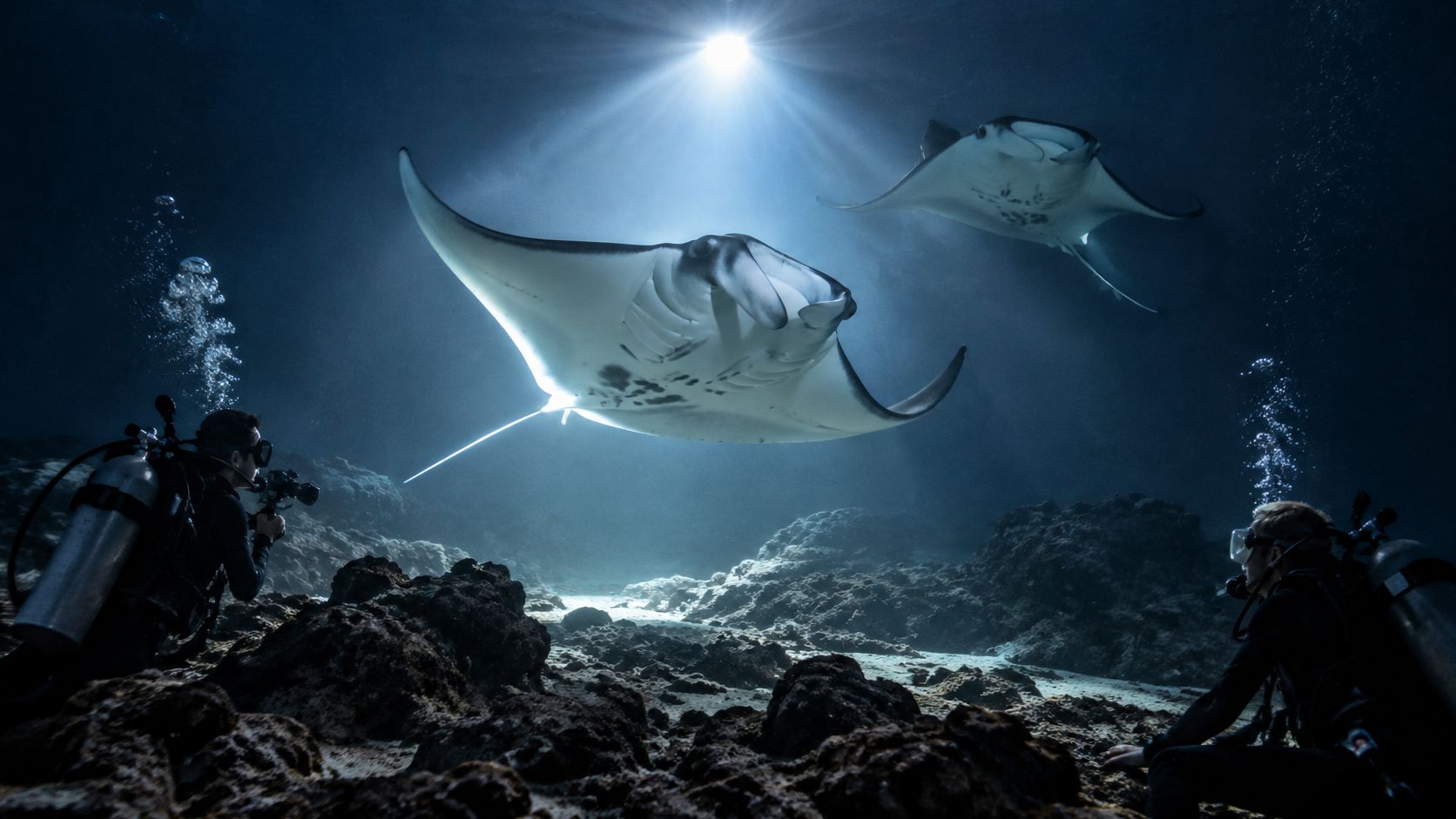
Underwater lights concentrate plankton in the water column. Reef mantas follow the food and filter-feed through the illuminated area, sometimes looping or barrel-rolling as they pass. Their movements follow feeding conditions, not a fixed schedule.
Why Garden Eel Cove is the better choice
Garden Eel Cove is the strongest choice for the manta dive because it offers a protected location, a better viewing area, and better reefs. Those advantages matter to divers who want a reef component as well as a clear place to observe the nighttime feeding activity.
Its protected setting doesn't make it immune to weather. It does make it a stronger starting choice than picking a site solely for departure convenience or assuming all manta sites offer the same underwater experience.
A 2025 University of Hawaii study analyzed 13 years of community observations, covering 2010–2022. It found consistently larger aggregations at Garden Eel Cove, a strong female bias in Keauhou site use, and aggregation sizes at both locations that tracked zooplankton density. The findings support choosing Garden Eel Cove, while underscoring that food availability affects how many mantas appear.
A better viewing area helps only if you can stay in your assigned position. A camera, unfamiliar weighting, or constant finning can turn an otherwise manageable observation dive into an equipment-handling problem.
What a quiet night means
A quiet night doesn't mean the site has stopped working or that the crew should attract animals more aggressively. Plankton distribution, sea state, and manta movement can produce a subdued encounter or no encounter.
Before choosing a manta ray dive and snorkel tour, read the trip format and any missed-sighting terms. Booking a second opportunity can give you another chance, but it cannot guarantee a sighting.
- For divers: Choose the underwater option when handling equipment at night feels comfortable.
- For mixed groups: Consider the snorkel option for companions who aren't scuba-certified, subject to swimming and trip requirements.
- For photographers: Plan for the animals' natural passes rather than expecting a particular angle or number of subjects.
Choose Garden Eel Cove for the manta dive, and leave room for a second night if the first is quiet. Keep that opportunity flexible instead of treating it as a guaranteed correction.
Protected Waters and Wildlife Rules to Follow
The Old Kona Airport Marine Life Conservation District has its own operating restrictions. It isn't an ordinary stretch of coast where standard boating and collecting assumptions necessarily apply.
Know the protected-area limits
The Hawaii Division of Aquatic Resources' district rules describe boundaries extending offshore from Old Kona Airport toward Kailua Lighthouse, reaching 500 yards seaward from designated points. Noncommercial use of state moorings is limited to three hours per boat per day, first-come, first-served. Commercial dive and tour operations using the mooring or operating from shore need a permit.
The district's prohibitions include:
- Marine life: Don't remove or injure aquatic animals or other protected marine life.
- Coral and geology: Don't take live coral or geological features.
- Attractants: Don't feed aquatic organisms to attract them.
- Anchoring: Don't anchor within the district.
- Powered vessels: Don't operate them in the designated no-boating zone except for emergencies or enforcement.
Use the official boundary description and map when planning an independent visit. A nearby place name, or a boat already occupying an area, doesn't prove that your intended activity is permitted.
Keep the manta feeding area open
At manta sites, follow the guide's assigned position and light instructions. Point lights upward rather than directly at animals, avoid unnecessary finning, and secure hoses, gauges, and camera attachments before entering the viewing area.
Maintain stable buoyancy without resting on coral. If the briefing specifies a bottom observation position, use only the designated nonliving substrate. Don't move into the central feeding area for a closer photograph.
Responsible diver etiquette means keeping your position predictable to the guide, your buddy, and other participants. A diver who repeatedly rises into the animals' path can disrupt everyone's observation without touching a manta.
Feeding animals isn't part of the experience. The attraction is naturally occurring plankton concentrated by light, not food handouts. Don't introduce anything into the water.
Wildlife rule: If you have to move toward an animal to keep seeing it, let it go instead.
That rule doesn't prevent a necessary safety adjustment. It discourages pursuit, crowding, and the idea that a diver should follow an animal when it leaves.
Getting There and Dive Day Logistics
Kona International Airport at Keahole is north of Kailua-Kona town. Most visitors arrange a rental car or transfer, but the important dive-day destination is the meeting point printed on your booking, not the shop address or the nearest waterfront.
Confirm the departure location and check-in instructions before leaving your accommodation. Allow time for traffic, parking, unloading, and finding the correct boat, particularly if you're carrying rental equipment or a camera case.
Make the morning straightforward
Arrive at the stated check-in time with your paperwork ready. Check-in needs time for waivers, certification checks, equipment fitting, and a conversation about concerns before the crew prepares to depart.
Pack the boat bag separately from your main luggage:
- Dry essentials: Towel, dry layer, and a dry bag for your phone and keys.
- Sun and hydration: Reef-safe sunscreen and drinking water.
- Personal items: Any medication you need, with instructions you can follow safely.
- Identification and dive records: Photo ID, certification card, and logbook.
- Labelled equipment: Mark similar-looking fins, bags, lights, and camera accessories.
Tell the crew about equipment problems before the boat leaves. A leaking inflator or unfamiliar computer won't become easier to manage at the site.
Leave room for changes
Morning departures suit reef diving and can provide an opportunity to dive before wind builds, but conditions still determine site selection. Night departures are planned around darkness, while wildlife activity depends on biological conditions, not departure time alone.
Choose accommodation for practical access as well as the view. This guide to places for divers to stay on the Big Island can help you weigh travel time against the rest of your holiday.
Keep dates flexible, particularly during winter swell periods, and leave a backup day when a particular dive matters to you. Before paying, read the cancellation policy and distinguish your cancellation from an operator cancellation for weather.
Confirm whether a cancelled charter leads to rebooking, a refund, or another arrangement. Don't build an itinerary that depends on a captain departing in unsuitable conditions.
Plan Your Dive Days and Book
Sample Kona Dive Plans by Trip Length
| Trip length and diver | Morning | Night | Best for |
|---|---|---|---|
| 1 day, certified diver | 2-Tank Morning Dive | Manta Ray Night Dive | A full Kona taste in one day |
| 2 days, certified diver | 2-Tank Morning Dive | Blackwater Night Dive on day two | Reef diving plus a deep-water night dive |
| 3 days, new diver | Morning Introductory Scuba Dive | Manta Ray Night Dive on day three, only after certification and confirmation of readiness | New divers who complete training and meet the tour requirements |
| 4+ days, experienced diver | Premium Advanced 2-Tank Trip | Blackwater and manta dives on separate nights | Advanced divers wanting deeper sites and two night dives |
These are sample itineraries, not guarantees of eligibility or course completion. The compressed new-diver plan works only if training is completed successfully and the instructor confirms readiness. An introductory dive alone doesn't qualify someone for a certified-diver night option.
Build the plan around a manageable day
A typical Kona Honu Divers dive day begins with arrival and gear setup, followed by a briefing on site conditions and entry style. The deeper or more condition-sensitive site comes first, followed by a surface interval and a more relaxed second dive.
Use the surface interval to rehydrate, warm up if needed, and discuss gas use or equipment adjustments. The crew handles site and weather decisions, while you should report how the first dive felt.
For an experienced certified diver, a workable plan might start with a morning reef charter and leave the evening undecided until comfort is clear. On a longer visit, schedule advanced sites later in the stay. A photographer can keep a separate manta evening rather than trying to fit every subject into one day.
- New diver: Treat a day-three manta booking as conditional on certification and demonstrated comfort.
- Experienced diver: Add advanced sites by day four only when the trip requirements and conditions align.
- Photographer: Keep a night slot available for mantas without making the entire holiday depend on that encounter.
Follow your agency's surface-interval and flying-after-diving guidance, and account for any planned travel to altitude. Leave a weather backup day instead of filling every available slot with dives.
Confirm the details before paying
Kona Honu Divers offers early diver discounts, dive packages, free nitrox, and rental equipment. Compare multi-day diving packages with the dives you're ready to do. Use nitrox only with the appropriate training and gas-analysis procedures.
Before booking, confirm the trip requirements, rental needs, forecast, and departure-flight schedule. For questions about conditions or suitability, call 808-324-4668.
If you're unsure which plan fits, book the morning dive first and make more demanding choices after you've assessed your comfort in Kona's water.
Kona Honu Divers offers morning reef dives, introductory instruction, manta encounters, and advanced night trips, so you can choose an experience that fits your skills rather than stretching to fit an itinerary. Visit Kona Honu Divers to choose a first dive, arrange equipment, and build a realistic plan for your time in Kona.