
Your flight lands at KOA in the afternoon, and by the next morning you're standing in a parking lot near Honokōhau Harbor with a mesh bag at your feet, a rental 3 mm wetsuit that fits in the shoulders and nowhere else, and a certification card you last looked at two years ago. Someone hands you a waiver. The boat leaves in twenty minutes.
That window, roughly twenty minutes in a parking lot, is where most dive trips succeed or fail. The water itself is forgiving: warm enough for a thin suit, sheltered from the trade winds by the island's own bulk, and clear often enough that regulars stop noticing. What isn't forgiving is a mismatch between the dive you booked and the diver you currently are.
This is the walk-through I'd give you on the dock: which dive fits your card, why the manta night dive has two sites and one clear first choice, what the rules require of you underwater, and how to plan around conditions that reshape a dive without warning.
Kona Dive Types and Standout Sites by Experience Level
Start with the column that matches the card in your wallet, not the trip that sounds most exciting on a booking page. Find your certification and comfort level in the first column, then read across to the dive, the diver it suits, the certification it requires and the feature that makes it worth the day.
| Dive | Who it suits | Certification needed | Standout feature |
|---|---|---|---|
| Introductory scuba dive | First-time, non-certified guests | None, guided by an instructor | Shallow, protected reef with calm water |
| Certified 2-tank reef dive (Old Kona Airport) | Open Water divers wanting reef variety | Open Water (PADI, SSI or NAUI) | Coral gardens, ancient lava tubes and arches |
| Garden Eel Cove manta night dive | Certified divers; snorkelers can join the night snorkel | Open Water to dive; none to snorkel | Protected bay with the best viewing area and reefs |
| Keauhou Bay manta night dive | Divers wanting a quieter manta encounter | Open Water to dive | Smaller, female-dominated aggregations |
| Blackwater night dive | Experienced divers comfortable at night | Open Water plus night experience | Plankton-rich open water off Kona |
| Advanced deep and drift dive | Advanced certified divers | Advanced Open Water or higher | Deeper, remote pinnacles and drop-offs |
Reading Down the Ladder
Introductory scuba dive. No card, no exam, no pool session required. You get a shallow site on a protected reef with an instructor within arm's reach, and the whole point is breathing comfortably and looking around rather than covering ground. It's the honest test of whether you want to spend three more days certifying, and a good option for the non-diver in the group who doesn't want to sit on the boat.
Certified 2-tank reef dive at Old Kona Airport. This is the bread-and-butter day for an Open Water diver: coral gardens on the shallow shelf, ancient lava tubes you swim through single file, and arches that frame the blue on the far side. Two tanks and a surface interval give you time to learn one site properly instead of sprinting through three.
For most of our regular charters we require at least an Open Water Diver certification from a recognized agency such as PADI, SSI or NAUI, which allows diving to 60 feet (18 meters) with a buddy. Bring your C-card. A photo of it on your phone is not the same thing at the dock.
Garden Eel Cove manta night dive. Certified divers settle on the sand while snorkelers hold lit boards at the surface, and the rays loop between the two groups. It's a shallow dive with an outsized payoff, which is why it fills first and why it belongs early in your trip rather than on the last night.
Keauhou Bay manta night dive. Same species, quieter night. Aggregations there run smaller and the boat ride suits some hotels better, so it works for divers who'd rather have space than volume.
Blackwater night dive. Open water, no bottom, no reef, and whatever the current delivers. It rewards divers who are already calm in the dark and can hold a depth without a visual reference.
Advanced deep and drift dive. Deeper sites, remote pinnacles, and current that dictates the route. Advanced Open Water or higher, plus genuine comfort in moving water, and no one should talk themselves into this row on the last day of a trip.
Where Shore Diving Fits
Shore entries stretch a dive budget and put you in the water on your own schedule, but Kona's shoreline is lava, not sand. Entries are over rock shelves and boulders, and surge that looks minor from the car park can make the exit ugly. If that's your plan, work from a site list with entry notes rather than guessing: our guide to the best shore diving on the Big Island covers which entries behave in which swell.
Manta Ray Night Dives and Why Garden Eel Cove Leads
The manta night dive is why many people book a Kona trip at all, and the mechanism behind it has nothing to do with showmanship. Shine light into dark water and plankton concentrates in the beam. Reef manta rays arrive to filter-feed on that concentration. Nobody feeds them and nobody trains them; the rays come because the food is there.
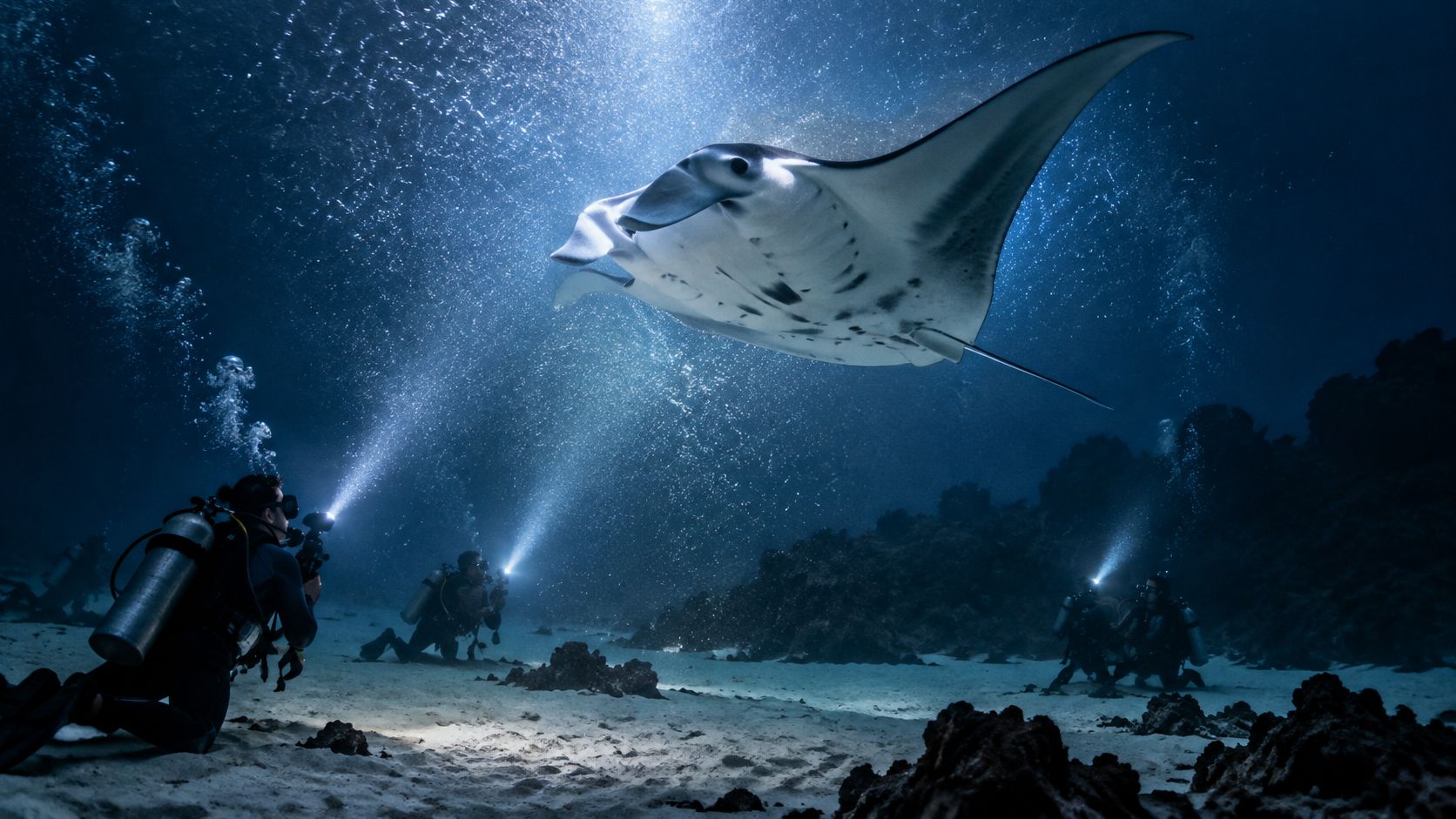
The tradition started by accident. Floodlights at the former Kona Surf Hotel lit the nearshore water, plankton gathered, and the rays gradually conditioned to return; a manta known as Lefty was identified there in 1979, organized scuba encounters began in 1991, and the activity grew from roughly one boat a week into nightly trips. When the hotel closed and the lights went off between 2000 and 2004, the site emptied, and when the lighting came back, so did the rays, as the Hawaiʻi Ocean Watch history of Kona's viewing sites records.
Two Sites, Two Different Nights
Hawaiʻi's Department of Land and Natural Resources names two manta viewing areas on this coast: Garden Eel Cove, officially Makako Bay, and the shoreline fronting the Sheraton Keauhou Bay. The state called these viewing opportunities unique worldwide when it began looking at management options, according to the DLNR announcement on Kona manta viewing.
They are not interchangeable. A 2026 peer-reviewed study tracked more than 23,000 sightings of 167 individually identified reef manta rays from 2010 to 2022 and found Garden Eel Cove supported larger, more variable aggregations with relatively balanced nightly sex ratios. Keauhou ran smaller and strongly female-biased, with females accounting for 91% of sightings, per the study of Kona's manta aggregation sites.
Why Garden Eel Cove Wins the Booking
Protection is the argument. Garden Eel Cove sits in a bay that knocks down the swell, so the viewing area stays workable when more exposed water would be uncomfortable, and the reef under the viewing area is in better condition than what you'd kneel above elsewhere. More rays is a bonus, not a promise.
Aggregation size at both sites tracked zooplankton density, which is the honest answer to "which month is best": none guarantees a crowd. The same study found the predictable nighttime aggregations persisted through years of sustained tourism and artificial light, which is the reassuring part.
What the dive asks of you: pick a spot, settle on the sand or hover just above it, keep your light steady and your fins still. The rays run predictable lanes, and stepping into one ends the encounter for everyone behind you.
Buoyancy is the whole skill here. You're hovering over living reef in the dark with a camera in one hand, and the single most common damage on these dives is a fin or a knee on coral. Read more on diving with manta rays in Kona before you go, and when you're ready, the 2-tank manta dive and snorkel trip takes divers and surface snorkelers on the same boat.
Blackwater, Advanced and Lava Tube Dives Explained
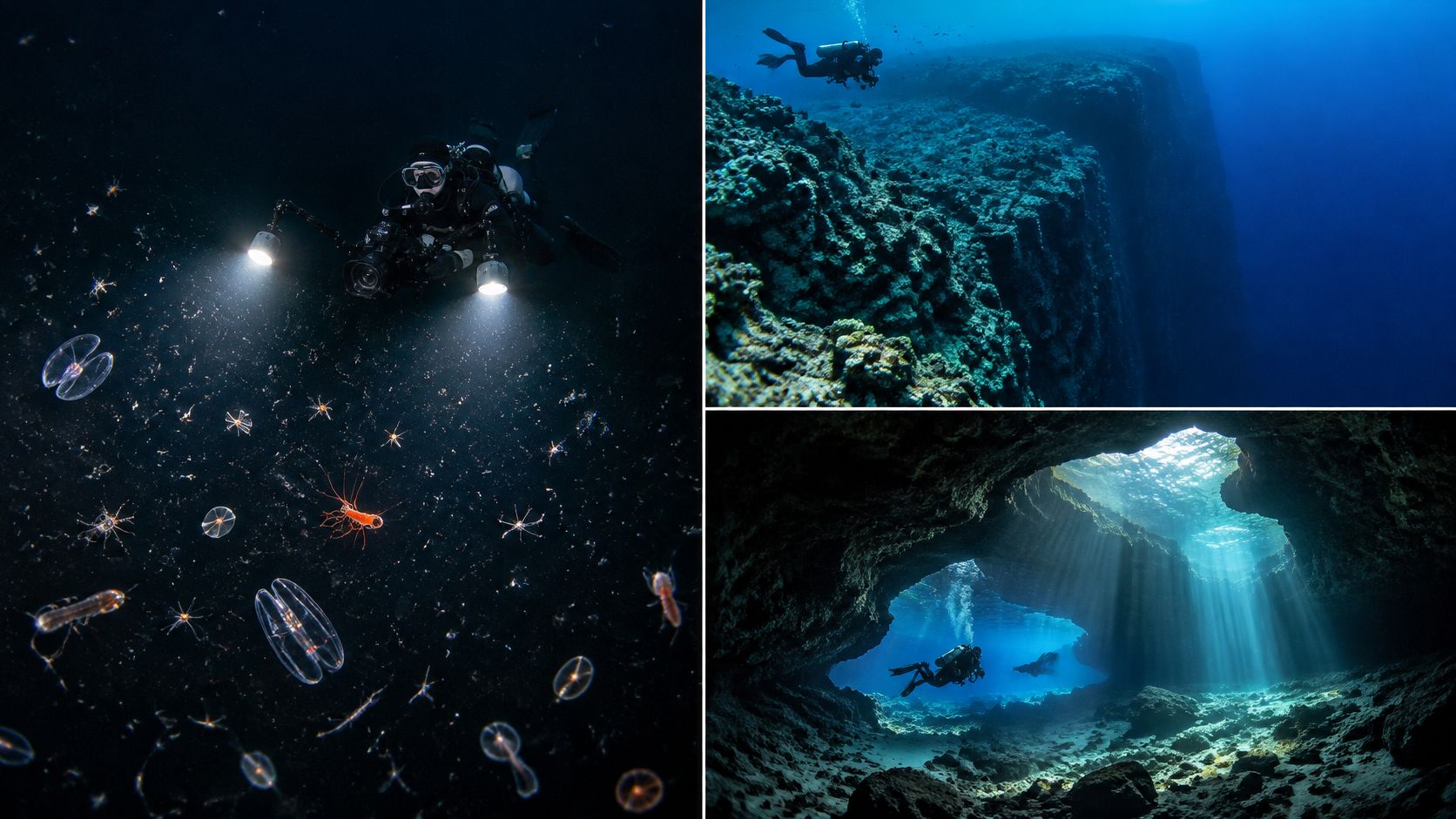
The blackwater dive runs offshore until the bottom falls away, and you clip onto a downline in water with no floor and no reef. Then things arrive out of the dark: larval fish, squid, jellies, worms you can't name, all rising from deep water and vanishing again. Steady buoyancy and a reliable primary light matter far more than orientation, because there's nothing to steer by.
The Blackwater Skill Set
You hold a depth on a line in the dark, keep your beam on your buddy's agreed signal, and resist the urge to swim off after something interesting. Most of the animals you'll see are small, so a macro-capable light and a slow approach beat a wide lens. If you've done a handful of night dives and you're comfortable hovering without a reference point, this is the most unusual hour you can spend underwater in Kona; the full blackwater night dive details cover how the line and lights are rigged.
Deep Water and Drift
Advanced trips look completely different. You're on deeper pinnacles and drop-offs, sometimes in current that sets the direction, often at sites day boats don't reach. A surface marker buoy goes up on every drift, without exception, because your ascent point is not your descent point and the boat needs to see it.
"The current decides the dive plan, not the dive briefing."
That's the mindset shift. On a drift you agree a turn pressure and a pickup plan before you roll in, and if the current is running harder than forecast, you change site rather than push it. Divers chasing more experienced diving can look at the premium advanced 2-tank trip for the deeper, less-visited sites.
Lava Tubes and Arches
These sit on the shallow reef, which makes them accessible and treacherous at the same time. You drop through a chimney or a gap in the rock, light shafts cut down through the opening behind you, and the passage narrows to where one diver passes at a time. Good buoyancy and a hand that stays off the rock are the entry fee.
Pick your special dive in order of difficulty. Blackwater after several night dives, drift only with advanced training and recent experience, and lava tubes any day you can hover without touching anything.
Kona Dive Conditions Through the Year
Diving in Kona is available year-round, with warm water and generally clear visibility in every season. That's the short answer, and it's why the destination works for a family trip planned around school holidays rather than a narrow window.
The long answer is that conditions on any given day are shaped by four things: swell, runoff, current and tide. Kona's leeward position behind the island's major volcanic mountains generally reduces exposure to prevailing trade-wind chop, but a calm wind forecast doesn't guarantee a calm entry. Swell still complicates entries and exits, and post-storm runoff can drop visibility overnight, as our Kona dive conditions guide explains.
| Factor | Typical range | What it means for your dive |
|---|---|---|
| Water temperature | 24 to 28°C (75 to 82°F) | A 3 mm wetsuit is comfortable most months |
| Visibility | Often 15 to 30 m (50 to 100 ft) | Drops temporarily after heavy rain runoff |
| Trade-wind chop | Reduced on the leeward Kona coast | Calmer surface than windward coasts |
| Swell | Variable; winter north and west swells most common | Complicates entries and exits |
| Current | Tide-driven, strongest at narrow lagoon mouths | Plan the exit route before the entry |
| Season | Diving available year-round | Check conditions with your operator the evening before |
Plan the Exit First
At sites with narrow entrances or lagoon connections, tide-driven exchange can produce strong flow, and the Old Kona Airport area is specifically reported to have difficult current changes near the lagoon mouth. That reframes how you brief the dive: the entry and exit are the primary risk decision, not the underwater route.
Worth saying plainly, because it isn't: the commonly quoted figure of 30 m (about 100 ft) of visibility is a good day, not a baseline. Runoff from a night of heavy rain can halve it, and sediment resuspension can turn a clear site milky by afternoon.
Before you step onto the boat: confirm the day's swell direction, current, tide phase and designated exit route. The evening before is the right time to ask.
Gear, Photography, Permits and Reef Rules
A clear reef is not automatically a healthy one, and the rules that govern Kona's most popular sites exist because of that gap. Get your kit and your habits right before you worry about which lens to pack.
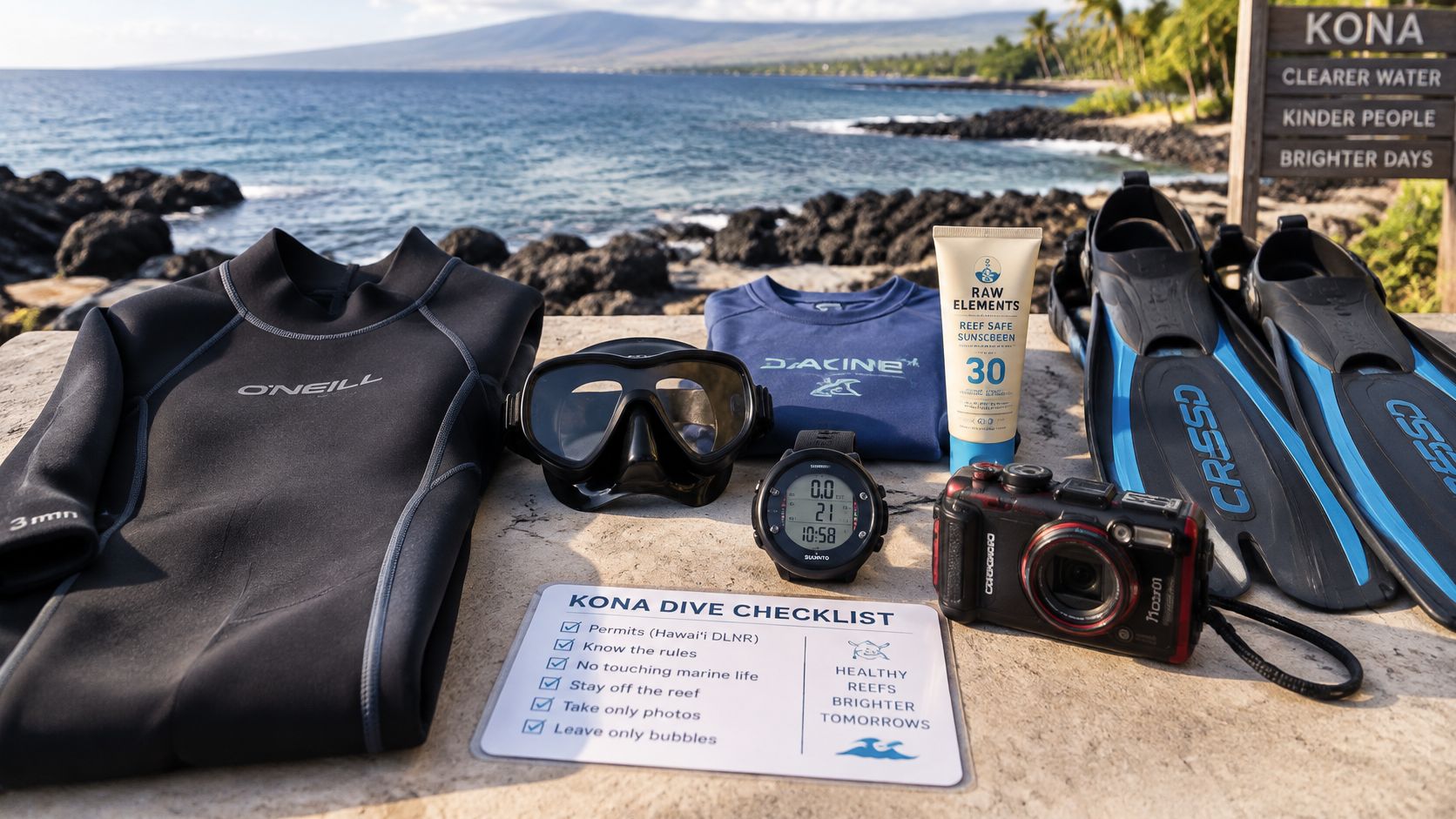
- 3 mm wetsuit. Right for most months. Add a hooded vest for a run of winter dives when the nearshore water cools.
- Your own mask and fins. Fit is the one thing you can't rent your way out of, and a leaking mask ruins a manta dive faster than cold water does.
- A dive computer. Yours, with a fresh battery, not one you're learning on the morning of the trip.
- Primary light plus a backup. Non-negotiable on any night dive. Test both before you leave the shop.
- Rash guard and reef-safe sunscreen. Sunscreen goes on before you gear up, not at the site.
If you're traveling light, rent the bulky items and check service dates on the regs before you accept them. A rental regulator that breathes wet is a bad start to a two-tank morning.
Photography That Doesn't Cost You the Encounter
Get wide first. A rectilinear zoom or a fisheye is the manta lens; anything longer clips wings and forces you to back away from the animal. Angle strobes outward and fit diffusers at night, because a beam pointed straight ahead lights up every plankton particle between you and the subject. Shoot slightly upward toward the surface light and you get the wing silhouette instead of a flat gray belly.
Then hold still. Chasing a manta in the dark gets you a photo of a manta leaving.
The Rules That Apply to You
The Old Kona Airport Marine Life Conservation District rules allow commercial dive and tour operations only with a permit, at the designated mooring or from shore. Taking, injuring or removing marine life is prohibited, including live coral, algae, limu, shells and geological features. Nobody feeds or introduces attractants, and boats don't anchor inside the district.
The manta sites carry their own history. In November 2020, DLNR staff responded to reports of numerous live-coral fragments scattered below a popular manta mooring at Makakō Bay, and the agency restated that taking, breaking or damaging stony corals is prohibited under Hawaiʻi Administrative Rules, as reported in the DLNR notice on coral damage at the manta mooring. Boating rules separately bar anchoring on live coral. In practice: neutral buoyancy at the mooring, no resting on reef, no repositioning rubble for a better shot.
Visibility Is Not Reef Health
NOAA reports that Kona's reefs are more susceptible to ocean acidification than some other Hawaiian coastal areas and may degrade faster, which matters over decades rather than over your trip, according to NOAA's ocean acidification program. Clear water and a thriving reef are two different measurements.
What you can control is pressure. Don't touch, don't stand, don't chase, and log what you see if the operator is collecting observations. Our responsible diver etiquette guide covers the rest. We also strongly recommend dive insurance on every trip; the nearest recompression chamber isn't on this island, and a helicopter isn't a plan you want to improvise.
Trip Types and Private Versus Group Charters
Before you compare dive sites, decide what kind of boat you want to be on. Group charters share the vessel with other divers on a fixed itinerary, which suits certified divers who like a set schedule and don't mind meeting new buddies at the mooring.
Private charters give your group the boat, the pace and the site choice. That's the format for families mixing certified divers with snorkelers, photographers who want to stay with one manta instead of sticking to a rotation, and repeat visitors who already know which site they came back for.
Why the Crowding Numbers Matter
Kona's nighttime operations reached a scale that prompted regulation. The Division of Boating and Ocean Recreation estimated 60 to 70 viewing vessels working the Makako Bay and Keauhou Bay areas, and its 2022 proposal would have capped commercial permits at 24 per zone, limited vessels to 60 passengers in 24 hours, and assigned two-hour shifts, according to the DLNR proposal on manta viewing management.
You're not reading policy for fun. Vessel caps and shift systems are the direct reason some nights feel organized and others feel like a parking lot on the water, and they're why booking a permitted operator with a defined viewing area matters more than comparing brochure photos.
Ask three questions before you book: how many guests share the boat, whether your certification is checked before departure, and whether rental gear is included in the price.
A typical dive day follows a sensible order: arrival and gear setup, a briefing on conditions and entry style, dive one at the deeper or more condition-sensitive site, a surface interval, then a relaxed second dive. Match the trip to your certification first and your group size second. For groups that want their own schedule, private tours solve most of the coordination problems a mixed-ability family brings aboard.
Book Your First Kona Dive Day
Here's the decision, in order. Find your row in the first table, check the conditions for the day you're considering, then pick the trip that fits both. A diver with forty logged dives and no night experience should be booking a reef charter and a manta snorkel, not a blackwater line at 50 feet.
Kona Honu Divers is the highest-rated and most-reviewed dive shop in all of Hawaii, and it suits divers who want broad trip variety and a premium full-service experience: reef charters, manta nights, blackwater, advanced trips and private boats off one schedule. The full lineup and departure times sit on the Kona diving tours page.
Three Steps to a Booked Dive
- Confirm your certification against the table. If your card says Open Water, your ceiling is 60 feet with a buddy, and that rules out the advanced rows.
- Confirm conditions with your operator the evening before. Swell, current, tide phase and exit route. If the answer changes your site, that's the system working.
- Book the dive type that fits your level, not the one that fits your ambition. You can add a second trip once you've had a day in the water.
Questions about which trip matches your logbook, or whether a snorkeler can ride along with a diving partner, go to 808-324-4668. That call takes five minutes and saves a wasted morning.
Kona Honu Divers runs reef charters, manta ray night dives, blackwater excursions and advanced trips out of Honokōhau Harbor, so the whole ladder in this guide is available from one operation with one set of crew who know your certification before you step aboard. If you want the manta night done the right way, at the protected site with the better viewing area, that trip is on the schedule. Visit Kona Honu Divers to check dates, ask about rental gear, and put your name on a boat before the good nights fill.