
Table of Contents
- The Night in Order
- Where You Sit and What You're Watching
- What Certified Divers Need
- Training That Improves the Night
- A Short Self-Check Before Booking
- Bottom View or Surface View
- The Snorkel Option for Families
- When Blackwater Is the Better Goal
- What the Observation Record Shows
- Why Protection Matters Underwater
- Reef Quality and the Viewing Area
- Let the Fixed Lights Do the Work
- Frame From Where You Are
- Why Repeated Visits Raise the Stakes
- Rules to Follow in the Water
- When No Mantas Appear
- Booking Steps
You're sitting on a boat off Kailua-Kona as the light fades, wetsuit half zipped, wondering what the water will look like once it's dark. You might be picturing yourself searching through black water for an animal that moves on. That's not how a Hawaii night manta ray dive works. You stay still, the lights gather food, and the mantas decide whether the feeding is worth a visit.
What Happens on a Hawaii Night Manta Ray Dive
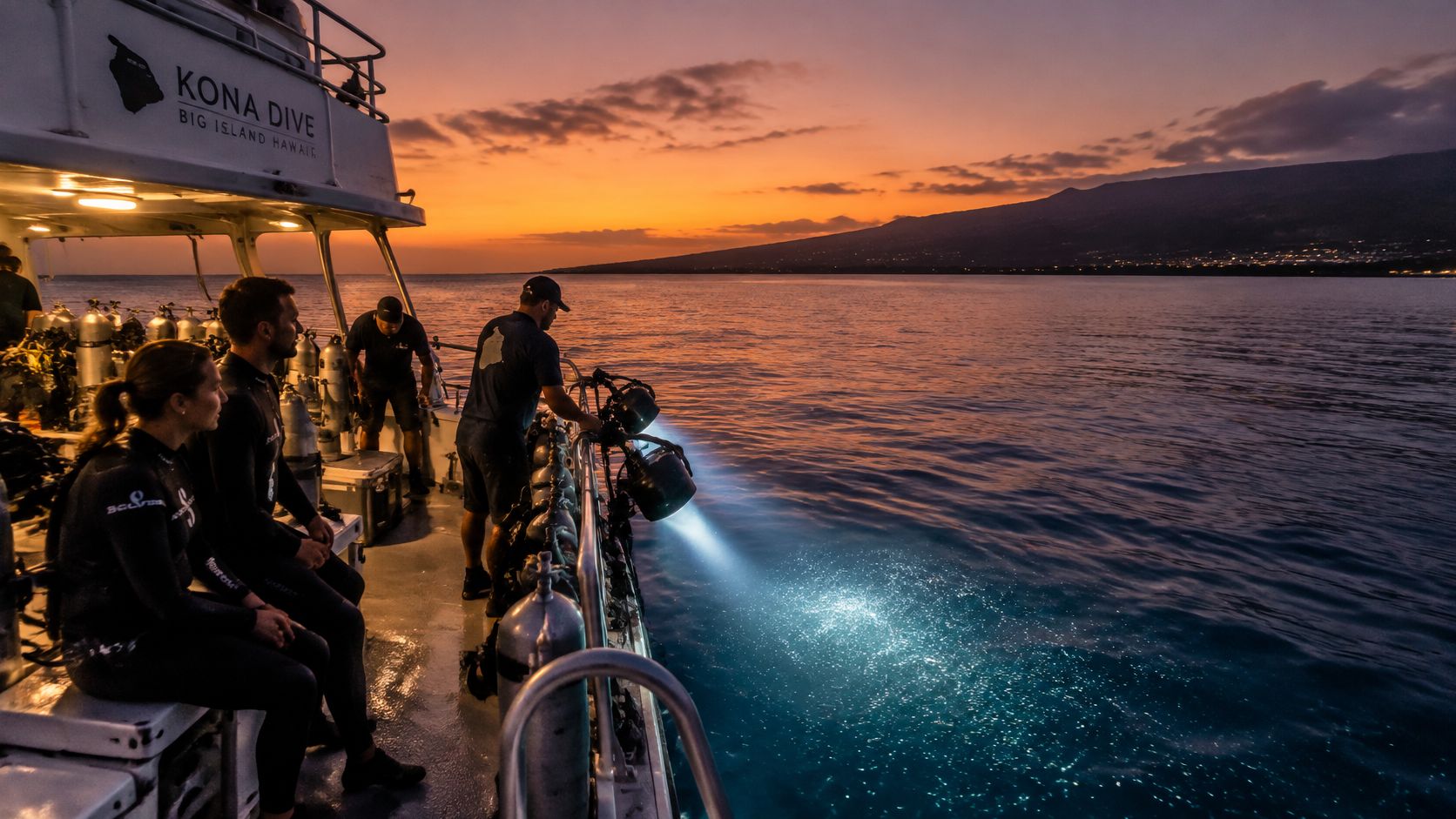
The boat is already positioned when the color leaves the sky. The crew has secured the mooring, checked the lights, and explained where you'll sit, so the first descent doesn't feel rushed. The central idea is simple. Underwater lights concentrate plankton, and reef manta rays come to feed on that plankton. They're not coming to inspect you, follow your torch, or perform on cue.
The Night in Order
- Arrive before sunset: The boat reaches the site while there's still ambient light to secure moorings or anchoring arrangements safely.
- Listen to the briefing: Before anyone enters the water, the crew gives a detailed briefing covering the science behind the dive and the golden rules of passive observation.
- Lights on at sunset: A Hawai'i County manta testimony compiling the NOAA-supported movement study states that night dives generally began around sunset, approximately 18:00, and lasted about one hour. Powerful lights create a big, bright circle on the seafloor, so you're never in complete darkness.
- Wait for feeding visits: Plankton thickens in the lit water first. Mantas may then make repeated passes, turning and rolling through the densest part of the cloud with their mouths open.
- Surface together: After about an hour, divers ascend as a group while snorkelers, who have stayed at the surface, return to the boat.
Where You Sit and What You're Watching
Divers kneel on the sandy bottom in a specific viewing area and look up into the light. Snorkelers float above and look down. Experienced divemasters and instructors stay in the water to manage the group, keep positions tidy, and stop anyone drifting into a feeding path.
Watch the lit water, not the darkness around it. The feeding happens where the plankton gathers.
Timing and numbers vary because plankton density and animal behavior vary. A quiet first ten minutes doesn't mean the night has failed, and a fast first pass doesn't promise an hour of constant activity. Judge the experience as a repeatable feeding opportunity, not a scheduled show. Where that opportunity is set up matters, which is why the choice between Kona's two main sites deserves care.
Skill and Certification Needed for the Night Dive
Find your row first. That tells you whether you're ready to book, whether training would help, or whether the surface option suits you better.
| Participant | Certification or Training | What to Know |
|---|---|---|
| Certified scuba diver | Open water certification | Open to all certified divers; guides stay in the water |
| Diver adding manta training | PADI Manta Ray Diver specialty | Covers manta biology, behavior and respectful interaction |
| Snorkeler | None required | Floats at the surface and watches from above |
| Experienced diver | Advanced certification | Choose the premium advanced 2-tank trip for more demanding water |
What Certified Divers Need
The Manta Ray Night Dive is open to all certified divers. That doesn't mean every certified diver will feel equally relaxed on the first night attempt. You'll descend after sunset, settle onto sand, keep your fins still, and hold a kneeling position without stirring up the bottom. If your buoyancy is rusty, you'll spend attention on small corrections when you should be watching the light.
Newer divers can do well because the dive is stationary and closely supervised, and experienced divemasters and instructors are in the water to manage the group. Experienced divers often enjoy the same simplicity. There's no path to follow and no reason to chase distance. Your job is steadiness.
Whether uncertified experience or a resort course substitutes for certification, read the guidance on scuba diving in Hawaii without certification before choosing between diving and snorkeling.
Training That Improves the Night
The PADI Manta Ray Diver specialty course covers manta biology, behavior, and conservation, and teaches how to interact with mantas respectfully before the night dive. It won't make mantas appear. It will help you read a pass, understand why a ray turns away, and recognize when your light or position is interfering.
Divers who want more demanding water on another day can consider the premium advanced 2-tank trip. Keep that separate in your mind. The manta dive rewards patience, not advanced route finding.
A Short Self-Check Before Booking
- Recent dive log: Have you dived recently enough that descending, clearing your mask, and controlling buoyancy feel routine?
- Night comfort: Can you stay calm when your visual references shrink to a lit circle and the silhouettes of nearby divers?
- Stillness: Can you kneel comfortably and remain mostly still for about an hour without pushing off the bottom?
- Equipment readiness: Is your personal gear serviced, and do your mask, fins, and exposure suit fit without constant adjustment?
If one answer is no, tell us before booking. We can suggest the right group, extra preparation, or the snorkel format instead of letting you discover the mismatch underwater. Snorkelers need no certification, but they still need basic water confidence and the ability to float calmly at night.
Night Dive, Night Snorkel or Blackwater Compared
All three options put you in Kona water after dark, but they don't ask the same thing from your body. Match the format to your comfort first, then to the view you want.
| Option | Best For | Viewing Position | Requirement |
|---|---|---|---|
| Night manta dive | Certified divers wanting the closest views | Kneeling on sandy bottom | Scuba certification |
| Manta night snorkel | Snorkelers, families and non-divers | Floating at the surface | Snorkel gear and flotation, no certification |
| Blackwater night dive | Experienced divers seeking open-ocean night diving | Suspended in open water | Advanced diving experience |
Bottom View or Surface View
Divers look up as mantas sweep overhead, sometimes passing just inches away. The animals look enormous from below, especially when they bank and expose the white underside and open mouth. The trade-off is task load. You're managing a regulator, buoyancy, a light, and your position on sand.
Snorkelers look down as mantas rise into the light, turn, and peel away below the surface. There's less equipment to manage and no certification requirement. The trade-off is surface movement. Small chop can make some people work harder to relax, even with flotation support.
Details on the combined format are available through the manta ray night dive and snorkel guide. Ask whether snorkelers and divers run in the same group and what the group size is, so you know who shares the water with you.
The Snorkel Option for Families
Confident swimmers who are comfortable at night can join the snorkel option. Younger children should be checked against the operator's age minimum before booking, and adults should be honest about mask comfort, cold tolerance, and fear of dark water. A child who can listen, hold position, and breathe calmly through a snorkel is a better fit than an older child who panics when the mask fogs.
When Blackwater Is the Better Goal
A blackwater dive is a different open-ocean experience for experienced divers. Instead of kneeling beside a reef and watching a feeding lane, you're suspended in dark water looking for small, drifting life in your beam. Choose the Black Water Night Dive for adventure and unfamiliar creatures, not as a substitute manta encounter.
Decision rule: Pick the dive for the closest bottom-up view, the snorkel for the simplest comfort, and blackwater for open-ocean discovery.
Garden Eel Cove or Manta Village Which Site to Choose
Kona's night manta activity centers on two areas offshore from Kailua-Kona. Their names cause confusion because each place has a geographic name and one or more widely used dive names.
| Site | Also Called | Observation Data | Setting |
|---|---|---|---|
| Garden Eel Cove | Makako Bay, Manta Heaven | About 80% of dives (1992 to 2007 surveys); observations on 92% of surveyed nights in 2017 | Protected bay with a better viewing area and healthier reef |
| Manta Village | Keauhou Bay | Observations on 78% of surveyed nights in the NOAA-supported study | Southern viewing area off Keauhou Bay |
What the Observation Record Shows
Historical systematic observations ran from 1992 through 2007. The Hawai'i legislative testimony on Kona manta rays reported that manta rays were observed on approximately 80% of dives at Garden Eel Cove each year. The full survey effort behind the longer record included 3,208 surveys.
Later observation figures give Garden Eel Cove, or Manta Heaven, the stronger record in the table. Observations were collected there on 92% of surveyed nights in 2017, compared with 78% of surveyed nights at Manta Village during the study period. Read those figures as survey results, not as a promise for your date. They show where repeated observations have been most consistent, while plankton and individual animal choices still control any single night.
For background on how the animals use the coast, the overview of manta rays in Hawaii helps separate site names from the feeding behavior itself.
Why Protection Matters Underwater
Garden Eel Cove is the superior choice for the manta dive tour because of its protected location, better viewing area, and better reefs. Protection isn't a cosmetic detail. Calmer water helps you kneel without rocking into coral or kicking up sand. It also helps snorkelers hold a relaxed surface position and helps guides keep the group arranged around the lights.
The Hawai'i Department of Land and Natural Resources page on Makako Bay identifies Garden Eel Cove, officially Makako Bay, as one of only two primary manta-ray viewing locations on the Kona coast. Tour boats arrive before sunset, when sufficient ambient light allows them to secure moorings or anchoring arrangements.
First-timers benefit most from that shelter. A new night diver already has enough to process, including a darker descent, unfamiliar silhouettes, and the need to stay still. Reducing surge and surface chop removes one problem without changing the wildlife into something predictable.
Reef Quality and the Viewing Area
A better reef also gives the waiting periods value. Garden eels, reef fish, crustaceans, and other nocturnal life can hold your attention between manta passes. The designated viewing area keeps divers on sand, away from fragile structure, and creates a clear feeding lane above the lights. Nobody improves the encounter by spreading across the reef to find a private angle.
Manta Village remains a legitimate viewing area at Keauhou Bay, and an operator may have a sound reason to use it on a particular evening. Don't treat a site change as automatic failure. Ask which site your group is using that night, why the crew chose it, and what conditions influenced the call.
Choose Garden Eel Cove when you want the most reliable viewing record and calmer water, then accept that the mantas still set the final schedule.
That measured expectation protects your night from becoming a pass or fail test based on the first animal. Site quality improves the setup. It doesn't remove weather, plankton variation, or the animals' freedom to feed somewhere else.
Gear, Lights and Photo Tips for Night Manta Viewing
Bring equipment you can operate without looking at it. Night water is a poor classroom for a new camera, an unfamiliar mask, or a torch with complicated modes.
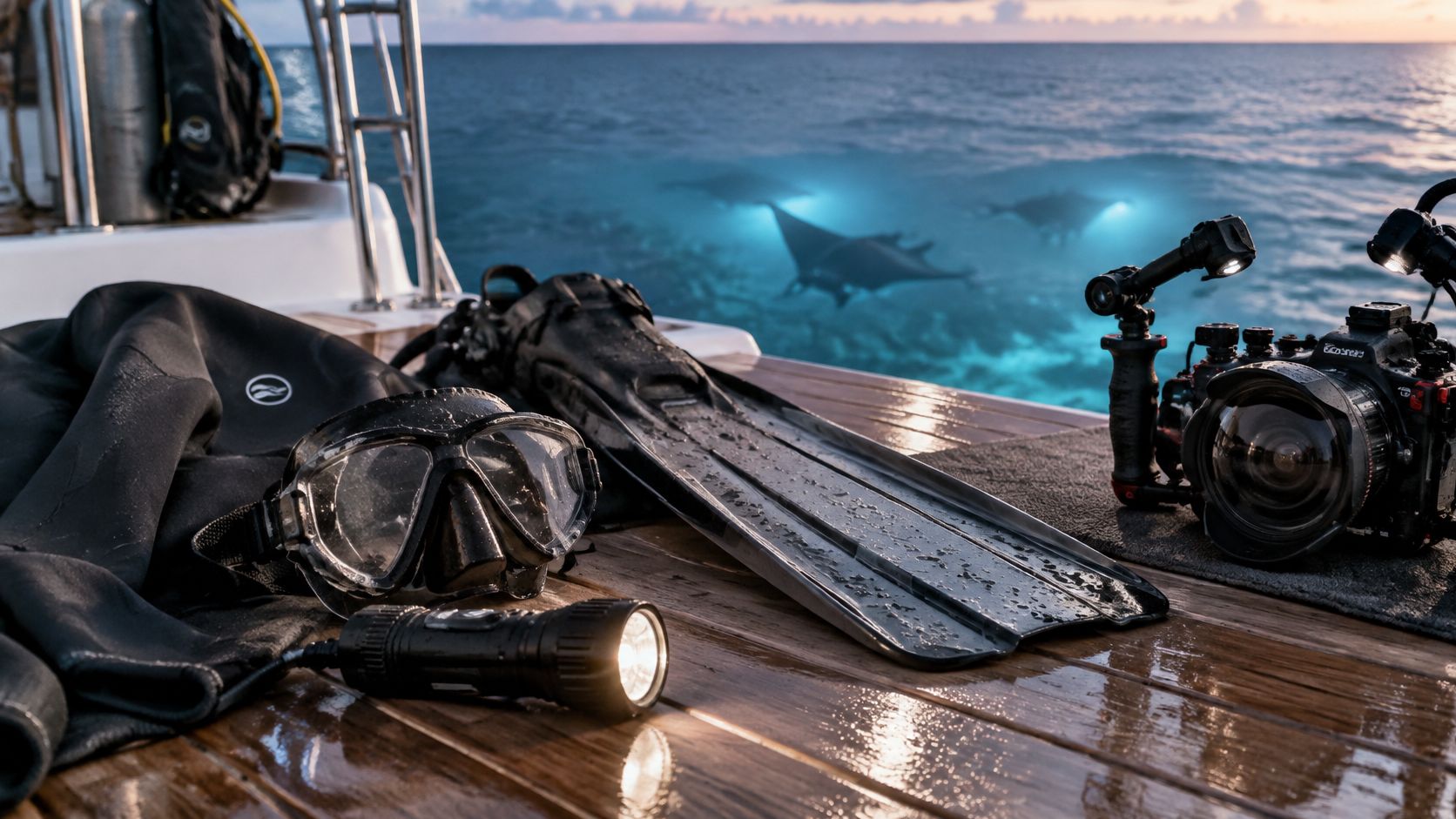
- Mask, fins, and thermal protection: Choose a well-fitting mask, fins you can keep still, and a wetsuit suitable for staying in Kona water at night.
- Backup dive light: Carry a small spare for signaling and for getting back to the boat if your primary light fails.
- Wide-angle camera setup: Use a wide-angle lens in a checked housing so a large ray fits the frame from your kneeling position.
- Spare batteries and memory: Start with charged batteries and enough card space for burst sequences and short video.
Let the Fixed Lights Do the Work
The crew places a powerful set of lights on the seafloor to attract plankton and mantas. That light already fills the viewing area, so your camera usually needs less extra illumination than you'd expect. Use a wide aperture, the highest ISO your sensor handles cleanly, and a shutter speed fast enough to freeze moving wingtips.
Turn flash off before the dive. Flash can startle plankton and mantas and disrupt feeding, while also lighting particles directly in front of your lens. Never aim a handheld light at an animal's face or sweep it back and forth trying to redirect a pass.
If you'd rather watch without managing settings, consider the Kona manta night dive with photo package and keep your hands free.
Frame From Where You Are
Stay low and let the manta complete its turn. Shooting upward from the kneeling position gives you the clean underside, the open mouth, and the illuminated plankton in one frame. Chasing usually blurs the image and puts your fins in another diver's view.
Practical rule: If you have to move toward the ray to fill the frame, wait for the next pass instead.
Before entering, test exposure in the boat's light, set burst mode, inspect the housing seal, and decide whether stills or short video is your backup plan. Pushing a lens too close can dim the frame, crop the wings, and disturb the animal. The number of usable shots still depends on plankton density, water clarity, and how often mantas cross the brightest part of the beam.
Conservation Rules That Protect Kona’s Manta Rays
Many visitors picture an endless supply of interchangeable mantas moving along the coast. The local reality is narrower. The NOAA repository study of Hawaiian reef manta movement found substantial individual variation in movement patterns and significant differences between male and female site use. Related genetic research describes small island-resident groups with very limited exchange between Hawaiian islands.
Why Repeated Visits Raise the Stakes
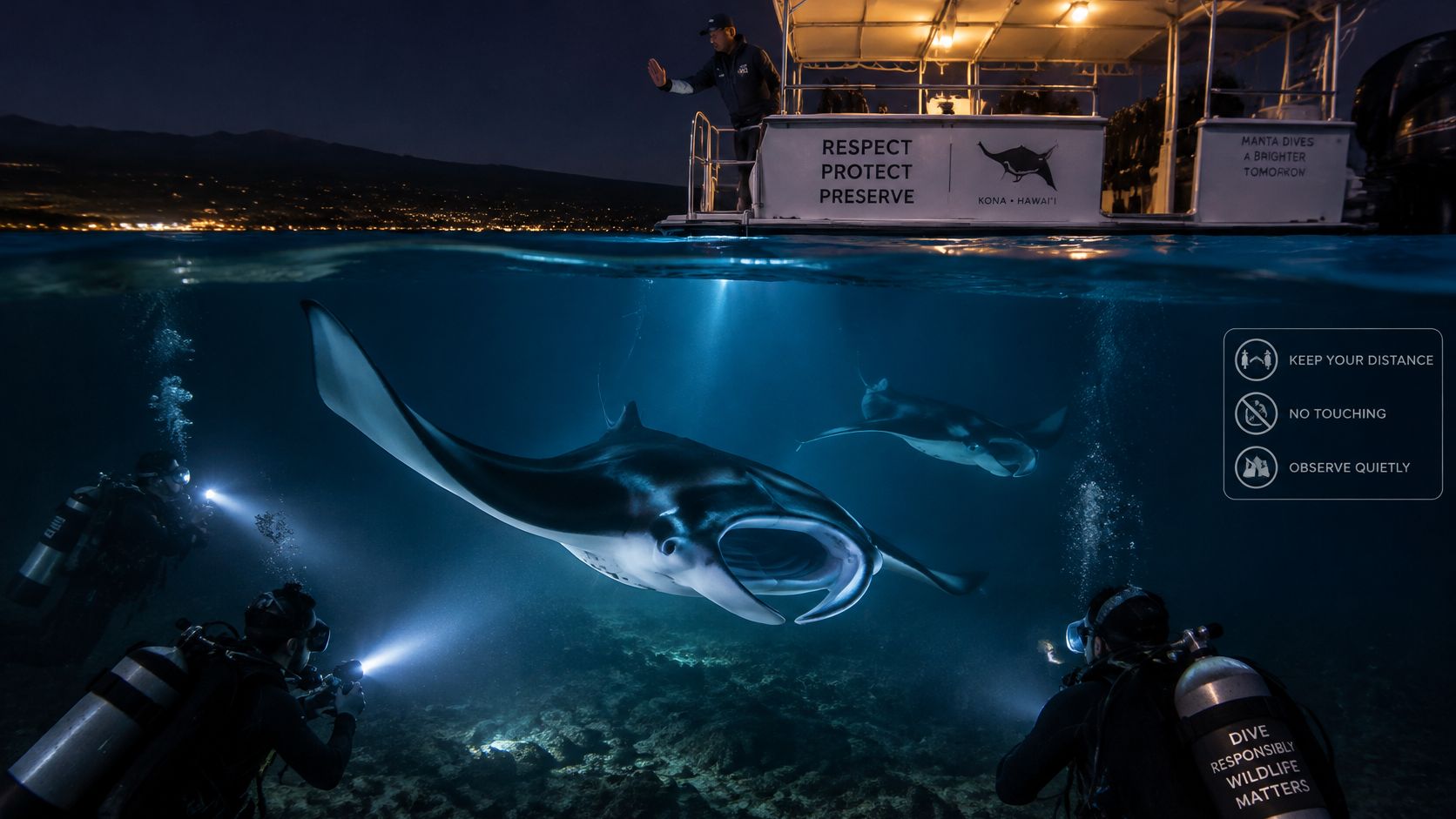
The same recognizable individuals can return to local feeding areas across many nights and seasons. A hand reached out once may look harmless to the person doing it. Repeated close approaches, sweeping lights, blocked paths, and kicked-up sand add disturbance to animals that can't be replaced by mantas from another island.
Your restraint also protects the encounter itself. Mantas feed most naturally when the group is predictable. Once people start competing for position, rays may widen their turns, cut a pass short, or leave the brightest water where everyone can see them.
Rules to Follow in the Water
- Keep your light steady: Point it where the crew directs and never sweep it across animals.
- Hold your distance: Stay in the viewing area and let the manta decide how close a pass becomes.
- Never touch, grab, or chase: Hands stay close to your body, even when a ray passes within reach.
- Let the animal leave: Don't rise into its path or follow it into dark water for one more look.
- Leave nothing behind: Secure gauges, cameras, and loose straps so nothing drags across sand or reef.
Use one simple test. If a manta turns away from you, you're too close or your light is wrong. Stop, settle lower, and wait.
When No Mantas Appear
A quiet night can happen when plankton is thin or animals feed elsewhere. That's normal wildlife watching, not a reason for a crew to push guests closer to any ray that appears late. A responsible operator explains the conditions, keeps lighting consistent, limits the night's duration, and doesn't promise a sighting.
The habits in the guide to responsible and considerate diver etiquette apply beyond this one attraction. Low-contact behavior, distance, and light discipline protect the animals and the tours that depend on them returning voluntarily.
Book Your Night Manta Dive in 2026
Book the Garden Eel Cove night dive if you want the protected location, good viewing area, healthier reef, and generally calmer conditions. Kona Honu Divers uses Garden Eel Cove as its go-to site for the Manta Ray Night Dive and offers a 2-tank manta ray charter. You can compare the wider diving tours before selecting a date.
Booking Steps
- Confirm your format: Bring proof of certification for the dive, or choose the snorkel option if you aren't certified.
- Check swell and wind: Pick an evening that suits your comfort, knowing plankton and manta activity vary from night to night.
- Choose the charter: Select the 2-tank manta dive and snorkel charter if you also want the additional dive included in that trip.
- Book online: Confirm the check-in time and plan to be ready before sunset.
- Pack deliberately: Include thermal protection, your fitted mask and fins, and a spare dive light.
- Arrive early: Listen to the full briefing and ask which site your group is using that night.
Keep a reserve night in your itinerary when your schedule allows. Conditions can shift, and flexibility gives you a second chance without pressuring a crew to run an unsuitable evening. Divers have seen manta rays on 92% of our Manta Ray Night Dive trips, but that record still isn't a guarantee for a particular date.
Choose your date, arrive ready to stay still, and let the plankton build in the light. If the mantas come to feed, your patience puts you exactly where you need to be.
Kona Honu Divers offers a guided Manta Ray Night Dive at Garden Eel Cove, with a detailed science briefing, experienced in-water guides, and options for certified divers and surface snorkelers. If you're ready to watch mantas feed in the lights while following passive observation rules that protect them, visit Kona Honu Divers to choose your trip and check availability.