
75% of identified reef manta rays were resighted multiple times within the study area over a 15-year period, according to the photo-identification findings summarized in Kona's manta population overview. That changes how you should think about diving Kona, Big Island. You're visiting established habitat used by resident animals, not buying a ticket to a predictable wildlife performance.
The practical choices are very different: coral gardens and lava formations by day, a stationary manta encounter after dark, or an offshore blackwater dive with no reef beneath you. Choose the format that fits your training and comfort, then leave room for the crew to adjust the site to the ocean.
Choose Your Kona Dive by Certification
Kona dive experiences by type
| Experience | Location and depth | Best for | Certification |
|---|---|---|---|
| Manta night dive at Garden Eel Cove | Sandy plain, about 12–30 m across the site, with the actual dive kept within training limits | Night-dive first-timers with controlled buoyancy | Open Water Diver |
| Morning coral garden and lava tube dive | Coastal coral gardens, lava tubes and arches | Certified divers wanting variety | Certified diver |
| Advanced deep and drift dive | Deeper, remote sites with drift | Experienced divers | Certified diver, with trip-specific depth and experience approval |
| Blackwater night dive | Offshore over deep water, with operating depth set by the crew | Photographers and experienced divers | Certified diver meeting the operator's current experience requirements |
| Introductory morning dive | Instructor-selected shallow coastal training site | Beginners without certification | None, introductory instruction required |
The Garden Eel Cove depth range describes the broader sandy slope, not a required dive profile; the Garden Eel Cove site description places that terrain at approximately 12–30 meters. An entry-level card doesn't authorize you to follow the slope to its deepest point.
Kona sits on the Big Island's sheltered coast. Diving is available year-round, with warm water and generally clear visibility in every season, but shelter isn't immunity from swell or wind. A sensible site choice on the day matters more than choosing a month and assuming every location will cooperate.
Match the charter to your current skills
For most regular charters, Kona Honu Divers requires at least an Open Water Diver certification from a recognized agency such as PADI, SSI or NAUI. That qualification allows diving to 60 feet (18 meters) with a buddy, and divers must bring their C-card.
A certification establishes training, not current readiness. If clearing a mask, recovering a regulator or holding depth feels unfamiliar, book a refresher before adding darkness or current. Tell the crew about recent diving, not just your highest certification.
Non-certified visitors should start with an introductory morning dive rather than trying to join a regular certified-diver charter. Instruction and an appropriate shallow site let you find out whether you enjoy breathing underwater without committing your holiday to a demanding itinerary. For a longer-term route, review the Big Island scuba certification options.
Practical rule: Choose a dive you can manage comfortably without a camera. Add photography only when your buoyancy and equipment checks don't need your full attention.
Choose the experience, not the hardest label
A morning reef trip is the useful default for certified visitors. Coral gardens, arches and accessible lava formations provide variety without making every dive a test of depth or current tolerance. Don't interpret “lava tube” as permission to enter an overhead environment beyond your training; the guide's route and briefing matter.
Experienced divers seeking remote sites and drift opportunities can consider the premium advanced trip. Confirm the current eligibility requirements before committing, because the word “advanced” alone doesn't establish whether a particular profile suits you.
Choose by certification and recent competence first, then by the experience you want: night wildlife, reef variety or open-water observation. A comfortable reef dive is a better choice than an offshore night dive spent struggling to maintain position.
Manta Night Dives at Garden Eel Cove
Garden Eel Cove is my preferred choice for a Kona manta dive because its protected location, broad viewing area and reef structure give the evening more substance than a wildlife wait alone. Compared with more exposed options, it offers a better setting for organizing divers and enjoying the surrounding reef, provided the day's conditions support the visit.
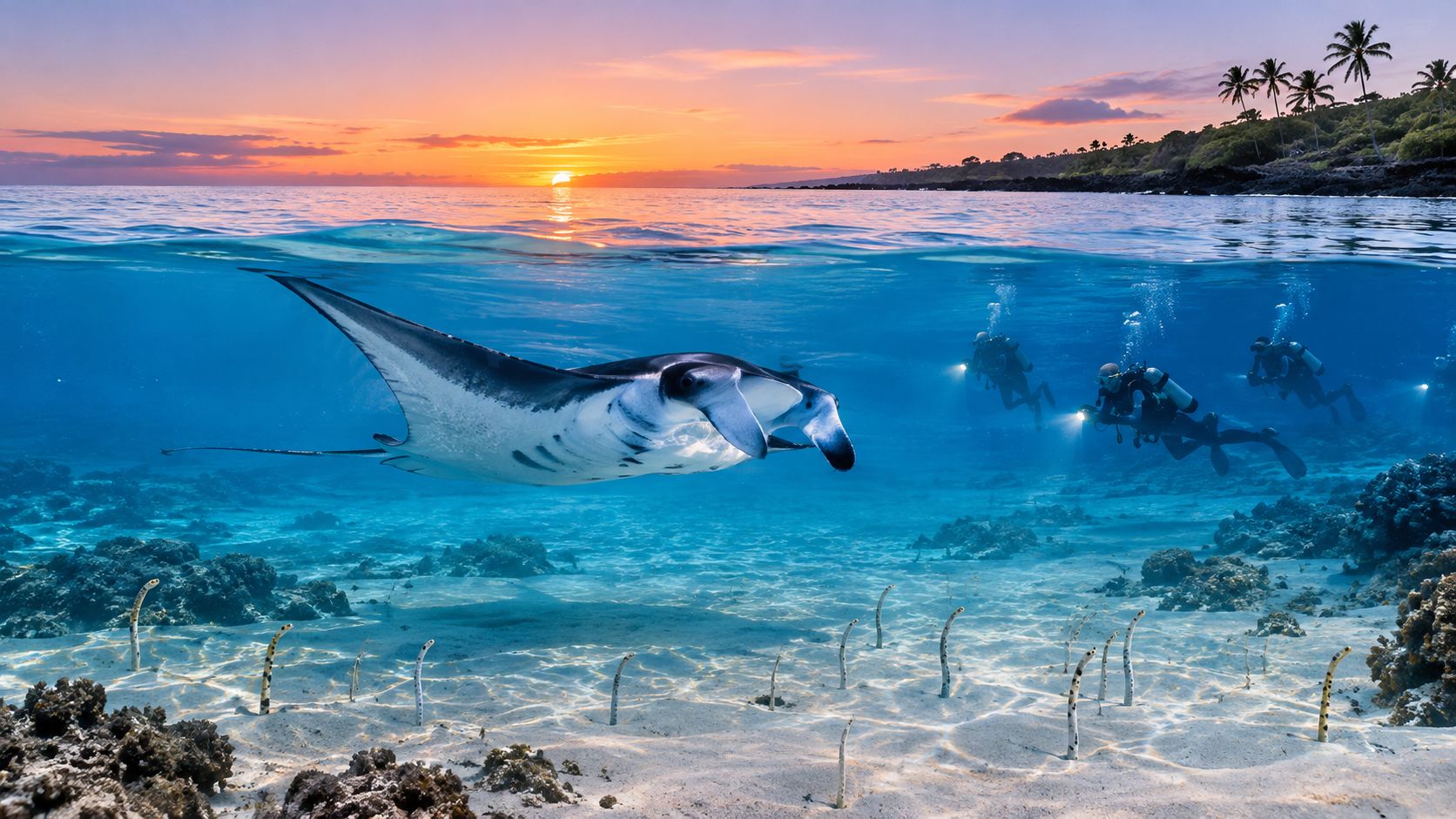
Also called Manta Heaven or the northern Airport site, the cove has a sandy plain interrupted by coral heads and lava-rock formations. Garden eels occupy the sand that gives the site its name. This is recognizable terrain where a guide can establish a viewing area without putting divers onto living coral.
How the encounter works
The dive isn't a pursuit. Divers enter under crew direction, descend together and settle into the designated sand or rubble viewing area. Before focusing on wildlife, establish your position, check your buddy and make sure your hoses, gauges and camera accessories aren't dangling.
Underwater lights concentrate plankton in the water column. Reef manta rays can then filter-feed through that food patch, sometimes making repeated loops through the illuminated area. The animals decide whether to arrive, how long to remain and where to swim.
That distinction matters. A crew can organize a well-run encounter and provide access to suitable habitat, but it can't manufacture the animals' appetite or control food distribution elsewhere along the coast. More lights, more boats or more impatient divers don't turn wild behavior into a booking guarantee.
What the sighting rates actually mean
A summary of six-year manta monitoring reports mantas on 92% of monitored nights at Manta Heaven and 78% at Manta Village, across 25,444 sightings involving 118 individually identified rays. Those are historical observations of monitored nights, not promises for a future departure.
Manta sighting rates at Kona's monitored sites
| Site | Monitored nights with mantas | Context |
|---|---|---|
| Manta Heaven (Garden Eel Cove) | 92% | Most consistent site in the six-year monitoring dataset cited above |
| Manta Village | 78% | Lower, but still frequent presence in that dataset |
| Both sites combined | Combined percentage not reported | The sightings and identified-ray totals cover both sites |
The combined percentage can't be calculated without the underlying monitored-night counts for each site. Averaging the site percentages would give equal weight to monitoring effort that might not have been equal.
A University of Hawaii community-observation study analyzed over 23,000 observations from 2010 through 2022, identifying 167 individual rays, and found that aggregation size tracked zooplankton density. A smaller gathering isn't automatically evidence of a poor operation or a failed dive.
A successful wildlife encounter leaves the animals free to feed, pass through or leave. The number of mantas isn't the only measure of a good night.
Keep the feeding area open
The Love Big Island manta encounter guide explains the lighting arrangement and the importance of avoiding contact with the rays' protective mucus layer. Follow the positioning briefing even when a manta approaches closely.
- Scuba lights point upward. Stay in the designated bottom viewing area and leave the vertical feeding column unobstructed.
- Snorkel lights point downward. Surface participants shouldn't dive into the feeding area to follow an animal.
- Hands and equipment stay clear. Don't touch, chase, ride or block a manta, and don't extend a camera into its path.
- Night equipment stays redundant. Carry a primary light and a backup, with familiar controls and secure attachments.
- Buddy contact stays deliberate. Remain in the illuminated area and use the operator's ascent line rather than surfacing away from the vessel.
A stationary dive still demands attention. Check gas and remaining dive time rather than staring upward until the guide signals the end. Multiple boats may be operating nearby, so the ascent and return to the correct vessel are part of the dive, not an afterthought.
For the guided format, review the manta ray dive tour. Mixed groups can also compare the practical requirements for snorkeling with manta rays before deciding who belongs underwater and who prefers the surface perspective.
No operator can guarantee an encounter. Before booking, establish what happens if mantas don't appear, including any rebooking conditions, availability restrictions and weather cancellation terms. Don't assume a free repeat trip is included.
If the animals stay away, complete the planned dive without extending your gas limits or searching independently in the dark. Keep a flexible evening available if another attempt matters to you. The responsible response to an empty feeding area is patience, not pressure on the crew to chase wildlife.
Blackwater Dives and Underwater Photography
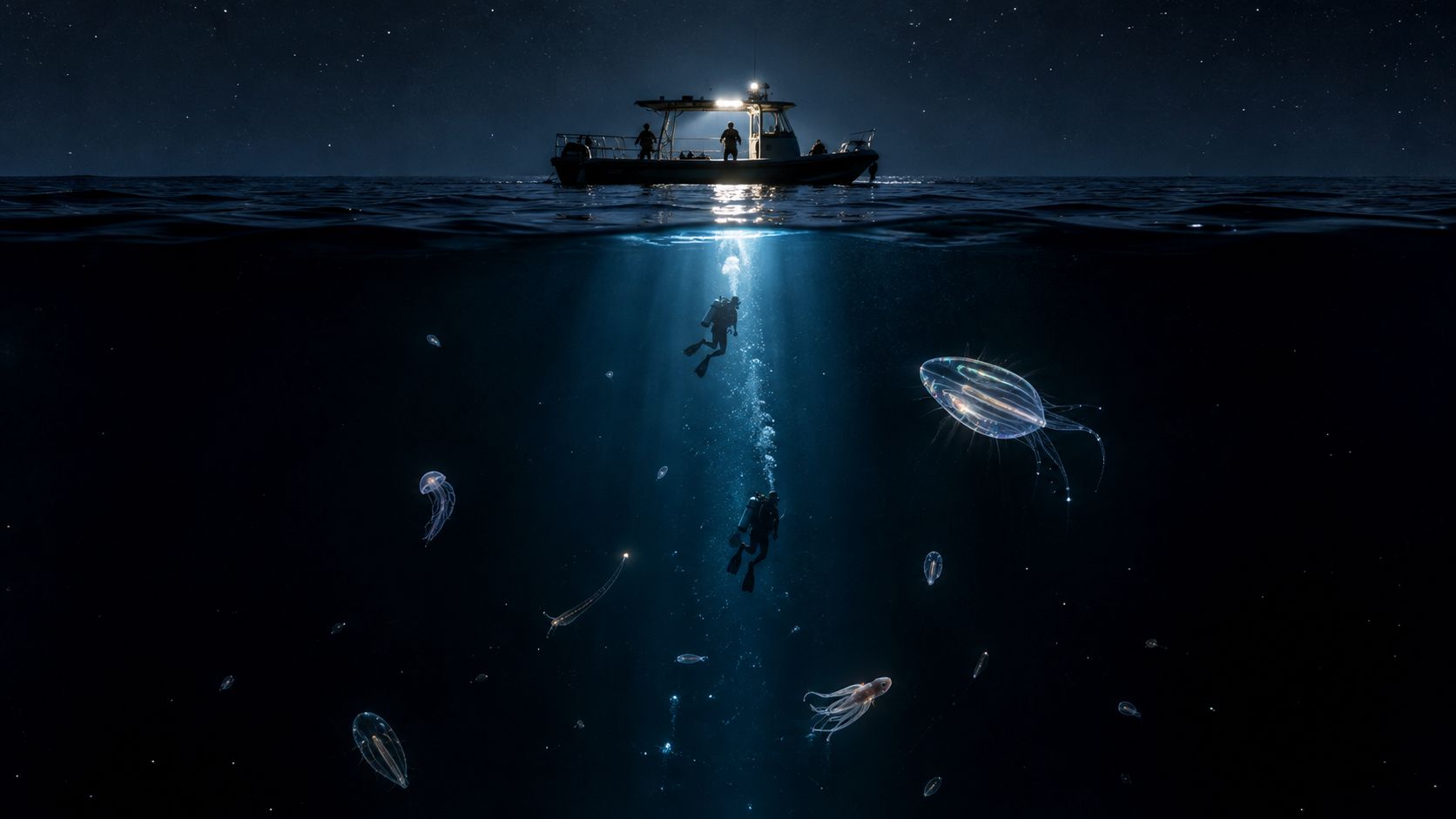
A blackwater evening begins with a different kind of departure: away from the coastline rather than toward a reef. The Los Angeles Times account of Kona's offshore night diving describes the format approximately 2–3 miles offshore, over deep water rather than a shallow coastal site.
After sunset, deep-water animals move upward through the water column in diurnal vertical migration. Divers enter that changing habitat to observe what passes through the lights. The ocean below may be deep, but your working depth is the controlled profile established by the crew, not an invitation to descend after a subject.
Let subjects come into view
On a typical descent, the first task is orientation: establish buoyancy, identify the boat's reference system and locate your buddy. Only then start examining the light beam for transparent bodies, tiny moving shapes and reflective eyes.
Potential subjects include ctenophores, siphonophores, salps, larval animals, squid and octopuses. Sharks and occasional dolphins are possibilities, not an expected checklist. You may spend longer observing a delicate, unfamiliar organism than photographing a recognizable animal.
A reef background won't help you judge movement. Review night-diving preparation beforehand, and make depth awareness more important than identification.
Photograph without following subjects away
Suppose a transparent animal enters your focus light. Stop swimming, stabilize your camera and let the subject's movement determine whether a photograph is possible.
- Track slowly. Abrupt finning can carry you past the subject and disturb the water around it.
- Keep illumination controlled. Hold the animal inside the focus beam without sweeping your lights across nearby divers.
- Manage backscatter. Angle strobes away from the lens axis and start with restrained power, then adjust exposure for the subject.
- Use short bursts selectively. Capture changing posture, but pause to check focus, depth and buddy position.
Don't spend the entire encounter reviewing images on the screen. A quick exposure check is useful; prolonged playback takes attention away from the environment.
Visibility alone doesn't make this an easy dive. Current, swell and wind affect how the crew manages the operation, while small subjects can be difficult to photograph even in clear water. Choose the Blackwater Dive tour for the offshore observation format, not because you expect a particular animal to appear.
Safety, Conditions and Reef Care at Kona Sites
The Kona diving guide's emergency-planning advice states that the Big Island has no recompression chamber and that serious decompression illness can require initial treatment and evacuation to Honolulu. Treat that as a consequential planning warning, while confirming current treatment access and evacuation arrangements locally before diving rather than assuming a particular facility or transport route is available.
Conservative profiles, accessible emergency oxygen and reliable surface support deserve attention before departure. Kona Honu Divers strongly recommends dive insurance. Check that your coverage includes the diving you intend to do and medical evacuation, not just ordinary travel disruptions.
Make the entry decision concrete
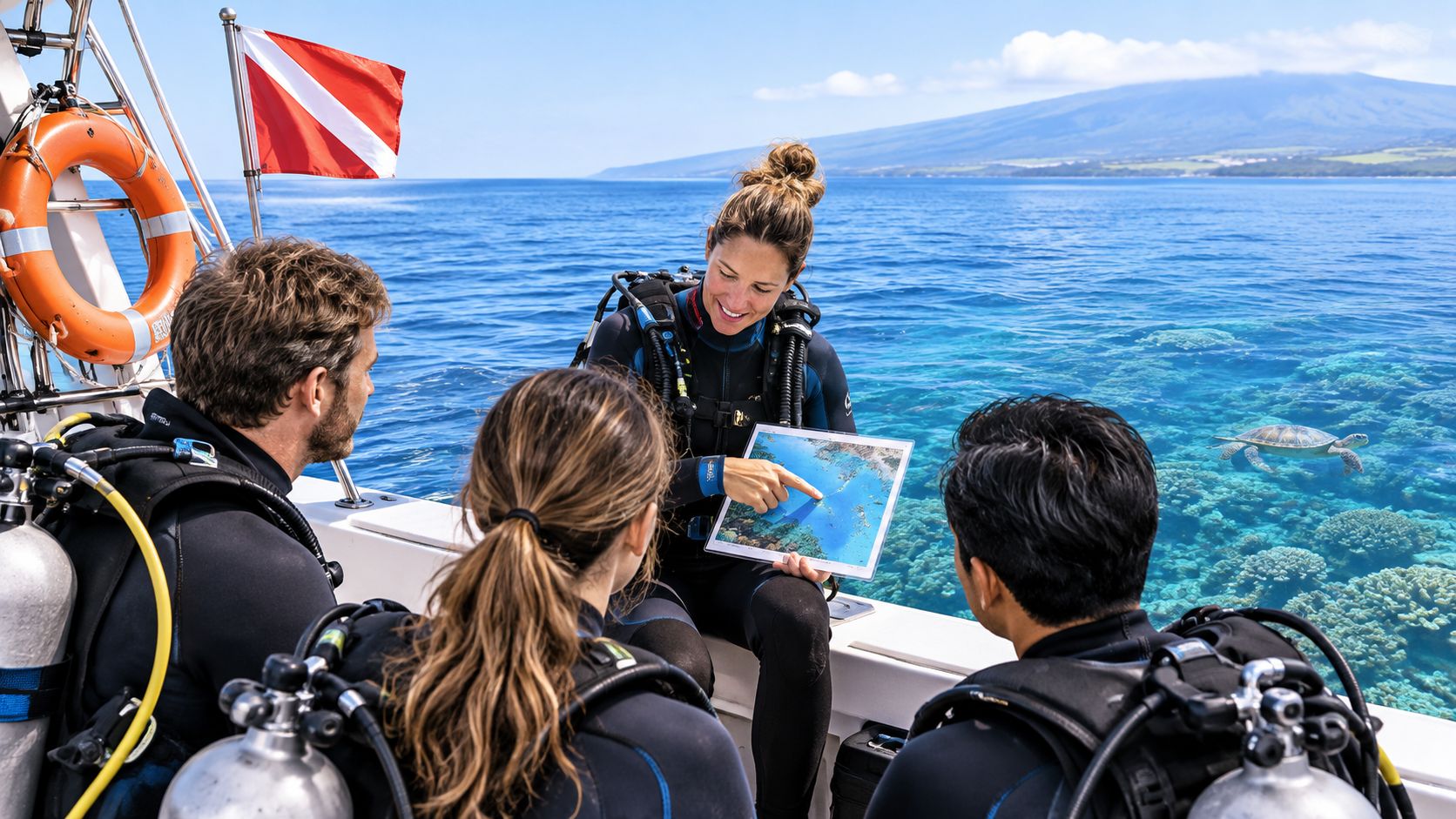
Calm-looking water doesn't remove sharp lava, abrupt depth changes or difficult exits. Watch an entry long enough to understand the swell, and identify where you'll leave the water if the preferred exit becomes unusable.
- Swell and exits. Cancel a shore entry if breaking water prevents a controlled approach or reliable exit.
- Runoff and visibility. Don't enter water where you can't assess the route or maintain buddy contact.
- Current and plankton. Consider both workload and visual conditions, rather than treating abundant wildlife food as an automatic benefit.
- Depth and gas. Agree on maximum depth, turn pressure and reserve before entering.
- Surface arrangements. Confirm buddy procedures, a surface contact, emergency access and a dive flag where required.
If symptoms suggest a diving injury, seek emergency medical care promptly and stop diving. Don't try to diagnose the problem by making another descent.
Reef care changes how you move
A USGS and National Park Service imagery comparison documented live-coral declines at protected Hawaii Island coastal sites between the early 2000s and 2022, with algae and rubble increasing by roughly 25% overall. A protected designation doesn't mean the reef can absorb careless contact.
Hold buoyancy with breathing and small adjustments, not repeated fin kicks against the bottom. Keep fins clear of coral, use established sand or rubble staging areas where directed, and accept an alternative site when crowding or conditions make low-contact diving difficult.
Reef-care test: If you can't stop and hold position without grabbing the bottom, simplify the dive before adding a camera or entering tighter terrain.
Good responsible diver etiquette is operational discipline: give other divers room, secure equipment and leave the guide space to manage the group.
Pre-Dive Checklist, Gear and Trip Options
- Certification proof. Pack your C-card or accepted digital proof where you can retrieve it before boarding.
- Recent dive records. Bring logbook entries that show your current experience, including relevant night or deeper dives.
- Medical self-check. Disclose conditions and medication changes that could affect diving; obtain medical clearance when indicated.
- Mask and fins. Check fit, straps and buckles before departure rather than discovering a problem during entry.
- Exposure protection. Bring a well-fitting warm-water suit or suitable rash guard, with enough thermal protection for your planned immersion.
Rental equipment suits travelers who don't want to fly with a complete kit. Familiarity still matters: locate the BCD inflator and releases, read the pressure gauge, and practice finding the alternate air source before the boat reaches the site.
A personal mask is worth bringing if fit is difficult. For other purchases, use a beginner scuba gear guide to prioritize comfort and usability over accessories you haven't learned to manage.
Set up before the briefing
Arrive early enough to assemble equipment without rushing. Check cylinder pressure, breathe from both regulators, test the BCD and confirm that your computer is configured for the gas you'll use in practice.
Use sun-protective clothing and reef-conscious sun protection on exposed skin. Keep lotions away from mask seals and equipment grips, and bring a dry layer for the boat ride after immersion.
Preparation is complete when you can explain your equipment and dive plan to your buddy, not when everything has been loaded onto the boat.
Compare formats by the work they require
The manta evening suits divers who want a structured wildlife encounter and can remain settled while watching overhead. Snorkeling offers another perspective for eligible companions, but it still requires comfort in the ocean and compliance with the surface briefing.
The blackwater format asks more of orientation and buoyancy. Photographers should be ready to abandon a composition immediately if depth control or group positioning needs attention.
The premium advanced format prioritizes remote terrain, deeper profiles and drift opportunities. Choose it because those conditions match your experience, not because an advanced label sounds like better value.
For a mixed itinerary, avoid packing every available format into consecutive departures. A daytime reef session can reveal equipment or weighting issues while there's still time to correct them before a night dive. Leave yourself enough energy to listen carefully and make conservative decisions.
Plan Your Kona Dive Days and Book Ahead
A useful sample itinerary builds familiarity before adding complexity. It's a planning example, not a fixed schedule, and it needs to fit your flight plans, altitude travel and the crew's assessment.
| Sample day | Dive choice | Reason |
|---|---|---|
| First day | Morning reef diving | Establish weighting, equipment comfort and local conditions |
| Following day | More varied terrain or an appropriate advanced profile | Add challenge only after assessing how comfortably you're diving |
| Later evening | Garden Eel Cove manta dive | Approach the night encounter with familiar equipment and a settled routine |
Don't place the wildlife evening at the only possible point in your holiday. An earlier booking with a flexible backup evening gives you more options if weather disrupts the departure or animals don't appear.
Understand the boat-day sequence
A typical Kona Honu Divers dive day starts with arrival and gear setup, followed by a briefing on conditions and entry style. The deeper or more condition-sensitive site generally comes first, followed by a surface interval and a more relaxed second dive.
Use the interval to report anything that needs adjustment: excessive weight, a leaking mask, difficulty equalizing or an uncomfortable workload. Solving a small problem on deck is better than carrying it into the next entry.
- Keep travel compatible. Plan flying and drives to altitude around current post-dive guidance and your actual profiles.
- Leave schedule margin. Don't make a dinner reservation or transfer depend on the boat returning at the earliest possible moment.
- Confirm the departure details. Use your booking confirmation for meeting location, check-in time and required equipment.
- Tell the crew your priority. Explain whether you value reef exploration, photography or a specific dive format, while accepting condition-led changes.
Book a plan with room to adapt
Kona Honu Divers suits divers who want broad trip variety and a premium full-service experience. For questions about your experience level or how to sequence dive days, call 808-324-4668.
Book ahead, but keep the itinerary adaptable. The useful commitment is to a suitable dive format with a competent briefing and realistic contingencies, not to an exact animal count or an unchangeable site.
Browse the Kona diving tours, choose the experience that fits your readiness, and confirm availability before arranging the rest of that day.
Kona Honu Divers offers daytime reef trips, Garden Eel Cove manta evenings, advanced diving and offshore blackwater excursions, with rentals and instruction for different experience levels. Visit Kona Honu Divers to choose your dive format, discuss your recent experience and build a Big Island itinerary with room for the ocean to change the plan.