
A common reason to book diving Hawaii Big Island is the chance to photograph a manta overhead. That photo is real, and it is also a poor planning tool. Kona's nights and reefs are documented wildlife events with patchy attendance, not a show you can schedule like a luau. Clear water can still hide surge, a rough entry, and a boat that stacks too many people over one light array. Pick the coast for the reef and the animals. Pick the day for the forecast and your actual skill.
Why Kona Is Hawaii’s Best Place for Diving
West Hawaiʻi is not just a pretty lee shore. NOAA's Big Island reef work identifies this coast as the largest expanse of intact, actively growing coral reef among the main Hawaiian Islands. That is why a diving Hawaii Big Island plan should start in Kona rather than treating every island as interchangeable.
The same reefs are habitat for corals, reef fish, green sea turtles, spinner dolphins, whales, and manta rays. NOAA-led scenario modeling at Puakō compared reduced fishing, less land-based pollution, herbivore protection, line-fishing limits, and marine protected areas. The model projected the greatest benefit to dive tourism from line-fishing restrictions and no-take zones. Protecting herbivores cuts algal overgrowth. Limiting extraction keeps fish biomass and the food web intact. Better reef condition raises your odds of abundant fish and turtles.
I still brief new guests the same way after a morning on a protected stretch and an afternoon where fishing pressure is heavier. The lava can look similar from the boat. The fish do not.
What you are actually choosing
A useful week is a set of decisions, not a highlight reel.
- Terrain: Shallow lava fingers, walls, and offshore pinnacles reward different skills. Standing on coral undoes the protection that makes these reefs worth the flight.
- Wildlife scale: Garden eels and small reef fish share the coast with animals many times a diver's size. You do not get both on every site.
- Format: Manta nights, blackwater, shore entries, and two-tank boat days do not substitute for one another.
- Readiness: Your card, a refresher, and honest buoyancy decide which of those days is realistic.
Historical photo-identification along the Kona Coast recorded 106 individual mantas between 1992 and 2007, seen anywhere from 1 to 724 times. Researchers identified 30 new pups from 1994 through 2007, about 2 pups a year. A Hawaiʻi legislative summary described the population then as probably fewer than 200 individuals, and noted that a formal mark-recapture estimate had not been finished, according to 2009 legislative testimony. These animals return to local feeding spots. They are not an unlimited cast you can swap between islands.
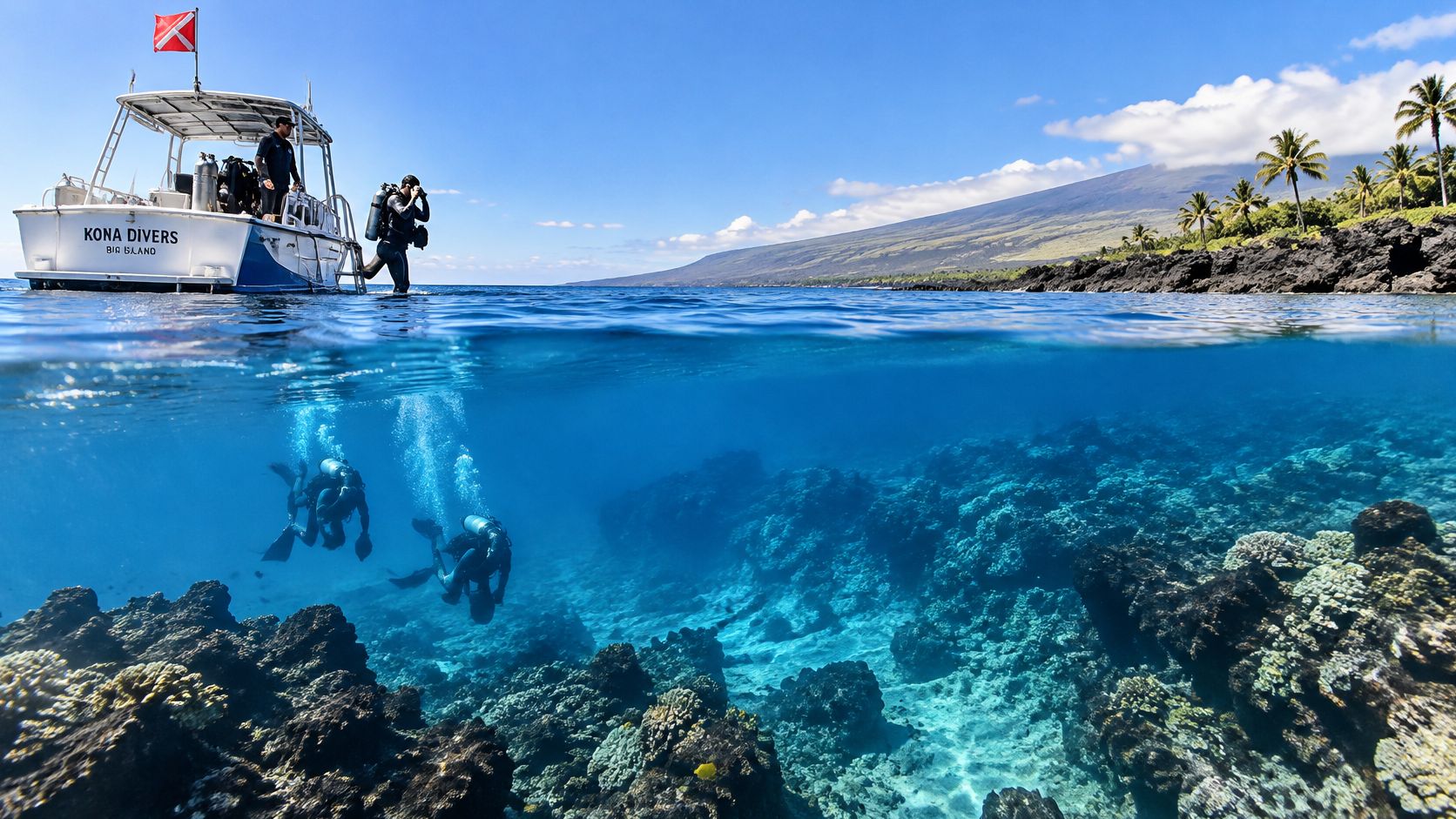
Kona stays distinct because you can stack a protected reef morning, a manta night, and, if your skills match, a blackwater drift, then fill gaps from shore. Look through guided diving tours and match the day to your card, your buddy's comfort, and the forecast.
The Manta Ray Night Dive and Why Garden Eel Cove Wins
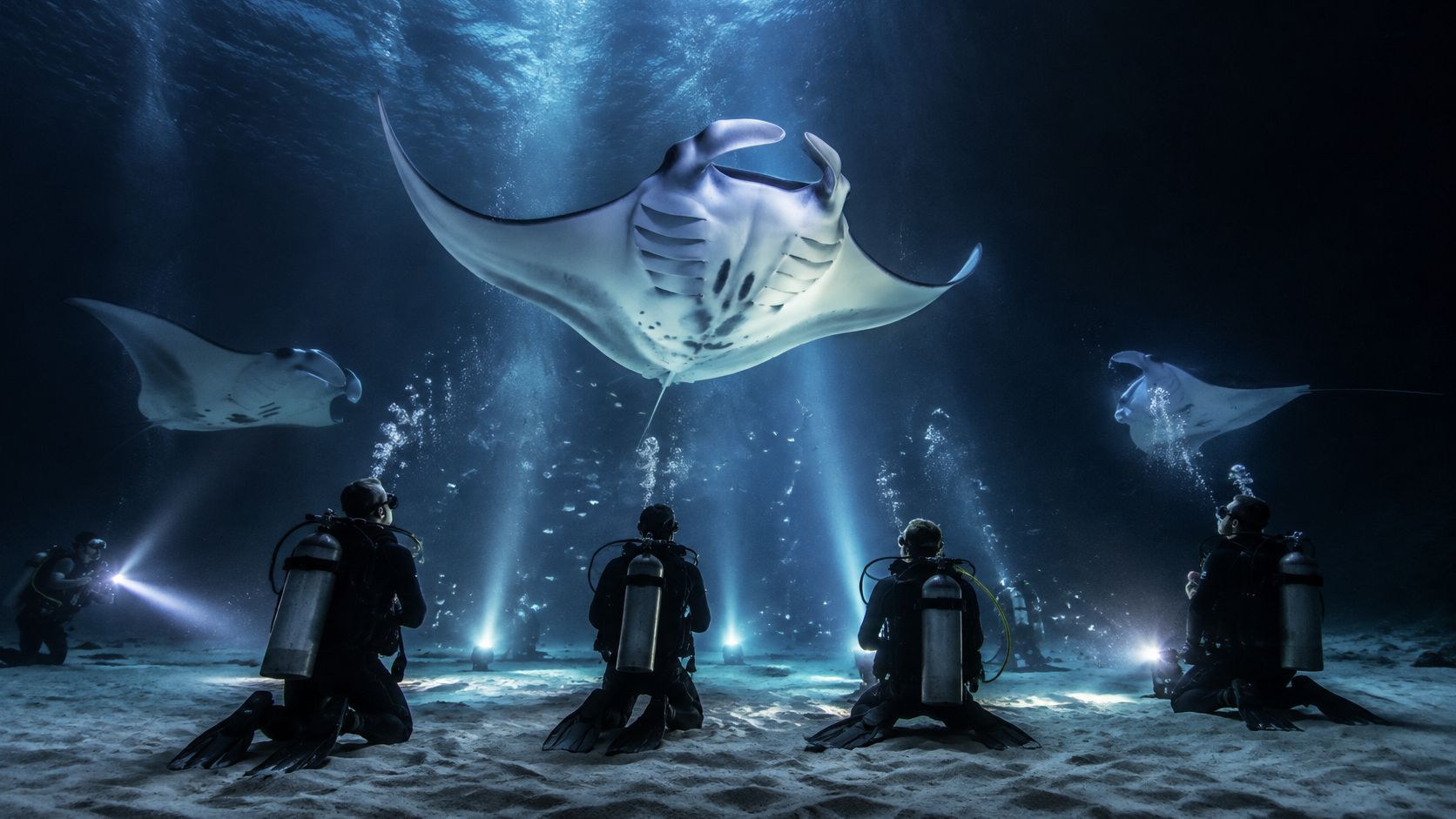
The night dive is an engineered plankton watch, not a trained animal show. Underwater lights concentrate planktonic prey in the lit water column. Filter-feeding reef manta rays, Mobula alfredi, may come in to feed. Lights are an attractant. They are not a switch. Presence still varies in space and time.
A 2025 University of Hawaiʻi study analyzed 13 years of citizen-science observations, 2010 through 2022, at Garden Eel Cove and Keauhou. Researchers documented more than 23,000 sightings of 167 individually identified reef mantas. Garden Eel Cove consistently hosted larger feeding aggregations. Keauhou was visited predominantly by females. Across both sites the sex ratio was about 1:1. Females showed strong site fidelity, especially at Keauhou, while males moved more. Annual and seasonal changes in aggregation size tracked zooplankton density. Patterns stayed relatively stable even as tourism grew, which is laid out in the University of Hawaiʻi scholar record.
Why Garden Eel Cove is the site to book
Garden Eel Cove is the better tour site because it sits in a more protected location, with a better viewing area and better reefs than the alternatives people lump together as "the manta dive." Larger feeding groups also mean more animals in the beam when conditions cooperate. Keauhou still matters biologically, particularly for females that favor it. For a guest who has one night, the protected viewing setup at Garden Eel Cove is the practical choice.
Separate Hawaiʻi eDNA research found manta presence was not significantly associated with local plankton assemblage or abundance. Offshore or mesopelagic prey and broader ocean conditions can matter. Treat a quiet night as oceanography, not a failed booking.
How to sit the dive
Stay put: Kneel or hover where the guide places you. Chasing a manta empties the viewing lane for everyone behind you.
- No contact: Do not touch a manta, ride the slipstream, or reach up into a feeding loop.
- Leave the path open: Photographers who block the beam change the behavior the dive exists to watch. Keep strobes and video lights tight and aimed, not swept across the animal's eyes.
- Hold your trim: Fin tips on the sand or coral are how a crowded site loses the habitat the plankton emerges from.
On the boat, expect a sunset run, a bottom briefing, and a dive that can be spectacular or sparse. Snorkelers usually watch from the surface lights while divers look up from the sand. A two-tank version adds a late-day reef dive before dark. Book the manta ray night dive when Garden Eel Cove is the plan, and ask how the crew caps the group if several boats share the cove.
Blackwater Diving and Kona’s Pelagic Night Life
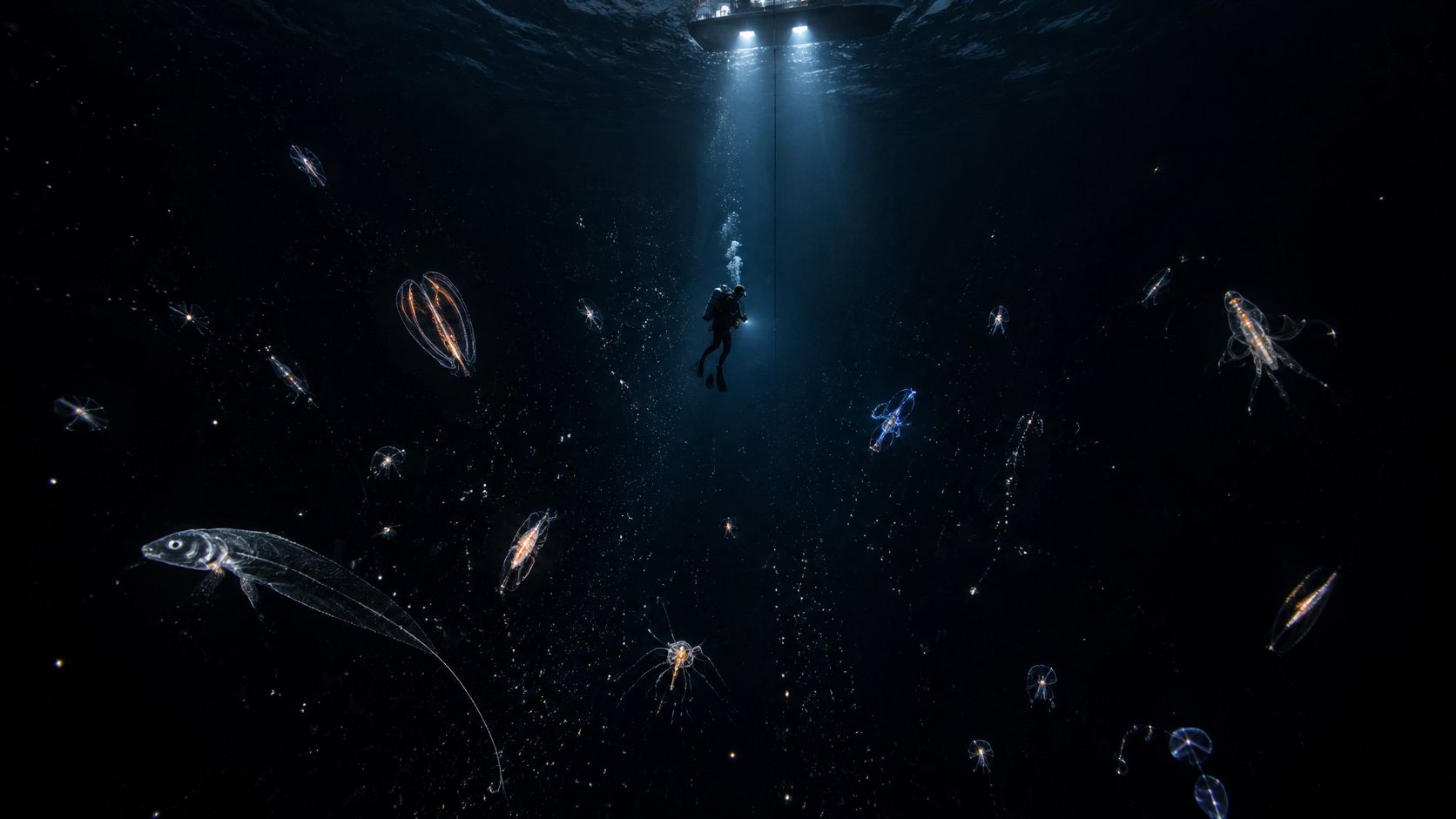
Blackwater is the research-minded cousin of the manta night, and it is a different dive in every way that matters. After dark the boat drifts over deep water. A light array hangs in the open column and draws pelagic and larval animals up from depth. You are not touring a reef. You are hanging in the dark, watching a vertical migration most divers never see.
What changes once the bottom disappears
Reef diving gives you a reference. Sand, a wall, a buddy's bubbles against lava. Blackwater removes that reference.
- Buoyancy: You manage depth against a line or a planned hanging depth, with no seafloor to catch a bad descent. Excellent trim is the entry ticket, not a nice-to-have.
- Light discipline: Your primary light is how you find animals the size of a fingernail. It is also how you blind your buddy. Point it at the subject, then off.
- Group control: Separation is harder to fix in open ocean at night. Stay with the briefed formation. Do not fin off toward a speck.
- Task load: The animals are small, translucent, and fast. Photographers who cannot hover and shoot will spend the dive chasing their own exhaust bubbles.
The coast's reputation for unusual life is what makes the drift worth scheduling. Larval fishes, gelatinous drifters, and other open-ocean animals show up in the lights because Kona sits on deep water close to shore. That proximity is the geographic advantage. It does not make the dive beginner-friendly.
Where it fits in a week
Do the blackwater night after you have already been in the water on this trip, not on the evening you land. A reef dive the day before tells you whether your weighting and night comfort are honest. If you are still fiddling with a new rental BCD, wait.
Read a plain-language briefing of the Kona blackwater dive before you commit, then reserve the blackwater night dive only if you can hover, manage a light, and stay self-reliant in open water. Pair it with day dives. Do not stack it against a long flight the next morning.
Shore Diving Versus Boat Diving on the Big Island
Neither format wins every day. Shore diving buys flexibility. Boat diving buys sites you cannot reach with a surface swim. Match the choice to the entry, the group, and the forecast, not to a blog ranking.
Shore Diving Versus Boat Diving in Kona
| Criteria | Shore Diving | Boat Diving |
|---|---|---|
| Entry | Lava rock, surge, and your own timing | Ladder or platform, crew-managed |
| Site access | What you can swim to from the beach | Pinnacles, walls, and offshore lava you will not reach from land |
| Cost | Tank and rental, or your own gear | Charter price, usually with a guide |
| Surface interval | You set it on the beach | Fixed by the boat's schedule |
| Comfort | Sun, stairs, and a long swim back | Shade, water, and a ride home |
| Marine life | Strong reefs near protected entries | Wider menu, including sites picked that morning |
The Old Kona Airport Marine Life Conservation District runs from the shoreline out to boundaries 500 yards seaward from the west end of Old Kona Airport State Park and from the Kailua lighthouse. Shallow lava fingers reach depths of up to 50 feet, then drop. Coral cover and reef-fish communities are substantial. Snorkelers and shore divers usually enter a partially protected cove at the park's northwestern end. A semiprotected lava basin at the southeastern end works in calm to moderate conditions, and not when the surge is up.
Rules that keep you legal and visible
Hawaii requires a red-and-white diver flag for scuba, freediving, and snorkeling when people are submerged. At night the flag must be illuminated and visible from 100 feet. Ocean users must surface within 100 feet of the flag except in an emergency. Boaters must hold slow-no-wake within 200 feet of a displayed flag. Stay out of navigation channels. Those rules are spelled out by the state boating division.
A pretty entry photo is not a condition report. If the shelf is washing, the exit you used an hour ago may not be there.
State rules also prohibit taking marine life while using scuba, possessing marine life and scuba together, or possessing scuba and fishing gear together, unless a specific exception applies. Separate nighttime rules prohibit taking or possessing marine life while diving from 30 minutes after sunset until 30 minutes before sunrise, and possessing fishing gear while diving in that window, under Hawaii Administrative Rules. Watching animals is allowed. Collecting them on a night dive is not.
Use shore days for experienced buddies who can read an entry. Use the boat when the group mixes new divers and snorkelers, or when the site you want sits offshore. A practical map of entries lives in this shore diving guide.
Seasonal Conditions and the Best Time to Dive Kona
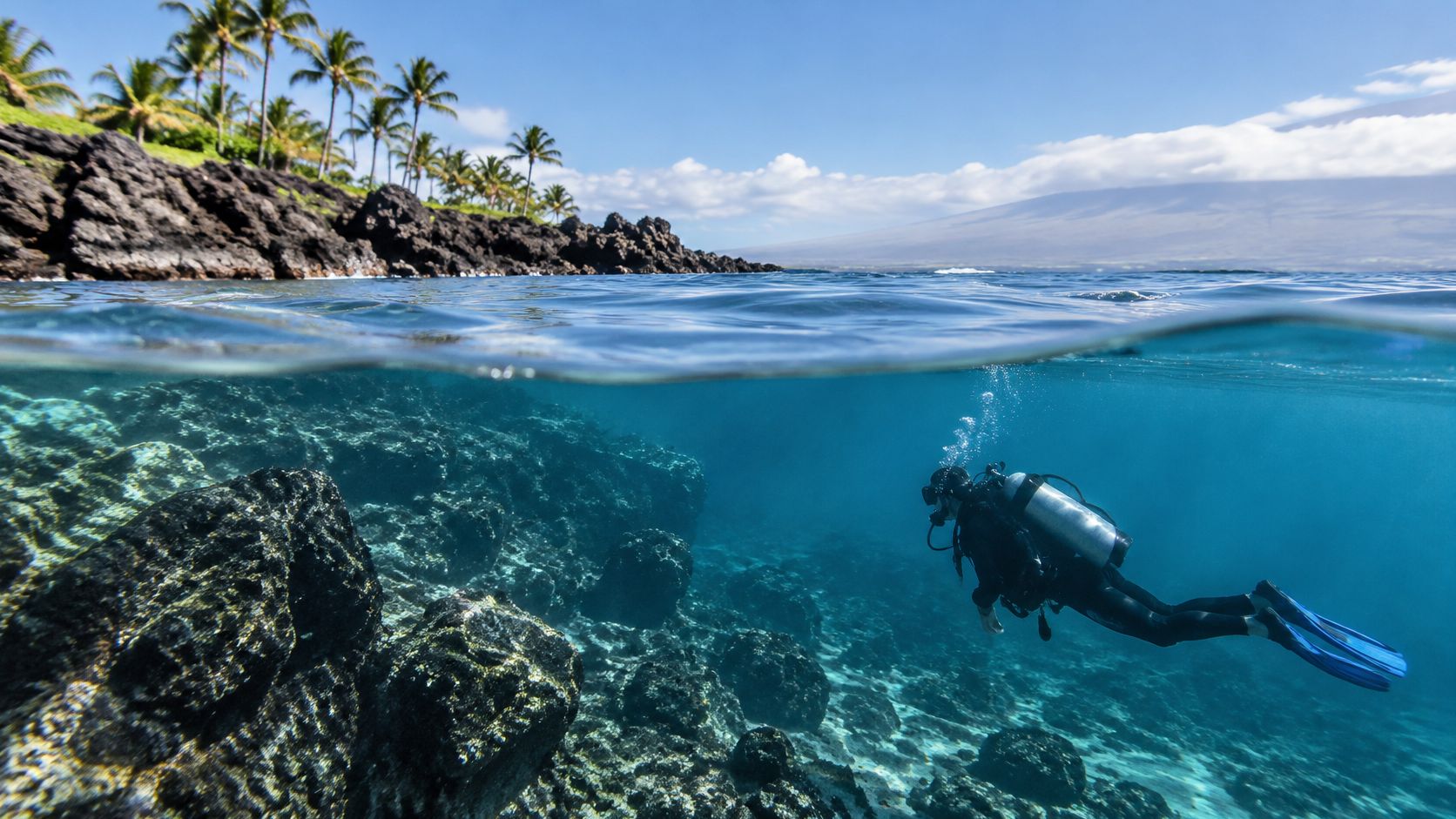
There is no single best month that makes every site easy. The Kona coast sits in the lee of the volcanoes, so it is often calmer and clearer than the windward side. Wind, north swell, surge, and runoff still decide which entries are real on a given morning.
What actually changes through the year
Winter usually brings larger north swell. Exposed points and north-facing shelves get undivable while a protected south or west cove may still be fine. Summer and early fall more often open the wider menu, including sites that need a flat ocean to be worth the swim. Trade winds can still stand up a surface chop that makes the boat ride and the safety stop less pleasant, even when the bottom is clear.
Visibility and risk are not the same dial. You can have excellent viz and a nasty surge, an exposed exit, boat traffic in a channel, or a wind shift that closes the site before you are back on the beach. Site choice should follow conditions and diver experience. A calm forecast for town does not describe every mile of coastline.
Wildlife does not run on your itinerary
Manta nights track prey, not the calendar on your boarding pass. As the long-term Kona feeding record shows, aggregation size rises and falls with zooplankton, so a "peak season" claim oversells what any operator can promise. Book the night. Do not book a guarantee.
Build a weather day into the week. The dive you skip on a big swell is the one that keeps tomorrow's boat available.
A workable plan is three to five dive days, not seven in a row. Put the manta night in the middle so a blowout can slide by a day. Keep one morning unbooked for a shore dive if the ocean lays down, or for rest if it does not. Divers comparing months in more detail can use this note on the best months to scuba dive in Hawaii. Check the marine forecast the afternoon before, and believe the crew if they move the site.
Certification, Courses and Refreshers for Every Level
Kona can take a first-time student and a diver who wants lava tubes on the same coastline. It cannot take them on the same dive profile. Match the card to the site before you match the site to the photos.
What each level actually unlocks
Beginners need a course or a closely guided intro, not a boat full of people who already know the signals. Open-water training here happens in the ocean, which is a better classroom than a quarry if the surf cooperates, and a worse one if you are fighting an entry on day one. Ask where the confined-water skills happen when the ocean is up.
Returning divers are the group that gets into trouble. A card from years ago does not restore buoyancy. Schedule a refresher before a manta night or any dive where lights, task loading, and other groups compete for your attention. The refresher is cheaper than a flooded camera and a ruined evening.
Advanced and experienced divers are the ones who should look at deeper pinnacles, lava tubes, and sites that ask you to manage your own gas and navigation. That is the point of an advanced two-tank trip. If the operator puts students on that boat, it is not an advanced trip.
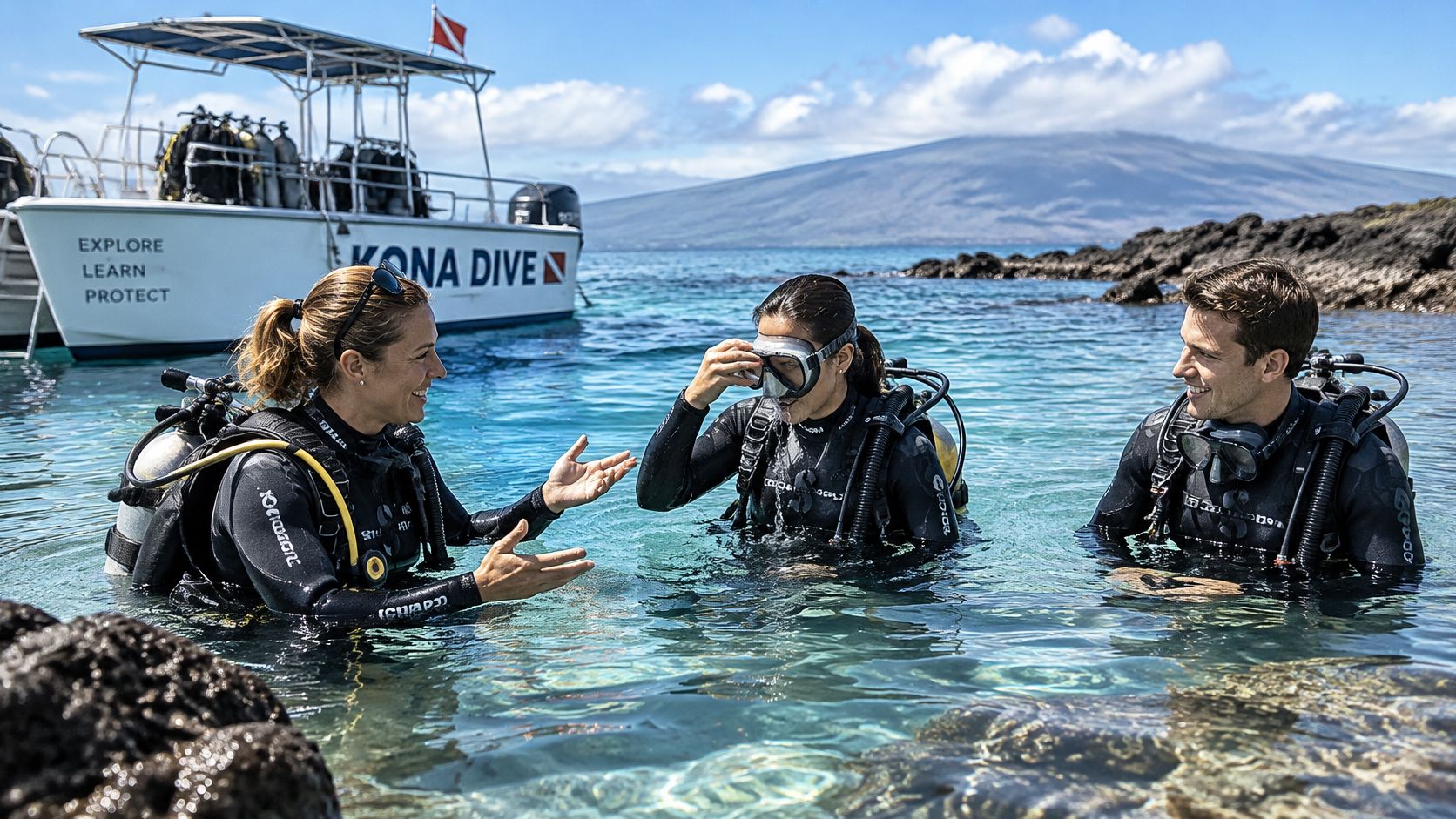
Mixed groups
Certified divers, snorkelers, and freedivers can share a boat when the operator plans for it. They should not share one briefing that pretends the risks are identical. Snorkelers need surface support and a flag plan. Divers need a real guide ratio. Freedivers need space and a clear rule about who is under the boat.
If you have not been in the ocean in a year, say so at booking. Crews can fix a refresher. They cannot fix a surprise on the ladder.
Judge a course provider on instructor attention, maximum group size, and whether the standards are explained before you pay. A class that will not tell you the student-to-instructor ratio is telling you something anyway. Compare options on a Big Island scuba certification page, then confirm dates against your flight. Do not finish a course the morning you fly.
Gear, Rentals, Nitrox and Underwater Photography
Show up ready, or rent gear that has been serviced on a schedule, not after it fails. A pro-actively serviced regulator and a BCD that fits will do more for a safe week than any gadget in your carry-on. If you bring your own kit, have it serviced before the trip. If you rent, ask what "serviced" means and whether the shop will swap a leaking inflator before you leave the dock.
Nitrox belongs on a multi-day schedule if you are certified for it. It extends no-decompression time on repetitive reef dives. It does not make a deep pinnacle or a sloppy ascent safer. The trade-offs are covered in this look at nitrox diving benefits. Do not use a mix you have not analyzed yourself.
Lights, cameras, and crowding
Manta and blackwater photography fails when the diver cannot hover. Practice the shot on a day dive. At night, keep lights low enough that you are not lighting the entire cove, and do not park in a feeding path. A camera is not a reason to break the no-touch rule.
Crowding shapes the night more than the brochure does. In a survey of 444 participants, 82% reported feeling crowded by snorkelers, and 78% reported crowding-related concerns. Separate research found that 53% of scuba divers experienced conflicts with other divers, usually with people rather than with the animals. A NOAA status review cited in the same record notes lower zooplankton emergence and diversity at a heavily used Kona site than at a less-used site, possibly tied to inadvertent habitat damage. Manta tourism's economic pull is estimated at roughly $140 million annually in direct revenue or related tourism impact. Those figures are summarized in county testimony compiling the Needham research and related reviews.
Compare operators on measurable points.
- Diver-to-guide ratio: Small enough that someone notices your bubbles.
- Maximum group size: Ask for the cap, not the average.
- No-touch and mooring: Reef hooks and anchors in coral are a no.
- Briefing quality: Lost-buddy plan, light signals, and what happens if another boat is already on the site.
- Crowding plan: A crew that will move or wait beats a crew that piles on.
Shops such as Kona Honu Divers run two-tank mornings, manta nights, and blackwater trips, and they service rental gear ahead of failures rather than after a dive is already compromised.
Kona Honu Divers runs guided reef days, Garden Eel Cove manta nights, blackwater drifts, and courses for divers who are new or coming back after a gap. If this coast is the trip, match a boat and a site to your card before the swell does it for you. Visit Kona Honu Divers to see the schedule and book the dives that fit the week you have.